Circle/Line Filmmaker’s Diary #4

Beg Steal Borrow News, Circle/Line, New projects

Day 11: Sunday 14 June (Victoria)

It is quite surprising how most people whom we interview are very cagey about revealing not only where they work, but also what they do for a job as a whole. I am not sure if people are always worried about what judgements they think that others will make once the nature of their work is revealed, but few people seem willing to say the area of their work.

With regard to naming the company for which they work, the reluctance to name a company speaks surely, meanwhile, of a lack of job security in the current climate: if X interviewee says Y thing about Z company, then Z company might have good cause to sack X interviewee. Indeed, anyone who is in work clothes (from Transport for London employees to Big Issue vendors, both of whom we have interviewed) has in fact been trained not to talk to people in front of a camera. In this instance, the company is also afraid of a lawsuit, since if X interviewee says Y thing about Z company, then W viewer of the film in which the interview takes place might sue Z company because they take offence at X interviewee’s comment/Y thing.

For me, this has two effects. Firstly, it makes me sad that we live in such litigious times, in which people are running scared the whole time, and in which we fundamentally live in a condition of bad faith because no one trusts anyone else.

And secondly, it reveals as in some respects untrue people’s claims to be happy, especially when they relate their happiness to their work situation (which is the first thing that people mention in the majority of cases). For, if they were happy at work, they why not sing from the rooftops what work it is that they do, such that others might be inspired by these claims and thus want to work in the same, happy-making industry themselves?

Nonetheless, at Victoria we meet a TfL employee who does mention his place of work. I am not sure whether I shall include any such mentions in the film – for fear of getting our interviewee the sack! But they seem happy both with work, and to talk to us for a few minutes into their shift. He also speaks about his family, which seems spread all over the world, as a source of happiness as he works on his music.

Across the road from Victoria, in Grosvenor Gardens, we also meet two young chaps who are up in town after their exams. They are studying at a private school outside of London, and are about to break up for the summer – heading back to their respective homes in the north of England and Hong Kong. And we also speak to two young Bulgarian women, one of whom has been in London for a few months now, and one who has arrived today, and who is in transit towards Edinburgh.

In particular, these women speak of how the perception of Bulgarians in London is that they are here to nick jobs from ‘proper’ British citizens. However, from their own perspective, they are just young people looking for a bit of a change of scene. Both hope to make it to New York at some point.

At the end of the interview, the one woman who has lived in London for a while suggests that there are too many black people in the area of London where she lives (Stratford). I am sure that the comment speaks more about an unthinking cultural prejudice, rather than a considered, conscious evaluation of a race of people. Nonetheless, after a pleasant and informative conversation about being young and Bulgarian in London, this seems disturbing, if out of character.

Furthermore, the comment is unjustified given the wonderful conversation that we then have with Egbert, a Dominican Rastafarian who has been living in London for many years now. He speaks of living in the moment and embracing a loving attitude towards others that is inspirational and cheery-making.

Finally, we end in Victoria with a conversation with Lini, a Malaysian cleaner who must be about 60, and whose English is very limited. She smiles broadly, though, exudes a warmth and pleasantness that, while making for a not particularly successful interview, means that she has a memorable face and persona.

Day 12: Monday 15 June (Tower Hill)

Since Grosvenor Gardens proved a successful hunting ground for interviewees (surely the fact that people are sitting down and not rushing is key), Tom and I decide to start out in Trinity Square Gardens, just opposite the entrance to Tower Hill, which otherwise is undergoing works.

We speak to Alex, who is studying history at Queen Mary, University of London. He says that art and other wishy washy things along those lines do nothing for him with regard to happiness, but that he instead is made happy by things logical. We then speak to George, a West Ham fan who is in the area to see a concert at the Tower of London. George is in particular good to speak to, because he is of about retirement age (I would not like to speculate on a precise age) and thus represents a demographic – over 55s, let’s say – that we have had trouble convincing to speak to us up until now.

And then, like the proverbial London buses, along come Mark and Dennis, both of a similar age to George, and who also talk to us. Mark is down from Lancashire on business. Having been involved in the London 2012 Olympics, he still does some work in London, but it seems as though his passion is (beyond his family) playing and training others to play rugby.

Meanwhile Dennis, an Irish-American New Yorker who has been travelling the world of late (he has just touched down from Malaysia), is one of the most enlightened interviewees whom we have met: the oldest of 12 children, he was the senior male in his family after the death of his father in his early teens. He tells us that struggling to raise the family was great shakes compared to the struggles that the average young person faces today, but he does not lord this over anyone. Instead, he is humble and suggests that seeking happiness is today is the only worthwhile philosophy in life – even if it is a philosophy that took him many years to cultivate.

Day 13: Wednesday 17 June (Great Portland Street)

I am always worried when I turn up at a station that I am facing another Moorgate: a station where no one will stop to speak to us because they are too busy. After a couple of false starts, however, we do manage at Great Portland Street to speak to a woman, Sarah, who has worked in housing for many years, and who tells us about the problems with housing in London at the moment.

There are, she says, not enough houses for the growing population, and with too many people snapping up houses that remain unoccupied – a fact also reported in our media. Space, Sarah is convinced, is key to happiness – and without space, it is harder for people to be happy.

We also speak at Great Portland Street to a nurse, Michael, who was born in the UK, grew up in New Zealand, but who returned to the UK as an adult (he still has a New Zealand accent). In what seems like another serendipitous coincidence (three more senior men at Great Portland Street, two people who work in issues relating to social welfare), we discuss the National Health Service in the UK and the role that it, too, plays in ensuring the happiness of as many people as possible.

Finally, Tom and I speak – in our longest interview yet (40 minutes; most are between 12 and 20 minutes, though some are of course shorter) – to two artists, Lyndon and Toby, who have just been putting up stands at London’s Taste Festival.

Lyndon is about to start teaching at a school in Suffolk and is worried about leaving London – although he recognises that the capital is also a hard place in which to eke out happiness as a result of the swelling of its population and the seeming lack of job opportunities.

Toby, meanwhile, is staying in London, where he runs an illegal psychedelic ice cream van that sounds like a sort of installation/performance art piece that he drives around London (getting told regularly to move on because he does not have a license to sell the generic ice creams that he stocks).

The pair also work on party-event-installations, the last of which sounds stupendous if crazy: everyone came in costumes designed by other people attending the party, which had as its theme something in equal measure amusing and bizarre (although my poor memory – I write eight days later – does not recall).

After some early noes, then, Great Portland Street works out well.

Day 14: Monday 22 June (Sloane Square)

Sloane Square itself seemed likely to prove a good place to talk to people – and yet most refused to speak to us. I hate the tone of voice that people adopt when, after I have spent a few minutes explaining what we are doing, a lack of trust remains, a thin smile crosses the would-be interviewee’s lips, and they explain that they do not want to take part. It’s not so much that it is a no, but more what I perceive to be insincere friendliness.

I am sure that in this I am wrong, because there is of course a camera present, but I cannot help but feel that to say no to someone who wants a conversation is unfriendly, and so to try to be friendly in saying no is insincere. The presence of the camera: why does this affect people’s decision not to talk? Because they are wary of their appearance, perhaps. But this speaks of how we are all supposed always to look not like ourselves but ready for a camera, or cinematic. Or perhaps they say no because they are worried about what they are going to say and how it will be portrayed. Again, understandable, but to experience someone’s general lack of faith (they do not trust others) is hard not to take personally (they do not trust me). Clearly I am not good enough (cannot be good enough) at explaining/demonstrating to people that I am, or hope that I am, trustworthy.

And yet, Sloane Square is also the venue of the most annoying interview yet – an interview in which someone does agree to speak to us, and then proceeds to spend 20 minutes being as vague as possible in their responses, resisting right up until the end the invitation to say anything interesting about themselves. Furthermore, the man in the end refuses to sign our Letter of Release, insisting that he gets a cut of the film before we do anything with it because, in his own words, I might put him in a porn film.

While to get rejected is frustrating and a cause of self-doubt, to get accepted – he agreed to do the interview – only then to film 20 minutes of ongoing rejection, which ultimately I am unlikely even to be able to use – just seems to be obstructive and destructive, as if the man took pleasure in wasting my and Tom’s time (in his defence, the man did start by saying that he had nothing to do, so why not do the interview – i.e. he had some time to waste).

The man runs a watch company and has lived in Sloane Square all of his life, except for two years in Westminster, which apparently were awful, although there was a fantastic flat on offer there, so he had to take it. I ask him whether working with watches has changed the way he thinks about time. No. How did he think about time before he started working in watches? He didn’t. How did he get into working with watches? You can do this several ways. Which ways are those? There are several of them. Which one did he do? With some seeming regret he says that he got trained – as if it were an embarrassment to admit that anyone else might have helped him in making his fortune… The interview is painful and, ultimately, unpleasant.

Thank heavens, then, to meet Luke and his friend Ivan. Luke is a writer who writes stories for people for money. He is a traveller and has an uncontrollable laugh and smile – full of the joys of the universe. He cheers us up no end before going off to a Beethoven concert in Cadogan Hall.

Finally, outside the Royal Court we talk briefly to Paul, an actor who, despite wearing shades**, speaks candidly about how most people who tell you that they are happy are liars, and that he is not. I like Paul. I like Luke. I like Ivan. I guess you cannot like everyone.

** I have a theory about sunglasses. Basically it runs this way: curious people look, but curious people also want to show that they are curious by also showing that they are looking. This is a means then to start dialogue, which can engender learning, which satisfies curiosity. Sunglasses are what one wears in order to look, but not to be seen looking (as well as being associated with ‘cool’ – with cool in most of its forms being associated with detachment from, rather than engagement with, the world). I’d much rather be and demonstrate the fact that I am enworlded, and that we are all entangled with the world and with each other than putting on some masquerade that somehow I am detached from the world and that I have nothing to do with it. People who tend to believe that they are simply the authors of their own destiny tend to be the sort of people who have lived lives of privilege, and whose greatest privilege is to believe that they were owed or won their privilege, and to forget the fact that they are enworlded, rather than remembering that all that they have necessarily depends on the contributions of other people.

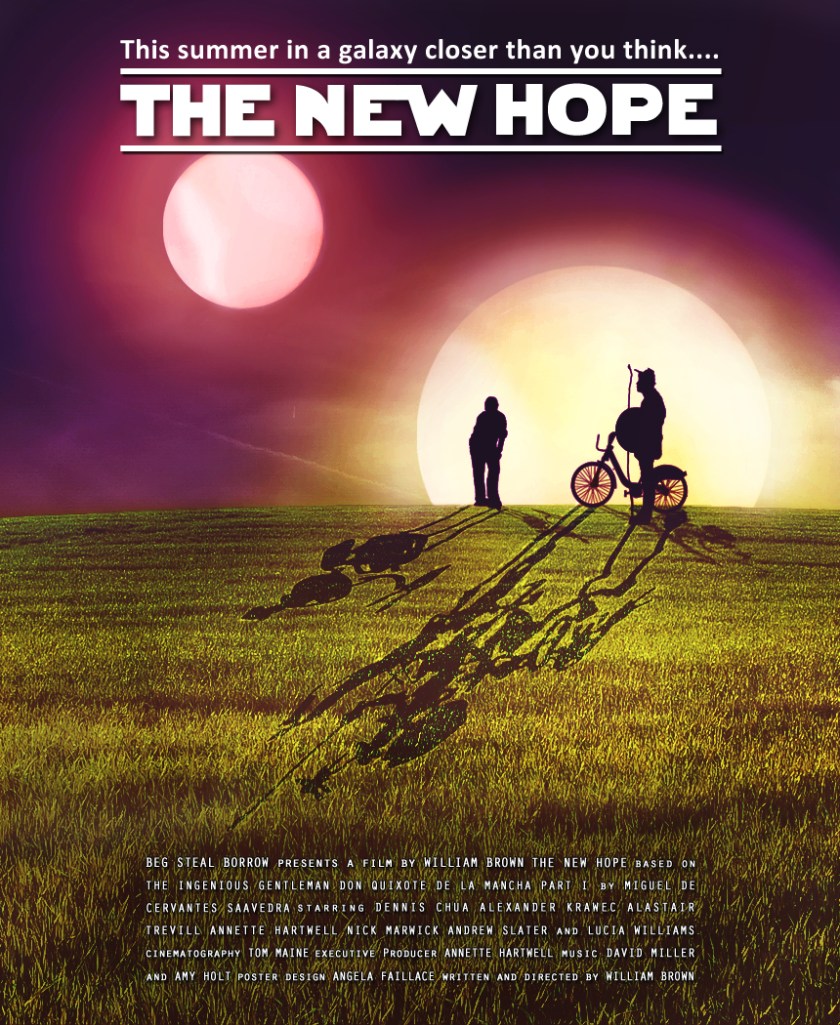
Announcing screenings of The New Hope in London and Oxford

Beg Steal Borrow News, Screenings, Selfie, The New Hope

The wait is soon over!

Two screenings, one in London and one in Oxford, have been arranged for The New Hope, the film that Beg Steal and Borrow shot in Hyde Park last summer on a shoestring.

The first is a preview screening at the Whirled Cinema in Brixton, London, and which takes place on Saturday 11 July at 2pm. Spaces are limited to 75 for this, but the event is free. So if you wish to book a ticket, then please follow this link.

The second screening takes place on Monday 20 July in the Mary Ogilvie Lecture Theatre in St Anne’s College, Oxford, at 8pm. This screening is part of the annual Film-Philosophy Conference, which this year is being held in Oxford.

In principle this screening is open only to delegates at the conference, but if you happen to be in Oxford on that evening, I am sure that you could sneak in if you wanted.

The New Hope tells the story of Dennis, a man who believes himself to be Obi Wan Kenobi. An updated adaptation of the first part of Miguel de Cervantes’ Don Quixote, the film itself tilts at the biggest windmill of them all, the myth that is the Star Wars universe, trying to show that cinema can be made not with CGI and massive budgets, but with a dustbin lid, a piece of string, and a colander. I wager my right hand that anyone watching The New Hope will find something of worth in it.

Come along to one of these and/or other screenings, and see if you agree.

Finally, it is hopeful – though not confirmed – that Selfie will also be screening at the prestigious Whitechapel Gallery in the not-too-distant future. Discussions are under way, then, to arrange a mutually convenient date.

Circle/Line Filmmaker’s Diary #3

Beg Steal Borrow News, Circle/Line, New projects

Day 9: Wednesday 10 June (Mansion House and Cannon Street)

Cameraman Tom Maine and I were apprehensive as we reached Mansion House. Our experience at Moorgate, also a Circle Line station that sits in the City, had been so poor (and dispiriting) that we feared more of the same.

However, that fear was not wholly necessary, for, despite some rejections (always disheartening), we did manage to convince a few people to talk to us. Brian, the first person with whom we spoke, seemed to enjoy the interview and took my number, since he works at an advertising firm and thinks that he might need interviewers for a show that he is producing in which people discuss what it is like to be thrown out of an aeroplane.

I have no idea whether to believe Brian, and the way he spoke to me led me to believe that he thinks me younger than I am, but either way it was nice of him to offer potentially to offer. Who knows? Maybe my interviewing skills will transfer to a new project before too long.

AJ, Ves, Prash and Kerry all followed, with Kerry perhaps being the most vocal. ‘No,’ she insisted straight away, she is not happy. And she laughed. ‘Why,’ I asked? ‘Money,’ she responded with a smile. ‘I have expensive tastes and I need lots of it.’

Over from New York and studying in London for a year, Kerry said that she is enjoying her time here, and is most happy when walking around London. I find it odd that Kerry, fun as she was to talk with, wants money for happiness, and yet is most happy when she is doing something, walking, that is free. Perhaps I should challenge people more with regard to their definitions of happiness.

Tom finally featured me in some wider shots of the interviews today – mainly with Brian and AJ at Mansion House. This made me think of my friend Jonathan Taylor, who has directed episodes of such high-profile BBC documentaries as Great Ormond Street and Protecting Our Parents.

In late 2014, Jonathan gave a masterclass on making observation documentaries at the university where I work. I remember him saying that more or less the first key lesson he learned about making obs docs – from a figure as influential as Roger Graef, no less, Graef being one of the giants of British documentary – was that while the film wants to give the impression that you, the filmmaker, are invisible, in fact you have to be absolutely visible and fully participating (after a fashion) in the events that you are seeking to portray.

The logic is that if you are invisible, or say nothing, then people will not open up to you. It is only by being fully present that your subjects can trust you, Jonathan explained. And given that so many of our interviewees have a propensity to speak for as long as possible in abstract terms or in generalisations, without ever being specific about things that interest them, what makes them happy, then getting them to open up becomes important.

Therefore, even though Circle/Line is not an observational documentary, I believe that this idea of needing to make yourself present is equally true with Circle/Line. The more I put into these conversations, the more I get from people in terms of them opening up and moving beyond those generalisations – even if the film will not reflect my participation as it emphasises the people whom we have met rather than me. In effect, while based increasingly on conversations rather than on monologues from the participants, it is through a two-way conversation that the most interesting things that people say can come out.

This evening a few people did the usual ‘walking away as soon as they see us coming’ routine. This is fair enough and one learns not to take offence, even though we (or at least I) believe that everyone with whom we have spoken for this film has had a few minutes of interesting fun with us. Maybe this is not true in the eyes of others, but thinking that you are offering people something that in fact is, or might be, quite pleasant, makes the out of hand rejection quite disappointing.

Thinking about these rejections, Tom and I discussed whether one of the reasons why various people seem unwilling to talk to us, and many completely unwilling to open up to us if they do, is because we live in a society that is much more media savvy than it used to be. It is safer to give nothing away, even about one’s own happiness, except to speak in vague generalisations, and rarely if ever with specific examples about personal experiences. (Maybe I am a bad interviewer.)

As I have perhaps mentioned before, Circle/Line takes its inspiration from Edgar Morin and Jean Rouch’s Chronicle of a Summer, a 1961 film shot in 1960, and which itself is a movie comprised of vox pops of people in Paris – with Circle/Line also featuring a touch of Chris Marker and Pierre Lhomme’s Le joli mai (1963) thrown in for good measure

In the Rouch and Morin film, from what I recall, people seem so willing to talk to the camera. Of course, we don’t know how many people said no, nor how long interviews lasted in order to get to what we see in the film. Nor, indeed, how prepped people were (I refuse to tell my interviewees the first question – ‘are you happy?’ – explaining to them that if they know it in advance, then it will spoil the response).

Nonetheless, in Chronicle of a Summer, it strikes me that when someone turns up with a camera in the street, people wander curiously over and want to know more. Nowadays, however, the camera is treated with suspicion, people are wary, tech savvy, and while some people are curious about what we are doing, most are not.

As Tom and I hang outside Cannon Street, I tell Tom about how it is apparently possible to run from Cannon Street to Mansion House in the time it takes for a Circle Line train to get from one station to the other, meaning that one can get off a train at Cannon Street and get on the same train at Mansion House. I shall have to check where that story comes from and whether it is true or not.

Tom and I continue to be concerned that older people are harder for us to persuade to take part in the film and that, oddly, we have not convinced a family to talk to us all at once so far. Still things to work on…

Day 10: Friday 12 June (Blackfriars)

A pleasant evening and people seemed willing to talk. If only all stations were like Blackfriars (especially because the station has a pub, the Black Friar, right opposite – meaning that finding people with whom to talk is, so Tom says, like shooting fish in a barrel).

We discuss amateur dramatics with Luke, the systemic shortcomings of capitalism with Omar, what it is like being away from one’s family with Julien (he has a brother and a sister in Mexico, with the majority of his family in his native France), and the joys (or, as I believe, the horrors) of shopping on Oxford Street and in the Westfield with Anisha.

I even questioned Anisha about several things, mainly because she is contagiously happy, and I am not sure why. Firstly, Anisha, like Kerry, feels that walking makes her happy. Secondly, Anisha suggested that poor people can and are happy and that in fact rich people are often unhappy. I asked her if she plans on giving away her money in order to be happier. She said that she will not.

I am not sure how much I should ‘challenge’ my subjects, but like Kerry who believes that she wants to be rich and yet is happiest doing something for free, Anisha seemed to say that happiness is inversely proportional to money, while also being unable to give up money for happiness.

This is not to single out Anisha; I feel this myself, and assume many people do (not that poor people are happier, but that one might well be happier if one sacrificed more money, while being unable to sacrifice that money). But it does raise the issue that our happiness, particularly if it is linked to money (as the overwhelming majority of responses would seem to suggest so far), is in fact illusory. As Julien says, perhaps we are all in the Matrix.

A final thought: a few people in these last few days – AJ, Ves, Prash, Anisha – all seem to believe that if you truly want it, then you can bring about happiness in your life. I hesitate to agree with this, mainly because to believe that we are the authors of our own destiny suggests a belief somehow that we are not quite in, or with, the world, but rather that we are separate from it, somewhat. For, we can do what we want, and the rest of the world does not constrain us, since it does not really touch us.

I am delighted that so many people tell us that they are happy. But I am always intrigued when people say both that unhappiness exists, that the unhappiness of others brings them down, but that they don’t let the unhappiness of others affect them too much. For me, this speaks of a lack of being touched by the world; happiness thus today becomes something not to be shared, but something more like a wall, or a womb (a matrix, indeed) that we construct around ourselves in order not to be touched by the rest of the world.

And yet, while it heartens me to know that so many people are happy, with exceptions like Kerry unhappy not because of loss but because she has not yet reached the point in life where she wants to be, I am concerned about the lack of touch, as well as the resort to insular as opposed to common happiness. Is constructing a common happiness what I am really wanting to ask people about here? I do ask questions along these lines. Indeed, Omar this evening suggested pessimism about the possibility for common happiness. Maybe I am making the film in search of how we can achieve it.

As Tom and I head home, we work out whether the Cannon Street to Mansion House dash is feasible. I reckon it is. Tom is a little bit more sceptical. Perhaps we should try it when Circle/Line wraps.

Circle/Line: Filmmaker’s Diary #2

Beg Steal Borrow News, Circle/Line, Interviews, New projects

Day 8: Thursday 28 May (Westminster and St James’ Park)

Today, Tom and I returned to Westminster because we did not feel that we had enough interviews there first time, even though we did speak to an unhappy footballer.

Fortunately for us, we got three interesting interviews. The first was with Faiz, who is a journalism student from Balochistan, and who was outside the Houses of Parliament in order to commemorate the fact that on 28 May 1998, Pakistan detonated six atomic devices in Balochistan and in order to exert pressure on the UK government in order to help bring about independence for Balochistan, where otherwise Balochis are treated as second class citizens, complete with what Faiz describes as unlawful arrests, state-sanctioned torture and worse.

Faiz is generally happy and believes that most Balochis are happy. Nonetheless, he still believes that for general happiness to be brought about, work needs to be done. And perhaps by all of us.

We then had a brief chat a student from Spain who is about to finish after eight long years his degree in aeronautical engineering, and to Mark, a laconic, big white-bearded black man who lives in a hostel nearby and who also claimed to be happy, suggesting that what goes around comes around.

Meanwhile, at St James’ Park, Tom and I had what is for certain our longest interview, talking to two civil servants who may or may not have had a few drinks prior to our arrival. Aggressive in their counter-questions, they put me to the test in terms of why I am doing the film. Clearly very smart, I worried that they also found me a bit dumb, not least because they think that the idea of limiting ourselves to stations on the Circle Line is a silly idea…

However, most interesting of the day were the people who declined to speak to us. Not because the average person who says no is that interesting. But in fact two people, one a woman approaching us from Whitehall at Westminster, and one a man in a blue suit called Sam who walked past us at St James’ Park, both refused to speak with us, not because they did not want to, but because they cannot go on camera and be seen… In other words, it was interesting to see that Westminster in general is home to some people who feel compelled (who need) to keep a low visual profile. I wonder what their Facebook pages are like…

Finally, since it was getting late, Tom and I had a drink in one of the pubs by St James’ Park, where we spoke at some length to Derrin, an ex-army officer who claims to be a ‘patriot’ (although I did suggest to him that if he were such a great patriot, then he might at least pronounce the word in the British (‘pat-tee-ut’), rather than the American (‘pay-tree-ut’) fashion.

He did not declare to be a UKIP supporter, but definitely referenced UKIP as he explained to us his (detailed) knowledge of British history, especially our involvement in various wars, and the difference between terrorism in the UK at the hands of Irish Republican Army and terrorism in the UK at the hands of Islamic fundamentalists. He believes that better a few civil liberties be denied than anti-patriotic sentiment be allowed to bloom.

I may not agree with all of what Derrin says (I don’t agree with much of it), but he was both admirable in many ways and certainly would have made for an interesting voice in this project.

With only one (admittedly long) interview at St James’ Park, we might need to head back at some point.

Common Ground and China: A User’s Manual Available for free online

China: A User's Manual (Films), Common Ground, Screenings

Fans of Beg Steal Borrow’s film will be pleased to know that we have made available for free both Common Ground and China: A User’s Manual (Films), two films that we completed in 2012.

The former played at FEST Film Festival in Espinho, Portugal, in 2013, as well as being selected for American Online Films Awards Spring Showcase 2014.

China: A User’s Manual, meanwhile, has had very few screenings, mainly because it is too smart for most audience to understand and thus is not really fit for selection in a lot of places. Smart, or boring. Whichever way you feel about the film, it likely says as much about you as it does about the film and its maker.

Either way, if you fancy watching either film (and in the case of China, there is black leader in between sections because the film is designed to be seen in small chunks), then please do!

Here are the links:

… and…

Circle/Line Shooting Commences: Filmmaker’s Journal #1

Beg Steal Borrow News, Circle/Line, New projects

We are happy to announce that filming has begun for Beg Steal Borrow’s new documentary, Circle/Line.

The premise of the film is to interview people at all of the 26 stops on the ‘regular’ Circle line of the London Underground (this does not include the stations that stretch from Edgware Road to Hammersmith and which now are part of a combined Circle and Hammersmith & City line).

We interview people about life in general, especially regarding whether they are happy, with the idea being to compile a vox pop film along the lines of two of the great documentaries from the 1960s, Jean Rouch and Edgar Morin’s Chronicle of a Summer (Chronique d’un été, France, 1961), and Chris Marker and Pierre Lhomme’s Le Joli Mai (France, 1963).

The rationale behind the film is to see how happy people are in 2015, with a particular emphasis on people in London. The reason for shooting at Circle line stations is because our hypothesis is that this will take in a mix of locations, at least within central London, while at the same time setting a natural limit on the film.

Meanwhile, given that I (this is William Brown writing) am not sure what happiness is, or if it can exist in the way that I think it could (everyone being happy), then I am intrigued by paradox, which ties in with the idea that a circle is somehow supposed also to be a line at the same time.

Tom Maine is shooting the film, but in portrait style. The idea is also, then, to film the architecture around the Circle line stations, and to see how organic and/or symbiotic is the relationship between the people whose portraits we take, and the buildings that surround them.

This post is intended not only to announce that we are making the film, but also to act as a journal of sorts about making the film. There may not be too many entries, but it can function as news about the production nonetheless.

Day One (Friday 1 May 2015 – Liverpool Street)

I am a nervous sort, in that I don’t particularly like approaching strangers to talk to them, and yet this is the basic remit of this project. Having hovered at Liverpool Street for a few minutes – during which time Tom and I bumped into Rosie Frascona, our star from Ur: The End of Civilization in 90 Tableaux – we finally decided to set up by Broadgate Circus.

And who should walk past for our first interview but my old friend Jonathan Stanley? He agrees to take part, and so suddenly talking to strangers feels very easy – if in fact we are only going to have to interview friends whom we bump into randomly on the street.

Buoyed by the luck of bumping into Jonathan, Tom and I then interview various other people for the next couple of hours, including a group of British lads who had been comically walking into the shot of and trying to sabotage the interview that we filmed with a couple of Spanish women. All seems to go well as we rack up several interviews in no time, with only one or two people actually saying no. Clearly filming in decent weather on the Friday evening of a bank holiday weekend is a good strategy. Most people seem happy.

Day Two (Saturday 2 May 2015 – Temple, Embankment, Westminster)

Tom and I meet at Temple and progress from there down to Westminster. Our interviewees include a devout Christian, a Big Issue seller, a couple of musicians who discuss Nietzsche and their baby with us, and more.

More people than not are saying yes to being interviewed, which surprises us still, while more significantly more people than not are saying that they are happy, which also surprises us.

We get our first unhappy person at Westminster, a footballer from Portugal who feels that he has not achieved his life goals. We get a few interviews at Westminster, but Tom and I think we’ll come back at a later point to do some more.

A few preliminary observations: most people talk about their jobs first of all, suggesting that work is the balance between happiness and not. Family comes second. No one has discussed love necessarily. And no one has mentioned politics. I feel that I need to devise some more questions in order to draw out different shades of happiness and how people feel them.

It also strikes Tom and me that perhaps only people who are going to say that they are happy are going to be drawn towards speaking on camera. Anyone who is not happy likely is to be unwilling to talk with us. This is interesting, but also problematic for the film. Can one truly get a cross-section of people to talk to us?

Day 3 (Sunday 3 May – Kings Cross, Euston Square, Baker Street)

Kings Cross is easy pickings, oddly enough. Lots of people waiting around, lots of people happy to talk given the good weather: a Danish-Vietnamese woman discusses leftist politics, we have our second person tell us he’s unhappy, a cheerful group of French tourists, and our first older lady talks to us. Tom and I are happy more or less about the mix of people that we are interviewing, but older people seem in particular wary of us.

At Euston Square we talk to an ethnomusicologist at some length. She is most interesting. As are some young men at school and a student at UCL. It strikes me that many people have wise things to say.

Tom and I skip Great Portland Street. e will be back, but our thinking is that the place is pretty dead at the weekend, and after spending a long time at Euston Square for few interviews, we decide to go straight on to Baker Street.

There we have a long conversation with a couple who talk Tom and I into going to watch an experimental short film in Shoreditch that night.

Day 4 (Wednesday 6 May – Aldgate)

The first of our weekday evening shoots. The time of day makes us think that less tourist-driven stops might work well at around the end of office hours. Aldgate is a relatively tough stop, but Tom and I get some interviews with some interesting people, including an Indian cricket fan and a chap about to get married.

Day 5 (Thursday 7 May – Farringdon, Barbican)

Thursday is the new Friday, it would seem, since Farringdon is busy and lots of people seem happy to talk to us, including an Irish construction worker, two ladies who work in fashion, an ambitious wannabe barrister.

Nearly everyone with whom we speak still seems remarkably to be happy. It being election day, we do ask people about their political happiness. Not many of those to whom we speak profess to care about politics at all.

Tom and I suspect that Circle line stations that are next to pubs work well, because we move along to Barbican – where suddenly it seems very difficult to get people to stop and talk to us. This surprises us, since we think that pre-theatre types going to the visually impressive Barbican might be interested in having a chat on camera – but apparently not. Without a pub, and being a bit of an in-and-out station with nowhere really to loiter, it’s not necessarily that good for interviews.

Day 6 (Friday 8 May – Monument)

Oceans of people wave past us, with barely anyone willing to stop to talk. This despite the fact that an entire office block has had a fire alarm and is loitering just by the station. However, none of them talk to us.

As Tom and I begin to get a few rejections, it is amazing how it knocks the confidence out of you. The suspicious look as the person you approach feels that you are going to sell them something, the head ducking down into the mobile phone, the ‘no’ and walk away before you have even opened your mouth to explain what it is that you’re doing.

Nonetheless, after some struggle – and this on a Friday, thereby scuppering our belief that it would be easier after Liverpool Street – we manage to interview three lads in sales, one of whom professes to have voted UKIP at the election (and who looks me up and down, sees my shabby trainers and hole-marked jumper, and remarks sarcastically that ‘you’re obviously doing all right for yourself’), and a lady who is studying for her accountancy exams and who takes the longest time out of anyone so far to think about how to answer the question.

Day 7 (Tuesday 12 May – Moorgate)

Our first washout. About 75 minutes at Moorgate station, asking maybe 50 to 60 people if they’ll talk to us – and every single one, without exception, says no, including a couple of ‘talk to the hand’ gestures that refuse any eye contact whatsoever.

Finally, we manage to speak to someone, Kai, who refuses to be on camera (or for us even to record his voice). He suggests that Moorgate is a bad place to talk to people because everyone is unhappy with their jobs, it is the end of the financial year, and the weather in May is too changeable for anyone to feel comfortable. It is a good conversation, not the first of the evening that would have been great for the film, but for the fact that the interviewee does not want to be recorded.

For, upon arrival at Moorgate Tom and I start chatting to Lulu, who is working a shift handing out flyers for a homeless charity. Her shift ends at 7.30pm, so jokingly we tell her we’ll collar her then.

Seventy thirty pm rolls around – and since we have had no joy whatsoever, we decide that we will collar Lulu, who packs up her charity stall with two of her colleagues. We’ve told them about the project, but not what our question is, since we like to keep responses unplanned to our first question (‘are you happy?’ – the only person to have heard the question in advance is Jonathan Stanley at Liverpool Street).

However, Lulu and her friends – who have been stopping people in the street to discuss charity – say that they are too busy to talk to us. I ask them what their charity is. Jehovah’s Witnesses, they tell me. ‘Jehovah’s Witnesses don’t have the time to talk to us?!’ I reply, and they laugh.

We then have a great conversation with these and other JWs who join them and in which we explain the project in more detail. Even though we talk for 10-15 minutes or so – easily the time required for an interview – they still don’t agree.

And so Tom and I leave Moorgate empty-handed. We are not sure whether to leave the station blank in the film (a black screen to indicate the lack of willing participants), or whether we shall return back soon to try our luck again, maybe on a weekend or at a lunchtime if we can.

Beg Steal Borrow Music Videos Launched

Beg Steal Borrow News, Music Videos, Screenings, Selfie

Beg Steal Borrow has made two music videos for post-punk outsider band Extradition Order.

The first video is for the single, ‘I Love an Eyesore (LBJ ’60)’, which was released by Jezus Records on 5 May 2015, while the second is for ‘Boy In Uniform,’ which is set also to be a single from the band’s new album, Kennedy.

The ‘Eyesore’ video sees archive footage of Lyndon Baines Johnson mouthing the lyrics to the song as the band, disguised in LBJ masks, frolic and play in a grand-looking house. At certain points, LBJ is pictured giving various versions of the famous ‘Johnson Treatment’ to the band members.

The video for ‘Boy in Uniform,’ meanwhile, sees the band in pseudo-Village People outfits performing an illegal gig at an unspecified venue. Part way through the song, the police arrive to shut down the gig, but two enthusiastic young cops are seduced by the music and end up acting out a live version of Banksy’s famous ‘Kissing Coppers’ mural.

The band’s album, Kennedy, is a concept album based upon political events and figures from the USA in the 1960s.

In addition to the band, the ‘Boy in Uniform’ video also features Beg Steal Borrow regular Dennis Chua as a police chief, with newcomer Ariel Pozuelo playing one of his amorous underlings.

Beyond that, Beg Steal Borrow’s Selfie enjoyed a warm reception at a screening at the Cinémathèque québecoise in Montreal, Canada, in late March. Keep reading for news of any other Beg Steal Borrow screenings coming up!

New screenings of Selfie and En Attendant Godard and a new music video for Extradition Order

Beg Steal Borrow News, Common Ground, En Attendant Godard, Friends of Beg Steal Borrow, Music Videos, Screenings, Selfie, The New Hope, Ur: The End of Civilization in 90 Tableaux

Three main things to report here!

1. Selfie will enjoy a preview screening at the Cinémathèque québecoise in Montréal on Saturday 28 March at 7pm. Entry is free and all are welcome, although space is limited at this preview screening.

2. Our lovely friends at FilmFest on TV will be showing En Attendant Godard again on Sunday 29 March at
9pm, as well on Saturday 4 April, also at 9pm.

3. Our video for Extradition Order’s ‘Boy in Uniform’ is about to go live, while we have also filmed a new video for their song ‘Love an Eyesore (LBJ ’60)’.

The Montréal screening of Selfie coincides with the annual Society for Cinema and Media Studies (SCMS) Conference, which is taking place there between 24 and 29 March. Sequences from Selfie were filmed at the 2014 SCMS Conference in Seattle.

Meanwhile, the FilmFest on TV screenings of En Attendant Godard can be found on Freeview channel 8 or Virgin
Media 159 in the Brighton area or online across the world at www.thelatest.tv.

We shall announce in a separate article when ‘Boy in Uniform’ goes live – but the video is currently ready and we are awaiting word from the band’s label regarding when to let it loose.

Nonetheless, in the meantime, we recently shot a second video with the band, ‘Love an Eyesore (LBJ ’60)’, a song that is about Lyndon Baines Johnson’s misguided efforts to be Presidential Candidate for the Democrats in the 1960 American general election.

The video features the band dancing and performing in LBJ masks and will be edited over the coming weeks.

Drummer Radhika Aggarwal wears her LBJ mask during the shooting of 'Love an Eyesore (LBJ '60)' for Extradition Order.

Drummer Radhika Aggarwal wears her LBJ mask during the shooting of ‘Love an Eyesore (LBJ ’60)’ for Extradition Order.

In other news, En Attendant Godard recently enjoyed wonderful screenings with the Associazione Kilab at the CinemAvvenire in Rome, at B-Film at the University of Birmingham, and also as a film screened as part of the Film History & Criticism module that is taught to first-year undergraduates at the University of Roehampton, London.

Common Ground also enjoyed a recent screening as part of FilmFest at 8 on thelatest.tv on 1 March.

We hope that further screenings for SelfieUr: The End of Civilization in 90 Tableaux and The New Hope will also take place in the next few months. Indeed, we are keeping our fingers crossed, and hope that the Like that Sheffield Doc/Fest recently gave to Selfie on Vimeo is something of a good omen.

A filmmaker’s thoughts from Roma, città chiusa

Beg Steal Borrow News, En Attendant Godard, Friends of Beg Steal Borrow

I step from the aeroplane at Ciampino and find that the bus company from whom I have pre-bought my transfer into town is not running its service that day. After a brief queue for a ticket from a rival company, I find myself smoking outside the airport.

An Italian man and a French woman are discussing where to buy cigarettes and so I offer them my last two. We get to talking. I am in town to show my first film, En Attendant Godard, at the CinemAvvenire, I say. The man replies that Rome is abuzz with anticipation because James Bond is in town as they shoot some sequences for the forthcoming Spectre.

The woman, meanwhile, whose hazel eyes beneath peroxide, cropped hair upon encounter demand thoughts of the potential for union, almost uniquely as a result of the fact that our eyes meet. Looking at someone and being looked at by someone; how simple a thing to make us feel the possibility for love, to fall deliciously in love a wee bit, love being maybe little more than the curiosity to look at and to be seen by the other’s eyes. The woman tells me that she does some film work herself and that she knows the organisers of a festival for independent cinema in her native Bordeaux.

We three continue to discuss various things until the bus comes, at which point we separate, them to the front and me to the back of the bus for the ride into town. And upon arrival at Termini, I hear the Italian man saying to what looks like his mother that that was a French girl he met at the airport, thus undermining my belief that they are a couple, and I see her looking back at the bus as she walks off. Dreaming that it might even be me that she is looking for, I call after her – to tell her where my screening is. And, if I can confess, also with a fantasy of lightning love, of continuing to look at each other in the eye, and of turning our lips into eyes that also gaze into each other.

Perhaps this is the hardest thing that I have ever confessed. My brain, my body often soon following suit, is more or less permanently adrift in thoughts of realising an as-of-yet imagined spiritual communion. It renders me sad, because I know that the fantasy of spiritual communion has such control over me that I cannot exist in the present; the fantasy is a veil of illusion that prevents me from engaging with reality. But this is also a nomadic desire that brings to me joy. For in knowing that this love, which on occasion I believe I have felt, though always in the most impossible and self-destructive of ways, gives to me a future. In the language of society’s majority, I have up until this point in life been afraid of commitment. Or I have not found that which I seek. In another language still, however, we might say that I am committed to prolonging for the length of my existence the belief that there is always more, that it is not finding that is important, but the process of seeking itself, and that learning – the process of seeking – thus never ends, with the experience of joy inherently tied to learning and the experience of the new, that amorphous thing that exists in the land of the as-yet-undiscovered future. In other words, this love is impossible, or if possible it exists as a series of more micro-loves, since one cannot but wonder that there are so many more eyes to look into and to be seen by, and one should fear no eyes and ignore none either. To keep looking, then, drives me always to become other, hopefully to improve myself without end, by learning without rest, and perhaps this also inspires me even to leave behind the minor monuments that are my films, and which will themselves continue to breathe beyond the moment of my last sigh.

I find this confession hard because my fantasies are cheap. Not in the sense that, since I have desires that are as sordid as anyone’s, they feature prosaic sexual encounters with idiotic and pneumatic women – though I can have such fantasies (fantasies that, so far in my life, have not turned into reality). Compared to cheap sexual fantasies, the ones I wish to describe are not cheap, since the feelings they engender are linked as much to the sexuality of my eyes, my mouth, and even my chest, as they are to the supposedly cheap sexuality of my genitalia. No, what is cheap about these fantasies is their heteronormative nature, together with the fact that I have these imagined micro-affairs with more or less any or every woman who pays me any attention and who conforms in some way to the images of women that circulate and which are validated by our male-dominated society from sunrise to sunset. In short, I know in advance the disappointment I could cause to the people who care about me as they see how stereotypical I can be in terms of my tastes in women – even if the main driver for me is women’s curiosity to know more about me (meaning that she is not a self-absorbed idiot) in combination with stereotypical, media-defined ‘good’ looks. Indeed, a woman who looks and who looks good are the combination of things which always set my heart aflutter, with looking being always the source of friendship, and people who do not look – at me, of course, since I am as narcissistic as anyone, but also people who do not look in general, but who walk around with glazed, closed eyes… These are people for whom I tend to have little time.

(Shades look cool, I confess. But people who wear shades tend to me not to be people who look and who hide that look, but people who do not look. People who look should never hide their look behind shades, because it is absolutely vital that you show to the world that you are looking, in search of encounters with other people who look.)

Anyway, as it is, the woman does not hear my call – and after following her for fifteen metres or so, calling twice more without response, I decide to stop, because otherwise she will just take me for a stalker. I go to my hotel, a shitty little dive on the via Principe Amedeo, right around from Rome’s central Termini train station and, after checking in, I drink one and a half beers and go to sleep.

I have come to Rome on a Thursday night rather than on a Friday since it is cheaper for me to travel before the weekend. However, I have not booked a day off work for the Friday, and so I do boring admin shit for my day-job from about 7am until 2pm – driven mainly by a feeling of guilt that I ought to be working, a feeling that invades more or less every moment of my waking existence.

But at about 2pm, I decide that I cannot just work all day when in Rome for the first time, and must instead see some of the city. And so, dressed in a winter overcoat and carrying my laptop bag, off I wander into Rome.

Seeing the Coliseum for the first time evokes a mixture of feelings. Joy is one of them, but where the joy of the exchanged glance is one about the promise of a future, this joy, that of looking at an historical monument, is associated heavily with the past. And yet, as per the love that is born when a person looks back at you as you look at them, this joy is also brought about by the monument looking back at you as you look at it. And it brings with its look – its look being what you can see – an overwhelm of history.

Let me explain. I first see the Coliseum walking up the Via San Giovanni in Laterano. It is a street lined with thirty or forty foot high walls that lower as the road climbs up to a view over the Coliseum from a similar height. The effect of the walls is to channel one’s gaze at the Coliseum as one climbs the Via, the Coliseum carrying out some sort of strip tease as it reveals more and more of its lower reaches.

By the time one has a view of the Coliseum not all the way round, but at least from top to bottom, one is in awe of just how tall it is. And as one walks around its base, this sense of awe is redoubled. The joy comes about, however, from looking up at the Coliseum from below, and imagining how those stones got there, at the top of the building, some 2,000 years ago.

This is not just about the human lives that must have been expended during and likely unwillingly for the creation of this monument. Nor is it about the human lives expended in this monument, to which I shall return shortly. It is simply that 2,000 years ago, someone managed to get a stone from somewhere else to 120 feet up into the air from here.

What do you need to do this? Firstly, exploited human and animal strength, of course. But also to do this one needs a crane of sorts. This I think I could design. But in order to have a crane, one must have wood at the very least. In order to have wood shaped to fit the crane, one must have something with which to chop the wood. In order to have something with which to chop the wood, one likely has to have an axe. In order to have an axe, one has to have metal. In order to have metal, one has to have worked out how to extract it from the ground and how then to melt it down into a mold that likely itself has been carved out of stone. Now that we have our wood, we now need rope. I imagine I can get some rope by cutting tails off horses. But to do this I must find and domesticate horses, then cut their tales, and then bind them in such a way that it stretches 120 unbreakable feet or so when wrapped around a stone that weighs the equivalent of several horses. In other words, I come to realize that I do not have a hope in hell of constructing something like the Coliseum, and yet my human counterparts 2,000 years ago managed this, and without Google.

This is a feeling of joy, because I marvel at the genius of humanity and I realize that I am nothing in comparison to humans who lived in an age without electricity, let alone computers. Nonetheless, this joy is tempered. For as I look at the Coliseum, especially walking around its western side, I somehow can hear the roar of the crowd inside the Coliseum from 2,000 years ago. And what they are cheering on is the slaughter of man and animal by man and animal. The height of civilization, then, is accompanied by inordinate monstrosity. We can build the Coliseum as humans, and yet in it we revel in the ripping of flesh and the dashing of blood on sand.

The mixture of horror and joy almost brings me to tears, but these feelings, and perhaps to feel more generally, are based upon the necessary fact that as I look at the world, so it looks back at me, and as I shall never be the same again after this exchange of looks, so has it too become a new and different world.

I look up at the balcony that Toni Servillo’s character spends some time on in La Grande Bellezza: what a beautiful view down to the Coliseum that place must have. Hundreds of people are taking selfies before the Coliseum. Surely the selfie is an attempt to throw oneself into history, to show that torture and time can do nothing to the life of the human spirit. And yet, almost by definition the selfie involves no looking, but a turning of one’s back to the monument and the looking not at the monument, but at the screen on which the self appears. And surely one is concerned more with the look of the self than with the look of the Coliseum. This ability not to look, it is the desire not to be part of this, material world, but to be part of the light and shadow world of images, the world of media, the world of putting media between us and the world, including the medium of money, whereby we ask how much a thing is worth rather than what it is.

As I wander from the Coliseum and along the Via dei Fori Imperiali, featuring Trajan and Augustus’ fora, among others, the sense of history continues to haunt me, and yet now it becomes mixed with another sensation. Namely, the feeling that I never understood what a/the circus really was until I came to Rome.

For, along this Via we have the places where centuries ago humans came in search of justice from the praetors and where politicians plotted and played, rubbing shoulders now with Asian vendors hawking selfie sticks, souvenir pushers blasting music from various boomboxes, further Asian street performers pretending to be enlightened Brahmin hovering in their orange robes three feet above the ground as they finger a rosary, barefoot beggars in grime-covered coats asking for money, Italian men dressed as Roman legionaries, and of course the population of the travelling world here as tourists, myself included. The impression is not how the world has changed since the age of the praetors, but more how exactly here, at the centre of the world 2,000 years ago, everything must have been the same. We dream of a past of quiet and contemplation, as senators whispered pre-Machiavellian plots while walking through the forum – and yet this place must have been chaotic then as it is now. The Romans invented the circus, not as a break from their society, but as a reflection of it. The circus is still in town today.

Continuing down the Via dei Fori Imperiali, I notice that the manhole covers that lead down to Rome’s invisible sewers each bear the legend SPQR: senatus populusque romanus. The Senate and the People of Rome. I spend time thinking about the importance of a system that is about the people as much as it is about the rulers, or senators. But that they even have to be identified as separate types of people suggests that they are not really the same, that the senators somehow see themselves not as people, but as something else (senators and people).

And as I arrive at the Vittoriano, the enormous marble monument erected to celebrate the union of Italy, and which, while impressive, has a whiff of the fascist about it, I find that this circus is political in some respects, because there waiting are a hundred or so police officers, in town to make sure that nothing untoward happens, I shall learn later on, during protests that I believe were in favour of the de-unification of Italy – as well as the desire to have foreigners removed. As if even in ancient Rome there were not already praetors in place to listen specifically to the legal requests of foreigners, and who already, 2,000 years ago, were visiting the city on holiday, on business and surely as immigrants of both the cultural and economic variety.

It will become clearer to me that, as I remark the hundreds and hundreds of police officers of various different types who stand around Rome on this Friday afternoon, perhaps they are here more for today’s senators than for today’s people. When later I reach the Piazza di Spagna, I see a guard in front of another building, official-looking, next to a van that proclaims to be about Operazione Strade Sicure – Operation Secure Streets. As I look at his military uniform and his carbine, I wonder that he would leave his post to chase after a pickpocket were one discovered. I suspect, perhaps unfairly, that he would not. He is not here to make the streets secure at all, but to make sure that today’s senators are safe – precisely from the people.

At this point, I am in touch with my old friend Hannah, who played the female lead in precisely the film, En Attendant Godard, that the good people at the Associazione Kilab are screening at the CinemAvvenire on Saturday. She is here because she is promoting another film, The Repairman, in which she also has the lead, and which by total coincidence is having its Rome premiere in a second cinema, the Nuova Aquila, about a twenty minute walk from the CinemAvvenire down in the south-east corner of the city. The film was directed by Hannah’s then-husband-to-be (and now-husband), Paolo Mitton.

Hannah has a meeting near Flaminio Metro station at 4pm, and so I suggest that we meet shortly afterwards at the Piazza del Popolo. As mentioned, I wander through the Piazza di Spagna, before meandering about, refusing to look at my map more than sparingly so as not to reveal myself too clearly as a tourist. Among other things, I pass the Pantheon, again marveling at the age of this building, the Palazzo Monteciforio, which like the Vittoriano is also heavily guarded, and the Piazza Colonna, where there is the Column of Marcus Aurelius.

Rome is a city full of obelisks, many adopting a kind of Egyptian hieroglyphic style. The Column of Marcus Aurelius has a similar hieroglyph on it, winding from bottom to top, depicting scenes from ancient Roman life. It strikes me that this is an early form of cinema, with the constant human figures in the mural being the equivalent of figures repeated frame after frame in a strip of film. I dream of a film camera which records on a sideways strip, such that it could be wound around an obelisk such as this one.

I undertake a cursory but obligatory pass of the Fontana di Trevi. It seems somewhat sorrowful at the moment, its water empty, its façade behind transparent but scarred plastic walls. One can walk along a pier to get closer to it, but I hang back and watch from afar. Tourists are taking photos and I try to refrain from reaching for my phone. But I do note that the horses that emerge from the marble seem like desperate beasts scrambling into life from the lifeless rock that previously held them prisoner. It is a powerful sculpture, and while we remember it for La Dolce Vita (what always impressed me more was the smallness of the square as Mastroianni looks on), it speaks more desperately of life’s refusal to bow to death, its teeth-bared determination to whinny its name into the night of lifelessness.

I pass the Spanish Steps without realizing what I am looking at, trying to find the Keats-Shelley House at least to contemplate its exterior, but it seems somewhat unimpressive to me – another house that I feel the need to look at because Coogan and Brydon do so in The Trip to Italy, and if these people (Coogan and Brydon) are cultured enough to take an interest, then I must force myself to, too.

And then to the Piazza del Popolo, where I am refused entry by another cohort of policemen. My Italian is not good enough to know if he explains to me why, but the square is closed until the next day. And so I text Hannah and move round the Piazza via the river and to the Piazzale Flaminio.

The Piazzale Flaminio is just outside Rome’s old city walls – and immediately it feels like a different city. For while there are elements of the people in the circus of the centre, the Piazzale Flaminio is characterized by different races and poorer clothes, a down-market selling granny shopping trolleys and the like, and the obligatory fast food outlets. The cops stand across the street protecting the Piazza del Popolo, and I notice some nettles growing up around the stone of a street-side bollard. Nature has a habit of creeping into the smallest cracks – and no one seems to care too much here to trim it back.

I enter a supermarket and buy the toothpaste that I had forgotten to bring with me the day before, as well as two tangerines that I conscientiously buy instead of a Bounty in order to better myself and in order not to succumb to the same lazy buying that I do in the UK. Fruit must surely taste better here.

And I wait under a lowering sun, bringing my laptop bag close to me at times, generally as people begin to stand too close to me, and I see if I can join a wifi network with my phone. I cannot, but I notice that there are two networks that are local if password-protected: one says Art Department and the other says Publicity Department, or some such. This must be Spectre, and at this point I wonder that it is for the filming of Bond that the Piazza del Popolo is closed, because cinema’s senators, too, take precedence over the populace.

Hannah arrives in a layer of telly make-up: a remnant from an interview she did earlier that day under bright studio lights (‘your skin is too fair for our lights,’ she tells me the make-up artist said to her), and which will be broadcast at 1.45am that night. Apparently the show is the best for reviews and information about cinema in Italy. We discuss her life: this morning’s was the latest in a long-ish and ongoing series of press interviews for The Repairman and she has just met an agent who, we discover later on, is about as big an agent as there is in Rome. ‘Just say you are about 30,’ he has advised her. ‘And don’t say that you are 5’8”. Take two inches off. Italians are small and don’t like tall women.’

Hannah and I wander into the Galoppatoio, a parkland space that is full of stone pines, the canopy roofs of which stand surreally out against the blue sky as a result of the magic hour lighting of the setting sun. The moon hovers half-nail in the sky.

We spot a sign for the Casa del Cinema, and so walk towards it, passing a band of 30 or 40-something Segway angels as we wander. Many are wearing helmets, and, in an Italian accent that often verges on the Russian, we joke about how they probably all live at home with their parents and that they promised their mammas that they would be careful going out on the Segway, never surpassing 10 miles per hour.

We have tea in the Caffè del Cinema, a kino that is about as unglamorous as any cinémathèque that I have visited, a ripped screen in an outdoor projection area typifying the slight disrepair into which the place seems to have fallen. Still, they are showing some interesting films from the posters that are on display – some stuff from Cannes 2014 that I definitely want to watch when I get the chance. (I checked all Rome cinema listings prior to coming and only found one kino that shows films not dubbed into Italian; I decided that there would be no kino visits this weekend.)

And we discuss the importance of continuing our work, Hannah as an actor, writer and comedienne, and me as whatever it is that I want to be and not the academic that I have become. Continuing in spite of small audiences; we are, I say, door-to-door salesmen picking up one customer at a time – and that is fine. We just need to keep going. Indeed, some people seem to think that making independent films somehow gets you closer to the film industry ‘proper’ where people can make money and not work teaching jobs around their filmmaking, as Hannah, her husband Paolo and myself all do. And I explain that making independent films gets you no closer to the film industry proper. The only difference is that you have made a film, rather than just sitting around talking about one. My films have never opened any doors to opportunities that might yield me economic reward, and I suspect that they never will. But then, as my friend Rhodri pointed out the weekend before Rome in Oxford, James Joyce was just doing the 1930s TEFL equivalent when he was writing in Trieste. And I wonder, of course, that this is what I should do with my life.

We joke that Italians cannot pronounce Hannah’s name and that they refer to her as Anna Kroff as we walk past the cool-looking Harry’s Bar at the city gates, and I set off on foot to San Lorenzo, where I am going to meet the Kilab organisers of my film screening to give them a digital copy for the projection. By the time I get there, I can feel that I have blisters on my soles; my suit shoes were not the things that I should have brought for so much walking.

The Kilab and CinemAvvenire meeting goes smoothly and my hosts make generous banter about getting me back for screenings of more films at a later point in time. I join Jole and Paola, who are the Kilab organisers, for a drink at a nearby restaurant, where briefly we discuss Michelangelo Antonioni’s L’éclisse. Jole, who has bohemian short hair and a left-leaning look that I’d not associate with the civil service, used to work in Eritrea and I ask after the relationship between Eritrea and Italy in the light of Italy’s colonization of Ethiopia in the past and Eritrea’s subsequent independence from Ethiopia. It is, of course, complex, but Eritreans are nicer toward Italians than are Ethiopians, she says. And à propos of Africa, I mention the scene in L’éclisse where Monica Vitti blacks up and dances along to the African music that her English friend has brought back from Kenya.

Jole and Paola will spend the evening hanging out with friends who also work for, among other places, the foreign office. And included among them is a guy who worked on the promotion of/for La Grande Bellezza. I tell him about the balcony that I spotted above the Coliseum. He smiles like I am a stupid tourist.

I head to the Cinema Nuova Aquila in order to watch Hannah and Paolo’s Repairman premiere. I hope that these dear friends will forgive me for saying that the film is something of an anachronism, in that it is in praise of slow and has a Tati-esque quality of not quite being of its time. As per seeing Tati’s Playtime today, it is easy to see some 45 years after its making that it shows a man out of sync with his world – because the world with which he is out of sync itself now seems so dated. Maybe it will take a similar amount of time for us to realize that the world with which The Repairman’s male lead, Scanio, played by Daniele Savoca, is also out of sync. I worry, however, that audiences today will not understand Scanio, because they do not feel out of sync with today’s world and therefore won’t get his sense of dislocation. More people will have to be dislocated from the present time to share his feelings.

My worries appear to be ill-founded, though. For after watching Hannah, director Paolo and Daniele pose for numerous photographs with journalists, they go up to a welcoming audience, which includes Giovanni Anzaldo, whom I recognize from Paolo Virzì’s last film, Il Capitale Umano/Human Capital, and then conduct a Q&A that suggests a vibrant and enthusiastic response. The film seems to be tapping into zeitgeist themes of recycling, since Scanio repairs seemingly obsolete objects, and slowness, since he wants a quieter life and not the bustle of the modern day. And the screening is a full house that engenders a second, late-night screening afterwards.

We go for a drink and read over Paolo’s shoulder a review of his film that has come in. It quotes Edmond de Rostand’s Cyrano de Bergerac, Paolo thinks, but none of us know the quotation and Hannah’s internet cannot place it. Either way, it is positive, and Paolo is happy because it is in what he describes as the best and only truly independent newspaper in Italy. Paolo mentions the name of one of the founding journalists behind the publication, and then in an off-hand manner, says that he’ll surely be killed some time for saying what he believes in. The casual nature of this imagined death makes me feel that Italy is indeed a foreign country.

I begin to flag at about 2am as Hannah and Paolo realize that they forgot to plug my film during their Q&A, which does not bother me, except for the fact that for Hannah it is a good coincidence to have two films premiering in Rome on the same weekend, and a plug might thus have helped to raise her profile here. Their distributor drives me to a long road that apparently leads up to my hotel. And after another 40 minutes of walking, I go to bed.

Saturday morning passes quickly, because I sleep until about 10am, and then mark essays until noon. I get angry with the Roman Metro system when they do not sell tickets in the underground station itself, but force travellers to head up to the main Termini train station itself to buy tickets from newsagents. And I head to Ottaviano on the Red line, where I emerge to go in search of the Vatican.

Needless to say, I am too late in the day to queue and get into the Vatican Museums; the Sistine Chapel and the inside of St Peter’s Basilica will have to wait for another time. But after sitting in the courtyard of the Basilica for about ten minutes, imagining how as many non-believers must come to see the Pope speak as do believers, simply because it’s a great spectacle like any other major sporting event, I decide to walk down to San Lorenzo once again. I pass the Castel Sant’ Angelo, and dip down to walk along the west Tiber-side pathway between the Ponte Sant’ Angelo and the Ponte Principe Amedeo di Savoia. I continue along the river to the Ponte Mazzini, at which point I cut across from west to east and into town. I get angry again because in the Campo dè Fiori, I eat at a restaurant where I get talked into buying a bottle of still water and some focaccia that I do not really want, unable to resist the exploitative gab of the waitress because I feel that my Italian is not good enough to say no. A meal that I had wanted to cost me less than 20 euros ends up costing 26.

I am glad that I am on my own, because this is the stuff of which holiday couple arguments are made. There is always, when you live life at my level, a budget, and one has to stick to it relatively closely. That is, one wants to be able to say fuck it and just spend without concern during holidays, but my experience tells me that one can get stung. One gets angry because, so this imaginary scenario goes, I wanted to have a really nice 100 euro meal at some point in the vacation, and yet over a week, the extra five euros at lunch and dinner quickly mount up, meaning that one has only another mediocre meal instead of the lovely treat that you wanted to offer to demonstrate your affection for your travelling companion. You’ve probably already booked the expensive place, or at least spoken about it, and so going back on that booking will be next to impossible without losing face, and so your irritation shows through and the argument begins – basically because you are spending too much money and cannot just enjoy yourself and not care. This isn’t about materialistic partners and frugal little me; it is my own obsession with money and a decision not to use credit and to try to operate with no debt that is at stake. Either way, the scene isn’t pretty.

After lunch, I return to the Pantheon, simply to stand inside it because I recently have seen a photo from the inside and felt that I missed out the day before when I walked cursorily past. I marvel at the marble and at the intricacy of the squares within squares that characterize the dome’s interior, and am filled again with something like joy. I walk down to the Isola, where back on the west side of the Tiber I contemplate and then film blue plastic bottles and large tree trunks tumbling in the undertow of a weir. It reminds me of Abbas Kiarostami’s film, Five, with its opening 10+ minute section of a piece of driftwood floating on the sea.

I then walk up into the Parco San Alessio, whence I take a look out over the city, St Peter’s Basilica and the Vittoriano standing out most conspicuously on the Roman skyline. I sit for a few minutes and look at the oranges growing on the trees, and wonder that I cannot take one – while also querying that they are not good, as many oranges are discarded. People seem nonsensically to be queuing not to enter the Knights of Malta institution that stands alongside the Parco San Alessio (if they were queuing to enter, some of them would). Instead, they seem to be waiting to hear some secret whispered in their ear at its otherwise closed front door. I go through Santo Anselmo, pondering how expensive the houses must be, while admiring a beautiful young Labrador that a woman walks. She looks at me uncomfortably, like on a quiet street I might mug her.

And I come out near the Pyramid, where a woman lies, lifeless, next to a bench, one of her gloves and her handbag on the stone bench, as if she had recently fallen off. There is a plastic cup next to her hand, so maybe she has been drinking and has passed out. But the stillness about her, together with the slightness of her body, make me think her dead. The slightness of her body speaks of a soul that has left. And I wonder how it happened, keeled over in broad daylight, a crumpled mass on the spot like that.

Others are looking at her. Surely they will take action if action needs taking, and so I continue to walk – across the street and past a film crew that is shooting something surely comic since it involves a car turned into a dog along the lines of the mutt mobile from Dumb and Dumber. I get lost, wandering long walls of the city, past Rome’s rather remote Casa del Jazz, and along to the Terme di Caracalla, the immense baths also constructed by the Romans. Another film crew is at work there – looks like B roll. I imagine the engineering involved in their baths, as well as the intrigues that must have happened as senators do their real business during pleasure in a back room reserved only for those wearing broad purple stripes on their toga. And I get lost and soon find myself back where the body of the woman is/was. I dare not look to see if she is still there, and turn back up towards the Circo Massimo, from where I get as soon as I can to San Lorenzo and the CinemAvvenire. On the way, in a small park, I remember a group of dogs running around barking, and I think again of L’éclisse, and the moment that Vittoria and her female friends must find the performing poodle out on the streets. I realize that I am disappointed only to have seen one cat in Rome, a cat that I was too afraid to approach since another woman was talking to it, and I did not want to muscle in on her moment.

And about three hundred metres from my destination, and after about five hours of walking, whom should I bump into but the French girl from the day before, together with a French guy, her boyfriend (although at one point he describes her and his girlfriend as lovers, a term I find curious). He is also a filmmaker. They are, coincidentally enough, on their way to see my film, and so we walk together to CinemAvvenire and have a beer before the film.

We discuss work – and he seems to be doing well, making short films that get accepted into film festivals and things for television. They play the card of young penniless lovers, and I imagine that there is truth to it, and so feel a bit jealous in several ways. But mainly I think that he’ll consider En Attendant Godard not to be a real film when he sees it.

He asks me a question after the screening – about the role of quotation in the film – and then goes off to a party with a producer friend. So I do not know his thoughts on the film, but wonder that my hunch stands, not least because we became Facebook friends soon afterwards, never to message each other.

The screening otherwise goes well enough. The film runs and the people at Kilab have not only produced a wonderful poster, but have also subtitled the whole film. What generosity, I feel, as they screen a nothing budget nothing film. My personal viewing experience is a good one. Sometimes I watch my films and hate them, and sometimes I feel that I am ‘with’, with them looking back at me as I look at them. This is more or less what happens at this screening.

People are polite afterwards, some a little drunk, since Kilab has the great idea of doing aperitivo – a drink and some food – with the film, and all for 8 euros. They really have a wonderful venue, seating about 30, and with a small library of film studies books and monographs on film theory. In London, it has an equivalent perhaps in Close Up off Sclater Street, by Brick Lane and Shoreditch High Street. Not that Close Up has shown any of my films…

I text Hannah, but my phone dies, and so I walk home and have an early night. When I get to my hotel, I see she has invited me out, but instead I buy a beer from a street vendor and sit in my hotel room. The next morning I grade some more essays and then go for a final walk, even though my feet hurt with almost very step. I check out the Via dei Fori Imperiali again, and am amazed at how the marble floor that lies below the Via for passersby to contemplate has been brought there from Tunisia. Stones carried from Tunisia to Rome. Thousands of years ago. And along cobbled streets, above the Coliseum, I again think about how each stone was hand crafted, and then put down to provide paving in Rome. Looking at the cobbles makes me wonder whether the ideal road imagined by the engineers would have been to hew a massive slab that would act as a smooth road surface, with no need for individual cobbles. Instead of a single, smooth and unbroken road surface, though, the opposite development seems to have happened – and asphalt has emerged from making smaller and smaller cobbles and then sticking them together in much the same way that blood no doubt congealed together the sand inside the Coliseum.

The Via is clogged by dancing Bolivians who follows behind cars loaded with boomboxes. They wear traditional Aymara dress – polleras and the like – and the procession seems odd to me, but typically of the circus. ‘Bloque Chuquiago-Rome, Italy’ says one banner, the only to appear in the slightest political or politicized. Chuquiago – gold river in Aymara – and the place that is now known as La Paz. Of course Chuquiago is also the name of a film, one of the few to have emerged from Bolivia during the 1960s, and a searing critique of social inequality.

An hour before I must leave for the airport and I have a gelato – not the three scoops of vanilla that I always promise myself, but a mix of non-vanilla flavours because even though vanilla is my favourite flavor, I always feel that I should order something else. I walk up again to the Via Veneto, where Harry’s Bar is. I see a placard in honour of Notte di Cabiria, and I think about Giulietta Masina not for the first time this trip and how Fellini’s close ups on her felt like the first close ups that I had seen that really meant something, especially as Cabiria walks back into Rome after discovering how yet another man has let her down, only to be cheered by the boys on the Vespas.

And back I am at the Casa del Cinema, where in a park a photography class is practicing taking photos of subjects jumping up as a group in mid-air. I wonder that the British pop group Busted will one day feel pangs of disappointment that their most enduring legacy was not any of their music but the fact that all three of them, like trained poodles, managed to jump into the air at the same time during their performances and videos.

And the rush comes on. I know that I am going to have to get to my hotel for my bags and then to the bus station and then to the airport. I have had such a rush of thoughts, my writing is supremely disappointing in relation to it. But the weekend has been full of joy. Not because I have been doing joyful things, but because I have been seeing new things, or better put old things for the first time, and I have been enjoying them looking back at me.

And I realize that I never want this to stop. I have enough money, I rationalize, to last me a month in this city. During that time, picking up some teaching work should not be too difficult, and then I could just begin the life that I once promised to myself and did not undertake: a life of travelling and learning, staying in places for good lengths of time, but in effect becoming a nomad, and in becoming nomadic creating for myself hope for a future.

Money is a medium, but capital is about stasis. Not in the sense of a Gold Standard or some such in which its value is forever fixed. Rather, capital is dependent on the verb to have, and to have possessions. To possess is stasis: this thing is mine and it can only go away if it breaks or if it is stolen. (Of course things are made to break before too long, and many things also go obsolescent, thereby revealing that nomadism of a sort – transience, impermanence – is an inherent and inescapable quality even of capital.)

And stasis is about states: achieving the state of happiness by having a home, which is more or less fixed. Our possessions do truly own us, because they weigh us down and keep us fixed to the spot where we are. There is no doubt much to learn in repetition; stasis no doubt has value to many people. But I am not sure that I can cope with stasis.

The world moves me too much, and, being moved, I must myself in turn move, as looking and love are two-way processes as well. In being moved, I feel compelled to create, even to create something as banal as this piece of writing. In creating, I change the world and am myself changed. And in changing, in learning via the movement not just of moving myself but of being moved, then I come to experience joy.

It is as if the brain gets used to certain pathways that they become concrete, and then something new comes along and rips up the concrete and says that you can cross the world both of thought and the world of flesh in whatever direction you like. New mental connections are made, and in learning you find out more of what your brain and your body can do. This is learning, and I never want it to stop, and I know that daring to reject the world of stasis and to embrace the life nomadic more fully even than I have until now is what will enable me to live, to love, to be moved, and also to move people and the world more generally as a human being in turn.

A romantic thought, I confess, but no wonder Roma, those other Roma that receive nothing like the attention of Rome and the Romans, care little for possession as a concept, because leading the life nomadic, possessions and the stasis of capital have little to do with them.

Today I did not stay and Joyce-like pick up the teaching work, but instead I came back and already rue my cowardice. But soon I shall go, and when I go I shall be gone. And while suffering and death, that final stasis, await us all, then I shall prepare my spirit to go soaring beyond the bounds of my body by teaching it to fly while my flesh can still move with the motions of this world.
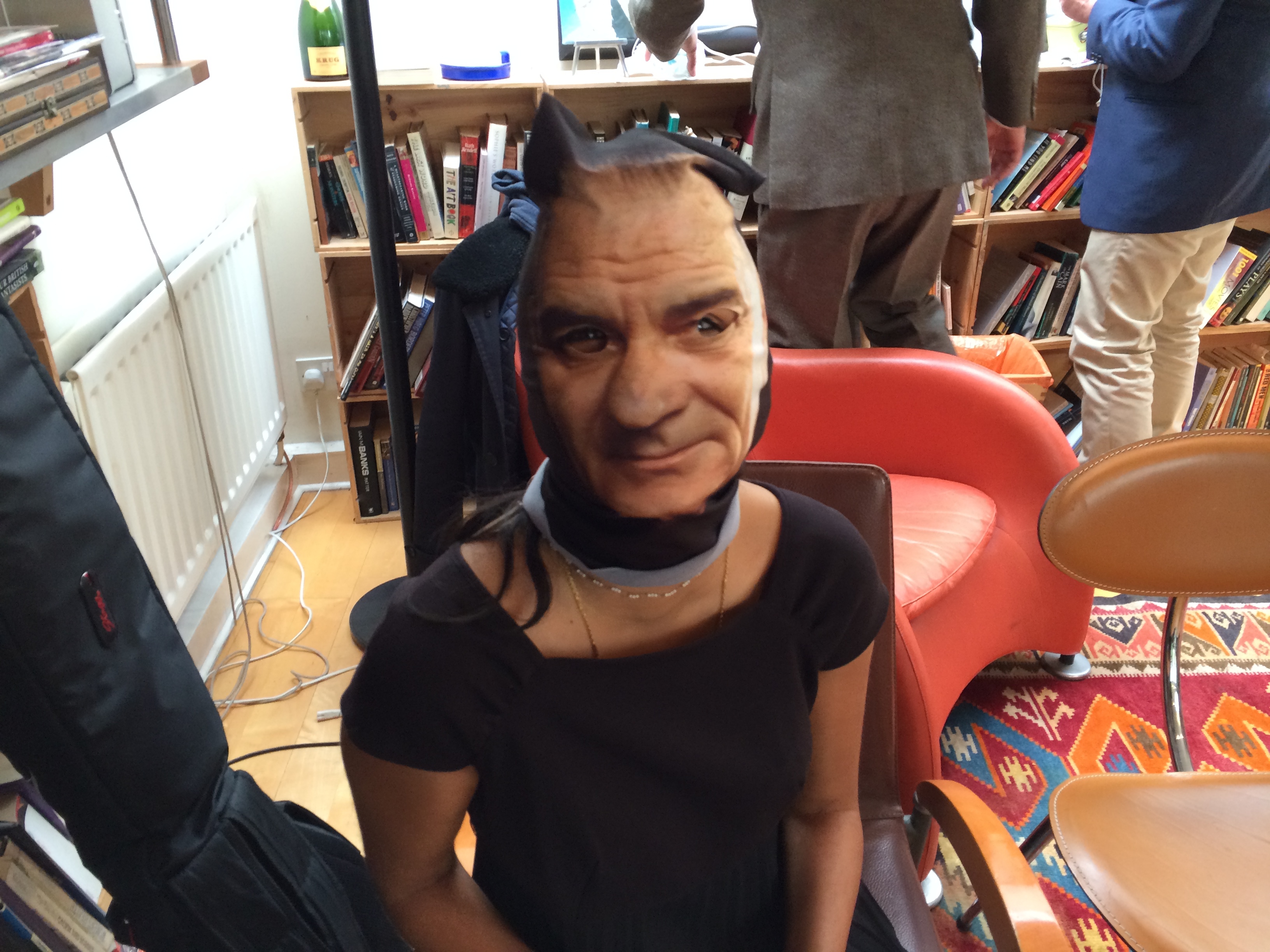
Poster for The New Hope unveiled

Beg Steal Borrow News, The New Hope

Beg Steal Borrow is excited and proud to reveal the new poster for The New Hope.

Designed by the talented Angela Faillace, the poster shows leading characters Dennis and Hadrian silhouetted against two suns as their shadows are cast over an expanse of grass.

The poster draws its inspiration from Star Wars and in particular one of the posters for The Phantom Menace, in which a young Anakin Skywalker casts the shadow of Darth Vader, thus suggesting his shadowy destiny.

Here, however, the shadows that Dennis and Hadrian cast are, respectively, of Don Quixote and Sancho Panza as in the 1955 sketch that Pablo Picasso created of the two characters for Les lettres françaises.

Blending Star Wars with Don Quixote, then, the poster conveys the key themes of the film, which is an adaptation of the first part of Miguel de Cervantes’ great novel – although in this updating of Cervantes’ story, the main character believes he is not a knight errant, but a Jedi knight.

Finally, the grassy expanse conveys the way in which the film takes place mainly in London’s Hyde Park, itself a common ground that is free for anyone to visit.

The setting in this way ties in with the democratic aspirations of the film. Not only is it a movie about a man who wishes to be a Jedi knight (thus proving that we can be whoever we want to be), but so is the movie’s zero budget a bit like tilting at the windmill of the mainstream film industry.

If one charges with enough conviction, though, maybe one can give hope to people, by showing that one does not need expensive equipment and flashy CGI to make a film, but that there is equally magic in a park, a Boris bike, a scooter, a stick and a dustbin lid.

Designer Angela Faillace is currently a student at the University of Roehampton, London, where director William Brown also teaches. She also designed the poster for Selfie, her work having caught William’s eye through the posters she designs for the Roehampton Film Society, which she also runs. Angela also worked as a crew member for Beg Steal Borrow’s video of Extradition Order’s ‘Boy in Uniform’ and can be seen in a couple of shots in Selfie.

Designed by the talented Angela Faillace.

Designed by the talented Angela Faillace.