Impressions of cinema in the UAE

Blogpost, UAE cinema, Uncategorized

In The Sheik and I (USA/UAE, 2012), Caveh Zahedi is invited to make a movie for an exhibition organised by the Sharjah Art Foundation, exploring the theme of subversion.

Zahedi finds it ironic that even though he is told repeatedly that he has open rein to make whatever movie he wants, he is also given a series of quite strict guidelines, perhaps especially the idea that he cannot critique the titular Sheik, who is funding his film, and Islam.

What ensues, then, is Zahedi making a film in which, among other things, he critiques employment practices in the UAE, creating a fantasy in which the Sheik himself decides to allow guest workers in the country to be able to achieve Emirati citizenship, and thus a civil status that is on a par with the historically local population (whatever that is or might be, and which Zahedi never quite specifies). Religion also plays a key part in the film, but I shall not be touching upon that here.

Rather, I open this post with reference to The Sheik and I because towards the end of his film, Zahedi explains how so many of the people whom he meets in the UAE are, in his own terms, ‘cool.’ That is, they get his sense of humour, and they are not offended by his jokes with regard to religion and employment, since they recognise both his concern for human beings regardless of race, religion, nationality and so on (Zahedi as humanist), and that his film is not to be taken too seriously.

However, Zahedi then suggests that the people whom he meets, perhaps most especially those at the Sharjah Art Foundation that is funding his film, are ‘not cool,’ because ultimately they pull the plug on his film, meaning that he does not make the film that he wanted and instead makes The Sheik and I, a film about not being able to make a film (and thus in some senses a non-film).

Here I personally part ways with Zahedi in terms of his opinion of his collaborators in the UAE. Where he sees them as ultimately ‘not cool’ for not going with him all the way in his subversion, I see them still very much as ‘cool.’ And that they do not ‘betray’ Zahedi so much as find themselves confronted with contradictions that they already know very well and concerning which Zahedi refuses to give any quarter.

What are these contradictions? In short, they are the fact that Zahedi’s collaborators in the UAE are by no means blind to the shortcomings of their society, but they cannot go about addressing them in the way that Zahedi does – while Zahedi’s charge that they are ‘not cool’ would seem to suggest that Zahedi thinks that they refuse to address these shortcomings. If they refused to address these shortcomings, Zahedi would not even be there, and so in some senses while his film is very funny and touching, in other ways it lacks subtlety – confronting head-on issues that might otherwise be addressed in more nuanced fashion.

I open with this reference to Zahedi, then, because it strikes me that for all of the clear and necessary criticisms that could be levelled at the UAE as a nation in terms of its structure and organisation, it is important to remember that the UAE is very much a cool place with some very cool minds that are as sharp as the minds anywhere, and which share a similarly ‘liberal’ sensibility – even if that sensibility, for reasons that I cannot fully explore here (for the sake of space more than anything else), is expressed in different ways.

It is important to remember that the UAE is ‘cool,’ because it can be very easy to lose sight of this fact – as perhaps is suggested in what follows.

Should anyone care to read it, I argue in a different essay that ‘cool’ drives much of the contemporary world. That is, the contemporary world is driven by appearances, with image therefore becoming as important as, if not more important than, reality. To take images for reality, to believe in images is in some senses to worship images – in the sense of attributing worth/value to them. In some senses, then, cool is associated with the superficial – the belief in surfaces and the visible as opposed to depth and that which might elude the sense organ of the human eye (which is sensitive only to about 5 per cent of the light spectrum).

In this post, though, I use the term ‘cool’ to mean something quite different, perhaps even the opposite of the definition used in that essay. Here, to be cool does not refer to appearances and a capitulation to the society of the spectacle, whereby flashiness is used to empower the self. Rather, ‘cool’ here refers to seeing through the surface of things and understanding that certain aspects of reality lie beyond the surface – and that if we accept only the surface as real, then we have a very incomplete understanding of reality.

So when I say that people in the UAE are cool, what I mean to say is that there are as many people in the UAE who are – to use a fashionable term – ‘woke’ as there are in any other part of the world that I have visited (if I am in a position to be a judge of coolness or wokeness). Indeed, I would say that the proportion of people who are ‘woke’ and/or ‘cool’ (by my imperfect reckoning) is about the same as anywhere.

What for me is the shortcoming of Zahedi’s film, then, is that he only goes by what is visible, endlessly creating scenes that in principle give us a ‘behind the scenes’ look at what happens in the making of a/his film, but in reality never going ‘behind the scenes,’ because that which is ‘behind’ the scene can by definition not feature in a film, since films can only be made up of scenes. Zahedi insists upon making a scene and upon only scenes being real rather than accepting the reality of that which is behind the scenes.

In other words, it might be possible to say that cinema as a tool is not capable of going behind the scenes – even if many films gesture at doing this by being self-conscious, reflexive and so on. That is, cinema is (very often) superficial.

What lies behind the scenes is not all good stuff. Indeed, we use the phrase ‘behind the scenes’ to describe intrigues and conspiracies, precisely the abuse of appearances and more. The desire to expose, to make a scene out of and thus to make seen, such ‘behind the scenes’ practices is valid and in some senses necessary.

But to insist that that which is behind the scenes is necessarily ‘bad’ (as Zahedi might seem to) is to accept only the seen/the scene as real, while it is also to have ‘bad faith,’ in the sense that the invisible (that which one cannot see and in which one therefore must have faith) is bad. Is it possible for us to construct a world in which we have good faith, and in which we trust that behind the scenes some good things might be going on? Zahedi would seem not to think this possible of the UAE. But I wish to suggest here that it is, and that there is reason for good faith in and about the UAE.

The UAE is not a cinematic society, in that few are the films that have been made there and the history of cinema in the UAE is not particularly long (fewer than 25 feature films in the last 12 years). That said, as cinema begins and grows in the UAE, it is becoming increasingly cinematic.

That the increasingly cinematic nature of the UAE is tied to a burgeoning belief in images might be clarified by the link between movie theatres and shopping malls there. The vast majority of cinema screens are inside multiplex cinemas that sit inside shopping malls, where people by fashionable products in order to demonstrate through their appearance (i.e. via their projected self-image) about how valuable they are/how much they are worth/how much they should be worshipped. In other words, having been uncool, the UAE is becoming increasingly cool in the negative sense defined above: a society that invests increasing amount of money and time in appearances, including the industry of appearances that is cinema.

But this does not mean that there is not quite a lot of cool stuff going on ‘behind the scenes’ and thus cool in the positive sense that I wish to use here, and which is related to cinema in various ways.

In what follows, then, I wish to relay some of my experiences of cinema in the UAE over the course of the four months that I was working there between late August and late December 2017 – for the simple purpose of sharing my imperfect and surely problematic (superficial?!) understanding of cinema in that place with other curious/interested parties (should they exist).

Over the course of the 17 weeks that I was in the UAE, I went to the cinema 42 times (I went twice to the cinema in the USA during this period during a brief work trip there soon after my arrival in the UAE). This averages at just over twice a week. Should you care to know, the full list of films I saw there is as follows:-

It (Andy Muschietti, USA/Canada, 2017); American Made (Doug Liman, USA, 2017); The Hitman’s Bodyguard (Patrick Hughes, Netherlands/China/Bulgaria/USA, 2017); Soul Food Stories (Tonislav Hristov, Bulgaria/Finland, 2013); Stronger (David Gordon Green, USA, 2017); Kingsman: The Golden Circle (Matthew Vaughn, UK/USA, 2017); Flatliners (Niels Arden Oplev, USA/Canada, 2017); Victoria and Abdul (Stephen Frears, UK/USA, 2017); Mark Felt: The Man Who Brought Down The White House (Peter Landesman, USA, 2017); The Foreigner (Martin Campbell, UK/China/USA, 2017); Blade Runner 2049 (Denis Villeneuve, USA/UK/Hungary/Canada, 2017); Scialla! (Francesco Bruni, Italy, 2011); Napolislam (Ernesto Pagano, Italy, 2015); Loving Vincent (Dorota Kobiela and Hugh Welchman, UK/Poland, 2017); The Snowman (Tomas Alfredson, UK/USA/Sweden, 2017(; Blessed Benefit (Mahmoud Al Massad, Germany/Jordan/Netherlands, 2016); mother! (Darren Aronofsky, USA, 2017); Human Flow (Ai Weiwei, Germany, 2017); Geostorm (Dean Devlin, USA, 2017); Brawl in Cell Block 99 (S. Craig Zahler, USA, 2017); Only the Brave (Joseph Kosinski, USA, 2017); Suburbicon (George Clooney, UK/USA, 2017); Thor: Ragnarok (Taika Waititi, USA, 2017); When Monaliza Smiled (Fadi Haddad, Jordan, 2012); Mafioso (Alberto Lattuada, Italy, 1962); Murder on the Orient Express (Kenneth Branagh, USA/UK/Malta/Canada, 2017); Ugetsu Monogatari (Kenji Mizoguchi, Japan, 1953); Justice League (Zack Snyder, USA/UK/Canada, 2017); Wonder (Stephen Chbosky, USA/Hong Kong, 2017); Wonderstruck (Todd Haynes, USA, 2017); Tabiib (Jim Savio, USA/UAE, 2017); The Mountain Between Us (Hany Abu-Assad, USA, 2017); Good Time (Josh and Ben Safdie, USA, 2017); Xenos (Mahdi Fleifel, UK/Greece/Denmark, 2014); A Man Returned (Mahdi Fleifel, UK/Denmark/Netherlands/Lebanon, 2016); A Drowning Man (Mahdi Fleifel, Denmark/UK/Greece, 2017); Sharp Tools (Nujoom Al-Ghanem, UAE, 2017); Mary Shelley (Haifaa al-Mansour, USA/UK/Luxembourg, 2017); Star Wars: The Last Jedi (Rian Johnson, USA, 2017); Coco (Lee Unkrich and Adrian Molina, USA, 2017); White Christmas (Michael Curtiz, USA, 1954); and The Killing of a Sacred Dear (Yorgos Lanthimos, UK/Ireland/USA, 2017).

This list does not include a programme of 8 short films that I watched at an event celebrating cultural exchange between the UAE and the UK, and which included four films from the UK and four films from the Gulf region (mainly the UAE) – an event to which I shall return shortly.

A brief glance at the above list will suggest that the majority of films that I saw are American films or transnational co-productions that include American talent and/or money. However, it should be worth emphasising immediately that there is a wide of range of films from India consistently playing at the cinemas in the UAE (I had in particular wanted to see Qarib Qarib Singlle, Tanuja Chandra, India, 2017 – mainly because I really like Irrfan Khan, who stars in it), as well as the occasional Philippine film, some Egyptian films (I was in particular sad not to be able to make it to see Sheikh JacksonAmr Salama, Egypt, 2017) – and more.

That said, American blockbusters do basically dominate the market – and in this respect movie theatres in the UAE are very ‘cool’ in the superficial sense – since a good number of the blockbusters mentioned above (for example, Geostorm) look good and have lots of loud crashes, bangs and wallops, but they do not have much depth. (Remember that this is the list of films that I saw, not the list of films that were showing.)

However, even within that list, there is clearly an appetite for work by relatively well regarded filmmakers, including Todd Haynes, Darren Aronofsky, George Clooney, Ai Weiwei, Yorgos Lanthimos and David Gordon Green. Furthermore, ‘sleeper’ films like Brawl in Cell Block 99 played, as did the Safdie brothers’ excellent Good Time, as well as experimental animation Loving Vincent. In other words, there might as anywhere be some shallow movies playing, but there is also some cool stuff – even at multiplexes in shopping malls.

If there is a distinction to be made between the films I saw and the films that showed, there is also a distinction to be made, meanwhile, between the films screening and how many people went to see them. This is anecdotal evidence, but I should highlight how on a semi-regular basis (on four or five occasions), I was the only audience member in the cinema, with audiences rarely exceeding ten – with even mega-blockbusters like Justice LeagueStar Wars: The Last Jedi and Thor: Ragnarok seeming to have relatively slim crowds when I went to see them.

What we might infer from this, then, is that the movies show and that no one is particularly interested in them. This would confirm that idea that there is no cinema in the UAE, and this is a position that seemed to be held also by a spokesman for Image Nation Abu Dhabi at the UAE-UK cultural exchange mentioned above, and which was supported in part by the British Council.

During an exchange at the event, someone asked why local films were not supported by the cinema chains in the UAE, with the response being along the lines that there is no appetite for them for the twin reason of people not being interested in movies and the perception that local films are not of a high enough quality in the sense that they do not match the production values of a Hollywood feature film.

However, to counter the first point, I would like to bring in a couple of bits of evidence. For while I did spend a fair amount of time sitting in relatively empty movie theatres while watching American blockbusters and auteur films in the UAE, I did also sit with very busy communities of filmgoers at more or less every film that I saw which was not an American blockbuster or the work of someone like Haynes and Aronofsky.

There is a film club called Cinema Space that meets three or four times a week at the Manarat al Saadiyat on the outskirts of Abu Dhabi, and at which I saw a handful of films, typically foreign and/or classic (Soul Food StoriesScialla!MafiosoUgetsu MonogatariWhite Christmas). While the average audience size in the mall multiplexes was less than 10, at Cinema Space the average audience size was about 50. And with their comprehensive and varied programme, Cinema Space is about as close to a cinematheque that Abu Dhabi has – and there clearly is an appetite (more of an appetite!) for art house over mainstream work.

Further evidence for the appetite for non-mainstream work would include the occasional film screenings held at Warehouse 421 in the Mina Zayed (port) area, and The Scene Club in Dubai, which also programmes independent work. I might also mention that I curated a series of 27 films based upon the theme of mavericks (maverick actors and maverick/cult-ish films), and which took the name of DXB Experiments Presents: The Cinema. With the screenings taking place in Le Royal Méridien Beach and Spa resort, this was like the other film clubs mentioned above an example of not-quite-theatrical film exhibition. And while the 27 films were relatively mainstream, the reported average audience again of about 50 far surpasses my experience of the multiplexes in terms of audience size.

With the opening of the Louvre Abu Dhabi, in which there was a tiny amount of moving image work on display (mainly a film about land art), together with small amounts of moving image work also on display at the Abu Dhabi Art Fair (held like Cinema Space at the Manarat al Saadiyat), and with a Guggenheim and other museums promised in the future, hopefully the appetite for artistic and/or experimental cinema will also continue to grow.

That said, a seemingly greater appetite for classic, independent and/or art house cinema than for mainstream work does not translate into an audience for local films. However, here I may suggest that an enterprise like CinemaNA, which is a joint venture between New York University Abu Dhabi and Paris-Sorbonne University Abu Dhabi, would again suggest the opposite. It is through CinemaNA that I saw Blessed Benefit to an audience of over 70 at the Sorbonne and When Monaliza Smiled to a full-house at NYUAD. Being Jordanian, we may say that these films are not strictly local, but nonetheless they suggest an appetite for films in Arabic.

Furthermore, I also attended a screening of Jim Savio’s locally-shot Tabiib at NYUAD, which similarly enjoyed a full house, while a triple-bill of short films by Mahdi Fleifel, the director of the excellent documentary, A World Not Ours (UK/Denmark/Lebanon/UAE, 2012), had over 30 people in attendance.

In other words, and in particular contrary to the Image Nation Abu Dhabi spokesman, it would seem that there is an appetite not just for classic, independent and art house cinema, but also for Arab and perhaps even more specifically Emirati cinema – with audiences going to watch these latter films not necessarily in spite of their low budget, but perhaps very much because of that low budget.

For, as many humans wear their wealth cosmetically as a means to demonstrate their worth/as a means to be worshipped, so, too, do movies. And so in some senses it is the more humble, less opulent film that stands a greater chance of taking us beyond appearances and which can give us a sense of what happens ‘behind the scenes,’ lending depth to the world that we see being depicted in the film. The truly cool, then, is not necessarily that which shares the values of a superficial world (that is only superficially to be cool), but that which sees through/beyond the surface and which perhaps demonstrates to us that there is a beyond the surface.

If cinema is only about surfaces, then perhaps films that go beyond and/or which demonstrate that cinema is superficial are not really cinema. Maybe, then, such films are non-cinema – even if they are still cinematic (in that they are still films). In this sense, the spokesman of Image Nation Abu Dhabi was perhaps right in suggesting that there is no cinema in the UAE. But he also did not appreciate how there positively is non-cinema in the UAE, the status of which as non-cinema is also reinforced by the non-theatrical venues in which many of the above clubs are held.

Here we reach the issue of production values. At the UAE-UK cultural exchange event, it seemed that speakers both British, American and Emirati insisted that all films have a certain (high) level of production values, and without which Emirati cinema will never get off the ground – before the speakers then (inexplicably) slamming today’s youth (millennials!) for not having the commitment (at university age) to learn the full range of skills involved in filmmaking.

Indeed, to return to the Image Nation Abu Dhabi spokesman, he invoked in his talk Woody Allen in order to suggest that the business dimension of show business is absolutely necessary – and that anyone who thinks that they can make films without also being a businessman is misguided.

The reference to Woody Allen is linked to the discussion of production values, because in order to achieve high production values, one needs money, which means that one must understand the cinema is a business. That is, cinema is inherently a capitalist enterprise, in which looking good (and thus qualifying as cinema) depends upon money. This means that young filmmakers must respect those who have money if they want to make films, since without that money, the films will not be funded. Again, cinema becomes a means for worshipping superficial values, in that the greater material worth of the rich person is deemed to be a more real worth than the measurement of humans according to a non-materialistic criterion.

It is not the UAE is a poor country. Far from it. But young people typically do not have access to money in the way that working adults do – and the UAE-UK cultural exchange event was aimed at discussing the future of film in the UAE, while also being attended by would-be future filmmakers in the UAE. To suggest that cinema requires money and that in some respects cinema is inherently conservative (since access to money is achieved by respecting one’s elders and their ethos of business) is not to encourage young filmmakers by telling them that it is possible, but to put up barriers to entry into the world of film – even though the desire to make films is clearly there given the presence of young filmmakers at the event.

The criticism of millennials by various of the speakers only clarifies further a split that the cultural exchange event drew out: that the established filmmakers and the established ways of making films do not feel enough respected, and perhaps that the young filmmakers and would-be filmmakers in the audience do not share the same conservative values as the established filmmakers.

Two examples of those conservative values might be explained. In her discussion of her career, Nayla Al Khaja somewhat jokingly explained how when she made her first short film, Arabana (UAE, 2006), she ended up with far too much money to make the film because so many people were enthusiastic to support her – and that in the end, she spent not very much money on her film but a huge sum of money on promoting her film, including by hiring a cinema and insisting upon a VIP guest list at her premiere.

Al Khaja’s entrepreneurial spirit is to be admired, and she clearly is a supporter of independent cinema in that it is she who organises The Scene Club in Dubai. But similarly this story not of making a great film but of channeling money into promotion suggests a capitulation in advance not to substance but to appearance (even if Arabana is a film about child neglect). Al Khaja is not necessarily wrong to play a superficial world at its own game, but she also implicitly accepts rather than challenges that world.

Meanwhile, the second example is the Image Nation Abu Dhabi spokesman’s reference to Woody Allen. For, as was suggested at the time, evoking Woody Allen in late 2017 as a shining light to be followed in the global film industry seems somewhat strange. That is, Allen may well acknowledge the business side of the film industry, but Allen also stands at this present time for an abusive patriarchy that objectifies women, rendering women as superficial images rather than as flesh and blood human beings with depth. The reference to Allen does not just suggest that cinema is inherently conservative, but it also suggests that cinema is inherently patriarchal.

That the Image Nation Abu Dhabi spokesman invoked Allen as a means to dismiss as naïve a question about youth filmmaking movements suggests not only that he does not understand the history of cinema (which since at least the nouvelle vague is a history defined by youth and/or by the most important filmmakers making work for very little by finding alternative ways to make films, or to make non-films if those alternative ways are not considered legitimately to be cinema), but it also suggests his own patriarchal perspective.

Given that in the audience of his talk was a group of c40 young female Emirati film students who had travelled to Abu Dhabi from a higher technical college (HTC) in Fujairah (a journey of about three hours by road), the reference to Allen also seemed especially inappropriate. But more than this, it confirmed the future of Emirati non-cinema, in the sense that if cinema is conservative and patriarchal, and if millennials do not respect cinema, and if the future generation of filmmakers (those same millennials) are mainly women… then the future of cinema is a non-superficial, non-patriarchal non-cinema – just as developments in cinema traditionally have been driven not by those who conservatively uphold its values, but by those who innovate by finding new ways to make – and to see films.

In this sense, if it is not in multiplexes but rather in clubs and in particular university spaces that alternative films get seen, then the UAE in the 2010s is not so dissimilar to the USA in the 1960s, where campuses were one of the main spaces in which young future filmmakers would see work by the likes of Ingmar Bergman – since you could not see these at the mainstream cinema, of which the younger generation had become tired, since the mainstream did not reflect their values or outlook on life. It is exposure on university campuses to European art house cinema (exemplified here by Bergman) that led to the reinvigoration of American cinema via the so-called Movie Brats that included Martin Scorsese, Francis Ford Coppola, Brian De Palma, Peter Bogdanovich and more. Again, the history of cinema is driven not by old men, but by brats – and in the UAE perhaps by female brats (with Al Khaja functioning as a kind of godmother figure, even if her emphasis on the superficial might also not quite chime with the younger generation).

What is true of exhibition is hopefully also true of production. In the era of digital media, in which ‘everyone can make a film,’ it seems clear that not only can everyone make a film, but that in some senses everyone does make films – just in formats that are not recognised by those who ‘officially’ define what cinema is.

Indeed, during my time in the UAE, I had the opportunity to speak at an event for Young Arab Media Leaders (YAML), which was attended by over 100 young media users from all over the Arab world (with the exception of Qatar). Indeed, you can see me images of me delivering my talk in the video below, and which was created after the YAML event, and which was posted by Shamma Al Mazrui, to whom I shall return imminently.

My aim is not to discuss the aesthetics/production values of this video, which may seem superficially cool with its use of slow motion, triumphant music and so on. Rather, I wish to say how, in particular during discussions after my talk, it seemed clear to me that there are young media users, including filmmakers, who are developing new ways to create and to show their work – and if cinema does not acknowledge the legitimacy of this work, then it is only cinema that will be left behind, and not the millennial generation.

Or rather: perhaps this millennial generation does not care for cinema with its inherently superficial and/or patriarchal set of values, but is instead developing non-cinema in order to create a different, better world.

In the old days, you did need vast amounts of money to make a film, which meant having contacts and so on. But nowadays, perhaps (by definition?) the most vibrant work is made without money. Or at the very least it is created with minimal budgets raised via crowdsourcing sites and by young, female voices with something to say – including, for example, Amal Al Agroobi, whose Under the Hat (Qatar/UAE, 2016) is a sweet tale of precisely old and new worlds colliding, and who is crowdsourcing money for a feature film about Philippine domestic workers in the UAE – a subject that is not a million miles from that of Caveh Zahedi’s The Sheik and I.

It is telling, then, that the YAML event was organised by Shamma Al Mazrui, the UAE’s first Rhodes Scholar and who at 22 was the youngest government minister in the world. Known for her engagement with media, Al Mazrui represents a female future of media leaders who perhaps move beyond the conservative/superficial/patriarchal values of cinema, and who instead create a different, deeper, more ‘feminine’ (non-)cinema, and/or society that moves beyond the superficial and cinematic values that define much of the world under globalised neoliberal capital.

Spending a few months in the UAE, I met many local cinephiles, whose knowledge and enthusiasm for cinema impressed me enormously, including Hind Mezaina, whose Culturist blog is one of the essential sites for discovering what goes on under the surface (‘behind the scenes’?) in the UAE.

It was lamented several times (including by some of its former organisers) that the Abu Dhabi Film Festival is no more, even if the day that I spent at the Dubai International Film Festival would suggest a vibrant capacity for cinema in the UAE. Indeed, the screening that I attended of Sharp Tools, a documentary about the late Hassan Sharif, the UAE’s best known conceptual artist, would give hope that people might support not only local films, but also local documentaries (i.e. non-mainstream films) about local artists who themselves were seeking consistently to push the envelope in terms of making art that raised consistently the question ‘what is art?’

As Sharif asked through his work ‘what is art?’, so might tomorrow’s Emirati filmmakers not simply accept the definition of cinema that is handed down to them, but instead they might continually be re-posing the question ‘what is cinema?’ in order to push the boundaries in terms of working out what it is that cinema can do. In this sense, art and filmmaking are not dissimilar to the human project of getting better to know ourselves and pursuing the ethical development of working out what it is that humans can do and learn. With bad faith, we will assume the worst and suspect that humans can realise great evil and that the quest to find out what it is that humans can do will lead only to violence. But with good faith, we might well learn that humans are capable of the most amazing and generous things.

This is not to deny the human capacity for evil, which is clearly documented even if regularly occulted because a) people do not want necessarily to see evil and b) because those who commit evil deeds do not necessarily want to be seen (evil takes place behind the scenes). But this does not mean that good can only take place in scenes (that good can only be staged). For this would be a world not necessarily of good, but of performed good – a world in which appearances of goodness would come to count for more than actual goodness, a slippage that would take us away from goodness itself.

If the UAE currently has no cinema (in a metaphorical if not in quite a literal sense), then I have faith that it will produce good if not excellent cinema before long – and that it might be all the better if that cinema includes a healthy dose of non-cinema. Indeed, the health of a nation might better be gauged not by its cinema, but by its non-cinema. In this respect, it may not at present be perfect, but the signs for the UAE are good.



F for Fake: Murder on the Orient Express (Kenneth Branagh, Malta/USA, 2017)

American cinema, Blogpost, Film reviews, Transnational Cinema, Uncategorized

One of the key scenes in Murder on the Orient Express involves Hercule Poirot (Kenneth Branagh) exposing Gerhard Hardman (Willem Dafoe) as a fake Austrian scientist as a result of his failure correctly to pronounce Turin. Hardman – if that is his real name – pronounces it TURin, whereas a genuine Austrian, as Poirot reminds us, would have pronounced it TurIN.

Given the importance that the film places upon pronunciation as a sign of authenticity, it is notable that on two occasions we hear the Belgian sleuth incorrectly pronounce the plural of the French word for eggs. The singular, œuf, involves the pronunciation of the f: ‘urf.’ However, when said in the plural, French speakers drop the f sound and say ‘uh’: des œufs (‘des uh’). Poirot, however, on both occasions persists incorrectly with the f and says ‘urfs.’

If it is an incorrect pronunciation that exposes Hardman’s act, then by the same token Poirot’s incorrect pronunciation exposes his own act. That is, if it is because he cannot correctly pronounce words that Hardman is revealed as not Hardman, then because he cannot correctly pronounce words, Poirot is similarly revealed as not Poirot. In other words, it is because of an f that the Poirot of Murder on the Orient Express is revealed as a fake.

What are we to make of this?

On a primary level, we can simply say that it is an error that any actor (here, Kenneth Branagh) might make when saying words in a language that is not his own. That is, the slip is meaningless – the sort of slip that should not be the basis of an entire argument about the film.

But, given that the film itself involves sleuthing based upon such slips, then by the film’s own standards, we can mount a case against the film as a result of its linguistic inaccuracies. If Hardman’s slip is deliberate, in the sense that it provides a clue as to the real nature of what it is that we are witnessing, then so must we read Branagh/Poirot‘s slip as deliberate.

[SPOILERS.]

Hercule Poirot finds himself on a train where 12 people have gathered ritually to murder a man (Edward Ratchett/John Cassetti, played by Johnny Depp) who himself abducted and killed a child in the USA some time prior to the titular train journey taking place. Each has a link to the victim and the victim’s family – and each is sufficiently devastated by the original murder that they are willing to take part in the murder from which the novel – and subsequently the film – takes its name.

The film presents to us as if it is by chance that Poirot happens to be on the titular train. Indeed, the murderers would have gotten away with it, too, were it not for the pesky Poirot’s presence – and an avalanche that happens to keep the train stuck for a day or more near Brod, in what at the time of the film’s setting (1934) was the recently formed Kingdom of Yugoslavia, and which today finds itself in the Muslim-majority country of Kosovo.

But what are the odds that all of these people with a connection to Cassetti happen to be on the same train – at precisely the same time that the world’s greatest detective happens to be there, too?

As the odds are extremely slim that so many people with connections to Cassetti can be on the same train as him by chance, so, too, are the odds slim that Poirot would be on the same train as all of these people and as Cassetti by chance.

Indeed, as it is not by chance that all of these same people are on the same train as Cassetti (they are here specifically to murder him), so might it also not be by chance that Poirot is on the same train. For, as Hardman is not Hardman, so is this Poirot not Hercule Poirot.

Instead, as indicated by his fake f, this Poirot is in fact an actor playing the part of Hercule Poirot – the world’s greatest detective – precisely so that he can uncover the crime and then use his credentials as a great moral arbitrator in order to excuse those who commit the murder of Cassetti.

That is, this Poirot is not on the train by chance, but, like all of the 12 perpetrators, he is equally on the train as a result of engineering. This Poirot is there not just to uncover the murder, but to justify the murder. He is part of the plot to allow murder to happen justifiably. For if the world believes that even Hercule Poirot allows these people to get away with murder, then everyone will allow these people to get away with murder. It is necessary to fake Poirot’s presence in order to justify murder.

But why do this?

On one level, this must be done in order to keep the train’s owner, Bouc (Tom Bateman), at bay. Where Bouc might otherwise blow a whistle about the murder, thanks to Poirot’s presence and his condonement of the killing, Bouc will keep quiet and let the killing happen ‘in peace.’ Bouc thus is a kind of bouc émissaire, or scapegoat, for the murder – not because Bouc literally takes the rap for what happens, but because Bouc’s naïve belief in the fake Poirot reconfirms (the fake) Poirot’s (fake) verdict that the killers are justified in their actions.

Except that Bouc specifically invites Poirot to take the train when Poirot is called to London to investigate the Kassner case. That is, Bouc is necessary in order to corroborate that this curious man whom we see is Hercule Poirot, while at the same time providing the necessary setting for the murder to take place. Bouc is in on it, too.

It is not simply that Poirot is part of the plot to murder Cassetti, then. It may even be that Poirot – this fake Poirot – is the mastermind behind the plot, a man playing the role of the Belgian detective in order to allow a murder to happen that he himself will expose and then condone precisely so that it takes place without consequence.

What evidence do we really have that Ratchett is Cassetti? None. That is, we have 12 liars who insist that this man is Cassetti, a child murderer who was never caught and the evidence for whose crime is never revealed to us. And then we have the word of a fake Poirot, whose explanations of the crime may be ingenious – but they explain to us neither who has been killed nor why.

Murder in Yugoslavia, or more specifically Kosovo, is therefore justified by the word of a fake authority. Indeed, because of the authority of a fake Belgian who justifies it, it becomes the perfect murder. Collective murder is perfect.

At the outset of the film, we see Poirot asking for the eggs that are the centre of this argument. Four minutes, he says, which presumably means that Poirot likes his eggs with a bit of unboiled snot in them given that five minutes is in my experience the best time to achieve a soft-boiled egg – give or take 30 seconds depending on the size of the egg.

(Furthermore, the boiling point of water falls with decreasing atmospheric pressure, and so it takes longer to cook an egg when one is at a higher altitude, since the boiling water there is not as hot and thus not as speedy a cooking medium as it would be at sea level.)

Having received two eggs that simply by appearance he does not like, the fake Poirot dismisses them and demands two more, which duly arrive.

Poirot (the fake Poirot) then takes out a ruler and measures the eggs, even though the eggs are visibly not the same size.

What is more, having dismissed the initial pair of eggs, he now accepts the second set of eggs, even though they are visibly disparate – and even though measuring them will not help him to know whether they have been boiled for the four required minutes.

In other words, first the insistence, then the refusal and then the nonsensical measurements are carried out in order to convince those around him (and we viewers) that this man is Hercule Poirot, the sort of man who would do such nitpicking. But of course, this is simply a performance by an impostor.

When Poirot makes it on to the Orient Express, he is served two much more equally-sized eggs for breakfast by the train steward Pierre Michel (Marwan Kenzari). How Michel knows to prepare the eggs this way is not revealed to us – and this is Poirot’s first experience on the titular train. In other words, Michel would seem already somehow to know Poirot. And Michel will eventually be revealed as yet another part of the plot to kill Ratchett, whom the murderers also claim to be Cassetti.

What is more, when Ratchett endeavours to employ Poirot to protect him from what he senses is imminent danger, Poirot (the fake Poirot) refuses – in part because he does not like Ratchett’s face.

In other words, not only would it seem that Poirot (the fake Poirot) is known in advance to at least one – but perhaps more – of the criminals who murder Ratchett. But it would also seem that Poirot himself has something against Ratchett. Perhaps it is for this reason that this detective who jumps up and who leaves his berth upon the slightest sound also somehow manages to sleep through 12 humans piling into a berth, stabbing a man and leaving again… because he also was a part of it.

But then who is this fake Poirot?

When the fake Poirot arrives at Istanbul train station with Bouc, he is told that there is no room left on the train – and that he therefore cannot travel in spite of his friend Bouc’s promise that he can.

At the last minute, however, someone suggests that an Englishman named Harris has not made it on time to catch the train. Passengers must arrive 30 minutes before departure, otherwise they forfeit their right to travel – and Harris has not arrived before departure and therefore cannot travel.

What has happened to Harris? Harris may have forgotten or missed his train. Or, given that Harris was otherwise booked on to a train where all of the passengers and even some of the staff members know each other, as an outsider he has been conveniently forced to miss the train – so as not to disrupt the murder that is about to take place (Harris is the victim of a second, earlier murder?).

Or, more simply, Harris does take the train. For the man who claims to be Hercule Poirot is really an Englishman called Harris, hence his inability correctly to pronounce the plural for eggs in French (des œufs/des ‘uh’).

Perhaps it is for this reason that MacQueen (Josh Gad) initially expresses surprise at seeing Harris/Poirot – for he does not recognise his friend in disguise, prompting Harris/Poirot to express his own dismay at MacQueen’s appearance. That is, Harris is indirectly expressing his own disappointment at having to look like Hercule Poirot.

Everything that follows is persiflage, pure show, or simply noise like the whistle of a train (per-siffle-age), including a somewhat nonsensical ‘action’ sequence in which Poirot chases MacQueen along a wooden bridge.

Indeed, this would explain the highly theatrical opening of the film, too, in which the fake Poirot supposedly solves the case of a missing treasure of which a rabbi (Elliot Levey), a priest (David Annen) and an imam (Joseph Long) are accused of stealing.

The fake Poirot himself points out that this is almost a joke scenario to the assembled crowd, who for some reason accept that a trial can or should take place in the open air and under the authority of a fake detective hired by the British government. That is, the trial is indeed a joke.

For, it becomes immediately obvious that there are not just the three religious men involved in this case, since the fake Poirot quickly explains to us that the last person to see the triumvirate was the British Police Chief Inspector (Michael Rouse).

We are told that Poirot (the fake Poirot) solves this crime as a result of a mark left by a shoe on a painting that lines the wall beneath the treasure. But far more simple a solution is to include among the suspects the very man who has known to accuse these three religious figures in the first place.

In other words, the ‘trial’ at the film’s opening is a pure show, a sham that is also put on in order to convince the assembled crowd and we viewers that this fake Poirot is the real Poirot.

The Chief Inspector supposedly steals the treasure, but it seems more logical to this viewer that the crime itself is a set-up so that the trial can be staged and so that the fake Poirot can be inserted into the story world.

That is, the fake Poirot is really engineered by the British – not to sort out who is responsible for the looting of valuables in Jerusalem (where the film opens), but in order to justify the British looting of valuables from Jerusalem and elsewhere in the Empire.

Supposedly called to London for the Kassner case, the British have in fact set Harris up as Poirot so that he can go on to the Orient Express to mastermind and then to justify the murder of Ratchett.

Why do this? Because Ratchett, too, is involved in the business of buying and selling antiques, including fake ones. That is, Ratchett wants to get involved in the very same racket that the British are operating throughout their Empire: stealing antiquities and replacing them with fakes that are sold at high cost.

As an upstart possible competitor, Ratchett must naturally be neutralised – otherwise the claims to power of the British will be exposed as fake. The Empire will be exposed as fake, its pretences to power merely an illusion staged to fool the assembled crowds that its figures of authority (the so-called Poirot) are in fact more powerful than their religious authorities (the rabbi, the priest and the imam).

Only two people will know the identity of the murderer, says the fake Poirot: God and Hercule Poirot. But if Hercule Poirot does not exist, then God may not exist. Or if Hercule Poirot is fake, then God may also be fake. That is, all who claim to be authorities on this Earth are fake, actors in a spectacle that is put on in order to create the illusion of power and in order to convince the spectators to believe in that illusory power.

(It is by this token important that the fake Poirot exposes corruption among the occupying British forces – the supposedly criminal Chief Inspector. In doing so, the fake Poirot would claim to show that the British bring their own people to justice – in the process covering over how the system of Empire will itself never be brought to justice. That is, the small crime is used as a mask for the massive crime that is taking place in broad daylight: the undermining and replacement of the local figures of authority for the purposes of ransacking the territory that the forces of Empire are infiltrating.)

Given the presence among the perpetrators on the train of three to five further Americans – MacQueen, the fake Hardman, Dr Arbuthnot (Leslie Odom Jr), the fake Countess Elena Andrenyi (Lucy Boynton) and the fake Caroline Hubbard (Michelle Pfeiffer) – it would appear that the British are not alone in ransacking the rest of the world.

Let us not also forget the Russians, including Princess Dragomiroff (Judi Dench) and Count Rudolph Andrenyi (Sergei Polunin), who seems expressly to take pleasure in the murder (as well as being prone to violence in general).

The group is rounded out by naturalised Americans Biniamino Marquez (Manuel García-Rulfo) and Pilar Estravados (Penélope Cruz), as well as British citizens with strong American ties, including Mary Debenham (Daisy Ridley) and Edward Masterman (Derek Jacobi), as well as Jewish émigrée Hildegarde Schmidt (Olivia Colman).

In other words, the major world powers are all united in a front to frame and to justify the murder of a man, Ratchett, whose crime is to seek to get involved in their game. Whose crime is to seek also to be a criminal. And who for his effrontery is branded a child abductor and murderer such that his assassination for theft and the peddling of fakes becomes morally justified.

When the fake Poirot performs his charade of egg inspection before a young boy (Yasine Zeroual), the fake Poirot explains that the disparity in size is not the fault of the eggs, but of the chicken. Or rather, that it is an inexplicable mystery.

To what end this prologue, which does not appear in the novel?

Perhaps Branagh is trying to tell us that as no two eggs are the same, so are a film and a novel not the same. That is, one can never get the original to match the copy. And so Branagh is suggesting from the very beginning that this is a fake version of Agatha Christie’s story that we are watching – and that it would be pointless to try to get the one to match the other.

Similarly, the film’s opening by the Wailing Wall in Jerusalem does not happen in the novel, which rather opens in Aleppo, and which sees Poirot travel by train (on the Taurus Express) to Istanbul, rather than by boat (as happens in this film).

We have already established how the film’s opening takes place simply for show – in the sense that it is a show designed to convince the world that this fake Poirot is the real Poirot and that the British are thus justified in their dominion over Jerusalem (which of course the British celebrate as being theirs whenever they patriotically sing the hymn ‘Jerusalem,’ as written by William Blake, to whom we shall return shortly).

But here the opening, with its overhead shots and its supposedly reliable flashbacks to the dispute between the rabbi, the imam and the priest, are all designed to convince us not just of the authority of the fake Poirot, but of the authority of the film.

This is especially clear in the fake Poirot’s illusory ability to predict the movements of the Chief Inspector. Firstly, he sends a guard to stand at the south gate in advance of denouncing the supposedly corrupt policeman, while also placing in the wall his walking stick, which eventually the fleeing Police Inspector will run into.

But this miraculous ability to predict the future is not so much magic as simply stage management: it is easy to seem to predict the future when it has been prearranged in advance for the policeman to go to the south gate and then to run into the walking stick.

In other words, the film wants us to believe in the power and authority of the film, when all of this is really staged, a fake that is a far cry from Christie’s novel. This is not Murder on the Orient Express that we are watching, but a fake film created by an impostor.

Put differently, cinema as a whole is an illusion machine that is used to give authority to those who peddle it. Like Ratchett, of whom the fake Poirot and his friends must get rid, cinema passes off fakes as if real, making handsome profits in the process while also stealing real local treasures via Empire, and as rendered here through the use in this film of Jerusalem’s Wailing Wall.

Which of course is not the real Wailing Wall, but a fake filmed in Malta.

More than this. As the fake Poirot is put into motion in order to justify the murder of Ratchett, so is cinema put into motion in order to justify murder more generally. As the disappearance of Ratchett is a conspiracy between the British, the Russians, the Americans and various naturalized Americans, so is the disappearance of Aleppo, for example, a conspiracy that is made to look like a struggle between the major world powers.

The point that I wish to make is not specifically about Aleppo, nor Palestine which was the nation in which Jerusalem resided at the time in which the film is set.

Rather, I am using Aleppo and Palestine here as examples of Empire and the role that cinema plays in the continuation of Empire. In bringing this fake magic trick to the world, the power of those who create cinema is justified.

The film regularly features extended sequences filmed from the exterior of the train, such that the train itself becomes a ‘character’ in the film. We might venture further yet, though, and suggest that it is not simply as if the train itself were a key player in the events that are unfolding, but as if the train demanded these events.

That is, the train is like cinema a tool for the creation of modernity. And what is modernity? Modernity is the creation of a system of power whereby some use the trickery of technology in order to demonstrate their power over others, whom they then ransack in order to consolidate their power – a perfect feedback loop of empowerment.

But this empowerment of some over others also involves the disempowerment of others for the benefit of some. This disempowerment is in effect murder. As a human seeking to become god kills others in order to use their life force and blood in order to prolong, increase and perhaps render permanent their own, so does modernity involve the sacrifice of many to sate the claims to divinity that a few are trying to make.

Naturally, anyone who sees through this fakery and who aims to achieve their own power must be removed – hence the murder of Ratchett. Revolution, or not to believe the proclaimed divinity of those who would have power, and to seek to establish via the same means one’s own power, similarly requires suppression, or else power will not be consolidated but distributed.

(It would seem all too human for humans to seek to become gods.)

In order for power to take on magic qualities that reinforce its power (power as appearance), power also seeks to hide its origin. As the projector from which images originate is hidden in the cinema, so is the provenance of power generally hidden. Power comes as if from nowhere, via sleight of hand. It is magical. And thus its authority is not to denied since it is beyond the ken of other, uninformed humans.

The status of Murder on the Orient Express as a Maltese-American co-production, then, functions as a means to hide the film’s own source of power (and that of cinema more generally). This is a film that comes from a ‘small’ place (Malta), but which really just reaffirms the big interests of cinema (Hollywood) – with Malta itself a screen enabled by the tax breaks that drew the production to it in the first place, and which tax breaks function as an invitation to under-pay local, Maltese workers, thereby justifying under-payment and exploitation as a whole.

What is more, as Malta functions as the home of an infamous Masonic order, and as small islands generally function as tax havens, or what the recent leak of documents would confirm to be ‘paradises’ on Earth (or what Nicholas Shaxson further defines as islands of [stolen] treasure), so does the presence of Malta in this production function as a means of burying treasure, turning theft into an illusion – something the reality of which cannot be proven, and which therefore is both godly and not real. To believe in it is to be an insane conspiracist. To be part of it is never to be discovered.

This is how Empire functions: power is nominally regulated through the creation of taxation systems, with the powerful then placing themselves outside of the jurisdiction of such regulation. Regular humans who are too stupid to be crooks are punished for their honesty (their money is stolen from them, and they receive next to nothing in return), while the so-called gods are never punished for breaking the rules that they impose upon other people.

(Europe/the West must be defended from Islam by the Knights Templar of the Order of Malta, a specifically Christian group that aims to put down the revolutionary religion of Mohammad, who is not divine but human, and so who threatens to undermine the claims to divinity of other humans. Murder in Kosovo is justified.)

And what of William Blake? The fake Poirot is called to London for the Kassner case. To what might this refer? Perhaps it refers to the work of author Rudolf Kassner, the man who translated Blake into German and who also was influenced by Laurence Sterne, whose Tristram Shandy is a novel in which fabulation becomes impossible to tell apart from truth as we are presented with illusion after illusion.

(Tristram Shandy as a deconstruction of power, and as a deconstruction of cinema avant la lettre/avant la caméra. In famously featuring a black page, Tristram Shandy renders itself antithetical to cinema, which relies upon darkness, but which cannot make darkness visible since this would be to bring to light and to humanise its otherwise invisible and would-be divine workings.)

(And so the ‘Jerusalem’ of Empire is not the real Jerusalem; it is a fake, builded elsewhere in England. But in building that fake Christian as opposed to that multi-faith Jerusalem, so are the dark Satanic mills of Empire put into motion.)

It is a kind of Blakean demonic energy that Ron Rosenbaum attributes to Adolf Hitler in a bid to explain his ascent to power – as if Hitler were the ultimate revolutionary little man born to rob power back from the gods in which he did not believe, and who thus provoked global war as the gods naturally demanded his blood to prove that Hitler was human as Hitler demanded blood to transcend his humanity and to become a god. With their nuclear light, the winners of the war demonstrated that they verily were gods.

The fake Poirot is perhaps, then, called to investigate the rise of Hitler and the role that literature, translation and perhaps even cinema played in that rise. Hitler is one more upstart, like Ratchett, whom the fake Poirot and his British, American and Russian friends must help to put down in order to perpetuate the balance of power as is. America, Britain and Russia may squabble over who has most power between them, but these squabbles merely cover over the bigger question of why they have power at all. They are a cinematic show that plays out so that people believe in their divinity as they rob the world of its treasures, selling back fakes to make yet more money and to consolidate all power in their own hands.

So for the sake of an f, Murder on the Orient Express is revealed as fake.

Or perhaps a simple show of ignorance on the part of Kenneth Branagh (he does not know how to pronounce his œufs) sets in chain a conspiracy theory that nonetheless reveals the very humanity and not the divinity of the world’s systems of power – and the role that cinema plays in creating and maintaining them.

Or perhaps this is just idle conspiracy theoretical fabulation, patterns where there only is chaos, and to be disproved in an ongoing apocalypse of false idols.

Fifteen thoughts about Flatliners (Niels Arden Oplev, USA, 2017)

American cinema, Blogpost, Film reviews, Uncategorized
1. Resuscitated films end up being haunted and made to feel bad by their past. Kiefer Sutherland is on hand to ensure that this is so.

2. In the contemporary age, suicide becomes the logical extension of the pressure to work oneself to death (and not to be a loser who simply works and goes home at the end of the day).

3. Computers are the urns in which we are always placing our remains.

4. Rich kids are not really haunted by feelings of guilt for their past sins. They in fact love their demons and accept even the most insincere of apologies – because they never really needed one.

5. The future of medicine is the preserve of the already-rich. They will play god with the lives of the poor who come to visit them. Medicine becomes like sport as doctors compete with each other to satisfy their narcissism.

6. “Why do you like me?” asks Nina Dobrev to Diego Luna after they have just boned. “Because you’re really hot,” he answers. Dobrev, her head on Luna’s chest, looks away with a satisfied glint in her eye: yes, I am, she is thinking. And even though Luna then adds that he was joking and that he likes her because she really cares about people, we all know that she does not care about anyone but herself and the only reason that he likes her and the only reason why anyone would like this film is because… she is really hot.

7. If the film is really a celebration of Hot People Boning, this all gets censored out in the UAE (where I saw this film). Meaning that the even less sense that the film makes… actually highlights precisely the senselessness of the film.

8. Death involves seeing oneself as if from outside one’s own body: death is basically the selfie stick/the selfie stick basically offers us a glimpse of death.

9. The fact that death comes back into life after the kids flatline would suggest that really these kids are already dead (inside).

10. People drive cars way too young in the USA. In being a film in which a woman (Ellen Page) is haunted by her sense of guilt after killing someone while answering her phone at the wheel, then it is not just a remake of a 1990s mediocrity, but it is also a remake of Lucrecia Martel’s Mujer sin cabeza/Headless Woman (Argentina/France/Italy/Spain, 2008). As we shall see, as that film is an expression of bourgeois guilt (or a lack thereof) for centuries of exploitation, so, too, is this film (although this does not make it any good).

11. As selfies are a channel through which we can see our own dead bodies, so are mobile phones a channel through which we speak to the dead. That is: mediation takes us away from direct human contact as we prefer instead phantom contact, or contact with phantoms.

12. The Mexican does not need to flatline – because as per Octavio Paz and the character who comes from the place where they celebrate El Día de los Muertos, he is basically already dead, too.

13. Privilege is based upon geopolitical exploitation and murder. But if you have it within you to forgive yourself, then it is okay to be a Nazi.

14. This recalls Slavoj Žižek‘s old observation that it is only when captured that Nazis tended to kill themselves – thereby exemplifying the public nature of shame, which is unbearable, versus the private nature of guilt, with which we can live. The film would seem to suggest a renewed era of shamelessness: I am shamed, but I basically can live with it – because I do not care (and because I am Really Hot). With the ongoing interest in figures like Eva Mozes Kor in mind (hat tip to the wonderful film scholar Leshu Torchin), one wonders that the forgiveness of victims only adds to the sense of shamelessness. Odd though this may sound, perhaps it is not for victims to forgive. Only God forgives. And if we do not think that this is so, then we are opening the door to new fascisms.

(And if there is no God, then we need a Law that can forgive. And if we have no universal Law as the guilty walk free, then who knows what is to happen? As the oppressed forgive their oppressors, then either we live in a world in which the oppressors are correct to oppress the oppressed, since neither God nor Law will judge them, and really there is no human equality, but only entitled superhumans and subjugated subhumans – many species as we cling to the illusion that really we are one species… or we must invent equality, change the Law, invent God, and give those self-proclaimed homines dei something really to be afraid of. The thing that the homo deus fears most in his belief that he is the summum of evolution… is revolution.)

15. Sex is a theme that runs throughout the film: slut-shaming; being a slut for having a one-night stand; paying for an abortion after a liaison with a working-class woman. Having a sexuality appears as more shameful than anything else, and at least on a par with murder – even though sex is designed to create and not to end life. Sex is shameful because it reveals mortality and failure in an era when one is supposed to live forever. In this way, sexuality has become death, an admission of mortality and of a body – as opposed to being an image, a selfie taken from outside one’s own body – about which one ought to be ashamed (it is only after flatlining that the Really Hot People can bone).

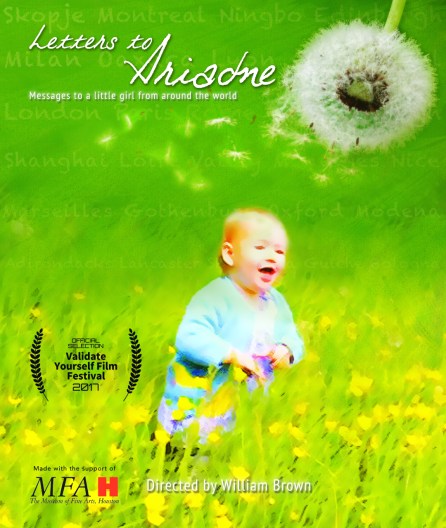
Beg Steal Borrow’s William Brown was delighted to attend the World Premiere of Letters to Ariadne at the Validate Yourself Film Festival in New York on 2 September 2017.

The film was warmly received at Hotel RL by Red Lion in Brooklyn by a dedicated crowd that included regular Beg Steal Borrow collaborator and screenwriter, Alex Chevasco (who has a small part in the forthcoming This is Cinema.)

IMG_9893

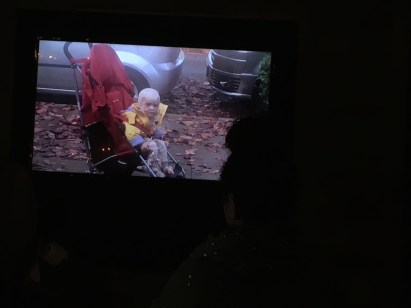
Ariadne prepares for Hallowe’en in Letters to Ariadne at RL Hotel by Red Lion in Brooklyn, New York, on 2 September 2017.

In other news, William is for the autumn of 2017 a Visiting Associate Professor of Film at New York University Abu Dhabi (NYUAD), where he is teaching a wonderful creative set of students who are making their final-year graduation (‘Captstone’) films – as well as teaching a course on Concepts in Film and New Media.

And Beg Steal Borrow is delighted to announce that there will be a preview screening of both Sculptures of London and The Benefit of Doubt at NYUAD before William leaves Abu Dhabi at around Christmas-time. More details will follow shortly!

Meanwhile, our short film, St Mary Magdalen’s Home Movies made the First Selection of the International Short Film Festival Kalmthout Belgium – although the film alas will not enjoy a screening there.

Slide1

St Mary Magdalen’s Home Movies made the First Selection of the International Short Film Festival Kalmthout Belgium.

And Circle/Line was selected by both the Stockholm Independent Film Festival and the UK Monthly Film Festival – although again these selections have not seemingly led to any actual screenings (the rise of ‘fake’ film festivals is a topic to discuss on another occasion).

And otherwise William continues to work on a series of films, including #randomaccessmemoryThis is Cinema and Vladimir and William, a series of letter-films that he is developing with Macedonian filmmaker Vladimir Najkdovski.

#randomaccessmemory, Beg Steal Borrow News, Festivals, Friends of Beg Steal Borrow, letters to ariadne, Screenings, Sculptures of London, The Benefit of Doubt, This is Cinema, Uncategorized, Vladimir and William

Letters to Ariadne will enjoy its world premiere at the Validate Yourself Film Festival in New York on 2 September 2017.

Letters to Ariadne

The screening will take place at 2pm at the Hotel RL by Red Lion, Brooklyn Bed-Stuy,
1080 Broadway, Brooklyn, NY 11221.

The film is comprised of a series of video-letters from director William Brown to his niece Ariadne as he travels around the world.

To this end, Letters to Ariadne features letters from places as diverse as England and Scotland, Canada and the USA, Italy, France, Mexico, Sweden, Macedonia and China.

The film is partly indebted to a Brown Fellowship that William won from the Museum of Fine Arts in Houston, Texas, to spend a month at the house of the late artist and photographer, Dora Maar, in Ménerbes, France.

VYFF

The screening follows a busy summer for Beg Steal Borrow. Not only have they shot both Sculptures of London and This is Cinema, while also continuing to work on The Benefit of Doubt#randomaccessmemory and Vladimir and William, but there have also been screenings of Circle/Line (at the East End Film Festival) and The New HopeRoehampton Guerrillas (2011-2016)Ur: The End of Civilization in 90 Tableaux and Selfie (at the Straight-Jacket Guerrilla Filmmaking Festival).

The Validate Yourself Film Festival is an annual festival run by filmmaker Antoine Allen, whose Life is Too Short was completed in 2015.


Beg Steal Borrow News, Festivals, letters to ariadne, Screenings, Uncategorized

The Straight Jacket Guerrilla Film Festival is this week showing four – yes, four! – Beg Steal Borrow films as part of its programme.

Straight Jacket

The Straight Jacket Guerrilla Film Festival.

The online festival, which specialises in underground, cult and experimental cinema, runs for a week, with a Beg Steal Borrow film playing on each of the festival’s first four days.

The running order sees our punk Don Quixote meets Star Wars film The New Hope playing on Tuesday 15 August.

A manifesto for the film can be read here: The New Hope – A Manifesto.

The New Hope is followed on Wednesday 16 August by Roehampton Guerrillas (2011-2016), a compilation of short films made by the titular group of guerrilla filmmakers and curated by William Brown.

Then our art house zombie homage to the Lumière brothers, Ur: The End of Civilization in 90 Tableaux, plays on Thursday 17 August.

And finally on Friday 18 August, the festival is showing Selfie, an essay-film about selfie culture comprised uniquely of moving-image selfies featuring William Brown.

We are completely delighted to be featuring so prominently as part of the festival, which is run by guerrilla filmmakers extraordinaire Fabrizio Federico and Laura Grace Robles.

The festival will culminate on Saturday 21 August with an awards ceremony at the Alamo Street Eat Bar in San Antonio,Texas. The ceremony runs from 9pm to midnight, with the Beg Steal Borrow films competing for Most Creative Feature Film. Let’s keep our fingers crossed!

Tune in to the Straight Jacket website in order to watch the films.

And click here to read an interview with William Brown about guerrilla filmmaking.

The Straight Jacket screenings come ahead of the World Premiere of Letters to Ariadne at the Validate Yourself Film Festival in New York on Saturday 2 September – and follow hot on the heels of the World Premiere of Circle/Line at London’s East End Film Festival in June.

In the meantime, we have also enjoyed preview screenings of The Benefit of Doubt at the Roxy Bar & Grill in London on 17 June and of Sculptures of London at the Film-Philosophy Conference at the University of Lancaster on 4 July.

We have also very nearly finished all filming for This is Cinema, the principle shoot of which lasted between 10 and 23 July.

So… all in all a busy summer for Beg Steal Borrow. Let us hope that we have more screenings in the near future. But in the meantime… please support our work by checking out our films!

Beg Steal Borrow News, Circle/Line, Festivals, New projects, Roehampton Guerrillas (2011-2016), Screenings, Sculptures of London, Selfie, The Benefit of Doubt, The New Hope, This is Cinema, Uncategorized, Ur: The End of Civilization in 90 Tableaux

Pretty Vacant: Song to Song (Terrence Malick, USA, 2017)

American cinema, Blogpost, Film reviews, Uncategorized

A Malickian montage of thoughts about Song to Song, the latest film from Terrence Malick.

Kill your gods
There may be a God. There may even be Gods. But there is no god who is a human. And for many years I thought Malick something akin to a god after various films that I enjoyed enormously: BadlandsDays of HeavenThe Thin Red Line. I am even one of a few people whom I know who liked To The Wonder.

Things began seriously for me to fall apart with Knight of Cups. Christian Bale moping around his privileged world, standing over homeless black people and moaning on about how tough his life is. A punch in the face and a few gulps of shut the fuck up were what I thought Bale’s character merited upon seeing the film.

And here, with Song to Song, the same trend continues.

More on this below. But the initial point is that Malick – together with director of photography Emmanuel Lubezki, whom filmgoers also feel can do no wrong… are mortal. Utterly and thoroughly mortal. To this extent: Song to Song made me believe that I am a better filmmaker than Terrence Malick and that my cinematographer, Tom Maine, is as good as Emmanuel Lubezki. And we work wonders from a position of relative poverty. Letters to Ariadne says as much as if not more than Song to Song. And Tom’s images are every bit as beautiful as El Chivo’s.

But this bit of flexing aside, let us look at the film…

Pretty Vacant
Of course latter day sell-out Johnny Rotten turns up to collect his fee by being in Song to Song, thereby evoking the whole history of punk that he has turned his back on as he takes role after role in advert after advert.

And yet this Sex Pistols song, ‘Pretty Vacant,’ effectively sums up Malick’s film: ‘Oh we’re so pretty / Oh so pretty / We’re vacant.’

For we basically get Rooney Mara (actually quite good in this), the Gos, Fassbender and a collection of other, typical Malickameo stars turning up to give us their thoughts and feelings about life, the universe and everything. That is: everyone is beautiful and everyone is ‘Troubled’ because they have, like, you know, relationship and daddy and self-absorption issues.

Real estate and empty parking lots
Song to Song has loads of shots of empty parking lots. America has been constructed around and for the car. What is the car? A machine for travel, of course. But specifically a machine that one uses to travel only in small groups or alone; a private form of transport, increasingly taking on the bulk and the aggression of a tank.

Space is dedicated for the temporary housing of these vehicles. They are often empty. Pretty. And vacant.

Song to Song also features lots and lots of empty apartments. These also are pretty. And vacant. We have real estate for cars and we have real estate for stars. Malick’s film insists upon such spaces so much. The emptiness no doubt reflects the inner emptiness of the characters that we see onscreen. Well done, Terrence, for using ‘Symbolism.’ Repeatedly. But to what end?

Whenever anyone calls anything ‘real,’ they are making a claim about the nature of reality. That is, they are labelling one thing as real at the expense of other things. The real (so say I) effect of the phrase ‘real time,’ for example, is not that we watch things unfold at the pace that they would in the ‘real world.’ On the contrary, the effect of the phrase ‘real time’ is to justify only one particular temporality or rhythm – the rhythm of the media that deliver ‘real time’ footage, which in turn is the rhythm of capitalism – as real. All other temporalities and rhythms are thus demoted to a realm outside of reality. This is a political manoeuvre.

And so it is with real estate: to say that only these estates are real is to consign to unreality those other estates that people occupy: the hovels, the slums. There is no room for these really in Malick’s film; offscreen, they are unreal. Instead, the only reality that he offers is the pretty and vacant world of lavish apartments.

Glass houses and the attention economy
How many windows and glass fronts are there in Song to Song? In the pretty and vacant estates that are passed off to us as real, we see glass house after glass house. ‘Transparency’ is the ‘Symbolic Meaning’ of that: all of our lives are on show, for people to see, constantly under scrutiny from others and our selves.

Oh, how tough it must be to be a star we find ourselves thinking: always being watched, it must So Hard.

Don’t get me wrong: I am not sure that I would care to be Famous particularly (I have not experienced it so I would not know). For, I am sure that being Famous is not such a Good Thing as we are led almost always to believe.

But here we have Famous People being Pretty and Vacant on screen for 129 minutes. They are Pretty, for sure. But to what end is this being shown to us?

Malick’s film is filled with scene after scene of people Acting Out. Look, a Pixie Woman cannot but do a Pixie Dance as she crosses a road because Pixie Women are Free, and Free People do Free Things like Pixie Dances.

But what is the Pixie Dance really about – and why is Song to Song filled with Pixie Dance after Pixie Dance?

Pixie Dances are about Getting Attention. And the reason why people want to Get Attention is so that they can Be Seen, which in turn allows them to Make Money from Being Seen and Getting Attention and doing Pixie Dances. That is, the Pixie Dance is a capitalist performance that feeds into the attention economy.

Is Malick critiquing the attention economy? Or is he really reinforcing it by showing Pixie Dance after Pixie Dance? Why is there basically no dialogue in this film – but instead a relentless collection of solipsistic inner monologues? Look at me! Give me money!

Men handling women
Watching Song to Song, you will notice that the film is also filled with scene after scene of Men handling Women. Gripping, grabbing, tying up, covering over. The film is a relentless demonstration of how men consider women to be property.

Rooney Mara at one points ties up the Gos – but two things: he pulls her along as she holds on to the rope used to tie him up; and then we see her untying him.

Men want to possess women. But does this mean that Malick is critiquing this tendency? Is that why Rooney Mara is only billed third in the end credits, despite having the largest monologue and occupying the most amount of screen time?

And what is the deal with that lesbian relationship with the Unbelievably Pretty (and Vacant) Parisienne who turns up part-way through the film? Oh, that’s not there for the titillation of the male viewer (like the insistence of Lubezki to film Natalie Portman at breast height and for the camera to be on Mara’s waist at every available opportunity)… that is Mara’s character Discovering Herself.

So where is the scene of the Gos sucking off Fassbender? Fassbender connotes Shame. And where McQueen was trying to replicate Malick with the use of thoroughly Hans Zimmer-like music in Shame, it would seem here that at least McQueen has bettered Malick with Shame, while Song to Song remains utterly prurient, even oddly innocent, while trying to give us some sense of Desire as understood by someone who seemingly Does Not Fuck On First Dates.

Indeed, the Gos asks Mara longer than halfway through the film whether she has slept with Fassbender. Are you serious? In my world, I’d have asked her that about three minutes into our relationship… and what does it fucking matter anyway? Of course people can do what they want. But not these ones: they are Troubled and Alone. Ah, the burdens of being Pretty and Vacant.

Montage of the mind and Patti Smith
But you have to understand that Malick is making a New Form of Cinema. Because his movies are not narrative, but rather Montages of the Mind. They are, as they say, Film-Philosophy, because they show that film can ‘think’ and that the Brain is a Screen is a Brain.

Okay. Sure. But then why insist on characters and narrative – even if the montage is choppy, fragmented, and clearly as much concerned by space (and the location of Austin) as it is by story?

Patti Smith turns up a few times to tell us a few pearls. And one cannot but think of Jean-Luc Godard’s Film Socialisme, where Smith rocks up on the Costa Concordia, too. But where JLG pushes for a radical montage that basically says Fuck You to story in a bid to democratise the image, Malick just offers Pretty Vacant Image after Pretty Vacant Image. There is no democracy here, for there is no critique of the rich, even if it is Democratic to explore how they might be Troubled by their Prettiness, too. This is just the Rich and their Troubles. Be Democratic, Terrence and get out of the Privilege – otherwise you are simply blinded by the limitations of your own world and showing us your blindness. No hermophroditic and fortune-telling Tiresias here, though; this is the blindness of the Powerful, who do not see that their own empty Real Estate is about to crumble.

Another Godard touch: an interview with a prostitute, whose pock-marked face perhaps reminds us that not everyone is So Pretty As A Star. She would have been a more interesting film than Song to Song, but Song to Song basically forgets her, just as it stuffs a few dollars into the hand of an old Mexican woman so that we can look at her face for a moment and Remember The Poor People – before going back to being Pretty and Vacant.

No one works
In the world of Austin, Texas, where Song to Song is set, apparently everyone is working on some music. Except that no one ever does any work. Ever.

Maybe the Gos and Mara pluck a few chords – because we all know the Gos can Play Piano after LaLaLand.

But basically No One Works in this world.

Because people basically drive around, park up, and then do some Pixie Dancing in or around Empty Real Estate, before driving on to a different Empty Lot where they do a bit more Pixie Dancing, they have nothing to fill their time or their minds but their worries about Love and Love Things.

But wait… at the end – more shades of a LaLaLand alternative ending montage – we see the Gos working for about two minutes. And we are told by Mara about how he dreamed of the simple life.

Because being an honest, hard-working American is a Simple Life, whereas being Pretty and Vacant is Difficult and Hard and brings with it many Troubles. Oh, to be poor and ugly. Life would be so much easier. And yet, we must carry our burden, and we are so burdened by it that we build glass houses so that everyone can see it. So that we can make ourselves gods, so that people will worship us as we demand their attention and thus earn money so as not to work but to worry about Love and Stuff.

And what work is it that the Gos does?

Of course it is drilling. So he is basically reminding us of how the USA is built upon energy for cars, so that the solipsism can continue. The destruction of the planet as fracking becomes increasingly common and we destroy nature even though we look at Birds and Dogs and Llamas and Deer and Horses and the various other Animals that feature in Malick’s film – along with Water and Air to remind us that there is a world out there and that the Privileged feel So Connected With Nature.

And America is not built upon genocide and slavery. And land grabs. And the claim that the estate created is real.

There is a rumour that Terrence Malick loves Zoolander and quotes it quite regularly. Maybe Song to Song is his Zoolander. But the speed of his Montage of the Mind would suggest more an ADHD editing style that is about Getting Attention as the film itself does Pixie Dance after Pixie Dance to convince us of its Prettiness and Worthiness (because it, too, is Heavy and Troubled). Indeed, for a film that is supposed to go from Song To Song, it seems odd that the film never in fact allows a song to play in completion.

The World Reduced To Symbols. A World Reduced To Cinema. To Be Consumed. And the poor, and women and other estates: they may feature as the playthings of the Rich – so in some senses they are in the film. But why not just commit to rejecting cinema and the values of the capitalist attention economy more thoroughly and make a film that really takes us into a human, even post human democratic or socialist vision of the world?

Even Zoolander, let alone Film Socialisme, manages to do that.

The odd-numbered streets of Espinho run down a gentle slope and to where the Atlantic laps Europe. When the sun sets on the town, rays of light burst horizontally through clouds and the sky turns the colour of dreams. It feels like it is the end of the world.

Looking at Espinho’s beach and at the ocean itself, one’s eye is cast in two directions: to the distant past and to the far future. The scene as a whole takes one back to an epoch when those too afeared to be explorers looked at the horizon and believed that there was nothing more – that this was verily the end of the Earth. Looking specifically at the waves of the Atlantic, however, one realises that this water has beaten this shore since before the explorers and during years that stretch back inconceivably further than the moment when footprints were invented. It will do so long after footprints have disappeared. What is more, the sand upon which this water beats also heralds another twin future, since it represents the coming desert as the water sings without rest about the coming flood. The face that Espinho presents to us, then, is once again the end of the world – or at least a world without men.

We can go further still. Espinho takes its name originally from the Latin word spina, meaning something like a spike, since it connotes thorns and fishbones alike. Given how the smell of grilled sardines floats through Espinho’s quiet streets, the fishbone connection is fitting. And yet spina/Espinho is also linked to the word spine – the long vertebral column that helps to keep us vertical. Espinho, then, asks us to think about backbone, standing up and desire.

This relates once again to the end of the world in an obtuse way, but one that I’d like to elaborate nonetheless. Ninety seven per cent of animal life does not have a spine; only three per cent of creatures on Earth are vertebrates. And beneath that ocean lurk creatures that have been there since long before the footprints and which have perfected their being in a way that is unfathomable to humans. That is, the invertebrates that have fathomed the ocean have had millennia more than us to achieve existential perfection, while we are mere children in relation to them.

And we are naughty, vicious children, too, having brought to our planet destruction and disequilibrium, all in the name of creating a perceived equilibrium that goes by the name of control (we want to control our planet, to enslave it rather than to exist with it), and which is recognised in concrete: the paving over of our outer and inner worlds such that they no longer grow or change or adapt, but so that they remain constant and unchanging. This is also an end of the world: the destruction of the future through bringing that future to its knees and letting it do nothing to surprise us.

And so when the planet comes back to destroy humans through the twin forces of the flood and the desert, this apocalypse is often pictured as being the return of tentacled, spineless monsters: the return from the depths of a species far more evolved than ours, and which will bring to us a kind of ecstasy as we free ourselves from our concrete prisons and begin to move again. Vampyroteuthis infernalis. Cthulhu. Arrival. Leviathan is capital, but Leviathan is capital as it logically crumbles into dust when the Earth rebels against the damage that capital causes to it. And so we may fear Cthulhu, but Cthulhu really is us.

And yet there is another force that can help us to break the concrete and to lose control, smashing through the walls that we have put up in order to control space and the rhythms of chronometry that we have used to control time. And this force is called art.

Sunlight with its attendant photogénie and the glamour associated with holidays as opposed to work are the perceived reasons for why numerous film festivals take place at beach resorts. And yet the fact that beaches are liminal spaces that take us away from the concrete and allow us to get wet – physically, emotionally and erotically – is perhaps also one of the major attractions: here where the water and the sand copulate, we have creation, creativity and the birth of new life, new lifeforms – evolution and change itself in progress, not brought under control.

In this way, art is what frees us from the concrete and without it Cthulhu would only return to destroy us, bringing to us a definitive end of our world via extinction. But one thing that art can also do for us is to remind us that there is no extinction if there is no control; there is only change and becoming, and thus everything is dying as much as it is living. And so we come to this truth: Cthulhu is not out there, rising slowly from the ocean to evacuate our souls; instead, we all carry Cthulhu within us, and art is what allows this destroyer to come forth, to function as an outlet to save us from the bloodbath that would take place were art never to have been invented, and which will take place if art is not allowed to continue.

In a patriarchal society, liking art is sometimes even directly considered to be ‘wet’ – as if that could be an insult. A world that values only dryness is a world that will bring forth the desert. We seem at times to be willing this dry world into existence – sobersides and rational, it leads only to the apocalypse of Cthulhu. Drunk with love, the sops and the soppy artist save the dryness and the concrete from itself.

It is useful, then, to be both wet and dry, to have backbone to stand up to the concrete, but a backbone that is always kept moist and limber, and not brittle and crumbling. The Atlantic is traditionally thought to mean The Bearer (of the Heavens), since as a word it has its roots in the copulative prefix a- and then the stem of tlenai, meaning to bear, from the ProtoIndoEuropean root tele-, meaning to lift, to support, to weigh.

As the Atlantic takes the weight of the heavens, then, so might the Fest Film Festival at Espinho carry the burden of a different heaven – the heaven that is our dreams, our ability to dream, with dream being the expression of Cthulhu in our sleep, as our wetware lets little Cthulhus out and every night we dream the end of the world.

Significantly, Fest is also a festival that is not really about watching films. For what makes it unique is the way in which it brings together hundreds of filmmakers – some with films showing and others with films in their heads but not yet on a screen – who together dream, and who together encourage each other – give each other the heart/cœur – to dream.

This is not the second hand dreaming of passive observation, though. This is the first hand dreaming of not consuming cinema/consuming someone else’s dream – but of creating and having one’s own dreams, one’s dream of reinventing dreams, thereby giving dreaming itself a future.

In a world of dry, corporate cinema, Fest becomes a beacon of independence. Like the huntress Atalanta, who in Greek mythology retained her independence resolutely by refusing to enter into the patriarchal business of marriage, Fest also embraces diversity and that which takes us away from patriarchy, away from business, away from cinema as busy-ness and towards a slower, wetter, dreamier form of cinema. Like Meleager with Atalanta, men and women here come together in their otherwise independent hunt for dreams.

The Portuguese setting of Espinho becomes a key ingredient, then, to this festival. For, there is in Espinho a lack of business and busy-ness and a whole-hearted emphasis on art that truly is the festival’s brilliance. It can be seen in the architecture: slightly crumbling, the weeds here are allowed grow back through the concrete as cats run wild through the streets.

Developed as a grid city in the style of New York, Espinho nonetheless resists the control of the metropolis in spite of its even- and odd-numbered streets. Emblematic of the country’s own tussle with dictatorship under António de Oliveira Salazar, Espinho is instead quietly shambolic and unfussed in its pacing. These are not flaws; what Fest Film Festival tells us is that these things enable a better life, a better way of living, a better way of dreaming. For it is not a festival defined by fear, but by a constant reminder that art itself is to run the risk of perceived failure, that it involves putting everything on the line, confronting and growing through fear, and working with poverty in order to get not to lies but to truth. Fest gives us courage and heart because the festival is itself courageous and hearty – especially in its welcome.

In this way, it is perhaps inevitable that Antonio Tabbucchi writes this about Espinho in his novel, Pereira Maintains:

and there was also Espinho, a classy beach with a swimming-pool and casino, I often used to have a swim there and then a game of billiards, there was a first-rate billiard room, and that’s where I and my fiancée whom I later married used to go… that was a wonderful time in my life, and maybe I dream about it because it gives me pleasure to dream about it.

For, Pereira is himself a slightly shambolic man who, like Meleager with Atalanta, falls in love from afar with the girlfriend of a young man whom he helps out with a job at the dawn of Salazar’s fascist regime – in the process coming to a political awakening that allows him to use art to oppose authoritarianism and control. He was happy in Espinho, and he associates it with dreams, even as the world comes to a fascist end.

Right next to the arc-like Centro Multimeios that is Fest’s hub there is a house that is falling apart – referred to by a Dutch couple at the event as a pigeon hotel and figured prominently in a film made and screened at the festival by Guy Farber – as a response to a challenge set by me to those assembled at my guerrilla filmmaking workshop at Fest to make a silent film that is about the relationship between Espinho and the festival.

Again, then, decay is never far from Fest; it carries the end of the world with it, an apocalyptic unveiling (apo-/un- + kaluptein/to cover) that allows us more clearly to see, as all art thus involves death and rebirth, the flood and the desert, the blurring of boundaries and the breaking of the concrete.

A festival that of course shows films, it is a festival that is not about business and busy-ness, but which is about heart, humans, relationships, sharing and encouraging. In some senses, the festival thus replaces cinema, providing to its participants the intensity of experience that cinema itself perhaps once gave to us, but which all too often these days it does not. The film festival is thus better than cinema, a realisation of something that cinema can but only seldom does achieve: a world of courage and the bid to participate in the creation of heaven, in heaven as creation. And so we must now as filmmakers go away from Fest and improve cinema, create a different and new cinema, to destroy and to recreate cinema, and thus to give to others this solidarity, this courage, this intensity.

Some think of the festival as being a structural support for business: in providing a welcome break from business, the festival means that we can return to business and accept it for another year.

And yet Fest teaches us that the festival can be more than this. Fest is not escape from an otherwise humdrum existence; Fest shows us a better world that we must now all work hard to realise. We all feel a sense of what the Portuguese might call saudade as we leave Fest – a melancholic longing for someone that one loves, perhaps like Meleager’s feelings for Atalanta when she refused his love, and certainly like Pereira’s thoughts about Espinho. Saudade is not negative, though. For it also is a marker of necessary change and difference and independence, and so we must keep this saudade with us at all times and not let it wear off; we must not leave Fest so much as at all times carry it in our hearts as it holds us in its; we must embrace and not fear death, we must love loss and difference and realise that we are dying a little all the time; for it is only through working with rather than against these things that we can create art.

And in this way art can and will save the world. And it might help to bring about a better world, a world of dream and art. Dreaming the end of the world in Espinho at the Fest Film Festival, then, encourages us for the burden of heaven, the weight on our backs that is the ceaseless struggle to explore beyond the horizon and to reach new worlds. It is to realise heaven on Earth.

Beg Steal Borrow News, Festivals, Roehampton Guerrillas (2011-2016), Uncategorized

Just a brief blog post to round off the shoot for our Sculptures of London project, which now moves into post-production.

Tom Maine and I spent Thursday 15 June meandering across the centre of London to film our final 35 or so sculptures for the film.

Many were figural, but there seemed to be a clear elephant theme – with various other animals appearing, too. Perhaps the thick skin of the pachyderm reflects the thick skin that one needs at times to live in a city like London.

However, we did also get to see a penguin and a lion.

Neal French’s Three Figures, which features Terence Donovan photographing Twiggy in Bourdon Street, also was a highlight of the day: sculpture as theatre (while retaining a sense of the male gaze and the objectification of woman as Donovan hides behind his camera).

We also Charlie Chaplin (who features in The New Hope) and Agatha Christie.

Before seeing a selection of sculptures climbing up the outside of buildings – as per the lion above.

Work starts imminently on the post-production. We’ll let you know how we get along!

Beg Steal Borrow News, Sculptures of London, Uncategorized

Shooting over 60 sculptures in a day for our Sculptures of London project is exhausting work – as both Tom Maine and I can testify. And yet this is what we achieved on Sunday 11 June 2017 – before immediately heading on to rehearsals for our forthcoming fiction film, This is Cinema.

In some senses, the day constitutes a sort of miniature version of the story told by the sculptures of London in general: it was defined by a large number of statues of figures, many monuments associated with war, and yet it also involved a series of abstract sculptures, and many of which invite interaction from passers-by.

Two works by John Maine perhaps summed up both of these strands of London sculpture: his ring-like war memorial on Islington Green and his Arena on the South Bank.

IMG_8553

Islington Memorial by John Maine

The war memorial suggests war, but not in a celebratory or heroic way – with a phallic statue. Instead, the ring that is the memorial’s centrepiece suggests something much more subtle, its twists suggesting pain as it resembles a wreath, while at the same time having a weight and beauty of its own. What is more, the way in which the ring becomes something like a Möbius strip also suggests the infinity, perhaps, of memory.

But where the Islington Memorial remains a monument that one looks at, Arena, on the other hand, is a piece that invites people to walk and to climb, maybe even to skateboard over. Set outside the National Theatre, it is a key feature of London’s South Bank, and it presents the kind of democratic and equalising vision of the city that we might think is fitting in the venue of the 1951 Festival of Britain.

IMG_8602

Arena by John Maine

Rather than being a ‘monumental’ sculpture, then, Arena perhaps even stops being a sculpture at all. Maybe it is better considered to be landscape design or just masonry. But even in challenging the border of sculpture, Arena reaffirms what art can do best, which is precisely to challenge borders, and to get us to rethink space and how we act in and with it in a city that otherwise is often defined by barriers and fences.

In some senses, then, London is on the one hand defined by statues, most often of men, whose lives are associated with a history of nation-building and/or national defence, i.e. war, and which stand on plinths that assert power and which do not let us touch or even approach the figure. And on the other hand, London has very approachable sculptures with which we can even interact.

Indeed, they ask us to touch them, as signalled in Lorenzo Quinn’s Hands, found on Millbank opposite the MI6 building and near Tate Britain.

If the statues are typically of men, it is also true that they are predominantly of white men. There are exceptions: in Parliament Square in Westminster there are statues of both Mohandas K. Gandhi and Nelson Mandela – but here, too, it is perhaps significant that these two men, known for their democratic values and their bid to create a society of equals, are much closer to the ground than the men who surround them, including Robert Peel (the founder of the police), Benjamin Disraeli and former South African leader Jan Smuts.

These latter figures enjoy much grander plinths than Mandela and Gandhi – with the contrast between Mandela and Smuts (who endorsed racial segregation in South Africa, even if apartheid only came into being after his term) being perhaps especially telling.

(My aim here is not to belittle Smuts unnecessarily; his achievements are numerous, and he might be considered a great liberal, even if he also had disagreements with Gandhi.)

If there is a seeming correspondence between plinth size and race, then there seemed to be a tendency on this day of filming to find it hard to film sculptures of women. We did find and shoot the sculptures of Emmeline Pankhurst in Victoria Tower Gardens and Edith Cavell at 10 St Martin’s Place, a fiery Boudica, as well as the bust of SOE officer Violette Szabo on Lambeth Palace Road.

But we also found that we could not film statues of Elizabeth I (because Little Dean’s Yard is in Westminster School and thus private), Mary Seacole (because one cannot film on the grounds of St Thomas’ Hospital without a permit), and Anna Pavlova (because the Victoria Palace Theatre upon which she lives was under scaffold).

Beyond that, the Women in World War II Memorial on Whitehall, together with the Suffragette Memorial in Christchurch Gardens do not actually feature any women, but instead seem to reference them through their absence.

There were plenty of sculptures, however, of animals, including men riding horses, lions at the feet of men, sphinxes at the base of Cleopatra’s Needle, a lioness hunting a lesser kudu, and a heron in a pond in Victoria Embankment Gardens.

IMG_8583

Jonathan Kenworthy’s Lioness and Lesser Kudu

(Queen Victoria herself looms large in London, but while there are various statues of her, significantly more things are named after her: Victoria Tower, Victoria Embankment, and so on.)

Finally, Oscar Wilde does not stand, nor even sit, but lies, almost as if in a coffin, by Charing Cross on Adelaide Street. It seems ironic that in contrast to the phallic Nelson whose column stands around the corner in Trafalgar Square, here we have a queer icon not pushing himself upwards, but lying in the gutter, looking at the stars.

Somewhere between monument and abstraction, Maggi Hambling’s sculpture also seems to embody the tension between the city’s imposition of hierarchies of power and its democratic impulses; it is a working embodiment of the story that is told us by the sculptures of London.

With one day left for filming, and half a day required to do the film’s voice over with brilliant actress Lissa Schwerm, sculptures of London is shaping up nicely. We shall wrap up with our final diary entry in the next few days…

Beg Steal Borrow News, Sculptures of London, This is Cinema, Uncategorized