The Life of an Academic Essay

Blogpost, Film education, Uncategorized

I am delighted to announce that Projections: The Journal for Movies and Mind has just published my essay, ‘Violence in Extreme Cinema and the Ethics of Spectatorship‘.

This blog will reproduce the first version of that essay, which I wrote originally in 2006, although I have on my computer only a version saved on New Year’s Eve 2007. That is, it has taken roughly six years for the essay to be published.

My point is not to demonstrate how ‘slow’ academic publishing can be. Nor is it quite to say that this version is better than the published version. Much has changed in the interim – and the published version demonstrates more scholarship, a greater amount of thought, and probably a greater maturity in thought – such that, even if I had to excise from it various ideas that might have deepened the take on the ethics of spectatorship that the finally published essay presents, it is still nonetheless the best version of the essay available.

What I want to highlight, though, is how academic publishing can often involve the removal of various ideas because they are a bit more speculative or, specifically, because they involve word play and punning.

There are two ideas from the original essay that are not in the final essay, but both of which I like and so in order to get them across, I reproduce that original essay in full (complete with rows of ‘xxxx’ to indicate where I had forgotten something from the film and wanted to check it – I have not updated this error here).

Here it is:

Monsters Incorporated

In an essay on Dusan Makavejev and Ingmar Bergman, the philosopher Stanley Cavell evokes the notion of revulsion in connection to the cinema. Certain images, Cavell says, are revolting, but the revolting, the disgusting and revoltedness are linked to innocence, for (provided I have not misunderstood him) the fact that we feel revulsion proves that we are free of the poison that the non-innocent can stomach without gagging.

I thought about moments in films that I have found disgusting. Divine eating dogshit at the end of John Waters’ Pink Flamingos came to mind; the initial rape scene in Baise-Moi; the death by fire extinguisher in Irréversible; and, most recently, the sexual violence at the end of Thomas Clay’s The Great Ecstasy of Robert Carmichael. There is an array of reasons for finding these scenes disturbing, although foremost among them is my shock at the actors’ bravery and ability to perform these tasks. Divine actually ate the dogshit. The rapists in Baise-Moi actually were aroused and penetrated the actresses before them. But, I asked myself, did I feel revulsion when witnessing these moments? If, truly, I felt revulsion, then I would, as the word implies, have turned away. But I did not.

Is it the case, therefore, that I am not innocent, for I can stomach what these films show me? Not only can I stomach it, but I go looking for it. I have no fear of ‘extreme’ films (although I am not in a hurry to see any of the above films again); I am curious to watch all manner of the Mondo films that exist, the disturbing contents of which are not staged but real and accidentally or deliberately caught on film. I don’t always like what I see, but I do not flinch. I am not revolted. I am glued to the screen. If I am appalled by anything, it is by my very lack of appal at the images I see.

There is an important distinction to make here. Morally, I may find these images repugnant. I was, for example, greatly chastened by Robert Carmichael, and I am perturbed to think that some people watch Baise-Moi as porn. But regardless of what my conscious mind thinks, my body gazes on, my eyes exercising supreme authority over my brain, whose lack of power is perhaps what scares me most. My eyes may have seen many grim things, but the fact of their looking, ‘despite’ ‘myself’, has also shown me other truths that make me believe myself a bit cleverer.

Cavell says that the performance of ugly and indecent acts is in part a rejection of a disgusting world and, again, if I understand him correctly, that to accept the world in all of its hideousness is a sign of adulthood, of the end of innocence. By accepting these films in their entirety (rather than only partially watching them by turning away during the grim parts), I give consent to them to exist as they are. I am in this sense an ‘adult’ spectator who accepts these films ‘as they are’, even if they are not strictly to my taste. We do, however, but true to form, reach a paradox: if, say, Robert Carmichael is a rejection of the world as it is (and this would seem to suit the continual references to contemporary geopolitics in the film), then it is young and innocent, but it is a young and innocent film that will only be viewed and accepted by those that it is seeking to reject – namely, adults who accept this real world. Those who leave the cinema when watching Robert Carmichael are the film’s fellow innocents who, through their revulsion, reveal themselves as kindred spirits, albeit ones who express this fellowship by putting distance between themselves and the screen, young Adams who turn away from the forbidden fruit whilst we Eves gobble it right down.

By eating this fruit, we attain Enlightenment (with all of its Luciferean undertones), and with wisdom comes independence. The troubling ultra-violence of art porn might well be nourishing for us, even if it also involves the sad understanding that, whether God exists or not, we do not need Him (and He does not want us). (By accepting the world, or Gaia?, we reject God. We become Eves, we get Even, we exit the order of men.)

But if becoming a woman (thank you, Gilles and Félix) is to embrace nature in all of its ugliness, then there might be a further worry, and one that Cavell, in his seemingly boundless wisdom, also identifies: if we are not men, are we still humans? Or are we monsters? Are we acting according to our nature, according to Nature, or have we mutated into something we cannot recognise? Quoting Thoreau, Cavell implies somehow that the monstrous, in particular death, is proof of a surabundance of life, before Stanley caveats that if the monstrous be natural, nature has still spawned some unpretty horrible monsters, like the Marquis de Sade… I suppose the clincher is this: is it pre-human to be an innocent child, or is it post-human to accept reality in an adult fashion, that is to say, unadulterated?

I don’t know the answer to this question, and I’m not sure that anyone can know it, except perhaps by widening our definition of humanity and saying that both are, impossibly, human. That humanity is defined by the non-humanity (and inhumanity) not only without, but also within (inhumanity is in humanity, except normally we like to put a space between it and us). Regardless of these thoughts, however, the idea that we could be monsters is interesting, in particular on account of the performative etymology of monstrosity. To be a monster is, naturally, to put on a show (to de-monstr-ate, to enact a demonstration not against the world but as part of it).

In the enhancedly explicit sex and violence of the art porn film that the above examples, and many others, typify, we see the emergence (at a time of emergency, no doubt) of a monstrous cinema that is hell bent on showing to us everything that there is to be seen, no matter how monstrous it is. Being a monstrous cinema, it is seemingly an inhuman and inhumane cinema, a worldly, mundane cinema that demeans the mental (‘rational’) endeavours of humans, instead foregrounding us as bodies, as mere meat (as Vivian Sobchack might put it), as flesh to be eaten by an anthropophagous camera, and, significantly more significantly, by insatiably hungry cinemagoers.

Perhaps it is no coincidence that obesity rates and the consumption of audiovisual media have risen side by side over the past century. No wonder, too, that the disappearance of the kindness that we thought was inherent in humankind can be found distastefully demonstrated in a film that combines the natural monster of the Marquis de Sade and our willingness, literally, to consume shit. I am, of course, referring to Pasolini’s Salò, which qualifies itself as an innocent art porn film that rejects a fucked up world and which seeks not to be consumed. That I managed to mangiare Salò perhaps means that the film fails in its honourable quest to question the terrible nature of the world (terrifically, the French know that the earth [la terre] is inherently terrible): I ate and digested Salò, when it was asking for its viewers to gag and rush from the auditorium, hand over mouth in search of the Royal Doulton. But if I were to allow vanity to speak (i.e. if I were to be honest), I’d say that I ‘got’ Salò and therefore could eat it, whilst those who have left the cinema instead of watching it are the naïfs that could do with getting down and dirty and seeing how the real world works.

I also dare to say that it is no coincidence that the title character wanks whilst reading a dog-eared copy of de Sade’s book some halfway through The Great Ecstasy of Robert Carmichael, a film ‘meal’ that I found very difficult to digest, but the benefits of which I am beginning to understand, and which entitle it, in my mind, to the status of ‘an important film’. For whilst the film is indeed a savage attack on the alienating nature of human society (whereas the moments of peace in the film come when the characters are not in human-constructed matrices but in Nature herself), it is, I think, an important attack on the masculine nature of that society.

This attack goes something like this: man thinks that woman is an unfathomable monster who fuels and is the object of his violent tendencies, whilst the truth is that man is himself the monster and not because of women elsewhere, but because the monster is in the (in)(hu)man already. The film’s puckeringly bitter final quotation from XXXX (“xxxx”) might seem to endeavour to render the movie a profound statement. But it is the quotation’s banality that is most revealing: for all of mancruel’s desire for profundity, it is on the surface that all truth is written. The truth is, tautologically, that there is no truth. Humans want for there to be some meaning to humanity; we construct entire societies and systems of politics in order to create this meaning. And with these noble endeavours there can and must always be a concomitant inhumanity. It is not that the creation of meaning is pointless or not worthwhile; simply that the making of meaning is also its unmaking; every birth necessitates a death.

Robert Carmichael, for me, critiques the shortsightedness of those who project blame on to women, when the log is in our own eyes. We might feel tempted to bite on the line that suggests that society creates Robert Carmichaels, and, as observations go, there is some truth in this. As Robert and his psycho (sicko?) pals walk through the Garden of England in the film’s final shot, however, we see that Robert is part of nature. Robert simply exists.

Interestingly, in the film’s final shot, Robert Carmichael is walking away, his back to us, enacting precisely the motion that we should have done were we truly revolted by this would-be revolutionary. But instead, we are still in our seats watching, and this alone reveals the lie, through the wonderful paradox of an externally projected film, that Robert Carmichael is not a monster out there, in a disgusting world that we do not want to accept, but that Robert is already in here, in us. Our eyes may see what Robert does – and they may be appalled by it; but also, monstrously, our eyes show through the very act of looking that the monster is within, that we are both male and female at the same time, and that adulthood consists of accepting this wholeheartedly.

Ends

Now, in many respects the 2013 essay represents many of the same ideas as the 2006/2007 essay – but in different form, and certainly with more refinement. In particular, I have since crystalised more clearly (mainly as a result of shortcoming I found in a paper by Noël Carroll on how movies teach us morality) the idea that films do not teach us how to act necessarily, but that they show us how we ourselves could be these people that we see, and that as a result of this, we can come to lead not a moral life (following behavioural guidelines by rote), but an ethical life (we decide for ourselves what we do; we take responsibility for our actions, even if where ‘we’ begin and end is not wholly clear-cut).

But, as mentioned, two ideas disappear from the published essay that are in the primitive version of the essay. These are: the notion that that which is ‘inhuman’ is always already in humans (the space that separates the words ‘in humans’ signifies how we deny the fact that inhumanity is in[ ]humanity); and the idea of getting Even, a kind of female revenge that involves becoming woman, becoming Eves rather than Adams.

Both are puns – and as such there is little room for them in academic essays. They might offer up a thought, but they present nothing conclusive. So I understand why the editors asked me get rid of them, and I comply – so I see that the essay is probably improved as a result.

But this does signal a wider issue, which is that academic essays tend increasingly less to feature what I might call creative or experimental aspects – with puns here being creative and experimental, in that they take pre-existing words and concepts (inhumanity; Even) and tease out of them new meanings (regarding the space that separates in from humanity when inhumanity is written as in humanity; regarding how getting Even might be related to Eve).

I had an email exchange with the editor of this issue of Projections, saying that I was aspiring to write in something like a Cavellian style when I first wrote the essay. They said they don’t much care for Cavell, and could I adopt a drier tone. Fair enough – that’s in some respects fine by me. But it also defeats in small part what I would like for an essay to be: that is, something that precisely asks us to re-think words and meanings, to take us in the direction of new thoughts.

Now, don’t get me wrong: most, many, some essays do contain the seeds of new thoughts. But not often in the experimental style that I was trying to use in that first/second draft from 2006/2007. And for me something really is lost.

I have been asked numerous times in my (brief) experience in academic writing to remove puns and what I consider to be mind-stretching ideas (puns as mind-stretching, the measure being my own mind that is stretched). I can loosely understand why: most readers are not reading for puns and might be irritated by the primitive nature of my thoughts. More often, the feedback simply says that the reader does not follow what I am saying/doing.

I cannot claim to be a great wordsmith, but I have my heroes and I aspire to their methods. And so it is always sad when little ideas like this have to go.

In short, I wonder that there might be more experimental writing – but academic publishing is not the place for it. Like I say, I can understand this. But it is always with sadness that a little idea must fall by the wayside.

So in the six years that it can take for an essay to go from germ to publication, it may well grow up and become something more rounded. But it also loses something a bit more fun in the process. I always find this a bit sad – where can these ideas find a home?

Why, in the blogosphere, of course!
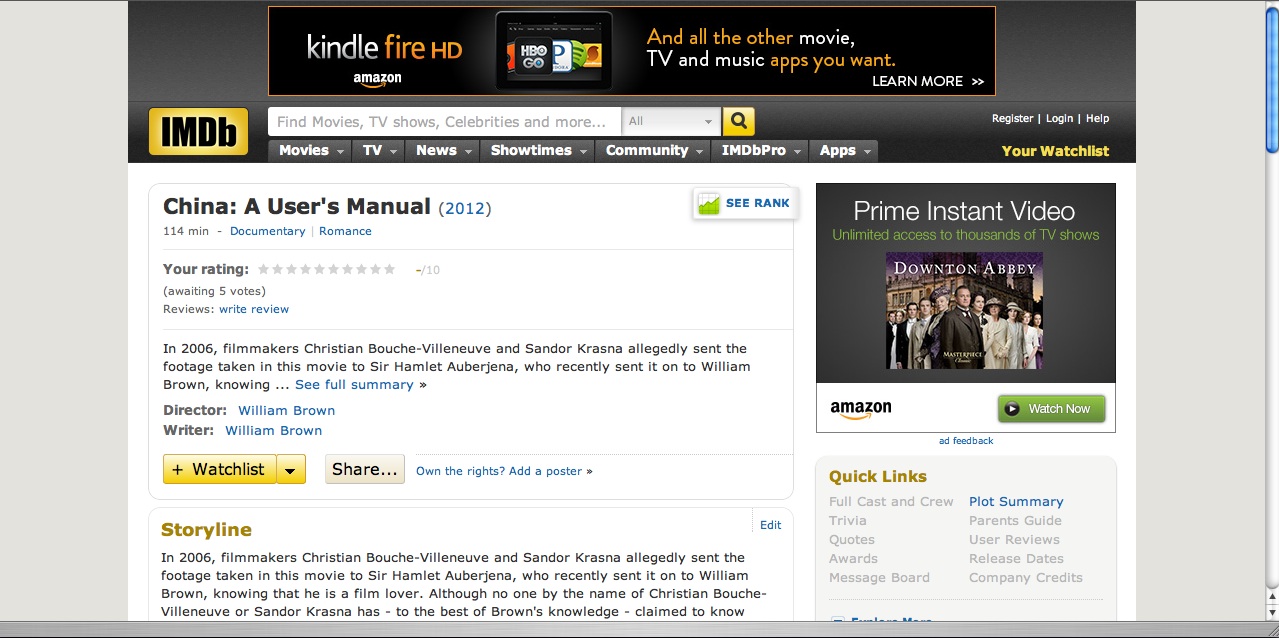
China: A User’s Manual (Films) gets IMDb page

Beg Steal Borrow News, Uncategorized

Beg Steal Borrow Films’s last effort, China: A User’s Manual (Films) has been granted its own page on IMDb.

To see the page, follow this link here.

Image

The film is a travelogue written by Christian Bouche-Villeneuve as he travels around China with his companion, Sancho Panza.

Christian’s musings and letters to and from Sandor Krasna form the soundtrack to the film, as we see them go in search of the real China and to understand what on earth what on might mean when one says ‘the people’.

New Beg Steal Borrow production in need of a title!

Beg Steal Borrow News, Uncategorized

In late July 2013, Beg Steal Borrow will be putting into production its latest film – an art house zombie flick set in the south of France.

The film is about a bunch of generation Zers who spend their time around the pool on the beautiful estate of Blondel, near Monpazier in France. And then the zombie apocalypse happens – only they don’t necessarily know it.

The cast is set to include Beg Steal Borrow regulars Alex Chevasco, Dennis Chua, Nick Marwick and Laura Murray, as well as performances from Edward Chevasco (Alex’s highly talented brother!), William Brown and others.

Tom Maine will, as ever, be heading up the photography of the film, while the production team will include Andrew Slater and maybe Deanne Cunningham and Charlotte Wolf (although both might at present be a bit too busy with other projects).

However, the project is in need of a title…! William Brown has two alternative titles, one slightly more pretentious than the other. The first is the simple Generation Z, while the slightly more pretentious option is Ur: The End of Civilization in 90 Tableaus.

Which do you think we should opt for? If you want to let us know, write to begstealborrowfilms@gmail.com.

Informal feedback on Beg Steal Borrow films

Afterimages, Beg Steal Borrow News, China: A User's Manual (Films), Common Ground, En Attendant Godard, endemic, Uncategorized

It is with great pleasure that I’d like to share some informal feedback that I have received on various Beg Steal Borrow films.

First of all, the great Mohsen Makhmalbaf contacted me briefly to write: “I like En Attendant Godard.”

Secondly, the prolific Josh Hyams also wrote to say that that he “thought your films are beautiful.”

And thirdly, the excellent academic David H. Fleming wrote to say:

China: A User’s Manual: I adored it. Really. It spoke with me. To me. It was like memories and thoughts I too have had. A prosthetic memory. Like I was on the back of the screen mirror. I knew some of the stories of course from talking to you. But they were also like reruns of my memories. Memories I did not know we shared. It’s so dense and yet light and free. Antonioni, Marker, the third-image. The epistolary form so like Montesquieu’s Persian Letters in light and sound. I had read almost all the books and stories you mentioned. Knew all the films and scenes you were referencing. The news stories and made up ones too. And recognised a China that I know and feel. I felt like you were talking to me. And wondered if it was not me, and I did not know you, would it be the same. We need to do something with this film out here.

“I really like Common Ground, too. Haunting… It was a dream-like recollection of Afterimages and to a lesser extend En Attendant Godard. Totally appreciate you sending them. A breath of fresh air.”

What wonderful feedback from such esteemed people. I am humbled, but also inspired by this feedback. Many thanks! Let’s carry ourselves with confidence to the next Beg Steal Borrow shoot, provisionally titled Endemic, scheduled for shooting in France in July 2013!

A Festival of Guerrilla Filmmaking

Blogpost, Film education

I run a module at my university called Guerrilla Filmmaking. It is a final year module, in which students are asked to make a series of films (a minimum of three, a maximum of five – they submit a portfolio of three at the end).

The rationale behind the module is to encourage students to make films at short notice – to prepare them for the short deadlines that they might face in later life, and to get them to think creatively about how to get around obstacles in their path.

Furthermore, the module is designed to get them to think about how to make films in spite of logistical and technical constraints.

Indeed, the module actively engages with technical constraints. Taking as our starting point Jørgen Leth and Lars von Trier’s Five Obstructions (Denmark/Switzerland/Belgium/France, 2003), and being inspired by Fernando Birri’s assignment to film students in Argentina to make a film without a film camera, the students have to make films that respond to the following challenges:

1.     Make a film that does not feature moving images and which responds to the question: what is the meaning of Europe?

2.     Make a film that does not feature any synchronisation between image and sound, which does not feature any music, and which documents an issue of concern local to you.

3.     Make an experimental, animated or found footage film that deals with recent political events, be those global or local.

4.     Make a film about a human rights issue using only a mobile phone and/or other telecommunications technology (i.e. do not use a dedicated camera).

5.     Make a silent film that consists only of one take, and which is about multiculturalism.

The fourth is intended to coincide with the Roehampton Human Rights Film Festival, to which students are encouraged to submit a film (and at which Guerrilla Filmmakers won all of the prizes this year – as they did last year, too).

Students can play a bit fast and loose with these challenges – and they do, as will be seen below.

Beyond The Five Obstructions, the module also involves watching a series of films that correspond in different ways to what guerrilla filmmaking is or might be.

The ‘guerrilla’ aspects of the films that we watch can be thematic or technical. In short, the films we watch and the texts that we read correspond to what we might term ‘minor’ cinema in various different ways. And they hopefully challenge any traditional hierarchy (particularly technical/technological hierarchies) concerning what constitutes a good or bad film. And of course to watch films from all over the globe.

Here is a list of the films we watch and the key readings that I ask students to look at (although I am not sure that many of the students do the reading):

Week 1 “Thou shalt be ready to do this module”

Screening: The Five Obstructions (Jørgen Leth/Lars von Trier, Denmark et al, 2003)

Key Reading: Mette Hjort, ‘Dogme 95: The Globalization of Denmark’s Response to Hollywood,’ Small Nation, Global Cinema: The New Danish Cinema, Minneapolis: University of Minnesota Press, 2005, pp. 34-65. 

Week 2 “Thou shalt embrace thy limitations”

Screening: Año Uña/Year of the Nail (Jonás Cuarón, Mexico, 2007)

Key Reading: Fernando Birri, ‘Cinema and Underdevelopment,’ in Michael Martin (ed.), New Latin American Cinema, Detroit: Wayne State University Press, 1997, pp. 86-94.

Julio García Espinosa, ‘Toward an Imperfect Cinema,’ Jump Cut, 20 (1979), pp. 24-26. http://www.ejumpcut.org/archive/onlinessays/JC20folder/ImperfectCinema.html.

Glauber Rocha, ‘An Esthetic of Hunger’ (trans. Randal Johnson and Burnes Hollyman), in Michael Martin (ed.), New Latin American Cinema, Detroit: Wayne State University Press, 1997, pp. 59-61.

Week 3 “Thou shalt make a virtue of poverty”

Screening: En Attendant Godard (William Brown, UK, 2009)

Key Reading: Mike Figgis, ‘Choosing Your Weapon, Learning to Love It,’ Digital Filmmaking, London: faber and faber, 2007, pp. 5-14.

Week 4 “Thou shalt keep it simple”

Screening: Lao ma ti hua/Disturbing the Peace (Ai Weiwei, China, 2009) [You can watch the whole film here.]

Key Reading: Valerie Jaffee, ‘Bringing the World to the Nation: Jia Zhangke and the Legitimation of Chinese Underground Film,’ Senses of Cinema, 32. http://www.sensesofcinema.com/2004/feature-articles/chinese_underground_film/.

Jia Zhangke, ‘The Age of Amateur Cinema Will Return’ (trans. Yuqian Yan), http://dgeneratefilms.com/academia/jia-zhangke-the-age-of-amateur-cinema-will-return/.

Wu Wenguang, ‘DV: Individual Filmmaking,’ Cinema Journal, 46:1 (2006), pp. 136-140.

Week 5“Thou shalt not flee but walk towards reality”

Screening: Kid Icarus (Carl Bird McLaughlin and Mike Ott, USA, 2008) [You can watch the whole film here.]

Key Reading: Ana Kronschnabl, ‘Plugin Manifesto,’ 2004. Available online at: http://manifestoindex.blogspot.com/2011/04/plugin-manifesto-by-ana-kronschnabl-web.html.

Rosa Menkman, ‘Glitch Studies Manifesto,’ 2010. http://rosa-menkman.blogspot.com/2010/02/glitch-studies-manifesto.html.

Neocinema, ‘Dogma 2001: New Rules for Internet Cinema,’ 2001. http://www.neocinema.com/.

Week 6 “Thou shalt find ingenious methods of production”

Screenings: Decasia (Bill Morrison, USA, 2002) and Superstar: The Karen Carpenter Story (Todd Haynes, USA, 1988)

Key Reading: Henry Jenkins, ‘Quentin Tarantino’s Star Wars? Grassroots Creativity Meets the Media Industry,’ Convergence Culture: Where Old and New Media Collide, New York: New York University Press, 2006, pp. 131-168.

Week 7 “Thou shalt have a week off” 

Week 8 “Thou shalt embrace that which is considered minor”

Screening:Go Fish (Rose Troche, USA, 1994)

Key Reading: Gilles Deleuze, Cinema 2: The Time-Image (trans. Hugh Tomlinson and Robert Galeta), London: Continuum 2005, pp. 207-215.

Patricia White, ‘Lesbian minor cinema,’ Screen, 49:4 (2008), pp. 410-425.

Week 9“Thou shalt dare to make unconventional films”

Screening: Afterimages (William Brown, UK, 2010)

Key Reading: Jacques Rancière, The Politics of Aesthetics: The Distribution of the Sensible (trans. Gabriel Rockhill), London: Continuum.

Week 10“Thou shalt learn to develop and work in a team”

Screening: Ang pagdadalaga ni Maximo Oliveros/The Blossoming of Maximo Oliveros (Auraeus Solito, Philippines, 2005)

Key Reading: Khoo Gaik Cheng, ‘Just-Do-It-(Yourself): independent filmmaking in Malaysia,’ Inter-Asia Cultural Studies, 8:2 (June 2007), pp. 227-247.

Alexis Tioseco, ‘Shifting Agendas: the Decay of the Mainstream and the Rise of the Independents in the Context of Philippine Cinema,’ Inter-Asia Cultural Studies, 8:2 (June 2007), pp. 298-303.

Week 11“Thou shalt meet the deadline”

Screenings: SMS Sugarman (Aryan Kaganof, South Africa, 2008) [you can watch the film here] and Trash Humpers (Harmony Korine, USA/UK/France, 2009)

Key Reading: Ryan Shand, ‘Theorizing Amateur Cinema: Limitatons and Possibilities,’ The Moving Image, 8:2 (Fall 2008), pp. 37-60.

Week 12 “Thou shalt think about and reflect upon thy work”

Screening: In film nist/This is Not a Film (Jafar Panahi and Mojatba Mirtahmasb, Iran, 2011)

Key Reading: Godfrey Cheshire, ‘Iran’s Cinematic Spring,’ Dissent, 59:2 (2012), pp. 76-80.

Shiva Rahbaran, ‘An Interview with Jafar Panahi,’ Wasafiri, 27:3 (2012), pp. 5-11.

So, overall, the rationale is also to get my students to un-learn what they believe ‘good’ filmmaking to be, and to realise that most constraints can also be considered opportunities for creative expression. It is also to get them to engage with the politics of filmmaking – and to try to understand how the methods used to make a film inform what the film can say and how it says it.

Some 60 or so short films were made this term by 18 students – most done single-handedly, but with some collaborations along the way (if students join up as a team – I only saw pairs this term – then they can only make one film with the same team).

So, with the above in mind, I’d like to use this blog as a means to ‘curate’ a mini, online festival of the most distinctive films that were made this term – with apologies and all due respect to those students who participated but who do not have more than one film in this festival (though at least one film by each student is present).

I shall embed the films from YouTube (you can watch all of the films on the Guerrilla Filmmaking channel). And I shall divide them up according to the five different challenges to which they respond.

1.     Make a film that does not feature moving images and which responds to the question: what is the meaning of Europe?

What is the Meaning of Europe? by Charli Adamson and Alex Crowe

What is the Meaning of Europe? by Metin Bülent and Daniel Pakbonyan

My Europe by James Holliday

Europa by Alex Taylor

2.     Make a film that does not feature any synchronisation between image and sound, which does not feature any music, and which documents an issue of concern local to you.

Local Concern by Jordan Steel

Sound Sync/Local Concern by Charli Adamson

Local Concern by Sam Taylor

– 30 + 30 = 0 by Oz Courtney

Silence of Night by Paulo Fernando de Sá Vieira

Alzheimer’s by Katie Willis

Oyster Users by Alex Crowe

Better than Sex by Danny Riches

3.     Make an experimental, animated or found footage film that deals with recent political events, be those global or local.

Vote Romney by Millad Khonsorkh

Found Footage Film by Kine Tvedt

Pinheirinho by Paulo Fernando de Sá Vieira (Second Place, Roehampton Human Rights Film Festival)

ALL HAIL THE KING OF THE WEST! by Danny Riches

War on Women by Katie Willis

From An Outsider by Oz Courtney

4.     Make a film about a human rights issue using only a mobile phone and/or other telecommunications technology (i.e. do not use a dedicated camera).

What are my Human Rights? by Eman Seidi

Bless Dale Cooper (Free Tibet) by Millad Khonsorkh

The Perfect Human’s Rights by Louise Dias di Benedetto and Sam Taylor (Winner, Roehampton Human Rights Film Festival)

Poverty at Your Doorstep by Cristiana Turcu (Third Place, Roehampton Human Rights Film Festival)

The Death Penalty by Charli Adamson (Third Place, Roehampton Human Rights Film Festival)

Arms Sales and Human Rights Don’t Mix by Dan T. Ngoy

5.     Make a silent film that consists only of one take, and which is about multiculturalism.

Underground by Sam Taylor

Multiculturalism by Daniel Pakbonyan

Multiculturalism by Charli Adamson

Multiculturalism by Kine Tvedt

I hope you enjoy them. Most show wit, some are easier to watch than others, but all show ingenuity in getting around the challenges set…

China: A User’s Manual (Films) discovered and presented by Beg Steal Borrow

Beg Steal Borrow News, China: A User's Manual (Films)

In 2006, filmmakers Christian Bouche-Villeneuve and Sandor Krasna allegedly sent the footage taken in this movie to filmmaker Sir Hamlet Auberjena.

Auberjena recently sent the film on to Beg Steal Borrow, knowing that we are film lovers.

Although no one by the name of Christian Bouche-Villeneuve or Sandor Krasna has – to the best of our knowledge – claimed to know anything about the film, we are presenting it to interested parties (first DVDs available now).

Although the film is presumably unfinished, we have decided to follow what appear to be the original filmmakers’ intentions and to call the project China: A User’s Manual (Films).

We are not sure that we will submit this film to any but the most exclusive of festivals, but if you want to copy of the film, get in touch and we’ll try to get a copy to you.

Brief Thoughts on The Master (Paul Thomas Anderson, USA, 2012)

American cinema, Blogpost, Film reviews

Thoughts on The Master can perhaps only be ill-formed, since the film is so complex that it any writing on it will only reduce its richness into too-easy sense (?). Nonetheless, here are some brief thoughts on PTA’s latest masterwork.

The film is a great love story between Freddie Quell (Joaquin Phoenix) and Lancaster Dodd (Philip Seymour Hoffman) as signalled – spoilers – by the end of the film where Freddie finally finds a girl called Winn Manchester (Jennifer Neala Page): Lancaster/Manchester and Quell are finally united in acceptable form as Freddie performs the same psychiatric-type session on Winn as Dodd performed on him earlier in the film.

And what drives this love affair is the opposite nature of the two characters: Dodd seems to want to eliminate the id from humanity such that humans can return to their perfect, soulful state, while Freddie is a man driven by the id and, while still with ego, seemingly without superego to censor his actions. As such, Freddie becomes the object of Dodd’s obsession as much as vice versa – and we have a true exploration of master-servant relationships such that both are inseparable (master needs servant as servant needs master) – on the scale and in the league of Diderot’s Jacques le fataliste et son maître and Molière’s Tartuffe.

The mutual obsession is signalled through otherness: one can never tell in Anderson’s unnerving film whether violence will erupt and the two will kill each other or embrace each other. They go hunting in the desert for a lost manuscript with guns – bringing back Dodd’s second book, Split Saber, from the wilderness like Moses with the Ten Commandments. Will they kill each other? Will either fall off their motorbike and die as they drive that – meaningfully again in the desert…? Will Dodd kill Freddie when they part – or will he erupt into song…? Time and again we are kept on tenterhooks as we simply cannot predict what will happen. Being unable to predict the actions of others reaffirms their otherness – and since we cannot understand them as a result of this otherness, we are compelled to analyse, scrutinise, look for me: can we make sense of them?

This tension is achieved by Anderson’s insistence upon long takes (not always, but often and relentlessly). It is also achieved by his use of long shots and masterful mise-en-scène in such a way that all too often we find ourselves seeing at the last minute characters, such as Dodd’s wife, Peggy (Amy Adams), staring offscreen at Freddie – her gaze having otherwise eluded our attention because of other movements and areas of focus in the frame.

The result is that our relationship with The Master is like Lancaster’s relationship with Quell. Those moments where we see something in the frame after several seconds of looking and scrutinising induce in the viewer a moment of panic: did I miss something? What else was going on that I did not see?

Not only does this make of Anderson’s film a film to be scrutinised and studied – perhaps endlessly – but it also lends to the film a sense of its own otherness: there is always something more to see, or rather the sense that there are depths that we do not and cannot see (even though they are there before our very eyes, incessantly excessive, demonstrating the limits of human perception in that we simply cannot take in all that the universe has to offer – not consciously at least, even if, like the camera, we record everything as Peggy says early on in the film, including everything that happened to the molecules from which we are constituted right back to the dawn of time).

There is also an unpredictability in Anderson’s script. Dodd’s son, Val (Jesse Plemons), tells Freddie that Dodd makes it up as he goes along. He is probably correct – as Dodd contradicts himself the whole time, cannot take being questioned in public (and perhaps not in private), as he himself must deal with his id, as Freddie also struggles with his ego. Suddenly Dodd will speak of the importance of laughter, or get Freddie to touch a wall. The film is so bizarre in this way that we are kept on our toes.

Compare to the finely crafted prose of many of the great writers (Shakespeare comes to mind): in Shakespeare we have repeated motifs and themes, such that each play is a masterpiece of tight construction – while Anderson’s characters are imbued with a sense of liveness, of spontaneity in the dialogue – we can never tell what they are going to say.

Again, the effect is disconcerting, but it is also profound. As Shakespeare lived in an era in which a clockwork universe and the motions of the spheres suggested tight construction that would naturally be reflected in the drama of its time, Anderson’s film is haunted by the chaos of the nuclear age – with World War Two and the spectre of Japan haunting the film through Freddie’s wartime experiences, the tail-end of which we see in the film’s opening scenes. In short, Anderson’s universe may well have patterns, but it is also full of randomness, chaos, the unpredictability of thought and the strange associations that the improvising human mind can make up (this within a tightly constructed film that suggests not a chaos or a cosmos, but a chaosmos of sorts).

Finally, though, there is of course something to Dodd’s method, even though charlatan he be. For what is wrong with improvisation? In a chaotic universe, perhaps playful improvisation is the best we can hope for – hence Dodd’s explosions of anger and frustration when Helen Sullivan (Laura Dern) suggests confusion that Dodd might have changed the emphasis in his works from memory to the imagination. Helen seeks too much order, whereas Dodd is only interested in endless experiment and the freedom that can come with simply seeing where thought can lead you. With working out what a brain can do. And Freddie working out what a body can do (and what it can consume – with his endless poison concoctions). There are pitfalls to experimentation and play – madness perhaps lies down this road. But so, too, is there madness in self-willed imprisonment.

So maybe we can only play with The Master and see where it leads us, with Anderson also seeing where filmmaking can lead him (and his actors going on a similar journey).

There is much more to say about this film – on so many levels. But for the time being, these are my brief, inept thoughts on the film. Another great piece of cinema from one of the best in the American business.

Smart people are stupid (in a good way) – and ‘stupid’ people are smart (in a bad way)

Blogpost, Film education

(A note of thanks to staff at the University of Reading, where I presented a paper that is loosely on a related topic to this post on 1 November 2012. In particular, discussion with Simone Knox, John Gibbs, Lisa Purse, James MacDowell and Ian Banks, allowed me to think critically about what I had discussed at Reading, such that this blog post might come into existence.)

I teach a module to first year film students called Reading Visual Aesthetics. The first exercise that we get students to do for that module is to describe what they see in a ten-shot sequence taken from a film.

When I first taught this module, I thought that the exercise might be a bit pointless; perhaps more time should be spent on analysing rather than describing. However, as time has gone on, the more I appreciate what a fantastic exercise this is to get students to undertake.

For, what is excellent about this exercise is how it reveals and/or exposes how we take for granted – or look unthinkingly – at many of the things and objects that surround us in everyday life, but which perhaps we should not take for granted.

This year, we showed a ten-shot sequence from the opening of The Opposite of Sex (Don Roos, USA, 1998) – and as happens every year, many of the students wrote their description pretty hastily and then sat in the classroom looking bored as the two-hour time limit that they have clocked down.

This in spite of my exhortations to check through work, to keep looking at the sequence (which we show 15 times over the course of the two hours – it becomes etched in your memory) and to keep writing down details that they see. I always insist that the exercise is harder than the students think, but nonetheless this does not stop many students from assuming that the exercise will be – in the parlance of our times – a piece of piss. And by and large those who believe this do most poorly on the exercise…

Which will lead me to the conclusion that I will make at the end of this blog and which is outlined in its title: smart people are stupid (in a good way) and ‘stupid’ people – by which I really mean lazy people – are smart – but in a bad way.

This blog is not about the poor spelling that I find in these descriptions, nor about the common errors that film students make with regard to film terminology (for example, barely any students correctly identified the opening sequence’s crane shots as crane shots, but instead called them pans or simply camera movements; this is not to mention how editing remains practically invisible to most students – and filmgoers more generally – with barely any students making mention of the dissolves that feature in this sequence).

The kinds of errors I have just mentioned are common, particularly to students just starting out in film – and they are common enough these days that I almost feel no point in commenting on them, especially – sadly enough – the spelling.

(Indeed, a quick comment: I had to read nine essays before finding one that spelt the word cigarette correctly. However, I should make clear that this is not a criticism of the students at my university in particular. I have come across poor spelling at all of the institutions at which I have taught film, which include Oxford, St Andrews and Roehampton. So anyone inclined to make any assumptions about the latter university and/or its students as a result of its not being so well known as the other two… well, desist immediately.)

Instead, what is interesting is the nature of the descriptions made. Or rather, how many things that are right before our eyes are often invisible to us, or do not seem worth commenting upon.

In the opening sequence of The Opposite of Sex, we see a firebrand Dede (Christina Ricci) trash her stepfather’s funeral and run away from home with the help of her quasi-boyfriend Randy (William Lee Scott) to Indiana, where she hopes to stay with her half-brother Bill (the wonderful Martin Donovan). There she meets Bill’s boyfriend, Matt (Ivan Sergei), whom we see towards the end of the self-same opening ten-shot sequence (he opens Bill’s front door in shot nine).

So, what sort of details from this sequence did barely anyone talk about?

Well, we can start with quite general things. Only one student mentioned that the characters speak in American accents, with no one making any reference to their race (all of the characters are white in this sequence).

Well, isn’t this obvious, you’ll perhaps say to yourself, since this is an American movie about white people? So obvious that it is not worth mentioning.

Well, yes. On a certain level it is obvious that we are dealing with white Americans – if you know anything about the film in advance – but that’s precisely my point. We should look at things precisely as if we knew nothing about the film in advance. For the minute that anything is obvious to us, we start regarding that thing as natural and we no longer question what surrounds us.

If, when asked to describe what you see in a film sequence depicting white Americans, you feel that someone being white is not worth mentioning, nor that someone is American (let alone from which part of America, what class their accent seems to betray, etc),then their whiteness is (after the venerable Richard Dyer) invisible, or naturalised.

Now you might say that you would not pass comment either if the characters were black and/or spoke with Russian accents. You – you will tell me in your best thinking or unthinking David Brent impression – are colour blind.

Well, aside from the fact that so-called colour blindness negates difference (something that we should do at our peril), and aside from the fact that I would probably not believe you (since I don’t think colour blindness exists – or if it does, it only speaks, as it does in the case of David Brent, of a condescending and predominantly white attitude towards racial difference), I think that we must describe what we see in the best and most appropriate language that we have.

And since we see someone’s skin colour, we should during a description exercise describe it.

Failing to do so implies that anyone who reads the description shares a similar white or white-centred outlook on the world, and the implicit assumption that the world is white. By virtue of this being an unthinking assumption, it also is only a few steps away from suggesting that the world should be white and/or white-centred.

Similarly, to feel that an American accent (even perhaps the fact that the characters are speaking English) is not worthy of comment also belies the belief that all movies are American, that America is somehow the natural home of cinema.

In other words, if it is considered ‘natural’ (well, naturally the film is about white Americans) that a film like The Opposite of Sex is about white Americans, then whiteness and Americanness are naturalised. By which I mean to say that they are normal, not necessary for comment, while all that deviates from this norm is, well, abnormal, deviant and somehow unnatural.

I can imagine some people having a hard time agreeing with, so I am going to bring forward three other examples that hopefully will make more clear what I mean.

During this sequence there are two night-time shots, one featuring Dede packing a bag in her bedroom, and one featuring her sneaking from her house, across a lawn and to Randy’s car. In the first shot, we see a bedside lamp and in the latter we can see lights from the house’s interior as well as a flash of Randy’s headlights.

What is interesting is that many of the sequence descriptions that I marked suggested that the lighting throughout the sequence is natural lighting.

That students put this in spite of repeated explanations in class that more often than not what looks like natural lighting is as a result of very powerful lamps is not the point that I wish to make. Rather, the point that I wish to make is that we know absolutely well that neither an electric bedside lamp nor a set of car headlights is natural lighting.

These are man-made phenomena. And yet they are so commonplace to us that they have become naturalised; we mistake as natural something that is man-made and, to a certain extent, artificial.

So if we end up mistaking manmade inventions like electric lighting for nature – perhaps a typical occurence for those humans who are surrounded everyday by such items – then perhaps we can see how this also becomes the case in terms of whiteness and Americanness. So commonplace are whiteness and Americanness in cinema that we take them as natural – when of course cinema could be very different.

Perhaps another way to think about this is that if electric lighting has become so commonplace as to be natural, then we should understand that nature is perhaps malleable and not absolute or fixed in nature. In this way, cinema need not predominantly depict whiteness and Americanness – but for some reason it does.

So we need to think about why this is the case – and we can perhaps then begin to construct a different cinema that is not so white-centred and Amerigocentric, but which instead is more ‘democratic’ and egalitarian.

The second of my three examples is the notion of costume. One student did very insightfully put that the costume in the film mimics the fashion of the late 1990s – or words to that effect.

We often unthinkingly assume that films should be about the contemporary age (and perhaps we do not even question the constructed nature of costumes in, precisely, costume dramas and period films).

And yet costumes in films – and costumes in general – are constructed and they tell us information about where and when they come from – even if most of the time we do not bother to analyse such things.

Finally, a couple of students noticed a yellow car in one shot that shows Dede approaching Bill’s front door (though none identified it as a Volkswagen, which surprised me; nor even as a hatchback, which disappointed me).

Only one student, however, said that this is a funny detail since we might typically associate a little yellow VW with a gay character – and Bill is a ‘real life homo’ as Dede tells us in her voice over during this sequence.

My point here is not to deconstruct why a yellow VW hatchback might be deemed gay – though such an argument no doubt deserves to be made elsewhere, since the link between the one thing (yellow VW hatchback) and the other thing (homosexuality) is certainly not natural, but a cultural construct.

Rather, it is to say that I am surprised no one commented on the car at all.

I have no empirical evidence for this, but I suspect that most students notice Bill’s yellow VW hatchback and that it conforms to Dede’s characterisation of him as gay in the voice over.

That is, while the visual joke that is made might well have been lost on some viewers (particularly those who precisely do not see the link as natural between a yellow VW hatchback and a gay owner), my guess is that most viewers ‘got it’ but did not feel the need to describe the car or the ‘appropriateness’ of the car’s colour – again because the point is supposedly too obvious.

This despite the fact that students have only been asked to make a description!

Now, here is where we send this blog in the direction of its title and conclusion – but we’ll do this by turning to what various scholars say in film studies about the experience of film viewing.

The great David Bordwell – and many cognitivist film scholars before and since – have long argued that the brain is working overtime during film viewing and that it really is a miracle of intelligence that people can work out that a shot of a woman at a desk after a shot of the outside of an office block means that the woman is (most likely) inside that office block and working at her desk.

This is no doubt true – and its truth pertains to the yellow car gag from The Opposite of Sex, too. It is a miracle of intelligence that people ‘get’ that the yellow car is a visual gag that reaffirms that Bill is gay (while at the same suggesting to us that what we are seeing is Dede’s version of events – as affirmed by her self-conscious voice over – and not necessarily, therefore, a trustworthy account of events. That is, in Dede’s head Bill of course has a yellow VW hatchback because he’s a complete flamer – but this is not necessarily the truth, nor how Bill would see things, nor necessarily as things are or were).

However, while it is a miracle of intelligence that we get the joke so quickly, automatically even – i.e. without having to think about it – it is also problematic precisely because we do not think about it.

Why do I say this?

I say this because the making-automatic or natural of associations and thoughts (manmade lighting = natural; contemporary clothing = natural; predominant whiteness and Americanness = natural; yellow VW hatchback = gay) has what I shall call a profoundly ideological aspect to it.

This is most clear in the “yellow VW hatchback = gay” idea. Yellow VW hatchbacks are of course not gay – but the association between a stereotype of homosexual American men as liking bright colours and small, relatively sporty and European cars has been made natural that not only did most people see the joke, not only did (I wager) most people get the joke, but when specifically asked, so natural did the joke seem that only one student even thought to comment on it.

We might say that finding a yellow VW hatchback to be gay is harmless. Ostensibly it is, and I do not think The Opposite of Sex a homophobic film – though it certainly deals with explicit homophobia as a theme. Nonetheless, we make these kinds of unthinking and automatic associations the whole time – and sometimes they really can be of a problematic nature (historical – unthinking? – shorthand would reach for World War Two Nazi propaganda here: it is unhealthy when a society starts to associate Jews with rats).

So you may not think that there is a particularly worrisome ideology about the yellow VW hatchback joke in The Opposite of Sex, but there is an ideology at play nonetheless.

(And it is Dede’s – problematic – homophobic ideology that is on display here, since it is she telling the story and she who would paint Bill as a typical flamer with a yellow VW hatchback – even if at play there is also the film’s own, non-homophobic ideology that creates some distance between us and Dede – we hear her voice over and so know that she might be manipulating events such that we see things her way and at the same time we learn not to trust her, meaning that we are not necessarily sharing her homophobic perspective but rather laughing at it as we see the yellow VW hatchback – making of The Opposite of Sex a very sophisticated film indeed.)

My argument is not that ideology = bad. I am of the view that one cannot escape ideology – but I am also of the view that ideology becomes dangerous when unthinkingly do we accept as natural, unchanging and as a given something/anything that is not natural, precisely because nature is malleable and susceptible to change (as opposed to being, precisely, unchanging).

Ideological perception – seeing the yellow VW hatchback as gay – needs to be thought about explicitly. In other words, we need to make un-automatic that which is automatic in our minds; we need to bring into thought precisely that which is otherwise unthinking. Because, as mentioned, otherwise we run the risk of some form of Nazism, or fascism.

Or, put less hysterically, if we just accept the world in an automatic or unthinking fashion, then we are not looking at the world for ourselves, but we are seeing it as others want us to see it. We are willing accomplices in our own subjugation to a version of reality that we could change if we wanted to.

(A sidenote – aimed mainly at film scholars: it is beginning slowly to be acknowledged – but the kind of automatic thought whereby yellow VW hatchback = gay means that we see films, and perhaps reality itself, as a system not of stand alone objects but as signs (yellow VW hatchback is not gay, but that we see it as such means that yellow VW hatchback has stopped being a yellow VW hatchback and has become instead a sign of homosexuality). In other words, that we see semiotically means that semiotics – and film as a language, language here being defined as a process, as the making-linguistic, the making-semiotic of cinema and of reality itself – might well rear its head back into film studies – even if it was precisely against such a semiotic approach to understanding cinema that David Bordwell and other cognitivists adopted the cognitive framework in the first place!)

If we are seeing the world not for ourselves but as others want us to see it, then perhaps nowhere is this more clear than in, of course, film viewing. That most students did not put into words the yellow VW, or the edits that of course they did see but to which they did not pay attention, makes this most clear: we see the film, but we do not see through the film. We see what the film shows us, but we do not see the film itself. We see the content and the story – but not its form, or how it is being told – even though this form, which exceeds our attention, is incessantly before us, right before our very eyes for us to see – if we had the eyes to do so.

When we have the eyes to see the invisible links, to rethink the associations that are otherwise automatic, then we begin to learn. Learning is the confrontation of the new – it is the rewiring of neurons in the brain, the making of new associations. The minute we stop learning, our brain will begin to atrophy – since only the same old clusters of neurons will fire as we begin to see the world in an automatic and unthinking fashion.

The minute we start thinking, or rewiring neurons, then we are no longer (as much) prey (be that willing or unwilling) to ideology; we move into changing ideology – we become political beings – as well as social, ecologically-embedded beings working on the construction of reality, of what is deemed natural, whether or not everyone agrees with the direction in which we want to change things. We bring into our conscious mind that which previously was unconscious – we become smarter – we develop the possibility to control our own destiny – we develop free will – we develop our capacity for freedom, both of thought and of deed.

So here’s where the title and conclusion of this blog post comes into play.

When our automatic perceptions rule our existence, in some ways we are functioning in a very smart fashion; we are efficient and do not need to waste energy consciously thinking about stuff since we can negotiate and navigate our way around reality in a smooth and energy-saving fashion.

But this is, after Daniel Kahnemann, also laziness. So ‘stupid’ – or what I really mean is lazy – people are smart. They are efficient and don’t have to, or don’t want to, think about things. But I see this, laziness, as being a bad thing. Why? Because it is not to get involved in the world, it is not to think and to re-think reality and what surrounds us, to fulfil one’s potential – to waste one’s life, in short.

(Note: a footballer gets so good at football that it becomes unthinking to them. My point is not that we should resist automation entirely – because sometimes being able to naturalise or automate skills, such as controlling and passing a football, are good things. But we should not rest on our laurels and we should always work at improving our game, on acquiring new skills. What is true of football is true of thought, even though thinking is frowned upon in British society and even though our government is prepared to take away much of the investment in education – sport for the brain – at the same time as pouring money into sport, even though sport by definition can employ or make employable far fewer people than can education as a whole. Scholars may not be as famous as David Beckham – but they are as good at what they do as Beckham is at what he does. A.J. Ayer is as big a man as Mike Tyson.)

Smart people, on the other hand, are a bit stupid, because they expend energy on analysing, rethinking, and asking questions. However, while intelligence is therefore not necessarily efficient (and therefore runs counter to the capitalist ethos and ideology that drives our society, if not our whole world, making the question of education and thought a deeply ideological one!), intelligence is the means to freedom, to thinking new things, to invention. It is by definition experimental; it is by definition somewhat speculative. But unless we create the conditions – for ourselves and for others – to realise our potential, then that potential is just going to be sat wasting away.

I imagine a film sequence description that one day will become obsessed with trying to take into account the particles of air that are in the frame of the camera, but which are too numerous to mention, and each quivering blade of grass in the wind – in addition to all of the large or human scale objects that we can see.

And while such a description might not get top marks (since in dedicating its energy to elements of the film that most people overlook), I will surely know that there is a keen, inquisitive and free intelligence at work – even if its intelligence is signalled in the very stupidity of its description (the description being stupid because mildly inappropriate). And I will expect future great things of that person.

Indeed, what importance are grades? Truly original work cannot really be graded at all – since it will at first seem entirely inappropriate and stupid to the person marking it. But university – perhaps education as a whole – is not and should not be about grades (which is to impose upon people a fixed – automatic and unthinking – system of thought that has its final goal, or telos, decided in advance, or a priori). That education and university are about grades is a direct manifestation of the capitalist and unthinking logic that is invading every last aspect of our world. So it is time to rethink such things…

So don’t worry about grades, but instead worry about thinking, about fulfilling potential, about working out what your brain and your body can do, what you can do in, with and for the world, about bootstrapping yourself into conscious thought, about being different, about becoming free.

(But please, dear students, don’t take this as an excuse not to make any effort, to be lazy. On the contrary, stupid intelligence of this sort cannot be lazy – but lazy intelligence is perhaps one of the most stupid things around.)

First review of Common Ground posted online

Beg Steal Borrow News, Common Ground, Reviews

The first review of Common Ground has been posted online – with hopefully many more to follow.

Trent Griffiths, who blogs under the name Dusty Roar, has been particularly warm about Common Ground, making us blush with embarrassment.

You can read the review here.

As per the review, we hope that the film makes some festival screenings soon!

Common Ground on IMDb

Beg Steal Borrow News, Common Ground, Press and Blog Mentions

The Internet Movie Database page for Common Ground has been created – meaning that the film is one step closer to being real in the eyes of the world.

The film has also been submitted to various festivals – and so fingers are crossed that the film will soon be screened in various places.

If you want a copy, want to arrange a screening, or know anyone who might – then please put them in touch with us.

As for the IMDb link, to see the page click here.