White Supremacist Cinema: The Gentlemen (Guy Ritchie, UK/USA, 2019)

American cinema, Blogpost, British cinema, Uncategorized

Perhaps the biggest problem with racism in the UK is the UK’s belief that it does not have one.

The ‘it’ from the previous sentence should be defined as pertaining most specifically to the UK’s white population, perhaps especially those white citizens who identify solely as British nationals.

And yet, when we watch a film like The Gentlemen, it seems clear that racism is alive and well in the UK, including in British cinema (which is not to say that cinema as a whole might be a tool built upon racism).

Or, at least, The Gentlemen would wish to suggest that its white, male and Anglo-American values are ‘cinematic,’ while other, diverse forms of expression belong to smaller, ‘inferior’ screens.

We’ll get to the treatment of race in The Gentlemen shortly. First, however, we should get to grips with what I mean when I include the phrase ‘white supremacy’ in the title of this post.

For, in order to understand how white supremacy works, it is important to understand what it is, and because The Gentlemen is not especially subtle in its white supremacy, it functions as a good tool for us to think about how and why white supremacy is at work in the film.

So, as perhaps needs to be said every time one engages with the issue of race in the UK, white supremacy, as well as racism more generally, are not uniquely defined by hood-wearing white people lynching non-white people.

Rather, white supremacy is, simply enough, the belief that whites and whiteness are of greater value than non-whites and non-whiteness, perhaps especially blackness, but for certain in The Gentlemen, more valuable than yellowness.

The immediate defence mechanism that a white supremacist will put into play is the idea that I just betrayed my own racism by using ‘racist’ terms like black and yellow, as well as perhaps white.

To be clear, ‘yellow’ especially is a term that is loaded with a racist history, not least because it has historically been and continues to be a term applied by whites (and others) to various Asian peoples in precisely a derogatory fashion: the ‘yellow peril,’ for example, has long expressed the fear of whites that the Chinese (or others) will ‘take over’ the white world – a fear that is overtly at work in The Gentlemen.

All the same, while Asian people rarely and perhaps only ever with some sense of irony define themselves as ‘yellow’ (unlike Blacks, who do define themselves proactively as black, even though what ‘black’ really is or means has never been accurately or exactly defined – except perhaps by whites), I use the term(s) here to get us to think about how white supremacy works from the inside.

By this, what I mean to say is that white supremacy sees whites and whiteness as being superior to all other colours. In order to do this, it has to cast those other, non-white people into those other colour categories (black, yellow, brown) in order specifically to highlight that they are not white.

Having made this conceptual distinction, which allows the white to value himself above the non-white, the white takes the ‘supreme’ position from among the different colour categories. It is not that there are different colours, so much as a hierarchy of colours, with white at the top. Hence white supremacy.

Thereafter follow myriad ways in which whites and whiteness receive preferential treatment, get more opportunities and so on and so forth, all because they are white, while those non-whites (yellow, black, brown and so on) get inferior treatment, fewer opportunities and so on and so forth.

The point that I wish to make at the outset, then, is that you don’t need to be an overt racist to be a white supremacist or, at the very least, to benefit from a white supremacist system, or to thrive within a society that is white supremacist.

Nor, I might add, do you need to be white to thrive in a white supremacist society. You can be non-white and thrive; and you can be white and not thrive.

But if you are white, then the chances are significantly increased that you will thrive, or at least be more comfortable than if you were not white; and if you are non-white, then you will have significantly greater barriers before you to both comfort and, better yet, thriving.

And so if you benefit from such a system or thrive within such a society because of your whiteness, and if you do not do anything to change the advantages that you have, by, for example, refusing to share that advantegeous position, then, simply put, you are a white supremacist out of complicity, if not out of explicit action.

(That said, how we might separate explicit action from ‘mere’ complicity when we are considering the entire fabric of a life seems quite difficult to me; ‘doing nothing,’ or allowing disadvantages to continue for others simply because this gives you greater advantages, is an explicit action, just as not helping your neighbour is an explicit action… whether or not you run the risk of seeming like a chump to other advantaged people, who will think that you are betraying them because you see, understand and try to do something about the disadvantages presented to some – with the same advantaged people perhaps also thinking you stupid for not taking the same advantages as they do, even though you have those advantages before you. In short, the easy option – allowing things to stand as they are – negates the difference between complicity and explicit action; taking the harder option is always harder, and part of why it is harder is because others will make your life harder for taking that option – calling you names, making you feel bad about yourself and so on.)

Anyway, one of the next defence mechanisms that a typical white supremacist would throw out in order to deny racism, be that their own racism or that of the system from which they benefit, would be an appeal to history.

That is, and as per the notion described above of complicity/allowing things to stand as they are, a white supremacist (be they explicitly racist or simply happy quietly to benefit from white supremacy), would say that the UK is historically ‘white’ and that blacks and other non-whites of course are welcome here, but that they have to come and work their way ‘up the ladder’ and that of course this cannot happen overnight and so on and so forth.

However, while the appeal of such a view is perhaps inevitable to an unthinking white supremacist and to an overt racist alike, it is also false and an act of white supremacist thinking in and of itself.

Its falseness would probably take too long to deal with here in full. But put bluntly, the view is false because the idea that the UK is ‘historically’ white elides in this case race with nationalism – using race to define what is ‘British’ as that which is ‘white.’

But if ‘British’ and ‘white’ are now supposed to be synonymous, then we quickly get into hot water, as many comedians have pointed out – including perhaps most memorably Stewart Lee – since what ‘British’ is has no clear or exact meaning. We are a nation historically made of up Angles, French, Vikings, Norsemen, Celts, the Welsh, the Cornish, Germans, Greeks and more. (Many more!)

To suggest that Britishness and whiteness are historically synonymous is false, then, not because these other nations (Angles, French, Vikings, etc) are non-white (although more on this detail in a short moment), but because if ‘British’ is a single identity that in fact springs from a wide range of different identities, then there is no reason to suggest that ‘British’ is a single identity that has to have a specific skin colour.

What is more, the idea that the UK is historically white is also false and in and of itself white supremacist because if those non-white people who supposedly are ‘now’ British were indeed ‘British,’ then they would simply be British – and there would be no need to tell them that they were somehow ‘not British enough’ because of their skin colour.

That is, when history is used as an appeal to justify ongoing imbalances along racial lines within the UK, it places those non-white people in the category of ‘not quite British’ or ‘not British enough’ – as if having British nationality and/or permission to live and work in the UK were not the end of it.

To be treated as ‘not quite British’ means that history is being used as an excuse to preserve white Britishness in its supreme position, with that supremacy now based upon whiteness (i.e. it is white supremacy), since it is the non-whiteness of the other that renders them ‘not quite British.’

(Nationality can also be used instead of race to classify someone as ‘not quite British.’ For example, one might be Irish or Polish in origin, and this non-British origin is now used as a reason to define the other as ‘not quite British.’ In other words, white supremacy can also work alongside a sense of nationalist supremacy. It is not for no reason, though, that the Irish and the Polish have historically sometimes been referred to as the ‘blacks of Europe.’ That is, nationalist supremacy and white supremacy often go hand in hand, and even though the skin of many Irish people is ‘white,’ and indistinguishable from the skin of many British people, the Irish have not always been considered ‘fully white,’ just as they have not always been considered ‘fully British’ – whatever that means. As a result, ‘whiteness’ is a set of values not always wholly linked to skin colour alone.)

(Furthermore, the appeal to history also is inherently conservative in that it assumes that the past is more correct than the present and the future – a perspective that contradicts the notion of ‘progress,’ which can be equally problematic, and which claims that the present is more correct than the past – and that the future will be more correct yet than the present. In other words, such a view suggests that historical whiteness overrules present diversity and future non-whiteness. Given that history has favoured whites, such a conservative view of the world is thus to my mind itself a culturally ‘white supremacist’ view.)

‘But,’ our white supremacist might contend in their next line of defence, ‘if we don’t look out, then we’ll be overrun by foreigners’ – which is the ‘yellow peril’ line of argument at work in its clearest fashion (although the peril need not always be yellow; it can also be black and/or Polish and so on).

What this line of defence suggests again is that the now-British person is again not quite British enough, and that rather than Britain changing in its complexion in order to match its citizens, it is citizens who must change in their complexion in order to match the nationality.

Again, if we are all only really ‘now-British,’ in that everyone is non-British if you go back far enough, then it is both senseless and racist to say that the newer ‘now-British’ are ‘not quite British’ or ‘not really British’ because of their skin colour (or former nationality). That is, none of us is ‘really British’ when we look hard enough at it, with Britishness – as well as whiteness – simply being imaginary constructs.

The contention comes in again: how can you say race is an imaginary construct when I can see that a black person has a different colour of skin to a white person? I am not ‘imagining’ that difference at all…

In some senses, this white supremacist defence is not wrong; many people defined as black do indeed have darker skin pigmentation than many people defined as white.

However, it is how these differences are meaningful that is an act of the imagination.

For, if I am six foot tall, I am definitely taller than someone who is five foot six. And while some tall people do think that they are superior to shorter people, we nonetheless do not at present exclude people from a group (except perhaps for ‘those who can enjoy certain theme park rides’) as a result of their height. No, theme park rides aside, that would be completely arbitrary and meaningless.

And yet, while we do not (in principle) offer different opportunities to people who are taller than to people who are shorter, white supremacist societies, including the UK, do offer different opportunities to people because of their skin colour.

If we lived in a world where, say, people with size 8 shoes and below were discriminated against, while people with size 9 shoes and above enjoyed the majority of the opportunities and spoils, then we’d not look at skin colour but at shoe size in order to differentiate between people. In such a world, someone with darker skin would still have darker skin, and we would still be able to recognise as much, just as in our current world we can still tell if someone is short and/or has a smaller shoe size. But as we are cool with grouping up with people of different heights and/or shoe sizes in our world, so would we be cool in that other world of grouping up with people of different skin colours – just as long as they had the right shoe size or were the right height!

Since on the whole we are cool with grouping up with people of different shoe sizes, it seems weird that some people are not cool with grouping up with people of different skin colours.

With this example, then, I hope to have suggested that while there are indeed different skin colours (indeed, there are so many different skin colours that there are perhaps no two people with exactly the same skin colour, just as there are perhaps no two people with exactly the same shape and size of feet), what is an act of the imagination is how skin colour determines so much meaning and value in our world.

In the world where we discriminate by height and shoe size, skin colour would still be real, but it would determine so much less. In our world, height and shoe size are still real, but for some reason they determine relatively little (but definitely not nothing) in how much we esteem and value people, while skin colour determines a lot. That it is one and not the other is because of how we imagine people to be and how we imagine people to have or to accrue value.

That is, for some reason the contemporary world sets a lot of importance by skin colour, while it doesn’t supposedly set that much importance by height or shoe size – even though these differences are all real. Why it is skin colour that is so important a marker of difference is an act of imagination; we imagine that this one marker of difference is somehow so much more important than any other (although skin colour is by no means the only important marker of difference, with even height and shoe size sometimes being important enough a marker of difference to make that difference meaningful).

So…

This is a long and roundabout diatribe that has not yet dealt much with The Gentlemen, but which I write at the outset of what is potentially a new series of occasional blogs about how white supremacism creeps into and is at work in contemporary cinema because it is important to demonstrate how the films in question engage with and suggest how whiteness is indeed attributed greater value in the western world, if not globally, and especially in the UK as per Guy Ritchie’s film.

With this in mind, we can turn to various moments in the film that demonstrate its white supremacist values, before then suggesting why it is important to point out the film’s white supremacy, even as it risks spoiling the ‘fun’ of this piece of what would like otherwise to be ‘harmless entertainment.’

Relatively early on in the film a mixed group of youths enter into the otherwise all-white and traditional space of a chippy. The group, which is marked by having non-white members among their number, approach the counter and start putting in orders without paying attention to the other clients – and while speaking in the vernacular of British urban youths.

However, what the youths do not know is that at the counter also awaiting his chips is Coach (Colin Farrell), an Irish boxing/fight coach who just wants peacefully to get his chips without being insulted by these ‘obnoxious’ youths.

What follows is a scene in which Coach beats up a couple of the youths before they recognise who he is and defer to him. As he does this, he also delivers a basic lesson in manners, all the while meeting the nodding approval of the chippy staff, who thus suggest that they have had enough of these young people, too.

The scene plays out as a fantasy of violence enacted against young, mixed groups – whose threat to the otherwise white clientele and workers at the chippy is signalled by the mixed, that is, partially non-white, nature of this particular group.

In other words, The Gentlemen here encourages us as viewers to enjoy seeing violence enacted against these young, urban kids – especially because they are lower class and non-white/mixed.

That this takes place in a chippy is significant: what more of a ‘British’ location could you get then a chippy, given that we are internationally famous for our fish’n’chips? Furthermore, given that a chippy is a ‘working class’ establishment, we can now understand that the youths are not unwelcome there because of their class – because, the chippy owners and the other chippy clients are all ‘working class.’ No – the reason that they are not welcome is because some of them are not white.

That the youths defer to Coach as they get beaten up suggests not only the imposition of a white supremacy over the course of the scene (re-establishing that whites are in charge after their supremacy has been threatened), but also that the youths themselves endorse and support this white supremacy.

That is, The Gentlemen does not just stage whites beating non-whites; it also has the non-whites basically tell the whites that they were correct to do so, since their white ways are better than the non-white ways of the youths – an important lesson that the non-whites learn over the course of this otherwise innocuous-seeming scene.

Having established Coach in his position of white supremacy – a position so supreme that even non-whites recognise his authority – the film then involves a scene in which two boxers at Coach’s gym have an argument. Indeed, one boxer calls Ernie (Bugzy Malone) a ‘black cunt,’ to which Ernie objects by suggesting that this is racist.

Coach interrupts Ernie and explains that it is not racist because Ernie is both black and a cunt, and therefore calling Ernie a black cunt is by definition not racist. Ernie agrees with Coach and goes about his business.

In other words, in this scene we have Coach delegitimise Ernie’s feeling that the other boxer has been racist (which is not to mention misogynist in his use of the term ‘cunt’). But more than simply telling Ernie he is wrong, Coach also gets to give Ernie a lesson in how to call someone a ‘black cunt’ is not racist – with the implication being to call someone a ‘black cunt’ is right. Furthermore, not only does Coach tell Ernie he’s wrong, before ‘proving’ to him why he’s wrong, but the script to The Gentlemen also has Ernie accepting Coach’s argument and basically agreeing with him.

It is important that this ‘lesson’ follows Coach having schooled the youths in the chippy. For now that his authority has been established in the former scene, it is in this second scene simply reaffirmed and not questioned. And this allows for the filmmakers to achieve a deeply problematic triple whammy: to sneak overt racism into this scene, to have that racism explained as non-racism, and for that racism then to be accepted as non-racism by the person to whom this racist slur was directed.

For those unwilling to accept this triple whammy, and who might rather posit that Ernie is indeed black, so it is not wrong to call him black, I should reply: Ernie is not called black, but specifically a black cunt. That is, blackness is here elided with cuntness in such a way that it is made to apply to an entire race, thereby making the discourse racist.

Furthermore, while the c-word does get bandied about in The Gentlemen with some frequency, it is never used in association with, say, white or whiteness. While Fletcher (Hugh Grant) and Ray (Charlie Hunnam) might call each other cunts, neither calls the other a ‘white cunt,’ for example.

Perhaps they don’t have to call each other a ‘white cunt’ because each of them is white; for Ray to call Fletcher a ‘white cunt’ (or vice versa) would be redundant and so it is simpler for them just to call each other a cunt.

However, Ernie must be specified as a black cunt. According to the logic of The Gentlemen, then, race apparently has nothing to do with cuntitude except when you are black, at which point in time it is always worth reminding the cunt in question that they are specifically a black cunt.

The upshot of this is that whiteness becomes invisible (whiteness is not even worth mentioning or specifying), while blackness must always be marked – because blackness is a mark – whether or not cuntness, deeply misogynistic as it is, is also a mark.

That blackness is a mark suggests that all deviations from whiteness are abnormal and need to be defined, most often negatively (Ernie is not a cunt, but a black cunt). The need to mark deviations from whiteness is part and parcel of white supremacy – with the filmmakers here going so far as to mark this marking also as correct, and not just by the white characters, but by the affected black character himself.

That Coach is Irish could conceivably mean that we have a ‘metaphorical black’ talking to a ‘genuine’ Black (the Irish as the ‘blacks of Europe’) about race; that is, these are ‘brothers’ talking. But really The Gentlemen seems here as in the chippy scene to want to use Coach’s Irishness to cover over what is otherwise overt white supremacy.

As is typical of much white supremacist cinema, The Gentlemen does not give much screen time to non-white characters. If you look at the poster for the film, you will see that the main cast is white with the exception of Henry Golding (who plays Dry Eye); while there are non-white characters, then, these generally are cast in subservient and secondary roles.

Furthermore, the only non-white character who does have a leading part and who appears on the poster, namely Dry Eye, is of course the film’s antagonist, or villain – an uppity young Asian man who threatens to take over the business of the whites who otherwise monopolise the marijuana business within the UK.

Now, Dry Eye is not just uppity towards the white overlords. No, The Gentlemen takes care to make sure that Dry Eye is also irreverent towards his Asian boss, Lord George (Tom Wu).

However, while this might with some gerrymandering mean that Dry Eye is just a ‘bad egg,’ and that actually there are some ‘good’ Asians, like Lord George, in the film… in fact the film also makes sure to show that Lord George is also a bad egg.

This in particular takes place through a scene in which weed kingpin Mickey Pierson (Matthew McConnaughey) goes to Lord George’s base and poisons him. Not only does he poison Lord George’s tea such that the latter vomits and soils himself – a humiliation in which Mickey seems to take some pleasure – but he also offers Lord George a lecture on vices.

For, at the start of the scene, Lord George explains that gambling on horses is his only vice. Cue Mickey explaining that Lord George, as someone who deals in cocaine and heroin, has many vices, even if he does not take those drugs himself (and this is not to mention the other rackets with which he is involved). This vileness Mickey compares to his own weed dealing, which in his own eyes is simply an innocent and not life-destroying drug, even as Mickey has knowingly slaughtered his rivals (notably black!) in order to be the biggest weed dealer in the UK and perhaps further afield.

This attribution to the Asian other of evil – which applies to Dry Eye, but especially here to Lord George – is not only another scene of the white telling the non-white about their place within the white world order, but it also involves a curious erasure of history. For, as has regularly been noted, it is the UK who supplied and got countless Asians, specifically Chinese people, addicted to opium during the so-called Opium Wars – and all in the name of Empire. And yet, here it is the ‘evil’ Chinaman (with his pompous faux British name!) who is guilty of doing the same…

Again, then, whiteness reigns supreme in the world of The Gentlemen.

The Gentlemen involves a sequence in which Ray goes with his colleagues, including Bunny (Chidi Ajufo), on to a housing estate in order to extract the daughter of a lord, Laura (Eliot Pauline Sumner). This they do, but not without mistakenly throwing a Russian heir out of a window and to his death.

The body is then filmed by a further group of youths, from whom Ray and his colleagues must take their phones in order to ensure that the mission is not recorded and placed on social media.

This then prompts a sequence just like the one in the chippy: white Ray confronts the mixed/non-white youths and then out-toughs them with a machine gun. While Bunny is indeed on Ray’s ‘side’ during this confrontation, as per the sequence in the chippy, the council estate sequence situates the viewer in such a way as to take pleasure in seeing these youths as humiliated, first by marking them as a threat (especially by keeping Ray’s machine gun hidden not just from the youths, but also from us as viewers), then by marking them as defeated.

Again, then, white supremacy creeps in.

And yet, just as Bunny works for Ray, so does urban youth culture work for the film, since the inclusion of celebrity performers like Bugzy Malone is surely done in a bid to boost the appeal of The Gentlemen beyond a white audience.

And what this means is that black/urban music features on the soundtrack to the film also in a bid to sell it – and in order to increase its coolness.

Toni Morrison has written about how white media regularly use encounters with blacks, especially black music, in order to signal a transition (a character suddenly is galvanised to do something tough by listening to hip hop, for example) – and it is clear in the history of cinema more generally that black music is regularly used to signify ‘action’ and ‘excitement’ in films that otherwise have unmarked white characters taking up the vast majority of the screen time.

This exploitation is also at work here in The Gentlemen, then, where all that is non-white is derided and yet used profitably by whiteness, including the humiliation of non-whites for the pleasure of white audiences. (There is even a series of jokes at the expense of a character called Phuc, played by Jason Wong.)

And yet, for all of its use of blackness to increase its caché and chances of making a profit, The Gentlemen also has the temerity to deride black culture.

This it does relatively subtly towards the beginning of the film. For, Fletcher explains to Ray that he has written a film script about the whole plot in which he finds himself involved – for Fletcher is an investigative journalist who has been following the exploits of Mickey Pierson now for some time… and he is with Ray, as Mickey’s sidekick, to extort some money from him so as not to have Mickey’s business exposed in the tabloid press (represented here by Eddie Marsan playing newspaper editor Big Dave).

As Fletcher explains to Ray, his script is cinematic, and he outlines what ‘cinematic’ is and means by comparing it to television or even something that one might watch on a small screen on the internet. As if to confirm Fletcher’s argument that cinema is ‘superior’ to these other media, the makers of The Gentlemen consciously change the dimensions of the screen in order to convey how the bigger/more ‘cinematic’ an image is, the more powerful it is.

That is, cinema is upheld in The Gentlemen as the supreme audiovisual format.

But more than this, cinema is also upheld as white when it transpires that Coach’s non-white protégés, including Ernie and others, have not only stolen some of Mickey’s weed from one of his plantations (a problematic term that I use provocatively by choice), but that they have also recorded their exploits and uploaded them to social media.

In other words, non-whiteness is here implicitly associated with the small screen, which in turn is defined as an inferior medium not just by Fletcher, but also by the film itself, since the film consciously changes the dimensions of the screen in order to demonstrate Fletcher’s point, i.e. to demonstrate that Fletcher is correct.

It is for this reason, then, that the makers of The Gentlemen elide whiteness with cinema as a whole, with whiteness being supreme, especially in this ‘supreme’ medium. Non-whites are associated with inferior media, which in turn confirms their ‘inferior’ societal status.

And yet, for all of their supposed aesthetic ‘inferiority,’ The Gentlemen is very happy to replicate the aesthetics of social media for the purposes of telling its story, including by showing in full one of the music videos created by Ernie/Bugzy Malone in the closing credits.

White supremacy, then, relies on the non-white for its own power, and yet denies this reliance even as it overtly uses non-whiteness to its own advantage.

Of course, a white supremacist might just finally contend two things. Firstly, that someone has to be the bad guy, and so why not the Asian other/Dry Eye? To which one might respond that no one has to be the bad guy at all, especially if we understand that anyone who does ‘bad’ things generally does them for reasons beyond simply being ‘evil’ – even if The Gentlemen cannot be bothered to take the time to show the reasons behind, say, Dry Eye’s greed (meaning that he is simply allowed to be or to become a ‘bad’ Asian).

(I might suggest that cinema as a whole does not generally bother to spend time investigating or exploring complexities of character, a wider issue that is related both to conventions of storytelling, and to the kinds of films we watch, how long they run, where they play and so on. That is, films generally cannot be bothered to explore complexity because it would require slower, less ‘interesting’ and more thoughtful films. This would in turn mean that cinema would run the risk of not making as much money; and so, capitalism as a whole is in part responsible for the lack of thoughtful movies, meaning that cinema is a race to the bottom in terms of indulging unthoughtfulness. How and why thought and thinking are so unappealing in our attention-driven and capitalist society is an issue that will have to await another discussion.)

Secondly, a white supremacist might contend that The Gentlemen need not be bothered to show such complexities because it is, after all, ‘just a movie,’ just ‘a bit of fun,’ or just entertainment – as the film consciously suggests by choosing The Jam’s ‘That’s Entertainment’ as the song that plays over the start of the final credits.

But, as Richard Dyer has also suggested, that which is put forward as ‘only entertainment’ is often far from being such.

Or, put differently, we don’t have many pro-KKK films (although we should worry about their existence and the popularity that any such films enjoy). And yet, we do have issues of white supremacy and racism in our society. And white supremacy persists in our societies not only because of overt racism, but also because of white supremacy is fed to us in ‘mere entertainments’ such as The Gentlemen.

I might push further and suggest that not only is there white supremacy in our society, but that we live in a white supremacist society as a whole; that is, our society is built upon white supremacy, among other things (including classism, sexism, homophobia, xenophobia and other issues – and all of which are present in The Gentlemen, too). Since our society is built upon white supremacy, we cannot change white supremacy without changing society.

I might also suggest that cinema as a whole is white supremacist and that we cannot change white supremacy in cinema without fundamentally changing cinema.

The reason to write a blog (series) such as this, then, is to suggest that we should indeed be looking to change cinema – by encouraging producers, editors, writers, directors, cinematographers, actors, all crew and cast, and even all cinema goers, as well as critics and so on – to be attuned to how white supremacy is at work in the medium, and especially in films like this one.

If we don’t put in such work – if we don’t kill some of the ‘joy’ that people take in white supremacy – then white supremacy will continue. And it is time to put an end to such white supremacy – not necessarily by making only films about paraplegic black lesbians or whatever other sarcastic response a white supremacist might put defensively in place (although why not have many more such films?), but by being and/or becoming more responsible for how we think, how we express our thoughts, and how we live with each other today.

That is, if we can spread a wider understanding of how white supremacy works, then perhaps the fabric of films like The Gentlemen might change. Producers, actors, writers, editors and so on would not want to make such films, and so such films would change. This in turn might change cinema. And by changing cinema we might in turn change society.

Such changes need to be made…

* Another white supremacist contention might be aimed at the writer of this blog as a white (cisgendered) male, etc: am I not also implicated in white supremacy, the recipient of many of its benefits and so on? That is, am I not just a virtue-signalling hypocrite in writing anti-white supremacy blogs? I am indeed complicit in white supremacy, and this has emerged in different ways at different points in my life – and it likely will never not be the case. However, as I grow increasingly to understand the workings of white supremacy myself, I feel it important not only to seek to change my own behaviours and complicity with that system, but also to share what it is that I am learning in a bid to bring about wider change. The process of learning has not ended and likely never will end. To bring it to an end, though, is what we might call a project: a part of one’s life work, something that goes on until death, but which may well give meaning to such a life, rather than persisting in meaningless complicity.

Blue Story (Rapman, UK, 2019)

Blogpost, British cinema, Uncategorized

I came to Blue Story with a pre-formed mix of admiration and expectation.

The admiration arises from Rapman’s meteoric rise as a rapper from ends being signed to Jay-Z’s Roc Nation – much on the back of Rapman’s music videos/online series, Shiro’s Story (UK, 2018).

Shiro’s Story involves some solid storytelling – with Rapman himself functioning as a kind of chorus over events as they unfold, involving love, betrayal, struggle and so on. I shall return to Shiro’s Story as a point of comparison to Blue Story later on.

The expectation that I had for Blue Story arises not only from the existence of Shiro’s Story as a decent piece of online media, but also from recent news stories that, for better or for worse, have helped to give the film a great amount of exposure in recent days, in particular a reported gang brawl involving c100 people at a Birmingham multiplex on 24 November 2019.

Not that the brawling has anything per se to do with Blue Story, but it nonetheless increases expectations about the timeliness and importance of the film. Indeed, the screen at which I saw the film (at the Odeon Covent Garden in London) was near-full (c160 tickets sold).

Furthermore, the vast majority of the audience were young and non-white – on a scale that I have rarely if ever seen at a central London theatre, suggesting that the film is connecting with an audience that otherwise does not often make the trip into such spaces. Clearly, London and the UK in general need more films like Blue Story in order to bring people together – especially to see demographics represented onscreen that all too often are overlooked, tokenised and so on.

Indeed, as has been reported, the decision by VUE to pull Blue Story from its screens (with Showcase having reinstated it shortly after removing it following the Birmingham brawl) is considered to have an element of structural racism associated with it: cinemas are white spaces where black and other non-white British (and other) people appear neither in person nor on screen.

And yet, if we are to have the wherewithal to recognise the importance of structures in the exhibition policies of British cinema chains, as well as perhaps in British cinema as an institution, then it is the absence of structures in Blue Story that constitute its most serious failings.

The film is not without many things to commend it: the performances are across the board intense, with leads Stephen Odubola and Micheal Ward clearly standing out; there are some moments that beautifully capture the awkwardness of youth (with audience members responding audibly about the familiarity of party and clinch situations during the screening I saw); and Rapman’s own appearances, rapping as if a Greek chorus in between acts. These latter in particular take the film into the territory of the musical that is fresh and engaging.

What is more, Blue Story clearly fits into a genealogy of black British and other filmmaking, with Noel Clarke looming as a key influence, even if Rapman himself first made a version of Blue Story for YouTube in 2014 – i.e. before Clarke had even finished his -hood trilogy, which culminated in Brotherhood (UK, 2016).

What is more, Rapman’s music clearly bears traces of what might seem an unlikely point of reference, namely Bruce Hornsby – he of ‘The Way It Is’ fame.

Except that Hornsby’s influence is not as unlikely as all that when we consider that ‘The Way It Is’ is a song about the American Civil Rights movement, with the song making reference to the Civil Rights Act of 1964, as well as racial segregation in the form of the ‘color bar’ (‘When all it sees at the hiring time / Is the line on the color bar, no / That’s just the way it is / Some things will never change’).

What is more, Hornsby has been a regular collaborator with Spike Lee, writing music for nine of Lee’s films, including Clockers (USA, 1995), Bamboozled (USA, 2001), Chi-Raq (USA, 2015) and BlackKklansman (USA, 2018), as well as his Netflix production of She’s Gotta Have It (USA, 2017-2019).

In other words, Lee’s legacy is felt at least indirectly in Blue Story, suggesting that the latter wishes on some level to situate itself within a history of politicised and political filmmaking – and music.

But as Blue Story struggles to recognise structures, so does it struggle to render its story political.

Here I encounter some ambivalence. As a white male film scholar, I am wary that I should be moved to write a blog about a black British film, especially when I am going to be critical of it.

For, why should I critique a black British film when I let so many white British films go for being mediocre, troublesome or problematic (I simply don’t have time to write about all of the films I see)?

It is not that I consider Rapman to be under pressure to represent the totality of the black British experience. But while I want to be supportive of Blue Story (and I hope that in writing this blog at all, I am demonstrating that in many ways I am), I also cannot let the film go for deficiencies that would for me be problematic in any film (all the while acknowledging that I am perhaps ‘no one’ to be able to comment on a film at all).

A read of bell hooks’ wonderful Black Looks: Race and Representation (1992) would quickly highlight various of the film’s problems. As hooks takes none other than Spike Lee to task for the phallocentric nature of his cinematic universe, so, too, is Rapman’s cinematic universe one dominated by men, especially as mothers and girlfriends disappear over the course of the first half of the film.

Conceivably Rapman is commenting on precisely the issue of sexism and the toxic nature of masculinity. Nonetheless, his female characters become background over the course of the film (while also being referred to repeatedly – and with intended humour – as ‘tings’ by the male characters who basically stare at them at parties). As a result, women function here as excuses for the men to puff their chests at each other – with barely a nod to the queerness of such behaviour being allowed in such a film.

However, I remain unconvinced that Rapman is commenting and inviting us critically to reflect upon black British masculinity, since the writer-director does so little to engage with where it comes from, how it is constructed and so on. That is, Rapman does not engage with the structures that bring about the aggressive black masculinities on display here – and in this sense his film plays more for entertainment than it does for politics.

This is a pity. Because in Shiro’s Story, for example, we get to see Shiro (Joivan Wade) working in a warehouse before he is then offered a break as a drug dealer. While there is some mention in Blue Story about how Timmy (Odubola) is sold out by a bribe from a rival gang, the world of film is not situated in any economic reality at all.

Furthermore, while there is the odd mention that the threatened and real violence that we see in the film is pointless given that the gang members do not ‘own’ their postcode, there is no sense of history here: how is it that London has come to have ‘ghettos’ and how is it that many young black men (in particular) come to feel hopeless and/or disaffected in such a way that they join gangs.

Rapman is clearly astute to how violence can breed violence, but he barely does more than namedrop the bigger issues that bring about the violence that seems endemic in black British urban society.

Indeed, from Shiro’s Story we know that Rapman can contextualise his stories; and so that he does not here is not because he is a first-time writer-director and thus inexperienced. That is, I shan’t let him hide behind that excuse, especially as he is not as young as all that (in his 30s, apparently), and even if his film does have some dodgy plotting (would a van door really be so hot that one could not touch it even for a quarter of a second in order to open it, especially using, say, a sleeve over one’s hand?).

Rather, the lack of explanation as to why these men are engaging in this behaviour is a choice made by or imposed upon Rapman. That is, he chooses not to show us, for example, the mother of Marco (Ward) and Switcher (Eric Kofi-Abrefa) working two jobs, preferring instead to show us her two sons, who seemingly come only to care to seek ‘beef’ with the paigons (pagans) from another postcode.

I say ‘imposed upon,’ because Rapman possibly delivered a film that pleases not so much the audience of his film as a ‘white’ financing institution like the BBC. That is, a kind of structural racism might have been at play in bringing about the end result that is Blue Story in its current form – and one that Rapman has either not been able to criticise, or with which he is happily complicit.

However, the result is the same: without going into the underlying issues that bring about violence, Blue Story becomes little more than a showcase of black men arguing and trying to out-macho each other.

In making little to no attempt to tell us why what we are seeing is taking place, these black men become simply spectacles of violence – and the film reaffirms (I assume without wanting to) the (racist) message that ‘black men are simply like this.’ Or: that’s just the way it is.

However, when Hornsby sings how ‘that’s just the way it is,’ he is of course employing irony because history has shown us that segregation could not continue in the USA, even as racial inequality continues via what Angela Y. Davis has repeatedly identified as the prison industrial complex (including most recently here).

Rapman, meanwhile, provides no history (with the lack of history wrapped up here in the trope/cliché of the absent father, which is repeated across both Timmy and Marco’s families) and in some senses no irony – even if there is ‘dramatic irony’ in that good friends become worst enemies.

To be clear, I am not saying that Rapman needs to offer us a happy ending in which people overcome rivalries and enmity. Indeed, there is a strong tradition of pessimism in movies about race, including in now-classics like John Singleton’s Boyz n the Hood (USA, 1991).

This in turns means that it is not quite fair to ask us to think about how Kasi Lemmons’ Harriet (USA, 2019) is playing on UK screens with very little fanfare when compared with Blue Story – since in its hopeful tale of historical female heroism it perhaps does not grasp a sense of despair that black and other non-white British audiences potentially connect with, rather than the white bourgeois sense of hope that a film like Harriet perhaps evokes.

But at least in Singleton’s film, the audience is constantly being reminded of a world beyond its Crenshaw setting, as well as the possibility of another world; there is always a choice, and there are economic, social and other structural pressures at work that make the personal lives depicted also political (even as Boyz n the Hood is formally quite conservative).

Notably, when Rapman’s film refers to anything beyond SE13 and SE15, it is generally to Rapman’s own music and/or the LinkUp TV channel that published his early work.

That is, Rapman foregoes political engagement for self-promotion. Again, this is Rapman’s choice; but as he prefers to promote himself over any genuine attempt to engage politically with the structural aspects of race and gang crime in the UK, so does he – in the language of the Dead Prez – choose a Lexus over justice.

Furthermore, as the film becomes repetitive in its succession of scenes in which black men argue, it conceivably ties into a history of what James A. Snead describes in his glorious essay as ‘repetition in black culture.’

But again, there is no motivation for this – meaning that gangs simply exist, without being concerned with territorial business interests connected to the grey or black markets, alternative economies, or social conditions. Apparently simply being born in Peckham will induce in black men a hatred for black men from Deptford – and vice versa, and that’s just the way it is.

Given the coverage that it has enjoyed, it seems a shame that Blue Story wastes a rare opportunity to offer up a scathing critique of structural racism in the UK.

In this sense, the coverage of the Birmingham brawl in fact becomes emblematic of the film as a whole: rather than making a film that incites audience members to take militantly to the streets in demand of social change, Blue Story instead becomes an excuse for young ethnic British people to fight each other.

Sure, this spectacle of self-destruction takes place in an otherwise white, consumerist enclave, and thus it does in some senses unsettle readers of national newspapers. But it also simply reaffirms and reinforces a white fear of a black Britain – reducing minority youths to hoodlums in hoodies who simply are violent, with no need for the rest of society to reflect on their own implication in this mess.

That is, blackness becomes a spectacle for white consumption.

The nihilism involved both in the brawl and in Blue Story is troubling – and in this sense there really is something to get behind here. What is more, there clearly is a British sensibility of nihilism, as we have seen in countless movies related to class (and now race): there is no way out of the British class system (meaning that the UK is truly corrupt since it sees change as impossible; history ended in the UK first, with numerous black and other non-white bodies being excluded from mainstream society).

Maybe it is my white sensibility that is at play when I say that I would hope for more, and maybe it is unfair to ask Rapman to be anything other than human, i.e. flawed and imperfect. But if we believe there is something wrong – as Blue Story would seemingly purport – then it is our duty (so say I) to understand why, so that we then might understand how to change it.

Without understanding why, and without any sense of history (because there is no history?), then it will simply perpetuate – as a spectacle as well as in the form of a reality that affects the lives of real people. The lack of critical engagement here is telling, but also self-defeating.

As Shiro’s Story demonstrates, Rapman can do better. Let us hope, therefore, that next time he will engage with a bigger picture and that he realises not just his commercial potential, but also the political and ethical potential of his considerable artistic talents.

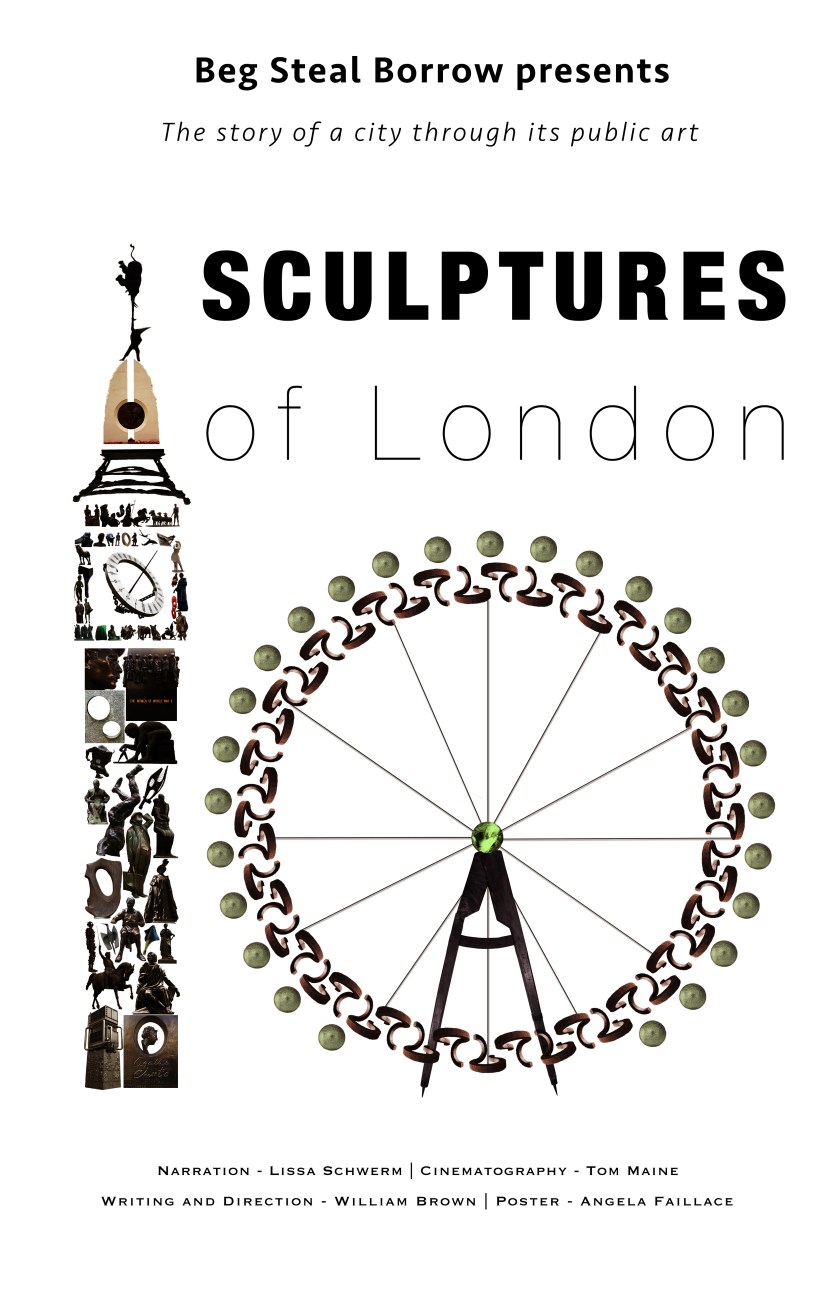
We are delighted to announce that Beg Steal Borrow’s short film, Sculptures of London, will play at Cross Cuts Film Festival, an event that forms part of the 2019 Stockholm Environmental Humanities Festival for Film & Text.

annals_laurels-v2_black

The screening will take place on Friday 22 November 2019 at 13:00 at the Bio Rio in Hornstull in Stockholm, Sweden. What is more, director William Brown will also be taking part in a discussion on Filmmaking as a Research Practice, also at the Bio Rio, on Saturday 23 November at 10:00.

The screening of Sculptures of London will take place as part of a double bill with Karl Palmås and Kalle Sanner’s Too Late for History to End, with introductions and discussions from Annals of Cross Cuts editors Jakob Nilsson, Jan Olsson and Jacob von Heland.

Meanwhile, the Filmmaking as a Research Practice session will also feature contributions from Jan Olsson of Stockholm University, Swedish artist and filmmaker Hanna Ljungh, Klara Björk of Valand Academy, Gothenburg University and Forum för Visuell Praktik, and Daniel Oxenhandler, a filmmaker at ENACTLAB and CPH:DOX SCIENCE ACADEMY.

After the festival, Sculptures of London will be published as part of Annals of Cross Cuts, which is a peer-reviewed publication for film-based research, and which supports the use of film and cinema as integral practices in the environmental humanities.

sculptures of london_v004

Sculptures of London is a documentary that considers the story told to us by the sculptures of London. That is, the film places London’s sculptures side by side in order to show the ideas and values that these monuments embody, and how they give us a sense of London as a city.

Narrated by Lissa Schwerm and shot by Tom Maine, Sculptures of London offers an intelligent and wry insight into one of the greatest cities in the world through its public art.

Beg Steal Borrow News, Festivals, Screenings, Sculptures of London, Uncategorized

Don’t Look Now: A Film Beyond Measure

Blogpost, British cinema, Film reviews, Uncategorized

I was recently invited to write an essay on “Don’t Look Now” for a catalog to accompany a recent exhibition of work by Martin Erik Andersen at Holstebro Art Museum in Denmark.

Always one to be persuaded by flattery, I naturally accepted, and subsequently spent a fair amount of time conducting research, watching and thinking about the film, and then writing this essay.

Alas, however, the below essay was not what they said that they were looking for – in that does not provide a ‘mathematical’ analysis of the film. Rather than waste the c30 hours of work that went into this, though, I figured I would post it here.

Don’t Look Now: A Film Beyond Measure

Spoilers.

“Don’t Look Now” seems to have it in for wizened old dwarf women, since the one who features in Nicolas Roeg’s film turns out to be a murderer who ultimately slays John Baxter, played by Donald Sutherland, and who is the central protagonist of the movie.

We have to start with a spoiler, though, because it is only by getting to the end of the film that we can begin in certain respects to make sense of it. For, as we shall see, “Don’t Look Now” offers up a conception of space and time that suggests that in many respects we are always already dead – and that it is simply an anthropocentric conceit to organise, or indeed to contain, space and time into measurable units, or indeed to measure space and time at all.

I should refine my last sentence and say that it is not simply an anthropocentric conceit to measure space and time (to divide space and time into measurements). Rather, it is quite specifically a tendency or a trope of what we might term capitalist man to do this (with the gender implications of the term ‘man’ being allowed to remain, with whiteness and western-ness also being qualities that remain consistent with such hegemonic practices, or practices of domination). In short, capitalist white man (who could almost certainly be specified via further adjectives) seeks to dominate nature by subjugating nature to measurement. By making our world finite and ordered. To bring order to chaos.

Why does man seek to do this? Because he wishes to halt time, not to die, to live forever, and to escape from the perceived cruelty of nature, which cruelty amounts basically to taking it as an insult that he does not live forever in the first place. That is, man seeks to do this out of narcissism. To prove that he is above the animals and ‘better’ than nature.

But what does this have to do with “Don’t Look Now”?

It has everything to do with “Don’t Look Now”, because (capitalist western white) man’s wrangles with the chaotic universe become the very fabric of Roeg’s movie, both as a documentary and as a self-consciously composed (fiction) film

What on earth do I mean when I describe the film as a documentary?

Well, what in particular I mean is that humans don’t have to go very far with a camera in order to find signs of humanity’s attempts to dominate nature/the world/chaos via what I am terming measurement. As it turns out, Venice is an excellent venue for this because it is a space where the straight lines and measurements that humanity imposes on the world (including the delimitation and naming of space that is calling this particular place ‘Venice’) come in direct contact with—and are reflected in—the chaotic waters on top of which that city is built (and into which it is slowly sinking, about which, more imminently).

But even if Venice provides an excellent visualisation of how a certain kind of humanity (patriarchal white society, with the Christianity business at its core) tries specifically to build itself upon water in order to subjugate that water, you could basically point a camera anywhere these days and what you would film would include the straight lines and geometric patterns applied to and/or covering over nature by humans, as well as signs of that nature itself in the form of tendrils, vines, blades of grass, trees, rain, clouds, and anything else that is not manmade. In this sense, pretty much all films document the ways in which humans try to, but in many ways cannot, pave over nature and create a measured and measurable world of order, and of which we can make easy sense. We simplify nature, making order of chaos, and in so doing we mark our separation from chaos, giving to ourselves a sense of our own specialness within the universe.

Except, of course, that this endeavour is all vanity—and Venice will indeed sink into the quagmire as churches will fall into disrepair, humans will die, and so on. At least, this will happen until humans do discover the elixir of eternal life (and preferably eternal youth rather than ageing forever but not dying). That is, humans will do this until they do finally become gods—a pursuit that even today many believe possible thanks to the powers of ‘science,’ i.e. thanks to the powers of measurement itself. We seek the bottles or other containers that will bring about eternal life, be those augmented bodies, computer avatars, elixirs that we can drink, space ships to take us to the stars and many more ideas, as often faddish as foolish.

Cinema and photography, as technologies that can in some senses preserve human life, including beyond what we typically refer to as death, are part and parcel of this endeavour. And yet, cinema can also, like many humans, be at war with this embalming impulse and it can also open itself up to and find regeneration in chaos. Rather than being a tool for eternal life, cinema can also let chaos and death into its system.

And so if “Don’t Look Now” documents man’s vanity as he attempts to cheat death (just look at Venice; such vanity is the very architecture of the place), it also consciously explores this contradiction, and thus it emerges as a work of art that actively works with chaos rather than trying to pour concrete over it.

Indeed, the opening shots announce as much: rain and the shuddering water of a pond—accompanied by a zoom that creates a pattern of almost televisual static. We dissolve to patterns of light on a black background, as light filters through cracks in a blind. The blind may keep out the light, but as the film will tell us, the blind can also see, and in seeing, show us aspects of our world that we otherwise miss.

After these opening seconds, we will repeatedly have flowers, vines and tendrils creeping into the frame. Indeed, in cutaway after cutaway, Roeg deliberately speaks the iconographic language of the still life, where the straight lines of the human world are juxtaposed with the sinewy mess of nature. Furthermore, pigeons will repeatedly emerge into frame to disrupt the geometry of the city, while cats meow from behind metal grates (which is not to mention dogs barking and children crying offscreen throughout the film).

Even when we do find ourselves in relatively geometric spaces, the human itself emerges as a force of chaos rather than one of control. We can picture John and Laura, framed by drawing tubes and hotel room furniture, and yet they themselves both have curly, barely controlled hair, spiralling out of their heads (and out of John’s lip)—a sort of cinematic Kandinsky consisting of monochromatic straight lines coming up against inconsistent spheres.

John is at the centre of this tension between order and chaos. If the blind seer Heather can tell that John also has visions, John tries as best he can to deny them. Even as he knows that he is restoring a fake church, something that he admits to Laura over dinner, he still is invested in the project of halting time and bringing about the restoration and eternal youth of this floating city.

Indeed, the tension that John feels is clearly reflected in his consideration of space. For, John has written a book called Beyond the Fragile Geometry of Space, which we see next to Laura on the sofa of their English home at the film’s start. We are not given access to the book’s contents, but from its title we might surmise that John can indeed see beyond space as geometric, that is, beyond space as being made of fixed and measured/measurable coordinates.

Let us dwell a while on this idea. For, the Greek term for measurement is metron, which for Reza Negarestani is

found etymologically encrypted in English words such as Dimension (from dimetiri: measure out), meter, etc. Keeping well in mind the famous doctrine of Pythagoras, ‘Man is the metron of everything’ (pantōn chrēmatōn metron anthrōpos), metron can be translated as scale, measure, standard, and value. According to Sextus Empiricus, metron expresses criterion (scale, measure) but Heraclitus and Sophocles saw it as certifying dominance, a domination over something. Therefore, metron indicates that both measures and dimensions inter-connect with power, judgement and reasoning. The critique of metron explains how dimensions (namely metron) bring power into effect, mobilizing and propagating it. (Negarestani 2008: 233)

In other words, metron is humanity’s attempt to control an otherwise dimension-defying reality and to become a god by measuring it out, by applying to it a fixed number of dimensions, and thus by dominating/subjugating/simplifying it. No wonder it is that we see a bust of Socrates’ note-taker, Plato, as John inspects a slide also at the film’s start. For, via his engagement with ancient Greek thought, John understands that measurement is nothing more than man’s attempt to control nature, and that it must therefore be fragile. What, however, lies ‘beyond’ this fragile geometry of space…?

Beyond the fragile dimensions that humans construct via walls, pavements and other straight, hard surfaces, which all eventually will crumble into the sea, man is lost—as John and Laura experience even within Venice as they wander its alleyways at night. Without illumination and thus without the visible markers or measures of space that man has created in order to navigate it, space is simply a labyrinth, and space simply swallows up man and demonstrates that his meaning and order, his straight lines and his religious myths, are mere consolations against the impermanence and complexity of the world. Even a frozen lake is not flat/straight, as Laura explains. And so the human world tries to be permanent and thus is carved in solid materials like stone, but even these become covered by moss and broken down, and even these give way to mud and water, which in turn drown humans and bring them back to the ever-shifting earth.

If “Don’t Look Now” pits an ordered solidity against chaotic liquid, then clearly humans contain within them the tension between these two states. For, humans are of course themselves mostly liquid, as is made most clear when blood flows forth from humans in injury and death—and monthly in the female human for as long as she might biologically generate new life. Humans thus create bottles for liquids in order to contain their chaotic power, much as humans bottle themselves up in order to keep the same chaos at bay (unsurprisingly, then, John is aghast when he vomits, which he claims not to have done in 10 years, since he prides himself on keeping everything inside).

And yet, if humans create and become bottles, glass nonetheless smashes on several occasions in the film: Laura and John’s son, Johnny, cycles over glass just before Christine drowns in the pond, while glass smashes as Laura faints in the restaurant, and John is covered in broken glass as he nearly falls from inspecting the mural in the Church of St Niccolò dei Mendicoli. Meanwhile, blood spills from John and Johnny at the moment of Christine’s death—and the water beneath Venice is always there to remind us that chaos can only be bottled briefly, if at all.

But still (western) humans persist in shutting themselves off from the outside and in seeking eternal, bottled and contained life. Indeed, “Don’t Look Now” anticipates, or at the very least positions itself as being part of a cultural logic of computation when little Johnny’s headmaster at Porton School is revealed as being called Babbage. Clearly an allusion to Charles Babbage, the progenitor of digital culture, his role as an educator clearly suggests that the logic of mankind as exempt from nature (with digital technology having since the film become the talismanic technology that will make this aspiration come true) is one that is inculcated in western humans from an early age, such that they go on to internalise this logic of separation-from-reality, and assume it to be real.

What is more, humans resist the outside world not just by building walls (even as doors fly open by themselves/at the power of the wind), but also by covering themselves with clothes—with “Don’t Look Now”being especially a treatise on gloves. It is as if humans want to avoid direct contact with as much of the world as possible, including with each other. In addition, humans cross their legs (John) in order not to let out the yonic energies that emanate from their genitals, and humans try to maintain sure and still postures. (Notably, Laura is told to uncross her legs when Heather tries to get in touch with Christine from beyond the grave.)

The awkwardness of Donald Sutherland running towards the pond where Christine drowns is one of the most important images in “Don’t Look Now”, since it conveys the imperfection of human movement—while at the same time working within the film to suggest that humans try otherwise to move as little as possible, to turn themselves into perfect statues and thus to live forever (in photographs?). This stillness involves a suppression of desire that is at odds with the openness to other dimensions that Heather experiences, shuddering and juddering as she communes orgasmically with the beyond… and which orgasmic shudder has clear echoes with the film’s ‘controversial’ (or at least for many people memorable) sex scene, in which John and Heather remain (alas, all too tastefully?) nude for what seems like a prolonged period.

To shudder and to quake is to be in touch with the infinite and to generate new life, much as the mud and the water generate new life and the continued evolution and change of life on earth. John Izod sees the brooch worn by Heather’s sister Wendy as a symbol of fertility (Izod 1992: 108), and in some senses he is not wrong; but when we get a close up view of it as Laura inspects the brooch while visiting the sisters in their hotel room, we see more clearly that it depicts a mermaid—as if these women were indeed from a chaotic water element, and thus also outside of the geometric world of masculinist stone.

In identifying the film as western, as well as by quoting an Islamic scholar in relation to measurement above, we perhaps have wandered far from the film’s intended/suitable critical framework. And yet, the film also contains seeds of such a ‘dewesternising’ critique. ‘The deeper we get, the more Byzantine it gets,’ says John to Laura just before he confesses to restoring not a real church but a fake. Not only is the western world in some senses fake as a whole because of its fundamental and wilfully illusory separation from nature/reality, but it also is one built upon a history of theft and a subsequent denial of that theft (with western man seeking no depth whatsoever, since to enter the murky depths, to enter murkiness as depth, is indeed the remit of the Byzantine/other; no wonder western man tries to surround himself with mirrors, which surfaces “Don’t Look Now” also consults repeatedly).

At one point, John comes face to face with a grotesque bust on the side of the church that he is restoring. Not only does this suggest that John himself is grotesque, but it also brings to mind the way in which the grotesque is itself a marginal form that is perhaps marginal precisely because it regularly blurs the boundary between the human and other species/the rest of the world, with grotesques (and its explicitly non-western cousin, the arabesque) regularly seeing the figure merge with the textual in the form of a flourishing vine. In other words, the grotesque reminds us not of the separation of man from world, but precisely of the interconnection between man, animal, plant and the rest of the material world (see also Marks 2010: 96-98). In the Islamic pictorial tradition, the grotesque and the arabesque both also bring to mind the autonomous life of the line; that is, as the line is freed from the burden of representation but instead becomes its own expressive force (flowing as it wishes and not because it must outline, say, a face), so does it move beyond the realm of the visual (this is a picture of a face) and into the realm of the haptic (you can feel the force of the line). It is not through vision that we can understand the world, but through touch, even as western humans put on gloves to avoid it.

But as the line comes alive in the grotesque and the arabesque, so might we also understand how colour, in particular through a Venetian history of art, also connotes hapticity. Laura U Marks can help to illuminate once again why Venice is such an apt venue for “Don’t Look Now”:

of course line and color are interdependent, as in the labile quality of the contour and the mercurial technique of chiaroscuro. It is notable that the Venetians, and their coloristic heir in the nineteenth century, Delacroix, were influenced by Oriental contact. Haptic space began to push to the surface of their paintings, while the linearists were still keeping the abstract line in check… Artisans began to emphasize flow over form. The tendril decoration inherited from Greek and Roman art quickly lost its naturalism and became what we call the arabesque. (Marks 2010: 54)

And so with its emphasis on red, “Don’t Look Now” similarly enacts an attempt to divorce colour from form, to give to colour a life of its own, as is made especially clear by the blood that floods the image during the climax of the opening death sequence. This haptic aspect of the film thus helps viewers to get beyond simply what is represented (here is a person in a red coat) and to access other dimensions hidden within these normal/normative ways of seeing (but of course the bearer of the red coat turns out to be a grotesque, old, murderous woman, since the grotesque, the old and the female are all antithetical to the myth of eternal youth that patriarchy seeks, promises, and narcissistically fools itself into believing it can realise; the woman does not bottle up life, keeping it for herself, but instead she bleeds and gives life).

If “Don’t Look Now” in some senses consciously places itself within artistic, pictorial and/or painterly traditions, then it is also knowingly a film. If for Mary Shelley the Promethean endeavour to establish eternal life led to the creation of Frankenstein’s monster, then Christine’s death clearly evokes the moment in James Whale’s Frankenstein (1931) when the monster throws a little girl, Maria, into a pond, causing her also to drown. Indeed, perhaps this allusion makes clear how John himself is a creating a monster in trying to resurrect a fake. Or rather, in trying to be Prometheus, John already is Frankenstein’s monster himself.

Meanwhile, “Don’t Look Now” of course follows hot on the heels of Luchino Visconti’s Thomas Mann adaptation, Death in Venice (1971), which itself tells the tale of how human desire cannot be kept straight, and how man will indeed only ever fail in his attempts to prolong his life. Finally, the moment when a dead body is fished from the water recalls a similar moment in Michelangelo Antonioni’s L’Eclisse (1962), in which a car is similarly fished out from the Tiber—as if that tale of human alienation were in some senses continued here. A poster of Charlie Chaplin further clarifies the film’s lineage: the tramp equally is alienated from the machinic world of capital.

But much as “Don’t Look Now” revels in its status as a film, it is and must also be in rebellion against that very same status. For if cinema is anything, it is perhaps, as mentioned, a technology for preserving human life beyond death. In this way, it is part of the Promethean project, while the very and inevitable existence of the frame means that cinema only ever ‘bottles’ or ‘boxes’ space, offering us the Euclidean coordinates of a framed reality. Cinema is like Venice in that if the latter is, as Heather suggests, a ‘city in aspic,’ then cinema likewise puts the human body in aspic, preserving us in polyester.

If this is so, then it is against the frame of cinema itself that Roeg will consistently reframe, zoom and blur the images that we see. As with the performances, in which lines are mumbled, and the sound recording, in which sometimes the dialogue is hard to follow, Roeg thus deliberately makes a technically ‘dirty’ film, reminding us regularly that we are watching a film, a fake, a story that is not necessarily to be believed. Indeed, the use of quotation marks in the very title of the film (“Don’t Look Now”) suggest a second-hand rather than an original story.* And it is a story that at times we literally cannot see very clearly; one that on occasion leaves us baffled as to what exactly is happening.

What is more, Roeg’s radical editing, in which we can jump from different times to different spaces and back again within what we would traditionally refer to as a ‘scene’ ties in with the film’s use of cinema not to affix time but to demonstrate its interconnected nature. That is, as the dimensions of space are attributes that we affix to ‘raw’ space so as to conquer it (and so as not to get lost), so do we do the same with time.

Clocks and watches abound within “Don’t Look Now”, with these technologies themselves being ways for humans to regulate and thus in some senses to control time. And yet time itself is not linear, as the love-making scene itself exemplifies; we jump back and forth between John and Laura engaging in coitus and the two of them getting dressed/covering themselves back up for dinner. What was formless and naked becomes formal once again—but the edit mixes the chronology up suggesting that the past, the present and the future all co-exist simultaneously. This is why John can see his own funeral, why Heather can foresee the future and why John is in some respects (always) already dead: as space is deeply, or fundamentally, dimensionless, so, too, is time.

(To “look now” is thus perhaps not to see; one cannot look now, or at least the film encourages not only to look at the now, but to see how the now/the present is intertwined with the past and the future. If we truly could see the “now” we would not see it isolated from other moments in time, but entangled with them.**)

If it is the destiny of all humans to fall, as John imagines at one point that he does in the church amidst a shower of broken glass, then gravity will bring all humans to the grave. And in that muddly hole, worms will devour us and vines will emerge from that mud in a new sprouting of life. In the mud, space is dimensionless, but, so, too, is time, with Roeg’s cinema travelling through edit ‘wormholes’ to connect up what would be different spaces and times as if they were all connected. Not extended geometrically into a manageable pattern—but all together all at once. The vanity of man is to live forever; the reality of the universe is that we do live forever, but we also die forever, too. The vain and Promethean endeavour of man is to separate life definitively from death; the destiny of the human is to realise that life is inseparable from death—even as this leads to life defying gravity and emerging from the grave. It is at La Fenice where the sisters are staying by the film’s end; they are thus like phoenixes, transcending the distinction between life and death via their embrace of immanence and rebirth, as John canters (awkwardly again) towards his own death in Venice (Fenice?) because he will not accept a world without measure.

When the corpse, which bears a remarkable similarity to Heather, is retrieved from the Venetian canal, we see the open-eyed actor playing that part suddenly blink. No doubt an ‘error,’ the moment nonetheless demonstrates that the world of life without death is a world of impossible unblinkingness, one of permanent light in which paradoxically we cannot see. It is only when we blink, or when, like Wendy, we have something in our eyes (including mud, which perhaps explains why John begins to drink—here’s mud in your eye!) that we actually do see. True reality is marked by invisible dimensions that perhaps we can feel through senses other than vision; to be limited only to unblinking vision is to close oneself off to those alternative dimensions, spaces and times that we might dismiss as fantasies, dreams or hallucinations, but which in fact are real.

But what is it that we actually are not seeing? Perhaps of particular note is that “Don’t Look Now” features a second book in addition to Beyond the Fragile Geometry of Space, and that is Rolf Hochhuth’s stage play, Der Stellvertreter (1963), which regularly is translated as The Deputy. Der Stellvertreter explores the way in which Pope Pius XII failed to speak out or take action against the Holocaust. What remains invisible, then, is the way in which National Socialism and the Catholic church both—in their attempts to control the world—lead to genocide, both within Europe and further afield. This blood, more than the Venetian lagoon, is the true chaotic liquid that has been spilt for the purposes of creating the western and patriarchal world of walls. And it is a blood that cannot be shown, but only alluded to, much as a black hole cannot directly be seen, but which can only be felt as a result of its gravitational and grave effects (everything falls towards it).

It is quite typical of 1970s art house movies to offer up many different signs, and yet which on the whole remain hard to decipher. “Don’t Look Now” is no exception, and there remain numerous details that I have not been able to mention, including the role of the police (‘The skill of the police artist is to make the living appear dead’); the way in which the camera always lingers on Signor Alexander, the owner of the hotel at which the Baxters are staying, after the other characters have finished talking to him; the way in which Laura is referred to as Mrs Baster at the airport, as if the family might be bastards; a poster about Boris Godunov; the prominence of a pair of neon glasses and a sign for an ottica, or optician’s, as John and Laura emerge from the darkness and back into familiar and lit alleyways in the Venetian night.

But of course if “Don’t Look Now” made total, coherent sense, then it would too much have subjugated its details to meaning; it would too much have made order out of chaos. In part, “Don’t Look Now” must remain chaotic on purpose, full of details that elude interpretation, and thus coming alive like the line and colour of the arabesque and/or the grotesque. In this way, it suggests an infinity beyond the finite world of walls and stone. An invisible world of blood unleashed. But also a world of life beyond death, of life in death, of dimensions beyond the measure of western capitalist man. Maybe the measure of a man, and the measure of this film, is that it seeks to go beyond measure, and to put is in touch with that infinite. Such an infinite reality can never be spoiled—except by the greed of men who seek to live forever.

* I overheard British Film Institute librarian Sarah Currant making this point during an induction session for students in the BFI Library. My thanks to her and my apologies for purloining the observation.

** This point was suggested to me by Mila Zuo. My thanks also to her for her help with this.

References

Izod, John (1992) The Films of Nicolas Roeg: Myth and Mind, New York: Palgrave Macmillan.

Marks, Laura U. (2010) Enfoldment and Infinity: An Islamic Genealogy of New Media Art, Cambridge, Mass.: MIT Press.

Negarestani, Reza (2008) Cyclonopedia: Complicity with Anonymous Materials, Melbourne: re.press.

We are delighted to announce that William Brown’s short film, Clem, will be screened as part of Besides the Screen, a festival-cum-conference that will take place at the Universidade Federal do Espírito Santo in Vitória, Espírito Santo, Brazil between 9 and 12 September 2019.

The screening will take place at 20.00 on 12 September 2019 as part of the final session, which focuses on Consciência Corporal (‘corporal conscience’). Clem will screen alongside work from Belgium, Brazil, Iran, Norway and the USA.

Besides the Screen

The full program for the festival, which has an especial focus on essay-films, can be found here.

Clem is a short essay-film about William’s cat, Clem, while also being a self-portrait that considers the role of the self in relation to others in the contemporary world.

The film consists of original and ‘found/appropriated’ footage from filmmakers as diverse as Agnès Varda, Jean-Luc Godard, Chris Marker, Djibril Diop Mambéty, Laura Mulvey, Federico Fellini, Pier Paolo Pasolini, Jordan Peele and more – while also featuring artworks by numerous painters and sculptors, especially Gustave Courbet.

The screening is the second screening of William’s work in Brazil, following a screening of En Attendant Godard at the Universidade Tuiuti do Paraná in 2016.

Besides the Screen follows promptly on from the World Premieres of Golden Gate at the San Francisco Frozen Film Festival in July and of La Belle Noise at the Fest Film Festival in Espinho, Portugal, in late June.

7DBB9419-00A4-4B80-A69C-E7CB243F8EE2

Guy Farber (sound) and Tom Maine (cinematography) relax in between scenes during the London leg of Mantis in July 2019.

Furthermore, William has been busy during the summer shooting his new fiction feature film Mantis, which took place in London and Collioure, France, while also helping out on the production of short film, Kin, which he co-wrote with director Mila Zuo, and which was shot in Oregon in August, with Frank Mosley playing one of the leads.

William is also working on the post-production of The New Hope 2, while also hoping for imminent screenings of his other films. Stay tuned for more news here…

Beg Steal Borrow News, Clem, Festivals, Short Films, Uncategorized

Yesterday (Danny Boyle, UK/Russia/China, 2019)

Blogpost, British cinema, Chinese cinema, Film reviews, Uncategorized

Imagine there’s no smoking. It’s easy if you try.

Obviously I could have started this blog with ‘imagine there’s no Beatles,’ as a number of journalists have done in their write-ups about Danny Boyle’s Richard Curtis-scripted Yesterday.

However, I want to start with the smoking because at one point in the film, lead character Jack (Himesh Patel) says that he’s dying for a cigarette only for his best friend Rocky (Joel Fry) to ask what cigarettes are – with Google (which along with Apple of course does exist) then confirming that in the alternative world where Jack has woken up, cigarettes do not indeed exist, alongside the Beatles, Oasis (the band), Coca Cola (the drink) and Harry Potter.

There are several things to pick apart here – beyond the obvious fact that bands like Coldplay (namechecked) would also not exist had the Beatles not existed.

For more specifically, without the tobacco industry, firstly the USA would quite possibly not have enjoyed the global economic dominance that it enjoyed in the twentieth century (and periods around it).

Secondly, slavery was a key component of the American tobacco industry, and so to imagine a world without smoking is, for better or for worse, to imagine an America without slavery.

Furthermore, the Indian tobacco industry is one of the world’s largest, and it historically commenced with the introduction of tobacco to Goa by the Portuguese, before the British then created a tobacco industry during their colonial rule of the country.

I wish simply to suggest, then, that to imagine a world without tobacco is in some senses to imagine a world without slavery and a world without colonialism.

Oh to imagine such a world.

And yet, to imagine such a world is in some senses to deny such a world.

That is, Yesterday asks us in part to imagine that slavery and colonialism never took place – even though Jack Malik’s British-Asian family has found its way to Lowestoft in order to live there, and even though there has, even without the Beatles, still been a history of music that includes many African-American sounds (Stevie Wonder is namechecked, among other indicators, including Ed Sheeran’s rapping).

Indeed, in Boyle’s film it is early confirmed that the Rolling Stones continue to exist, meaning that these arch-appropriators of African-American sounds have indeed continued to be successful, even though the grounds for their success – the African-American music from which they ‘borrowed’ so many licks and beats – ought not to have existed since there was no tobacco trade and thus not slavery in the same fashion.

Jack, bless him, feels bad for appropriating the Beatles’ music, even though John Lennon (Robert Carlyle) appears in the film to confirm that basically he has not written his songs (he is not a frustrated musician, but a happy widower living on a beach, seemingly only a taxi ride from Lowestoft, blissfully unaware of pop music and the media).

And yet, if in effect appropriation has gone on (the Stones are still around), and if in effect the supposed non-existence of a history of slavery and colonialism has still resulted in more or less the same world as we have now – except without the Beatles and without Coke – then the principle of the film is that theft and the occultation of theft through the rewriting of history is absolutely fine.

Let us imagine basically the same world as we have now – except that there was no slavery and no colonialism.

So basically the film is a denial of at least two of the most pernicious moments in western history, including the gigantic theft that led to the very creation and dominance of the west that the film affirms.

More fool Jack, then, for confessing – even if it allows him to get the girl (Lily James). For, in doing so he basically demonstrates that he is a dupe for a set of values (upheld in typical Curtis fashion as implicitly ‘English’) that he has been fed and yet which no one else believes in.

Indeed, Jack’s gesture might have a touch of the Mr Smith Goes to Washington (Frank Capra, USA, 1939) about it, but I am not sure what the panic from record producer Debra Hammer, played by Kate McKinnon, is about.

For while Rocky uploads all of the Beatles songs at the end of the film to the internet for people to download for free, the production and recording rights would still belong to her record company, and so Rocky/Jack will spend their whole life in penury, if not in prison, as a result of their unprovable story and their breach of contract (how to prove the existence of a band that never existed?) – all the while the record company owns rights to the songs, regardless of whether people have downloaded them for free.

Indeed, pretty much every song in the world is already easily available online on a host of websites, and it has not led to the collapse of the music industry – even if bands like Radiohead (whose poster for In Rainbows adorns Jack’s door) have attempted to give away their music.

(Besides, the record label would just get a better set of musicians and singers to sell better versions of the songs to the world, thereby making more money.)

So, Jack/Rocky’s ‘revolutionary’ gesture is in other words just business as usual in the contemporary record industry.

What is perhaps of greater import, though, is that the denial of history is also business as usual in the contemporary world.

Perhaps it is not by accident that Jack first ‘breaks through’ internationally while playing a gig in Moscow as Ed Sheeran’s warm-up – with the sequence of course involving a cover of ‘Back in the USSR.’

For if there is a country that knows about how to manipulate history, then it is surely Russia. And the manipulation does not stop at history; it also includes the present, as the victory of Vladimir Putin in the 2016 American Presidential elections makes clear.

What is more, it is notable that Jack also relies solely on Google for his verification or otherwise of the existence of the Beatles.

Not only does Yesterday thus affirm that it is only by existing on the internet that one can be validated as real, but it also implies – in a celebratory, product-placement fashion – that companies like Google shape our reality, determining what is real or not.

In other words, Yesterday plays out as comedy what is perhaps one of the most tragic aspects of the digital, ‘post-truth’ age: that what we consider to be real is highly manipulable, is indeed manipulated, but here is something to be celebrated as we deny slavery and deny colonialism as we live in a world without history and smoking.

Facetiously one might suggest that Yesterday could just as easily be called ‘Cambridge Analytica Saves The World.’

And yet in this facetious comment lies a sense in which Yesterday plays fast and loose with history as it offers up an extended Google advert, even as Google surely does shape our perceptions of reality thanks to its manipulable algorithms, data mining, listings of people and events, and so on.

If ‘Imagine’ were indeed a song about imagining ‘no countries,’ ‘peace,’ and more, it perhaps is a song about a world that beats to the unified drum of a single military-industrial-entertainment complex. That is, ‘Imagine’ is as much a bitter indictment of world history as it is an attempt to dream that humanity’s bloody, planet-destroying history did not take place.

A denial of a reality in which borders are being continuously reaffirmed on both sides of the Pond. A denial of a reality in which exploitation has created this world of huge injustice… Yesterday is in some senses, then, simply a reimagined version of today: the world is falling apart but no one wants to believe it and everyone just denies it. And so the entropy of the world will just go on happening…

In the face of trying to build of a new tomorrow, Boyle and Curtis instead waste their time dreaming of an alternative yesterday. Where that will get us… no one knows.

We are absolutely delighted to announce that the short essay-film, Golden Gate, will have its international premiere at the San Francisco Frozen Film Festival on 21 July 2019.

The screening will take place at 9pm in the Little Roxie room at the iconic Roxie cinema in San Francisco – as part of a programme of shorts on Science Fiction and Horror.

OFFICIAL SELECTION - San Francisco Frozen Film Festival SFFFF - 2019

This is especially exciting because MovieMaker Magazine voted Frozen one of the 20 Coolest Film Festivals In the World.

Golden Gate is a short essay-film that comprises clips from 43 experimental and feature films shot on or around the Golden Gate Bridge in San Francisco.

If you’d like to read more about the film, you can check out this essay that director William Brown wrote on his film criticism blog.

The screening takes place during the shooting of our new feature film, Mantis, which is shooting in Collioure and Port Vendres in France, and which tells the story of three young women celebrating the life of one of their late friends.

Golden Gate also recently played at the Film-Philosophy Conference at the University of Brighton on 10 July 2019.

Beg Steal Borrow News, Festivals, Golden Gate, Mantis, Uncategorized

Film-Philosophy 2019: Golden Gate

Uncategorized

The below is text to accompany the screening of my short essay-film, Golden Gate, which is to be screened (or if you are looking at this after 10 July 2019, which was screened) at the 2019 Film-Philosophy Conference at the University of Brighton, in Brighton, UK.

The film stands alone, but this text functions as a means of elaborating on the ideas that the film covers.

Golden Gate is an essay-film that reworks footage from 43 movies, spanning eight decades, in order to suggest that in cinema – and perhaps in the real world – the Golden Gate Bridge marks, if not the end of humanity, then the end of western patriarchal masculinity.

The film does this by weaving together scenes from these 43 films in such a way that we see how the Golden Gate repeatedly suffers apocalyptic events in movies: nuclear bombs, attacks by monsters from the ancient past, including ‘atomic creatures’ Godzilla and the giant octopus from It Came from Beneath the Sea (Robert Gordon, USA, 1955), as well as post-ecological kaiju and mega sharks, earthquakes, sun blazes, meteors and more.

More than this, the Golden Gate is also a place where congregate such posthuman entities as intelligent apes, intelligent octopuses, intelligent sharks, intelligent aliens, including Vulcans, intelligent cars, mutant humans (X-men), hulks, terminators, other intelligent machines and Supermen/Superman.

Perhaps it is obvious that this would be the case. For the Golden Gate is also a space where the desert meets the sea, with the interaction of these two elements creating unpredictable weather conditions, including fog, that connote uncertainty and amorphousness. That is, the Golden Gate Bridge is a space for all manner of unusual becomings, or what Reza Negarestani terms ‘new sentiences’ (Negarestani 2008: 92).

Small wonder, then, that San Francisco lies just next to Silicon Valley, where in the desert a silicon singularity is being beckoned into existence. Small wonder, too, that the Golden Gate marks the edge of the psychic space of the USA and perhaps of modernity itself: it is the limit of the west, and once that limit is reached… humans have few places left to go, except perhaps by evolving into new life forms, by being replaced by new life forms (or life forms that are at least new to us), by taking their own lives, or by disappearing in a flash of nuclear light.

Indeed, that flash of nuclear light heralds not just the end of man and the arrival of creatures from the deep, but perhaps also the very birth of cinema itself as a sentient being that is set to replace the human, be that as a machine apart from humans or as a cyborg symbiogenetically entangled with humans. Small wonder, again, that filmmakers like Chris Marker, Jenni Olson and Sophie Fiennes (who brings with her auti-philosopher Slavoj Žižek) all come to the Golden Gate to explore cinema’s own ability not just to touch humans, but also to think for and with itself.

And final small wonder, too, that in their essay-film about San Francisco, Guy Maddin, Evan Johnson and Galen Johnson also define the city as one defined by The Green Fog (USA, 2017), with the Golden Gate Bridge featuring heavily in this film that makes reference to the new sentience that emerges from havoc-wreaking weather conditions.

It is for this reason, too, that Golden Gate explores how early film theorist Vachel Lindsay, who in his poetry considered San Francisco to be beyond repentance, sees cinema as a prophecy machine, harking into existence these new life forms that cinema allows us to see, being itself such a life form, as is the Golden Gate, too.

One of the speakers from Eric Steel’s documentary about Golden Gate suicides, The Bridge (UK/USA, 2006), suggests that the schizophrenia suffered by one of the jumpers (Lisa Smith) meant that for them life was like having 44 television channels on simultaneously with all of them occupying equal attention.

This recalls Steven Shaviro’s claim that ‘people along the autistic spectrum are not solipsists, and they are not lacking in empathy… Their vision… “makes everything it represents exist on a strictly ‘equal footing’… fully outside any ontological hierarchy”’ (Shaviro 2014: 132).

To see and to treat equally, to achieve ontological democracy and to remove hierarchies, is perhaps to become autistic, to remove hierarchies. Perhaps Superman is thus autistic. Perhaps Spock is thus autistic. Perhaps Tommy Wiseau is thus autistic. Perhaps it is no mistake that the autistic Khan (Shah Rukh Khan) comes to San Francisco in order to live.

And as vision becomes democratised across space, so does it across time, such that past and future are also equal, such that fantasy and reality also become equal. Where truth and fiction become indiscernible, so are we in the realm of cinema, a form, a sentience and an intelligence where fiction and documentary blend. This is a reality that Golden Gate seeks to depict.

By coincidence, there is a 44thfilm that is worth mentioning for the purposes of explaining Golden Gate, and this is James Franco’s Disaster Artist (USA, 2017), which is a dramatized history of the making of Tommy Wiseau’s ‘bad movie,’ The Room (USA, 2003). For, while The Disaster Artistdoes not feature the Golden Gate Bridge (and in fact is concerned more with Greg Sestero and Tommy Wiseau’s time in Los Angeles than it is with their time in San Francisco), it nonetheless brings to mind the concept of disaster, especially as it relates to cinema.

For, as Jennifer Fay reminds us at the outset of Inhospitable World: Cinema in the Time of the Anthropocene, disaster is a pejorative from dis(bad) and astro(star), being thus ‘the catastrophe that results from planetary misalignment’ (Fay 2018: 1). It is not just that the Golden Gate suffers disasters in the colloquial sense of the word, then, but that it also is a place where humans encounter the alien, or that which is from the stars (in French, des astres, or désastres).

What is more, it is perhaps also here that humans realise that they are from the stars – and that their state is always to fall.

Indeed, Steel has compared his film to Pieter Bruegel the Elder’s Landscape with the Fall of Icarus (c1558), in which we see Icarus’ legs emerging from the sea after falling to earth (see Holden 2006).

There are many falls in Golden Gate, including that of the camera and the endless motorcade (from cadere, which means to fall in Latin) that crosses the bridge’s span. This is not just a film about trying to defy but being limited by gravity, even if the film is also about a dream of flight, as Caroline Pressley says of Bridge jumper Gene Sprague, who loosely resembles the disaster artist himself, Tommy Wiseau.

For, part of man’s flight is his flight into cinema – the flight of fantasy in which woman is not an intelligent being with whom he shares a world, but an image from which he is separate, which is like a dumb machine, and which he can control – as per Alfred Hitchcock’s Vertigo (USA, 1958).

The fall of man or mankind, then, is really the fall of masculinity, or the fall of the patriarchal world, which headed west, and which invented cinema in order to try to establish control over the environment, over machines, over animals and over woman. But that control is impossible.

If cinema is part of man’s attempt to control woman, then perhaps this essay-film is an example of non-cinema. Or if cinema really is a new sentience, or a new intelligence, then a non-patriarchal cinema, in which man has fallen, is really the birth of cinema proper, not the fall of man, but the rise of the machines.

Perhaps it is to be critiqued that it takes an ontological democracy of objects and subjects in order for woman finally to be given equal footing to man. Nonetheless, the future human world, which will not be a world defined uniquely by humans, will also be a world not defined by the binary distinctions of gender that traditionally have been in play. The death of man is the birth of the human, beyond merely man (super-man), and where equality is established through difference, without difference being a reason to create hierarchies (man above woman, above world, above objects, above animals, above machines). Not woman as the invented other of man. But woman as woman, woman as superman (beyond man). Humanity on the level.

Man, says experimental filmmaker Peter Rose, could not see far enough. But the Golden Gate provides a view to a kill: the end of man; James Bond saved (again!) by a woman.

And so perhaps, as per the title of Krishna D.K. and Raj Nidimoru’s 2014 Bollywood film, which features as the final images in Golden Gate, it is after the fall of western man, at the end of the west, that man will not try to control woman (as per Vertigo), but where non-western man and woman can fall in love. Where man falls, humanity might have a Happy Ending.1

Endnote
1. William Brown would like to thank David H Fleming, Matthew Holtmeier, Murray Pomerance, Clive Smith, Chelsea Wessels and Mila Zuo for their help in the creation of this film.

References
Fay, Jennifer (2018) Inhospitable World: Cinema in the Time of the Anthropocene, Oxford: Oxford University Press.
Holden, Stephen (2006) ‘That Beautiful But Deadly San Francisco Span,’ The New York Times, 27 October, https://www.nytimes.com/2006/10/27/movies/27brid.html. Accessed 1 May 2019.
Negarestani, Reza (2008) Cyclonopedia: Complicity with Anonymous Materials, Melbourne: re:press.
Shaviro, Steven (2014) The Universe of Things: On Speculative Realism, Minneapolis: University of Minnesota Press.

Films featured in Golden Gate
10.5 (John Lafia, USA, 2004)
A View to a Kill (John Glen, UK, 1985)
The Abyss (James Cameron, USA, 1989)
Bicentennial Man (Chris Columbus, USA/Germany, 1999)
Big Hero 6 (Don Hall and Chris Williams, USA, 2014)
The Bridge (Eric Steel, UK/USA, 2006)
Bumblebee (Travis Knight, USA/China, 2018)
The Circle (James Ponsoldt, UAE/USA, 2017)
The Core (Jon Amiel, USA/Germany/Canada/UK, 2003)
Dark Passage (Delmer Daves, USA, 1947)
Dawn of the Planet of the Apes (Matt Reeves, USA/UK/Canada, 2014)
Escape in the Fog (Budd Boetticher, USA, 1945)
Godzilla (Gareth Edwards, USA/Japan, 2014)
Happy Ending (Krishna D.K. and Raj Nidimoru, India, 2014)
Herbie Rides Again (Robert Stevenson, USA, 1974)
How the West Was Won (John Ford, Henry Hathaway and George Marshall, USA, 1962)
Hulk (Ang Lee, USA, 2003)
It Came from Beneath the Sea (Robert Gordon, USA, 1955)
Land of the Lost (Brad Silberling, USA, 2009)
The Love Bug (Robert Stevenson, USA, 1968)
The Maltese Falcon (John Huston, USA, 1941)
The Man Who Could Not See Far Enough (Peter Rose, USA, 1981)
Mega Shark vs. Giant Octopus (Ace Hannah, USA, 2009)
Meteor Storm (Tibor Takács, USA, 2010)
Monsters vs. Aliens (Rob Letterman and Conrad Vernon, USA, 2009)
My Name is Khan (Karan Johar, India/USA/UAE, 2010)
On the Beach (Stanley Kramer, USA, 1959)
Pacific Rim (Guillermo del Toro, USA, 2013)
The Pervert’s Guide to Cinema (Sophie Fiennes, UK/Austria/Netherlands, 2006)
The Rock (Michael Bay, USA, 1996)
The Room (Tommy Wiseau, USA, 2003)
The Royal Road (Jenni Olson, USA, 2015)
San Andreas (Brad Peyton, USA, 2015)
Sans soleil (Chris. Marker, France, 1983)
Star Trek (J.J. Abrams, USA/Germany, 2009)
Star Trek Into Darkness (J.J. Abrams, USA, 2013)
Star Trek IV: The Voyage Home (Leonard Nimoy, USA, 1986)
Superman (Richard Donner, USA/UK/Switzerland/Canada/Panama, 1978)
Teknolust (Lynn Hershman-Leeson, USA/Germany/UK, 2002)
Terminator Genisys (Alan Taylor, USA, 2015)
The Towering Inferno (John Guillermin, USA, 1974)
Vertigo (Alfred Hitchcock, USA, 1958)
X-Men: The Last Stand (Brett Ratner, Canada/USA/UK, 2006)

Other films
The Disaster Artist(James Franco, USA, 2017)
The Green Fog(Guy Maddin, Evan Johnson and Galen Johnson, USA, 2017)

Texts referenced in Golden Gate
Berger, Arthur Asa (2012) Understanding American Icons: An Introduction to Semiotics, Abingdon: Routledge.
Fleming, David H. (2017) Unbecoming Cinema: Unsettling Encounters with Ethical Event Films, Chicago: Chicago University Press.
Irigaray, Luce (1991) Marine Lover of Friedrich Nietzsche (trans. Gillian Gill), New York: Columbia University Press.
Lindsay, Vachel (1913) ‘The City that Will Not Repent,’ in General William Booth enters into heaven and other poems, Borgo Press.
Lindsay, Vachel (2000 [1915]) The Art of the Motion Picture, New York: Modern Library.
Negarestani, Reza (2008) Cyclonopedia: Complicity with Anonymous Materials, Melbourne: re:press.
Nietzsche, Friedrich (1997 [1891]) Thus Spake Zarathustra(trans. Anthony Common), London: Wordsworth.
Shaviro, Steven (2014) The Universe of Things: On Speculative Realism, Minneapolis: University of Minnesota Press.
Wark, McKenzie (2016) Molecular Red: Theory for the Anthropocene, London: Verso.

Painting featured in Golden Gate
Pieter Bruegel the Elder (c1558) Landscape with the Fall of Icarus.

la belle noise poster_v008 (cmyk)

La Belle Noise premiere at Fest Film Festival
We are very excited to announce that our experimental documentary, La Belle Noise, will have its world premiere at the Fest Film Festival in Espinho, Portugal, on 30 June 2019.

Shot at the Fest Film Festival itself in 2018, La Belle Noise stars Colin Morgan as himself and as a sleaze ball film producer who is at the seaside town of Espinho in order to wreak havoc on the minds of hopeful filmmakers.

Meanwhile, Beg Steal Borrow legend Dennis Chua turns up at Cthulhu, the ancient one from Lovecraftian mythology, who also is in turn to have fun.

Various actors and other filmmakers reflect upon their desire to be involved in film, as well as their relationship with love – and as the film blurs the distinction between fiction and documentary, so it blurs the distinction between signal and noise, suggesting that there is beauty to be found in those aspects of cinema that typically we discard or overlook.

The screening takes place at midnight on 30 June (as it transitions into 1 July) at the Casino. It follows right after Alex Ross Perry’s Her Smell, which is the festival’s closing film.

Other news
These screenings are accompanied by a preview screening of This is Cinema at the Birkbeck Institute of the Moving Image on Saturday 13 July – ahead of what we hope to be a festival run for that film.

This will take place just ahead of the shooting of Mantis, a new Beg Steal Borrow production that will be shot in Collioure, France, in mid-July – and about which we hope to announce more later.

And then there is in August the shooting of Mila Zuo’s short film, Kin, co-written by William Brown, and which stars Frank Mosley, with principle photography taking place in August.

Finally, look out for The New Hope 2, which we hope to complete some time in the autumn!

Beg Steal Borrow News, Uncategorized

We are very excited to announce the launch of a crowdfunding campaign for Kin, a new short film to be directed in August by the highly talented Mila Zuo – based on a script co-written by Zuo and Beg Steal Borrow’s William Brown.

The campaign comes on the back of Zuo winning the 2019 Oregon Media Arts Fellowship, sponsored by the Oregon Arts Commission and administered by the NW Film Center.

The crowdfund campaign is being run through Seed&Spark, a site dedicated uniquely to filmmakers. For more information about the campaign – and to donate – check it out here…!

It is only between your help and the award from the Oregon Arts Commission that Kin will get made.

About Kin
Kin tells the story of three 20-somethings who live together in beautiful rural Oregon, passing their time with beer, TV, home repairs, and vague dreams about a better future.

Conversations about love, security, and taste punctuate the film’s depiction of three young adults in a forgotten Pacific Northwest town, as a shy young man is enthralled by the overconfidence of the couple he lives with.

While the men repair their neglected home, the young woman works at a small motel, as Kin builds towards a violent climax, exploring its origins and testing how far audiences can go in their ability to sympathise, identify with, and even forgive characters.

Cast and crew
Kin looks set to feature various actors who are well known from the realms of American independent cinema – and it will be exciting to update people about that as soon as the cast is confirmed.

Meanwhile, the film’s director, Mila Zuo, is best known for her short film, Carnal Orient, which premiered at Slamdance in 2016 before going on to play at a host of other festivals in North America and further afield.

Zuo Mila

Mila Zuo preps a new film shoot

The film has since been picked up by online horror distributor ALTER, where Carnal… has thus far received over 77,000 views.

In addition, Zuo’s visual essay Détourning Asia/America premiered at CAAMfest 2019 in San Francisco. The film features and is made in collaboration with renowned Asian-American film director Valeria Soe.

Kin will be lensed by Edward P. Davee, who is an award winning writer/director whose films have screened in several film festivals and art galleries around the world.

His first feature, How the Fire Fell won Best Feature Film at the Seattle Film Forum’s Local Sightings Film Festival and was distributed by FilmBuff.

In 2012, Davee also won the Oregon Media Arts Fellowship as well as additional grants from the Oregon Arts Commission and the Regional Arts and Culture Council. The proposal for his 2nd feature film, Lost Division, won him the annual RACC Innovation award as well.


Beg Steal Borrow News, Crowd funding, Friends of Beg Steal Borrow, Kin, New projects, Screenplays, Scripts, Uncategorized