The comedy of experimental cinema

American cinema, Blogpost, Canadian cinema, Experimental Cinema, Film reviews, Uncategorized

I can only say what I saw and heard (and felt and thought).

Over the last two evenings, I have attended two experimental film events. The first was a screening of Michael Snow’s La région centrale (Canada, 1971) at the Serpentine Gallery, which screened alongside the opening credits of Vertigo (Alfred Hitchcock, USA, 1958) – with both being chosen by artist Lucy Raven, whose solo exhibition, Edge of Tomorrow, is currently on there. The second was a performance at Tate Modern of Tony Conrad’s 55 Years on the Infinite Plain (originally called 10 Years on the Infinite Plain when first performed in New York, USA, in 1972, and which has been growing in age ever since – now beyond Conrad’s death last year).

For those unfamiliar with either of these works, the former is a three-hour film shot on the top of a mountain in Québec, and which features images captured remotely by Snow using a robotic arm, to which Snow’s camera was attached, and which rotates in a long series of different directions. The latter is a 90-minute piece featuring ‘drone’ music and black and white strips that flicker on a screen from four projectors simultaneously.

Both experiences involve a fair amount of discomfort, not least because traditional cinema seats were not provided, with the viewer instead having to sit on a wooden stand (La région centrale) or on the floor (55 Years…). Standing is an option. But either way, one really feels the presence of one’s body as one tries to find comfort during the screenings (and live musical performance in the case of 55 Years…).

I am not an expert on experimental cinema. I have seen a fair amount, read a fair amount of literature about it, and also think about it (and occasionally write about experimental aspects of cinema that is otherwise not so overtly non-narrative as these two films).

I am driven to write about these back-to-back experiences, though, not simply to expose my ignorance of the subject (I can’t imagine that I shall say much that others have not written – or certainly thought – in relation to these films), but to convey some thoughts that I had while watching the films. Perhaps that is, after all, one of the things that a blog can do.

To get to my thoughts, though, we must describe what happens in the films. As I have already hinted, ‘not much happens’ from the perspective of someone looking for a film that tells a story. La région centrale features images captured by the camera as it moves round and round, back and forth, spinning upside down, moving in circles in all sorts of directions and more.

55 Years…, meanwhile, features a deep electric bass line (performed on this occasion by Dominic Lash), accompanied by violin (Angharad Davies) and long string drone (Rhys Chatham). At first one projector, then two, then three, then four fill the wide screen with the flickering lines, before all four projectors slowly begin to converge, their images overlapping, and then are turned off one by one, until only one flickering image remains.

Probably sounds pointless, maybe even dull, right – especially if one lasts 180 minutes and the other 90?

I do not think so. Indeed, quite the opposite.

The Snow experience induced in me so many different thoughts, which perhaps have at their core a sense of seeing the Earth as if through the eyes of an alien. Initially surveying the ground, the camera then begins to rotate in such ways that we are consistently being given new perspectives on our world – toying with it, twisting it, turning it, experimenting with it.

As María Palacios Cruz explained in her introduction, Snow deliberately tried to find a spot in his native Canada where no visible trace of human life could be seen (something that might recall my earlier post about the ‘American eye’ in relation to Le corbeau). In other words, he absolutely wants us to see the world from an inhuman perspective; to see the world ‘for itself.’

In the process, we begin to understand how as humans we often do not see the world ‘for itself’ but how it is ‘for us’ (and this is not necessarily a bad thing; we are driven to live and survive by our selfish genes, after all). By getting us to see the world ‘for itself,’ the world itself is made ‘alien’ to us, or we see the world as if through alien eyes. The film becomes a panoply of different ways to look at the world through the insistent movement of the camera – with the non-stop nature of that camera movement also bringing to mind the way in which our relatively static perspective of the world is perhaps key in bringing about our inability to see the world ‘for itself.’

For, the world is also movement – but generally we do not have eyes to see it. The rhythms of the world are perhaps too slow for us to detect. What Snow’s film does, then, is to bring to mind those rhythms. Not just Snow’s film, but by extension cinema as a whole is thus in part a machine to present to us something like ‘deep time’ – the long, slow rhythms of the world that extend further back than we can remember and further into the future than we can imagine (in other words, a world without humans). Perhaps this is why a narrative classic like Vertigo is also chosen to play in part alongside Snow’s film.

If Snow’s film takes us into the realm of planetary time, Conrad’s film takes us (or me, at least) into the realm of universal time.

Using black and whites strips alone, Conrad takes us into a realm whereby I am confronted not just with a world that exists far beyond the human realm, but with the way in which the world – the universe itself – comes into and out of being. If the world pre-existed humans by billions of years, and if it will outlive humans by billions of years (La région centrale), then Conrad’s film tells us that the universe pre-existed the world by trillions of years, and will continue to exist after the world has gone by trillions of years. (It exists beyond time itself, and beyond measure. Again, language becomes meaningless.)

More than this… 55 Years on the Infinite Plain tells us – in its flickering of white, or being, and black, or nothing – that existence itself comes into and out of being. That there is a beyond existence; that there is a beyond being; that there is a beyond ‘is’ – such that one cannot even express what we are describing since to say that ‘there is a beyond “is”‘ is clearly a contradiction in terms (how can not-is and is co-exist?)!

If language cannot suffice for the task of explaining what we see, then we enter into the realm of experience and of a new, different kind of thought (that also cannot be defined simply by what we ‘see,’ since it must be experienced, too).

What is the universe? But simply a flicker of light in an otherwise infinite blackness.

If 55 Years… takes us somehow beyond the universe, then it takes us into a realm not of a singular reality (a uni-verse), but into the realm of multiple realities. An alien perspective, or what philosopher Jean-Luc Nancy and physicist Aurélien Barrau might suggest is the necessary understanding that there is no world, but only multiple, infinite worlds.

As per the translation of their book on the matter: what is these worlds coming to? What these worlds is coming to (note the grammatical error; again, language does not quite suffice) is the co-existence of existence and non-existence. To invoke a different philosopher, Jean-Paul Sartre, being and nothingness at the same time.

Am I being pretentious? Possibly. I mean, people walked out of both screenings – and so clearly not everyone goes with these films. But at the end of 55 Years… the remaining audience members (perhaps as many as 100 people) sat in silence and darkness for about a minute. Finally, some applause – enthusiastic applause, some whoops of joy. Clearly they needed a moment to catch their thoughts, because this film had taken them somewhere different, somewhere special.

In other words, if to someone who was not there this all sounds like wank, to the majority of people who were there, this meant something – even if expressing it is and perhaps remains difficult. “That was absolutely fucking amazing,” said the woman sat next to me. I felt like dancing (and did nearly throughout 55 Years… – although I refrained from doing so).

Elsewhere I have written about how Hollywood presents to us narrative films that, even if they contain ‘puzzles’ for us to work out (my example is Inception, Christopher Nolan, USA/UK, 2010), they are still designed to be easy to consume and, by extension, not particularly challenging. I then suggest that films that do not involve narratives (my example is Five Dedicated to Ozu, Iran/Japan/France, 2003, by the late Abbas Kiarostami) can be quite challenging, even if there is no specific puzzle to work out – as we just see images of waves lapping the shore, or ducks walking along a beach, or a pond at night.

My argument in that essay is that common responses to Five… might include either ‘I got it after two minutes, so I do not know why I had to sit through that’ or ‘I did not get it’ – while people might easily say that they ‘got’ Inception (even though it is more than twice the length of Five…).

I suggest that there is not so much anything to ‘get’ with Five… (or Inception, or Vertigo – as its inclusion by Lucy Raven in her programme makes clear), but that one might ‘get into’ that sort of film by working at being an attentive audience member and beginning to marvel at what a wave lapping against the shore is and might mean (is it not a miracle that this happens?) as opposed only to marvelling at special effects and ‘mind-bending ideas’ (even though the leaders of the two largest energy companies in the world sit next to each other on an aeroplane and do not recognise each other).

(Besides which, whenever one says that one ‘got’ such a film after two minutes, they clearly do not ‘get’ it since part of getting it must involve experiencing the film in its entire duration, including the sense of slowness, and the different time or tempo of the piece. To demand that it be shorter is not to respect this otherness, but to apply one’s own rhythm to it, to curtail it, perhaps even to kill it.)

(Speaking of marvelling, I also found myself marvelling during 55 Years… about the fact that I can rotate my head. How is it possible that a human evolved from the mud of a planet that itself was a rock spewed from a star, such that it has a head that can rotate on a joint that sits atop a backbone and which contains eyes that can see and ears that can hear?)

To return from these loco parentheses: I make reference to my own essay not simply to continue to explain to a(n imagined?) ‘viewer-on-the-street’ that these non-narrative films might do something for us (and that thus people who might otherwise never go to watch such films might do worse than to give them a try), but also to correct what I wrote in that essay.

In that essay, I wrote that we might ‘get into’ films like Five Dedicated to Ozu by putting in some effort ourselves (rather than having nigh everything served up to us on a plate, as per Inception). However, now I think it would be better to suggest that we do not ‘get into’ but that we ‘get with’ such films (which is not necessarily to the exclusion of ‘getting with’ mainstream films; I believe that we can get with cinema as a whole – but don’t think that we should only get with the mainstream at the expense of the weird and the wonderful).

Why do I now want to say that we should ‘get with’ as opposed to ‘get into’ these films?

Well, in part this is to explain that getting a bit ‘pretentious’ (talking about cosmic things like a world without humans and a multiverse that exists and does not) is to get with what these films are doing, or at the very least what these films can do with us (it might also be an act of love if we were to say that we ‘go with’ these films – since coitus itself means to go with [co-itus] – as I have suggested here).

Furthermore, the preposition ‘with’ (a favourite of Jean-Luc Nancy) suggests not quite a disconnection from the world (seeing it through alien eyes), but also a connection with the world (seeing it ‘for itself’ – or from the perspective of a world that has seen so much more than humans and a multiverse that has seen so much more than our world).

Seeing through the eyes of the other, a kind of forgetting oneself, is also to commune with another – and in this case not just another human, but a whole other timescale (the entirety of existence) and space scale (a planet, a universe – as well, in the case of La région centrale when it shows us the land beneath the camera in close up, a rock, a patch of earth, a blade of grass). ‘With’ is to go beyond the self, to open the self up not only to the other human, but in the cases of La région centrale and 55 Years on the Infinite Plain, the inhuman.

Furthermore, ‘with’ always implies plurality, or a multiplicity of things and perspectives. For, one cannot be with anything or anyone if there is no thing or one beyond the self with which to be. With, therefore, suggests that we live in a multiverse, and that what these worlds is coming to is perhaps us, our understanding of the multiverse, and our place with it.

(The Conrad also suggests with in other ways – particularly the way in which my eyes when they move from left to right can make the flickers seem as though moving in that direction – before then moving in the other direction as my eyes move from right to left… That is, I am with the film in the sense that I co-create what I see; I see not just a different perspective, but a different perspective with my own eyes; I am entangled with the multiverse. This might seem to contradict the idea that I get beyond myself – but what perhaps really is exposed is not just the world beyond the self, but also the relationship between that world beyond self, and the self itself. What is exposed or revealed is our withness – and how the otherness of that with which we are is necessary for me even to exist and to have my sense of self/my perspective in the first place.)

I wish to end, then, by suggesting that these films do not just put us with the universe or multiverse. They put us with the medium of cinema, too, which opens us up to these new perspectives. I hear the 16mm projector rattle along during La région centrale, and I turn to see the projectors during 55 Years…. The experience of these two films is, then, to be with media, to be co-media, to be comedy.

What we can experience during these films is thus the comedy of the multiverse. When we find such films frustrating, we are perhaps taking them far too seriously (I personally found myself laughing regularly during both films as I marvelled at the possibility of anything existing at all). When we are serious, it is because we are rigid in our ways, in our thinking, and we are resistant to change. We do not become, we are not coming to, we are not with (perhaps we are solipsistically dreaming, a state of unconsciousness from which we can recover only by ‘coming to’).

To be less serious, to enjoy the comedy: this is not only a route to laughter and thus by extension happiness – it is perhaps also a route via with to wisdom (to be ‘other-wise’).

Long live experimental cinema. When screenings like these come along, I can only recommend one thing: get with it.

Some notes on cinema in 2016

Blogpost, Film education, Film reviews, Uncategorized

I saw 416 films for the first time in 2016. I saw 237 of these at the cinema. I saw 128 online. I saw 27 on DVD or from a file. I saw 13 on an aeroplane. I saw 9 in a gallery. And I saw 3 on television.

I do not know how well qualified I am to judge anything like Films of the Year, although I suspect that I have seen more films than a number of people who have offered up their thoughts on the matter. But as a result of the number of films that I have seen, I can at the very least draw upon a wider knowledge base – if not a stronger understanding of what I have seen – than those others in order to summarise the year.

In my view, there were two films that really stood out for me at the cinema. The first is Toni Erdmann (Maren Ade), which I understand many other people also greatly to have liked. The second is We Come as Friends (Hubert Sauper), a documentary about South Sudan.

Beyond this, I was very much taken with Actor Martinez (Mike Ott and Nathan Silver), Güeros (Alonso Ruizpalacios), Under the Shadow (Babak Anvari), Baden Baden (Rachel Lang), Mustang (Deniz Gamze Ergüven), L’Avenir/Things to Come (Mia Hansen-Løve), Nocturama (Bertrand Bonello) and I, Daniel Blake (Ken Loach). So these films might constitute my Top 10 of sorts.

Films that then get a kind of proxime accessunt might include: The Revenant (Alejandro González Iñárritu), The Big Short (Adam McKay), Spotlight (Tom McCarthy), Rams (Grímur Hákonarson),  Chronic (Michel Franco), Obra (Gregorio Graziosi), Les Habitants (Raymond Depardon), Desde allá (Lorenzo Vigas), Notes on Blindness (James Spinney and Peter Middleton), Heart of a Dog (Laurie Anderson), Personal Shopper (Olivier Assayas), Sieranevada (Cristi Puiu), Sweet Bean (Naomi Kawase), I am Belfast (Mark Cousins), Divines (Houda Benyamina), Hell or High Water (David Mackenzie), Hunt for the Wilderpeople (Taika Waititi), After the Storm (Kore-eda Hirokazu), Ma’Rosa (Brillante Ma. Mendoza), Minute Bodies: The Intimate World of F. Percy Smith (Stuart A Staples), Ta’ang (Wang Bing), Paterson (Jim Jarmusch), Les Innocentes (Anne Fontaine) and Your Name (Makoto Shinkai).

I feel that I ought not to given the hullabaloo about it, but I also found Birth of a Nation (Nate Parker) and Snowden (Oliver Stone) to be quite curious films that I cannot claim to understand, and yet the verve and self-confidence of which still remain with me.

Other highlights of the year included the British Film Institute’s retrospective of the work of Jean-Luc Godard, which provided me with the opportunity to see a bunch of films that I had not seen before. I was also especially taken with the retrospective of Kidlat Tahimik’s work that took place as part of the Essay Film Festival organised through Birkbeck.  This involved a rare opportunity to see Who Invented the Yo-yo? Who Invented the Moon Buggy?Why is Yellow the Middle of the Rainbow? and Balikbayan #1: Memories of Overdevelopment – all of which are excellent.

MUBI continues to offer numerous pleasures, including a wee season of Jacques Rivette films (especially Out 1: Noli Me Tangere) that I enjoyed immensely, with an ongoing retrospective of Lav Diaz (whose Heremias (Book One: The Legend of the Lizard Princess) I also saw for the first time) also taking place. Meanwhile, MUBI also allowed me to see Pedro Costa’s In Vanda’s Room and Horse Money. Furthermore, I enjoyed getting to know a bit the work of Joseph Morder and Jean-Paul Civeyrac through MUBI, while also being taken with White Dog (Sam Fuller), Mikey and Nicky (Elaine May), Los Hongos (Oscar Ruiz Navia), and Mes séances de lutte (Jacques Doillon).

Beyond MUBI, the internet also provided me with various other pleasures, including an introduction to the work of Paolo Gioli, about whom I spoke with John Ó Maoilearca at the Wilkinson Gallery, and Beyoncé’s Lemonade extended video. The BBC iPlayer allowed me to see Adam Curtis’ provocative HyperNormalisation, while I was also very excited to see Michael Chanan’s Money Puzzles online. The latter two are thought-provoking and wonderful films, with Chanan working on almost a zero budget to investigate the workings of contemporary capital.

Meanwhile, three fantastic gallery exhibitions were John Akomfrah’s solo show at the Lisson Gallery, William Kentridge’s Thick Time at the Whitechapel Gallery, and The Infinite Mix at the Hayward Gallery. I also enjoyed Tacita Dean’s Event for a Stage at the Frith Street Gallery, with Stephen Dillane’s performance being one of the most exciting things I have seen in a while. Finally, Hito Steyerl’s How Not to Be Seen: A Fucking Didactic Educational .MOV File, which is showing at Tate Modern as part of their Media Networks exhibition, is well worth seeing, too.

With regard to actors, I did keep noticing Finnegan Oldfield cropping up in lots of French films; perhaps one to watch out for. The films in which he featured all seemed to draw upon a nexus of anarchic sex and/or violence from young people.

In a year of celebrity deaths, Brexit, Donald Trump, Homs, Aleppo, Mosul, Andrey Karlov and more, it struck me that there were a lot of films about child birth, lost babies, stolen babies, abortions and so on – from Nocturnal Animals (Tom Ford) through to Blue Jay (Alex Lehmann). I have commented in my last post on Le corbeau on how I query that this relates to creeping fascism in our time.

There also seemed to me to be a number of films about the difficulty of distinguishing between life and death – including The Girl with All the Gifts (Colm McCarthy) and Swiss Army Man (Daniels).

I read a couple of student essays while teaching my World Cinemas class towards the end of the year, in which it was claimed that Bollywood recycles ideas, is thus unoriginal, but also unrealistic in its story lines – while the West is more invested in originality and realism.

My reply to the students who said this was to ask them to look at the highest grossing films of 2016. These include Captain America: Civil War (a sequel), Finding Dory (a sequel), Zootopia, The Jungle Book (a remake), The Secret Life of Pets, Batman v Superman (a sequel), Deadpool (based on a comic book), Suicide Squad (based on a comic book) Fantastic Beasts and Where to Find Them (a sequel) and Doctor Strange (based on a comic book).

If the West is so invested in originality, then why does the Top Ten list consist of eight sequels and/or  adaptations based on existing material? Furthermore, if the West is so invested in realism, then why are all 10 of these films either about talking animals or flying humans (or both)?

The point is not simply to demonstrate how the young Western mind continues regularly to have little to no idea about its own cinema, its own reality, its own originality, its own understanding of what realism is or might be and so on – such that it can make such sweeping claims. Rather, the point is also to show that it is outside of the mainstream that the most interesting, the most original, and perhaps even the most realistic work might be found.

All of this said, I think I am still hoping for something really quite extraordinary from contemporary cinema – be that its makers (if it does not yet exist) or programmers/promoters (if it does exist, but we simply do not get to see it). Perhaps I am too beholden to cinema as a form (and really the most exciting stuff is circulating outside of cinema). I completed three films in 2016 – Letters to AriadneCircle/Line and St Mary Magdalen’s Home Movies, and I am proud of all of them (which is not to mention the compilation film that I have curated, Roehampton Guerrillas (2011-2016), with which I am deeply proud to be associated). It is a shame that there seems not to be an audience for these films (blanket rejections from festivals so far); I am not sure that there is much out there like them, and yet I personally (being biased) of course feel that there is much to like about them. What I mean when I say that I am ‘hoping for something really quite extraordinary,’ then, is that it would be extraordinary but wonderful to find some films that chime a bit with mine – however arrogant, narcissistic, stupid and plain twattish that might sound.

Ade, Sauper, Kidlat, Lang, Ott/Silver, Ruizpalacios, Depardon, Chanan, Mendoza, Rivette, Costa, Morder, Cousins, Lang, Steyerl, Hansen-Løve, Diaz, Dean (and Khavn de la Cruz, whose Goodbye My Shooting Star I also got to see this year, with Ruined Heart: Another Lovestory Between a Criminal and a Whore lined up for viewing shortly): perhaps they all have in common a sense that they don’t care about imitating the cinema of other people, and are instead making the films that they want to make, often disregarding the so-called rules – and regularly working on tiny budgets.

Far from being (overly) alienating as a result of its weirdness and difference, such filmmaking paradoxically becomes all the more exciting for it. It is in some senses a cinema of poverty, then, or a cinema of commiseration, that is most exciting to me. And I should like to see that pushed further. I certainly find it more exciting than the unoriginal mainstream stuff being churned out and which dominates the box office. I hope that makers, programmers, distributors, promoters, reviewers, audiences and others alike can encourage this other cinema – this micro-cinema, what Steyerl might characterise as the poor image, or the wretched of the screen, and what I might call non-cinema – to proliferate.

Beg Steal Borrow’s William Brown is proud to curate Roehampton Guerrillas (2011-2016), a showcase of short films made by participants in William’s Guerrilla Filmmaking class, which he has been teaching at the University of Roehampton, London, since 2011.

The class involves students making a series of short films that involve both a technical and a thematic constraint – akin in some respects to Lars von Trier and Jørgen Leth’s The Five Obstructions (2003), which is the first film that participants watch as part of the class.

The class also invites participants to draw on a history of guerrilla filmmaking from around the world, reading important texts and manifestos by filmmakers like Julio García Espinosa, Fernando E. Solanas and Octavio Getino, Glauber Rocha, Jia Zhangke and Wu Wenguang. Participants also watch and gain inspiration from work by zero- to micro-budget filmmakers like Giuseppe Andrews, Ai Weiwei, Khavn de la Cruz, Mike Ott and Harmony Korine.

Roehampton Guerrillas (2011-2016) features 39 short films by 31 different filmmakers, and which respond to eight different challenges set to participants on the course. The films, chosen from among 100s made during the first five years of the Guerrilla Filmmaking course, are all packed in to a 127-minute running time!

Short on time, with no technical support, and forced to make films about topics and using techniques that are not of their choosing, the Roehampton Guerrillas prove the following:-

  • You don’t need money to make a film.
  • You don’t even need a camera.
  • You only need an idea.
  • Limitations do not hinder creativity. They drive it.

Among the filmmakers whose work is showcased are various who have worked with Beg Steal Borrow in different capacities, including Aleksander Krawec and Millad Khonsorkh, who both perform as actors in The New Hope, and Angela Faillace, who has designed the posters for The New Hope and Circle/Line.

Viewers may want to watch the films out of order. As a result, below is a list of films included in Roehampton Guerrillas (2011-2016) with timings so that viewers can browse the selection at their leisure.

Challenge #1
Make a film using only still images and which answers the question: what is Great Britain?

00m46s-04m37s – ‘This is Britain’ by Pablo Saura
04m37s-07m23s – ‘Keep Calm and Carry On’ by William Guy
07m23s-09m58s – ‘#1’ by Josh Fenwich-Wilson
09m58s-11m08s – ‘Bricks’ by Lola Lextrait

Challenge #2
Make a film using only still images and which answers the question: what is Europe?

11m18s-15m02s – ‘Postcards from Europe’ by Marc Moyce
15m02s-16m48s – ‘Europe’ by Charli Adamson and Alex Crowe
16m48s-19m58s – ‘EuropA’ by Aleksander Krawec
19m58s-24m10s – ‘The Foreigner’ by Lino Negri

Challenge #3
Make an experimental, animated or found footage film that deals with a personal issue.

24m19s-29m17s – ‘Gainsbourg For Eve(r)’ by Eve Dautremant-Tomas
29m17s-30m43s – ‘Ambition’ by Joshua Bessell
30m43s-33m55s – ‘#3’ by Audrey Jean
33m55s-35m12s – ‘Your Future Depends on Women’ by Zainab Nassir
35m12s-39m32s – ‘Early Onset Alzheimer’s’ by Taylor Matsunaga
39m32s-40m28s – ‘Memory’ by William Guy
40m28s-43m18s – ‘#3’ by Josh Fenwick-Wilson
43m18s-46m10s – ‘Open Your Eyes’ by Benita Paplauskaite
46m10s-48m49s – ‘Mind Glitch’ by Pablo Saura
48m49s-50m16s – ‘Monday Morning’ by Marina Oftedal
50m16s-52m41s – ‘Vote Romney’ by Millad Khonsorkh
52m41s-56m39s – ‘From An Outsider’ by Oz Courtney

Challenge #4
Make a film about a political issue that does not feature any synchronisation between image and sound.

56m48s-60m56s – ‘Aylesbury Estate’ by Maya Djurdjevic
60m56s-67m21s – ‘Free Tibet (Bless Dale Cooper)’ by Millad Khonsorkh
67m21s-69m58s – ‘Eat My Fear’ by Lino Negri
69m58s-72m52s – ‘Access’ by Marc Moyce

Challenge #5
Make a film about a human rights issue that does not feature any synchronization of image and sound.

73m01s-76m45s – ‘Surveillance’ by Mary Burnett
76m45s-81m56s – ‘Peri’ by Eve Dautremant-Tomas
81m65s-84m03s – ‘The Imperfect Human’ by Gabrielle Littlewood
84m03s-89m15s – ‘The Perfect Human’ by Louise Benedetto and Samuel Taylor

Challenge #6
Make a film about a political issue that consists of only a single take.

89m23s-92m12s – ‘Patriarchy in Porn’ by Zainab Nassir
92m12s-95m50s – ‘Alien’ by Sian Williams
95m50s-99m15s – ‘Toaster’ by Ewelina Lipska

Challenge #7
Make a film about multiculturalism using a smartphone, or which is silent and consists of only a single take.

99m23s-102m28s – ‘Girl Before a Mirror’ by Wajod Alkhamis and Pablo Saura
102m28s-109m20s – ‘Underground’ by Samuel Taylor
109m20s-111m20s – ‘Watts’ by Dasha Sevcenko
111m20s-113m52s – ‘Dilution’ by Myles Bevan

Challenge #8
Make a film that is a letter to a loved one and which consists either of found footage or which is an animation.

113m59s-116m54s – ‘Google Heart’ by Lola Lextrait
116m54s-119m59s – ‘Letter to a Loved One’ by Valerie Gonzalez
119m59s-122m26s – ‘The Façade’ by Tom Heffernan
122m26s-126m23s – ‘Dawn of the Third Challenge’ by Angela Faillace

Beg Steal Borrow News, Roehampton Guerrillas (2011-2016), Uncategorized

Philosophical Screens: Le Corbeau/The Raven (Henri Georges Clouzot, France, 1943) and the abortion film today

Blogpost, Film reviews, French Cinema, Philosophical Screens, Uncategorized

I am writing this post ahead of/as a companion to a discussion of Le Corbeau that will (have) take(n) place on Tuesday 22 November 2016 at the British Film Institute in London as part of the Philosophical Screens series organised by Kingston University and the London Graduate School. It contains my thoughts only, and not those of my co-panellists Lucy Bolton and Catherine Wheatley (except where credited).

The post will explore how Le Corbeau is in part a critique not uniquely of the fascist era in which it was made (France under occupation), but of a more lingering everyday fascism, perhaps even the fascism of the everyday, the everyday fascisms that are part and parcel of the human project – and which when they become dominant lead to death. I shall also relate this to the ongoing relevance of Le Corbeau today.

Le Corbeau focuses on Dr Germain (Pierre Fresnay), a surgeon recently arrived in a small town called Saint Robin in France. In a series of anonymous letters, he is accused of having an affair with Laura (Micheline Francey), the younger wife of psychiatrist and work colleague, Dr Vorzet (Pierre Larquey). He is also accused of carrying out abortions and, latterly, of sleeping with Denise (Ginette Leclerc), the coxalgic sister of one-armed school master Fernand Saillens (Noël Roquevert).

Germain is not alone in receiving these anonymous letters; in fact, everyone in town seemingly receives them, since we are told at one point by Vorzet that the person sending the letters, who signs off as Le Corbeau/The Raven, has sent some 850 such accusatory epistles. Each letter either lays bare or accuses its recipient of a scandal that has taken place – with Germain also being accused of sleeping with Denise’s younger, 14-and-a-half year old niece, Rolande (Liliane Maigné).

SPOILERS

While the town at first suspects (and drives away) Laura’s nurse sister, Marie Corbin (Héléna Manson), after the suicide of a hospital inmate, François (Roger Blin), who is dying of cancer, Germain begins to suspect Denise, especially after she breaks down during a handwriting test set up by Vorzet, who happens to be an expert in detecting supposedly anonymous handwriting. Indeed, Germain discovers in Denise’s digs a letter from Le Corbeau to Germain announcing that Denise is pregnant, thereby seeming to confirm his suspicions.

However, when Denise tells Germain to look her in the eye, she explains that this is the first and only letter that she has sent. Germain becomes confused – and goes to see Laura, on whose hands he finds some ink, leading him to suspect her.

Vorzet intervenes and says that his wife did indeed begin the letters, hoping to lure Germain into an affair as a result of his old age and his inability sexually to satisfy her. However, he explains,  when Germain did not reciprocate, she went insane and started to send out many such letters to everyone in Saint Robin.

Laura denies that this is so – and says that Vorzet himself has been sending (most of) the letters. Germain goes back to Denise, who has fallen (deliberately) down some stairs – affirming that he wants (‘needs’) her to keep his child, a decision that lays to rest the ghost of his former wife who, along with his first child, died during a botched delivery (Germain’s real name is Germain Menatte, a well-known brain surgeon).

Denise then says that Laura could not have sent the letters because she was too scared about violence that might be done to her if she revealed the true identity of Le Corbeau. Germain realises, therefore, that it must have been Vorzet – but arrives too late to prevent Laura from being carted off to a mental institution, the details of which he gave to Vorzet.

However, Germain steps into Vorzet’s office only to find him killed at his desk – his throat cut with the same razor blade that François used to take his own life. We see the mother of François (Sylvie) leave the premises and walk away down the street. How she found out about Vorzet’s guilt we do not know, but she has made good on her promise to use the François’ razor in order to avenge the premature death of her son.

Having got this synopsis out of the way, I can now turn to my analysis of the film.

In the first anonymous letter that we see/hear, Le Corbeau announces that (s)he has an œil américain, or an American eye. The term supposedly comes from novelist James Fenimore Cooper, who in The Heidenmauer, or The Benedictines (1832), which is set in sixteenth century Europe, writes to his American readers about how ‘an American eye would not have been slow to detect its [the landscape’s] distinguishing features from those which mark the wilds of this country [the USA].’

Interestingly, the differences that the American eye would spot are the small signs that would announce Europe to be occupied by humans; the trees in Europe ‘wanted the moss of ages,’ Cooper explains, before suggesting that the landscape offered ‘certain evidence that man had long before extended his sway over these sombre hills, and that, retired as they seemed, they were actually subject to all the divisions, and restraints, and vexations, which, in peopled regions, accompany the rights of property.’

I shall return to how Cooper’s American eye would spot how the sculpted landscape of Europe might seem natural but that it does not contain the truly natural ‘mouldering trunk’ or ‘branch [that] had been twisted by the gale and forgotten’ or ‘any upturned root [which might] betray the indifference of man to the decay of this important part of vegetation’ (all Cooper quotations are from page 2 of this edition).

For the time being, though, I should like to stress how Cooper’s term soon made it into French literature, where it came to take on the sense of an all-seeing eye. As soon as 1835, Honoré de Balzac’s arch-villain Vautrin accuses Eugène de Rastignac of scrutinising him with ‘the American eye’ in Le père Goriot, while Gustave Flaubert also uses the phrase in Madame Bovary (1856), where Lheureux, the pernicious merchant who causes Charles and Emma to go into debt (and Emma, ultimately, to kill herself) also claims to have an ‘American eye.’

Reworked within French literature to convey a sense of omniscience and a sense of evil, the term is an apt one to reappear in a film about secrets and affairs like Le Corbeau.

However, for most viewers of the film, to hear about an ‘American eye’ cannot but also bring to mind that most American of eyes on to the world – the cinema. That is, the cinema is an American eye.

Let’s be clear: the French have as strong a claim to the invention of cinema (the Lumière brothers) as the Americans (Thomas Edison), but by 1943 it is the American cinema that dominates globally. For Le Corbeau to claim that it has the ‘American eye’ might also imply, then, that the film is an attempt to rival American film productions – as might also be suggested by Judith Mayne‘s assertion that the absence of American films in Occupied France during the Second World War led to filmmakers trying to make more ‘American’ movies. This is not to mention how the famously troubled history of the film, in that it was produced by Continental, a German-backed and German-led production house, also suggests a German desire to rival American cinema. Which is not to mention still how the noir style that Le Corbeau more or less adopts is not unique to the USA, but that it has strong roots in both Germany and France. In other words: cinema as a whole, and the film noir style of Le Corbeau more particularly, are not necessarily American.

However, at least for the purposes of discussion, I should like to propose that in Le Corbeau the ‘American eye’ does speak of cinema – and perhaps especially of the kind of cinema-eye that Cooper describes. That is, an eye that can see a world without divisions, without property, and in some respects without man, as opposed to the European eye that only sees divisions, property and the human.

While Le Corbeau (the anonymous letter writer) claims to have an American eye, then, Le Corbeau (the film) also adopts an American eye, the American eye of cinema – not simply for the purposes of mimicking a Hollywood style, but in order to lay bare the very European way in which space is divided up into segments of property, with the human at the centre of this exploitation of space.

We can see how this is so in the film’s treatment of space.

Le Corbeau contains a very fluid camera, with the second shot of the film seeing the camera moving along a cloister that lines a cemetery, before then moving through a gate that seems to open of its own accord. In other words, from its beginning, Clouzot suggests that his camera moves and is alive, even as humans die. Furthermore, his camera can pass through gates – something that we also see humans do regularly in the film.

Indeed, I counted 419 shots in Le Corbeau (giving to the film an average shot length of 12.24 seconds given a running time – excluding opening credits – of 85 minutes and 28 seconds). Over the course of the film, we see people walking through doors or gates 64 times, with people opening but then not passing through doors twice. We hear doors opening and closing offscreen a further 7 times, with characters also passing through car doors twice. We see people walk through curtain partitions three times, while characters open cupboards, postboxes, bureaux, drawers, and/or a trunk a further 9 times. Furthermore, we have 2 POV shots of characters looking through keyholes and/or windows, and we see characters (generally Germain) open or close windows 4 times.

In other words, Le Corbeau features c93 instances of thresholds being crossed and/or reaffirmed. Since many of the moments featuring characters passing through thresholds are shown over the course of two shots (with a cut as the character or characters pass from one room to the next), then we can see how there are 100+ instances in the film of threshold crossing and/or container opening, meaning that likely one quarter of the shots in the whole film features the crossing of boundaries.

However, where Le Corbeau opens with the camera passing through a gate, and while we see humans pass through gates and door themselves, Clouzot’s otherwise mobile camera does not pass itself through gates or doors after this initial transgression.

In other words, a tension is set up between the mobile camera that can go anywhere irrespective of boundaries, and humans who also travel, but who are very much restricted by boundaries. If the second shot of the film tells us that the camera is mobile and alive while humans are immobile and dead, then the enclosed rooms and containers that humans inhabit and use in some senses move humans towards immobility. The creation of divisions, the creation of property, the creation of those things that Cooper’s and Clouzot’s American eyes can see as arbitrary, and yet which to the European are real, these are moving humans towards death.

(This is not to mention the walls of the town, or the grilles and other objects that seem strongly to delimit space in the film.)

This tendency to create divisions can also be understood through the importance of letters in the film, the postal service, and the way in which all letters are sent to an address. The term address originally in the early 14th century meant

“to guide, aim, or direct,” from Old French adrecier “go straight toward; straighten, set right; point, direct” (13c.), from Vulgar Latin *addirectiare “make straight” (source also of Spanish aderezar, Italian addirizzare), from ad “to” (see ad-) + *directiare “make straight,” from Latin directus “straight, direct” (see direct (v.), and compare dress (v.)).

As philosopher Alan Watts can be heard explaining on the Institute of Contemporary Arts’ ident, wherever people go, they want to straighten things out – to ‘set right’ rather than to let wiggle, with nature itself being full of wiggly things.

In other words, the notion of the address is an attempt to ‘straighten’ humans, with the idea of addressing someone being the idea also of straightening out their identity. This is also linked to the idea of dress – as reflected in the stiff costumes that nearly every character wears, from Marie and Laura to the men who claim to run Saint Robin.

One’s address, forms of address, dress: all in effect ‘straighten’ humans. But as the division of space is in some respects unnatural, so, too, are these linked concepts of dress and address unnatural – and Le Corbeau tells us so.

For, while Marie and Laura and the men are all buttoned up and repressed (or unable to repress desires that perhaps otherwise might be celebrated), it is Denise who from her initial appearance takes her clothes off/gets undressed and who, most notably as a result of her coxalgia, cannot walk straight (as well as being horizontal a lot of the time while other characters, but in particular by contrast Laura, are vertical – as Mayne also points out).

Germain is attracted to Denise – but he cannot bring himself to admit to loving her for reasons of decorum and social pressure; she is too lower class for him, and he (in Denise’s words) is bourgeois. He closes her window when they first meet, and he addresses her as vous (instead of tu, much to Denise’s displeasure) after they have slept together.

And yet, those who address Germain as Germain are not addressing him quite correctly, for his name is not Rémy Germain, but really Germain Manotte. That is, Germain has a repressed, or rather a fluid, identity. It is only through loving Denise that he can let go of the memory of his first wife and his lost child and learn to be himself again. It is only through accepting his own lack of straightness that Germain can move forward, or be alive. This is signalled most clearly in his impending fatherhood: to be alive is to create life in the universe of Le Corbeau, as we shall discuss in more detail shortly.

There is another side to the division of space that the film creates through its insistent depiction of doors, walls, gates, barriers and other containers. This is seen in the regular shots of characters speaking, but not looking at each other. Sometimes (such as when Laura and Germain meet one evening by the walls to Saint Robin) they positively look away from each other.

It is as though the characters in Le Corbeau do not look at each other, preferring instead to read about each other and/or to address each other formally – but not to address each other properly. We see each other not as people, then, but as symbols – as what we are supposed to mean as opposed to who we are. This is also made clear by the gendered spaces of the film: the all-male club in which most of the men hang out in the evening, and the all-female shop from which Germain is excluded at one point.

If Denise is honest in her lack of straightness (her limp and her desire to get undressed), then she also is honest in her interactions with Germain. For it is only with Germain that we specifically see prolonged exchanges of gaze, with Denise proving her innocence to Germain not through anything other than a remarkable exchange of looks into each other’s eyes.

(Addendum: Germain and François’s mother also look in each other in the eye in an important scene where she announces that she will take her revenge; the old lady also is hunched and thus not ‘straight.’ My thanks to Catherine Wheatley for pointing this out.)

In some senses, then, this is also the ‘American eye’ of cinema: it takes us into a world beyond language and consisting of direct connection via looking into the eyes of another human being. Language itself, then, is part of the ‘straightening’ process of the human world – with the tension between the written text and the visual ‘language’ of cinema also making this clear.

Perhaps it is also important that at one key moment in the film we see Denise from an impossible angle as she lies in bed with Rolande putting cups on her back. In other words, this impossible, ‘American eye’ angle suggests that Denise is a key to a world beyond division and a world beyond conventional notions of property.

It is not that Denise or Germain are heroes in the film. Indeed, Germain causes Laura to go to the asylum (although hopefully he will be able to recall her once Vorzet’s guilt is discovered), while he also literally has blood on his hands from the start of the film: he literally cannot save the life of a baby (and this, we are told, is the third such instance of a miscarriage with which he has been involved). Clouzot is, indeed, too smart a director to make a film that can read in such a straightforward way; for the film to be straightforward would be to contradict the film’s critique of straightness.

Nonetheless, Germain is, ultimately, a figure who respects the crooked and un-straight path that is life, and which irrevocably involves death as a part of life. This can be contrasted with the character whom we assume to be the main culprit, the ‘real’ Corbeau, Vorzet.

As Mayne has pointed out, Vorzet does not sound too dissimilar to the verb avorter, meaning to abort. And while he claims that Laura at first aroused him as a partner, nonetheless his relationship with her is sexless, straight-laced (as per Laura’s costume, but not necessarily as per her desire) and sterile. Furthermore, before marrying Laura, Vorzet was also engaged to Marie – who herself has become sexless, perhaps as a result of her rejection by Vorzet.

(If this play with Vorzet’s name sounds unlikely, we can again see how such wordplay with names is used by Balzac: as Christopher Prendergast points out in The Order of Mimesis, Vautrin’s name could mean vaut rien, or ‘worth nothing,’ which Prendergast associates with Vautrin’s role as a deceptive cipher in Balzac’s Comédie Humaine/Human Comedy. There is possibly also an oblique reference to Balzac when the post office workers discusses la splendeur et décadence postale, possibly a reference to the latter’s 1847 novel, Splendeurs et misères des courtesans.)

And so, Le Corbeau seems to suggest a world in which straightness (walls, fences), the division of space, and the idea of property all are related to the antithesis of life, all are a kind of death. Fascism, as the manifestation of straightness and control, is thus a kind of death that the film critiques in its depiction of space. Human desire, meanwhile, cannot – and perhaps should not – be controlled. It is not that the fascism of German National Socialism is specifically the target of Clouzot’s critique, then, but the fascisms that involved in everyday human life as we button ourselves up, straighten each other out and address each other with fixed names (Denise at one point calls Germain Joseph – as if identity did not matter to her).

This straightness can, finally, be related to the roundness of balls in the film: Rolande, on the cusp of womanhood, regularly is seen bouncing a ball, signalling both her childishness but also her discomfort at being socialised into the straight world (and this ‘neurotic’ behaviour – as Vorzet describes it – is acted out by her regular theft from the till of the post office where she works). At one point, a ball arrives suddenly from off screen, with Germain having to deflect it; the round has a habit of destroying the straight (the ball has of course been thrown by a child – a human not as yet socialised into straightness).

Not only might we think of the round chaos that is Melancholia swallowing up Earth in Lars von Trier’s film of the same name, but the insistent presence of a globe in Fernand Saillens’ classroom also reminds us that the world itself is not straight – as Cooper observes in The Heidenmauer thanks to her American eye.

An aside of sorts: being about the Benedictines, Cooper’s American eye is perhaps also reflected in Le Corbeau, which potentially also offers an oblique critique of the Benedictines. Not that the denomination is anyway made clear, but the town name of Saint Robin recalls the origin of the name Robin, St Robert of Molesme, a Benedictine who founded a series of small communities in the 11th century.

In The Myth of the Machine: Technics and Human Development (1967), Lewis Mumford writes about how

The Benedictine Order, instituted by Benedict of Nursia in the sixth century, distinguished itself from many similar monastic organisations by imposing a special obligation beyond the usual one of constant prayer, obedience to their superiors, the acceptance of poverty, and the daily scrutiny of each other’s conduct. To all these duties they added a new one: the performance of daily work as a Christian duty… the Benedictine monastery laid down a basis of order as strict as that which held together the earliest megamachines: the difference lay in its modest size, its voluntary constitution, and in the fact that its sternest discipline was self-imposed. (264)

In other words, the Benedictines constitute (for Mumford) a society of control and scrutiny, an early instantiation of the ‘megamachine’ that is modernity, especially as brought into being through the globalisation of capitalism.

And so, finally, if Le Corbeau offers us a critique of the death that is (everyday) fascism, proffering in its place a celebration of life – even if not straightforward and even if including physical death as an inevitable part of its imperfect, everyday existence – then what does this tell us about today?

It is notable that in the past few weeks various films have come out that involve childbirth, child death and abortion. A short list would include Nocturnal Animals (Tom Ford, USA, 2016), The Light Between Oceans (Derek Cianfrance, UK/New Zealand/USA, 2016),  Arrival (Denis Villeneuve, USA, 2016), The Girl on the Train (Tate Taylor, USA, 2016) and, in its own way, Bridget Jones’ Baby (Sharon Maguire, Ireland/UK/France/USA, 2016).

It would seem that abortion becomes a key theme in relation to fascism – and that the rise of films dealing with the issue of life and birth bespeak both the way in which fascism certainly has not left us in contemporary times, and thus also of the ongoing relevance of Le Corbeau nearly 75 years after it was made.

I, Daniel Blake (Ken Loach, UK/France/Belgium, 2016)

Blogpost, British cinema, Transnational Cinema, Uncategorized

A brief thought about I, Daniel Blake, including **spoilers** (for which apologies).

The film is about the title character (Dave Johns), who has recently had a heart attack. Although his doctors advise that he does not return to work, the company contracted by Blake’s local employment bureau in Newcastle deems him fit for work.

As a result, Daniel must go in search of work – at least nominally – in order to get benefits and thus economically to survive.

One day in the employment bureau, Daniel meets Katie (Hayley Squires), a single mother relocated to Newcastle from London by the housing association, who misses her first meeting at the bureau, and so who thus does not receive benefits.

The two strike up an unlikely friendship, with Daniel helping to keep Katie’s home warm, helping her out with food and more.

In some senses, I, Daniel Blake is a large-format, narrative version of the famous ‘Computer says no’ sketch repeated in various ways on Little Britain (Matt Lucas and David Walliams, 2003-2006): it is about the inflexibility of systems that are dominated by information technology.

It is not that information technology is necessarily bad. It is the internet and a direct link to a show manufacturer in China that gives Daniel’s neighbour, China (Kema Sikazwe), a chance of getting out of his own employment misery.

But, through Daniel’s unfamiliarity with computers, it does speak of a generation of humans who are being left behind by the insistent computerisation of all aspects of life. If one does not know how to use or speak to the computer, then the computer will inevitably say no.

As per Ken Loach’s Kes (UK, 1969), Daniel’s answer is frustratingly right before his (and our) eyes, and yet he does not act upon it. In Kes, Billy Casper (David Bradley) demonstrates at length that he is excellent with animals. And yet at no point do any of his teachers or the employment office suggest that Billy might make a good zookeeper, say, with Billy himself also fairly resigned to working down in the Barnsley pit.

Likewise, carpenter Daniel fabricates beautiful wooden mobiles – suggesting in some senses that he might also simply endeavour to work at a pace that is not stressful or necessarily detrimental to his precarious health, and to sell his wares at least to supplement his benefits lifestyle. At one point, Daniel even turns down an offer to buy some of his work from a man (Stephen Halliday) who otherwise buys up all of his furniture.

Something of a tangent: when Lewis Mumford writes in The Myth of the Machine: Technics and Human Development that the surplus labour force provided by slaves in the USA basically led to a stagnation in technological development (no need to create machines to do work that humans will do for free), he also would seem to suggest that it was only when machines were created that could outperform slaves that slavery was abolished.

It is a controversial claim, but one might even say that the American Civil War was in some senses brought about for economic reasons: advances in technology and thus the ability to make profit without slaves is what made some people comfortable with the idea of abolishing slavery – while those who did not have the same technology (the South) were forced to accept the ‘privileged’ perspective that slaves were (now) deemed to be a Bad Thing… and ended up going to war over this.

And so it might be with computerisation: the privileged, technologically advanced people can force their technologies on to everyone else, thereby consigning to misery those who cannot really afford or get access to them.

(Read in terms of a technologised elite imposing its privileged perspective on the masses, one can in some senses account for both Brexit and the election of Donald J Trump as a negative reaction against precisely such a process – however ‘misguided’ or otherwise one might consider both Brexit and/or Trump’s election to be.)

There has been a lot of hoo ha in the reactionary press about I, Daniel Blake being contrived (I think of reviews by the likes of Toby Young). And yet, its contrivances are what make I, Daniel Blake most powerful.

For, there is a sense in Loach’s film of making absolutely clear at all stages that this is a film: the ‘naturalness’ of the acting (which can sometimes seem ‘amateur’), the somewhat forced nature of the script. It would seem that Loach is not trying to pull the wool over anyone’s eyes that this is a film.

This is also made palpable as a result of Daniel’s death at the film’s end: Daniel cannot deliver the speech that he has written about his experiences and how he has been handled, which instead Katie reads out at his funeral. If Daniel lived and delivered the speech himself, then the contrivances of the film would be hidden. Instead Loach and screenwriter Paul Laverty place them front and centre. Daniel Blake must die.

This is not to say that we should dismiss I, Daniel Blake simply on the grounds of being manipulative. What else do you think that cinema is if it is not manipulative? Acknowledging its own manipulations, the film nonetheless brings its viewers into a position of having to think about why the film is doing this – not simply for the sake of fooling viewers. On the contrary, it is so that we might take seriously what the film has to say.

The final confirmation of this is when Daniel and Katie enter at first into Daniel’s hearing (if I remember correctly). Looking directly at the camera – for the first time in the film – both speak not to the assembled assessors, but also directly to us.

I, Daniel Blake contains warmth and nightmarish visions of life on benefits in equal measure, with Katie’s display of hunger at a food bank (where she opens and begins to eat directly from a tin of cold baked beans) being in particular harrowing.

We are all implicated in this world. We all should take on the collective responsibility for our fellow citizens. Through the false, Ken Loach encourages us to confront the real.

Arrival (Denis Villeneuve, USA, 2016)

American cinema, Blogpost, Uncategorized

Only some brief notes, including **spoilers**, owing to a lack of time…

Arrival tells the story of linguist Louise Banks (Amy Adams) who, with physicist Ian Donnelly (Jeremy Renner), is charged with establishing contact with aliens who have arrived on Earth.

Banks opens the film by asking a question to her class about Portuguese – why is it so strangely spoken given the location of that country? In Portuguese, it is common to refer to another human being as a cara, which literally means ‘face,’ although it also has a sense of ‘dear’. In other words, all humans have a face, and all humans are dear – no matter where they come from, who they are, or how long they live.

When Banks et al approach the aliens, spatial orientation is warped: sideways is upside down is the right way up. The aliens appear from behind a giant white screen, clearly of the dimensions of the contemporary widescreen cinema screen. That Banks and Donnelly are really talking to cinema is made clear by the fact that Donnelly dubs the two aliens whom they encounter Abbott and Costello: they are really just cinema talking back to humans.

The language of the aliens demonstrates a nonlinear conception of time: the aliens (shades of the Tralfamadorians from Kurt Vonnegut’s Slaughterhouse Five) perceive all time at once. It is perceiving all of time at once that Banks will learn is the key to understanding the aliens who, as per Interstellar (Christopher Nolan, USA/UK, 2014), are basically here to help us.

The aliens are here to help us by giving to us their language, or rather their understanding of time.

In a world in which linear time becomes ‘meaningless,’ the distinction between life and death also becomes meaningless. That is, we know that we will die – and in the case of Banks, this means knowing that her future daughter will die of a rare disease and that she can do nothing about it.

Nonetheless, what Banks learns is to embrace this destiny and to give life to her daughter (although this will lead to a split between her and the daughter’s father, who will be Donnelly). Why? Because while we might fear death, it is worse that we should fear life, no matter how transient.

However, there are further extrapolations to make here.

When the spaceships leave, they in effect disappear, or dematerialise.

It is as if the aliens simply flip into the dimension of reality with which humans are most familiar, only to flip out again.

What this tells us, beyond the life that is Banks’ daughter, is that all matter – perhaps including all antimatter (that which exists, but not in the human dimension) is alive, or has the potential for life. All matter has a face. All matter is a cara. All matter is dear.

There is confusion in the film regarding the use of the word weapon. Might it really mean tool? Might it mean something else?

It is disclosed that the weapon that the aliens give to humans is their language, their nonlinear conception of time, which, in allowing humans to see life everywhere in principle brings about world peace.

Why does it do this?

It does this because in recognising that all matter is alive, in recognising that everything is dear, or has value, then it becomes the role of humans all to become woman, or more pertinently to become mother. A literal mother in Banks’ case. But a mother to all matter. To nurture the world and the universe by extension. To take care/cara of the world.

Where humanity has gone wrong is precisely in the concept of the weapon. For, while the give to us a language, it might be that this language is a weapon. However, what this ‘weapon’ really is, is a gift.

This is important for Banks. Because while we hear about/see the traumatic (future) loss of her daughter, she is also working through the fact that some Farsi translations that she did for the US government led to the deaths of various people – as she off-handedly remarks to Colonel Weber (Forest Whitaker) at her point of recruitment.

In other words (not unlike Harry Caul, played by Gene Hackman, who is working through the deaths of various people whose schemes he exposed in The Conversation, Francis Ford Coppola, USA, 1974), Banks is dealing with the trauma of having used language as a weapon and not as a gift. Or, put differently, of using information as a weapon, rather than realising information as a gift.

When information is a weapon, then only some things are dear/cara/have a face, and the rest is discardable, expendable, can be killed. When information is understood as a gift, then we can come to see not that some things are dear, but that all things are dear – that value is evenly spread across the universe and across time, including the virtual time of when matter spins out into antimatter/different dimensions, before spinning back into the material world of the human dimension. Everything has a face.

So… if the aliens are really cinema, then what Arrival suggests is that cinema’s chief gift is to show us universal life and universal time, even the time of the virtual (that which does not exist, parallel dimensions and so on). Cinema is alien. Cinema is intelligent. Cinema is alive. Linear time is an illusion. Is is an illusion. The becoming of the universe is life.

We are delighted to announce that there has been a recent series of screenings of Beg Steal Borrow films, both in the UK and abroad – including our first ever screening in South America!

En Attendant Godard was screened at the Universidade Tuiuti do Paraná in Curitiba in Brazil on 19 October to a warm crowd who also got to hear director William Brown giving a keynote address at the SOCINE XX Conference in the same venue two days later.

eag-in-brazil

Alex Chevasco on screen as En Attendant Godard screens at the Universidade Tuiuti do Paraná in Curitiba, Brazil, on 19 October 2016.

Our warmest thanks go to Denize Araujo for organising the screening, as well as to Minda Moreira for helping with the subtitles for the film.

Furthermore, there have been private screenings of Circle/Line at the University of Skövde in Sweden, for which we should thank Lars Kristensen for his warm invitation, and at the University of Roehampton in London.

The short, St Mary Magdalen’s Home Movies, also screened at We’re Not Kids Anymore, a regular night run at the Betsey Trotwood pub in Farringdon by the fantastic band, Extradition Order, for whom we have of course made a couple of music videos.

The night also included performances from author Sam Jordison, historian Jonathan Healey, comedians Hannah Croft and Fiona Pearce, and of course Extradition Order themselves.

Many thanks to the Order’s Alastair Harper for that kind invitation.

And, finally, Selfie is due to screen at the Philosophy Faculty of Vilnius University in Lithuania on 10 November 2016, with warm thanks going to Francisco Janes for helping to arrange it.

We are also hoping for further screenings in the near future – word has it that Selfie might also get a screening in Brazil in 2017, with Circle/Line potentially playing at the University of Greenwich.

This is not to mention festivals to which Beg Steal Borrow films have been submitted, and other possible screenings that have been mentioned… So fingers crossed that these shall come to fruition!

Beg Steal Borrow News, Uncategorized

Second Circle/Line preview screening sold out

Screenings, Selfie, The New Hope, Uncategorized

After a successful first preview screening at the Whirled Cinema in Brixton in July, we are delighted to announce a second preview screening of Circle/Line at renowned visual effects house Double Negative.

We are also pleased to say that the screening sold out shortly after tickets became available – hopefully a sign both of how the first screening was well received and of how people are interested in seeing a film about happiness in contemporary London.

dneg

The DNeg screening has kindly been made possible by Garry Madison, a senior colourist at the company, and who has worked on such prominent films as The Dark Knight RisesInterstellarEx Machina and Paddington.

Garry saw Circle/Line at the Whirled and was sufficiently impressed to propose the second preview screening, which takes place at 6.30pm on Thursday 29 September. Places may become available at the last minute, so if you’d like to join a waiting list, please contact us.

The Circle/Line preview screening is just one of a few screenings of Beg Steal Borrow films set to take place over the next few weeks: Circle/Line will have a private screening at the University of Skövde in Sweden, with Selfie enjoying a forthcoming screening at the University of Roehampton, The New Hope playing at the University of Central Lancashire, and En Attendant Godard due for a screening in Curitiba, Brazil, in October.

More information will follow about these screenings when details have been confirmed.

About Circle/Line

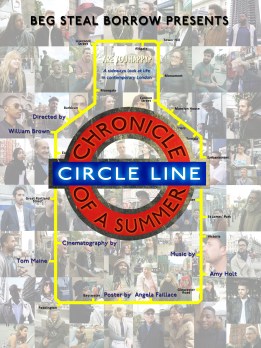
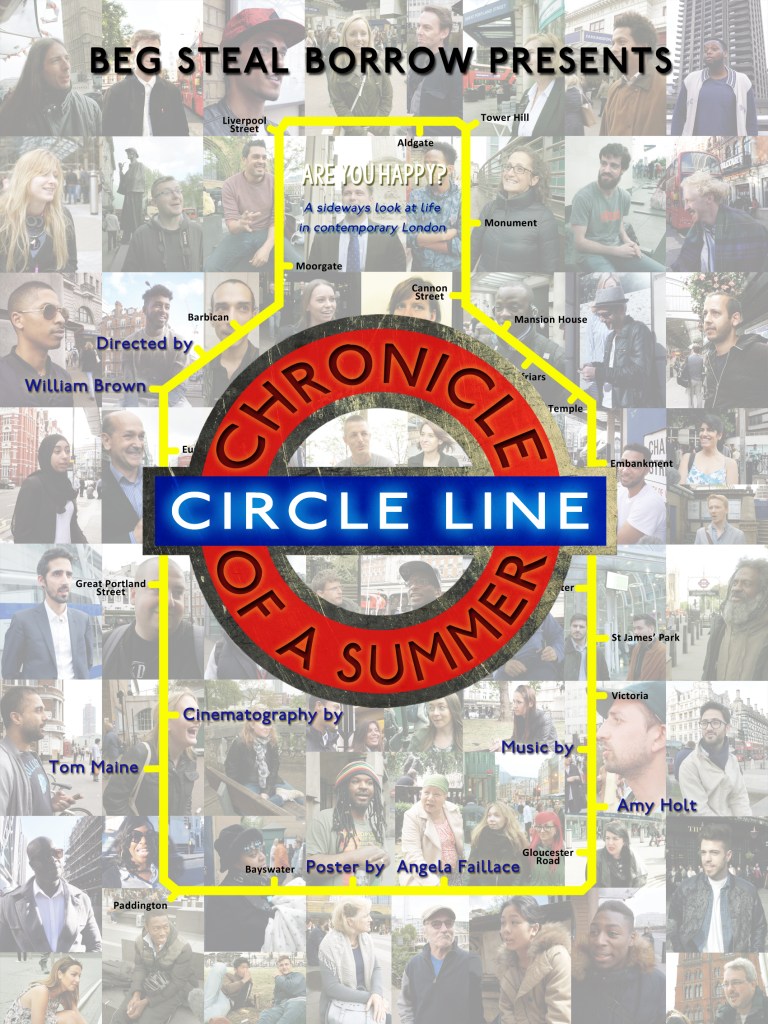
circle line_poster_v.5.2

Are you happy?

This is the question that we ask people outside or near the stations of London Underground’s Circle Line.

Circle/Line is, then, a documentary comprised of vox pop interviews with ‘everyday’ people – from the homeless to the hopeful, from the ambitious to the activist, from task-driven Londoners to tourists.

Inspired by Jean Rouch and Edgar Morin’s classic documentary, Chronique d’un été/Chronicle of a Summer (France, 1961), Circle/Line is nonetheless an original work and a fascinating insight into the lives of people in contemporary London.

Shot by Beg Steal Borrow regular Tom Maine, the film is both a portrait not just of people, but also of the city of London itself.


New support for The Benefit of Doubt

Beg Steal Borrow News, The Benefit of Doubt, Uncategorized

Two new personnel have joined the crew of The Benefit of Doubt as post-production work continues with the film.

Francisco Janes, an artist and filmmaker currently based in Vilnius, Lithuania, has come on board to carry out a sound mix for the film, while Oliver Campbell, a Beg Steal Borrow regular, has stepped in as an executive producer.

Francisco’s work has been exhibited internationally, including at Los Angeles Contemporary Exhibitions (LACE), Human Resources, AT1 Projects and the Kristi Engle Gallery.

Reminiscent of the work of filmmaker James Benning, Francisco in particular has a wonderful eye for form and space, as can be seen at his website here.

And for a sample of Francisco’s work, here is untitled (Last Chance Range, Benton Way), which Beg Steal Borrow’s William Brown first saw as an installation at the Cinema Camp in Gelgaudiškis, Lithuania, in 2014.

Oliver, meanwhile, has helped out on various Beg Steal Borrow films, perhaps most notably Common Ground, in which he acted the part of the missing brother of lead character, Dennis (Dennis Chua).

We are delighted to have both Francisco and Oliver on board – and are very enthusiastic about being able soon to show The Benefit of Doubt to viewers.

So look out for more news on the film’s progress here!

About The Benefit of Doubt

The Benefit of Doubt tells the story of Ariadne (Hannah Croft), a woman who finds herself single after ten years in a relationship, and who is now in her mid-thirties unsure as to what to do with her life.

bod

Hannah Croft as Ariadne in The Benefit of Doubt

Deciding to go on holiday to Nice, she drifts around before encountering Nick (Nick Marwick), an actor who has just taken, and who is about to start, a job teaching in order to supplement his attempts to break into the world of theatre and film.

Finally, she then also encounters Greg (Greg Rowe), a drifter who also finds himself in the south of France.

The three strike up an unlikely friendship as they walk around Nice discussing life, love and also their sense of doubt regarding their validity or worth in the world.

The film is inspired by the myth of Ariadne from Greek mythology. Having helped Theseus to defeat the minotaur by giving him a thread of wool, Theseus fulfils his promise to help her to escape from Crete and her tyrannical father, King Minos.

However, Theseus quickly abandons Ariadne on the shore of Naxos – leaving her alone and without support. Fortunately, Dionysus/Bacchus turns up and the two get married and have children.

And so, The Benefit of Doubt also features Nick and Greg as two aspects of Bacchus: one as the god whom most people do not consider to be a ‘true’ god (a struggling actor who is not recognised) and the other as a man of wine and the life Bacchanalean.

To be shot by Beg Steal Borrow stalwart Tom Maine, the film will draw upon both the numerous artworks and artists that are on display in or near Nice – from museums dedicated to Henri Matisse, Marc Chagall and Pierre-Auguste Renoir to nearby places dedicated to art naïf, modern and contemporary art and, in St Paul de Vence, the Fondation Maeght – as well as upon other films.

For, The Benefit of Doubt certainly takes inspiration from Jean Vigo’s classic 1930 experimental documentary, À propos de Nice, as well as from films like Richard Linklater’s Before Sunrise and Eric Rohmer’s Le rayon vert/The Green Ray, which sometimes is also referred to as Summer.

The film reunites various Beg Steal Borrow regulars, including director William Brown, cinematographer Tom Maine, actors Hannah Croft (En Attendant Godard), Nick Marwick (AfterimagesCommon GroundThe New Hope) and Greg Rowe (The New Hope), with Andrew Slater (Afterimages, Common Ground, The New Hope) helping on the production side of things, together with contributions from Annette Hartwell (The New Hope) and Lucia D. Williams (Common GroundThe New Hope).

The film will also feature some first-time contributions from Nice local Mark Hodge. And music-man David Miller (Common GroundUr: The End of Civilization in 90 TableauxThe New Hope) will be providing music for the score, together with original pieces by Amy Holt (who also did music for The New Hope and Circle/Line) and Alex Fixsen.

Filming is to take place in Nice between 1 and 9 October. Weather-permitting, we shall successfully finish what is Beg Steal Borrow’s ninth feature.

Circle/Line Preview Screening

Beg Steal Borrow News, Uncategorized

Beg Steal Borrow is happy to announce a preview screening of their documentary, Circle/Line, which will take place at the Whirled Cinema in Loughborough Junction on Sunday 14 August at 2.30pm.

circle line_poster_v.5.2

The Circle/Line poster was designed by the talented Angela Faillace.

To reserve a free ticket for the event, just follow this link and fill in the necessary details.

Here is a trailer for the film, with some further details below:

Are you happy?

This is the question that we ask people outside or near the stations of London Underground’s Circle Line.

Circle/Line is, then, a documentary comprised of vox pop interviews with ‘everyday’ people – from the homeless to the hopeful, from the ambitious to the activist, from task-driven Londoners to tourists.

Inspired by Jean Rouch and Edgar Morin’s classic documentary, Chronique d’un été/Chronicle of a Summer (France, 1961), Circle/Line is nonetheless an original work and a fascinating insight into the lives of people in contemporary London.

Shot by Beg Steal Borrow regular Tom Maine, the film is both a portrait not just of people, but also of the city of London itself.