Ur Preview Screening Announced

Beg Steal Borrow News, Uncategorized

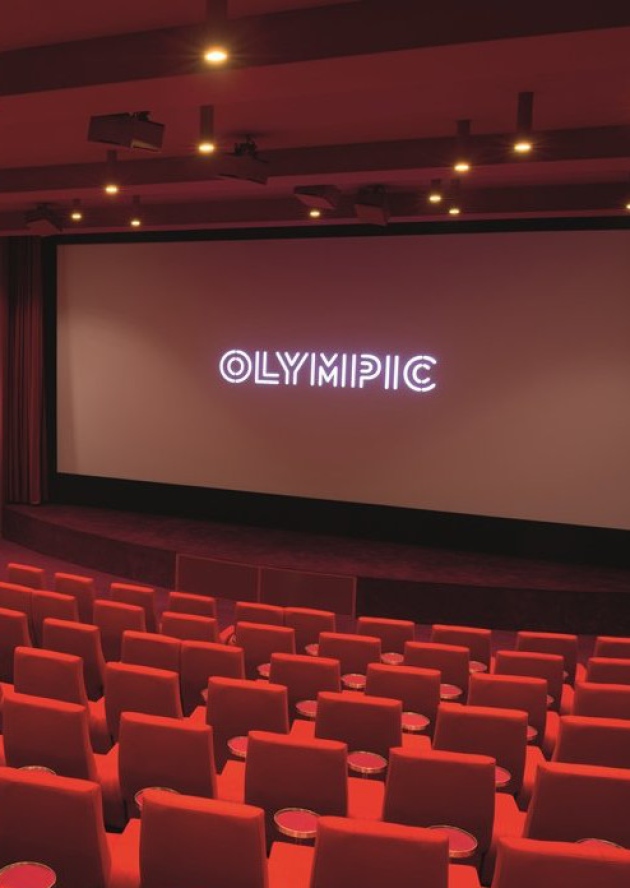
Ur: The End of Civilization in 90 Tableaux will enjoy a preview screening at the prestigious Olympic Studios in Barnes.

The screening will take place at 10am on 25 May 2014.

If for any reason you have come across the film and would likle to attend, then please email us here.

The Olympic is the site where many of the world’s greatest music artists have recorded their work – including the Rolling Stones, the Beatles, Led Zeppelin, David Bowie, The Jam, Pink Floyd, Duran Duran, Queen, Oasis, Barbara Streisand, Madonna, Prince and The Spice Girls.

Film-wise, the Olympic also features in Jean-Luc Godard’s film One Plus One/Sympathy for the Devil (UK, 1968), which is about the Rolling Stones.

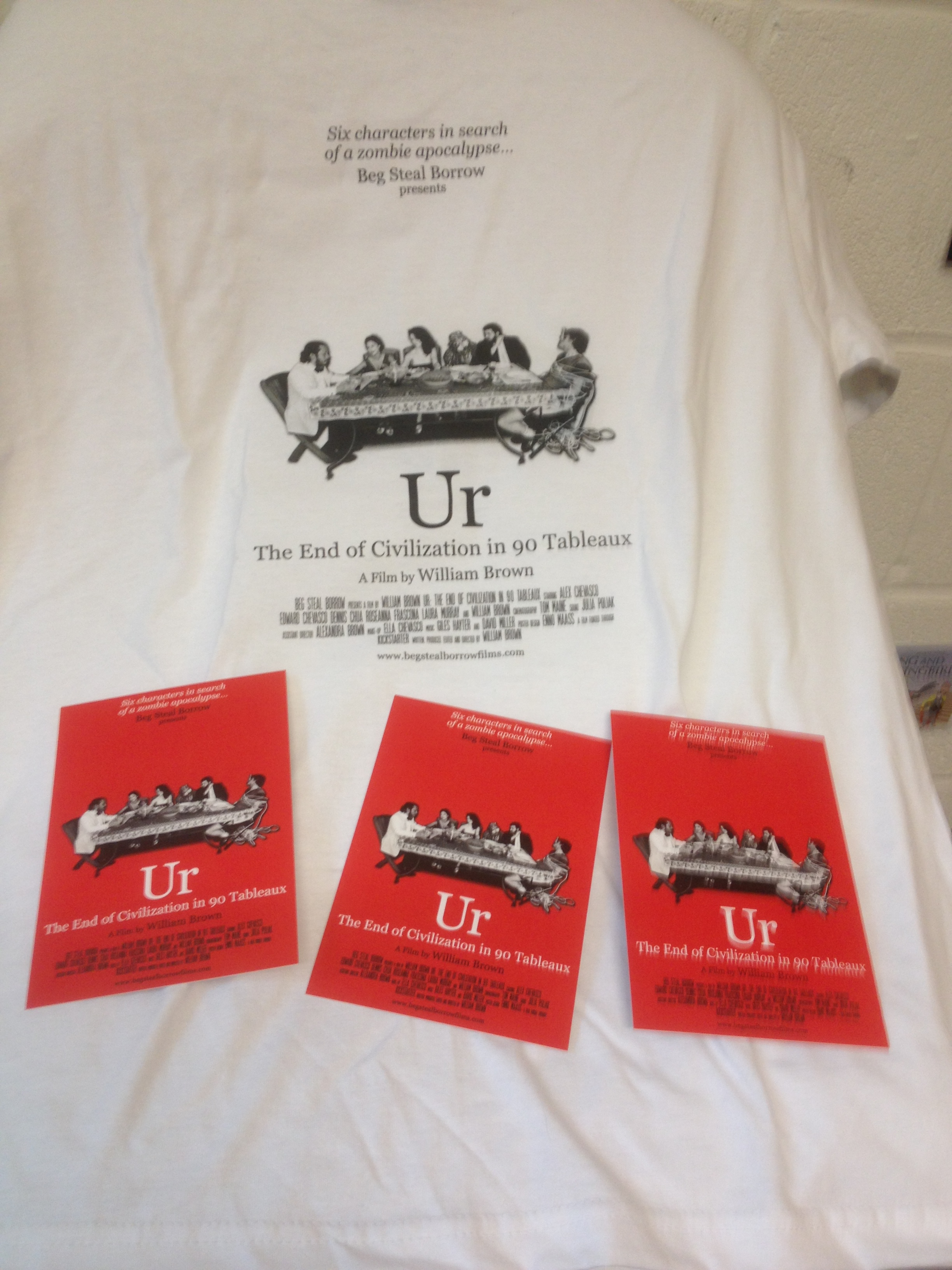
Ur t-shirt and flyers

The Rocket (Kim Mordaunt, Australia/Thailand/Laos, 2013)

Australian Cinema, Blogpost, Film education, Film reviews, Laotian Cinema, Uncategorized

I recently introduced The Rocket at the Ritzy Picturehouse in Brixton, London. The cinema has asked me to post my comments on the film online. While I was working from notes, and thus cannot reproduce fully what I said, this blog post nonetheless can convey some of my thoughts on the film.

So…

Set in Laos, The Rocket tells the story of Ahlo (Sittiphon Dissamoe), one of a pair of twins, but whose brother dies during childbirth. Ahlo is loved by his mother, Mali (Alice Keohavong), but twins are considered to be omens of bad luck according to local superstition. And since Ahlo’s brother died in childbirth, Ahlo must be a bringer of bad luck – or at least this is what his grandmother, Taitok (Bunsri Yindee), believes.

That Ahlo brings bad luck to the family is affirmed when the family is forced to migrate as a result of a dam being constructed in the region where they live. They are taken to a refugee camp, where their lives are affected by poverty. At the camp, Ahlo befriends fellow outsiders Kia (Loungnam Kaosainam) and her father Purple (Thep Phongam), who is obsessed with James Brown.

The family flees the camp, but endures more loss – affirming Ahlo’s status as the purveyor of bad luck, something that even Ahlo’s father, Toma (Sumrit Warin), begins to believe.

And so, in order to redeem himself, Ahlo decides to enter a rocket competition. This is a festival in which people build their own rockets and then fire them at the sky. Those rockets that fly highest, explode biggest and, if possible, which bring much-needed rain, will win a cash prize.

Ahlo enters, re-bonds with his father, and sets off a rocket that soars high, explodes mightily and forces the heavens to open. After tragedy, then, the film has a happy ending.

The Rocket is directed by Kim Mordaunt, a British-Australian who has lived extensively in Asia, and who has also taught filmmaking there.

Mordaunt has historically plied his trade most prominently as a documentary maker. Indeed, his earlier film, Bomb Harvest (Australia, 2007), has various similarities with The Rocket. Although the central character of that film is an Australian bomb disposal specialist, it nonetheless features Lao children who collect bombs to sell as scrap metal. This film no doubt informed The Rocket, since we also see Lao children playing around and working with unexploded bombs, including Ahlo.

The Rocket is Mordaunt’s first fiction feature, and it has won awards at the Berlin (Crystal Bear, Best First Feature, Amnesty International Film Prize), at the Sydney (Audience Award), and at the Tribeca (Best Film, Best Actor, Audience Award) Film Festivals.

Nonetheless, Mordaunt’s documentary sensibility remains in the film. This is made clear in the use of locations in the film (especially the stunning mountain scenery), but also, particularly, through the final rocket festival that is the film’s culminating point. Here, Mordaunt fuses documentary footage shot from an earlier, real rocket festival with footage shot at a recreation of that festival – and featuring his actors.

Furthermore, The Rocket has something of an ethnographic sensibility, charting rural Laotian life, including superstitions – as embodied in particular in Taitok and her belief that Ahlo is the bearer of bad luck.

Indeed, the clash of tradition with modernity is perhaps one of the key themes of the film, as I shall discuss presently.

According to Mordaunt, Laos is the most bombed nation on the planet, in part as a result of American bombing of the country during the so-called ‘Secret War.’ The ‘Secret War’ is another term for the Laotian Civil War that took place between 1953 and 1975, and which also involved those taking part in the Vietnam War. As a result, American and other forces dropped many bombs in/on Laos during this period.

Indeed, there are haunting scenes in The Rocket featuring unexploded bombs that have become an almost fixed part of the Laotian landscape – even 40 years after the end of the Secret War. The bombs, therefore, come to symbolise in the film both the precarious nature of life for the many people living in the Lao countryside (these devices could explode at any time, and lives can end suddenly, as the film shows us even from the outset with the death of Ahlo’s brother), but also the way in which Laos has perhaps been affected not by internal forces (how ‘civil’ was the Secret War?) but by external forces.

One senses, almost, that rural Laos might well continue to exist in a peaceful and bucolic fashion had it not been bombed into modernity. This forced entry into modernity continues today, but instead of bombs, the film shows to us the forced relocation of many Lao people as a result of dam construction (Mordaunt in interview reminds us that 60 million people have been relocated worldwide for dam construction – more than the entire population of the UK).

And, in an interview with the BFI, Mordaunt talks about how the film wants to reflect on Laos’ relationship with the wider world, suggesting how Australia plays a role in the dam-related relocations and the problem of robber barons (basically, people who bleed a country’s veins dry of its natural resources and get extremely rich in the process).

In Mordaunt’s own words: “There are a lot of cowboys about,” he says. “Our government is always saying we must relate to Asia. But the majority of that relationship is sheer economic opportunism. There are Australians making millions every year out of the place.”

In short, then, we see in The Rocket a Laos being forced into modernity by external factors that are not necessarily much to do with the country itself.

Nonetheless, the film does not simply suggest a romantic return to a pre-modern existence. Taitok’s superstitious belief that Ahlo means bad luck is ultimately proven wrong; Ahlo is not bad luck and, indeed, might be the bearer of good luck as he wins the rocket competition.

Indeed, that Ahlo wins the rocket competition by using materials from the unexploded bombs dropped during the Secret War suggests something quite stubborn, inventive and empowering. As Mordaunt says, the rocket competition allows the Laotians to ‘shoot back at the sky’.

That is, we see Laotians reappropriate the very bombs that brought them into modernity – even if, as Curtis LeMay might have put, the aerial onslaught of the time was also designed to bomb the Laotians back to the Stone Age. And in taking the remnants of foreign presence in Laos, in turning them into their rockets that help to maintain a Laotian tradition (the rocket festival), then we see an affirmative, potentially nationalistic, act of resistance taking place.

Perhaps we can read the character of Purple in this fashion as well. In impersonating James Brown, we see Purple take on an American icon who is associated with sex and libidinal release, suggesting that Laos, too, has desire for change.

However, the film is not without issues – and we can start to sort through those with a further consideration of the character of Purple.

On 5 April 1968, the day after the death of Martin Luther King, James Brown held a concert in Boston (the city where King had been assassinated) that was otherwise due to be cancelled, thus pacifying that city’s black community, which otherwise might have risen up in resistance and outrage in response to the events (as documented in The Night James Brown Saved Boston, David Leaf, USA, 2008).

With King as a noted civil rights activist who was vocal in his opposition to the Vietnam War, Purple would seem to use Brown also a means to speak out against the national trauma that has been the Secret War. Indeed, with Ahlo’s lost brother, with Purple’s alter ego as James Brown, and with the Secret War being the hidden other of the much more widely recognised and covered Vietnam War, The Rocket is in part about doubles – about missing doubles and overlooked histories that really ought to figure much more in our historical consciousness and in our understanding of the world today.

Nonetheless, Brown also caused controversy during the Vietnam War by travelling out to Asia in order to play to American troops. How ‘against’ the war was he such that he could do this? Brown insisted that soldiers are humans, too, but this makes the Purple-Brown analogy muddier and more problematic. And it becomes even more so when a source like this one suggests that Brown only agreed to play the concert if paid US$60,000 (of which he only allegedly received US$10,000). Did Brown take the money because one should not work for the Man for free, as it were? Or in going on stage and in asking Boston’s community not to react violently to the King assassination, did this make of Brown an ‘Uncle Tom’ figure – as various people accused him at the time?

In relation to Purple in The Rocket, that James Brown is such an unclear figure perhaps only reinforces the sense of trauma that Purple, with his military past, must have suffered. Somewhere here we have reworked Purple’s erased, real identity as the double of James Brown, as Ahlo is the double of Laos’ past, trying to work his perceived bad luck into some good luck by taking American bombs and firing them back into the sky.

The explosion might cause some rain to come down – with water being a key symbol of the film. A dam is being built – to use water for power, of course, but in an effort that might also privatise water, this most natural resource. The rural dwellers of the film are in a drought – and all that they have experienced in the past is a rain of bombs. And so they fire back into the sky and a new shower descends; perhaps the past will not so much be washed away, but allowed properly to appear and to be understood.

However, Purple is played by a well known Thai actor, Thep Phongam. In other words, if Purple as a character, and the film perhaps as a whole, are designed to make visible a ‘secret’ past that has for far too long remained invisible, it is ironic that a Thai star in fact only re-occults Laos; not even a Laotian actor can be found to play the part of a traumatised Laotian. That is, Laos continues to be invisible.

Perhaps the same is taking place through the casting of Bunsri Yindi as Taitok, Ahlo’s grandmother. Yindi is also a Thai actress, best known for playing the mother of Ting (Tony Jaa) in Ong-bak (Prachya Pinkaew, Thailand, 2003).

But most pertinent to this erasure-under-the-pretence-of-exposure is Mordaunt as director and the film itself.

 As the film’s website says, ‘The Rocket is one of the first feature films for international release set and shot in the intriguing and little-known country of Laos, rarely seen by the outside world since the end of the Vietnam War.’

(Air America, Roger Spottiswoode, USA, 1993, was set in Laos – but the film was in fact shot in Thailand and the USA. It stars Mel Gibson and Robert Downey Jr as pilots ‘recruited into a covert and corrupt CIA airlift organisation’.)

And yet, the film is made by an Australian-British filmmaker – and not by a Laotian.

In the film’s press kit, Mordaunt proudly declares that after Bomb Harvest, the ‘Lao and international response to the film was that we should make another film with a Lao child as the protagonist. And because Laos didn’t have a funded film industry we should be the team to endeavour to make Laos’ first internationally released feature film.’

It is in some ways fair enough that Mordaunt should make any film he chooses to, not least because, as he makes clear, Laos has no film industry to speak of. But on another level, since it is Mordaunt who is at the centre of the film’s publicity (rather than, say, Ki, the boy who plays Ahlo and whose performance is absolutely remarkable), we see Mordaunt himself becoming a quasi-robber baron of sorts – exploiting Laos and its history in order to make a career for himself.

Similarly, Australia put the film forward as its nomination for the Best Foreign Language Film at the 2014 Academy Awards. Australia, therefore, is happy to reap the benefits of this film in a similar fashion that makes Australian a film that is supposed to be giving to Laos its own cinematic identity. Those amazing landscapes that help to sell the film are not Australian, but Laotian. They should be recognised as such.

In short, then, if the film is supposed to convey how Laos has been forced into modernity by foreign forces (Vietnam, the USA, Australia), then the film and Mordaunt in fact only continue this cycle. Laos itself gets re-buried after having exhumed for the benefit of Western audiences – something made clearer still when we learn that the film was banned in Laos itself (my thanks to Sonia P Barras and to Ben Dunant for bringing this to my attention).

Perhaps this also explains why, even though Mordaunt mentions that the film reflects on how Australia plays a role in shaping contemporary Laos, this is not actually particularly visible (if at all) in the film itself. In other words, while Mordaunt’s words do help to justify his film politically, one wonders that the film itself does not in fact have much political, but rather an economic sensibility.

This is made clear by the film’s final ambition for Ahlo to get rich quick via a rocket competition. As per the equally problematic Slumdog Millionaire (Danny Boyle and Loveleen Tandan, UK, 2008), money – and money gained via luck/a lottery of sorts (it happens to start to rain when Ahlo fires his rocket) – is posited as the answer to all problems. In other words, Laos can only get on board in modernity if it adopts a policy of individual, rather than collective, enrichment via competition.

In short, The Rocket suggests that capitalism is the answer for Laos. No wonder the film got banned in the communist country that is Laos itself…

Slumdog is equally problematic in its British use of India – and in its tale of individual escape by competition-winning. That co-director Loveleen Tandan is barely given any credit for the film – Danny Boyle did not share his directing Oscar with her – demonstrates clearly the true erasure of India that the film in fact gives to us.

Perhaps, then, it is no coincidence that Western reimaginings of places like India and Laos can only be problematic – and perhaps we are in the midst of seeing a new, cinematic imperialism given how prominent it is becoming that Western filmmakers travel to the Third World in order to start their filmmaking careers.

(A short list of films might include Maria Full of Grace (Joshua Marston, Colombia/USA/Educador, 2004), Año bisiesto/Leap Year (Michael Rowe, Mexico, 2010), Soi Cowboy (Thomas Clay, Thailand/UK, 2008), Grand comme le baobab/Tall as the Baobab Tree (Jeremy Teicher, Senegal, 2012), Katalin Varga (Peter Strickland, Romania/UK, 2009) – but there are many, many more.)

Finally, then, cinema is itself a double of reality. As Ahlo hides his dead twin, so perhaps The Rocket hides the real (dead?) Laos that this film proclaims to reveal. The Rocket is a visually stunning and beautifully acted film, demonstrating the precarious nature of life in rural Laos and showing us – at least implicitly – a scarred and traumatic national past in a sensitive and affecting fashion.

The problem remains, however, that while Laotians should perhaps indeed shoot back at the sky, they are not (yet) shooting their own films. The deprivation of water, here understood as the flow of cinematic images, seems instead to continue…

Ur Preview Screening Announced

Beg Steal Borrow News, Screenings, Uncategorized, Ur: The End of Civilization in 90 Tableaux

A preview screening of Beg Steal Borrow’s latest film, Ur: The End of Civilization in 90 Tableaux, has been announced.

The screening will take place at 10am on Sunday 25 May 2014 at the prestigious Olympic Cinema in Barnes, London.

The prestigious Olympic Cinema will host the first preview screening of Ur: The End of Civilization in 90 Tableaux.

The prestigious Olympic Cinema will host the first preview screening of Ur: The End of Civilization in 90 Tableaux.

If you are interested in attending the screening, please email begstealborrowfilms@gmail.com – although places will likely be limited.

Further preview screenings will hopefully be arranged during the summer as the film’s makers move towards submitting the film to various European and other festivals.

A teaser for the film can be found here:-

Ur posters ready…

Beg Steal Borrow News, Uncategorized

We are just weeks away from Ur: The End of Civilization being ready to watch – with a hopeful preview screening coming up in April…!

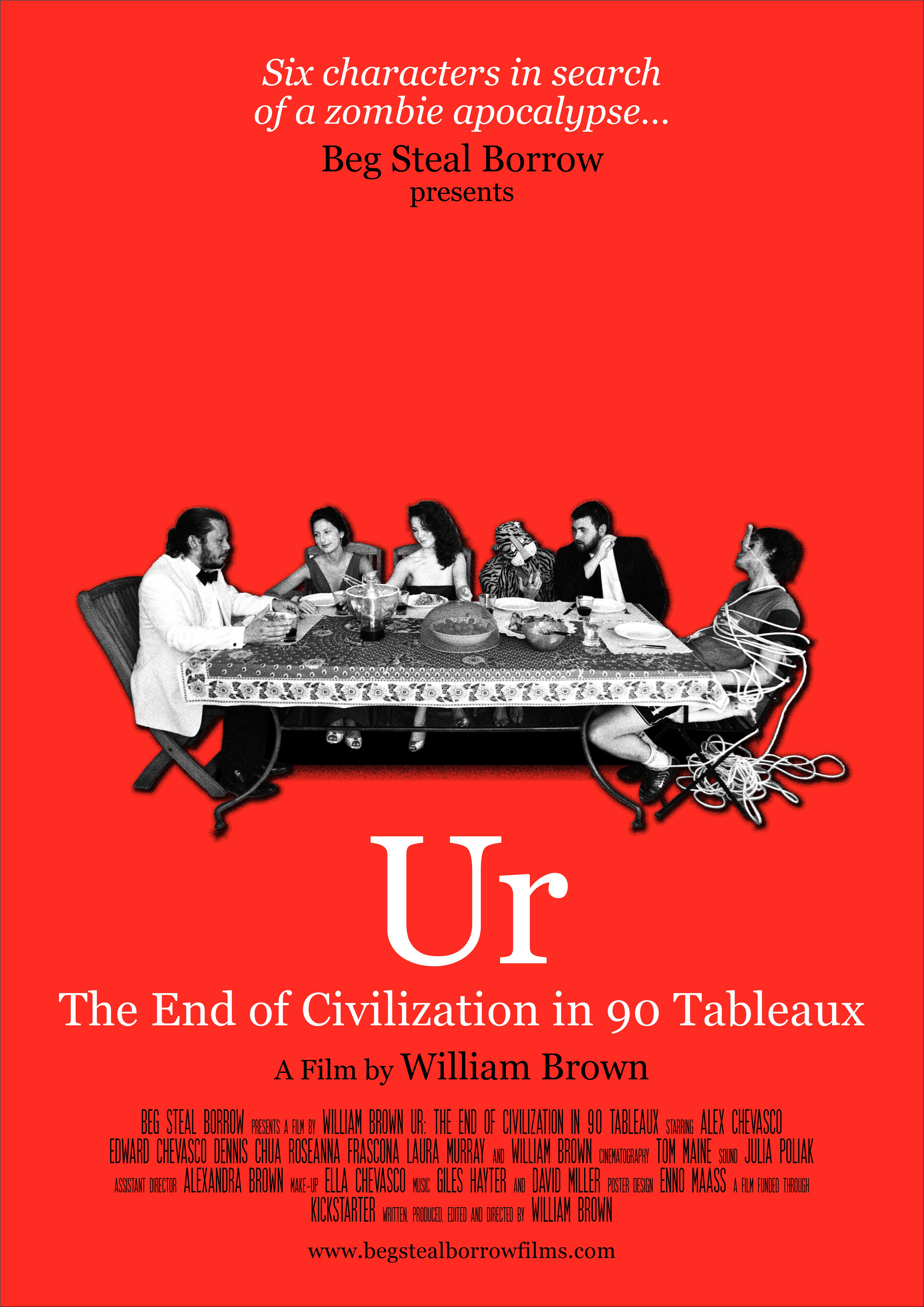
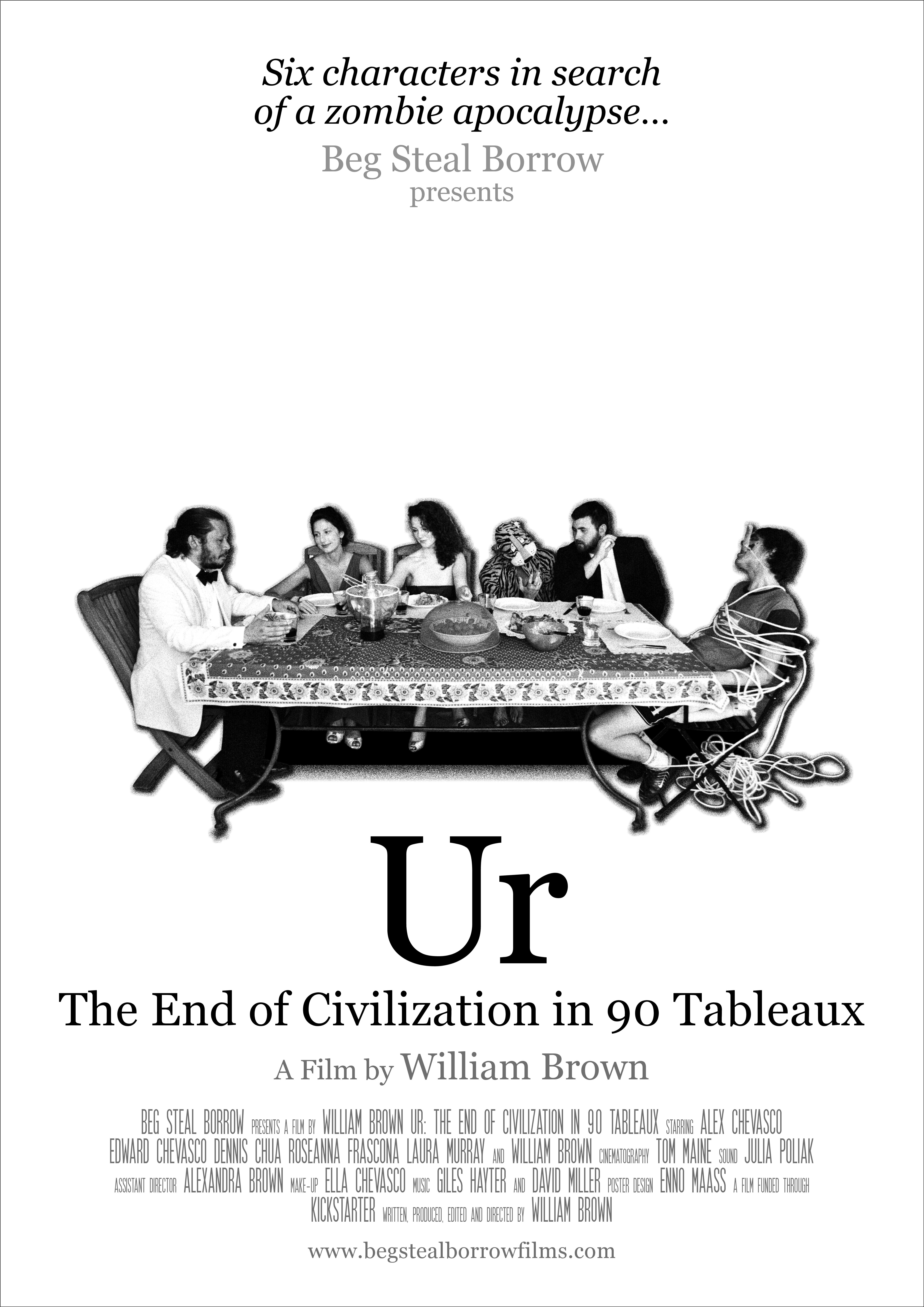
However, in the meantime, the supremely talented Enno Maass has put together two designs that will become the film’s promotional poster and postcard.

And you can see them both here…

Please enjoy first the red version:

The red poster for Ur: The End of Civilization in 90 Tableux

The red poster for Ur: The End of Civilization in 90 Tableux

And then the white version:

The white poster for Ur: The End of Civilization in 90 Tableaux.

The white poster for Ur: The End of Civilization in 90 Tableaux.

Many thanks to Enno for such a great job!

And keep your eyes open for more Beg Steal Borrow news shortly!

Beg Steal Borrow enters a new domain

Beg Steal Borrow News, endemic, Uncategorized, Ur: The End of Civilization in 90 Tableaux

Beg Steal Borrow is pleased to announce that it has secured the new domain name for its website, http://www.begstealborrowfilms.com.

This means that Beg Steal Borrow is upgrading from being a WordPress site to its own, dedicated site.

This is simply the next step in the evolution of the enterprise from handmade beginnings to, well, slightly less handmade continuations.

Evidently, do check out Beg Steal Borrow on Facebook, as well. And check out the possibility of watching Beg Steal Borrow productions on Vimeo (hopefully to be announced officially in the near future).

Finally, do keep reading for updates on Ur: The End of Civilization in 90 Tableaux, our forthcoming feature, and other projects here…

Gravity (Alfonso Cuarón, USA, 2013)

American cinema, Blogpost, Film reviews, Uncategorized

I was fortunate enough early this week (18-20 November 2013) to give a few talks in Sweden, at the University of Gothenburg and at the University of Skovde. At both institutions, I spoke about digital cinema, while also delivering a third paper on neuroscience and film at Skovde.

What was in particular of interest, however, was the way in which the trip allowed me to discuss with my esteemed colleague, Lars Kristensen, about his ongoing work on bicycles in cinema. Furthermore, since Skovde, where Lars works, has a strong emphasis on the study of video games, it also allowed us to discuss gaming.

In a relaxed conversation, we ended up hypothesising something along these lines: cinema has a dual tendency – for realism and for fantasy, a dual tendency also at work in video games, but which manifests itself in a different way.

Put succinctly, when cinema deals with bicycles, it often presents to us a strong notion of the physicality – of the embodied nature – of bike riding, and also of what goes into owning and maintaining a bike.

We need look no further than Vittorio de Sica’s classic Ladri di biciclette/Bicycle Thieves (Italy, 1948) to see this realist tendency at work in terms of how the bike is an important component in physical existence: the film tells the story of a man whose very livelihood depends on the bicycle, even if we do not see him ride it very much.

To take a less well known example, we also see in Mohsen Makhmalbaf’s Bibycleran/The Cyclist (Iran, 1987) the way in which the physical act of riding a bike is exhausting – a physical experience that is understood best through one’s body.

This we can compare with a film like E.T.: The Extra Terrestrial (Steven Spielberg, USA, 1982), in which we are given a fantasy version of the biking scenario: Elliott (Henry Thomas) eventually flies on his bike, in effect no longer needing physically to ride the thing, because E.T. just allows him to take off.

This latter example, E.T., is cinema as fantasy: cinema allows us at times to transcend the limits of gravity and to take off.

Now, we tend to think of computer games as not being particularly realistic, and therefore perhaps more fantastic. This is most clear in terms of the relationship of the images that we see in video games to reality: unlike analogue photographs, which have an indexical link to reality owing to the much theorised concept that photographic and cinematographic images bear the direct imprint of the light that was before the camera at the time of the image’s taking, digital images have no such link. And as a result, digital images are freed from the shackles of the real world and can depict fantastic places and deeds that defy the physical limitations of that real world.

The same applies to digital images in cinema as applies to digital images in games: digital cinema – in terms of special effects cinema – sees fantastic figures performing fantastic feats, many of which defy gravity. Flying cameras, flying characters – all unhooked from reality and existing in a fantasy realm.

While cinema commonly offers us myths of flying – of defying gravity – gaming, however, seems paradoxically to be defined precisely by gravity, at least a lot of the time. Sports simulations may involve getting the game’s avatars to perform bitchen and radical moves, including on bikes. But they also involve falling back to Earth. Mario and Sonic can jump great heights, but they always land. Lara Croft sometimes cannot jump high enough. And Tetris is defined almost uniquely by the inevitable weight of gravity – including, as the game progresses, the notion that the objects fall faster and faster the further one gets.

(To go way back through the canon of video games, I always felt horrified when Jet Set Willy would on occasion fall down from one room in his mansion and through into another, where Willy would continue to fall to his death – sometimes seven times in a row (Willy’s number of lives), since Willy would always start a new life in the exact location where he entered the last room before his death. It was agonising to watch Willy fall seven times in a row, even worse when he did this after I’d loaded the cheat version and caused Willy to have innumerable lives – i.e. he would fall and die in a loop forever.)

This discussion provides an excellent context through which to offer up a brief consideration of Alfonso Cuarón’s latest film, Gravity, which I saw this evening (21 November 2013) at the BFI IMAX in London in 3D.

I shan’t do much more than allude to the way in which Gravity has something like a game structure: it is about solving problems in short order, getting from space shuttle to space station, to another space station and then – spoiler (of a sort) – to Earth (though the clue is in the title of the film, so this should not constitute too ‘bad’ a spoiler – ‘worse’ are to follow).

However, being a film that is in enormous part the result of digital animation, Gravity does also play with the dual tensions within cinema – as explained via the bicycle analogy – towards fantasy and towards realism.

For, while digital cinema can show us incredible feats performed by impossible specimens, Gravity seems instead to want to use its digital effects to convey something a lot more ‘realistic’.

This is not simply a case of the perceptually realistic images that we see of Earth and of the Heavens from orbit – excellent though these are, and important though they also are to my argument about the film.

Nor is it that Gravity is without fantasy/fantastic elements, as I shall discuss presently.

But rather, I shall propose that Gravity demonstrates the way in which something so false as a digital image can in fact function towards realistic ends. Or rather, it can function towards helping us to believe in reality.

To paraphrase Gilles Deleuze, the film offers a parable about how the power of the false (the digital image) can reaffirm our belief in the real (the world that we inhabit) – and that, arguably, this is key to the film’s power over audiences (even though some people I know have responded to the film in a way that we might in the vernacular term ‘meh’ – i.e. not particularly impressed).

(I should qualify this by saying – based upon off-blog discussions about the earliest version of this posting, that I am not particularly in love with Gravity if you want my value-judgement of the film. I found the IMAX 3D in particular annoying because parts of the images, typically Sandra Bullock’s face, blur if you do not look at them directly, and Cuarón did not push the deep focus far enough – for me, variable focus and 3D are antithetical, since my eyes want to search the depth of the image, and instead I am confronted with more blur. Beyond which, I am not particularly interested in whether a film is good or bad; these are relative and relatively pointless terms. I am more interested in what a film is trying to do, and I might – as per Gravity – cut the film some slack when it is trying to do something interesting, even if it does not achieve its aims for every audience member – hence the ‘meh’ that many people express at the film.)

Now, Gravity tells the story of how a physicist, Ryan Stone (Sandra Bullock), tries to get back to Earth after her first space flight to work on a telescope goes horribly wrong as a result of a débris shower brought on by destroyed satellites.

She struggles with her colleague Matt Kowalski (George Clooney) to get from her space shuttle to a first and then a second space station, all the while with limited resources – before trying to get back to Earth.

So, here is a key fantasy element: there is in particular a sequence in which Kowalski reappears to Stone late on in the film. She is about to give up on her attempts to re-enter the Earth’s atmosphere, but he enters the Russian pod in which she finds herself and gets her to continue in her endeavours to escape/to survive.

Significantly, the film does not cut as we transition from what appears to be a realistic moment (Stone alone in the pod), into this fantasy apparition from Kowalski, and then back again to her being alone in the pod.

In other words, the fantastic seems to be on a continuum with the real, such that we cannot tell them apart. Indeed, one might infer from this that nothing else that we see is real, but instead all a fantasy – and that Stone is in fact dreaming the whole situation.

This is a plausible take on the film, but one that would only to me signal something that all viewers already know: that the film as a whole is of course a fantasy – this is a fiction film starring well known stars whom we know not to be astronauts in real life – but that this fantasy might nonetheless have an effect in the real world, that this fantasy might allow its viewers to believe (once again?) in the real world.

Perhaps the casting of those self-same stars is important here. We have Clooney, the star of Steven Soderbergh’s slightly maligned but interesting remake of Andrei Tarkovsky’s Solyaris/Solaris (USSR, 1972; USA, 2002). In that film, space is used as a vehicle for fantastic projection: faced with the void of space, the fact that our memories and our fantasies structure and are an inseparable part of our perception of reality becomes most tangible. In effect, we realise that humans are incapable of facing the void, of facing the reality of the enormous scale of the universe, of facing our insignificance and our death, and that we use fantasy (we use the desire to see reality as a film?) to cope with the emptiness that otherwise surrounds and perhaps is us.

Bullock, too, is the veteran of many a ‘fine’ action film – Speed (Jan de Bont, USA, 1994) is the one that most particularly comes to mind – though she also does increasingly a line in credible, realistic portrayals of ‘real’ people, as The Blind Side (John Lee Hancock, USA, 2009) and 28 Days (Betty Thomas, USA, 2000) might suggest. That is, she seems to come with – and to embody – the dual concerns of gravity.

And then, perhaps importantly, we have the voice of Ed Harris as Mission Control – he being associated with ‘real life’ space travel films Apollo 13 (Ron Howard, USA, 1995) and The Right Stuff (Philip Kaufman, USA, 1983). In other words, Harris ‘grounds’ the film in supposedly true/authentic cinematic depictions of space/space travel, thereby reinforcing Gravity‘s credentials as a film that relates to the real world.

I mentioned earlier the shots of Earth and the Heavens from space. These are digital compositions and not ‘real’. However, in particular during the film’s opening 10 minutes, in which we enjoy a single, unbroken shot of space and then of the astronauts as they work on the damaged telescope (and conjoined shuttle), we are – or at least I was – inclined to view these images as awe-inspiring.

Conceivably, images of Earth and of the Heavens have become ubiquitous, such that we look at them without thinking very much when we see them. Nonetheless, we can look at them sometimes and feel that sense of being small, of feeling lucky to breathe, of feeling lucky – mind-bogglingly lucky – to exist at all in a universe that is so dark and cold.

The duration of the shot/take is here important: for no doubt many viewers might regard the Earth and the Heavens in an unthinking fashion, especially were they to pass by rapidly, as can often happen in films set in space. However, because we get so long to contemplate in this opening sequence (as well as at other times), the very duration of these shots helps to maximise the possibility of this sort of response.

If one still feels inclined to say ‘but we know that these are not real images, and therefore I cannot feel about them anything “philosophical” along the lines suggested here’, then perhaps my only attempt to get such a reader to reconsider would be by saying that it is perhaps important that Stone is up in space working on a telescope.

For, telescopes like Hubble in fact have digital cameras. That is, they do not take images of space that have an indexical link to reality – as per analogue photos defined above. Rather, telescopes like Hubble take digital images of space – what we see has no indexical link to what was before the camera at the time of the image’s taking, for what we see is in ‘reality’ only made up of the 1s and 0s that form digital code – and yet these digital images still form the foundation of our best, scientific understanding of the universe.

In other words, it is only in art/cinema that the indexicality issue seems to loom so large; in science, there seems to be no such problem (a likely overstatement, but I hope its spirit is understood).

And when faced with the vastness of the universe, and with our own insignificance and mortality, we are confronted with the void, with death. Perhaps it is for this reason that the film then feels compelled to suture into a disaster movie/game scenario: genre functions as the coping mechanism for us to deal with the fact that ultimately there is nothing but the void, that ultimately digital images are indices, not of the world, but of the void itself.

But cannily, the genre is, as we know, a disaster movie: Stone has to save herself from the perils of space, just as many movie characters before her have saved themselves from sinking ships and alien invasions.

In other words, the film works hard to maintain the notion of a threat of death. And here the ’embodied’ nature of the film becomes important: as many spectators testify, and as the supposedly ‘immersive’ nature of both 3D and large format cinema (IMAX) reinforce (especially when working in conjunction), it becomes as if we are ‘there’ with Stone. That is, we ‘experience’ what Stone experiences, namely a fear of death.

We particularly ‘experience’ this fear through the film’s use of sound, as has been widely noted. We are given to hearing Stone’s breathing – with oxygen forming a central theme of the film, as well as her heartbeat, and I for one as a viewer did often find myself tensing up at crucial moments.

Also key to the film is the notion of touch, and in particular of gripping. The human mirror neuron system functions in such a way that when we see conspecifics (other humans) trying to grip an object, the same neurons fire in our brain as fire in the brain of the person doing the gripping.

Here the film’s editing becomes key. For while the movie is defined by long takes that suggest massive scale – lending to the film a temporal, experiential realism (‘real time’) that sits alongside the film’s perceptual realism, the close ups of hands trying to grasp objects that will save the life of Stone (and Kowalski) give to the film a ‘haptic’ quality, such that we are not just feeling what the characters are feeling, but also feeling for something to hold on to in the same way that they are.

Perhaps it is important that the threat in this film is human caused. Aside from some potential digs at the Russians for launching a missile at one of their own satellites – the initial cause for the débris – it is not necessary for this film to resort to aliens as threat.

By making the threat ‘human’ in origin, Gravity seems to offer no escape from the void, retaining a level of plausibility that in turns helps the film to seem realistic.

As Stone begins to despair, she finds a Chinese radio operator who has a dog that barks and a baby that cries. It is a remarkable moment when Stone barks along with the dog: the barking seems to be the expression of the inner void that the film seems to want to depict.

Perhaps it is no coincidence that Stone has lost a child in her past; that is, she is a woman in despair, overwhelmed by her helplessness before the lack of justice in the universe. For her, work – conceptual space travel – becomes the device that helps her to fill not the void created by the loss of her child, but the fact that the void is all around her anyway. Death is everywhere.

(Perhaps it takes a Mexican director, a compatriot of Octavio Paz, a celebrant of the Day of the Dead, to get a handle on death in this way. Although Danny Boyle’s remarkable Sunshine (UK/USA, 2007) also has a strong understanding of death within the context of a space film.)

I have repeatedly said that Gravity is realistic, and yet the film is also full of symbolic images. Symbolic images potentially challenge the idea of realism, because in real life there arguably are no symbols.

I am thinking in particular of Stone in the foetal position as star-child, or Stone continually being reborn as the film progresses, emerging from womb after womb.

Nonetheless, while symbolic, these moments also visualise something important: namely that, in being continually reborn, we get a sense in which Stone is consistently becoming. That is, she does not settle for who she is and lean back and die, but instead she consistently fights/struggles to overcome her situation.

This may be a (female twist?) on the classical male heroism of normative cinema. But on another level it suggests that Stone learns, that she consistently is taking positive lessons from her interactions with the void/with death, and using these to project herself forwards into life. In other words, even though the film has various symbols of rebirth, Gravity seems to suggest that Stone paradoxically becomes via her interactions with the void, it inspiring in her ever deeper coping strategies that come in the form of her will to survival.

If I have tried to avoid spoilers so far, I am about to offer up a description of the final scene, so you have been warned…

If movies like E.T. present a defiance of gravity – with the defiance of gravity/fantasy being a key aspect of cinema – Cuarón paradoxically (since this is a big budget special effects movie) represents gravity as inevitable. The film must be dragged down to Earth eventually.

And nowhere for me is this more clear than after Stone has landed back on Earth (conveniently in a small lake). Stone (who like all stones must fall) swims to the shore and lies on the beach. We see her grip the sand, then stand up and walk away.

Briefly we get to see during this final sequence one of Stone’s footprints in the sand. The footprint is another index: like light hitting the analogue film stock, so, too, is a footprint a direct imprint of the human standing on that spot at a particular place in time.

In other words, as Stone breathes air and touches the sand, so, too, does she make an impression on it. After much time in space touching objects with gloves (even if keeping a grip is, in every sense perhaps, key to her survival), she is now in touch with reality again.

In other words, having fled into empty space after the loss of her child, she is now able to be in and with the world again. She can believe in the world again. And so maybe the whole film is her fantasy – a fantasy of the void in order to help her escape the void and to believe in the world again.

But we also have here a sense in which the world is our only refuge from the void. Perhaps even our experiential perceptions are attempts for to us impose a pattern on what is otherwise essentially formless, what is otherwise just an empty void, dead.

As such, we cannot ever really see reality/the void, even if we can feel its presence everywhere, just as we feel gravity.

Gravity may be a film that is full of non-indexical, digital images. And yet, if the power of the false that we use/need in order not to be overwhelmed by the void is sufficient to make us believe in the world – as happens for Stone – then perhaps the power of the false that is Gravity can also help us viewers to believe in the world as well.

Digital cinema may be empty like the void; but like the void, what it can do is to spur us to embrace the world and our fragile lives as best we can.
Notes from the LFF: Dast-Neveshtehaa Nemisoosand/Manuscripts Don’t Burn (Mohammad Rasoulof, Iran, 2013)

Blogpost, Film reviews, Iranian cinema, London Film Festival 2013, Uncategorized

I fell in love with the cinema of Mohammad Rasoulof when I saw Bé omid é didar/Good Bye (Iran, 2011) at the 2011 London Film Festival. For me this film was every bit as good, if not better, than the works by Jafar Panahi and Asghar Farhadi that caught most/more public attention in terms of films from Iran at around that time.

I was then fortunate enough to see the remarkable Jazireh ahani/Iron Island (Iran, 2005) and Keshtzar haye sepid/The White Meadows (Iran, 2009) during a retrospective of Rasoulof and Panahi’s work at the British Film Institute last year.

So it was with great expectation that I went to see Manuscripts Don’t Burn at this year’s London Film Festival. And in many respects the film does not disappoint.

The film is about a writer, Kasra, played by an anonymous actor – since all who took part in the film must remain anonymous, apart from the director, of course, as a result of the danger in which they will be for taking part in this film – who has written an exposé about the murder of various writers in Iran in the 1980s and 1990s.

His manuscript, entitled The Uneventful Life of a Retired Teacher, is to be published clandestinely, except for the fact that the authorities are on to him and are searching for the titular piece of work – in his house and in the houses of those who work with him (publishers, other writers, poets).

Interestingly, however, the film is told predominantly from the perspective of those who are carrying out the investigation into Kasra’s manuscript. To this end, we follow two hitmen, Morteza and Khosrow, as they carry out searches, abduct individuals, torture and murder suspects and the like.

Since Rasoulof is, like Jafar Panahi, serving a 20-year ban from filmmaking, Manuscripts Don’t Burn is by consequence an underground film, even if it predominantly eschews the handheld and improvised aesthetic of many ‘underground’ movies – such as Bahman Ghobadi’s Kasi az gorbehaye irani khabar nadareh/No One Knows About Persian Cats (Iran, 2009).

That said, while the film does often look controlled and elegant, rather than filmed in a rush, Manuscripts… opens with, and continues for quite a while to show, images shot with a high shutter speed, which lends to the action that we see a sort of ‘digital jitter’ that does in fact suggest a hurried, ‘guerrilla’ aesthetic.

There is a nod, then, to the clandestine manner in which the film was shot, but Manuscripts… is aesthetically interesting because it spans the two trends that seem to predominate concerning films coming out of Iran. These are namely underground films along the lines of Persian Cats and others – films shot without permits, often made on the fly and, in Ghobadi’s case, on the streets, and genre films, like Rafi Pitts’ The Hunter (Iran/Germany, 2010), more ‘official’/authorised films that seem to ‘hide’ subversive elements within more mainstream-seeming fare (suggestions in the muse-en-scène).

Manuscripts… is also politically interesting, because rarely will one have seen a film out of Iran that features such violence (even if still shot and carried out in a muted, unsensational tone), the drinking of alcohol, and, simply put, criticism of the authorities as they carry out their surveillance and torture in pursuit of the elusive manuscript.

The film is downbeat, pessimistic even, but also fearlessly defiant in this way. Even though, I have read, the film’s story is based on the real abduction of writers in 1995 (what unites many of the writers is their having all been on a bus to Armenia for a conference), Rasoulof nonetheless sets the film in the present: mobile phones seem ubiquitous and at one point a character, Kian, says that in the age of Facebook and Twitter no one is interested anymore in politics – a sentiment echoed when another writer, Forouzadeh, suggests that politics today means just living, the implication being that it does not mean protesting.

And yet, the deliberate digital jitter that we see so overtly for the opening section of the film (potentially it remains, but my eyes began not to see it anymore as the film progresses) suggests that this overtly political film is a result of the digital age, the age of Facebook and Twitter. And so Manuscripts… seems to be more upbeat than its characters about the possibility of and for change in the contemporary era.

Nonetheless, it is a guarded ‘upbeatness’ – for the film also ends in a loop, taking us back to the beginning of the film where the government hitmen run away from the scene of one of their murders.

The moment triggers several thoughts: is what I have seen real, or a hallucination? What takes place when? Have I utterly misunderstood the film? This hallucinatory quality suddenly instils a kind of fear or vertigo in the viewer, bringing out the feverish urgency, perhaps, of Rasoulof’s movie. It also unsettles our understanding of what is real and what is not, or of what happens when. This suggests the malleable nature of truth in societies that control all media outlets that help to form the consensual hallucination known as ‘the truth’. And it also suggests a sense of entrapment – for both the victims and the perpetrators of state crime.

What is more, the film ends with one of the hitmen walking away from the camera and into a crowd of people (before the credits tell us that no one is to be credited). This is the territory of Ladri di biciclette/Bicycle Thieves (Vittorio de Sica, Italy, 1948).

But where in that film we see Ricci merge with the crowd to suggest that life is tough for people on the streets in post-war Italy, here we have a sense of conspiracy: whom can we trust if anyone on the streets might be coerced, for financial if not for ideological reasons, to become a murderer for the state?

Rasoulof’s film sets us in a panic, then – and we are not even sure that we have watched a ‘film’ proper because no one is credited. Manuscripts may not burn, but Manuscripts Don’t Burn burns passionately – and yet it seems indestructible, even if its life is mainly a digital file mainly to be pirated. Unafraid of complexity, Rasoulof has delivered another excellent, relevant and profound film.

The Repairman (Paolo Mitton, Italy/UK, 2013)

Blogpost, European cinema, Film reviews, Italian Cinema, Raindance Film Festival 2013, Uncategorized

Nominated for best debut feature at this year’s other London film festival, Raindance, The Repairman tells the story of Scanio (Daniele Savoca), a man who ekes out a living fixing machines for an absentee boss, and whose fate in life it is to be perennially criticised by his friends.

Scanio meets and enters into a relationship with Helena (Hannah Croft), but, ultimately, their relationship falters because Scanio cannot show much passion for her – obsessed instead as he is with his job, or at least with trying to maintain his job.

If the above synopsis seems brief, this is because not that much really happens in The Repairman. But instead of being a film about plot, The Repairman is, rather, a film about a certain mood or mode of living.

Put most succinctly, the mood or mode of the film is that shared by the main character, Scanio: a sort of strange, naïve but upbeat melancholy. ‘Upbeat melancholy’ probably sounds like a contradiction in terms. Well, perhaps does not so much sound like one as it actually is one. But this is because the terms are not quite sufficient to convey the mood/mode of the film – and the difficulty that one has with conveying the mood/mode of the film is in fact what makes the film particularly unique and worthy of a brief blog on a Raindance film amid what I hope will be a few posts about films from the ‘bigger’ London Film Festival.

One could potentially characterise The Repairman as bittersweet, but this is a term one might use for a Mike Leigh film or some such – and while there is humour in Mike Leigh, his films are not (often) as overtly comic as is The Repairman. The film features scene after scene of slow charm – wry observations of dinner party conversation, quirks of habit, the refusal to conform – mixed in with very un-Mike Leigh-like quasi-fantasy elements.

Put in terms of cinematic precedents, The Repairman might be defined as a mix of Le fabuleux destin d’Amélie Poulain/Amélie (Jean-Pierre Jeunet, France/Germany, 2001) and the works of cineastes like Nanni Moretti and Jacques Tati.

The Amélie elements are suggested by the interest in technology shown by the film and the way in which these are interspersed with romantic elements. It is a staple of Jeunet’s work, especially his collaborations with Marc Caro (particularly Delicatessen, France, 1991 and La cité des enfants perdus/The City of Lost Children, France/Germany/Spain, 1995) for his characters to be working on machines – and this is of course one of Scanio’s main pastimes, creating/inventing new and better machines from older, neglected and/or broken ones.

The repurposing of older machines means that The Repairman oddly has vague elements of steampunk, though it is far from being a steampunk film; this is because, as per Jeunet’s films, there seems to be a sort of nostalgia for times past. But here Mitton’s film diverges from Jeunet’s work, because while Jeunet incorporates high end digital special effects to (re)create a mythical past, Mitton’s film on the whole eschews high end special effects.

And this is not simply for budgetary reasons. Indeed, Mitton’s career has seen him work as part of the digital visual effects team on a number of big budget productions, including Troy (Wolfgang Petersen, USA/Malta/UK, 2004) and Charlie and the Chocolate Factory (Tim Burton, USA/UK, 2005).

Indeed, The Repairman features at its outset a significant digital special effect in the form of a duck that is flying over the fields of northern Italy as Scanio and one of his friends drive through the countryside. However, the duck soon hits a overhead electricity wire and falls to the ground, lifeless.

No doubt this image can be read in multiple different ways – including as a metaphor for Scanio’s spiritual development. However, it also seems to encapsulate the film’s nostalgia: unlike Jeunet’s work, here is a film that wants to achieve its effects in an old-fashioned, ‘lo-fi’ fashion – and the choice is a deliberate one because digital special effects are kept to an absolute minimum.

As a result of the divergence, then, between The Repairman and Amélie – in spite of the resemblance between them that is also useful to convey the experience of watching the film – the film moves more into the realm of the likes of Nanni Moretti and Jacques Tati.

Like Jeunet, Moretti and Tati are also well known for their nostalgia – Moretti for a time when films were simple, Tati for a less technologised and impersonal world. The Repairman shows an appreciation of technology – but its appreciation is what we might call ‘holistic’ in the sense that Scanio is all about resuscitating old, broken machines, rather than following the (capitalist) logic of casting out the old through the creation of both the new and the obsolescent. That is, Scanio loves all machines, not just the new ones that contemporary fetishists of technology seem uniquely and exclusively to endorse.

Here the film’s slow pace, together with its unhappy-happy ending (spoilers – but the guy does not get the girl), become important aspects of the film, even if both likely make it a harder film to ‘sell’ to audiences. For, the system that drives technology to be a celebration only of the new at the expense of the old is the same system that demands constant and rapid bursts of excitement, grand spectacles, and the myth that everything is always only ever improving.

By deliberately eschewing spectacle – the CGI duck is removed from the film in the first scene (although it does return) – Mitton seems also to celebrate slowness, to find a loving humour in slowness, which makes the film a sort of ‘slow comedy’ – with comedy not often being linked to other manifestations of what we might term ‘slow cinema’ – which refers to a cinema that explicitly rejects the ethos of the technology-driven and rapid-paced crash bang wallop mainstream (Hollywood and its imitators).

The myth of the happy ending – perhaps even the myth of the heterosexual couple – is also challenged for similar reasons: that technology only gets better and that the old stuff can be discarded suggests that happiness increases as the world is always ending. Mitton, however, rejects this, as Helena ultimately rejects Scanio. Scanio’s ability to see beauty in obsolete machines – and his ability to recycle them in unique and original ways – suggests a different time, a different rhythm of life – one grounded in technology and the contemporary world, but with a different approach to it.

In short, why not be unhappy? Perhaps one can derive greater happiness from being oneself – a fetishist of old machines? – than one can from trying to conform to society’s norms (settling into a heterosexual union).

Here we have shades of Tati and shades of Moretti. In Caro Diario/Dear Diary (Moretti, Italy/France, 1993), Nanni (playing himself) comes across Jennifer Beales (playing herself) in Rome. A discussion arises (as far as I recall – it has been a long time since I saw the film) over the term sciemo – a term applied to Nanni and which is translated as ‘whimsical’. This is perhaps a term for The Repairman as well. For, as per Moretti’s film, The Repairman also has an idiosyncratic slowness, an insistence that life will – can – only be lived at one’s own pace. For life lived to the beat of someone else’s drum is not life at all.

The same is often the case with Tati: in Play Time (France/Italy, 1967), we see clearly how the rhythms of modern life are crazy in comparison to that of the famous Monsieur Hulot (played by Tati himself). And while the same Hulot in fact, like Scanio, is involved in the creation of ingenious vehicles in Trafic (Italy/France, 1971), the film is also a celebration of slowness, learning to love breakdowns, and living with the consequences of that.

For, as Hulot is fired at the end of Trafic (all of Tati’s films have ‘bittersweet’ endings), so, too does Scanio not find happiness as per mainstream movies at the end of The Repairman. Although Hulot may seemingly walk away with the girl in Trafic, and although Scanio does not walk away with the girl in The Repairman, nonetheless, Tati and Mitton seem to share a love for slowness and a celebration of what others might deem to be failure – since this is also a part of life, and if we are to know and to love living, then we must acknowledge, accept and even love this part of life, too.

Tati himself plays Hulot – and Moretti plays a screen version of himself in Dear Diary (among other films). Although Mitton is not in his own film, nonetheless The Repairman declares at its opening that this is a true story – or that this happened to ‘me’, anyway. Who ‘me’ is, is unclear; it could be Scanio already talking, or it could be Mitton from ‘beyond’ the diegesis of the film.

Either way, one gets the impression of a deeply personal film having been made. Quirky, slightly hard to understand, but valuable for those very attributes, for its determination to go at its own rhythm, its determination not necessarily to have a happy resolution, and yet its determination to find warmth, humanity and humour in (spite of) the situations presented to us, makes of The Repairman a unique and precious film.

On the eve of the London Film Festival 2013

Blogpost, Film education, Uncategorized

In many respects, I am certain that what I am about to write will be proven wrong over the next couple of weeks. The London Film Festival (LFF) is about to start, and I am going to write below that cinema is not just dead, but has been for a long time – from a certain point of view, at least. I hope that I shall at the LFF see at least a few films (I cannot afford to go to many) that are formally and thematically interesting. Indeed, on a certain level I have no reason to believe that human genius has come to a close and that humans do not continue to be innovative and ingenious in all fields of endeavour, including filmmaking. But I’d like to outline some concerns nonetheless.

I have a voice that does not carry very well. It is a common experience in restaurants, at shop and kiosk counters, and on the telephone for my interlocutor to say to me something along the lines of ‘I can’t hear you’ – typically in an irritated tone that immediately riles me and which often will lead to me saying something along the lines of ‘well don’t you think you should listen more carefully, then?’ I then often will raise my voice in an exaggerated fashion so that they definitely can hear me – i.e. I basically start shouting at them (or I start doing my version of shouting, which is probably just about audible for them).

Why this anecdote? Well, I am using it as a symptom of something else: namely the fact that the world is not so interested in the low voice, the whisper and the murmur – but really only in the shout, the bang, the loud noise. And having naturally a quiet voice, I find it saddening and infuriating that no one will listen.

Don’t get me wrong; I can perform ‘loud’ both professionally – I am a teacher/lecturer and it is necessary on a certain level to perform ‘loud’ – and socially – I can demand attention as others do, and likely in an equally annoying fashion, especially when inebriated. But forasmuch as I do desire and demand attention, especially when inebriated, I, like many others, also try not unnecessarily to be loud – except when circumstances suit or require it (e.g. during group inebriation).

(This blog is a performance of quiet, too, of course – so bear in mind the fractal of infinite regress that potentially we are entering: is this a ‘loud’ quiet or a ‘quiet’ loud?)

What is true of my personal experience – not only do people not listen to quiet voices, but in fact they find them annoying and are impatient with them (my interlocutors in various places in my daily life) – is perhaps also true of movies.

That is, people have little patience, it seems, with ‘quiet’ movies. With slow movies. With movies that are not immediately recognisable.

What does this have to do with the LFF?

Well, it is not uniquely to do with the way in which the LFF has a large number of gala events revolving around blockbusters (by which I mean large-scale productions, typically featuring well known stars). This is increasingly commonplace at film festivals and it does suggest the encroachment into art house territory of mainstream cinema. Festivals need to hold such events because they attract attention, which in turn attracts audiences, sponsors, and the interest of the media. Nonetheless, that festivals need to do this at all suggests the prevalence of ‘loud’ as the defining ethos of the LFF and other festivals, and ‘loud’ as the defining feature of contemporary society, driven as it is by the storm of hysteria propagated by the media.

Don’t get me wrong; the LFF will also feature many ‘quiet’ films – typically films about poor people from other places on the planet. But there is a sense in which the ‘quiet’ films that one sees are of a kind that has been sanctioned and/or ring-fenced in advance. That is, they are a ‘controlled quiet’ that, by virtue of being controlled, are not necessarily ‘quiet’ at all, since they are ‘quiet’ in the pay of ‘loud’ – or what we might in short term festival films. We might refine our dichotomous quiet/loud analogy here and say that these films belong to one of a small number of vocal pitches or tones that are deemed acceptable; there is not much scope, however, for differences. And while the term festival evokes loudness as probably a defining feature, nonetheless a festival should also be a celebration of difference. Sanctioned/ring-fenced difference is not really difference at all.

Talking with filmmaker colleagues of mine, a common rant against film festivals is the submission process. This is not simply an excuse for me to rant (again) about Withoutabox, the online film festival submission system owned by Amazon, and which sees hundreds of hopeful filmmakers sink large amounts of money into film festival submissions without telling them the honest truth: that maybe one or two per cent of films submitted via this system will make it into the festival in question; that the interns that watch the films submitted may watch two to three minutes of each film submitted, but by no means the whole; that the interns that watch the films may not watch their film at all, the festival instead taking the (substantial sum of) money paid for the submission and – so to speak – ‘running’.

Indeed, the rant against Withoutabox cannot on some levels apply to the LFF at all; they are one of few festivals that does not use Withoutabox (as far as I am aware), and if you are a British filmmaker, it is in fact free to submit your film for consideration. I have no idea who watches films submitted or for how long, but I take it on faith that everything is fair and equal. Although, oddly enough, it remains strange how pretty much all films at the festival have a clear ‘pre-sold’ element to them. That is, the festival is not just thinking about whether a film is good or bad, they’re thinking about how much of a ready-made audience that film already has, about how easy or hard it will be ‘sell’ that film to the general public.

I am going to return to the general public, since they/we are an important aspect in my hopelessness, my sense that cinema has long since been dead. But I would like right now to stick to an issue just raised in connection to Withoutabox. For, filmmakers know these days that they might have two or three minutes in which to convince a festival intern (or a festival director; I am happy to accept that some festival organisers watch every film submitted to them) to accept their movie, and so they commonly ‘frontload’ their film, in effect making it ‘loud’ so that the viewer will continue watching.

But surely wanting to continue watching is the definition of a good film, and why would one accept a film if one did *not* want to continue watching it?

This is on many levels a likely and a useful objection. It helps to raise a couple of points. Firstly, if indeed it is often (likely unpaid) interns who sort through the first rung of film submissions to a festival (and this would include the LFF, regardless of whether one pays to submit a film or not), then – no disrespect to those interns – their tastes most likely reflect their (probably young) age more than they represent the whole filmgoing community. Secondly, and in a related fashion, this means that only certain types of film will be accepted, namely ‘loud’ ones – with ‘loud’ here not being defined by explosions, but by familiar faces (stars), familiar scenarios, familiar locations and/or, in the case of ‘unfamiliar’ faces, scenarios and locations, ones that are ‘familiarly’ unfamiliar, by which I mean to say ‘recognisably exotic’. What is left out, then, are films that are truly different, ones that are, metaphorically speaking, too quiet to be heard. Ones that may be very quiet to begin with – films that are not ‘frontloaded’ – but which potentially could redound in the imagination for years to come, were they given the chance.

But they are not given the chance. Even though they are, like me at the kiosk/on the phone, the client (who we should know nowadays is always wrong, and if he should raise his voice when complaining, then he is obviously being abusive to the poor and not responsible staff member and could face a fine and/or imprisonment, even though bus drivers, to take one example familiar to me, are regularly abusive to their clients, as if now the service provider were the only person who was right), they are chastised for speaking too quietly, as if they were wasting the service provider’s time. And that is all that festivals are – service providers. And makers of different films, like me at the kiosk, are made to feel inferior, incapable, unacceptable as a result of the way in which the service provider/festival is unresponsive to them and/or the way in which the service provider will take their money, but will also make clear that they are really/somehow wasting that service provider’s time.

I sometimes wonder that filmmakers wasting their money on festival submissions would be better advised taking their £50ish submission fee and contacting a school or university that is somewhere within their reach, and using that money to travel to that school or university to present their work to that school or university’s film society (or a film club out in the country, in a small town, in a suburb, in an area of a large city – wherever). This way they might play their film to 10, 20, 30 or 40 people at a time, rather than to a lone festival intern who won’t watch the whole thing.

But this then needs to address the fact that many university film societies themselves just play mainstream fodder in order to attract viewers/people. That is, if I am Jane Filmmaker and I contact a university to show my film, they likely will just ignore me as the festivals do.

To restore some structure to what otherwise might seem to be becoming a rant: the frontloading filmmaker, the festival filmmaker, the mainstream filmmaker, the film festival organiser, the film society organiser, the film festival goer who is not dissatisfied with the service provider – all are guilty of the same logic. And that logic is the cult of the silver screen. It is the belief that you are nobody unless you are cinematic. And this is where the general public must be brought into this blog.

For, so in the grip of cinema are we as a (global) society that many, many (most? all?) people are prepared to go to enormous lengths, perhaps to any lengths, in order to ‘make it’, in order to ‘get into the industry’, in order to become ‘somebody’ by being on or by being connected to the silver screen. This is the cult of celebrity – and it extends beyond cinema itself, though I use cinema as a keyword because cinema is still largely considered the ‘top of the pile’ – even though television and internet celebrity might involve a significantly greater number of viewers.

Everyone is complicit in this system of cinematic logic such that those who are making films to say something unique and different rather than in the interests of pleasing others, those who are making ‘quiet’ films, are inaudible to others. Not only are they inaudible, but people do not want to hear them – not even a student film society that is ludicrously worried that both that no one will turn up to their *free* event, but also that if the audience does not *like* what they show at that free event that somehow this will reflect poorly on them; likewise film festival organisers both put themselves forward as arbiters of taste while also running scared that people won’t like their tastes – as if disappointment were not the most common reaction to most mainstream films, as if people were not actually happy enough with disappointment that the experimental reaching out for new thought that is filmgoing could not sustain greater levels of experimentation with regard to making and programming. And yet, given that films are made by people, not to value original, different, ‘quiet’ films is akin to saying that they do not value the people making those films. Potentially it is against the concept of value that we should take issue; nonetheless, even within a system of value, it is problematic to deem some humans as without value, while others have value because they are ‘loud’ (that is, because they not only conform to, but also set the terms concerning what constitutes value – i.e. they validate themselves and others are complicit in going along with them, in believing their self-validation to be ‘true’ or ‘real’).

But just because people believe the loudest to be the best and thus the quietist the worst, this does not mean that it is so. Everyone has had experiences in which they have a quiet moment to think for themselves. These are not solipsistic moments; most often what happens during these quiet moments is the person thinking or reflecting eventually lets the world consciously into their experience and they get to think about how amazing is a tree, a car, air, the sky, the universe and existence more generally. As humans, we value these moments.

Nonetheless, as humans we are seemingly also bent on destroying these moments and on destroying the possibility for these moments. For, the sheer loudness of the world makes it impossible for us to think. We are bombarded by loud sights and sounds day in day out, and if they do not come from our surroundings (i.e. if we live in the remote countryside), these sights and sounds will nonetheless come crashing into our world via our media (a generation of people who grew up in the countryside and who cannot stand the thought of going back there). In effect, we are killing our capacity to think; we are rewiring our brains such that we would rather put on our iPod headphones and blast musical shit into our brains than listen to what is actually going on around us. Quiet moments of reflection are not solipsistic; the acceptance of a loud world and the putting up around us of a loud wall such that quiet has no place – that is the road to solipsism, and it is the road that humans walk down in growing numbers, traipsing stupidly after the belief that they will become cinematic, that they will ‘make it’, that they will ‘get in’ – with no concern for what is actually around them, for the life that they are leading now.

I like and watch a lot of mainstream films. They are not uniquely bad for you. But they cannot be the only thing. On the eve of the London Film Festival, I take time to reflect on this and related matters – and while I hope to proven wrong, I am concerned that the LFF is more complicit in the culture of loud, in the cult of cinema and of celebrity, than it is in the world of quiet, the world of difference.

If the media, with cinema as their figurehead, are responsible literally for rewiring our brains – for brainwashing us – then this is something that we should take very seriously, indeed. But the battle is not one that can take place outside of cinema – encouraging people simply not to watch films. It is one that is taking place in and on cinema screens. Note how a large number of recent blockbuster movies have involved the use of ‘arty’ directors – from Tim Burton to Sam Raimi, from Ang Lee to Kenneth Branagh. Why the rise of the ‘blockbuster auteur‘? It is because the art house poses a threat to the mainstream; too much quiet, too much quiet time, too much thinking for and – Heaven forbid – expressing of oneself is too much of a threat to a system that requires people to accept their fate by stupidly chasing the carrot on the stick that is cinematic and celebrity culture. And so the way to negate that threat is to get art house directors to become complicit with the mainstream, by making mainstream films.

The rise of the ‘blockbuster auteur‘, then, is an aggressive, combative manoeuvre to negate the art house. To drive the quiet films from art house cinemas and into the fewer screenings that are film festival screenings. And then to drive them from film festival screenings and on to television. And then to drive them from television and on to the internet. And then to drive them from the internet and into oblivion.

This is a war that is raging – the war for our hearts and minds, the war to have a heart and a mind of your own, or to have a heart whose desires and a mind whose thoughts are dictated by the commercial imperatives of cinema and its fellow media. The London Film Festival is a minor battleground in that war, which is ubiquitous and ongoing. Like all wars, what is happening is confusing and confused; people think they are fighting on one side, but in fact are unleashing friendly fire on their fellows. The ideal would be to put down the weapons entirely. But as long as this does not happen, we can only participate in how things unfold. I hope that I am about to see some quiet and different films that help me to think; I am worried that the ones that I see will simply be POWs paraded by a festival that really is wearing the uniform of the loud. Perhaps cinema – a cinema of difference – has long since been dead; it went with a whimper, but no one heard it because they were distracted by the ongoing series of loud bangs.

Common Ground loses out at FEST

Beg Steal Borrow News, Uncategorized

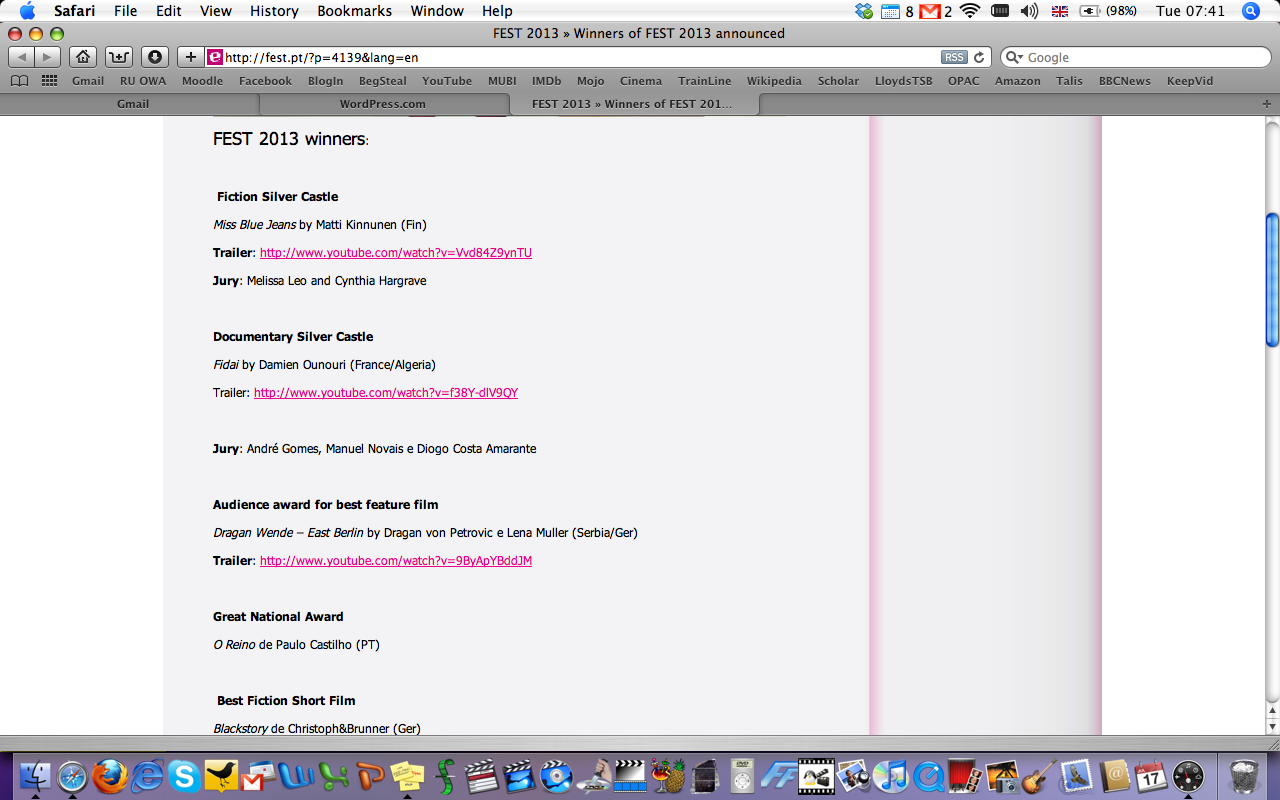
Common Ground sadly missed out on prizes at FEST Film Festival 2013, where it was in competition for the Silver Castle.

However, regardless of the result, we know that the film was seen by Melissa Leo, the Oscar-winning actress from The Fighter (David O. Russell, USA, 2010), and by Cynthia Hargrave, the producer of Wes Anderson’s first film, Bottle Rocket (USA, 1996).

The winner for best fiction film at the festival was Finnish film, Miss Blue Jeans, directed by Matti Kinnunen.

A full list of winners from FEST can be found here.

We are of course honoured even to have taken part. And again: we defy any £500 film to do as well…!

Image