Circle/Line Filmmaker’s Diary #5

Beg Steal Borrow News, Circle/Line, Uncategorized

I have been meaning to write about the progress of Circle/Line for some time now.

In short, editing progresses not necessarily apace, but steadily.

There have been some frustrations along the way. First and foremost is that it appears that we have lost the video files for one interview conducted at High Street Kensington, all of the interviews that we conducted at Gloucester Road, and part of the long interview that we enjoyed at South Kensington (the very final interview that we conducted).

I guess these things happen – and we still have the sound files, so not all is lost; but this might mean that to include those interviews in, say, a finished film, would mean having the sound over other images, which might seem odd with regard to the look of the rest of the film.

Either way, though, having been through all of the footage it is clear that we have numerous wonderful interviews with numerous fascinating people – all talking about happiness in lots of different ways/approaching it from lots of different angles.

How to arrange it now becomes the big challenge.

I hope that the ‘film’ will in fact take several different shapes.

Firstly, I would like to edit together a film in the traditional sense, which includes footage from a range of the interviews conducted, although not necessarily all of them. I shall return to this shortly below.

Secondly, however, I hope also to create a website with all of the interviews (at least in part) uploaded – in 27 instalments, with one shorter film for each stop on the Circle/Line.

This not only will provide a space for visitors to browse far more of the footage than I can ‘reasonably’ include in a single film (unless watching six and a half hour films is your thing), but I would also like to make the footage available for download, so that visitors can then use the footage potentially to edit a completely different film to the one that I put together.

Finally, more ambitiously and more unlikely, I’d love to find a space where I could mount 27 screens, one for each station, and then allow visitors to come and browse the films at their leisure – for as long or as little as they would like, with each monitor (as per the website) screening footage from that particular station.

Obviously, a yellow theme as per the Circle Line’s appearance on the standard London Tube map, perhaps with a ‘yellow brick path’ around the space, might also be good.

Now, I am editing both the 27 short films and the feature film simultaneously – and what is quickly apparent is that it is very tough to know what to include and what to exclude, in the feature film at least.

It is clear that various themes emerge over and over again: the weather, sport, comparisons between London and other cities – both in the UK and abroad, and so on. I shan’t be able to include all of these, and it becomes clear to me that I am editing a more ‘political’ film, in which issues like the cost of living, work, religion, housing problems and other issues are explored, than I am necessarily editing a ‘feel good’ film (although I hope that the film conveys a lot of the optimism of the people that we interviewed).

Tom Maine – with his customary elegance and sensitivity – has captured absolutely beautiful portraits of the people whom we have interviewed, and so I generally feel happy with the look of the film and in a sense edit more to what people say.

However, sometimes one also edits not only because of what the interviewee does in terms of gesture or facial expression, but sometimes one also edits because of chance events that occur in the background.

I am still undecided as to whether it will make the final cut, but Tom has done shots for example through a taxi that pulled up between him and me/an interviewee at Cannon Street – and which look absolutely fantastic.

In addition, small things like a moving crane also can provide visual attractions that do not necessarily belong to the interview. The vertical framing does, in my humble opinion, work very well – and so the point is that while Circle/Line is a vox pop film, in that it features people talking, it is also – I believe – a very visual film.

Indeed, we set out to create a portrait of London – or at least of London’s Circle Line, the people that pass through and/or inhabit it, and a sense of the relationship between the two by staging the interviews in the street, near public transport, and with an emphasis on the vertical in order to see the human figure in relation to the giant buildings that surround her.

I hope that others consider the film to be successful in presenting not just a series of portraits of people interviewed in London, therefore, but also in many respects a portrait of the city. In the spirit of Jean Rouch and Edgar Morin’s film from which Circle/Line draws inspiration, I hope also that the film is a ‘chronicle of the summer’ of 2015 in one of the world’s most vibrant cities.

The next time I post, I hope that it will be to announce that a cut of the film is ready. But everything continues enjoyably and hopefully with the result of producing a watchable and engaging piece of work.

Below are some stills – from interviews at (clockwise, starting top left) Kings Cross, Liverpool Street, Embankment, Edgware Road, Notting Hill and Bayswater.

And also keep an eye out for a trailer and a poster somewhere in the pipeline, too!

Ur screened in China

Beg Steal Borrow News, Press and Blog Mentions, Screenings, Uncategorized, Ur: The End of Civilization in 90 Tableaux

We are pleased to report that Ur: The End of Civilization in 90 Tableaux enjoyed a screening at the University of Nottingham Ningbo, China (UNNC).

The screening took place on 17 December 2015, and was attended by an enthusiastic gathering of UNNC staff and students alike, with a Q&A led by Dr David H. Fleming.

Director William Brown also led a couple of masterclasses in micro-budget ‘guerrilla’ filmmaking while at UNNC.

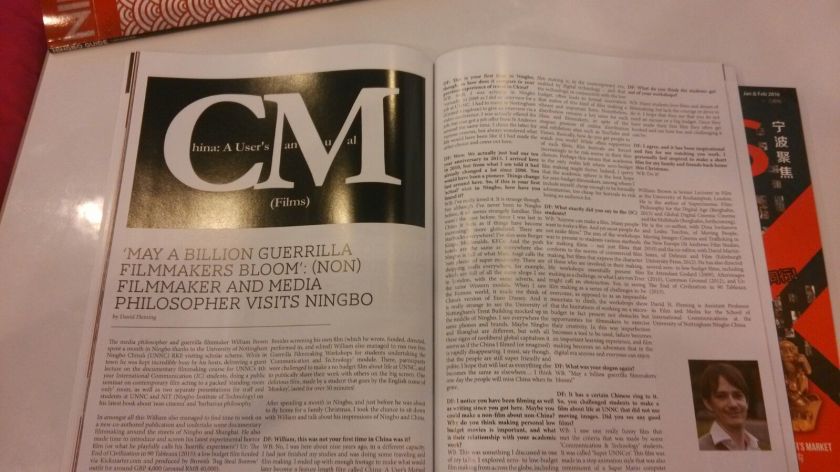
His visit received coverage in Ningbo Guide, a local English-language cultural journal.

We hope to be able to announce more screenings of Ur and other Beg Steal Borrow films in the coming months.

IMG_7732

William Brown’s visit to China, which included a screening of Ur, was covered in local journal, Ningbo Guide.


Kiss and Make-Up selected as finalist for Oaxaca FilmFest Global Script Challenge

Awards, Beg Steal Borrow News, Festivals, Kiss and Make-Up, New projects, Press and Blog Mentions, Prizes, Screenplays, Scripts

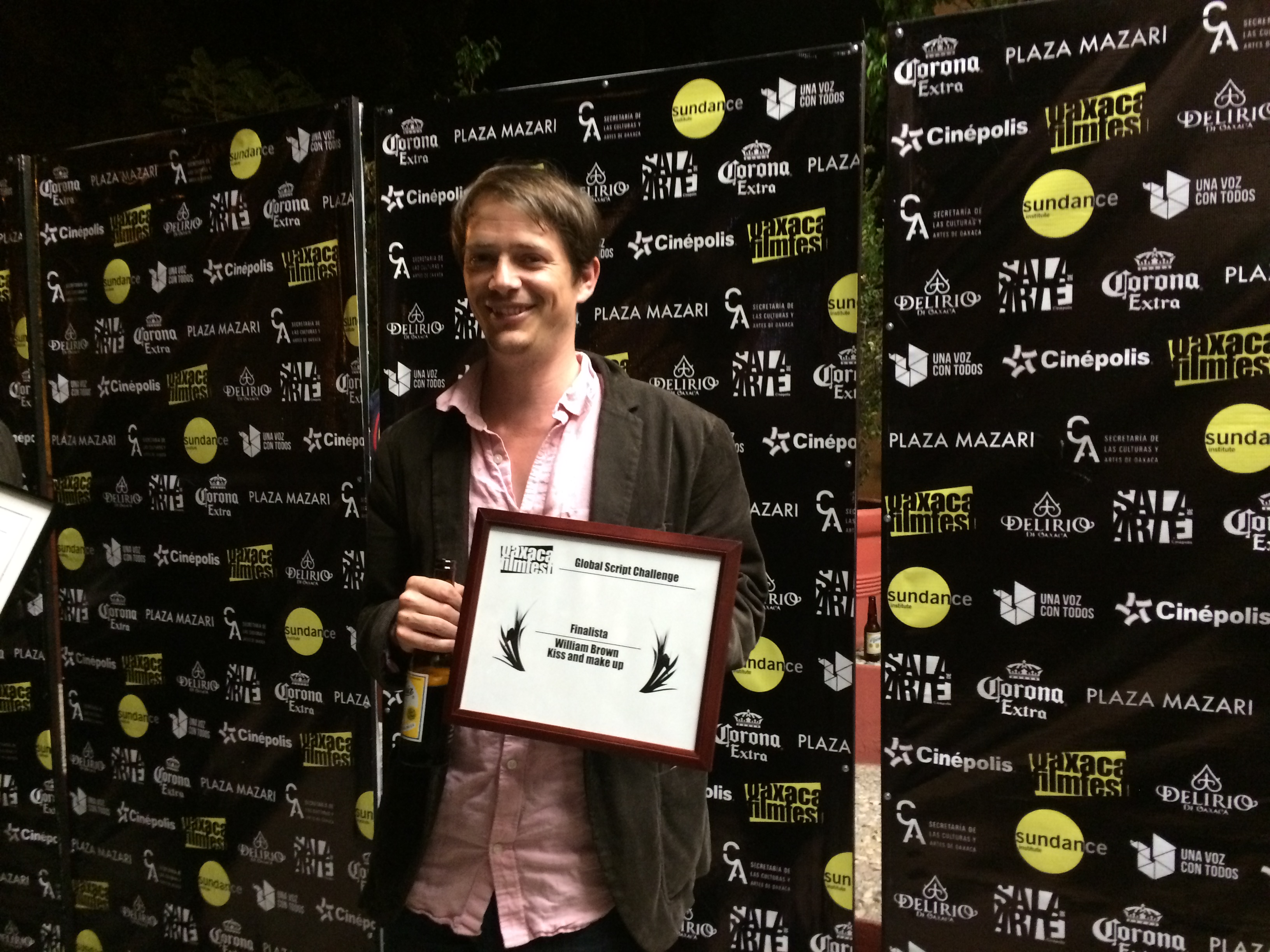
Beg Steal Borrow’s William Brown was selected as a finalist for the Global Script Challenge at the sixth Oaxaca FilmFest in Oaxaca, Mexico.

The top left positioning alas did not mean first prize.

The top left positioning alas did not mean first prize.

William’s script, Kiss and Make-Up, was one of 12 scripts to be selected for the final – with William ultimately losing out to Dave Ryan for his script, Coffin.

Kiss and Make-Up is a script about a man who disguises himself as different people in order to remain close to his ex-girlfriend. It is the first script that William has submitted to a film festival – and he is delighted to have made it through to the final.

Indeed, as a finalist one can happily claim to have come second or joint second.

Now, all that remains is for someone to produce the film – be it specifically as a Beg Steal Borrow production or otherwise.

Oaxaca FilmFest’s curator, Enrrico Wood, described the script as ‘funny, well-written and witty.’ May such positive feedback continue – and may this be the first of many festival inclusions and perhaps even plaudits.

William relaxes with a beer after making it to the final of the Oaxaca FilmFest's Global Script Challenge.

William relaxes with a beer after making it to the final of the Oaxaca FilmFest’s Global Script Challenge. Photo by María Villanueva.

Many thanks to the Oaxaca FilmFest for including the script and then for listing it as one of the 12 finalists. The Global Script Challenge’s panel of judges included Couch Fest founder Craig Downing, actor Orlando Moguel Granados, directors Ron Leach and Jorge Pérez Solano, screenwriter Mariana Musalem Ramos, Keya Khayatian of the United Talent Agency, and film critic José Quintanilla.

Furthermore, the Oaxaca FilmFest, which was founded in 2010 and which has already garnered a reputation as ‘Sundance south of the border’ also works in partnership with the Sundance Institute – thereby making it even more of an honour to have been selected and then included as a finalist.

Selfie and Ur selected for Worcestershire Film Festival

Beg Steal Borrow News, Festivals, Screenings, Selfie, The New Hope, Ur: The End of Civilization in 90 Tableaux

We are delighted to announce that Selfie and Ur: The End of Civilization in 90 Tableaux will both play at the 2015 Worcestershire Film Festival.

Worcestershire Film Festival

The screenings will both take place on Sunday 8 November 2015, with Selfie screening at 10am and Ur screening at 3pm.

Both screenings will take place at the Worcester Arts Workshop.

Meanwhile, The New Hope will also enjoy a screening at the University of Skövde in Sweden on Thursday 22 October at 10.15am.

We are hugely excited about all of these screenings – and hope that you can make it there!

News about two feature films and a script

Beg Steal Borrow News, Circle/Line, New projects, The Benefit of Doubt

Long time no blog – for which apologies.

But there have been some interesting/exciting Beg Steal Borrow developments over the past few weeks – with even more brewing – so keep a look-out for future events, too – since there hopefully will be screenings of SelfieUr: The End of Civilization in 90 Tableaux and The New Hope to announce in the coming months, both in the UK and further afield.

The script

Let’s start with the script. William Brown’s screenplay, Kiss and Make Up, is in competition for six awards at the Oaxaca FilmFest in Mexico, which takes place 9-17 October 2015.

The script, a comedy that tells the story of a man who disguises himself as different people in order to stalk his ex-girlfriend, is one of the screenplays selected for the Global Script Challenge. And at Oaxaca, William will hopefully be meeting other writers and film people in order to be inspired.

Circle/Line shoot completed

While this blog does not constitute a final diary entry for the film per se, it is to announce that cinematographer Tom Maine and director William Brown finished shooting Circle/Line just before the end of August – and in spite of heavy rain that often made stopping people in the street for an interview next to impossible.

We did a mid-July shoot at Edgware Road, meeting in particular a couple of former students from Kingston University who are engaged in trying to do charitable work in the Middle East, before then filming in late August at Paddington, where we had a fascinating interview with a somewhat distraught and unemployed man, who feels hopeless with regard to being able to turn his life around – particularly in relation to finding a job.

There followed a rain-soaked interview Bayswater with, amongst others, a man from Sicily who talks to people about God, and a very chilled-out/relaxed guy from Australia who seemed to know the formula for happiness.

At Notting Hill Gate, we met some visitors from Germany and a student from Italy, before at High Street Kensington chatting with another German woman and a man on his way to watch the Arsenal play.

At Gloucester Road, we spoke in particular to an Argentine lady who is hoping to find a way to stay in London, a city that she feels that she loves. And at South Kensington, our final location, we chatted to two men, one French and one British, who are working on an app that is designed to help people to maximise happiness.

Given that the topic of the film is, with a hat tip to Edgar Morin and Jean Rouch’s Chronicle of a Summer, about how happy people in London are, this seemed a most appropriate interview with which to finish principle shooting. For, the final interview combined not only people also engaged in happiness, but also an Anglo-French effort to achieve it.

Now, for the edit. More news to follow when the film is ready for preliminary screenings.

The Benefit of Doubt

But, before that, Beg Steal Borrow are also set to shoot a new fiction film, The Benefit of Doubt, which retells the myth of Ariadne after she has been abandoned by Theseus in France’s Nice.

Starring En Attendant Godard lead Hannah Croft in the Ariadne role, the film will also feature performances from Beg Steal regular Nick Marwick, and Greg Rowe, who makes his second film with us after a small, but memorable role as an R2 unit in The New Hope.

Filmed in Nice, The Benefit of Doubt hopefully will also pay homage in part to Jean Vigo’s À propos de Nice, one of the great short films that was shot by Dziga Vertov’s brother, Boris Kaufman.

More news will certainly follow after the shoot, which takes place from 1st to 9th October, with Tom Maine taking up his regular duties as cinematographer, and with Andrew Slater also returning for production duties – with help from Annette Hartwell and Lucia D. Williams.

Introducing A Letter to Ariadne

Beg Steal Borrow News, Short Films

This is just a quick note to announce Letter to Ariadne #1: From Preston to Peristeri, a short film-letter that was shot on 30 June 2015 in Preston, England, and which takes the form of a letter from its maker to Ariadne, the maker’s one-year old niece.

From Preston to Peristeri was made ahead of the referendum in Greece on 5 July 2015 regarding whether to accept the bailout conditions proposed on 25 June 2015 by the so-called Troika of the European Commission (EC), the International Monetary Fund (IMF) and the European Central Bank (ECB) to help Greece out of its current debt crisis.

Although the referendum is concerned with a choice made by the people of Greece, a refusal to accept the bailout conditions could/would effectively involve Greece’s exit from the European Union, which in turn might affect the future of that organisation, of the currency that many of its member states use, the euro, and of Europe itself. This in turn might affect geopolitics in a considerable fashion.

When the letter asks Ariadne to consider not excluding Greece, the idea is not to deny that Greece can and will take its destiny into its own hands. However, it is to ask Ariadne to consider the root of the Greek debt crisis, which to the best of the filmmaker’s understanding involves a role played by the richer countries in Europe, namely those which have most influence over the afore-mentioned Troika, both in the creation of debt and in the perpetuation of debt in Greece through its proposed bailout conditions – a debt that would through interest be greater than Greece’s entire GDP (i.e. unpayable).

Let us be clear. Greece borrowed money beyond its means, but those who lent it also were not checking with any particular care about whether those loans were sound. Here’s some free money, someone says to you. What? You mean, I can have that money and thus lead a life a bit more like yours, or at least what I perceive yours to be? Or more simply: what? You mean I can use this money in order to lead an easier life? Who would not say yes to such a tempting tibi dabo?

Families fall apart and what family is or means changes over time. Nonetheless, in a Union, we should support each other. This is the principle of Union. But when the Union is built upon mutual greed, exploitation and economic subjugation that is sold as economic liberation, then this seems less like a Union and more like use and the treating of the other as an object, as a means to an end, and not as an end in itself.

The human cost is great: unemployment, depression, suicide and the turn to extremism in desperation. Another place hollowed out for the purposes of profit. Humans are weak, but we should not hate each other for this.

So, in effect, the film asks Ariadne to consider never to exclude anyone from her life and to whom she owes many things just because they are perceived as being or materially are more poor than she. It also asks her never to perpetuate the perceived or material poverty of others.

The filmmaker hopes that the film does not come across as condescending, especially to the people of Preston and Greece, not least because he uses images of the former to frame discussions of the latter. He surely has grasped imperfectly the condition of Preston in the contemporary world, but on 30 June 2015, Preston posed for him in the fashion that features in this film-letter.

Although the filmmaker does not mention Peristeri in the letter, he likes the idea that a place in Athens might signify a dove (Περιστέρι/Peristeri means pigeon or dove in Greek), and thus by extension peace. May peace reign both in Preston and in Peristeri.

The music that features in the film is by David Miller.

Apologies for the quality of the sound recording on the voice over; the maker only had his laptop with him at the time of making the film.

Circle/Line Filmmaker’s Diary #4

Beg Steal Borrow News, Circle/Line, New projects

Day 11: Sunday 14 June (Victoria)

It is quite surprising how most people whom we interview are very cagey about revealing not only where they work, but also what they do for a job as a whole. I am not sure if people are always worried about what judgements they think that others will make once the nature of their work is revealed, but few people seem willing to say the area of their work.

With regard to naming the company for which they work, the reluctance to name a company speaks surely, meanwhile, of a lack of job security in the current climate: if X interviewee says Y thing about Z company, then Z company might have good cause to sack X interviewee. Indeed, anyone who is in work clothes (from Transport for London employees to Big Issue vendors, both of whom we have interviewed) has in fact been trained not to talk to people in front of a camera. In this instance, the company is also afraid of a lawsuit, since if X interviewee says Y thing about Z company, then W viewer of the film in which the interview takes place might sue Z company because they take offence at X interviewee’s comment/Y thing.

For me, this has two effects. Firstly, it makes me sad that we live in such litigious times, in which people are running scared the whole time, and in which we fundamentally live in a condition of bad faith because no one trusts anyone else.

And secondly, it reveals as in some respects untrue people’s claims to be happy, especially when they relate their happiness to their work situation (which is the first thing that people mention in the majority of cases). For, if they were happy at work, they why not sing from the rooftops what work it is that they do, such that others might be inspired by these claims and thus want to work in the same, happy-making industry themselves?

Nonetheless, at Victoria we meet a TfL employee who does mention his place of work. I am not sure whether I shall include any such mentions in the film – for fear of getting our interviewee the sack! But they seem happy both with work, and to talk to us for a few minutes into their shift. He also speaks about his family, which seems spread all over the world, as a source of happiness as he works on his music.

Across the road from Victoria, in Grosvenor Gardens, we also meet two young chaps who are up in town after their exams. They are studying at a private school outside of London, and are about to break up for the summer – heading back to their respective homes in the north of England and Hong Kong. And we also speak to two young Bulgarian women, one of whom has been in London for a few months now, and one who has arrived today, and who is in transit towards Edinburgh.

In particular, these women speak of how the perception of Bulgarians in London is that they are here to nick jobs from ‘proper’ British citizens. However, from their own perspective, they are just young people looking for a bit of a change of scene. Both hope to make it to New York at some point.

At the end of the interview, the one woman who has lived in London for a while suggests that there are too many black people in the area of London where she lives (Stratford). I am sure that the comment speaks more about an unthinking cultural prejudice, rather than a considered, conscious evaluation of a race of people. Nonetheless, after a pleasant and informative conversation about being young and Bulgarian in London, this seems disturbing, if out of character.

Furthermore, the comment is unjustified given the wonderful conversation that we then have with Egbert, a Dominican Rastafarian who has been living in London for many years now. He speaks of living in the moment and embracing a loving attitude towards others that is inspirational and cheery-making.

Finally, we end in Victoria with a conversation with Lini, a Malaysian cleaner who must be about 60, and whose English is very limited. She smiles broadly, though, exudes a warmth and pleasantness that, while making for a not particularly successful interview, means that she has a memorable face and persona.

Day 12: Monday 15 June (Tower Hill)

Since Grosvenor Gardens proved a successful hunting ground for interviewees (surely the fact that people are sitting down and not rushing is key), Tom and I decide to start out in Trinity Square Gardens, just opposite the entrance to Tower Hill, which otherwise is undergoing works.

We speak to Alex, who is studying history at Queen Mary, University of London. He says that art and other wishy washy things along those lines do nothing for him with regard to happiness, but that he instead is made happy by things logical. We then speak to George, a West Ham fan who is in the area to see a concert at the Tower of London. George is in particular good to speak to, because he is of about retirement age (I would not like to speculate on a precise age) and thus represents a demographic – over 55s, let’s say – that we have had trouble convincing to speak to us up until now.

And then, like the proverbial London buses, along come Mark and Dennis, both of a similar age to George, and who also talk to us. Mark is down from Lancashire on business. Having been involved in the London 2012 Olympics, he still does some work in London, but it seems as though his passion is (beyond his family) playing and training others to play rugby.

Meanwhile Dennis, an Irish-American New Yorker who has been travelling the world of late (he has just touched down from Malaysia), is one of the most enlightened interviewees whom we have met: the oldest of 12 children, he was the senior male in his family after the death of his father in his early teens. He tells us that struggling to raise the family was great shakes compared to the struggles that the average young person faces today, but he does not lord this over anyone. Instead, he is humble and suggests that seeking happiness is today is the only worthwhile philosophy in life – even if it is a philosophy that took him many years to cultivate.

Day 13: Wednesday 17 June (Great Portland Street)

I am always worried when I turn up at a station that I am facing another Moorgate: a station where no one will stop to speak to us because they are too busy. After a couple of false starts, however, we do manage at Great Portland Street to speak to a woman, Sarah, who has worked in housing for many years, and who tells us about the problems with housing in London at the moment.

There are, she says, not enough houses for the growing population, and with too many people snapping up houses that remain unoccupied – a fact also reported in our media. Space, Sarah is convinced, is key to happiness – and without space, it is harder for people to be happy.

We also speak at Great Portland Street to a nurse, Michael, who was born in the UK, grew up in New Zealand, but who returned to the UK as an adult (he still has a New Zealand accent). In what seems like another serendipitous coincidence (three more senior men at Great Portland Street, two people who work in issues relating to social welfare), we discuss the National Health Service in the UK and the role that it, too, plays in ensuring the happiness of as many people as possible.

Finally, Tom and I speak – in our longest interview yet (40 minutes; most are between 12 and 20 minutes, though some are of course shorter) – to two artists, Lyndon and Toby, who have just been putting up stands at London’s Taste Festival.

Lyndon is about to start teaching at a school in Suffolk and is worried about leaving London – although he recognises that the capital is also a hard place in which to eke out happiness as a result of the swelling of its population and the seeming lack of job opportunities.

Toby, meanwhile, is staying in London, where he runs an illegal psychedelic ice cream van that sounds like a sort of installation/performance art piece that he drives around London (getting told regularly to move on because he does not have a license to sell the generic ice creams that he stocks).

The pair also work on party-event-installations, the last of which sounds stupendous if crazy: everyone came in costumes designed by other people attending the party, which had as its theme something in equal measure amusing and bizarre (although my poor memory – I write eight days later – does not recall).

After some early noes, then, Great Portland Street works out well.

Day 14: Monday 22 June (Sloane Square)

Sloane Square itself seemed likely to prove a good place to talk to people – and yet most refused to speak to us. I hate the tone of voice that people adopt when, after I have spent a few minutes explaining what we are doing, a lack of trust remains, a thin smile crosses the would-be interviewee’s lips, and they explain that they do not want to take part. It’s not so much that it is a no, but more what I perceive to be insincere friendliness.

I am sure that in this I am wrong, because there is of course a camera present, but I cannot help but feel that to say no to someone who wants a conversation is unfriendly, and so to try to be friendly in saying no is insincere. The presence of the camera: why does this affect people’s decision not to talk? Because they are wary of their appearance, perhaps. But this speaks of how we are all supposed always to look not like ourselves but ready for a camera, or cinematic. Or perhaps they say no because they are worried about what they are going to say and how it will be portrayed. Again, understandable, but to experience someone’s general lack of faith (they do not trust others) is hard not to take personally (they do not trust me). Clearly I am not good enough (cannot be good enough) at explaining/demonstrating to people that I am, or hope that I am, trustworthy.

And yet, Sloane Square is also the venue of the most annoying interview yet – an interview in which someone does agree to speak to us, and then proceeds to spend 20 minutes being as vague as possible in their responses, resisting right up until the end the invitation to say anything interesting about themselves. Furthermore, the man in the end refuses to sign our Letter of Release, insisting that he gets a cut of the film before we do anything with it because, in his own words, I might put him in a porn film.

While to get rejected is frustrating and a cause of self-doubt, to get accepted – he agreed to do the interview – only then to film 20 minutes of ongoing rejection, which ultimately I am unlikely even to be able to use – just seems to be obstructive and destructive, as if the man took pleasure in wasting my and Tom’s time (in his defence, the man did start by saying that he had nothing to do, so why not do the interview – i.e. he had some time to waste).

The man runs a watch company and has lived in Sloane Square all of his life, except for two years in Westminster, which apparently were awful, although there was a fantastic flat on offer there, so he had to take it. I ask him whether working with watches has changed the way he thinks about time. No. How did he think about time before he started working in watches? He didn’t. How did he get into working with watches? You can do this several ways. Which ways are those? There are several of them. Which one did he do? With some seeming regret he says that he got trained – as if it were an embarrassment to admit that anyone else might have helped him in making his fortune… The interview is painful and, ultimately, unpleasant.

Thank heavens, then, to meet Luke and his friend Ivan. Luke is a writer who writes stories for people for money. He is a traveller and has an uncontrollable laugh and smile – full of the joys of the universe. He cheers us up no end before going off to a Beethoven concert in Cadogan Hall.

Finally, outside the Royal Court we talk briefly to Paul, an actor who, despite wearing shades**, speaks candidly about how most people who tell you that they are happy are liars, and that he is not. I like Paul. I like Luke. I like Ivan. I guess you cannot like everyone.

** I have a theory about sunglasses. Basically it runs this way: curious people look, but curious people also want to show that they are curious by also showing that they are looking. This is a means then to start dialogue, which can engender learning, which satisfies curiosity. Sunglasses are what one wears in order to look, but not to be seen looking (as well as being associated with ‘cool’ – with cool in most of its forms being associated with detachment from, rather than engagement with, the world). I’d much rather be and demonstrate the fact that I am enworlded, and that we are all entangled with the world and with each other than putting on some masquerade that somehow I am detached from the world and that I have nothing to do with it. People who tend to believe that they are simply the authors of their own destiny tend to be the sort of people who have lived lives of privilege, and whose greatest privilege is to believe that they were owed or won their privilege, and to forget the fact that they are enworlded, rather than remembering that all that they have necessarily depends on the contributions of other people.

Announcing screenings of The New Hope in London and Oxford

Beg Steal Borrow News, Screenings, Selfie, The New Hope

The wait is soon over!

Two screenings, one in London and one in Oxford, have been arranged for The New Hope, the film that Beg Steal and Borrow shot in Hyde Park last summer on a shoestring.

The first is a preview screening at the Whirled Cinema in Brixton, London, and which takes place on Saturday 11 July at 2pm. Spaces are limited to 75 for this, but the event is free. So if you wish to book a ticket, then please follow this link.

The second screening takes place on Monday 20 July in the Mary Ogilvie Lecture Theatre in St Anne’s College, Oxford, at 8pm. This screening is part of the annual Film-Philosophy Conference, which this year is being held in Oxford.

In principle this screening is open only to delegates at the conference, but if you happen to be in Oxford on that evening, I am sure that you could sneak in if you wanted.

The New Hope tells the story of Dennis, a man who believes himself to be Obi Wan Kenobi. An updated adaptation of the first part of Miguel de Cervantes’ Don Quixote, the film itself tilts at the biggest windmill of them all, the myth that is the Star Wars universe, trying to show that cinema can be made not with CGI and massive budgets, but with a dustbin lid, a piece of string, and a colander. I wager my right hand that anyone watching The New Hope will find something of worth in it.

Come along to one of these and/or other screenings, and see if you agree.

Finally, it is hopeful – though not confirmed – that Selfie will also be screening at the prestigious Whitechapel Gallery in the not-too-distant future. Discussions are under way, then, to arrange a mutually convenient date.

Circle/Line Filmmaker’s Diary #3

Beg Steal Borrow News, Circle/Line, New projects

Day 9: Wednesday 10 June (Mansion House and Cannon Street)

Cameraman Tom Maine and I were apprehensive as we reached Mansion House. Our experience at Moorgate, also a Circle Line station that sits in the City, had been so poor (and dispiriting) that we feared more of the same.

However, that fear was not wholly necessary, for, despite some rejections (always disheartening), we did manage to convince a few people to talk to us. Brian, the first person with whom we spoke, seemed to enjoy the interview and took my number, since he works at an advertising firm and thinks that he might need interviewers for a show that he is producing in which people discuss what it is like to be thrown out of an aeroplane.

I have no idea whether to believe Brian, and the way he spoke to me led me to believe that he thinks me younger than I am, but either way it was nice of him to offer potentially to offer. Who knows? Maybe my interviewing skills will transfer to a new project before too long.

AJ, Ves, Prash and Kerry all followed, with Kerry perhaps being the most vocal. ‘No,’ she insisted straight away, she is not happy. And she laughed. ‘Why,’ I asked? ‘Money,’ she responded with a smile. ‘I have expensive tastes and I need lots of it.’

Over from New York and studying in London for a year, Kerry said that she is enjoying her time here, and is most happy when walking around London. I find it odd that Kerry, fun as she was to talk with, wants money for happiness, and yet is most happy when she is doing something, walking, that is free. Perhaps I should challenge people more with regard to their definitions of happiness.

Tom finally featured me in some wider shots of the interviews today – mainly with Brian and AJ at Mansion House. This made me think of my friend Jonathan Taylor, who has directed episodes of such high-profile BBC documentaries as Great Ormond Street and Protecting Our Parents.

In late 2014, Jonathan gave a masterclass on making observation documentaries at the university where I work. I remember him saying that more or less the first key lesson he learned about making obs docs – from a figure as influential as Roger Graef, no less, Graef being one of the giants of British documentary – was that while the film wants to give the impression that you, the filmmaker, are invisible, in fact you have to be absolutely visible and fully participating (after a fashion) in the events that you are seeking to portray.

The logic is that if you are invisible, or say nothing, then people will not open up to you. It is only by being fully present that your subjects can trust you, Jonathan explained. And given that so many of our interviewees have a propensity to speak for as long as possible in abstract terms or in generalisations, without ever being specific about things that interest them, what makes them happy, then getting them to open up becomes important.

Therefore, even though Circle/Line is not an observational documentary, I believe that this idea of needing to make yourself present is equally true with Circle/Line. The more I put into these conversations, the more I get from people in terms of them opening up and moving beyond those generalisations – even if the film will not reflect my participation as it emphasises the people whom we have met rather than me. In effect, while based increasingly on conversations rather than on monologues from the participants, it is through a two-way conversation that the most interesting things that people say can come out.

This evening a few people did the usual ‘walking away as soon as they see us coming’ routine. This is fair enough and one learns not to take offence, even though we (or at least I) believe that everyone with whom we have spoken for this film has had a few minutes of interesting fun with us. Maybe this is not true in the eyes of others, but thinking that you are offering people something that in fact is, or might be, quite pleasant, makes the out of hand rejection quite disappointing.

Thinking about these rejections, Tom and I discussed whether one of the reasons why various people seem unwilling to talk to us, and many completely unwilling to open up to us if they do, is because we live in a society that is much more media savvy than it used to be. It is safer to give nothing away, even about one’s own happiness, except to speak in vague generalisations, and rarely if ever with specific examples about personal experiences. (Maybe I am a bad interviewer.)

As I have perhaps mentioned before, Circle/Line takes its inspiration from Edgar Morin and Jean Rouch’s Chronicle of a Summer, a 1961 film shot in 1960, and which itself is a movie comprised of vox pops of people in Paris – with Circle/Line also featuring a touch of Chris Marker and Pierre Lhomme’s Le joli mai (1963) thrown in for good measure

In the Rouch and Morin film, from what I recall, people seem so willing to talk to the camera. Of course, we don’t know how many people said no, nor how long interviews lasted in order to get to what we see in the film. Nor, indeed, how prepped people were (I refuse to tell my interviewees the first question – ‘are you happy?’ – explaining to them that if they know it in advance, then it will spoil the response).

Nonetheless, in Chronicle of a Summer, it strikes me that when someone turns up with a camera in the street, people wander curiously over and want to know more. Nowadays, however, the camera is treated with suspicion, people are wary, tech savvy, and while some people are curious about what we are doing, most are not.

As Tom and I hang outside Cannon Street, I tell Tom about how it is apparently possible to run from Cannon Street to Mansion House in the time it takes for a Circle Line train to get from one station to the other, meaning that one can get off a train at Cannon Street and get on the same train at Mansion House. I shall have to check where that story comes from and whether it is true or not.

Tom and I continue to be concerned that older people are harder for us to persuade to take part in the film and that, oddly, we have not convinced a family to talk to us all at once so far. Still things to work on…

Day 10: Friday 12 June (Blackfriars)

A pleasant evening and people seemed willing to talk. If only all stations were like Blackfriars (especially because the station has a pub, the Black Friar, right opposite – meaning that finding people with whom to talk is, so Tom says, like shooting fish in a barrel).

We discuss amateur dramatics with Luke, the systemic shortcomings of capitalism with Omar, what it is like being away from one’s family with Julien (he has a brother and a sister in Mexico, with the majority of his family in his native France), and the joys (or, as I believe, the horrors) of shopping on Oxford Street and in the Westfield with Anisha.

I even questioned Anisha about several things, mainly because she is contagiously happy, and I am not sure why. Firstly, Anisha, like Kerry, feels that walking makes her happy. Secondly, Anisha suggested that poor people can and are happy and that in fact rich people are often unhappy. I asked her if she plans on giving away her money in order to be happier. She said that she will not.

I am not sure how much I should ‘challenge’ my subjects, but like Kerry who believes that she wants to be rich and yet is happiest doing something for free, Anisha seemed to say that happiness is inversely proportional to money, while also being unable to give up money for happiness.

This is not to single out Anisha; I feel this myself, and assume many people do (not that poor people are happier, but that one might well be happier if one sacrificed more money, while being unable to sacrifice that money). But it does raise the issue that our happiness, particularly if it is linked to money (as the overwhelming majority of responses would seem to suggest so far), is in fact illusory. As Julien says, perhaps we are all in the Matrix.

A final thought: a few people in these last few days – AJ, Ves, Prash, Anisha – all seem to believe that if you truly want it, then you can bring about happiness in your life. I hesitate to agree with this, mainly because to believe that we are the authors of our own destiny suggests a belief somehow that we are not quite in, or with, the world, but rather that we are separate from it, somewhat. For, we can do what we want, and the rest of the world does not constrain us, since it does not really touch us.

I am delighted that so many people tell us that they are happy. But I am always intrigued when people say both that unhappiness exists, that the unhappiness of others brings them down, but that they don’t let the unhappiness of others affect them too much. For me, this speaks of a lack of being touched by the world; happiness thus today becomes something not to be shared, but something more like a wall, or a womb (a matrix, indeed) that we construct around ourselves in order not to be touched by the rest of the world.

And yet, while it heartens me to know that so many people are happy, with exceptions like Kerry unhappy not because of loss but because she has not yet reached the point in life where she wants to be, I am concerned about the lack of touch, as well as the resort to insular as opposed to common happiness. Is constructing a common happiness what I am really wanting to ask people about here? I do ask questions along these lines. Indeed, Omar this evening suggested pessimism about the possibility for common happiness. Maybe I am making the film in search of how we can achieve it.

As Tom and I head home, we work out whether the Cannon Street to Mansion House dash is feasible. I reckon it is. Tom is a little bit more sceptical. Perhaps we should try it when Circle/Line wraps.

Circle/Line: Filmmaker’s Diary #2

Beg Steal Borrow News, Circle/Line, Interviews, New projects

Day 8: Thursday 28 May (Westminster and St James’ Park)

Today, Tom and I returned to Westminster because we did not feel that we had enough interviews there first time, even though we did speak to an unhappy footballer.

Fortunately for us, we got three interesting interviews. The first was with Faiz, who is a journalism student from Balochistan, and who was outside the Houses of Parliament in order to commemorate the fact that on 28 May 1998, Pakistan detonated six atomic devices in Balochistan and in order to exert pressure on the UK government in order to help bring about independence for Balochistan, where otherwise Balochis are treated as second class citizens, complete with what Faiz describes as unlawful arrests, state-sanctioned torture and worse.

Faiz is generally happy and believes that most Balochis are happy. Nonetheless, he still believes that for general happiness to be brought about, work needs to be done. And perhaps by all of us.

We then had a brief chat a student from Spain who is about to finish after eight long years his degree in aeronautical engineering, and to Mark, a laconic, big white-bearded black man who lives in a hostel nearby and who also claimed to be happy, suggesting that what goes around comes around.

Meanwhile, at St James’ Park, Tom and I had what is for certain our longest interview, talking to two civil servants who may or may not have had a few drinks prior to our arrival. Aggressive in their counter-questions, they put me to the test in terms of why I am doing the film. Clearly very smart, I worried that they also found me a bit dumb, not least because they think that the idea of limiting ourselves to stations on the Circle Line is a silly idea…

However, most interesting of the day were the people who declined to speak to us. Not because the average person who says no is that interesting. But in fact two people, one a woman approaching us from Whitehall at Westminster, and one a man in a blue suit called Sam who walked past us at St James’ Park, both refused to speak with us, not because they did not want to, but because they cannot go on camera and be seen… In other words, it was interesting to see that Westminster in general is home to some people who feel compelled (who need) to keep a low visual profile. I wonder what their Facebook pages are like…

Finally, since it was getting late, Tom and I had a drink in one of the pubs by St James’ Park, where we spoke at some length to Derrin, an ex-army officer who claims to be a ‘patriot’ (although I did suggest to him that if he were such a great patriot, then he might at least pronounce the word in the British (‘pat-tee-ut’), rather than the American (‘pay-tree-ut’) fashion.

He did not declare to be a UKIP supporter, but definitely referenced UKIP as he explained to us his (detailed) knowledge of British history, especially our involvement in various wars, and the difference between terrorism in the UK at the hands of Irish Republican Army and terrorism in the UK at the hands of Islamic fundamentalists. He believes that better a few civil liberties be denied than anti-patriotic sentiment be allowed to bloom.

I may not agree with all of what Derrin says (I don’t agree with much of it), but he was both admirable in many ways and certainly would have made for an interesting voice in this project.

With only one (admittedly long) interview at St James’ Park, we might need to head back at some point.