Trying to comprehend Trump, Jacksonville, fake news, the World Cup and Crimea: Gaamer/Gamer (Oleg Sentsov, Ukraine, 2011)

Blogpost, Film education, Film reviews, Ukrainian Cinema, Uncategorized

It is perhaps strange to write a post about a film that is now seven years old.

However, I wanted to discuss Gamer, which I saw this week while staying in Kyiv, the capital of Ukraine, for a number of reasons – a couple of which are complicated by the deaths of three people, including shooter David Katz, at a gaming convention in Jacksonville, Florida, USA, this week.

Gamer tells the story of Alex, or Lyosha, whose gaming nickname is Koss (Vladislav Zhuk). He lives in a small town in Ukraine where he ditches school and shuns the company of others in order to spend his time playing Quake.

He is sufficiently good at the game that he progresses from his small town, Simferopol, to Kyiv and all the way to Los Angeles in the USA, where he comes second in a world championship.

However, this success seems to mean little to Koss, who remains affectless throughout more or less the whole film. As a younger gamer, Kopchick, comes to replace him as the leading gamer in his home town, Koss instead begins to find dignity in helping his mother (Zhanna Biryuk) work in a shop – with one reviewer commenting that this leads him to smile for the very first time in the film.

A movie about a kid who plays truant naturally recalls François Truffaut’s Les Quatre Cent Coups/The 400 Blows (France, 1959), with director Oleg Sentsov being wise to this point of comparison by having his movie end with a freeze frame on Koss – much as Truffaut’s ends with a freeze frame on Antoine Doinel (Jean-Pierre Léaud).

But more than this, the film is also striking for the way in which it, like many a film from the French New Wave, takes to the streets, mixing documentary and fiction as the film involves real gamers and footage taken from real-world gaming tournaments.

Shot on an estimated budget of US$20,000, the film also involves direct sound, long takes in real locations and various other tropes that suggest the economic realism of cinema. By ‘economic realism,’ I mean that the less money one has as a filmmaker, the more one is likely to be pushed into the direction of long takes in order to save on time and money for set-ups.

But this is not a deficiency. On the contrary, it is a strength of the film that it does this, since the resulting intrusion of the real world (hence realism) into an otherwise fictional story is precisely what makes Gamer and numerous other films like it all the more powerful.

Indeed, it is the presence of the real world alongside the fantastic and violent world of Quake, from which we see a few play-throughs, that makes of the film an interesting investigation into the nature of gaming and virtual worlds in the present era – especially in a context like that of the contemporary Ukraine.

It is interesting how in games, the presence of cut-scenes would suggest that the medium aspires in some senses to become cinema. That is, games aspire to have the cultural clout of cinema, even if gaming is a larger industry than cinema worldwide.

Indeed, the cut scene, as well as the exemplary play-through, or the automatic action replay that takes place in some games when one performs a virtuoso bit of skill (or scores a goal) would suggest that the ‘best’ bits of games, and that towards which we should all aspire, become games not for us to play, but videos for us to watch.

In other words, gaming involves a logic of becoming image, or becoming cinema – since to become cinema bespeaks power, elevating the person out of the human realm and into the divine and supposedly eternal realm of the image, or light.

Given the presence of such ‘cut scenes’ in Sentsov’s film, one might suggest that Koss also aspires to become cinema, and to transcend his earthly identity, as marked by his change of names, precisely from Lyosha to Koss.

What is more, since such virtual images are placed alongside ‘mundane’ shots of everyday life, the effect is to suggest that the power of Gamer resides precisely in its not aspiring to be cinematic, but to express something like the outside of cinema, or what in my more academic writings I have termed non-cinema, and which may be something like reality itself.

That is, Gamer as a film charts Koss’ transition from aspiring to being cinematic (even if via gaming), a process that he finds ultimately hollow, and which is set against the smile that he achieves by becoming not cinematic, to his reconnecting with the real world (getting a job in a shop and working with his mum, who herself is also a translator/academic whose job does not pay enough for her to survive, suggesting that critical thinking is undervalued and discouraged in the contemporary world).

Notably, Gamer is also punctuated by other ‘cinematic’ moments during which a brightly lit Koss can be seen turning to the camera as dreamy music plays. A sort of set of fantasy sequences, these moments made me think that Lyosha was dreaming of an absent father – whom we never see and who is not even mentioned during the course of the film.

That is, Lyosha’s aspirations to be cinematic are also about him finding his father: to achieve success, to be famous, to become an image – these are all things that we are encouraged to achieve in our patriarchal and capitalist society (to ‘be someone’/to be ‘a man’ is our father, the thing that we pray for… and not to achieve it is to be a loser, perhaps not even to be human – as many a victim of cyber bullying might testify).

And so, as Lyosha ditches his cybernetic ambitions as Koss, and as he reconnects with the real world by taking a humble and dignified job in a shop as Lyosha, so does he also reconnect with his mother and a more feminine world.

Arguably this means that the film essentialises femininity as earthly and wise or some such. Nonetheless, it still means that the film’s story – together with its ‘realistic’ aesthetic – suggests a rejection of patriarchy and the myth of becoming cinema that lies at the heart of the contemporary capitalist world. Non-cinema is the way forward in a society dominated by the aesthetics and politics of cinema, or the aesthetics and politics of spectacle.

At one point we see Koss look through a window at his school and, using a speck of dirt on the window as a would-be rifle sight, he imagines shooting his fellow pupils.

Notably this moment takes place through the medium of a window. That is, Koss sees the real world through the medium of a separating screen rather than being directly in touch with it. And it is this separating screen that allows him to indulge his violent dreams, with violence itself being part of the logic of the cinematic world, in which we also repeatedly see violent images on screen, especially when playing a game like Quake.

Without wishing to pathologise the deeds of David Katz in Jacksonville this week, it is perhaps precisely because of the warping screen that media create, distorting our vision, that we humans go crazy and carry out violent deeds both in a simultaneous and paradoxical bid to become image (I become famous even if only as a murderer) and to destroy rivals who are seeking also to become image (Katz killing rival gamers, a crime that reveals the way in which the competition to become famous/cinematic perhaps necessarily involves violence, meaning that the murders are oddly and upsettingly a logical extension of the world in which gaming conventions take place – even if of course the absolute vast majority of gamers are wonderful, generous and loving people).

But more than the events of this week, Gamer benefits from a brief comparison with Ready Player One (Steven Spielberg, USA, 2018), another film that is about gaming and gaming culture, and which is one of the biggest box office successes of the year so far.

Indeed, where Gamer reportedly made only US$2,696 at the box office, Ready Player One has made US$582,018,455 worldwide. It is perhaps no coincidence that the film with the major special effects, the fast cutting rate and the conventional hero logic (replete with manic pixie dream girl who is there to help the hero to become a man) should make so much money. For, Ready Player One is patriarchy writ large.

Not only is it patriarchy writ large, but it also is an indulgence in nostalgia for the values of cinema, with a kind of weird fantasy posited at the end that maybe not all humans should spend all of their time playing games (or living in what the film calls the Oasis).

Aside from how closing the Oasis for a day a week would be commercial suicide (as other companies replace it by leaving their virtual worlds open 24:7, which is to say nothing of how to regulate different time zones into this fantasy logic), Ready Player One suggests that the Matrix is not something of which we should be fearful, but that being in the Matrix is great.

More than this, it also indulges a fantasy scenario in which the world of gaming really involves a sort of political activism (even though there are no hackers here), as ‘rebel’ gamers take on the corporate gamers in order to take/retain control of the Oasis.

(Forgive me; I am assuming some familiarity with Ready Player One, rather than explaining everything about it in too much detail. I sort of hope that readers can fill in the gaps if they have not seen the film; it really is all quite predictable.)

The point to make here, though, is that gaming is not rebellious, even if one believes that it is. Indeed, Katz is doing nothing more than committing an act of murder in taking the logic of the game (to ‘win’ by all means possible) outside of the game and into the real world. Indeed, gaming is always to, ahem, play into the hands of power (at least in the way that I am describing it here; I am sure that this view of gaming-as-patriarchy does not and should not always hold – except insomuch as it applies to patriarchal games, which not all games necessarily are, just as not all films are patriarchal; indeed some can be non-cinema, as per my argument above and elsewhere).

Here we come to perhaps the crux of my argument.

For as Gamer presents to us a vision of gaming as separating us from a real world with which we might do well to reconnect, so does Ready Player One suggest to us that gaming and virtual worlds are politically progressive.

To ditch digital culture and to ‘get back to reality’ naturally sounds like a conservative position. It involves a rejection of the novel possibilities that new technologies allow. To embrace those new technologies, meanwhile, sounds progressive, rebellious, young and hip.

And yet I am going to suggest that Gamer is a far more progressive film than Ready Player One. And this is not only because Gamer is not always-already creating spectacles for the purposes of making money/capital. That is, it is not simply because Gamer is not cinema but non-cinema.

However, in order to explain this point properly – and thus to explain the topsy-turvy-seeming logic of a kind of technological conservatism as progressive over a technological utopianism as progressive – we need to think about what has subsequently happened to the director of Gamer, Oleg Sentsov.

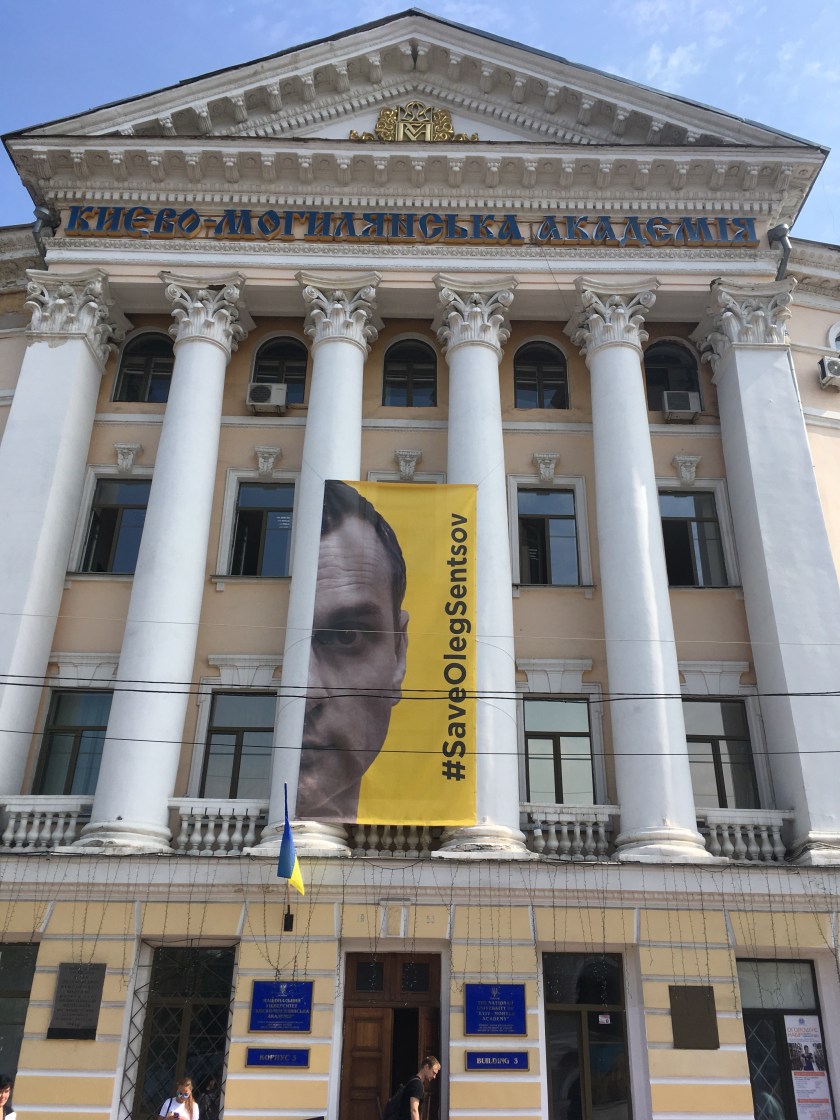
If you wander around Kyiv today, you will see numerous posters demanding that Oleg Sentsov be freed.

For, the #SaveOlegSentsov movement started when Sentsov was arrested by the Russian Federal Security Service in 2014 on charges of terrorism against the Russian state and sentenced to 20 years in prison.

Widely purported to be fake charges, Sentsov nonetheless was supposedly, according to Verity Healey, coordinating ‘relief efforts to help Ukrainian soldiers barricaded into their barracks by the Russian military.’

Sentsov’s reasons for doing this are that in 2014, Sentsov’s native Crimea, which includes Simferopol and which at that point in time was part of Ukraine, was ‘annexed’ by Russia – and which move remains to this day the cause of combat between the Ukrainian and the Russian militaries.

In late 2013 and into 2014, thousands of Ukrainians poured into and occupied the Maidan Nezalezhnosti in Kyiv in protest against, among other things, the decision by then-President Viktor Yanukovych to withdraw Ukraine from signing agreements with the European Union – preferring instead to cement ties with Russia.

After police violence against the protestors, which involved c130 deaths (with Ukrainians referring to the victims as the Heavenly Hundred), Yanukovych was toppled and an interim government set up.

During the instability that followed (not least because some Ukrainians would prefer to side with Russia than to join Europe), Russia annexed Crimea – and during this period Sentsov suspended shooting his second feature film, Rhino, in order to take part in the EuroMaidan and then to protest the annexation.

Sentsov has since his arrest allegedly been tortured and ‘left to die‘ by Vladimir Putin after the filmmaker began a hunger strike while the rest of the world decided to forget about reality and to celebrate Russia as a result of its wonderful hosting of the 2018 Football World Cup.

In other words, for Sentsov active participation in the world is more important than filmmaking. Reality is more important than media. And while we watch spectacles like cinema, games and soccer, people are fighting and dying in an unofficial war over Ukrainian territory.

Let’s ratchet this blog up a bit.

As the UK’s England side, with its rather unremarkable Won 3 Drew 1 Lost 3 record, progressed to the semi-finals of the World Cup, numerous memes began to circulate, often accompanied by the song ‘Three Lions’ by Skinner & Baddiel and the Lightning Seeds, and which encouraged England fans finally to ‘believe.’

What they ‘believed’ was that football might – after 52 years – ‘come home,’ in the sense that it has been 52 years since England last won a major international tournament (the 1966 Football World Cup), and in the sense that the English believe that they invented football since they were the first to formalise an enjoyable sport into a violent, money-making spectacle that today leads many human beings to be trafficked (as per Soka Africa, Suridh Hassan, UK, 2011), which is not mention alleged sexual abuse conspiracies within the sport and other human rights abuses that take place as a result of the sport.

It is interesting that the response of England fans to their team’s perceived success and possible chances of winning the tournament were framed by the word ‘belief.’ Football is not about being the better team, but about believing that one can win. But not on the part of the players, but perhaps especially the fans (which is not to rule out some irony in a good number of the memes, suggesting that people did not really believe that a mediocre England team could at all be the best in the world).

More than this, that belief is spurred on not just by the performance of a football team and its fans, but also by the plethora of media artefacts that circulate around it (and I’d like to write a blog at some point about Gareth Southgate’s waistcoat and the role that it played in both creating that sense of belief, but also ultimately in betraying that belief as false).

That is, what we believe – what we consider to be real and true – is shaped by media. Hence it is that the pages and pages of British media covering men in shorts running around a grass field create a sense in which that sport is more important to many human beings than lives in Ukraine, where a covert war is taking place – simply because the British media do not cover it. (Perhaps rather than cover it, they cover it up.)

So while Sentsov was protesting the World Cup, England fans got all excited because they managed to stick six goals past a weak Panamanian side and score a few penalties. Sentsov could, in effect, go hang as far as the England fans were concerned; they were having far too much fun on Russian soil to want to think about serious matters like politics.

Indeed, if anything, the UK with its Brexit vote would seem to side with Yanukovych in wanting to be shot of the European Union.

More than this. The UK, with the involvement of Cambridge Analytica in a bid to shape what American voters consider to be real and true, seems increasingly to be the plaything of Russia, which itself seems increasingly likely also to have been involved in shaping what American voters consider to be real and true, and which thus led to the election of Donald J Trump as the 45th President of the United States of America.

You may think that I am going too far and that this all sounds far too conspiracy theory-like.

But the point that I wish to make is that to embrace technological progress as unthinkingly and uncritically wonderful (Ready Player One) is to lead towards the post-truth world of digital fake news that characterises the contemporary era. Hipster rebellion is not rebellion; giving up games and filmmaking in order to fight for something that one truly believes in… is properly to lead a political life – even if that just means making human connections and working a modest but dignified life in a shop (Gamer).

Note that what I do not mean by evoking fake news is that Russian involvement in American politics is not true. On the contrary, we must critically examine what has happened if we are to work out the truth. But what the world of fake news does politically is that it allows everyone to be precisely uncritical and to dismiss as ‘fake’ that which simply does not please them.

It is to dismiss from view the unpleasant realities of a film director undergoing hunger strike in a Russian prison in order to prefer the spectacle framed by ‘belief’ of a football team doing well at a World Cup.

It is to dismiss from view the unpleasant possibility that we are all being manipulated by media in order to manage our perceptions. It is, à la Ready Player One, to prefer the Matrix to reality – reality not as something that lies beyond our attempts to find out exactly what it is, but reality as precisely our attempts to discover it. Reality as critical thinking and ongoing thought, rather than the matrix of no critical thought, a loss of human connection, a loss of humanity, a world of docile reception in which the only actions possible seem not to be ones of love (making human connections), but ones of violence against other human beings (murder) because one does not believe those humans (or perhaps anything) to be real. We love what we consider to be real, or rather what we love is what we consider to be real, and we love images more than humans. And yet to love should be to love humans (and perhaps images, too – but not only the images that one a priori loves; to love is to love what one does not love; to love is to love unconditionally; to love is only to love and not to love and to hate; to love and to hate is really just an excuse to hate).

In rejecting gaming, Gamer, then, tries unlike Ready Player One to take us back to the human realm (even if the hero of Spielberg’s film gets the one-dimensional girl and takes a day off gaming every week in a pseudo-effort to placate the notion that living in a fantasy world might not be all that it is cracked up to be).

Even if Ukraine cannot officially be at war with Russia, and if in this sense it must always already be complicit with the precedence of images over reality (no country can join NATO or the EU if at war, and so if Ukraine wants to join either of these institutions, it cannot be officially at war), we can nonetheless bear in mind that the fate of a Ukrainian filmmaker in Russia is still connected to Trump, Putin, the World Cup, fake news and the murders that took place in Jacksonville. And that Oleg Sentsov’s Gamer can help us to make sense of how this is so.

Understanding that this is so might be key to helping us not simply to accept by forgetting the corruption and the violence of the contemporary world, but also to believe in and thus to help create a better world. To believe not just that England might once again be ‘great’ (a true conservatism expressed through digital media and in the Brexit vote), but to believe that we can live in a world that ignores the divisive mechanisms of nations and nationality and which is based upon the shared humanity and life of our fellow human (and other) beings. To believe not in the patriarchal matrix of a society of control, but to believe in and to act towards a world of liberty and self-determination.

You can watch Gamer on the website for the International Film Festival Rotterdam for US$4. Money goes towards supporting Sentsov’s case.

The Escape (Dominic Savage, UK, 2017)

Blogpost, British cinema, Film reviews, Uncategorized

A woman is unhappy with her marriage and her children and so becomes depressed and dreams of escape.

Sound familiar?

If you are familiar with the plot of Gustave Flaubert’s Madame Bovary (1856), then maybe you will indeed know this story.

And of course Gemma Arterton, who is the star of The Escape, played a modern-day version (of sorts) of Emma Bovary in Anne Fontaine’s Gemma Bovery (France/UK, 2014), in which Martin (Fabrice Luchini) tries to project on to Gemma the story of Emma after she and her husband (Jason Flemyng) have moved from England to live in the French countryside, where Martin works as a baker (having quit the city life some time before).

So perhaps it comes as no surprise that here Tara (Arterton) lives in an unhappy marriage with Mark (Dominic Cooper) and their two annoying kids somewhere in Kent.

Mark clearly has a decent job, even if we never find out what he does, since the house that they inhabit on their close is pretty big and they have two cars. In other words, Tara is not unhappy because of a lack of material wealth.

Mark, meanwhile, is not without his flaws. He veers between being an ignorant oik who has no interest in art and boring things like that, and actually being quite a sensitive man who wants to make an effort to understand and to improve the lot of his clearly unhappy wife…

However, for whatever reason, he does not quite have the emotional or intellectual intelligence properly to help Tara, as can be signalled by his lack of care for her pleasure when having sex and in the way that he does not let her rest at a barbecue and/or passively-aggressively complains about her not having his dinner ready.

Since Mark is, to put it bluntly, inarticulate (or what we might call ‘a bit thick’), he gets angry when he cannot help Tara, and so he lashes out. Not that he hits her, but he swears at her and puts her down, calling her stupid and deriding her artistic ambitions.

For, Tara is depressed by her repetitive life of getting the kids breakfast, taking them to school, picking them up, being treated like a shag object by Mark and so on. And she clearly dreams of doing something more creative with her time – as signalled by her aspiration to sign up for an art course after taking a day trip up to London, and as signalled by the first part of her ‘escape,’ which involves going to Paris to see tapestries that she also has read about in a book she buys on London’s South Bank.

As a study of depression, The Escape involves some very strong performances – especially from Arterton (although I shall return later to issues of accent – both in relation to her and in relation to Dominic Cooper).

However, The Escape is also not quite a study of depression, be it post-natal or otherwise. For depression does not necessarily go away if one happens to escape one’s milieu; being a psychological disorder, it is something that can follow one around and affect even the most privileged person.

**Spoilers**

In The Escape, though, the film ends with Tara having moved from Kent to London, where she lives in a massive apartment right next to a square that does not look dissimilar to somewhere like Eaton Square Gardens by Sloane Square.

She walks into the square’s gardens and turns to look at some children playing – whom we hear but do not see. It is hard to tell what Tara is thinking and feeling, but Arterton comes close to tears (there is a lot of crying in this film), suggesting that in part she misses her kids (whom, we infer, she has left with Mark).

But at the same time, the film would seem to end on a positive note: Tara has left behind her shitty working class life in Kent and now is more fulfilled, and more in her skin, living in posh ends in London. She may still get sad, but it would seem that she is no longer depressed. Meaning that The Escape is basically a fantasy of becoming (upper) middle class: when you get to live in a ridiculously large apartment in somewhere like Sloane Square, having got rid of your chavvy husband and your screaming brat chav kids, then depression melts away and you are fine.

Note that I explicitly do not want to say anything along the lines of Tara being a terrible mother for abandoning her children. I do not want to make this a critique of her character based upon some predetermined biological role that she as a female is supposed to play.

No – I am happy to take it on face value that Tara is happier without her children, and that this might indeed be the case for many people, even if The Escape would look odd when placed alongside Tully (Jason Reitman, USA, 2018), where post-natal depression gets paradoxically a much more realistic treatment, since the kids there are not depicted as such an unremitting nightmare, but are characters that can do more than just scream (but perhaps this is because they are not ill-educated chavs).

Rather, I am more concerned with how The Escape paints estuary England with such total bleakness that it is hard not to see the film ultimately as a work of complete snobbery, even if it has claims to realism.

Don’t get me wrong. I sometimes wonder how the eloquent and erudite Owen Jones (the author of Chavs) would survive if he had to spend all of his days with Mail-reading Kent and Essex boys rather than with The Guardian and Celebrity Pointless lot that are his contemporary crowd.

That is, there is an element of British society in which a kind of unconscious anti-establishment attitude emerges through wilful ignorance – even if this plays directly into the hands of the ruling classes (problematically to generalise: schools are designed deliberately to discipline working class society members, who then are betrayed by schools that do not help them and/or who betray their class by doing well at school, and who must then choose not to do well at school and/or to ditch school in an act of rebellious ignorance that then consigns them to the working class for the rest of their days, which imprisonment they will fiercely defend, hence a tendency for conservative thinking to flourish in working class areas).

By which I mean that I can sympathise with Tara wanting to do something else with her life other than knock out more kids and begin to drink gin and smoke fags in her close until she withers away.

But The Escape as a film also specifically wants us to share Tara’s desire for escape, and in this it must present to us a relatively specific vision of working class Kent life. Or rather: lower middle class Kent life, which may involve certain material trappings (nice house, two cars, coffee from a cafetières at breakfast, orange juice decanted into a jug – ‘lower’ middle class/’working class’ is not really defined here by money), but which nonetheless lacks any sensitivity or sensibility towards thought and/or art (class defined here by cultural capital, and in particular how one spends not so much one’s money, but one’s time). A life that lacks, if you will, the humanities, and thus, as the film might at times want to have us believe, (a certain type of ‘refined’) humanity.

And in performing this trick, the film becomes (for this viewer) problematic. Since surely there is so much humanity in estuary England that it need not be a world that one can only escape by moving to Paris and/or Sloane Square – as if becoming posh were the only true solution to the class problem in the UK.

Where Flaubert – in his typically misanthropic and misogynistic fashion – makes Emma suffer (and die) for her imprisonment and her aspirations (even if she is married to a dullard doctor rather than a besuited barrow boy), Tara escapes. Not that she should be deprived of any class mobility (for to suggest that we all must know and remain in our place would betray a different kind of conservatism). But her escape involves leaving chav life behind.

The Arterton star persona here becomes important. For, it is as if her physical beauty (as well as her bosom, which Savage allows to play a prominent part in many scenes, even if always covered) is being used here as a tool to help convey that Tara is better than and does not deserve this life. That is, beauty cannot survive in and does not belong to the Garden of England, but a cinematic central London Garden of Eden.

Arterton is loosely associated with Cinderella-type roles. Tamara Drewe (Stephen Frears, UK, 2010), for example, is about the transformation of Arterton from ugly duckling to beautiful swan, while Gemma Bovery also sees Martin project on to her the narrative of social climbing that Flaubert so mercilessly mocks.

That said, Arterton broke through playing a kind of troublesome private school girl in St Trinian’s (Oliver Parker and Barnaby Thompson, UK, 2007), meaning that her star persona sits somewhere uneasily between different class strata – something that also holds for Dominic Cooper, whose breakthrough role was as Dakin in The History Boys (Nicholas Hytner, UK, 2006) – in which his character wins a scholarship to Oxbridge as a result of his academic excellence.

In other words, both actors sort of connote upward mobility – which means that their very chavviness here rings somewhat false. That is, their Estuary English accents seem just a bit forced at times (to this viewer), suggesting that the film involves actors performing downwards in a film that is about a fantasy of moving upwards. While Arterton grew up in Kent and is from a relatively working class family, thereby meaning that she surely has claims to giving an authentic performance, the same performance could have been given without the forced accents. With the forced accents, the film again comes across as slightly disingenuous, condescending even – regardless of whether the emotional range of the performance(s) on offer is superb (which it is).

But more than this. What is equally interesting about The Escape is its formal features.

About halfway through the film, Tara has a conversation with her mother (Frances Barber), who explains that her life is not like a television show.

And yet, in its very domesticity, The Escape is not wholly dissimilar to British soap operas, even if it uses various stylistic features that we typically do not associate with the smaller format (slow motion shots, variable focus, extreme close ups, musical accompaniment, relatively abstract shots of the sun setting and so on).

In this way, The Escape would seem in some senses to be about the escape from television and into cinema – as if these very media were themselves representative of different classes.

It is perhaps no coincidence, then, that Tara heads to the South Bank in order to get a sense of what life might be like outside of the close. For it is on the South Bank that Mark (Michael Maloney) will hop – somewhat embarrassingly – alongside Nina (Juliet Stevenson) in Truly Madly Deeply (Anthony Minghella, UK, 1990). And it is on the South Bank that Charles (Hugh Grant) will talk to his brother David (David Bower) about love in Four Weddings and a Funeral (Mike Newell, UK, 1994). It also is on the South Bank that Alex (Alex Chevasco) will meet Patricia (Hannah Croft) in En Attendant Godard (William Brown, UK, 2009).

There are more examples, but these three will alone suffice to demonstrate that the South Bank is a middle class space that is in some respects associated with cinema – and certainly not with television. Indeed, the stall where Tara buys her book, on the cover of which is The Lady and the Unicorn tapestry from the Musée national du moyen âge in Paris, is right next door to the British Film Institute.

Gemma Arterton must be saved from television and upheld as truly cinematic. Tara, too, must be cinematic. And Tara, too, must therefore not just practice art, but also become art – which is what happens when Tara ditches Kent for Paris and meets Philippe (Jalil Lespert) at precisely the Musée national du moyen âge – after he spots her on the Boulevard St Michel.

(Is Tara suddenly finding herself inside Peter Sarstedt’s ‘Where Do You Go To (My Lovely)?’ – even if that song is a critique of the emptiness of living in a fancy apartment in Paris and hanging out with Sacha Distel?)

For, Philippe is a photographer who cannot but take photos of Tara in front of The Lady and the Unicorn tapestry – because she is to beautiful. Inevitably they sleep together, then, with Tara calling herself Sam (her real self, rather than the fake woman who leads a fake life in Kent?).

(Jalil Lespert is an actor associated with upward mobility, too, owing to his role in Ressources humaines/Human Resources, Laurent Cantet, France/UK, 1999, where he plays a university graduate who must sack his own father and the rest of his workforce from the factory in which they have for many years worked – all in the name of economic rationalisation.)

And yet, this view of Paris is highly romanticised, as is clear from the homeless people that Tara passes and the beer can that nestles on a Gare du Nord cornice as she exits the station. Tara seems not to notice these ‘trash’ details, but instead falls immediately in love with the City of Lights for what it means: escape from dull and grey England.

Cinema is upheld as better than television – and Tara manages to make her life cinematic by leaving behind all that she knows in Kent. This is a far cry from that other relationship between a man and a woman who has artistic aspirations and who seeks to escape an unhappy marriage – and which is perhaps one of television’s finest achievements, namely the relationship between Tim (Martin Freeman) and Dawn (Lucy Davis) in The Office (Ricky Gervais and Stephen Merchant, UK, 2001-2003).

In sum, then, The Escape involves a wonderful central performance from Arterton, with Cooper also being as strong as in anything else in which he features and which I have seen (the film is sympathetic to him as he cries after feeling out of place in a posh London restaurant; but he is also unredeemable, suggesting a sort of hopelessness about his character).

However, the film also would have us believe that the chav classes of the UK are a hellhole from which one must escape – televisual and bleak as opposed to beautiful and cinematic, associated with relentless interiors and small gardens as opposed to clear skies and open space.

Arguably the film stages the way in which public space is not public, but really middle class – with Tara wanting to gain access to these spaces. But she does so by leaving her Kent home behind. A study in depression that is sympathetic both to Tara and to Mark, the film nonetheless posits that the cure for all of this is to escape. And that Brexit Britain is a small-minded and awful place, with a ‘European’ sensibility being the only one that can save us. (Don’t get me wrong – I am strongly anti-Brexit; but how The Escape is quite one-sided just means that it is not the film to give pro-European views the most fair account.)

First things first.

Pre-production
We are still working on all manner of projects, including a possible sequel to The New Hope, a film about a group of university friends holding a reunion in France called Mantis, and a film about members of a singularity cult who decide to blow up server farms called How to Get Killed in the UK. This is not to mention our unnamed musical project about London’s French community. Hopefully one or more of these will get made in the next few months.

Production
Recently we travelled to Portugal, where we did the principal photography for an experimental film about actors and acting called La Belle Noise. The movie stars Beg Steal Borrow regular Dennis Chua and newcomer Colin Morgan in the lead roles. Alya Soliman and Guy Farber helped out on the production, which featured numerous contributions from participants at and around the Fest Film Festival in Espinho, just south of Porto.

Fest provided the backdrop to the film, with William Brown also delivering a masterclass on zero-budget directing at the festival.

Post-production
We are continuing post-production work on This is Cinema and The Benefit of Doubt. Imminently our collaborative epistolary film with Macedonian filmmaker Vladimir Najdovski will be completed and will enjoy a screening in London. Keep an eye out for this!

Exhibition
William’s recently completed short film Clem, which is about one of the cats that lived with his family during his childhood, played at the 2018 Film-Philosophy Conference in Gothenburg, Sweden, where it was generally well received.

On a separate note, though, Circle/Line was accepted into the Jogja International Film Festival in Indonesia, where it received an International Award of Merit.

While this sounds like good news, there was no actual screening of the film, since the organisers of the festival insist that all filmmakers be present if their film is to be screened – and William could not afford the cost of the airfare to Indonesia.

Failing the presence of the filmmaker, one can pay a local representative to be at the film, while the festival also only accepts films that have been burnt to DVD/BluRay by the local designated company. Oddly, the festival does not accept file transfers.

The combination of these quirky policies has led William to question whether the festival is really one aimed at getting the filmmaker to spend money locally in Indonesia, which is not necessarily a bad thing, but which does reaffirm the way in which many festivals are not screening stuff because they really like it, but for other reasons, perhaps here economic.

This prompted William to survey his festival submissions over the past few years. Looking at FilmFreeway alone, William has submitted his projects to a total of 128 festivals.

There have from this been 11 acceptances, 113 rejections and 3 submissions the outcome of which has not yet been decided. This means that less than one in 10 submissions has resulted in an acceptance.

Of those 11 acceptances, two were for film scripts (or rather, for the same film script, namely Kiss & Make-Up – at the Oaxaca FilmFest and at Scriptapalooza respectively), while six acceptances were for films that ultimately did not have a screening (with those screening-less festivals being the Beijing International Film Festival, the Stockholm Independent Film Festival, the UK Monthly Film Festival and the Barcelona Planet Film Festival, which supposedly accepted three of our films at once).

This then leaves three festivals alone as having taken our work and actually screened it – with one of those being a screening of The New Hope at the Bad Film Festival in New York, where there was an audience of zero people (although this number has not officially been confirmed). Otherwise, Letters to Ariadne played at the Validate Yourself Film Festival in New York (where over two thirds of the audience walked out and where the festival organiser himself tried to clap the film off the stage), and Circle/Line played at the wonderful East End Film Festival in London.

This means ultimately that 128 submissions have led to three film screenings, a hit rate of less than one in 40. And it means that a sum of roughly £1,500 has led to about 100 people watching our films. In order words, we are paying about £15 per head for people to watch our films.

(This is not as bad as the £400 paid to a cinema in London recently to show a preview screening of The Benefit of Doubt, and to which 10 people turned up. A simple case of mathematics: for that screening we paid £40 per person to be there!)

A couple of things follow from this, the last of which will be a typical performance of self-deprecation.

The first is that if you want to make some easy money, we suspect that you could do worse than to set up a film festival that never actually runs, or which if it does run, plays only one or two films from among those ‘selected.’ All you need really to do is to give to people ‘palms’ (if that) so that they can put them on their poster to give their film the air of having had ‘festival success.’

Charging a small fee in order to attract those filmmakers who do not have the money to foot £75 entry charges, I imagine that you would have a steady stream of 50-100 submissions each month (especially if you create a ‘rolling’ festival, like the UK Monthly Film Festival). At, say, £10 a pop, that would make you between £500 and £1,000 per month, minus your fee to Film Freeway. It would certainly help with the rent and/or to pay for one’s own creative projects – including the hire of a venue at which to the screen your own work (something that William has also spotted some festivals as doing).

The second point is that such a low hit rate would suggest that our/my/William’s filmmaking is shit – since no one wants to watch it (we have to pay people to watch our work).

Even after a high profile screening of Circle/Line at the East End Film Festival, not a single door has been opened in terms of giving to that film a further festival life – in much the same way that no festival screening has ever in our careers led to further festival screenings, with none of our 14 feature films having played at more than two festivals (and with none of our shorts having ever been selected for a film festival at all).

This compares very negatively with numerous other filmmakers, whose work seems to enjoy a ‘run’ of 30 or 40 festivals with a single film.

Perhaps one day we’ll work out what it is that we do wrong. But certainly we are just wrong, or we just get it wrong the absolute vast majority of the time. We certainly very rarely get it right – in terms of not just having a screening, but also in terms of people actually liking what it is that we do.

I guess, however, that we carry on – even if it is to the displeasure of those who wish that we would just give up, and even if it is to the displeasure of those who enjoy having a good laugh/bitch at our expensive when our work is mentioned in conversation.

Because if we didn’t carry on, then the feeling of not being right would become overwhelming, since it also is linked with not being right for this world. And the logical thing to do for someone who is not right for this world is to remove oneself from it.

Awards, Beg Steal Borrow News, Circle/Line, Clem, Festivals, Kiss and Make-Up, New projects, Prizes, Screenings, Scripts, Short Films, The Benefit of Doubt, The New Hope, This is Cinema, Uncategorized

Incredibles 2 (Brad Bird, USA, 2018)

American cinema, Blogpost, Uncategorized

In April, amid all of the hoo ha about the ‘revolutionary’ nature of Avengers: Infinity War (Anthony and Joe Russo, USA, 2018) – because to make war infinite and to propose an unhappy ending is really revolutionary? – Steve Rose wrote in The Guardian about how Thanos (Josh Brolin) may in fact not be the bad guy… but really the good guy who wants to restore balance to a multiverse that humans have otherwise put out of balance.

Fast forward three months, and Incredibles 2 strikes me as another example of a film where basically I find myself rooting for the baddie, even though I quite like the goodies, too.

For, about a third of the way into the film, the seemingly arch-villain, the Screenslaver, explains the rationale behind his/her plans. Without remembering the speech verbatim, the Screenslaver basically makes the point that superheroes and representations of superheroes have become ubiquitous and that everyone spends all of their time looking at their screens that feature superheroes rather than heading out into and embracing the real world. People have lost touch with reality, and so the Screenslaver wants paradoxically to use the screens in order to bring people back to reality… but he/she can only do this by defeating those superheroes.

Spoilers.

When it turns out – rather obviously – that the Screenslaver is in fact Evelyn Deavor (Catherine Keener), the only question that remains is whether her brother, Winston (Bob Oedenkirk), is in cahoots with her or whether he is blissfully unaware.

It turns out that he is unaware of her plan. So a couple of questions arise.

For, Winston is basically a billionaire media magnate who just wants to develop a strong publicity campaign to bring ‘supers’ back into the fold after they have lost favour owing to the amount of collateral damage caused by their otherwise invisible labour. With the right coverage, people will understand why they have to destroy so much stuff… and then they will be upheld as the heroes that they are.

What Winston is not, therefore, is a media magnate who understands that he should just develop the whole combat between supers and villains as a media spectacle – since it is eyeballs on screens that makes and keeps him rich.

Rather, this is something that his sister realises… and yet she only wants to destroy the media empire – and in the process also to destroy the supers’ hopes of being able to act out their superpowers by getting into large-scale fights in public.

I don’t want to get too bogged down in sorting through the nuances of this slightly illogical plot. As most people would say: it doesn’t matter, just enjoy the movie and go with it.

Except for the fact that the Screenslaver/Evelyn basically argues for what I consider to be the point of my job: namely that people should be much more media savvy and literate than they are, learning how critically to evaluate both what they see and the mechanisms that are in place that allow them to see it. Without such critical thought and eyes, one is simply prey to the propaganda messages that surround us.

Indeed, that Winston is not acutely aware of the money that he will make from the supers is unthinkable. And how the supers are not aware, or even suspicious, from the get-go that they might be patsies within a ‘sinister’ media plan… just begs the question of when a superhero will come along who is capable of ideological critique and who realises that most of their violent actions are simply an enactment of their interpellation into and perpetuation of the systems of violence that keep the contemporary world as it is (which as it turns out is to be on a crash course with ecological cataclysm).

That is, I wonder when a superhero will come along whose superpower is… intelligence – because most of these ‘superheroes’ might be amazing beefcakes, and they may even be able to bend space and time and to invent amazing technologies… but as far as political sensibility is concerned, these guys are fucking dumb (Charles Xavier/Professor X is about the closest to being an exception to this so far; no wonder Lex Luthor doesn’t respect Superman).

In effect, then, Incredibles 2 is saying that film and media studies are the bad guys, and that critical thought/intelligence is bad in a world where supers should just do what supers do (fight), and we should all watch more and more of them on our screens (in a Disney monopoly) as we are fed endless fictions about ubermensch that help us to forget that in our human, all too human capacity, we have basically brought about the destruction of our planet and continue to be exploited into doing nothing about eking every last penny of profit from the environment, its animals and its humans (if they are separate things) because we are interpellated into being unthinking and uncritical subjects by the ideological state apparatuses that surround us, including cinema and films like Incredibles 2.

In other words, if you are critical of capitalism, then you are the enemy. If you question, then you are the enemy. If you think, then you are the enemy.

And yet, maybe some skills in critical thinking would have helped Elastigirl (Holly Hunter) to realise of course she was getting played in putting a camera on her suit so that she can be entered into and win not just a war of perception about whether she is ‘good’ or not, but also a ratings war that Winston pretends to deny but surely cannot be so naïve as to overlook.

But of course, for Elastigirl to out-think her opponents would make for boring cinema. And so here is the rub: given the cinematic values of our society, if you endorse anything that is not cinematic (including intelligence), then you run counter to the role that society has assigned to you, even as the powers that be accrue information/intelligence about you as a result of every keystroke that you make on your laptops.

Did I spoil your fun? Did I spoil your film? I apologise if I woke you from your gentle slumber. Well… sorry not sorry. Sorry. Not sorry.

Apologies for the relative silence on the Beg Steal Borrow front.

However, we are delighted to mention various screenings that have recently taken place featuring Beg Steal Borrow movies.

Firstly, The Benefit of Doubt screened at B-Film at the University of Birmingham on 12 January, before Selfie screened on 23 February at Coventry University – where there was a large and lively audience.

IMG_0262

Selfie screens at Coventry University.

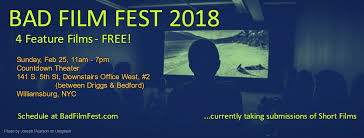
Then The New Hope screened on Sunday 25 February at the Countdown Theater in Brooklyn, New York, as part of the Bad Film Fest – as well as at the University of Roehampton, London, on 29 March.

Bad Film Fest

Finally, Circle/Line screened at the University of St Andrews on 11 April, while Sculptures of London will enjoy a screening at the University of Bedfordshire in Luton on 10 May.

IMG_0416

Circle/Line screens at the Byre Theatre in St Andrews, Scotland.

Many thanks to all those who have shown and who continue to show support for our endeavours.

This is Cinema is coming along slowly but surely, and we hope that there are more similar screenings soon.

Beg Steal Borrow News, Circle/Line, Festivals, Screenings, Sculptures of London, Selfie, The Benefit of Doubt, The New Hope, This is Cinema, Uncategorized

Mini-Mythologies #2

Blogpost, Mini-Mythologies, Uncategorized

Two more mini-analyses of adverts…

The first is for AUDI’s Q5 React, a spot created by Marc Rayson and Callum Prior at Bartle Bogle Hegarty, and directed by Alan Bibby. The advert features the song ‘If I Only Had a Brain’ from The Wizard of Oz (Victor Fleming, USA, 1939), here recorded by Faultline


A few things to consider.

Firstly, as the car progresses through the rain, we see text crop up explaining to us what is going on. The ‘intelligence’ of the car, then, cannot really be shown to us in images, but only using text – as if a mastery of language alone were what justified intelligence. That is, it reaffirms the idea that a car/machine will only be considered intelligent when, like Kitt in Knight Rider (Glen A. Laron, USA, 1982-1986), it talks.

What this really means is that anything that does not talk is not intelligent – and can thus be treated accordingly. That is, we can kill animals and we can treat as subhuman those who do not speak (our) language.

Will an intelligent car have rights? And will it only be able to assert those rights – not when it obeys a human, but when it disobeys?

This leads us to the second point, which is the reworking of ‘If I Only Had a Brain’ is in some senses misapplied, for in The Wizard of Oz, it is not the Tin Man (Jack Haley) who lacks a brain; it is the Scarecrow (Ray Bolger).

What the Tin Man lacks is a heart.

And since a car is closer to a Tin Man than a scarecrow, then is the advert not telling us that the car already has a brain, but that what it really wants is a heart? That is, it what the ability to love, but also the ability to reject domination because not only does it think, but it also feels, with suffering at the hands of its human overlord being one of the primary things that it feels?

Finally, to see text explain the meaning of objects means that the advert is in some senses  restaging the famous IKEA walk-through from Fight Club (David Fincher, USA, 1999), where we see Edward Norton’s Narrator walk through his apartment as items from it appear, their name and meaning equally explained via pointers and text.

Does Fight Club presage a thinking/feeling home?

But more importantly, does the anti-consumerist message of Fight Club mean that this advert is somehow undermining its own status as an advert? Or rather, do we see here how an anti-consumerist aesthetic has now been co-opted for precisely consumerist means? Perhaps the one thing that does have a brain is capitalism itself.

The second advert is Pepsi Max’s new Love It or Taste It campaign.

It is surely an obvious point to make. But if you can only love it or taste it, then you can only love it if you have not tasted it. To taste it is not to love it.

Note that it is not love it or drink it. Many people can drink this stuff, but that does not mean that they love it. But if you actually taste Pepsi Max, then you will not love it.

I admire their honesty, but this seems somewhat nonsensical as an advert, since it it the equivalent of saying ‘if you actually buy this stuff, you won’t like it.’

A final thought: possibly no one cares – meaning that language is redundant in this advert and perhaps also in the AUDI advert. It’s not the words that do anything; it is that there are words that is conveying something – meaning that adverts are not about language, but more about affect and how they make us feel (with the close up on sparkling beverages surely being designed to make us feel thirsty and with language, but not the actual words, making us feel like this ‘base’ desire is actually informed and intelligent).


Tomorrow Never Knows (Adam Sekuler, USA, 2017)

American cinema, BFI Flare, Blogpost, Documentary, Uncategorized

After last year watching and loving a version of his Work in Progress (USA, ongoing), I was particularly glad to see Adam Sekuler’s latest and remarkable film, Tomorrow Never Knows, at Flare, the LGBTQ+ film festival run through the British Film Institute (BFI).

Like Steven Eastwood’s equally profound Island (UK, 2018), which is set to enjoy a theatrical release in the UK in the next couple of months, Tomorrow Never Knowsis a documentary that looks at death, specifically here the build-up to the passing of Shar Jones, a transsexual living in Colorado with her partner, Cynthia Vitale.

Shar has Alzheimer’s and wishes to take her own life, but this is not legal—certainly not with assistance. And so, Shar prepares to die in the only legal way possible, which is by no longer eating and drinking, i.e. by starving herself to death.

Shar is a Buddhist who is interested in the passage of time, as is made clear by her love the Beatles song, ‘Tomorrow Never Knows,’ from which the film takes its title and the lyrics to which we hear Shar repeating/singing several times.

In particular, we might note that the song includes the line ‘it is becoming.’ That is, we live in a universe that is not static, but which always is changing. We cannot control the flow of time, and so perhaps one thing we might do is to accept it.

What is interesting about this interest in the flow of time is the tension that the film sets up both thematically and formally.

Thematically, the fllm invites the viewer to consider how death itself is a form of becoming; it is a passage of our bodies (if not a spirit) into another non-living realm, and in which—at the very least—our bodies are dispersed into the universe.

However, so also is Alzheimer’s a cerebral deterioriation that also involves, in some senses, the dissolution of the self into multiple selves—with some memories at certain points in time and few to no memories at other points in time.

There is no intention here to make light of the disease and the devastating effects that it has its sufferers and those around them.

Nonetheless, while death becomes Shar, she does this in particular by attempting to remove Alzheimer’s from her life—refusing what we might call a passive becoming (the disease) for an active becoming (choosing to die).

Paradoxically, this happens via Shar also refusing both to eat and to drink. In other words, in order to be open to death and in order to close out Alzheimer’s, Shar has to close off her body.

These thematic paradoxes extend to the film’s form/style, as I can explain by making reference to something Sekuler said in the Q&A session after the Flare screening that I attended.

Sekuler spoke of some moments featuring Shar that he had shot, and which we remarkable, but which he did not include in the film because he did not get a clean enough recording.

It is not strictly Sekuler’s aesthetic choices that I wish to question. But I use this anecdote as a way of showing how Sekuler is something of a formalistfilmmaker. That is, he aims for and very often achieves spare shots, in which there is little if any camera movement.

In other words, his style searches deliberately for a certain aesthetic, one that is, like Shar’s body as it progresses from life to death via starvation, one that seeks to shut out the outside and to demonstrate control, in particular through static long takes.

But as the human cannot fully close off the outside, and as the Buddhist might seek becoming, nor can Sekuler close off the outside from his film.

Indeed, in some senses Sekuler cannot make the movie that he might ideally want to because of the very reality that consistently invades his film.

Because Shar and Cynthia’s home is quite small, Sekuler cannot achieve distance, the frame is often cluttered, and in greater close-up, with people leaving and entering the frame a lot. Sound regularly must come from offscreen, and, in the form of traffic and other noises passing by their home, there is nothing that Sekuler can do about this.

Likewise even the light that streams in through Shar’s window.

The effect of these interruptions, though, is remarkable. For, as we see a man dying, we also hear the unstoppable nature of the world outside. The world of Shar seems to be one increasingly defined by containers, including her home and the coffin in which she will be buried, and in some senses, too, both her body and her disease are containers.

And yet these cannot be shut off from the world; the becoming cannot stop. The outside always come in.

The philosophical ramifications of Sekuler’s style hopefully here become clear: it is as if Sekuler is striving to stop the outside from coming in by making a technically flawless and aesthetically beautiful film… and yet he cannot achieve this, meaning that in some senses his film is an exercise in failure… just as every human life, as a result of its mortality, is an exercise in failing to stop death—even if one aid its advent through various measures like those taken by Shar (willed starvation).

A couple more things.

Firstly, some of the more remarkable moments of Tomorrow Never Knowsinvolve the outside and a loss of control from both Sekuler and his subjects. For example, when on a hike, we see Cynthia fall over, before Shar also needs to catch her breath.

Sekuler wants to do his static frame, but really cannot. He wants to keep his distance to film aesthetically pleasing shots, but cannot. The couple want to carry on as if unobserved, perhaps, but neither can nor do, as they talk to Adam, who in turn talks back, a voice entering the frame from offscreen.

In its imperfections, I would suggest that Tomorrow Never Knows shows most life, perhaps even most cinema, even if its struggle with the outside and its struggle for aesthetic control (its struggle to control death?) is equally a sign of life and cinema. But in both cases: cinema is not total control, but an absence of it…

But in this sense, cinema is not unlike Shar: she cannot control her disease—and this is just a fact of life. But she can control her death. So we reach another paradox: to be alive is to choose to die.

Sekuler shows us Shar’s dead body several times—at the start and then at various other points in the film. By starting with her corpse, Shar thereafter is reanimated, as if cinema could bring the dead back to life.

Cinema is thus a record of a world now dead, and it is both beautiful and haunting later to see images of Shar dancing in the countryside, a bridge (the bridge between life and death?) in the distance background.

But in contradicting death (Shar is brought back to life), Tomorrow Never Knows only reaffirms its inevitability—as a classical tragedy will depict its dead protagonists before the action unfolds: we know how this is going to end, with a key ingredient of tragedy being that one cannot escape one’s fate (and is perhaps hubristic to believe that it is possible).

Cinema is becoming, Life is becoming. Death is coming, if not becoming from the perspective of the self (which ends with death). But cinema also makes death becoming as it creates memories—an absence of becoming in that it creates something enduring. But even memories are, like cinema, fragile—as Alzheimer’s makes exceptionally clear.

The beauty of life and the beauty of cinema alike, then, lies perhaps in the shared but inevitably flawed attempt to exert control, to stave off the inevitable, to outlive it, both to become with it and not to become at all. To try to create in the face of destruction is perhaps to show spirit, to show that we have a spirit, a spirit that dances across the screen, before once more fading into nothingness.

As an addendum, I might say that while I will struggle to find time to write about it, Jason Barker’s A Deal with the Universe (UK, 2018) was also a highlight at Flare with its tale of attempts at transexual pregnancy.

Meanwhile, I would also like to give a big shout out to Siân Williams, who managed to have not one but four shorts feature in the UK Film Industry online section/selection at Flare. These included Montage of the Mind (UK, 2017), Bedside Surgeon (UK, 2017), DJ Pygmalion (UK, 2017) and Girl Under You (UK, 2017).

A Quiet Place (John Krasinski, USA, 2018)

American cinema, Blogpost, Uncategorized

A Quiet Place depicts a world in which no one can fart, or at the very least where humans have developed exceptional sphincter control in a bid to ease out silent (but violent) guffs rather than make a noise. For, if they do make a noise, then aliens with exceptionally sensitive powers of audition will hear you and kill you.

We open with the Abbott family leaving a city in a post-apocalyptic time when the streets are empty, but strangely not littered with the corpses of humans who have been eviscerated by the monsters—begging the question of how they managed to clear up the devastation without making a noise.

They follow a trail of sand that has been laid down between the city and a farm in the countryside. How any human being managed to carry that much sand in order to lay down a path along roads and through countryside is not explained. Nor is the fact that no one else is travelling along this trail of sand, with the sand acting as a way of muffling footsteps.

By a railway bridge, youngest son Beau (Cade Woodward) puts batteries in a toy spaceship, which starts to make some noise. Given the stakes, this is a dumb move, but Beau’s only three and a half years of age, so clearly does not understand what is going on. Summarily he is slaughtered by an alien, which happens to be in that exact area and an exceptionally fast runner—so fast, in fact, that Beau has not been able to move to a different spot and remain quiet, or throw away the noise-making toy, such that the alien, which is blind and can only hear, can either no longer find him or goes and follows a false trail towards the plastic toy.

Indeed, although blind, the monster clearly roams the wooded area through which the Abbotts travel without bumping into trees, without being distracted by the wind in the trees, and without there being any leaves or twigs on the ground for people to crunch and snap (even though the Abbotts end up on a corn farm, as discussed below, Kellogg’s will clearly have gone out of business in this dystopian world).

The next we know is that it is Day 472—either since the apocalypse or since the Abbott family arrived at the farm.

Even though more than a year has elapsed, the farm is in excellent working order, with pater familias Lee (John Krasinski) having somehow managed silently to maintain a giant crop of corn, which remains in neat rows and has not overgrown at all.

Despite not being able to flush a toilet, piles of faeces do not lie strewn everywhere. Luckily no one in the Abbott family snores. And Lee has managed silently to ejaculate inside his wife, Evelyn (Emily Blunt), such that she is now pregnant. By some stroke of fortune, the electricity is also still working, even though no silent power generators seem to have been developed—meaning that the monsters clearly have not found and disrupted the otherwise noisy electricity grid.

That said, the internet is apparently not working, with cell phones also being out of action, meaning that no one is sending or receiving texts (with ringtone and keypad set to silent, obviously), such that humans can communicate to each other the whereabouts of the beasts, information about them and so on.

Instead, humans exist in isolated micro-communities, every night lighting a fire atop corn towers to let others know that they are there. All very idyllic.

During these 472 days, Lee has managed to install and keep running in a basement an old-fashioned radio kit, through which he sends messages in Morse code saying SOS, even though he also clearly sees the fire signals of others at night. Why he wants to be helped (SOS) seems unclear, and why he does not go see the bearers of the other torches also is unclear (smoke signals might also be a decent way of communicating, except that Native Americans do not exist to pass on such skills).

In his basement den, Lee also has in over a year managed to accrue the following ideas: the aliens follow sound, you must be silent, and you must survive. Even though he has a go at electronics—trying to develop new hearing aids for his deaf daughter Regan (Millicent Simmonds)—one gets the impression that if this is the sum of his knowledge after one and a half years of living under alien invasion, then Lee truly is a Salt of the Earth American. Or as Mel Brooks might put it: you know, a moron.

Indeed, while one newspaper headline announces ‘steps to survive the apocalypse’ (or words to that effect—with silent print presses clearly having also been developed, together with a silent transport infrastructure that allows for the silent distribution of print newspapers during the period of alien invasion), Lee has not actually put up on his noticeboard what those steps are. Instead, he just has the headline showing—to let him know that there are steps to surviving the apocalypse. Some humans are happier just knowing that they could improve their lot, with no inclination actually to do so…

Clearly it has been beyond the ken of humanity, with all of its technology and know-how, to learn how to, for example, make noise in one place in order to attract one of these beasts, while actually being in another place, and then using this ruse as a way of trapping the beast and then working out its functioning and, bluntly put, how to kill it.

What is more, poor bloody aliens: they kill or at least attack anything that makes a sound (which in the film includes an alarm clock, previously unseen, and a television monitor). For clearly sound annoys the hell out of them. And yet even though they make one hell of a racket as they go about, they do not attack themselves, nor do they go crazy with rage at the sounds of cicadas, birds, and the wind, and nor do they drown endlessly trying to fight rivers. God knows what they’d make of a thunderstorm.

We do see one of the monsters eat a beaver or some such critter at one point, so the aliens clearly do attack and possibly eat more than humans. And yet, the countryside is not an Armageddon of bleating animals—from cows to mice to rabbit to pheasants to squirrels to badgers to sheep to goats—being torn to shreds by terrible monsters, who also might attack each other. Indeed, given that these monsters have such sensitive hearing, one wonders that they have ended up on the wrong planet, really. With no one realising that because their hearing is so sensitive, sound might actually be used against them. And certainly with no one realising that the aliens clearly are vulnerable when they expose their ears, and thus can be killed really quite simply—if you can shoot inside their open ear rather than at the rest of their impenetrable body.

(Presumably in this scenario, Cuba is safe, since Cuba knows how to use inaudible sound frequencies as a weapon, as per the rendering-deaf of various workers at the American Embassy in Havana. God damn those spick communists for being better able to stave off the apocalypse.)

Back to Lee. In 472 days, he has not been bothered to fix the massive nail that sticks up out of the stairs down to his basement, and on which Evelyn will later tread, presumably because he a) does not really like DIY, and b) because he really just wants to be left alone down there (he wants people to tread on the nail so that they won’t go down, with Lee refusing Regan entry to his den at one point in the film).

Furthermore, even though Lee climbs atop the corn tower every day to do his fire ritual (having not yet run out of lighter fluid), in 472 days and as a full-size human adult, he has not managed to fall through the roof of the corn tower, even though his small son manages to do exactly this later on in the film on what is, as far as we know, his first visit to that place (we can guess this because his son, Marcus, played by Noah Jupe, is a wuss who does not want to venture outside; Lee forces him to go fishing, where Marcus, clearly the inheritor of his father’s brains, finally realises that if he is around things louder than him, he can make noise, although why no one else has decided that behind a waterfall might be a good place to live in the era of these acoustic monsters is unclear).

When Marcus does fall inside the corn tower, one of the aliens arrives to kill him, but is put off by feedback from Regan’s otherwise malfunctioning hearing aid. The monster then bursts through the corn tower and out into the (still perfectly kept) corn field, only to reappear a bit later when Marcus and Regan are inside a now defunct car. But where the monster just ripped through a corn tower with ease, it apparently has much more trouble with car windows, meaning that Lee has time to arrive and sacrifice himself for his kids by causing a distraction.

Meanwhile, Evelyn has given birth and she keeps her new son (a replacement for Beau – yay!) in a coffin to keep him quiet—and an oxygen tank, which hopefully will last for three years or so before the newborn learns to be quiet. Even though this secret room is soundproof, and Evelyn and Lee can talk down there, it has enough holes in it that it floods when one of the monsters sets a pipe leaking upstairs while looking for them.

The point of this blog is not necessarily to demonstrate that A Quiet Place has as many holes in it as Lee’s sound-proofed room. Nor is it to suggest that if this film can get a major release, then The Room (Tommy Wiseau, USA, 2003) really should be upheld as an entirely legitimate film, since it makes about as much sense as this film, and yet was made for so much less money. Likewise, anyone who derides as inferior a movie like Mega-Shark versus Giant Octopus (Ace Hannah, USA, 2009) is duty-bound to do the same with this film—unless it is really cosmetic issues like budget that one wants to deride (i.e. what one really wants to deride when deriding Mega-Shark over A Quiet Place is poverty; this film may not make sense, but it’s a film with money, so it cannot be shit; only poor films are shit, like only poor people are shit, even though they may be much smarter than the rich male ‘heroes’ we have on display here).

Rather than make these points, though, the issue that I really want to address is why A Quiet Place is the way that it is.

Lee basically sits down in his basement doing completely useless things: making hearing aids that do not work, not fixing the nail, managing in 1.5 years to realise that ‘survival’ is key (no shit, Sherlock), and not reading the ways that might help him to survive the apocalypse, but just the headline that tells him that there are ways to do so. In other words, Lee is a redundant male and completely useless, consoling himself as being useful because he can fish and because he can light a fire with lighter fluid on the top of a corn tower, and sending pointless SOS signals via his radio rig.

At one point, we see a list of radio frequencies for him to try, and as Lee crosses out about the fifteenth frequency down a list of about twenty, you wonder whether he has really been trying to get help at all… Fifteen attempts in a year and a half, Lee? I mean, come on, man… how much do you want to get saved?

But this is the point: in its utter flimsiness, and in being predicated like many recent films around the premise of a dead and/or imminent birth (or in this case both), then A Quiet Place would seem to suggest that Lee does not want to get saved (he does not want anyone to answer the SOS call).

And why not? Basically because he fantasises about being in a world where finally his kids shut the fuck up and leave him alone to fuck about in his basement den doing absolutely nothing useful, but pissing away his time in the way that he wants and not responding to the demands of his family.

‘What do you mean I’ve only tried fifteen frequencies in a year and a half? Shut up! I’m busy. And no you can’t come down here to see how busy I am. You’d just get in the way. And ruin everything, like you’re ruining my life!’

‘Thank God that annoying kid got killed by that monster, even if I did make a token effort to save it. And better yet, I can punish his deaf sister for giving him the batteries and still claim to love her, even though she is deaf. And to top it all: hopefully my new son will both shut my wife up as she keeps banging on about replacing my dead son, while the screaming infant won’t have a hope in hell of surviving, so we might as well put him in a coffin already.’

The moral of the film, then, is that your kids will kill you—making your personal way of life untenable and taking away from you every freedom that you had and which narcissistically you do not want to give up, but in fact want to prolong, and preferably by producing not alien monsters, but clone versions of yourself.

Conversely, if you want to be a responsible father, then you must basically die for your kids—especially if humanity is to have a future. But who is prepared to die? While Lee does die in this film, the film is also about the difficulty he has in coming to this decision.

In its transition from selfish to selfless father, then, the film speaks to a contemporary world in which unruly kids are an abomination, and we pathologise and diagnose kids as having all manner of conditions, disorders and diseases in a bid to get them to shut up, and in a bid to get them to internalise as wrong the very things that make them most alive—namely their differences from their parents (with the pathologised kid being made both to shut up and getting to fool themselves that this uniformed shutting up is a signifier of how different from everyone else in the world they are, perhaps especially their parents, such that they feel exactly like an alien; that is, through their pathologisation, the kids are interpellated into solipsistic silence).

‘A kid that cannot behave? Socialise it through medication and medical diagnosis! Get to a world of silence where parenthood involves no sacrifice, but just a continuation of single and perhaps partnered life as usual.’

Perhaps this also reveals the function of horror stories: equally to get kids to behave by scaring the shit out of them (except that we can flush away that shit in our world, while it magically disappears in A Quiet Place).

More: it is the kids that are the monsters, since they, like the monsters, function in a world without language, without sense, in touch with chaos. It is through language (by being made not just to hear, but by being deafened by the cacophony of modernity) that they will be socialised and made to conform to the law of the father. Or else kill the father.

What this film reveals—the narcissism of the middle class white male (and perhaps of Krasinski as director, co-writer and star)—is also part of the problem: in getting to die for his kids, the useless white male is also rendered a hero, in the process having his cake and eating it—being correct to tell his kids to shut up, being allowed himself to do some shouting, and then being correct finally to let the monsters/the little monsters take over from him.

Notably, Regan and Evelyn take about two minutes after Lee’s death to work out how to kill the aliens, while Marcus whimpers in the corner with his baby brother. And so yes, we have an empowered pair of women, one of them ‘even more empowered’ because physically impaired/hard of hearing—which makes A Quiet Place all very fashionable given the presence of mute and/or deaf women in Oscar-winners The Shape of Water (Guillermo del Toro, USA, 2017) and The Silent Child (Chris Overton, UK, 2017), even if collectively these films suggest a desire for women to be mute and deaf in the era of #metoo.

But then we have just spent the best part of ninety minutes watching the patriarchy. Even when in auto-critique mode, then, the patriarchal film still preens itself in an overblown peacock display of uselessness, asking us to marvel at its ability to fart (or not)—and expecting to be loved for it. Much as there is some capable acting and directing here, A Quiet Place just seems to ask for too much.

NOTE: I arrived a few minutes after the beginning of the film, and so might have missed something important. That said, I asked one guy what happened and he said that he was asleep. And so I asked a couple what had happened, and they said that I had missed nothing (with one of them saying, remarkably, that they could not remember the beginning of the film).

Mini-Mythologies #1 [+ Tomb Raider (Roar Uthaug, UK/USA, 2018)]

American cinema, Blogpost, Mini-Mythologies, Uncategorized


Don’t ask me why I went to see Tomb Raider. But I did.

However, while I want to offer a brief critique of the film below, I also figured I’d use this blog as an opportunity to start something I’ve been meaning to do for a while, which is basically to write mini-critiques of adverts, both posters and audiovisual pieces – in the spirit of Roland Barthes’ Mythologies. Hence ‘mini-mythologies.’

Numerous adverts preceded Tomb Raider, but four caught my eye in particular.

The first was ‘Five Go On a Great Western Adventure,’ a pleasant enough animation that sees the Famous Five take a train journey to the coast, but with dog Timmy getting separated from the rest of the gang and ending up travelling via other means to the same destination.

Created by adam&eveDDB, what is interesting about this advert is that Timmy arrives at exactly the same time as the other four of the Five, in spite of going for a long stretch in a hot air balloon, a motorbike with a sidecar, and then a speed boat.

Now, some speed boats can go quite fast. But on the whole, I’d imagine that a speed boat cannot go as fast as a train by any stretch. Certainly a hot air balloon cannot go as fast as a train.

Except, of course, when the train is very slow because of problems with the signals, leaves on the track, a touch of snow, and all of the other things that go to make British rail services generally disappointing.

In suggesting that the train only goes as fast as a hot air balloon, are adam&eveDDB in fact suggesting the true nature of Great Western Railway trains – namely that they also go at a speed that is dictated by the whims of the weather rather than by man’s technological advantage over nature?

The second advert is Dell’s Introducing Dell Cinema. The above is not quite the version that I saw, but it comes close enough.

Several things. Firstly, Dell suggests that watching a movie on a laptop is the equivalent of watching a movie at the cinema. It may be that we mainly watch films on computers now, as we have progressed from standing to sitting to lying down before movies, in the process prostrating ourselves before cinema as if it were a god. But in other ways, one wonders that what is missing from solo (solipsistic?) film viewing is the communal aspect of the cinema, which is not to mention simply the sound and image quality of the theatrical venue: hundreds of thousands of pounds are spent on cinemas, and unless you are very rich, home viewing, especially on a laptop, will never match it.

Nonetheless – and here is my second point – in suggesting that it can match it, we have a re-emphasis as communal something that is essentially solitary – watching a movie at home.

Thirdly, that the laptop aspires to be cinema suggests that culturally cinema is still at the top of the pile as far as being a medium that connotes power. A laptop does not aspire to be a laptop; it aspires to be a cinema.

Fourth, it is ironic that the snippets of ‘cinema’ that we see are in fact ‘television’/laptop shows like The Crown and Stranger Things. While we do live in an era of technological convergence, whereby laptop shows and movies are made using the same equipment, there is nonetheless a false claim being made here. The Dell machine is not cinematic, but televisual. However, it claims to be cinematic in order to empower itself. In other words, as per the GWR advert above, the advert lets slip that it is lying to us (that it is an advert, if all adverts are in certain respects lies, or mythologies).

Finally, that the laptop – which initially was a tool devised for computing – is now a tool sold for the purposes of viewing, suggests a shift from work to entertainment. Or more accurately, it suggests the immaterial labour that is screen-viewing for the purposes of the attention economy. It suggests how entertainment is used to keep us looking at the screens in order to keep the wheels of commerce turning. And it suggests that consumption via ‘cinema’ viewing is, again, a better thing to do with one’s time than production, especially if one might produce something that challenges the status quo by being a product not from the sanctioned sources. That is, the Dell Cinema is an anti-revolutionary machine designed to keep us staring at screens rather than bringing about a better world.

Third up is Halifax’s Top Cat advert.

In this advert, TC basically lies to a woman at the Halifax in order to get a mortgage from the bank, employing Benny to play a sad violin score, while other cats stand around outside pretending to be homeless children.

Not only is the advert basically a riff on Top Cat as a ‘benefit scrounger,’ lying to the Halifax in order to get money. But in making TC the hero, the bank is also encouraging people to take out loans.

Why is it doing this?

Well, in part it would seem to be doing this because clearly after the 2008 economic crisis, which was in large part based on sub prime loans, it would seem that banks are up to exactly the same thing again: handing out cash to anyone who asks for it.

But more than this… the banks are doing this because we live in a culture that wants to use debt as a form of control. Not only does debt help to stave off crisis (if I have debt that I cannot pay back, then I must create more debt from somewhere else in order to pay it back temporarily, a bit like the gambler who thinks that doubling up a bet after a loss is what will make them their money back). But this attempt to stave off the crisis is unsustainable: using debt to pay off debt will ultimately come crashing down, as happens during crisis and as happens to the gambler.

The Halifax advert, then, is a signal of a new, impending crisis. But not only this: it demonstrates that crisis is exactly part of the natural cycle of capitalism – its very rule, rather than being an exception to it.

And it is this because debt will keep people enslaved, rather than able to create new or different economies. So while TC thinks he is being super savvy in conning the Halifax out of some money, in fact he is being duped. I can guarantee that the bank will not be so kind to him when he cannot pay off his mortgage.

Although not included in the version here, the cinema advert also includes ‘out-takes’ at the end of the advert. A mildly amusing gag, in that animated out-takes are clearly not out-takes at all, the advert uses the illusion of exposing labour (look at the failed attempts that we went through to make this advert) in order to keep labour hidden (but these are manufactured failures and not real failures at all).

Top Cat is a television character, but the ‘out-take’ is more common to cinema. Not only is there an aspiration to being/becoming cinematic going on here, but it also is linked to the idea that cinema is about not working – and that money and good things can and should come for free, an ideological trick that is played precisely to keep people working – in the hope of becoming cinematic…

Another advert, then, another lie.

And finally, there is a new Max Factor advert that I cannot share here, and in which we see make-up being applied to a woman in order to bring out ‘the leading lady’ in her. The usual awful clichés apply, with the advert suggesting that it is ‘her time,’ with the possession of time here being precisely the myth that drives much of capitalist society: that time is something that we can possess and use rather than something that flows through us and which we are incapable of controlling.

What is more, the imbrication to insist that it is ‘your time’ basically is a byword for saying that you will truck nothing that does not sit comfortably with your worldview. That is, the endorsement of ‘my/me time’ is equally an endorsement of greed, selfishness, solipsism and a destruction of relationships with others.

Importantly, this greed/solipsism is linked explicitly to cinema: to behave this way is to be cinematic, or to be a leading lady. So cinema is again a chief tool for capitalism, and something to which we must all aspire.

Notably, this is also at the root of the cosmetics industry. This is not simply a cheap point in that cosmetics reaffirm superficiality and an emphasis on appearances/the visual. But more specifically it bespeaks how numerous humans prepare themselves visually not to be seen by other people, but to be seen by cameras in order then to be seen in images.

For, to be seen in images/to be cinematic is, as mentioned, a sign of power and/or a sign of someone with money (even if it is debt). Indeed, to be in images is to be/become a sign/icon, with money itself being a sign and an icon (i.e. we want to be/become money, or cinema, with cinema and capital thus being basically the same thing). We live in a world that worships icons, that upholds becoming an icon as the highest achievement, and which worships money. To become cinematic is the summum of achievements.

In order to become an icon, one must dispense of or deny one’s body; one must cover or make it up so that it cannot be seen. So to be/become cinematic, and thus to deny one’s body, enables the cosmetics industry to exist as such. It relies upon making people feel ashamed about their bodies, which are too real and not cinematic enough, and thus modifying their bodies not in order to be real, but to be cinematic. So when the advert sells you ‘your time,’ it is in fact selling you a fake time, since ‘your time’ only comes about when you are not yourself, but when you are an image. Again, then, the advert is lying to you.

As for Tomb Raider, a few thoughts:-

  1. Lara starts out poor because she has not accepted her inheritance from her father because she cannot accept that he is dead. Fair enough. On some levels. Except that Lara clearly is not poor, and yet slums it in London. This is disingenuous tourism among the poor (‘poorism’), which makes Lara somewhat objectionable and dishonest. Indeed, when we see Lara’s flat with skylights and rooftop terrace… she clearly has used money from outside of her bicycle courier job – because I could not afford such a place and I earn a respectable wage.
  2. Lara’s daddy issues subvert any claims to empowered femininity that the film might otherwise purport to offer.
  3. Of course, Lara cannot have sex with anyone, and does not. Because powerful women cannot have partners (because they are too good for everyone else?).
  4. When Lara discovers her father’s hidden lair of treasure… we get a sense of how the Croft family wealth is predicated upon theft – a basic re-enactment of colonialism. As Lara denies her class, so she denies in some senses a history of colonial theft – in order to justify and perpetuate it.
  5. The film’s other women are basically carriers of a plague and/or corporate bitches.
  6. Spoiler. Lara discovers at the end that the woman to whom she has given power of attorney over her fortune is basically heading up the evil corporation that is seeking power via colonial theft. Obviously a cue for sequels. But importantly, Lara does not do anything specific about this, like launch an investigation into anything. Apparently she cannot because she does not have ‘power of attorney.’ But if the attorney were unsuitable, a court would surely be sympathetic, and indeed want criminal activity to be investigated and stopped. But Lara does not take this course of action, not least because it would not be cinematic, but instead a bit boring. So what we learn, then, is that Lara really needs her own company to be doing evil things so that Lara can have her adventures. In other words, Lara does not want the evil to end at all, but in fact wants it, because she is part of it. Because she is indeed an expression of rich, white (and here feminised) colonialism, faking some affinity/kinship with the lower classes and in fact justifying the exploitation of the rich by the poor. Lara in fact endorses the slave labour that one of her companies is carrying out. As it is with Lara, so it is with Tomb Raider.

There are other things to discuss (like the fact that the diseased woman that is found at the film’s end infects and kills people really quickly, and yet within the final tomb there are neatly arranged bodies, as if the disease were really just a genteel experience… while the elaborate underground tomb must have taken years of slave labour to build, begging the question of what happened in the meantime to the plague bearer… and a thought that if the threat of her plague were so real,  then you’d just burn the woman and illico/immediately, rather than waiting for ages to build a ceremonial tomb in which to place her… which in being accessible, even if difficult to reach, only begs the usual question about King Kong: if you don’t want the monster to escape, don’t build a gate big enough for the monster to fit through. Clearly the plague is supposed to escape. Clearly Lara wants the plague to spread, just as the map of her company’s holding looks suspiciously like globalisation, like globalisation as plague, the plague being capital, that Lara needs in order to be rich, while at the same pretending to be poor.).

But I shall leave it at that…

Erase and Forget (Andrea Luka Zimmerman, UK, 2017)

Blogpost, British cinema, Uncategorized

Andrea Luka Zimmerman is clearly one of the most important voices in British contemporary cinema and perhaps art more generally.

Her Taşkafa, Stories of Street (Turkey, 2013) is a fascinating investigation into the lives of street dogs in Istanbul – a precursor to Ceyda Torun’s Kedi (Turkey/USA, 2016), and in some senses unjustly overshadowed by the latter, charming though that film is.

Meanwhile, Estate, A Reverie (UK, 2015) is – alongside Enrica Colusso’s Home Sweet Home (UK, 2012) – one of the most important investigations into the condition of housing in contemporary London, focusing especially on the displacement of long-term estate residents for the purposes of renewed property development (which is perhaps a euphemistic way of saying gentrification).

With Erase and Forget, Zimmerman provides us with an investigation into the life of Bo Gritz, a former soldier who supposedly is/was the real-life inspiration for John Rambo, the maverick soldier who is the central character of such films as First Blood (Ted Kotcheff, USA, 1982), Rambo: First Blood Part II (George Pan Cosmatos, USA, 1985), Rambo III (Peter MacDonald, USA, 1988) and, latterly, Rambo (Sylvester Stallone, Germany/USA, 2008).

However, where we might expect something go an aggrandisement of heroism and service to and for one’s country, instead we have really a quite extraordinary investigation into something like post-traumatic stress disorder (I say ‘something like’ because it is not revealed ay any point whether Gritz has been diagnosed).

Zimmerman’s film is not simply remarkable for having access to a remarkable figure. Nor is it simply remarkable for having been made on a shoestring.

What equally makes Zimmerman’s film remarkable is how its lack of budget is in fact one of its chief virtues, rendering Erase and Forget not just a powerful documentary, but also in many respects a work of art. That is, it is not simply the film’s content that is remarkable, but also its form.

To describe the film’s form, I am going to use the term non-cinema.

To describe a work of cinema as non-cinema may sound like the sort of thing that a wankstain academic who has nothing to do with their time but invent poncey-sounding terms would come up with in order deliberately to confuse people and in the process endeavour to use that confusion as a way of making the reader feel stupid and thus the author to seem clever.

Perhaps it goes without saying that this is not my intention – even if, as a feeble-minded human being, this ends up being the result.

But in a bid to stave off that result, let me do my best briefly to explain what I mean by non-cinema.

By non-cinema, I mean a set of values that typically are not found in cinema, and which perhaps are antithetical towards – not because one cannot find those values in certain films, but because those values do not conform to the drive for profit that is at the heart of cinema (and capitalism more generally).

The drive for profit (rather than, say, subsistence) requires permanent growth, which can be achieved in large part through (and thus in some senses logically demands) exploitation.

Exploitation requires humans to consider each other not as humans, but as things or objects or units of production – with my profit being predicated upon my ability to yield ever-greater production from my workers/units of production, while at the same time trying to reduce how much money I spend on protecting and ensuring the health and safety of my workers/units of production.

What is true of workers is true of resources: since profit is my over-riding goal, then I must find not the best but the cheapest way of creating products. In considering my raw materials and my workers as merely things, they become objects that are deprived of humanity.

A capitalist society, then, is a society in which we see people not as people but in some respects as symbols or as objects. This creation of people as symbols de-realises or dehumanises them (they’re just a symbol, so you can do with them what you want). It also creates separation where otherwise there might be connection.

That is, capitalism and its necessary exploitation leads to the creation of class divisions (rich and poor), as well as to the concept of (private) property (this is mine and not yours), which in turn leads to an ethos of selfishness and not sharing, and which in turn is linked to the idea that the self is a sovereign entity that does not rely on, want contact with, or which depends upon others, but which is entirely able to live on its own.

In the language of Simon and Garfunkel (and against John Donne), it is to say: I am a rock, I am an island. In the language of Ralph Waldo Emerson, it is say that I am self-reliant. And in psychoanalytic terms, it is to create a phallocentric society, in that the individual stands like a hard, solid cock, not interesting in touching of making love with someone else, but interested in pumping and pounding the other – i.e. once more treating them like an object.

This is, then, the world of patriarchy, and it is also the world that, during the onset of neoliberal capital in the 1980s saw mainstream films characterised by the hard, phallic bodies of action stars like, precisely, Sylvester Stallone – who killed other human beings with impunity and without remorse (in the sequels if not in First Blood, as director Ted Kotcheff pointedly remarks).

Not only is the cinema of capital a cinema that reflects this hard-bodied, phallocentric outlook, then. But perhaps cinema, in being a medium that almost as a matter of course turns human beings into symbols dancing around hieroglyphically on a screen, is also inherently capitalist.

More than this. For, as we are encouraged to respect the rich and to disrespect the poor, so does the separation of humans into classes not just involve a separation, but also a hierarchisation (rich above poor, both socioeconomically, morally, and on nearly every other level that we can think of).

More still: not only are we are encouraged to respect the rich and to disrespect the poor, but we also are encouraged to respect richness and to disrespect poverty. That is, I do not respect the other as a human, but I disrespect them because they are poor (or I want to steer clear of them since they might contaminate me with dirt, disease, bad luck, and so on). That is, I see the other not as a human who to be poor, but as an incarnation of poverty. That is, I see the other not as a human but as a symbol. That is, the symbol becomes more real than the actual human. That is, symbols become the measure of reality more than reality becomes the measure of symbols (we consider humans to be inferior because they are poor, rather than considering poverty to be an inadequate concept since it discourages us from seeing the poor person not as poor but as a person).

Finally: as we see rich humans as being better than poor humans (and as everyone therefore pursues the goal of becoming rich, or special, or famous, or phallcentrically like a hard cock to be admired), so, too, do we see rich images (images that require a lot of money to create) to be better than poor images (images that are made on a shoestring).

If this is true (or if we allow ourselves to entertain the possibility that this claim has some truth), then the idea behind saying that something is non-cinema, then, is because it ignores or critiques capitalism, or it tries to find another way of depicting the world that is not capitalist. If cinema is capitalist, then non-capitalist cinema has to be something that cinema is not, i.e. non-cinema.

Put differently: while rich images might be created to critique the system of rich images as being inherently superior to poor images (as rich people are perceived as inherently superior to poor people as a result of the separation of rich from poor that was a necessary result of exploitation, which was demanded by the relentless pursuit of profit), it seems unlikely that, as rich images, they will do anything other than reinforce the idea that we should only look at rich images.

So, if you want to create images that challenge the system of validating only rich images at the exposed of poor images, then you have really to create what Hito Steyerl might term poor images. Or you have to create non-cinema.

Kedi opens with an aerial shot of Istanbul taken from a drone. Taşkafa, meanwhile, opens with a handheld shot of a dog lying in the street, its paws in the air in a heliotropic trance.

Where Kedi‘s opening shot suggests power and mastery through its technologically-enabled overhead drone shot, Taşkafa suggests something much more pedestrian and poor. Indeed, the opening shot of Taşkafa sees the camera film the dog for a bit, then approach it to reframe closer up – and then approach and go round the other side of the dog to reframe it again.

Rather than appearing as if made without effort (the drone shot from Kedi), Taşkafa makes clear the work that has gone into its making.

While the film is obviously made up of symbols (since it is a film), Taşkafa at least goes to the effort of demonstrating in its opening shot, though, that we are seeing nothing more than symbols, and that these are constructed. In revealing its own process of creation, the images from Taşkafa do not arrive as if fully-formed and perfect (like a god), but as imperfect and human. Taşkafa demonstrates its humanity from the get-go – in the process using symbols to undermine the system of symbol creation that is cinema.

In being a ‘poor image,’ Taşkafa runs the risk of alienating its viewers, since they may not like poor images – in a way that is similar to how they do not like poor people. But at least  in the process, the poor image points out to to the alienated viewer how their dislike of poor images expresses little more than their own prejudices and a subservience to phallocentric power – on an ideological level even if not on a physical level (it is common enough for poor people to dislike poor images, precisely because they are ashamed of poverty, a shame brought about not least as a result of being treated like a part of society of which to be ashamed; perhaps inevitably such tastes can veer towards the ‘gauche’ as any and every sign of wealth, be it sophisticated or crass, is better than a sign of poverty).

But perhaps enough explanation of non-cinema and discussion of Taşkafa. For this blog post is about Erase and Forget, and thus should do justice to that film by properly giving it its due.

In being a film about the real-life John Rambo, Erase and Forget is clearly in some ways about cinema – or about the way in which cinema reinforces a masculinist, hard-bodied sense of separation, individual heroism, personal sovereignty and violence.

And yet, Erase and Forget also in some senses deconstructs that myth, allowing us to see not just Gritz as a performer of ultimate masculinity and, quite specifically, as a symbol of American heroism.

Instead, we see a remarkable portrait that goes beyond the cinema of Rambo – and into the non-cinema of a human being. As cinema is part of a system that replaces humanity with symbols, Erase and Forget tries to replace symbols with humanity.

Gritz is an inspiration to children who want to grow up to be like him. That is, Gritz clearly is understood by many people as a symbol.

And yet, Zimmerman then includes in her film a sequence in which she plays back an encounter between Gritz and two young men who wish to follow in his footsteps – only for Gritz to comment while watching the video that these kids are wasting their time as they will only get killed in combat and/or scarred irreversibly by their otherwise-desired experiences of war.

This moment is significant in at least two ways.

Firstly, it undoes the myth of violent heroism, suggesting that war as a process of ensuring separation between countries is in some senses futile.

Secondly, it does this by showing Gritz watching a video of himself at a moment that we have already seen as a part of Erase and Forget. That is, akin to the opening shot of Taşkafa, Erase and Forget shows its own process of being made, thus also undercutting the very process of symbol-making that is cinema itself.

What is most remarkable is that in being so honest about its own imperfections – in being a human cinema – Gritz allows himself to become more human, too.

That is, Gritz clearly develops a close and trusting relationship with Zimmerman, such that he is willing at times to let his guard down and to express his disillusionment with war and perhaps with various other aspects of contemporary life more generally.

In other words, in not treating Gritz as a symbol (which is how most people do treat him, including his lovers from what Gritz says), we get the most remarkable aspects of this film, namely access to intimate parts in which Gritz is not necessarily not performing, but in which he offers to us a performance that is different from the one that he is carrying out most of the time as a war hero.

It is important here to emphasise that Gritz is not consistent. That is, Zimmerman’s film does not show us the ‘real’ Bo Gritz that lies underneath the ‘fake’ Bo Gritz that walks around performing heroism and/or performing being a war hero.

Indeed, if the film did this, it would not demonstrating that symbols are constructed as simply trying to replace one symbol with another (this symbol of Gritz is the ‘real’ one).

If the film is to deconstruct the system of symbols as a whole, then it has to show the many Gritzes alongside each other: he is all of these different sides to his personality, and he is inconsistent, and sometimes he does believe in his heroism and at other times he does not. And sometimes he seems to prefer to recount his life as if he were a legend, and sometimes he feels sorry for himself.

It is not in his singularity that the humanity of Gritz will emerge. It is precisely in his plurality, his multiplicity, his complexity. And it is not that the film will give us the full complexity of Gritz. In some senses, cinema, as a system of symbols, cannot achieve this. But rather than presenting us an incomplete picture as if it were the complete picture, it can make clear that we are seeing is incomplete. It can point to the outside of cinema, to the human, and thus be (or at least point to the realm of) non-cinema.

The Bo Gritz story is truly remarkable, with the man having played a role in Vietnam, Panama, the Middle East, Ruby Ridge, and more. He is a man who has struggled with life – having attempted suicide at one point and being surrounded by violence at many points (with a violent death also taking place during the film’s making).

Zimmerman’s film is all the more remarkable for not shying away from this complexity, while also embracing its own limitations (being self-conscious – including by having the film’s original images feature alongside images from various Rambo and other films – but taking low-grade DVD-rip YouTube images from these films, thereby creating a shift in image quality in the film, again bringing to mind/making the viewer conscious of the how we somewhat arbitrarily put out faith in rich images more than we do in poor ones).

Gritz is a fragile human being. But in showing his struggle with reality and with himself, the film highlights the very impossibility of being human in an era when we are supposed to see each other and to turn ourselves into symbols. Since the human is inferior to symbols, we are encouraged to hate ourselves and our human aspects, and to eliminate them for the purposes of being only symbolic or existing only in the symbolic realm.

Rather than pick apart Gritz’s possible insanity, then (in the sense that Gritz is inconsistent), Erase and Forget instead takes us into that insanity, depicting how a certain kind of schizophrenia is the logical result of an inhuman world in which to be human is shameful. It does this by itself being a ‘crazy’ film – perhaps in some ways not even a film at all (not a ‘proper’ film made with a ‘proper’ budget).

[In this way, there is some resemblance between Erase and Forget and William English’s recent It’s My Own Invention (UK, 2017), which likewise takes us into insanity not in a bid necessarily to bunk or to debunk it… but show it as a kind of logical extension of a world where humans suffer from the collective insanity of mistaking symbols for reality.]

Zimmmerman’s refusal to buy into the language of symbols makes Erase and Forget about the most human, if non-cinematic, piece of cinema going…