Notes from the LFF: Exhibition (Joanna Hogg, UK, 2013)

Blogpost, British cinema, Film reviews, London Film Festival 2013

The two most disappointing films that I saw at the London Film Festival were both British – namely Blackwood (Adam Wimpenny, UK, 2013) and Love Me Till Monday (Justin Hardy, UK, 2013).

(The former is a workaday, unremarkable horror – and sadly not, as one wag wittily put it upon leaving the film, a biopic of Richard Blackwood; the latter an extended episode of Hollyoaks. However, the former did make me want to see more of Sophia Myles, the latter more of Tim Plester, who played the only character with whom I might actually enjoy a conversation.)

It is fortunate, then, that there were The Selfish Giant (Clio Barnard, UK, 2013) and Exhibition to make things more interesting – even if, as per my earlier blog on it, I have some ‘philosophical’ reservations about The Selfish Giant.

(I am sad that I did not get to see films by the likes of Ben Rivers at this London Film Festival – but I hope to catch some interesting British cinema at a theatre like the ICA before long.)

To business: Exhibition is never going to be everyone’s cup of tea, but it continues Joanna Hogg’s unabashed efforts to lay bare the foibles of the British upper middle classes, as witnessed in both Unrelated (UK, 2007) – a major inspiration behind, ahem, my own latest film, Ur: The End of Civilisation in 90 Tableaux (UK/France, 2013) – and Archipelago (UK, 2010), the two films that gave to the world Tom Hiddelston, who returns here in a small role as a smarmy, unnamed estate agent.

Exhibition is about a couple, D (singer/songwriter Viv Albertine) and H (conceptual artist Liam Gillick), who live in a beautiful, somewhat art deco style house in an unidentified area of London. And the film is about property as much as anything else. D and H are planning on moving out of this house, because, one gets the sense, that while owning property is upheld as the very raison d’être/telos of working life, the property that we own (so the platitude goes) ends up owning us.

(Not that I am anywhere near getting on to the [London] property ladder, I should hasten to add. The rise in property prices since the late 1970s/early 1980s means that a generation of people have become – at least on paper – incredibly wealthy without effort, while those who have grown up since and who do not have property in their family face never owning property at all. One at times feels tempted to say that those pesky 1960s and 1970s lot, with all their free love nostalgia and ban the bomb bollocks ended up being the most greedy generation of them all.)

The house-owning-the-inhabitants motif is made most clear by the fact that H and D are grieving the loss of a child, or so it is obliquely suggested to us via fragments of dialogue, which means that neither, but D in particular, wants to or can leave the property.

Indeed, one wonders that the ‘lost child’ is a metaphor for a generation that will not have the property that these two have enjoyed – even if they are frustrated in their current digs and feel the need to sell up – hence the presence of the estate agents.

Not only are H and D trapped inside their own home, then, but they are also trapped inside their own rooms within that home. Their most common means of communication is via an intercom – and their exchanges are often terse, with D dreaming of sexual liaisons perhaps with H, but often on her own, and H calling down to chance his arm for the odd BJ and/or shag, should D be in the mood.

Their relationships become less with each other and more with their computers. In this way, Hogg works into her film the role that technology also plays in cordoning off films within their domestic space; first came the television to trap families in their home, then a television in every bedroom; now a computer in every room; an electronic device in every hand; and no one need ever speak directly to each other anymore; mediation is the only relationship that we have. It is a dysfunctional world at best.

The sense of self-willed enclosure is also class-based. In one hilarious scene, H tells a man who is awaiting a delivery and who has parked in their driveway that he ought to put a fence up in front of his parking spot, together with a big sign saying “Fuck Off”, to keep people like him out – the implication being that he is a ‘working class oik’ who does not belong on the hallowed ground of the upper middle classes.

And this is all reaffirmed by Hogg’s masterful use of the soundtrack, which uses echoes, alarms, rumbles and general sounds from the streets and from the rest of the house to convey a sense of claustrophobia and fear of the outside world.

This technique is reminiscent of Rosemary’s Baby (Roman Polanski, USA, 1968), and one gets the sense, somehow, that issues of diabolical insemination, lost children, hellish homes and the like are all equally at work here, in this observational piece about the British bourgeoisie as they are in Polanski’s critique of 1960s New Yorkers.

And yet, for all of the enclosure, this is a film that is, finally, about ‘exhibition’. Perhaps the exhibition of enclosure, of closed mindedness. But the dream to get out into the open – perhaps via art? D is an artist, after all – all that is otherwise contained in our repressive and repressed society.

(Perhaps this makes Hogg’s film somehow anti-cinematic – because maybe cinema itself is paradoxical in the fact that its predominant mode of exhibition is to have viewers hide away in a little dark cube.)

One final observation: I only gleaned this from the end credits, but the family that we see move into the D/H house at the end is, from the names of the actors, Asian in origin. A nod to the way in which much new housing in London is being bought up at great rates by Asian, specifically rich Chinese, buyers.

There is no xenophobia intended (nor, hopefully, taken) here. Simply perhaps that the castle that is the British home is now not sturdy enough, and those Britons that do fear contact with, and contamination from, others (with H and D among their number?) are going to have to hide elsewhere, further afield, in order to avoid this fate.

A restrained, elliptical film. Hogg remains one of the most distinctive voices in British cinema. (And, given the film’s 5.9 rating on IMDb, the most interesting work on that website continues to score between 5.5 and 6.8.)
Notes from the LFF: Grigris (Mahomet-Saleh Haroun, France/Chad, 2013)

African cinema, Blogpost, Film reviews, London Film Festival 2013

There are several points of interest regarding Grigris, Mahomet-Saleh Haroun’s latest film, which tells the story of a dancer-cum-photographer-cum-tailor, Souleymane, also known as Grigris (Souleymane Démé), who falls into a somewhat inept life of crime as a result of a need to raise money for his ill uncle.

Firstly, while this film does not quite hit the heights of Haroun’s explosive Un homme qui crie/A Screaming Man (France/Belgium/Chad, 2010), it is nonetheless a remarkable work from one of Francophone Africa’s most skilled and current practitioners (alongside Abderrahmane Sissako, if I were to name the most noteworthy two – of those whose work I have seen, of course).

Secondly, and much more importantly than any judgment of ‘quality’, the film is an important study of gender.

Grigris falls for local escort and would-be model, Mimi (Anaïs Monory), in particular when he photographs her for a shoot. We are in the classic territory of woman as spectacle; Grigris decides that he will love Mimi from this point on – and does not feel much the need actually to ‘know’ her.

However, Mimi has already spotted Grigris – and we have already seen him – earning (some of) his money as a dancer in a local nightclub. That is, Grigris is himself something of a spectacle for the clubbers of what I presume is N’Djamena (Chad’s capital, unspecified – at least to this viewer – during the film).

Importantly, Grigris is lame in one leg, walking permanently with a limp and being somewhat thin and wiry in frame as a whole. He is also ripped off at the film’s outset by a friend who collects money while he is dancing.

In other words, Grigris is himself a sort of entertaining escort, a (freak?) (black) body to behold – who is also pimped out and who does not receive full recognition for his labour.

Kind at heart, Grigris is also told on various occasions – at least implicitly – that he cannot hack it in the man’s world that is the illegal trade of petrol. This is particularly clear when he tries, with his new boss Moussa (Cyril Guei), to swim petrol barrels across the Chari river (I assume) into neighbouring Cameroon. In other words, ‘feminised’ in his job, Grigris is also marked out as ‘not masculine.’

Grigris and Mimi end up getting together – and when his relationship with Moussa is soured as a result of the latter (in fact – *spoiler* – rightly suspecting Grigris of ripping him off) – they flee together to her home village, somewhere out in the country.

Grigris’ ‘non-masculine’ status is reaffirmed during his theft and sale of Moussa’s petrol: he beats his head repeatedly against a wall to give the impression that he has been beaten and robbed. In other words, there is a masochism to Grigris that separates him from the more sadistic like of Moussa.

Back in Mimi’s home village, Grigris quickly becomes accepted as the only man in the village – and he teaches dancing to the local kids, as well as fixing village radios and the like (with one particular shot, of a stack of radios, recalling a similar image in the last film of the late, great Ousmane Sembène, Moolaadé (Senegal/France/Burkina Faso/Cameroon/Morocco/Tunisia, 2004), also a study of the role of women, this time in rural Burkina Faso).

Not only does Grigris’ presence in the village speak of the migration of all fit men to the city in order to make money, leaving the countryside inhabited uniquely by woman, children and, occasionally, old men, but it also suggests again that he has in certain senses ‘become woman’.

But this becoming woman is not a sign of weakness, even if others take it as such. During one of Grigris’ remarkable dances, he lifts up his lame leg, holds it like a gun, and pretends to fire with it – an image that recalls the sort of thing that the quietly (if not exactly subtly) subversive Robert Rodriguez does in a film like Planet Terror (USA, 2007).

I am thinking in particular of Rose McGowan turning a stump leg in that film into a literal gun. The metaphorical gun/leg that Grigris shows here also suggests a sort of ‘female revenge’ fantasy, in which his disability (being a ‘woman’) is in fact not a disability at all – it is simply a token of difference, even if society wants to make him a spectacle and not a fully functioning human being as a result of this.

When one of Moussa’s men finds Grigris in Mimi’s village, the entire female population gathers in what is both an amusing, rousing and moving scene – and they beat the intruder away (second *spoiler* – they in fact beat him to death).

Sure, this may be problematic from the moral standpoint – killing is not good. But it also suggests that in womanhood there is a solidarity that is nowhere to be found in the dog-eat-dog male world of the city, and that it is women who are the bearers of a more hopeful, communal future.

As per A Screaming Man, Haroun sets his films against a backdrop of globalisation, particularly the continued presence of Chinese settlers in Africa (Chad specifically) – rendered in Grigris as in A Screaming Man via the presence of a seemingly powerful, and notably female, businesswoman (here, a hard-drinking restaurant owner).

But really the film is about how there is beauty and community to be found in those typically outcast by society – the supposedly disabled Grigris (whose solo dance sequences in his studio are beautiful and far more artistic than his nightclub performances) and the community of women into which he ultimately inserts himself.

Perhaps this is a simplistic reading of Haroun’s film – but at first blush, Grigris nonetheless seems to suggest that the future of Chad/Cameroon (I think I recall that Mimi says she is from Cameroon at one point), and potentially by extension ‘Africa’ (if one can speak of it as a singular entity), is female and in the hands of those currently overlooked.

Without the seething anger of A Screaming ManGrigris is nonetheless a warming and hopeful tale. It only seems a pity that few were the films from Africa to have made it to this latest London Film Festival. Perhaps the upcoming Film Africa festival (the website of which is at time of writing down, but the link to which I include anyway).

Notes from the LFF: The Selfish Giant (Clio Barnard, UK, 2013)

Blogpost, British cinema, Film reviews, London Film Festival 2013

Clio Barnard’s new film, a loose adaptation of Oscar Wilde’s short story of the same name, tells the story of Arbor (Conner Chapman) and Swifty (Shaun Thomas), two kids from Bradford who, when Arbor finds himself excluded from school as a result of his poor behaviour for which he takes pills, decide to make money for themselves gathering up scrap for recycling, and in particular finding, even stealing, copper, a very valuable resource.

As has been mentioned, The Selfish Giant is a film strongly in the tradition of Ken Loach’s Kes (UK, 1969): young boys wandering the countryside that surrounds a northern town/city, from impoverished/broken homes. There are also some visual nods to Andrea Arnold’s Fish Tank (UK/Netherlands, 2009), primarily as a result of the presence of horses in both films, with horses taking the place of the kestrel that Billy looks after in Loach’s film. Here, Swifty in particular is good with horses and hopes to take part in unofficial/illegal horse-and-cart races along the local A roads at some point.

(One might also mention Pawel Pawlikowski’s Twockers (UK, 1998) as a precursor to The Selfish Giant, not least because Pawlikowski won Best Film at this year’s London Film Festival with his film, Ida (Poland/Denmark, 2013).)

Overall, then, there is a sense that nature is good for children – a thesis that seems to be the moral of Wilde’s story as well. For, in Wilde’s story  a giant is deemed selfish for not letting children play in his otherwise walled garden.

In Wilde’s story, the giant finds redemption when he eventually opens up his garden to the children – although this is motivated by the fact that his garden is permanently in winter.

Wilde writes:

But the Spring never came, nor the Summer. The Autumn gave golden fruit to every garden, but to the Giant’s garden she gave none. ‘He is too selfish,’ she said. So it was always Winter there, and the North Wind, and the Hail, and the Frost, and the Snow danced about through the trees.

The giant of Barnard’s film is, presumably, Kitten (Sean Gilder), the owner of the local scrapyard, who employs Arbor and Swifty, but who also is constantly ripping them off.

In Wilde’s story, the giant eventually finds redemption, in particular for having spoken to and embraced a little boy who still is enshrouded in winter, even though spring has arrived elsewhere after the opening up of his garden.

This does transpose on to the film when Kitten, ultimately/*spoiler* (of sorts) takes the rap for a misdemeanour involving Arbor and Swifty. But Kitten’s ‘redemption’ is prison; and while Arbor may learn from this experience, Swifty will not.

In other words, while we can try to fit Wilde and Barnard neatly together, ultimately we cannot. And the main reason for this is that Barnard, in the tradition of British social realism, does not attribute the metaphorical winter (i.e. poverty) of her characters to the selfishness of Kitten, even though Kitten is a ‘selfish’ character (because struggling financially, it would seem; his is not the life of Beemers and Cristal).

Rather, Barnard wishes to address systemic failures that lead to poverty, the need for children to work in order to help their family makes ends meet, a failure for schools to look after children like Arbor, and how economic desperation will drive people to take desperate, ill-advised measures.

Perhaps one way in which Barnard’s film does not quite match Loach’s is the way in which Loach analyses the education system in some depth. Repeatedly we see Billy Casper (David Bradley) in classes, with teachers overlooking him and so on. In The Selfish Giant, moving as it is, it is hard to get a sense of where Arbor and Swifty’s exclusion from society comes – except the oblique reference to the fact that Arbor has psychological problems and is from a broken family. In other words, Barnard does seem to suggest that the family is at fault for Arbor’s behaviour, while Kes suggests that the education system as a whole lets down good kids, including Billy Casper.

This slight shift in emphasis perhaps reflects different times; but it also seems to suggest that responsibility lies perhaps more with individuals than with institutions in terms of people leading ‘better’ (i.e. more economically secure) lives. Perhaps this is also a result of using Wilde as the guiding text; Wilde squarely places the long-standing winter on the giant’s shoulders. The claim might be: who in the contemporary world of economic hardship cannot afford not to be selfish? But a) this potentially reaffirms the ideology of selfishness; and b) it does not get to grips with the causes of selfishness – which are only alluded to, almost namedropped here, rather than explored in detail.

Stepping away from Wilde, The Selfish Giant is also a treatise on electricity. We notice early on that the electricity in Swifty’s house has been cut off and that the family is eating cold beans on bread.

This is a family that is not hooked up to the grid, that is not connected to society. And as Arbor and Swifty seek copper – that most conductive element of electricity – we get a sense that they are also thereby seeking inclusion in society. And, ultimately, it is electricity that will be their downfall, that will cast out and permanently exclude Swifty and Arbor, be it not for Kitten’s decision to ‘save’ Arbor from his own fate.

There is a muted hope, then, in Barnard’s new film. But one that is tempered as a result of us never really knowing where the suffering of these characters comes from (is it a given that people are excluded for no reason?), meaning that we cannot know how to help this suffering (apart from via blythe sayings like ‘we need to redistribute wealth’ – against which I have no objections, but for which concrete plans need to be made). If Loach pointed to shortcomings in education in particular in Kes, I am not sure what we can take from The Selfish Giant – except a bleak vision of a bleak part of the UK.

We should be reminded that the UK is not a garden shrouded permanently in spring and sunshine and that there are many excluded people here about whom we should collectively be doing something. But  a film that points this out only achieves half of what film might achieve; the other, harder half of proactively addressing the issue of ongoing poverty and desperation in our society, seems to remain invisible here – as if Barnard herself had no hope. Muted hope, then, verging on hopelessness. A moving, but for me a ‘philosophically’ difficult film.

Notes from the LFF: Dast-Neveshtehaa Nemisoosand/Manuscripts Don’t Burn (Mohammad Rasoulof, Iran, 2013)

Blogpost, Film reviews, Iranian cinema, London Film Festival 2013, Uncategorized

I fell in love with the cinema of Mohammad Rasoulof when I saw Bé omid é didar/Good Bye (Iran, 2011) at the 2011 London Film Festival. For me this film was every bit as good, if not better, than the works by Jafar Panahi and Asghar Farhadi that caught most/more public attention in terms of films from Iran at around that time.

I was then fortunate enough to see the remarkable Jazireh ahani/Iron Island (Iran, 2005) and Keshtzar haye sepid/The White Meadows (Iran, 2009) during a retrospective of Rasoulof and Panahi’s work at the British Film Institute last year.

So it was with great expectation that I went to see Manuscripts Don’t Burn at this year’s London Film Festival. And in many respects the film does not disappoint.

The film is about a writer, Kasra, played by an anonymous actor – since all who took part in the film must remain anonymous, apart from the director, of course, as a result of the danger in which they will be for taking part in this film – who has written an exposé about the murder of various writers in Iran in the 1980s and 1990s.

His manuscript, entitled The Uneventful Life of a Retired Teacher, is to be published clandestinely, except for the fact that the authorities are on to him and are searching for the titular piece of work – in his house and in the houses of those who work with him (publishers, other writers, poets).

Interestingly, however, the film is told predominantly from the perspective of those who are carrying out the investigation into Kasra’s manuscript. To this end, we follow two hitmen, Morteza and Khosrow, as they carry out searches, abduct individuals, torture and murder suspects and the like.

Since Rasoulof is, like Jafar Panahi, serving a 20-year ban from filmmaking, Manuscripts Don’t Burn is by consequence an underground film, even if it predominantly eschews the handheld and improvised aesthetic of many ‘underground’ movies – such as Bahman Ghobadi’s Kasi az gorbehaye irani khabar nadareh/No One Knows About Persian Cats (Iran, 2009).

That said, while the film does often look controlled and elegant, rather than filmed in a rush, Manuscripts… opens with, and continues for quite a while to show, images shot with a high shutter speed, which lends to the action that we see a sort of ‘digital jitter’ that does in fact suggest a hurried, ‘guerrilla’ aesthetic.

There is a nod, then, to the clandestine manner in which the film was shot, but Manuscripts… is aesthetically interesting because it spans the two trends that seem to predominate concerning films coming out of Iran. These are namely underground films along the lines of Persian Cats and others – films shot without permits, often made on the fly and, in Ghobadi’s case, on the streets, and genre films, like Rafi Pitts’ The Hunter (Iran/Germany, 2010), more ‘official’/authorised films that seem to ‘hide’ subversive elements within more mainstream-seeming fare (suggestions in the muse-en-scène).

Manuscripts… is also politically interesting, because rarely will one have seen a film out of Iran that features such violence (even if still shot and carried out in a muted, unsensational tone), the drinking of alcohol, and, simply put, criticism of the authorities as they carry out their surveillance and torture in pursuit of the elusive manuscript.

The film is downbeat, pessimistic even, but also fearlessly defiant in this way. Even though, I have read, the film’s story is based on the real abduction of writers in 1995 (what unites many of the writers is their having all been on a bus to Armenia for a conference), Rasoulof nonetheless sets the film in the present: mobile phones seem ubiquitous and at one point a character, Kian, says that in the age of Facebook and Twitter no one is interested anymore in politics – a sentiment echoed when another writer, Forouzadeh, suggests that politics today means just living, the implication being that it does not mean protesting.

And yet, the deliberate digital jitter that we see so overtly for the opening section of the film (potentially it remains, but my eyes began not to see it anymore as the film progresses) suggests that this overtly political film is a result of the digital age, the age of Facebook and Twitter. And so Manuscripts… seems to be more upbeat than its characters about the possibility of and for change in the contemporary era.

Nonetheless, it is a guarded ‘upbeatness’ – for the film also ends in a loop, taking us back to the beginning of the film where the government hitmen run away from the scene of one of their murders.

The moment triggers several thoughts: is what I have seen real, or a hallucination? What takes place when? Have I utterly misunderstood the film? This hallucinatory quality suddenly instils a kind of fear or vertigo in the viewer, bringing out the feverish urgency, perhaps, of Rasoulof’s movie. It also unsettles our understanding of what is real and what is not, or of what happens when. This suggests the malleable nature of truth in societies that control all media outlets that help to form the consensual hallucination known as ‘the truth’. And it also suggests a sense of entrapment – for both the victims and the perpetrators of state crime.

What is more, the film ends with one of the hitmen walking away from the camera and into a crowd of people (before the credits tell us that no one is to be credited). This is the territory of Ladri di biciclette/Bicycle Thieves (Vittorio de Sica, Italy, 1948).

But where in that film we see Ricci merge with the crowd to suggest that life is tough for people on the streets in post-war Italy, here we have a sense of conspiracy: whom can we trust if anyone on the streets might be coerced, for financial if not for ideological reasons, to become a murderer for the state?

Rasoulof’s film sets us in a panic, then – and we are not even sure that we have watched a ‘film’ proper because no one is credited. Manuscripts may not burn, but Manuscripts Don’t Burn burns passionately – and yet it seems indestructible, even if its life is mainly a digital file mainly to be pirated. Unafraid of complexity, Rasoulof has delivered another excellent, relevant and profound film.

Notes from the LFF: Norte, hangganan ng kasaysayan/Norte, the End of History (Lav Diaz, Philippines, 2013)

Blogpost, Film reviews, London Film Festival 2013, Philippine cinema

At four and a quarter hours, Norte, the End of History is in fact a relatively short film for Filipino filmmaker Lav Diaz. But its extreme length in comparison to other films showing at the festival (average running time probably somewhere near one hour and forty minutes) makes it no inferior piece of work. On the contrary, this is a film that may well involve much of what we might call ‘dead time’ – but surprisingly little in fact, and the film is visually and thematically rich from start to finish.

We open with a prolonged philosophical discussion between a former law student Fabian (Sid Lucero) and his tutors concerning history and justice; this is not a film to show smart people talk smart about ideas, a move that many might find surprising outside of films by people like Richard Linklater, and which in turn might be all the more surprising for a film from the Philippines, whence we might typically expect exposés of the harshness of street life, as per the London Film Festival’s revival of the magnificent Maynila: Sa mga kuko ng liwanag/Manila, In the Claws of Neon (Lino Brocka, Philippines, 1975) or the recent Metro Manila (Sean Ellis, UK/Philippines, 2013), the latest of many films seemingly made by filmmaker-conquistadors heading out from the West and into the so-called Third World to make films of various shapes and sizes in a somewhat problematic fashion – to my mind (even though Metro Manila is actually quite good).

Not that Norte is without what we might term ‘street life’. On the contrary, half of the film tells the story of Joaquin (Archie Alemania), a labourer and loving family man who is framed for the death of money-lender Magda (Mae Paner), who in fact dies at the hands of Fabian. Nonetheless, Joaquin serves time, and much of the film is about his incarceration and Filipino prison life.

Joaquin proves himself to be a caring and kind man, who earns the respect of his peers in prison. Meanwhile, Fabian descends from bright young thing into recluse after the murder of Magda, and then into insanity as he goes home to visit his sister.

Indeed, Norte suggests itself as a critique of thinking too much about economic injustice, while at the same time refusing to offer easy solutions regarding what one should actually do about it. For Fabian fares appallingly, and one wonders that his ultimate refusal of family as a bourgeois construct means that to live a life too much guided by ideas and not enough by emotions and one’s sense of being in the world and with the world and other people, is the path towards insanity.

What, then, is the ‘end of history’? For Francis Fukuyama it is, broadly speaking, the time when capitalist ideology holds sway over the entire planet, such that it cannot be replaced by any other ideology. It is not that events don’t take place – natural disasters in particular – but basically nothing can change since there is no alternative way of thinking.

Diaz’s film is not necessarily an account of precisely this mono-ideological state of affairs. On the contrary, the film’s very slowness suggests an alternative rhythm, an alternative tempo at which one can lead one’s life, one that is not that of capitalism – with time here, the rhythm or pace at which one leads one’s life – being the key ideological battleground in the twenty first century.

But this ‘slowness’ is not for everyone; Fabian comes undone potentially by dropping out of the ratrace, while in some senses the slow time of prison is Joaquin’s (unfortunate) making.

I wonder, then, that history may have ended for the north, but in the ‘global south’, there is still plenty to fight for, plenty of alternative ways of life that can be saved.

If Fabian presents a corrupt and corrupting way of life, committing murder in the name of economic justice (getting rid of the evil moneylender), then Joaquin represents honesty and dignity.

Many have compared Diaz’s film to Dostoyevsky and the comparison is apt. But more than any particular novel, what is beautiful about Diaz’s film is simply how novelistic it is. This is hard to describe, but its slow rhythm, the way in which it spends time with characters, before changing tack and becoming for a great length of time a film about someone else, while remaining a unified work, makes of it a remarkable film that is well worth the effort of four hours plus in a cinema (this is still much quicker than reading a novel of any quality).

Finally, the film did also make me think of this passage by the Invisible Committee, which I shall leave readers with as the final words of this blog post:

It’s useless to wait – for a breakthrough, for the revolution, the nuclear apocalypse or a social movement. To go on waiting is madness. The catastrophe is not coming, it is here. We are already situated within the collapse of civilisation. It is within this reality that we must choose sides.

To no longer wait is, in one way or another, to enter into the logic of insurrection. It is once again to hear the slight but always present trembling of terror in the voices of our leaders. Because governing has never been anything other than postponing by a thousand subterfuges the moment when the crowd will string you up, and every act of government is nothing but a way of not losing control of the population.

We’re setting out from a point of extreme isolation, of extreme weakness. An insurrectional process must be built from the ground up. Nothing appears less likely than an insurrection, but nothing is more necessary.

Perhaps this can serve as the starting point for a more prolonged discussion if Norte and Diaz’s work more generally.

Notes from the LFF: Abus de faiblesse/Abuse of Weakness (Catherine Breillat, France/Germany/Belgium, 2013)

Blogpost, European cinema, Film reviews, French Cinema, London Film Festival 2013

Catherine Breillat’s latest, very personal film tells the story of a filmmaker, Maud (Isabelle Huppert – remarkable as ever), who suffers from a stroke and who, in her recovery period, starts to work on a new project that will star gangster and seeming millionaire Vilko Piran (Kool Shen, of French rap group NTM, and also remarkable in this film).

However, as the film goes on, it becomes clear that Vilko is milking Maud for all that she is worth – taking cheque after cheque from her for variously large sums of money, until Maud gets a visit from the bank and runs the risk of losing all that she has.

The dilemma at the heart of Abuse of Weakness, then, is who is abusing whom. Is Maud willingly being taken for a ride by Vilko, or is he really the heartless character who is prepared to take advantage of an inform stroke victim in order to line his own pockets?

As is perhaps to be expected from Breillat, there is no easy answer to this question, and this is particularly signalled by the way in which Vilko keeps on reappearing in Maud’s life. He could easily have taken Maud’s money and run – but instead seems as tied to her as she becomes to him.

As such, the film becomes an exploration into the seductive nature of power and, of course, the seductive nature of images – for one gets the sense that it is his chance to become a star that keeps Vilko hanging around as much as does any attraction to Maud. And similarly, one senses that Maud falls for an image of Vilko from the outset – spotting him on television for the first time during one sleepless night at home.

It is perhaps also about the way in which social change – the myth that persists in Western/capitalist societies that those who come from nothing can, with supreme will, make ‘something’ of themselves – is in fact a by-word for bourgeoisification. That is, Vilko becomes rich, but he does not become bourgeois, or ‘well mannered’ (from the bourgeois point of view) – and while we as viewers are hoping/expecting Vilko to suddenly develop more of a conscience, he seemingly does not, with Maud seemingly also aware that to expect the leopard to change its spots is futile. Instead, he is like the scorpion on the frog’s back; he’ll sting the frog that takes him across the water. And why? Because he is a scorpion, of course.

Except that Vilko is perhaps not really rich (we don’t know this – but we’d wonder otherwise why he needs to take Maud’s money). And thus he is in fact already bourgeois, in the sense that his wealth is really based upon the (criminal?) exploitation of others – Vilko perhaps exploiting Maud precisely because she feels bad about how her own wealth – and the wealth of those of her kind – is based upon a history of exploitation. This intricate film, then, is a kind of modern day Viridiana (Luis Buñuel, Spain/Mexico, 1961).

What is also of interest about Breillat’s film is the way in which it is about property – the film at times seems a paean to Maud’s amazing apartment and the fact that she perhaps does not want or deserve such a luxurious pad.

And also Abuse of Weakness is about sleeping, and in particular sleeping with – and having sleep being interrupted by – mobile phones. This is a repeated image throughout the film. And while – to the best of our knowledge – Maud and Vilko never have a sexual liaison, one gets the sense that the phone is the fetish that stands in for their desire for one another. It functions, however, as an illusory, unstable bridge between them – perhaps as unstable and as unreliable as any image.

In other words, Breillat suggests how technology seemingly plays a part in humans’ inability to connect – humans instead seeing each other as images and not as people. And outside of our relationship(s) with technology, it seems as though we are otherwise asleep, lost in our own thoughts and dreams.

Abuse of Weakness, then, is perhaps about our abuse of our own weaknesses, especially our propensity to hide from the world (in our beds, in our apartments, behind a mobile phone), and to avoid encounters with that world as much as possible. Indeed, we’d rather shell out all of our money rather than really to engage with that world. Perhaps it is wealth that makes us weak, then, and not a stroke. And Vilko is right to be profligate with his money – for after all, if it is a crutch for the weak, who really needs it?


Notes from the LFF: Vi är bäst!/We Are The Best! (Lukas Moodysson, Sweden, 2013)

Blogpost, European cinema, Film reviews, London Film Festival 2013, Swedish cinema

There seems to be something problematic about all movies that try to tell globe-spanning stories that demonstrate the interlinked nature of our lives in the contemporary, globalised era. Between Babel (Alejandro González Iñárritu, France/USA/Mexico, 2006), 360 (Fernando Meirelles, UK/Austria/France/Brazil, 2011), and Lukas Moodysson’s own Mammoth (Lukas Moodysson, Sweden/Denmark/Germany, 2009), each film ends up being slightly disappointing – as if trying to take on too much for a single film to depict (globalisation/the globe), while at the same ticking boxes concerning class difference/economic status, such that they seem disingenuous. That is, mobile and wealthy filmmakers trot the globe while at the same time asking us to think about what globe-trotting really means (regardless of a filmmaker’s no doubt ‘good’ intentions).

Prior to Mammoth, Moodysson’s directed two intriguing – if very difficult to watch – digital films in Ett hål i mitt hjärta/A Hole in My Heart (Sweden/Denmark, 2004) and Container (Sweden, 2006). These certainly polarised audiences, such that viewers might begin to wonder – with three arguably duff films on the bounce (personally I really like A Hole in My Heart, and I teach it every year and have written about it here) – whether Lukas Moodysson is really a decent filmmaker at all.

However, the two films with which he made his reputation – Fucking Åmål/Show Me Love (Sweden/Denmark, 1998) and Tillsammans/Together (Sweden/Denmark/Italy, 2000) – demonstrated such warmth and humanity that the pessimism that followed – inaugurated by his harrowing human traffic film, Lilja 4-Ever/Lilya 4-Ever (Sweden/Denmark, 2002) – seemed somewhat uncharacteristic.

Or rather, his pessimism became characteristic, meaning that the deep love that Moodysson showed for his characters in those early films seemed lost – even if my contention is that Moodysson in fact shows great love towards his most unlovely characters in A Hole in My Heart.

We Are The Best!, however, sees Moodysson back on top form. The film tells the story of two punk girls, Bobo (Mira Barkhammer) and Hedvig (Liv LeMoyne), who decide to form a punk group with the help of a local Christian girl, Klara (Mira Grosin).

The film is by turns cute and smart as the characters, Bobo in particular, say things that are wicked funny and intelligent, and way beyond the ken of many/all children of her age in the UK with regard to political astuteness, the role of punk in society and so on.

What is most pleasing about the film is its embracing of those who fail while performing – namely our girls in their punk trio. That is, Moodysson is not interested in fairy tales and happy endings, but more with what being in a band provides for young women growing up in Sweden in the aftermath of punk. Instead there is a kind of ‘creative chaos’ – that is characteristic of punk itself, and which gives us insight perhaps into Moodysson’s own work.

That is, while any or all of Moodysson’s films might be disappointing to some (many) audiences, what is great about his work is that he is prepared to try and thus also to fail. And he loves his characters, who themselves try and also fail, as if failure itself is what defines us as human. This most palpable here when Bobo, Hedvig and Klara perform their first concert.

Rather than the enormous success that we would expect of a mainstream film, their gig is in fact chaotic, half a success, half a failure. The same goes for the girls’ love lives, and more or less every other plan that they hatch and try to put into action. It is this ‘creative chaos’ that really brings We Are The Best! to life, and which demonstrates Moodysson’s love for his characters.

Imperfect though his films are, then, Moodysson himself is a cineaste who evidently loves filmmaking, who experiments, and who is prepared to fail, since in failure his films become learning experiences that allow him to grow and learn as a human being.

If Mammoth disappointed me, it was perhaps because – like the other ‘globalisation’ films mentioned above – its pretense to omniscience is, precisely, too knowing. Moodysson works best when approaching the world through the eyes of those who do not really know what they are doing. A return to his best form, We Are The Best! sees Moodysson embrace the way in which life may be performative, but it is also an improvisation – and even though characters ‘fail’, they also succeed, since it is in not knowing what we are supposed to do, or how we are supposed to lead our lives, but in going forward and leading them in our way as best as we can anyway that we truly become ourselves, become alive.

Notes from the LFF: Computer Chess (Andrew Bujalski, USA, 2013)

American cinema, Blogpost, Film reviews, London Film Festival 2013

In a recent essay that chimes with many aspects of my own ongoing research – into DV filmmaking from all over the world – Francesco Casetti and Antonio Somaini argue that low definition filmmaking is cinema’s attempt, after Marshall McLuhan, to ‘cool down’.

That is, cinema has become so fast, so ‘hot’, such an intense stimulation of the senses, that it needs to ‘cool down’ – and to become more low definition in its images. Or rather, films that are made using low definition images seek to cool the medium down, such that a balance is within audiovisual media is restored.

I like this line of argument, but I do not agree with it entirely. For, what Casetti and Somaini’s essay suggests is that low definition films are always already in the service of high definition films – acting as a necessary brake to their relentless drive towards bigger, faster, brighter, louder…

And while I suspect that there is truth in this, I am not sure that filmmakers of deliberately low definition films feel that they are complicit with the high definition films with which they (cannot) compete.

Nonetheless, given that Andrew Bujalski’s Computer Chess is a film shot using video cameras (the Sony AVC-3260) as per those available at the time of the film’s late 1970s/early 1980s setting, this is nonetheless a movie that has resonance with Casetti and Somaini’s thesis.

The film tells the story of various computer programmers who holes up in a hotel conference room for a weekend to take part in a computer versus computer chess tournament, which will culminate in the winner taking on a human chess Grand Master.

Given the ‘tournament’ set-up, the film’s mockumentary approach, and the video aesthetic, Computer Chess feels very much like a mix between Best in Show (Christopher Guest, USA, 2000) and recent return-to-video films Trash Humpers (Harmony Korine, USA, 2009) and No (Pablo Larraín, Chile/USA/France/Mexico, 2012).

But the combination works: here at the beginning of the more intense period of the digital era, we have in fact a nostalgia for buggy, inefficient computers that will never be faster or smarter than a human, delivered with the blocky, blurry images of a video camera that promised never to replace good ol’ analogue filmmaking.

While Bujalski draws some hilarious geek characters, whose commitment to computer chess might make of them something like human automatons, nonetheless Computer Chess itself is a very human film – something made most clear by the increasingly hallucinogenic nature of the film.

That is, cats invade the screen, a computer seems to become sentient, and humans start to act as if computers. Akin in a certain fashion to Ben Wheatley’s wonderful A Field in England (UK, 2013), the trippy nature of Computer Chess suggests the way in which human identity and thought remain elusive in terms of our ability to compute ourselves (indeed, within neuroscience, the argument that the human brain is like a computer has somewhat receded in recent years).

A deliberate assault upon mainstream film aesthetics, Computer Chess does ‘slow down’ mainstream cinema – making of this film an example of the non-cinema that is the beating heart of cinema proper.

In other words, while some so-called ‘mumblecore’ directors seem to be inching – if not sprinting – towards increasingly audience-friendly, cutesy fare (I am thinking of the Duplass brothers and Lynn Shelton, even though I like all as filmmakers), Bujalski seems to be pursuing a braver, more idiosyncratic path (as also is Joe Swanberg, what with his seven-productions-a-year ethos).

Computer Chess won’t please everyone, but is prepared to be its own film, to court disapprobation by telling both a weird story and with a ‘grungy’ aesthetic. Whatever ‘mumblecore’ is or was, if this is it, then it remains relevant and exciting even today.

Notes from the LFF: La jaula de oro/The Golden Dream (Diego Quemada-Díez, Mexico, 2013)

Blogpost, Film reviews, Latin American cinema, London Film Festival 2013, Transnational Cinema

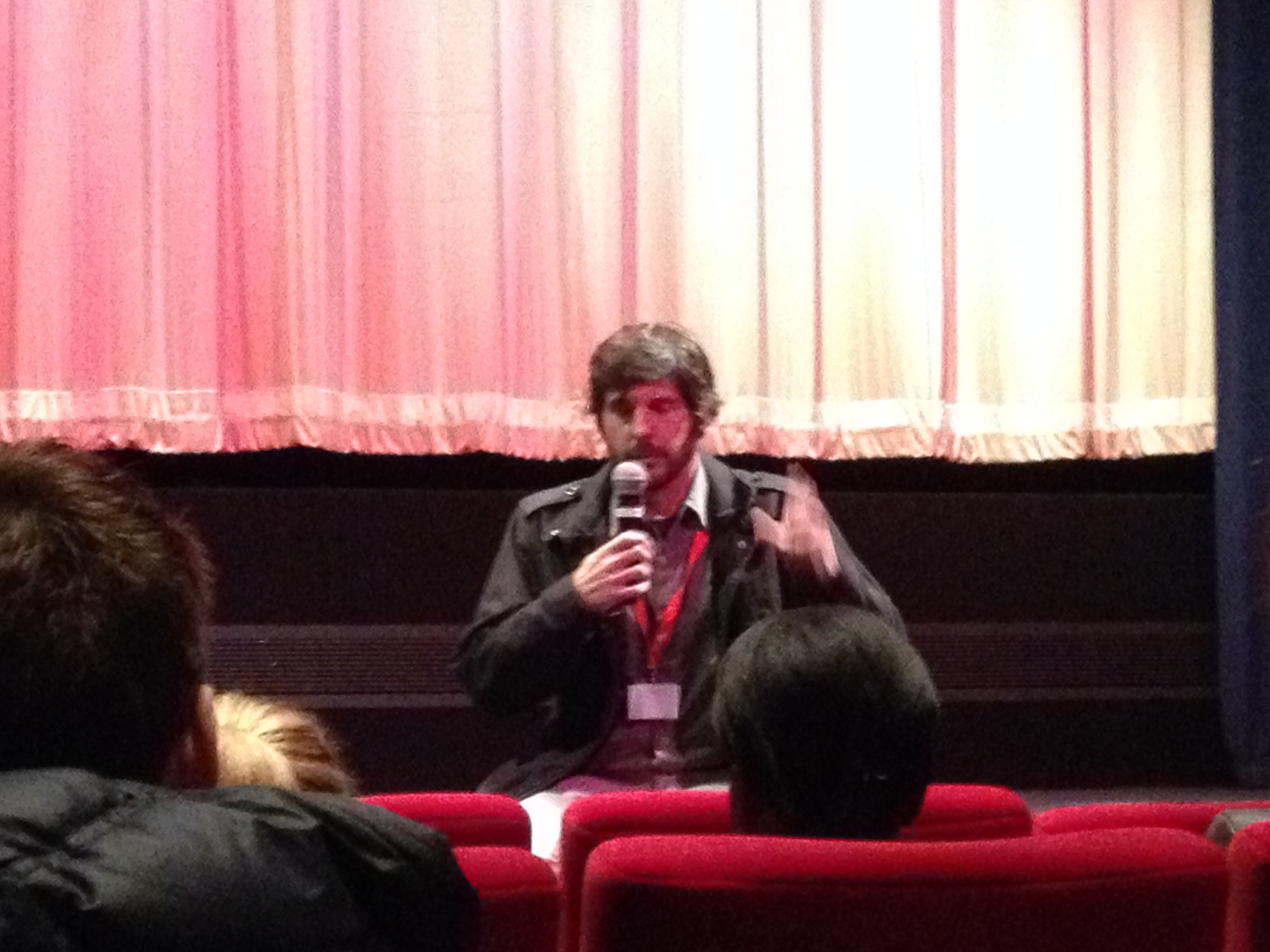
In a Q&A session after the screening of The Golden Dream, director Diego Quemada-Díez compared his film to a western.

The film follows the journey of four youngsters travelling from Guatemala towards Los Angeles across Mexico – in a bid to have a better life in the north of America. They include Juan (Brandon López), Sara (Karen Martínez), Samuel (Carlos Chajon) and an Indian boy, Chauk (Rodolfo Domínguez).

During their arduous and unforgiving journey (not all them make it to the United States), we see Juan pose for a photo session dressed as a cowboy, while Chauk is dressed as an Indian.

Although the analogy is neither perfect (Juan is not necessarily a Yankee, even though he is both most determined and most successful in his bid to get to the USA) nor subtle (to have Chauk pose as a ‘Red Indian’ is something of an ‘obvious’ image), we sense nonetheless that Quemada-Díez is suggesting that the migration of Latin American peoples (here, from Guatemala) to the USA is a direct result of the settling in what was to become the USA of white Europeans.

That is, The Golden Dream seems to suggest that it is American/US history, replete as it is with imperial/economic expansion into the rest of the continent, alongside a longer history of European colonialism, that has caused the economic imbalances that lead to people wishing to travel north to places like Los Angeles in order not to live in a slum (Juan), and in order not to work on a garbage tip (Samuel).

However, where (in broad terms) the western is about the taming and ‘civilisation’ of nature, in particular via the suppression of the savage ‘Indian’, here nature is the dog-eat-dog world of the railways and stopovers that span the length of Mexico – and its conquest ultimately, for Juan, at least, is (*spoiler*) to eke out a similarly ‘bare’ life working in a meat factory north of the border.

That is, the ‘golden’/American dream is severely compromised – as in fact ‘civilisation’ has resulted in huge economic imbalances that in turn bring about a morality that is far removed from that of Ransom Stoddard and Will Kane. Indeed, The Golden Dream does not pull its punches in terms of showing how fraught life is for those on the margins of the USA and who are hopeful of ‘getting in’ (as one apparently ‘gets in’ to ‘the industry’ that is cinema – without any need to qualify ‘the industry’ as ‘the film industry’, since for many people the manufacture of images is the only industry that really counts).

Quemada-Díez also mentioned Eduardo Galeano’s blistering text, The Open Veins of Latin America, in his Q&A. In other words, he (Quemada-Díez) seems determined to locate his film within a history of exploitation that is indeed made most clear at the film’s climax in the meat factory: necessary labour is taken on without papers and job security, such that the USA is now importing from countries south of its border the single resource that is perhaps Latin America’s strongest, its human workforce.

The Golden Dream has an excellent bedfellow the similarly-themed and disturbing film, Sin Nombre (Cary Fukunaga, Mexico/USA, 2009), while also offering a similar structure to Michael Winterbottom’s masterful migration tale, In This World (UK, 2002).

Indeed, Winterbottom – among many other filmmaking luminaries, including Fernando Meirelles, Gillo Pontecorvo and others – is thanked in the film’s end credits. As are some 600 real-life migrants/would-be migrants whom the filmmakers encountered and filmed along the way during the film’s making.

Diego Quemada-Díez gives a Q&A at the London Film Festival 2013.

Diego Quemada-Díez gives a Q&A at the London Film Festival 2013.

Although staged, then, The Golden Dream is a strong film that has many documentary elements – not least real-life participants in such fraught journeys (Sara’s fate, in particular, is too horrific to recount here).

Nonetheless, The Golden Dream also features many poetic elements. Quemada-Díez has a fascination with trains – a key component of the journey, as well as using spaces that are former buildings now reclaimed by nature. It is as if we have, then, something like an anti-western – the return of the ‘wild’, the ‘savage’ to haunt the USA, because it is upon the wilderness and the ‘savage’ that the USA relies – much as the tradition of Thanksgiving is founded upon European settlers in America receiving aid from native Americans, who (broadly speaking) were then summarily exterminated in recognition of their help.

Particularly of interest is the way in which ‘dream’ images of snow, initially linked to Chauk, who has never seen snow, become the reality of Juan. It is problematic that the Indian boy must be sacrificed for Juan’s ‘dream’ to come true; but the truth is far from being as beautiful as a dream, and snow certainly is nothing like gold. One dreams of comfort, and instead one has cold.

One does wonder why Chauk’s native dialogue is not subtitled; while it conveys the way in which Juan, Sara and Samuel do not understand what he is saying, it also runs the risk of having Chauk appear an incomprehensible ‘other’, a fetishised ‘body’ who in fact cannot speak, because no one understands him. That is, while we in fact are given access to Chauk’s dreams (of snow) and visions (of Sara, after she has been separated from the boys), we are at risk of having no ‘real’ access to him, because we (Western viewers) are not privy to his words. The decision is as problematic, then, as it is pointed.

But Quemada-Díez has made a superior film about the issue of economic migration/would-be migration – and his ability to mix the documentary with the poetic, potentially problematic in that he might mythologise too much what is a real world issue, in fact seems sensitively handled and makes for harrowing viewing.

Notes from the LFF: Soshite chichi ni naru/Like Father, Like Son (Kore-eda Hirokazu, Japan, 2013)

Blogpost, Film reviews, Japanese Cinema, London Film Festival 2013

Kore-eda Hirokazu is for me one of the finest filmmakers in the world today. He makes splendidly and subtly crafted films about everyday characters plunged into slightly extraordinary situations – and although I have not seen all of his films, those that I have seen are always fascinating and humane.

Like Father, Like Son is no exception. It tells the story of a family that discovers, six years after living with who they believe to be their child, that their son is in fact not their son, but really the child of a different family – whose presence in their home has come about as a result of a mix-up at the hospital where the children in question were born.

The film is in part a moral tale about how money is not necessarily the best thing that one can provide for a family, since love and time are perhaps two unquantifiable commodities that nonetheless might help not only to bring and keep a family together, but also might create the conditions to raise a child that is better suited (ethically?) to the world in which we live today.

However, while beautiful – and while ultimately very moving – it is not this aspect of the film that I would like to discuss briefly now – even if Hirokazu manages to make a moral film seemingly unmoralistic, which is no mean achievement given (I could not help thinking how uneven this film would be if the same story were told by, say, Mike Leigh – which I do not wholly intend to serve as criticism of Mike Leigh, whose films I also like).

*Spoilers* (though it will not spoil the emotional impact of the film).

What I wish briefly to discuss now is the fact that wealthy businessman Ryoto Nonomiya (Japanese singer, songwriter and actor Masaharu Fukuyama) realises that he cannot abandon his adopted son Keita (Keita Ninomiya) when he finds on his digital camera pictures that Keita has taken of Ryoto while he has been asleep in the build-up to the big child swap (the families decide to raise their own genetic children rather than to raise children that are not their own).

The moment is moving in a way that – inevitably but perhaps also lazily – recalls Roland Barthes’ concept of the punctum – the idea that certain images can pierce/traumatise us so much because they bring the person depicted in the images to life, even though they of course technically absent (or, in the case of Barthes who devises the concept in relation to a photography that he sees of his mother, dead). I say that this is a lazy link, because death, irretrievability, and a real family bond seem key to punctum – and so while Ryoto arguably has a punctum in the film, we do not and cannot necessarily have one, because we are seeing fictional characters. Nonetheless, some aspects of the punctum remain relevant.

What is more noteworthy, though, is that Ryoto chooses to abandon Keita after six years as his father basically because Keita does not have his genes – and he’d like to sire a child that continues his blood line (Ryoto is something of a snob, unlike his counterpart father, Yudai Saiki (Lily Franky), who runs an electronics store in the countryside).

And so when it is that Ryoto reverses this decision as a result of seeing photos that Keita has taken of him while asleep, we get a sense here not simply that time with someone is what creates a family bond – but that images, photographs in particular, create a stronger bond between humans than do genes.

The ramifications are numerous, though I shall mention only two: no wonder we find CCTV synonymous with the notion of the Big Brother; maybe Facebook friends are an ersatz family for those who use Facebook and who tag themselves in photos with other people.

Photos seemingly are our memories – the photos jogging Ryoto in such a fashion that now Keita truly is his son (even though Keita is not in the images; he just took them). Furthermore, photos do not simply show that which is within their frame; they also show the intentions of those who take them – as Ryoto realises as Keita’s love for him becomes clear in these images. Finally, photos are not objective records of events, but they are invested with emotions and they touch us in a fashion that extends far beyond simply our eyes.

To suggest that the digital – because manipulable, deletable, reproducible – somehow eludes the photographic, because unlike an analogue photograph, a digital photograph does not necessarily have what is often termed an ‘indexical’ link to reality (digital images are made up of numerical code and are not necessarily the direct impression of light on polyester/celluloid film, such that the image is proof of what was before the camera at the time of the image’s taking), would be to misunderstand the digital.

Indeed, it would be to misunderstand the digital on a variety of levels – of which I shall name two.

Firstly, it would reduce to the digital alone the possibility that the world is not a fixed thing ‘out there’ but something that is in fact dynamic and undergoing constitution at all points in time; in fact, even analogue photography was always only ever mummifying change (to borrow a phrase from André Bazin), which in turn leads us to understand that change is perhaps the chief characteristic of reality – but not necessarily a change that happens ‘out there’, but in/with which we are entangled and in/with which we take part.

Secondly, to separate analogue from digital photography would be to lose how photography is the concept that unites the two, and that it is – to continue with the biological discussion that Like Father, Like Son evokes – a meme of sorts that evolves. That is, photography has migrated from analogue to digital; it has changed in the process – as all things evolve; but the digital has also allowed photography to prosper even more than analogue ever allowed it to.

As a result, we have photography transcending its ‘genes’ (it will evolve via digital if it has to), just as Ryoto realises that family also transcends genes, with photography playing a key role in gluing a family together and making it what it is, above and beyond the genetic link that yokes father to son.

In this way, Like Father, Like Son is not only the most moving film that I saw at this year’s London Film Festival, but it is perhaps also one of the most profound.