Notes from the LFF: Norte, hangganan ng kasaysayan/Norte, the End of History (Lav Diaz, Philippines, 2013)

Blogpost, Film reviews, London Film Festival 2013, Philippine cinema

At four and a quarter hours, Norte, the End of History is in fact a relatively short film for Filipino filmmaker Lav Diaz. But its extreme length in comparison to other films showing at the festival (average running time probably somewhere near one hour and forty minutes) makes it no inferior piece of work. On the contrary, this is a film that may well involve much of what we might call ‘dead time’ – but surprisingly little in fact, and the film is visually and thematically rich from start to finish.

We open with a prolonged philosophical discussion between a former law student Fabian (Sid Lucero) and his tutors concerning history and justice; this is not a film to show smart people talk smart about ideas, a move that many might find surprising outside of films by people like Richard Linklater, and which in turn might be all the more surprising for a film from the Philippines, whence we might typically expect exposés of the harshness of street life, as per the London Film Festival’s revival of the magnificent Maynila: Sa mga kuko ng liwanag/Manila, In the Claws of Neon (Lino Brocka, Philippines, 1975) or the recent Metro Manila (Sean Ellis, UK/Philippines, 2013), the latest of many films seemingly made by filmmaker-conquistadors heading out from the West and into the so-called Third World to make films of various shapes and sizes in a somewhat problematic fashion – to my mind (even though Metro Manila is actually quite good).

Not that Norte is without what we might term ‘street life’. On the contrary, half of the film tells the story of Joaquin (Archie Alemania), a labourer and loving family man who is framed for the death of money-lender Magda (Mae Paner), who in fact dies at the hands of Fabian. Nonetheless, Joaquin serves time, and much of the film is about his incarceration and Filipino prison life.

Joaquin proves himself to be a caring and kind man, who earns the respect of his peers in prison. Meanwhile, Fabian descends from bright young thing into recluse after the murder of Magda, and then into insanity as he goes home to visit his sister.

Indeed, Norte suggests itself as a critique of thinking too much about economic injustice, while at the same time refusing to offer easy solutions regarding what one should actually do about it. For Fabian fares appallingly, and one wonders that his ultimate refusal of family as a bourgeois construct means that to live a life too much guided by ideas and not enough by emotions and one’s sense of being in the world and with the world and other people, is the path towards insanity.

What, then, is the ‘end of history’? For Francis Fukuyama it is, broadly speaking, the time when capitalist ideology holds sway over the entire planet, such that it cannot be replaced by any other ideology. It is not that events don’t take place – natural disasters in particular – but basically nothing can change since there is no alternative way of thinking.

Diaz’s film is not necessarily an account of precisely this mono-ideological state of affairs. On the contrary, the film’s very slowness suggests an alternative rhythm, an alternative tempo at which one can lead one’s life, one that is not that of capitalism – with time here, the rhythm or pace at which one leads one’s life – being the key ideological battleground in the twenty first century.

But this ‘slowness’ is not for everyone; Fabian comes undone potentially by dropping out of the ratrace, while in some senses the slow time of prison is Joaquin’s (unfortunate) making.

I wonder, then, that history may have ended for the north, but in the ‘global south’, there is still plenty to fight for, plenty of alternative ways of life that can be saved.

If Fabian presents a corrupt and corrupting way of life, committing murder in the name of economic justice (getting rid of the evil moneylender), then Joaquin represents honesty and dignity.

Many have compared Diaz’s film to Dostoyevsky and the comparison is apt. But more than any particular novel, what is beautiful about Diaz’s film is simply how novelistic it is. This is hard to describe, but its slow rhythm, the way in which it spends time with characters, before changing tack and becoming for a great length of time a film about someone else, while remaining a unified work, makes of it a remarkable film that is well worth the effort of four hours plus in a cinema (this is still much quicker than reading a novel of any quality).

Finally, the film did also make me think of this passage by the Invisible Committee, which I shall leave readers with as the final words of this blog post:

It’s useless to wait – for a breakthrough, for the revolution, the nuclear apocalypse or a social movement. To go on waiting is madness. The catastrophe is not coming, it is here. We are already situated within the collapse of civilisation. It is within this reality that we must choose sides.

To no longer wait is, in one way or another, to enter into the logic of insurrection. It is once again to hear the slight but always present trembling of terror in the voices of our leaders. Because governing has never been anything other than postponing by a thousand subterfuges the moment when the crowd will string you up, and every act of government is nothing but a way of not losing control of the population.

We’re setting out from a point of extreme isolation, of extreme weakness. An insurrectional process must be built from the ground up. Nothing appears less likely than an insurrection, but nothing is more necessary.

Perhaps this can serve as the starting point for a more prolonged discussion if Norte and Diaz’s work more generally.

Notes from the LFF: Abus de faiblesse/Abuse of Weakness (Catherine Breillat, France/Germany/Belgium, 2013)

Blogpost, European cinema, Film reviews, French Cinema, London Film Festival 2013

Catherine Breillat’s latest, very personal film tells the story of a filmmaker, Maud (Isabelle Huppert – remarkable as ever), who suffers from a stroke and who, in her recovery period, starts to work on a new project that will star gangster and seeming millionaire Vilko Piran (Kool Shen, of French rap group NTM, and also remarkable in this film).

However, as the film goes on, it becomes clear that Vilko is milking Maud for all that she is worth – taking cheque after cheque from her for variously large sums of money, until Maud gets a visit from the bank and runs the risk of losing all that she has.

The dilemma at the heart of Abuse of Weakness, then, is who is abusing whom. Is Maud willingly being taken for a ride by Vilko, or is he really the heartless character who is prepared to take advantage of an inform stroke victim in order to line his own pockets?

As is perhaps to be expected from Breillat, there is no easy answer to this question, and this is particularly signalled by the way in which Vilko keeps on reappearing in Maud’s life. He could easily have taken Maud’s money and run – but instead seems as tied to her as she becomes to him.

As such, the film becomes an exploration into the seductive nature of power and, of course, the seductive nature of images – for one gets the sense that it is his chance to become a star that keeps Vilko hanging around as much as does any attraction to Maud. And similarly, one senses that Maud falls for an image of Vilko from the outset – spotting him on television for the first time during one sleepless night at home.

It is perhaps also about the way in which social change – the myth that persists in Western/capitalist societies that those who come from nothing can, with supreme will, make ‘something’ of themselves – is in fact a by-word for bourgeoisification. That is, Vilko becomes rich, but he does not become bourgeois, or ‘well mannered’ (from the bourgeois point of view) – and while we as viewers are hoping/expecting Vilko to suddenly develop more of a conscience, he seemingly does not, with Maud seemingly also aware that to expect the leopard to change its spots is futile. Instead, he is like the scorpion on the frog’s back; he’ll sting the frog that takes him across the water. And why? Because he is a scorpion, of course.

Except that Vilko is perhaps not really rich (we don’t know this – but we’d wonder otherwise why he needs to take Maud’s money). And thus he is in fact already bourgeois, in the sense that his wealth is really based upon the (criminal?) exploitation of others – Vilko perhaps exploiting Maud precisely because she feels bad about how her own wealth – and the wealth of those of her kind – is based upon a history of exploitation. This intricate film, then, is a kind of modern day Viridiana (Luis Buñuel, Spain/Mexico, 1961).

What is also of interest about Breillat’s film is the way in which it is about property – the film at times seems a paean to Maud’s amazing apartment and the fact that she perhaps does not want or deserve such a luxurious pad.

And also Abuse of Weakness is about sleeping, and in particular sleeping with – and having sleep being interrupted by – mobile phones. This is a repeated image throughout the film. And while – to the best of our knowledge – Maud and Vilko never have a sexual liaison, one gets the sense that the phone is the fetish that stands in for their desire for one another. It functions, however, as an illusory, unstable bridge between them – perhaps as unstable and as unreliable as any image.

In other words, Breillat suggests how technology seemingly plays a part in humans’ inability to connect – humans instead seeing each other as images and not as people. And outside of our relationship(s) with technology, it seems as though we are otherwise asleep, lost in our own thoughts and dreams.

Abuse of Weakness, then, is perhaps about our abuse of our own weaknesses, especially our propensity to hide from the world (in our beds, in our apartments, behind a mobile phone), and to avoid encounters with that world as much as possible. Indeed, we’d rather shell out all of our money rather than really to engage with that world. Perhaps it is wealth that makes us weak, then, and not a stroke. And Vilko is right to be profligate with his money – for after all, if it is a crutch for the weak, who really needs it?


Notes from the LFF: Vi är bäst!/We Are The Best! (Lukas Moodysson, Sweden, 2013)

Blogpost, European cinema, Film reviews, London Film Festival 2013, Swedish cinema

There seems to be something problematic about all movies that try to tell globe-spanning stories that demonstrate the interlinked nature of our lives in the contemporary, globalised era. Between Babel (Alejandro González Iñárritu, France/USA/Mexico, 2006), 360 (Fernando Meirelles, UK/Austria/France/Brazil, 2011), and Lukas Moodysson’s own Mammoth (Lukas Moodysson, Sweden/Denmark/Germany, 2009), each film ends up being slightly disappointing – as if trying to take on too much for a single film to depict (globalisation/the globe), while at the same ticking boxes concerning class difference/economic status, such that they seem disingenuous. That is, mobile and wealthy filmmakers trot the globe while at the same time asking us to think about what globe-trotting really means (regardless of a filmmaker’s no doubt ‘good’ intentions).

Prior to Mammoth, Moodysson’s directed two intriguing – if very difficult to watch – digital films in Ett hål i mitt hjärta/A Hole in My Heart (Sweden/Denmark, 2004) and Container (Sweden, 2006). These certainly polarised audiences, such that viewers might begin to wonder – with three arguably duff films on the bounce (personally I really like A Hole in My Heart, and I teach it every year and have written about it here) – whether Lukas Moodysson is really a decent filmmaker at all.

However, the two films with which he made his reputation – Fucking Åmål/Show Me Love (Sweden/Denmark, 1998) and Tillsammans/Together (Sweden/Denmark/Italy, 2000) – demonstrated such warmth and humanity that the pessimism that followed – inaugurated by his harrowing human traffic film, Lilja 4-Ever/Lilya 4-Ever (Sweden/Denmark, 2002) – seemed somewhat uncharacteristic.

Or rather, his pessimism became characteristic, meaning that the deep love that Moodysson showed for his characters in those early films seemed lost – even if my contention is that Moodysson in fact shows great love towards his most unlovely characters in A Hole in My Heart.

We Are The Best!, however, sees Moodysson back on top form. The film tells the story of two punk girls, Bobo (Mira Barkhammer) and Hedvig (Liv LeMoyne), who decide to form a punk group with the help of a local Christian girl, Klara (Mira Grosin).

The film is by turns cute and smart as the characters, Bobo in particular, say things that are wicked funny and intelligent, and way beyond the ken of many/all children of her age in the UK with regard to political astuteness, the role of punk in society and so on.

What is most pleasing about the film is its embracing of those who fail while performing – namely our girls in their punk trio. That is, Moodysson is not interested in fairy tales and happy endings, but more with what being in a band provides for young women growing up in Sweden in the aftermath of punk. Instead there is a kind of ‘creative chaos’ – that is characteristic of punk itself, and which gives us insight perhaps into Moodysson’s own work.

That is, while any or all of Moodysson’s films might be disappointing to some (many) audiences, what is great about his work is that he is prepared to try and thus also to fail. And he loves his characters, who themselves try and also fail, as if failure itself is what defines us as human. This most palpable here when Bobo, Hedvig and Klara perform their first concert.

Rather than the enormous success that we would expect of a mainstream film, their gig is in fact chaotic, half a success, half a failure. The same goes for the girls’ love lives, and more or less every other plan that they hatch and try to put into action. It is this ‘creative chaos’ that really brings We Are The Best! to life, and which demonstrates Moodysson’s love for his characters.

Imperfect though his films are, then, Moodysson himself is a cineaste who evidently loves filmmaking, who experiments, and who is prepared to fail, since in failure his films become learning experiences that allow him to grow and learn as a human being.

If Mammoth disappointed me, it was perhaps because – like the other ‘globalisation’ films mentioned above – its pretense to omniscience is, precisely, too knowing. Moodysson works best when approaching the world through the eyes of those who do not really know what they are doing. A return to his best form, We Are The Best! sees Moodysson embrace the way in which life may be performative, but it is also an improvisation – and even though characters ‘fail’, they also succeed, since it is in not knowing what we are supposed to do, or how we are supposed to lead our lives, but in going forward and leading them in our way as best as we can anyway that we truly become ourselves, become alive.

Notes from the LFF: Computer Chess (Andrew Bujalski, USA, 2013)

American cinema, Blogpost, Film reviews, London Film Festival 2013

In a recent essay that chimes with many aspects of my own ongoing research – into DV filmmaking from all over the world – Francesco Casetti and Antonio Somaini argue that low definition filmmaking is cinema’s attempt, after Marshall McLuhan, to ‘cool down’.

That is, cinema has become so fast, so ‘hot’, such an intense stimulation of the senses, that it needs to ‘cool down’ – and to become more low definition in its images. Or rather, films that are made using low definition images seek to cool the medium down, such that a balance is within audiovisual media is restored.

I like this line of argument, but I do not agree with it entirely. For, what Casetti and Somaini’s essay suggests is that low definition films are always already in the service of high definition films – acting as a necessary brake to their relentless drive towards bigger, faster, brighter, louder…

And while I suspect that there is truth in this, I am not sure that filmmakers of deliberately low definition films feel that they are complicit with the high definition films with which they (cannot) compete.

Nonetheless, given that Andrew Bujalski’s Computer Chess is a film shot using video cameras (the Sony AVC-3260) as per those available at the time of the film’s late 1970s/early 1980s setting, this is nonetheless a movie that has resonance with Casetti and Somaini’s thesis.

The film tells the story of various computer programmers who holes up in a hotel conference room for a weekend to take part in a computer versus computer chess tournament, which will culminate in the winner taking on a human chess Grand Master.

Given the ‘tournament’ set-up, the film’s mockumentary approach, and the video aesthetic, Computer Chess feels very much like a mix between Best in Show (Christopher Guest, USA, 2000) and recent return-to-video films Trash Humpers (Harmony Korine, USA, 2009) and No (Pablo Larraín, Chile/USA/France/Mexico, 2012).

But the combination works: here at the beginning of the more intense period of the digital era, we have in fact a nostalgia for buggy, inefficient computers that will never be faster or smarter than a human, delivered with the blocky, blurry images of a video camera that promised never to replace good ol’ analogue filmmaking.

While Bujalski draws some hilarious geek characters, whose commitment to computer chess might make of them something like human automatons, nonetheless Computer Chess itself is a very human film – something made most clear by the increasingly hallucinogenic nature of the film.

That is, cats invade the screen, a computer seems to become sentient, and humans start to act as if computers. Akin in a certain fashion to Ben Wheatley’s wonderful A Field in England (UK, 2013), the trippy nature of Computer Chess suggests the way in which human identity and thought remain elusive in terms of our ability to compute ourselves (indeed, within neuroscience, the argument that the human brain is like a computer has somewhat receded in recent years).

A deliberate assault upon mainstream film aesthetics, Computer Chess does ‘slow down’ mainstream cinema – making of this film an example of the non-cinema that is the beating heart of cinema proper.

In other words, while some so-called ‘mumblecore’ directors seem to be inching – if not sprinting – towards increasingly audience-friendly, cutesy fare (I am thinking of the Duplass brothers and Lynn Shelton, even though I like all as filmmakers), Bujalski seems to be pursuing a braver, more idiosyncratic path (as also is Joe Swanberg, what with his seven-productions-a-year ethos).

Computer Chess won’t please everyone, but is prepared to be its own film, to court disapprobation by telling both a weird story and with a ‘grungy’ aesthetic. Whatever ‘mumblecore’ is or was, if this is it, then it remains relevant and exciting even today.

Notes from the LFF: La jaula de oro/The Golden Dream (Diego Quemada-Díez, Mexico, 2013)

Blogpost, Film reviews, Latin American cinema, London Film Festival 2013, Transnational Cinema

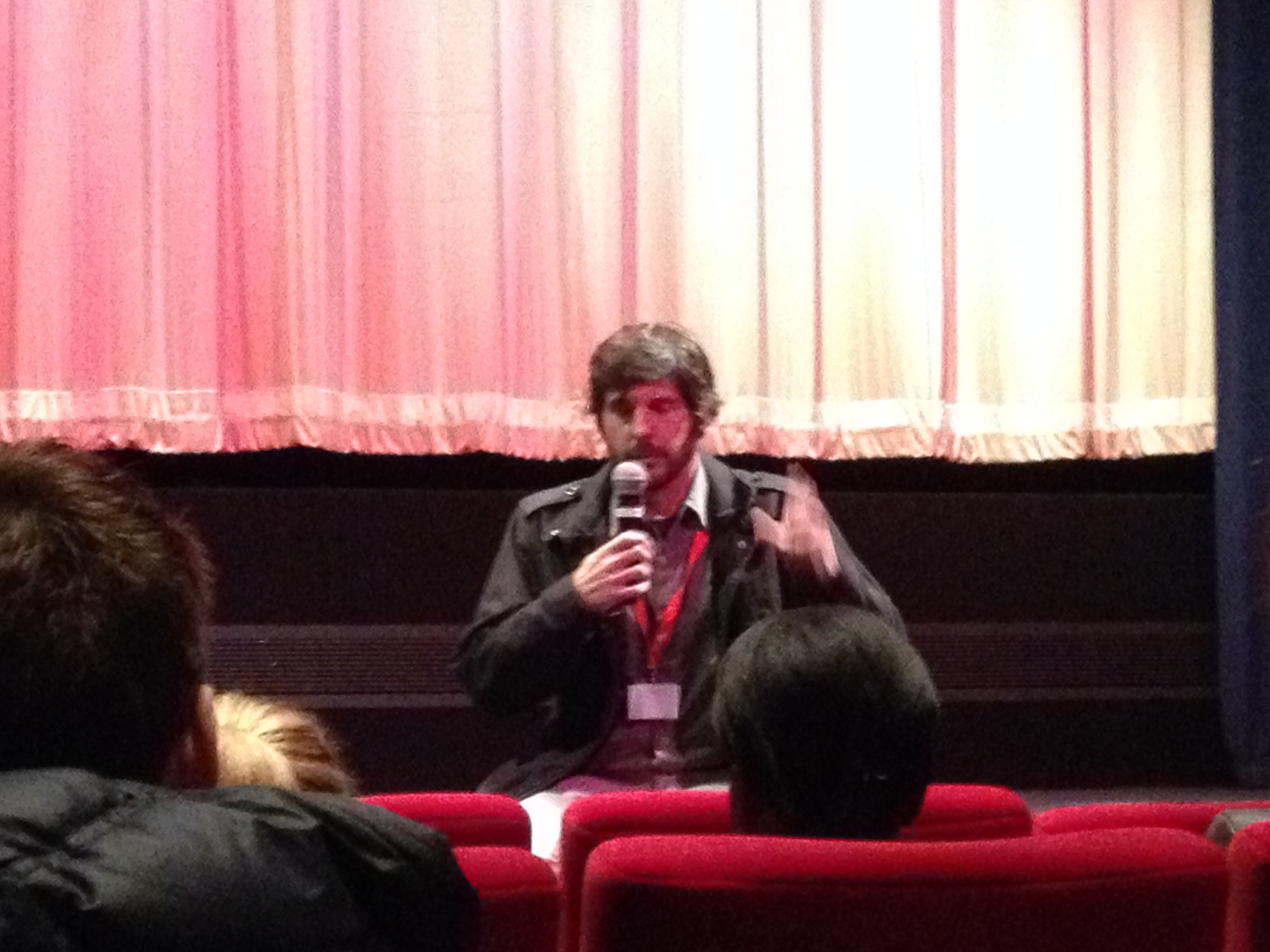
In a Q&A session after the screening of The Golden Dream, director Diego Quemada-Díez compared his film to a western.

The film follows the journey of four youngsters travelling from Guatemala towards Los Angeles across Mexico – in a bid to have a better life in the north of America. They include Juan (Brandon López), Sara (Karen Martínez), Samuel (Carlos Chajon) and an Indian boy, Chauk (Rodolfo Domínguez).

During their arduous and unforgiving journey (not all them make it to the United States), we see Juan pose for a photo session dressed as a cowboy, while Chauk is dressed as an Indian.

Although the analogy is neither perfect (Juan is not necessarily a Yankee, even though he is both most determined and most successful in his bid to get to the USA) nor subtle (to have Chauk pose as a ‘Red Indian’ is something of an ‘obvious’ image), we sense nonetheless that Quemada-Díez is suggesting that the migration of Latin American peoples (here, from Guatemala) to the USA is a direct result of the settling in what was to become the USA of white Europeans.

That is, The Golden Dream seems to suggest that it is American/US history, replete as it is with imperial/economic expansion into the rest of the continent, alongside a longer history of European colonialism, that has caused the economic imbalances that lead to people wishing to travel north to places like Los Angeles in order not to live in a slum (Juan), and in order not to work on a garbage tip (Samuel).

However, where (in broad terms) the western is about the taming and ‘civilisation’ of nature, in particular via the suppression of the savage ‘Indian’, here nature is the dog-eat-dog world of the railways and stopovers that span the length of Mexico – and its conquest ultimately, for Juan, at least, is (*spoiler*) to eke out a similarly ‘bare’ life working in a meat factory north of the border.

That is, the ‘golden’/American dream is severely compromised – as in fact ‘civilisation’ has resulted in huge economic imbalances that in turn bring about a morality that is far removed from that of Ransom Stoddard and Will Kane. Indeed, The Golden Dream does not pull its punches in terms of showing how fraught life is for those on the margins of the USA and who are hopeful of ‘getting in’ (as one apparently ‘gets in’ to ‘the industry’ that is cinema – without any need to qualify ‘the industry’ as ‘the film industry’, since for many people the manufacture of images is the only industry that really counts).

Quemada-Díez also mentioned Eduardo Galeano’s blistering text, The Open Veins of Latin America, in his Q&A. In other words, he (Quemada-Díez) seems determined to locate his film within a history of exploitation that is indeed made most clear at the film’s climax in the meat factory: necessary labour is taken on without papers and job security, such that the USA is now importing from countries south of its border the single resource that is perhaps Latin America’s strongest, its human workforce.

The Golden Dream has an excellent bedfellow the similarly-themed and disturbing film, Sin Nombre (Cary Fukunaga, Mexico/USA, 2009), while also offering a similar structure to Michael Winterbottom’s masterful migration tale, In This World (UK, 2002).

Indeed, Winterbottom – among many other filmmaking luminaries, including Fernando Meirelles, Gillo Pontecorvo and others – is thanked in the film’s end credits. As are some 600 real-life migrants/would-be migrants whom the filmmakers encountered and filmed along the way during the film’s making.

Diego Quemada-Díez gives a Q&A at the London Film Festival 2013.

Diego Quemada-Díez gives a Q&A at the London Film Festival 2013.

Although staged, then, The Golden Dream is a strong film that has many documentary elements – not least real-life participants in such fraught journeys (Sara’s fate, in particular, is too horrific to recount here).

Nonetheless, The Golden Dream also features many poetic elements. Quemada-Díez has a fascination with trains – a key component of the journey, as well as using spaces that are former buildings now reclaimed by nature. It is as if we have, then, something like an anti-western – the return of the ‘wild’, the ‘savage’ to haunt the USA, because it is upon the wilderness and the ‘savage’ that the USA relies – much as the tradition of Thanksgiving is founded upon European settlers in America receiving aid from native Americans, who (broadly speaking) were then summarily exterminated in recognition of their help.

Particularly of interest is the way in which ‘dream’ images of snow, initially linked to Chauk, who has never seen snow, become the reality of Juan. It is problematic that the Indian boy must be sacrificed for Juan’s ‘dream’ to come true; but the truth is far from being as beautiful as a dream, and snow certainly is nothing like gold. One dreams of comfort, and instead one has cold.

One does wonder why Chauk’s native dialogue is not subtitled; while it conveys the way in which Juan, Sara and Samuel do not understand what he is saying, it also runs the risk of having Chauk appear an incomprehensible ‘other’, a fetishised ‘body’ who in fact cannot speak, because no one understands him. That is, while we in fact are given access to Chauk’s dreams (of snow) and visions (of Sara, after she has been separated from the boys), we are at risk of having no ‘real’ access to him, because we (Western viewers) are not privy to his words. The decision is as problematic, then, as it is pointed.

But Quemada-Díez has made a superior film about the issue of economic migration/would-be migration – and his ability to mix the documentary with the poetic, potentially problematic in that he might mythologise too much what is a real world issue, in fact seems sensitively handled and makes for harrowing viewing.

Notes from the LFF: Soshite chichi ni naru/Like Father, Like Son (Kore-eda Hirokazu, Japan, 2013)

Blogpost, Film reviews, Japanese Cinema, London Film Festival 2013

Kore-eda Hirokazu is for me one of the finest filmmakers in the world today. He makes splendidly and subtly crafted films about everyday characters plunged into slightly extraordinary situations – and although I have not seen all of his films, those that I have seen are always fascinating and humane.

Like Father, Like Son is no exception. It tells the story of a family that discovers, six years after living with who they believe to be their child, that their son is in fact not their son, but really the child of a different family – whose presence in their home has come about as a result of a mix-up at the hospital where the children in question were born.

The film is in part a moral tale about how money is not necessarily the best thing that one can provide for a family, since love and time are perhaps two unquantifiable commodities that nonetheless might help not only to bring and keep a family together, but also might create the conditions to raise a child that is better suited (ethically?) to the world in which we live today.

However, while beautiful – and while ultimately very moving – it is not this aspect of the film that I would like to discuss briefly now – even if Hirokazu manages to make a moral film seemingly unmoralistic, which is no mean achievement given (I could not help thinking how uneven this film would be if the same story were told by, say, Mike Leigh – which I do not wholly intend to serve as criticism of Mike Leigh, whose films I also like).

*Spoilers* (though it will not spoil the emotional impact of the film).

What I wish briefly to discuss now is the fact that wealthy businessman Ryoto Nonomiya (Japanese singer, songwriter and actor Masaharu Fukuyama) realises that he cannot abandon his adopted son Keita (Keita Ninomiya) when he finds on his digital camera pictures that Keita has taken of Ryoto while he has been asleep in the build-up to the big child swap (the families decide to raise their own genetic children rather than to raise children that are not their own).

The moment is moving in a way that – inevitably but perhaps also lazily – recalls Roland Barthes’ concept of the punctum – the idea that certain images can pierce/traumatise us so much because they bring the person depicted in the images to life, even though they of course technically absent (or, in the case of Barthes who devises the concept in relation to a photography that he sees of his mother, dead). I say that this is a lazy link, because death, irretrievability, and a real family bond seem key to punctum – and so while Ryoto arguably has a punctum in the film, we do not and cannot necessarily have one, because we are seeing fictional characters. Nonetheless, some aspects of the punctum remain relevant.

What is more noteworthy, though, is that Ryoto chooses to abandon Keita after six years as his father basically because Keita does not have his genes – and he’d like to sire a child that continues his blood line (Ryoto is something of a snob, unlike his counterpart father, Yudai Saiki (Lily Franky), who runs an electronics store in the countryside).

And so when it is that Ryoto reverses this decision as a result of seeing photos that Keita has taken of him while asleep, we get a sense here not simply that time with someone is what creates a family bond – but that images, photographs in particular, create a stronger bond between humans than do genes.

The ramifications are numerous, though I shall mention only two: no wonder we find CCTV synonymous with the notion of the Big Brother; maybe Facebook friends are an ersatz family for those who use Facebook and who tag themselves in photos with other people.

Photos seemingly are our memories – the photos jogging Ryoto in such a fashion that now Keita truly is his son (even though Keita is not in the images; he just took them). Furthermore, photos do not simply show that which is within their frame; they also show the intentions of those who take them – as Ryoto realises as Keita’s love for him becomes clear in these images. Finally, photos are not objective records of events, but they are invested with emotions and they touch us in a fashion that extends far beyond simply our eyes.

To suggest that the digital – because manipulable, deletable, reproducible – somehow eludes the photographic, because unlike an analogue photograph, a digital photograph does not necessarily have what is often termed an ‘indexical’ link to reality (digital images are made up of numerical code and are not necessarily the direct impression of light on polyester/celluloid film, such that the image is proof of what was before the camera at the time of the image’s taking), would be to misunderstand the digital.

Indeed, it would be to misunderstand the digital on a variety of levels – of which I shall name two.

Firstly, it would reduce to the digital alone the possibility that the world is not a fixed thing ‘out there’ but something that is in fact dynamic and undergoing constitution at all points in time; in fact, even analogue photography was always only ever mummifying change (to borrow a phrase from André Bazin), which in turn leads us to understand that change is perhaps the chief characteristic of reality – but not necessarily a change that happens ‘out there’, but in/with which we are entangled and in/with which we take part.

Secondly, to separate analogue from digital photography would be to lose how photography is the concept that unites the two, and that it is – to continue with the biological discussion that Like Father, Like Son evokes – a meme of sorts that evolves. That is, photography has migrated from analogue to digital; it has changed in the process – as all things evolve; but the digital has also allowed photography to prosper even more than analogue ever allowed it to.

As a result, we have photography transcending its ‘genes’ (it will evolve via digital if it has to), just as Ryoto realises that family also transcends genes, with photography playing a key role in gluing a family together and making it what it is, above and beyond the genetic link that yokes father to son.

In this way, Like Father, Like Son is not only the most moving film that I saw at this year’s London Film Festival, but it is perhaps also one of the most profound.

Notes from the LFF: Electro Chaabi/Electro Shaabi (Hind Meddeb, Egypt/France, 2013)

Blogpost, Egyptian Cinema, Film reviews, London Film Festival 2013

Hind Meddeb’s documentary is about a group of Cairo-based musicians who have pioneered and cornered as their own the genre of ‘electro shaabi’ – a fusion of hip hop, electronic music, protest songs and Middle Eastern and Indian sounds.

Over the course of the film, the extended group begins to splinter, in particular as two of their number, Oka and Ortega, gain commercial success and begin to appear on television, in films, and elsewhere. Of course, they drop their long-standing collaborators like a stone – as per the story of commercial success from indy roots that has been told so often.

The film, however, remains with Wiza, Figo and others, especially MC Sadat, who continue to eke out an existence on the streets as performers at birthday parties, weddings and the like. Their music is often pirated (they tell a story of being ripped off by one of Egypt’s biggest film stars); and they rarely/barely see a penny for their creative endeavours. But, Oka and Ortega perhaps aside, making money is not what motivates them; telling their story is their raison d’être.

This seems also to be Meddeb’s rationale for making this film; the film has an evidently low budget, features much ‘crude’ handheld camera work, and yet captures the vibrancy of the Cairo streets.

The film culminates in MC Sadat and friends observing a march against Mohamed Morsi. It is not my place to judge these actions; Morsi may have been the first democratically elected President of Egypt, and to have had him deposed by the military may seem to an outside observer a worrying sign of anything but democracy – but however odd such events may seem to the outsider, those on the march evidently are against Morsi. And the reason that I raise this is because on the march, MC Sadat explains that those marching are ‘the people’ – and he asks how can the people be considered enemies of the nation. And yet protestors are (often) considered enemies of the nation because they do not conform to the image of that nation that someone else – typically in power – is trying to impose.

The reason that I mention this sequence is because an interesting distinction seems to be drawn here by MC Sadat, one that is perhaps enlightening beyond Electro Shaabi, and which is arguably ‘philosophical’ in nature. By in effect saying that the people and the nation are separate entities/phenomena, we gain a sense of how the people perhaps always eludes the nation.

That is, the nation is a top-down concept that is imposed upon various humans who, for whatever reason, happen to live within certain geographical boundaries during a certain period of history. The people, meanwhile, cuts across those temporal and spatial boundaries – in a fashion that cannot entirely be defined.

For so long, thinkers and politicians have tried to characterise the people according to nationality; the concept of the nation was a means to contain the rebellious libido of the people. And yet now we seem to have a sense – from MC Sadat’s interpretation of contemporary Egypt at least – that the people cannot be contained, and that the nation might well be a concept that needs refining and redefining, even if MC Sadat is referring (paradoxically) to a uniquely Egyptian situation when he raises his question about the people and the nation.

Nonetheless, what we can glean from MC Sadat in Electro Shaabi might have significance elsewhere: the people always exceeds (perhaps even disappoints) the nation, or those who seek to apply a rigid definition to what constitutes a (particular) nation at any rate. It is this excess that is their power, their source of hope, that potential for change. Long may it elude definition…

A final aside: the film definitely embraces the utopian potential of digital technology, with musicians using free software to make their music, and online video sites to share their music. Although the story of Egypt is far from finished, there remains hope when we know that people like MC Sadat are still out there, and that they will not (they say) be nullified by the bright possibility of becoming light, of becoming cinema, as happens to Oka and Ortega.

Instead, MC Sadat and friends elude the ‘cinematic’ in the sense of glossy, beautiful/beatified images, and instead belong to that other aesthetic that is ‘cinema’s’ necessary but neglected twin, the non-cinema that is low grade images, low grade sound, but all the more real because achieved in a guerrilla fashion. An intriguing film.

Notes from the LFF: Taşkafa: Stories from the Street (Andrea Luka Zimmerman, Turkey, 2013)

Blogpost, European cinema, Film reviews, London Film Festival 2013

Taşkafa: Stories from the Street is ostensibly a film about street dogs in Istanbul. It consists of interviews with residents of the city – who talk about the role and meaning that the street dogs play in their lives – as well as the reading by John Berger of extracts from his novel, King, which, in Zimmerman’s own words, is ‘a story of hope, dreams, love and resistance, told from the perspective of a dog belonging to a community facing disappearance, even erasure.’

Made for a tiny budget, Taşkafa is a wonderful example of what we might call democratic filmmaking. That is, the film seeks to explore the ways in which human society – in this case the city of Istanbul – often seeks to exclude from its reality – here, dogs – that in fact are a core part of that society’s ecosystem.

That the dogs form a core part of Istanbul’s ecosystem is made clear by the testimonies of many of the city’s dwellers. And yet, as we hear from numerous Istanbulites, we get the impression that these humans, too, might be on the verge of exclusion. In other words, what is true of dogs and other animals – that some humans seek to exclude them from their lives for the sake of a ‘sanitised’ (bourgeois?) existence – seems also to be true of people.

In other words, while ostensibly about street dogs, then, Taşkafa is really about the drive to exclude certain ‘undesired’ aspects of society from our spaces – and all in the name of ‘progress’.

As such, the film is a passionate defence of what we might term ‘the people’ – but with people here extended into the realm of people and their confederate animals, with whom we share our existence.

Given its emphasis on people and a desire to include that which is otherwise excluded, it is important that Zimmerman’s film gives voice to people – and gives screen time to dogs – who can tell their own story or show their existence.

Zimmerman has written about how films should be collaborative and communal – a perspective I tend to share. This means that her work is not far from Gilles Deleuze’s understanding of ‘modern political cinema’ – a cinema comprised of ‘intercessors’ – people who come in and tell their own story, with or without embellishment and/or exaggeration, and who thus shape the film with, perhaps even instead of, the so-called auteur.

And thus, since time is the focus of Deleuze’s study of modern political and other ‘time-image’ cinemas, we can understand that Taşkafa is also really about time. It is about the need for the world to allow people to live at their own pace, and not to be coerced into leading their lives following the beat of a particular (for want of a better generalisation, capitalist) drum.

A film made under the dictates of profit and production value is always already taking part in this ‘capitalist’ process of homogeneising time, of making all humans march to the same rhythm (this militaristic image is intentional). And so it is also important that Zimmerman is working outside of the confines of the film industry qua industry.

There are nonetheless some issues. These centre around the question of ‘where do we stop?’ By which I mean to say: one of the Istanbulites in the film says that we should do no harm to plants or ants – in addition to dogs. Or rather (for my memory is not exact), if we cannot but occasionally do harm to plants and ants, then we should at least recognise their part in our ecosystem, the importance that even these overlooked elements play in our lives.

And yet Taşkafa seems to stop at dogs (and cats) – and we are not asked (not specifically, at least) to reflect on the provenance of the meat that we see some people offer to the dogs. Is to eat meat to be harmful? Or is it that – beyond good and evil – we can eat meat, but we should be respectful of where it comes from? That is, we should give thanks to life – in all of its forms – meaning that we are now on ground similar, in the smallest type of film, to the ‘lesson’ offered in James Cameron’s Avatar (USA, 2009), the biggest type of film.

(Perhaps it is okay to like Avatar, but the issue is whether you can get beyond its insistent fast pace and its high production values and learn also to love Taşkafa, for the latter forms an equally important part of the mental, cinematic and perhaps material ecosystem that is our world. And if you cannot love Taşkafa, too, then you are potentially lost.)

And if we opened up our inclusive love for the world to ants and plants, then surely we must also to air, that which helps sustain and constitute us, and also then to mere matter for it is that from which we are composed, and thus also to antimatter, for antimatter is also real, simply it ‘exists’ at a different rhythm to matter itself. We need to push as far as we can go – this is my argument in Supercinema – in order to lead an ethical existence based on what we might call ‘withness.’

Finally, given his own views on the cruelty and indifference of nature, I wonder what Werner Herzog, to whom Zimmerman makes reference in her essay on Open Democracy, would make of Taşkafa? Does it romanticise its canine brethren (too much)? I’d like to think not, but I am interested nonetheless.

Taşkafa is a beautiful film – about much more than street dogs, as this blog post has hoped to suggest (and this is without going into the specificities of its being a film made and set in Istanbul, for which oversight on my part, apologies). It is wonderful that the LFF chose to programme it. It would be great to see more films like it…

The Repairman (Paolo Mitton, Italy/UK, 2013)

Blogpost, European cinema, Film reviews, Italian Cinema, Raindance Film Festival 2013, Uncategorized

Nominated for best debut feature at this year’s other London film festival, Raindance, The Repairman tells the story of Scanio (Daniele Savoca), a man who ekes out a living fixing machines for an absentee boss, and whose fate in life it is to be perennially criticised by his friends.

Scanio meets and enters into a relationship with Helena (Hannah Croft), but, ultimately, their relationship falters because Scanio cannot show much passion for her – obsessed instead as he is with his job, or at least with trying to maintain his job.

If the above synopsis seems brief, this is because not that much really happens in The Repairman. But instead of being a film about plot, The Repairman is, rather, a film about a certain mood or mode of living.

Put most succinctly, the mood or mode of the film is that shared by the main character, Scanio: a sort of strange, naïve but upbeat melancholy. ‘Upbeat melancholy’ probably sounds like a contradiction in terms. Well, perhaps does not so much sound like one as it actually is one. But this is because the terms are not quite sufficient to convey the mood/mode of the film – and the difficulty that one has with conveying the mood/mode of the film is in fact what makes the film particularly unique and worthy of a brief blog on a Raindance film amid what I hope will be a few posts about films from the ‘bigger’ London Film Festival.

One could potentially characterise The Repairman as bittersweet, but this is a term one might use for a Mike Leigh film or some such – and while there is humour in Mike Leigh, his films are not (often) as overtly comic as is The Repairman. The film features scene after scene of slow charm – wry observations of dinner party conversation, quirks of habit, the refusal to conform – mixed in with very un-Mike Leigh-like quasi-fantasy elements.

Put in terms of cinematic precedents, The Repairman might be defined as a mix of Le fabuleux destin d’Amélie Poulain/Amélie (Jean-Pierre Jeunet, France/Germany, 2001) and the works of cineastes like Nanni Moretti and Jacques Tati.

The Amélie elements are suggested by the interest in technology shown by the film and the way in which these are interspersed with romantic elements. It is a staple of Jeunet’s work, especially his collaborations with Marc Caro (particularly Delicatessen, France, 1991 and La cité des enfants perdus/The City of Lost Children, France/Germany/Spain, 1995) for his characters to be working on machines – and this is of course one of Scanio’s main pastimes, creating/inventing new and better machines from older, neglected and/or broken ones.

The repurposing of older machines means that The Repairman oddly has vague elements of steampunk, though it is far from being a steampunk film; this is because, as per Jeunet’s films, there seems to be a sort of nostalgia for times past. But here Mitton’s film diverges from Jeunet’s work, because while Jeunet incorporates high end digital special effects to (re)create a mythical past, Mitton’s film on the whole eschews high end special effects.

And this is not simply for budgetary reasons. Indeed, Mitton’s career has seen him work as part of the digital visual effects team on a number of big budget productions, including Troy (Wolfgang Petersen, USA/Malta/UK, 2004) and Charlie and the Chocolate Factory (Tim Burton, USA/UK, 2005).

Indeed, The Repairman features at its outset a significant digital special effect in the form of a duck that is flying over the fields of northern Italy as Scanio and one of his friends drive through the countryside. However, the duck soon hits a overhead electricity wire and falls to the ground, lifeless.

No doubt this image can be read in multiple different ways – including as a metaphor for Scanio’s spiritual development. However, it also seems to encapsulate the film’s nostalgia: unlike Jeunet’s work, here is a film that wants to achieve its effects in an old-fashioned, ‘lo-fi’ fashion – and the choice is a deliberate one because digital special effects are kept to an absolute minimum.

As a result of the divergence, then, between The Repairman and Amélie – in spite of the resemblance between them that is also useful to convey the experience of watching the film – the film moves more into the realm of the likes of Nanni Moretti and Jacques Tati.

Like Jeunet, Moretti and Tati are also well known for their nostalgia – Moretti for a time when films were simple, Tati for a less technologised and impersonal world. The Repairman shows an appreciation of technology – but its appreciation is what we might call ‘holistic’ in the sense that Scanio is all about resuscitating old, broken machines, rather than following the (capitalist) logic of casting out the old through the creation of both the new and the obsolescent. That is, Scanio loves all machines, not just the new ones that contemporary fetishists of technology seem uniquely and exclusively to endorse.

Here the film’s slow pace, together with its unhappy-happy ending (spoilers – but the guy does not get the girl), become important aspects of the film, even if both likely make it a harder film to ‘sell’ to audiences. For, the system that drives technology to be a celebration only of the new at the expense of the old is the same system that demands constant and rapid bursts of excitement, grand spectacles, and the myth that everything is always only ever improving.

By deliberately eschewing spectacle – the CGI duck is removed from the film in the first scene (although it does return) – Mitton seems also to celebrate slowness, to find a loving humour in slowness, which makes the film a sort of ‘slow comedy’ – with comedy not often being linked to other manifestations of what we might term ‘slow cinema’ – which refers to a cinema that explicitly rejects the ethos of the technology-driven and rapid-paced crash bang wallop mainstream (Hollywood and its imitators).

The myth of the happy ending – perhaps even the myth of the heterosexual couple – is also challenged for similar reasons: that technology only gets better and that the old stuff can be discarded suggests that happiness increases as the world is always ending. Mitton, however, rejects this, as Helena ultimately rejects Scanio. Scanio’s ability to see beauty in obsolete machines – and his ability to recycle them in unique and original ways – suggests a different time, a different rhythm of life – one grounded in technology and the contemporary world, but with a different approach to it.

In short, why not be unhappy? Perhaps one can derive greater happiness from being oneself – a fetishist of old machines? – than one can from trying to conform to society’s norms (settling into a heterosexual union).

Here we have shades of Tati and shades of Moretti. In Caro Diario/Dear Diary (Moretti, Italy/France, 1993), Nanni (playing himself) comes across Jennifer Beales (playing herself) in Rome. A discussion arises (as far as I recall – it has been a long time since I saw the film) over the term sciemo – a term applied to Nanni and which is translated as ‘whimsical’. This is perhaps a term for The Repairman as well. For, as per Moretti’s film, The Repairman also has an idiosyncratic slowness, an insistence that life will – can – only be lived at one’s own pace. For life lived to the beat of someone else’s drum is not life at all.

The same is often the case with Tati: in Play Time (France/Italy, 1967), we see clearly how the rhythms of modern life are crazy in comparison to that of the famous Monsieur Hulot (played by Tati himself). And while the same Hulot in fact, like Scanio, is involved in the creation of ingenious vehicles in Trafic (Italy/France, 1971), the film is also a celebration of slowness, learning to love breakdowns, and living with the consequences of that.

For, as Hulot is fired at the end of Trafic (all of Tati’s films have ‘bittersweet’ endings), so, too does Scanio not find happiness as per mainstream movies at the end of The Repairman. Although Hulot may seemingly walk away with the girl in Trafic, and although Scanio does not walk away with the girl in The Repairman, nonetheless, Tati and Mitton seem to share a love for slowness and a celebration of what others might deem to be failure – since this is also a part of life, and if we are to know and to love living, then we must acknowledge, accept and even love this part of life, too.

Tati himself plays Hulot – and Moretti plays a screen version of himself in Dear Diary (among other films). Although Mitton is not in his own film, nonetheless The Repairman declares at its opening that this is a true story – or that this happened to ‘me’, anyway. Who ‘me’ is, is unclear; it could be Scanio already talking, or it could be Mitton from ‘beyond’ the diegesis of the film.

Either way, one gets the impression of a deeply personal film having been made. Quirky, slightly hard to understand, but valuable for those very attributes, for its determination to go at its own rhythm, its determination not necessarily to have a happy resolution, and yet its determination to find warmth, humanity and humour in (spite of) the situations presented to us, makes of The Repairman a unique and precious film.

On the eve of the London Film Festival 2013

Blogpost, Film education, Uncategorized

In many respects, I am certain that what I am about to write will be proven wrong over the next couple of weeks. The London Film Festival (LFF) is about to start, and I am going to write below that cinema is not just dead, but has been for a long time – from a certain point of view, at least. I hope that I shall at the LFF see at least a few films (I cannot afford to go to many) that are formally and thematically interesting. Indeed, on a certain level I have no reason to believe that human genius has come to a close and that humans do not continue to be innovative and ingenious in all fields of endeavour, including filmmaking. But I’d like to outline some concerns nonetheless.

I have a voice that does not carry very well. It is a common experience in restaurants, at shop and kiosk counters, and on the telephone for my interlocutor to say to me something along the lines of ‘I can’t hear you’ – typically in an irritated tone that immediately riles me and which often will lead to me saying something along the lines of ‘well don’t you think you should listen more carefully, then?’ I then often will raise my voice in an exaggerated fashion so that they definitely can hear me – i.e. I basically start shouting at them (or I start doing my version of shouting, which is probably just about audible for them).

Why this anecdote? Well, I am using it as a symptom of something else: namely the fact that the world is not so interested in the low voice, the whisper and the murmur – but really only in the shout, the bang, the loud noise. And having naturally a quiet voice, I find it saddening and infuriating that no one will listen.

Don’t get me wrong; I can perform ‘loud’ both professionally – I am a teacher/lecturer and it is necessary on a certain level to perform ‘loud’ – and socially – I can demand attention as others do, and likely in an equally annoying fashion, especially when inebriated. But forasmuch as I do desire and demand attention, especially when inebriated, I, like many others, also try not unnecessarily to be loud – except when circumstances suit or require it (e.g. during group inebriation).

(This blog is a performance of quiet, too, of course – so bear in mind the fractal of infinite regress that potentially we are entering: is this a ‘loud’ quiet or a ‘quiet’ loud?)

What is true of my personal experience – not only do people not listen to quiet voices, but in fact they find them annoying and are impatient with them (my interlocutors in various places in my daily life) – is perhaps also true of movies.

That is, people have little patience, it seems, with ‘quiet’ movies. With slow movies. With movies that are not immediately recognisable.

What does this have to do with the LFF?

Well, it is not uniquely to do with the way in which the LFF has a large number of gala events revolving around blockbusters (by which I mean large-scale productions, typically featuring well known stars). This is increasingly commonplace at film festivals and it does suggest the encroachment into art house territory of mainstream cinema. Festivals need to hold such events because they attract attention, which in turn attracts audiences, sponsors, and the interest of the media. Nonetheless, that festivals need to do this at all suggests the prevalence of ‘loud’ as the defining ethos of the LFF and other festivals, and ‘loud’ as the defining feature of contemporary society, driven as it is by the storm of hysteria propagated by the media.

Don’t get me wrong; the LFF will also feature many ‘quiet’ films – typically films about poor people from other places on the planet. But there is a sense in which the ‘quiet’ films that one sees are of a kind that has been sanctioned and/or ring-fenced in advance. That is, they are a ‘controlled quiet’ that, by virtue of being controlled, are not necessarily ‘quiet’ at all, since they are ‘quiet’ in the pay of ‘loud’ – or what we might in short term festival films. We might refine our dichotomous quiet/loud analogy here and say that these films belong to one of a small number of vocal pitches or tones that are deemed acceptable; there is not much scope, however, for differences. And while the term festival evokes loudness as probably a defining feature, nonetheless a festival should also be a celebration of difference. Sanctioned/ring-fenced difference is not really difference at all.

Talking with filmmaker colleagues of mine, a common rant against film festivals is the submission process. This is not simply an excuse for me to rant (again) about Withoutabox, the online film festival submission system owned by Amazon, and which sees hundreds of hopeful filmmakers sink large amounts of money into film festival submissions without telling them the honest truth: that maybe one or two per cent of films submitted via this system will make it into the festival in question; that the interns that watch the films submitted may watch two to three minutes of each film submitted, but by no means the whole; that the interns that watch the films may not watch their film at all, the festival instead taking the (substantial sum of) money paid for the submission and – so to speak – ‘running’.

Indeed, the rant against Withoutabox cannot on some levels apply to the LFF at all; they are one of few festivals that does not use Withoutabox (as far as I am aware), and if you are a British filmmaker, it is in fact free to submit your film for consideration. I have no idea who watches films submitted or for how long, but I take it on faith that everything is fair and equal. Although, oddly enough, it remains strange how pretty much all films at the festival have a clear ‘pre-sold’ element to them. That is, the festival is not just thinking about whether a film is good or bad, they’re thinking about how much of a ready-made audience that film already has, about how easy or hard it will be ‘sell’ that film to the general public.

I am going to return to the general public, since they/we are an important aspect in my hopelessness, my sense that cinema has long since been dead. But I would like right now to stick to an issue just raised in connection to Withoutabox. For, filmmakers know these days that they might have two or three minutes in which to convince a festival intern (or a festival director; I am happy to accept that some festival organisers watch every film submitted to them) to accept their movie, and so they commonly ‘frontload’ their film, in effect making it ‘loud’ so that the viewer will continue watching.

But surely wanting to continue watching is the definition of a good film, and why would one accept a film if one did *not* want to continue watching it?

This is on many levels a likely and a useful objection. It helps to raise a couple of points. Firstly, if indeed it is often (likely unpaid) interns who sort through the first rung of film submissions to a festival (and this would include the LFF, regardless of whether one pays to submit a film or not), then – no disrespect to those interns – their tastes most likely reflect their (probably young) age more than they represent the whole filmgoing community. Secondly, and in a related fashion, this means that only certain types of film will be accepted, namely ‘loud’ ones – with ‘loud’ here not being defined by explosions, but by familiar faces (stars), familiar scenarios, familiar locations and/or, in the case of ‘unfamiliar’ faces, scenarios and locations, ones that are ‘familiarly’ unfamiliar, by which I mean to say ‘recognisably exotic’. What is left out, then, are films that are truly different, ones that are, metaphorically speaking, too quiet to be heard. Ones that may be very quiet to begin with – films that are not ‘frontloaded’ – but which potentially could redound in the imagination for years to come, were they given the chance.

But they are not given the chance. Even though they are, like me at the kiosk/on the phone, the client (who we should know nowadays is always wrong, and if he should raise his voice when complaining, then he is obviously being abusive to the poor and not responsible staff member and could face a fine and/or imprisonment, even though bus drivers, to take one example familiar to me, are regularly abusive to their clients, as if now the service provider were the only person who was right), they are chastised for speaking too quietly, as if they were wasting the service provider’s time. And that is all that festivals are – service providers. And makers of different films, like me at the kiosk, are made to feel inferior, incapable, unacceptable as a result of the way in which the service provider/festival is unresponsive to them and/or the way in which the service provider will take their money, but will also make clear that they are really/somehow wasting that service provider’s time.

I sometimes wonder that filmmakers wasting their money on festival submissions would be better advised taking their £50ish submission fee and contacting a school or university that is somewhere within their reach, and using that money to travel to that school or university to present their work to that school or university’s film society (or a film club out in the country, in a small town, in a suburb, in an area of a large city – wherever). This way they might play their film to 10, 20, 30 or 40 people at a time, rather than to a lone festival intern who won’t watch the whole thing.

But this then needs to address the fact that many university film societies themselves just play mainstream fodder in order to attract viewers/people. That is, if I am Jane Filmmaker and I contact a university to show my film, they likely will just ignore me as the festivals do.

To restore some structure to what otherwise might seem to be becoming a rant: the frontloading filmmaker, the festival filmmaker, the mainstream filmmaker, the film festival organiser, the film society organiser, the film festival goer who is not dissatisfied with the service provider – all are guilty of the same logic. And that logic is the cult of the silver screen. It is the belief that you are nobody unless you are cinematic. And this is where the general public must be brought into this blog.

For, so in the grip of cinema are we as a (global) society that many, many (most? all?) people are prepared to go to enormous lengths, perhaps to any lengths, in order to ‘make it’, in order to ‘get into the industry’, in order to become ‘somebody’ by being on or by being connected to the silver screen. This is the cult of celebrity – and it extends beyond cinema itself, though I use cinema as a keyword because cinema is still largely considered the ‘top of the pile’ – even though television and internet celebrity might involve a significantly greater number of viewers.

Everyone is complicit in this system of cinematic logic such that those who are making films to say something unique and different rather than in the interests of pleasing others, those who are making ‘quiet’ films, are inaudible to others. Not only are they inaudible, but people do not want to hear them – not even a student film society that is ludicrously worried that both that no one will turn up to their *free* event, but also that if the audience does not *like* what they show at that free event that somehow this will reflect poorly on them; likewise film festival organisers both put themselves forward as arbiters of taste while also running scared that people won’t like their tastes – as if disappointment were not the most common reaction to most mainstream films, as if people were not actually happy enough with disappointment that the experimental reaching out for new thought that is filmgoing could not sustain greater levels of experimentation with regard to making and programming. And yet, given that films are made by people, not to value original, different, ‘quiet’ films is akin to saying that they do not value the people making those films. Potentially it is against the concept of value that we should take issue; nonetheless, even within a system of value, it is problematic to deem some humans as without value, while others have value because they are ‘loud’ (that is, because they not only conform to, but also set the terms concerning what constitutes value – i.e. they validate themselves and others are complicit in going along with them, in believing their self-validation to be ‘true’ or ‘real’).

But just because people believe the loudest to be the best and thus the quietist the worst, this does not mean that it is so. Everyone has had experiences in which they have a quiet moment to think for themselves. These are not solipsistic moments; most often what happens during these quiet moments is the person thinking or reflecting eventually lets the world consciously into their experience and they get to think about how amazing is a tree, a car, air, the sky, the universe and existence more generally. As humans, we value these moments.

Nonetheless, as humans we are seemingly also bent on destroying these moments and on destroying the possibility for these moments. For, the sheer loudness of the world makes it impossible for us to think. We are bombarded by loud sights and sounds day in day out, and if they do not come from our surroundings (i.e. if we live in the remote countryside), these sights and sounds will nonetheless come crashing into our world via our media (a generation of people who grew up in the countryside and who cannot stand the thought of going back there). In effect, we are killing our capacity to think; we are rewiring our brains such that we would rather put on our iPod headphones and blast musical shit into our brains than listen to what is actually going on around us. Quiet moments of reflection are not solipsistic; the acceptance of a loud world and the putting up around us of a loud wall such that quiet has no place – that is the road to solipsism, and it is the road that humans walk down in growing numbers, traipsing stupidly after the belief that they will become cinematic, that they will ‘make it’, that they will ‘get in’ – with no concern for what is actually around them, for the life that they are leading now.

I like and watch a lot of mainstream films. They are not uniquely bad for you. But they cannot be the only thing. On the eve of the London Film Festival, I take time to reflect on this and related matters – and while I hope to proven wrong, I am concerned that the LFF is more complicit in the culture of loud, in the cult of cinema and of celebrity, than it is in the world of quiet, the world of difference.

If the media, with cinema as their figurehead, are responsible literally for rewiring our brains – for brainwashing us – then this is something that we should take very seriously, indeed. But the battle is not one that can take place outside of cinema – encouraging people simply not to watch films. It is one that is taking place in and on cinema screens. Note how a large number of recent blockbuster movies have involved the use of ‘arty’ directors – from Tim Burton to Sam Raimi, from Ang Lee to Kenneth Branagh. Why the rise of the ‘blockbuster auteur‘? It is because the art house poses a threat to the mainstream; too much quiet, too much quiet time, too much thinking for and – Heaven forbid – expressing of oneself is too much of a threat to a system that requires people to accept their fate by stupidly chasing the carrot on the stick that is cinematic and celebrity culture. And so the way to negate that threat is to get art house directors to become complicit with the mainstream, by making mainstream films.

The rise of the ‘blockbuster auteur‘, then, is an aggressive, combative manoeuvre to negate the art house. To drive the quiet films from art house cinemas and into the fewer screenings that are film festival screenings. And then to drive them from film festival screenings and on to television. And then to drive them from television and on to the internet. And then to drive them from the internet and into oblivion.

This is a war that is raging – the war for our hearts and minds, the war to have a heart and a mind of your own, or to have a heart whose desires and a mind whose thoughts are dictated by the commercial imperatives of cinema and its fellow media. The London Film Festival is a minor battleground in that war, which is ubiquitous and ongoing. Like all wars, what is happening is confusing and confused; people think they are fighting on one side, but in fact are unleashing friendly fire on their fellows. The ideal would be to put down the weapons entirely. But as long as this does not happen, we can only participate in how things unfold. I hope that I am about to see some quiet and different films that help me to think; I am worried that the ones that I see will simply be POWs paraded by a festival that really is wearing the uniform of the loud. Perhaps cinema – a cinema of difference – has long since been dead; it went with a whimper, but no one heard it because they were distracted by the ongoing series of loud bangs.