Wakaliwood: where supercinema meets non-cinema

African cinema, Blogpost, Film education, Film reviews, Uncategorized

This is a slightly extended version of a paper that I gave last week (on Wednesday 8 March) at the University of Reading. It was part of a symposium called Reconsidering Movie Special Effects: Aesthetics, Reception, and Remediation, organised by Lisa Purse (University of Reading) and Lisa Bode (University of Queenland). My thanks to them for inviting me to give the paper…

While there have been various high profile and big budget special effects movies coming out of Africa in the recent past – with Neill Blomkamp being a chief player in this move with films like District 9 (South Africa/USA/New Zealand/Canada, 2009) and CHAPPiE (USA/South Africa, 2015) – digital special effects have also been on the rise in other, lower budget African productions.

Indeed, in this paper I shall discuss the role that digital special effects play in Who Killed Captain Alex? (Nabwana I.G.G., Uganda, 2010), a film made for the princely sum of US$200, and which comes from Wakaliwood, the piecemeal film industry run by Nabwana in Wakaliga, a suburb of Kampala, Uganda.

I shall argue that the film’s raw aesthetic – but perhaps especially its lo-fi digital special effects – follow what Achille Mbembe, after Mikhail Bakhtin, might classify as an attempt to embrace ‘obscenity and the grotesque’ in a bid to ‘undermine officialdom by showing how arbitrary and vulnerable is officialese and by turning it all into an object of ridicule’ (Mbembe 2001: 103-104). Except that here, rather than officialdom and officialese being the language of the ruling classes in Cameroon, the object of Mbembe’s study, here officialdom and officialese are mainstream cinema and mainstream film aesthetics.

As we shall see, the adoption of lo-fi digital special effects in Who Killed Captain Alex? can be understood politically, then, as an attempt to give expression to a Ugandan sense of disempowerment in postcolonial Africa – not because the film aspires to be ‘cinematic’ by adopting digital special effects in the first place, but because the film is deliberately ‘imperfect’ or ‘non-cinematic.’

In this way, Who Killed Captain Alex? allows us to bridge the gap between the ‘perfection’ of contemporary mainstream digital special effect blockbusters and the impoverished if still digital lives of contemporary Ugandans.

Who Killed Captain Alex? tells the story of a crack commando, the titular Captain Alex (William Kakule), who is seeking to shut down the criminal Tiger Mafia organisation, which controls Kampala and which has at its head a man called Richard (Ernest Sserunya, who also did the props for the film).

During an early skirmish between Alex’s commandos and a group of Richard’s mercenaries, Richard’s brother, Martin (Farooq Kakouza), is captured and taken into custody. Bent on revenge, Richard dispatches his right-hand man, Puffs (Puffs G.), to kill Alex – except that Alex has already been killed by the time Puffs and his men get there, meaning that Puffs can only take hostage two of Alex’s soldiers.

Alex’s unnamed brother (Charlse Bukenya), a kung fu master, turns up to try to find his brother’s killer, while the soldiers themselves bring in a famous commando, Rock (Dauda Bisaso), to help them defeat Richard and the Tiger Mafia.

All hell breaks loose as Richard sends one of his henchmen to steal a police helicopter and to bomb Kampala, as Alex’s brother arrives at the Tiger Mafia camp and starts fighting with some of Puffs’ newly-acquired mercenaries. The commandos also attack – both on foot and by assault helicopter – and a bloody battle ensues until Richard is shot and taken into custody.

A news report featuring archive footage repurposed for Nabwana’s film tells us that order is restored in Kampala thanks to the imposition of martial law, but… we still never discover who killed Captain Alex.

If the plot of the film sounds a bit silly – a kind of African mash-up of 1980s hard bodied American action films and kung fu movies from Hong Kong in the 1970s – then the style of the film is what we might term ‘raw’ at best. The sound is all recorded on location, meaning that many lines of dialogue are inaudible, while the film has blotchy digital images that generally are captured handheld and seemingly often on the fly – with a spot just right of centre near the top of the frame clearly staining the camera lens, and thus the images captured, for much of the film.
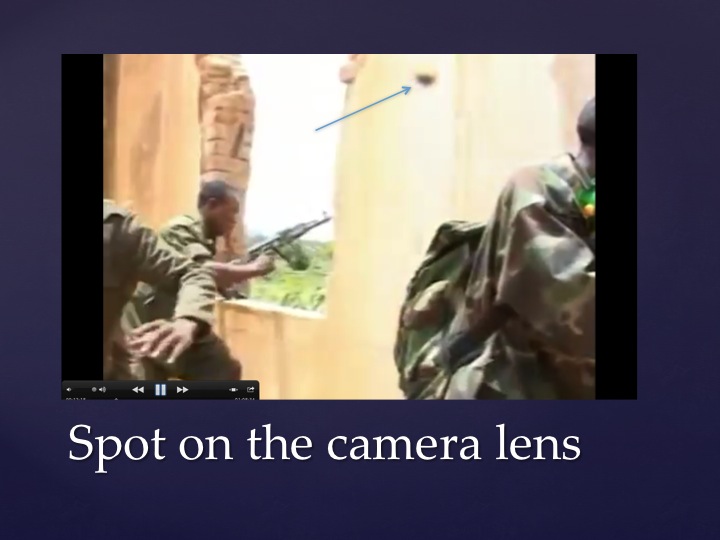
Slide3

In an early scene where Alex’s men relax in a local bar after setting up camp in Wakaliga, it seems clear that those performing the soldiers are improvising, not least through the awkwardness of their movements. Indeed, the acting is on the whole ‘atrocious,’ and the physical performances of Alex’s brother – who is not bad at martial arts at all – are clearly of far more importance to director Nabwana that any emotional connection that we might develop with the film’s characters.

That said, Who Killed Captain Alex? does have an array of interesting stylistic features, including some canny editing in order to make stunts seem more impressive than perhaps they were (a mercenary leaps into the air; cut to Alex’s brother with some feet striking his head; cut back to the mercenary landing on the ground), some innovative cross-cutting between the different strands of the action (Alex’s brother, the commandos, the helicopter attack on Kampala), and slow motion, freeze frames and other techniques that demonstrate some engagement with film form above and beyond ‘straight’ storytelling.

However, perhaps most noteworthy and celebrated about Who Killed Captain Alex? is the film’s use of super low-budget digital special effects, especially enormous spurts of blood as soldiers and criminals are shot, wafts of smoke, bursts of flame from the muzzles of various of the (wooden prop) guns that the characters fire, and the helicopters that destroy Kampala, the Tiger Mafia camp and the surrounding jungle.

I shall return to these effects shortly, but there is one other technique that I ought in some detail to discuss, namely the inclusion in the film of its own commentary.

Who Killed Captain Alex? is violent and certainly open to critique from the perspective of gender. There are women soldiers in the film, but on the whole the female characters are untrustworthy, including Vicky (Ssekweyama Babirye), who is a soldier in Richard’s pay, and one of Richard’s multiple unnamed wives, who betrays Richard by helping Alex’s brother to break into his camp. While these are serious charges to level against Captain Alex, it nonetheless aspires to be something of a knockabout film, as is perhaps made most clear by the mainly English-language commentary that we hear throughout the film from VJ Emmie Bbatte.

Where normally we might think of a VJ as a video jockey (an audiovisual equivalent of a disc jockey), in the context of Ugandan cinema, a VJ is a ‘video joker.’ Since cinema theatres are rare in Uganda, most people go to watch movies in video halls. Indeed, where Lizabeth Paulat says that there were only three dedicated cinemas in Kampala in 2013 (see Paulat 2013), The Economist reports that there were 374 video halls in Kampala alone in 2012 (M.H. 2012) – a ratio of 1:124 (which is not to mention video libraries, of which there are supposedly over 650 in Kampala). It is very common practice in video halls for a VJ not only to explain and to interpret what is happening in the film, but also to comment upon the action – often ironically and amusingly.

As two interviewees explain in the report in The Economist: ‘most people don’t want to concentrate and follow the movie, so the translator interprets the movie, making it easier for them to follow… [and] I watch translated movies because of the dramatic expressions the guys add in their descriptions, making them fun to watch’ (M.H. 2012).

In other words, the practice suggests that viewers do not necessarily pay that much attention to the films. As a result, film-viewing in Kampala shares similarities with the ‘cinema of interruptions’ of Bollywood, in that people come and go during the course of a movie (see Gopalan 2002). What is more, it also resembles early silent cinema, which equally made use of narrators (commonly referred to in Japan as benshi) in order to make sense of events on screen for the audience.

This echo of early silent cinema that is found in contemporary Kampala perhaps also opens up space for us to think about special effects cinema – and perhaps cinema as a whole – as a form of spectacle as much if not more than it is a form of narrative.

But more importantly for present purposes, the version of the film that exists on the ‘official’ Wakaliwood YouTube channel includes commentary provided by VJ Emmie, meaning that his words are not so much an unofficial layer added post hoc to the film during a screening, but they have become an important part of the film itself.

There are several issues to pick apart here.

Firstly, for Who Killed Captain Alex? to include its own voice over commentary in the film is a self-reflexive step that suggests that, far from being ‘primitive’ (a term that occasionally is applied to early silent cinema), Captain Alex is as ‘post-modern’ in its self-reflexivity as anything that Hollywood (as per DeadpoolTim Miller, USA, 2016) or someone like Michael Winterbottom (think A Cock and Bull Story, UK, 2005) would dare to produce.

Secondly, that the voice over from VJ Emmie is so parodic means that the text of the film itself is destabilised. For example, when Alex conducts a press conference early on in the film, Emmie suggests that all of the female reporters love him, only for Emmie to slip into being the voice of Alex’s consciousness, declaring ‘I like men.’ Equally, when Alex’s brother later encounters Richard’s wife, VJ Emmie says, as if he were also a voice inside the brother’s head, ‘I’ve never seen a woman.’ Although possibly problematic in its reference to homosexuality, the commentary – now an official part of the film – undermines the otherwise masculinist narrative that is being put forward. That is, the film undermines its own authority as it goes along.

To be clear, Emmie’s explanations are sometimes very helpful. When Alex’s brother turns up at a warehouse, fights three men, and then has a conversation with another man about how he wants revenge, it is only really thanks to Emmie that we know that we are at the dojo of Alex’s brother’s kung fu master (Ivan Ssebanja) – even though Emmie cannot help but also undermine the master’s authority by calling him ‘fat.’

On the whole, though, Emmie’s comments are intended as amusing and self-conscious. For example, when the wife of Richard who is now helping Alex’s brother remembers how she came to marry Richard, the film flashes back via black and white images to a sequence in which another woman, presumably another of Richard’s wives, throws water over her, having offered her the ultimatum of marrying Richard or dying. ‘She was caught watching Nigerian movies,’ Emmie comments as we see the wife being ‘tortured.’ ‘This is Uganda,’ Emmie continues. ‘We watch Wakaliwood.’ At other moments, Emmie also plugs subsequent Nabwana productions, such as Bad Black (Nabwana I.G.G., Uganda, 2016), while enthusiastically preparing the audience for action as we near combat sequences: ‘Movie movie movie… One hell of a movie!’

While creating some ironic distance from the action that we are seeing (as well as guiding us through narrative lacunae), Emmie’s commentary also possesses a political dimension. When we meet Alex’s brother, Emmie describes him as the ‘Ugandan Bruce Lee,’ and even names this otherwise unnamed character ‘Bruce U.’ This appeal to Bruce Lee would suggest that Who Killed Captain Alex? is endeavouring to embody the same principles of anti-imperialism that have been read into that actor’s star image (see, for example, Prashad 2003).

In other words, the violence of the film is related to a postcolonial desire to be taken seriously on the world stage, to throw off colonial/imperial oppression and not just to be recognised but in some respects also to enact some sort of revenge – even if the master of Alex’s brother says that revenge is not the aim of martial arts. That is, the reference to Bruce Lee would suggest a desire to be or to become cinematic.

As far as Charlse Bukenya’s martial arts prowess is concerned, Who Killed Captain Alex? is utterly cinematic: he is skilled and graceful. However, on another level, the film fails entirely to be cinema.

This is not simply a case of Captain Alex not screening in cinemas, but rather in video halls, where the ‘video joker’ makes clear how from a ‘western’ perspective a film like Captain Alex might be considered a ‘joke’ (which is not to mention how audience members will not be concentrating on the film very much, thereby consistently ‘interrupting’ the film, as suggested earlier).

Nor is it strictly related to the fact that director Isaac Nabwana has ‘never set foot inside a movie theatre’ – instead watching films himself on television and/or ‘seeing’ films based upon oral accounts of what happens in them (see Park 2016).

Rather, we can see Captain Alex as failing to be cinema as a result of its sheer cheapness, as made clear by the film’s clunky and blocky digital special effects, which are more reminiscent not of movies but of video games.

The issue of Captain Alex not being cinema, or, put more positively, being non-cinema, relates to the status of Uganda on the world stage. For, if there are only three cinemas in Kampala, then Uganda itself is a nation that rarely if ever achieves recognition in cinema, a lack of recognition that mirrors the lack of recognition for Uganda in a geopolitical sense.

Uganda is not a nation where cinema thrives. But what does thrive in Uganda is non-cinema, with Nabwana’s non-cinema nonetheless being explicitly tied to the nation when Emmie declares the brilliance of Wakaliwood and when he shouts ‘Uganda!’ during the action scenes.

‘Tell everyone that Uganda is crazy,’ Emmie implores at the end of the film, with sanity thus being linked to cinematic prowess, and Captain Alex and Uganda more generally thus being vaunted precisely for not being sane, or cinematic, but for being crazy or non-cinematic.

In other words, Uganda on the whole lies beyond the purview of cinema; as a nation created by colonial powers, we might understand that cinema is the preserve of the nations of the First and Second Worlds, but not the Third World. Being a Third World film, Who Killed Captain Alex? can thus be read via the tradition of ‘imperfect cinema’ established by the late Julio García Espinosa, who proclaimed that

[i]mperfect cinema is no longer interested in quality or technique. It can be created equally well with a Mitchell or with an 8mm camera, in a studio or in a guerrilla camp in the middle of the jungle. Imperfect cinema is no longer interested in predetermined taste, and much less in ‘good taste.’ It is not quality which it seeks in an artist’s work. The only thing it is interested in is how an artist responds to the following question: What are you doing in order to overcome the barrier of the ‘cultured’ elite audience which up to now has conditioned the form of your work? (García Espinosa 1979)

Nabwana’s film may seem to be an old-fashioned action movie, but it is also a film that gives expression to the way in which not just a Ugandan but also a global ‘“cultured” elite’ has erected a barrier whereby Ugandan cinema (and by extension Uganda itself) does not really exist, not least because it does not exist (or only rarely exists) on cinema screens both in Uganda and in the rest of the world.

When García Espinosa writes that imperfect cinema should ‘above all show the process which generates the problems,’ he may not necessarily be talking about a film that exposes corruption or which explores the history of Idi Amin, Milton Obotwe or Yoweri Museveni, who since 1986 has been leading Uganda.

Rather, Nabwana and Emmie show how cinema is what Jonathan Beller (2006) might describe as the embodiment of capital, and that cinema itself is thus a process that generates problems, by generating the distinction between the included visible, who are thus cinematic, and the excluded invisible, who are thus non-cinematic.

That is, Who Killed Captain Alex? demonstrates little to no interest in exposing specifically Ugandan problems or Ugandan history, not least because ‘[m]ost Ugandans (including every RFP actor except one) grew up long after the violence of Idi Amin and the civil war’ (McPheeters 2015).

Nonetheless, it does expose how cinema and colonialism both functioned as tools for a capitalism that has created Uganda as such and yet which has also rendered Uganda incapable of being the equal of the First and Second World, incapable of being cinematic – even if Nabwana’s film clearly conveys a defiant appetite for cinema.

Who Killed Captain Alex? may thus fit García Espinosa’s paradigm of imperfect cinema, but it is not exactly an example of Third Cinema in the classic sense defined by Fernando Solanas and Octavio Getino.

For, the film does not eschew the entertainment of First (North American) Cinema and the artistry of Second (European) Cinema in a bid to create a new, political ‘Third’ cinema that gives expression to postcolonial political realities and which seeks to overthrow imperial oppression (see Solanas and Getino 1976).

Rather, Captain Alex embraces action cinema and attempts to provide a film that is spectacular. It is in the knowing disparity between the imperfect special effects of this film and the special effects extravaganzas provided by Hollywood, however, that the film’s power lies: Uganda aspires to a spectacular, cinematic existence, but it simply cannot afford one.

In this way, it is not that Captain Alex is worse than a Hollywood film; in some senses it is every bit the equal of a Hollywood film, if not significantly more impressive given the resources and budget with which Nabwana and colleagues are working (this is not intended as a case of presenting a condescending appreciation for the film, thereby repeating a neo-colonial claim to power over the Third World text).

Instead, with Captain Alex being the equal of a Hollywood blockbuster, we can understand that all films are equal. If all films are equal, then what distinguishes films is not quality (a measure that has been destabilised thanks to thinking ‘philosophically’ about Nabwana’s film) so much as the amount of money that they have, with the amount of money that they have determining in some respects the amount of money that they can make. In cinema as in life under globalised neoliberal capital, the rich live in a different world from the poor.

To refer back to Mbembe, Captain Alex suggests an obscene and grotesque assault upon the ‘official’ language of cinema, where the cost of an image is conflated with how ‘official’ it is perceived to be. That is, the ‘official’ language of cinema is the language of capital: cinema is legitimated by money, not by cinema itself. By undermining this process through its proud display of cheap special effects, Who Killed Captain Alex? points to wider economic imbalances, as also conveyed by the existence of Captain Alex (and Uganda more generally) outside of cinemas, even if Captain Alex is cinematic (albeit cheap).

The lack of resolution in the film here comes to the fore. Never finding out who killed Captain Alex might function as a mirror of the Hollywood franchise film that equally must never be fully resolved for the purposes of creating sequels and spin-offs. But in some senses it also presents a mystery regarding the injustices of global economic disparities: what is the reason for Uganda not to be recognised as a legitimate nation with a legitimate cinema?

Captain Alex, as the hope for establishing order and justice in Wakaliga, is killed – but we do not know by whom. Not only might this constitute an unresolved mystery suggesting the chaotic nature of the universe as per the films of Michelangelo Antonioni, for example, but it also points to the impossibility of Uganda to achieve economic equality and to receive justice for its colonial exploitation – as instead the film demonstrates a chaotic world of male-dominated violence (undercut by Emmie’s commentary), and in which martial law is the only way of restoring domestic order.

If Who Killed Captain Alex? does not, in its bid to entertain, fit the classical paradigm of Third Cinema, it also does not fit the definition of a powerful and entertaining First Cinema that Solanas and Getino suggested conveyed bourgeois values to a passive audience.

Emmie’s commentary would suggest an active audience that is encouraged to engage with the political dimension of the film’s digital aesthetics, rather than for the film’s digital aesthetics seducing its audiences into forgetting about politics.

If the film is not an example of First Cinema, it is also not quite an example of ‘supercinema,’ which I have defined elsewhere as being a digitally-enabled cinema that seeks philosophically to democratise space, time and identity (see Brown 2013).

For, Captain Alex is defined as much by its self-conscious failure to achieve big budget special effects as it is by any success in rivalling a Hollywood film production. And yet, if Captain Alex is as much a manifestation of digital special effects cinema as a Hollywood spectacle, then perhaps Who Killed Captain Alex? functions as a film, and Wakaliwood as a space, where supercinema meets non-cinema.

That is, the potential of digital cinema to open us up to new ways of thinking as a result of how it can depict space, time and identity, comes up against the realities of a world – also digital – in which disparities of wealth, mobility and visibility, as well as political injustice, continue to be part of the fabric of everyday life.

Supercinema may elevate us beyond the cinematic divisions and boundaries that are typical of the society of the spectacle; non-cinema, meanwhile, validates the obscene and the grotesque, it validates difference, in a bid for us democratically to understand that, even if Isaac Nabwana cannot afford high end special effects, all films and thus all humans (and perhaps even non-humans) are not necessarily the same (they are different), but they are also equal.

Bibliography

Beller, Jonathan (2006) The Cinematic Mode of Production: Attention Economy and the Society of the Spectacle, Lebanon, N.H.: University Press of New England.

Brown, William (2013) Supercinema: Film-Philosophy for the Digital Age, Oxford: Berghahn.

Brown, William (Forthcoming) Non-Cinema: Global Digital Filmmaking and the Multitude, London: Bloomsbury.

García Espinosa, Julio (1979) ‘For an imperfect cinema’ (trans. Julianne Burton), Jump Cut, 20, pp. 24-26.

Gopalan, Lalitha (2002) Cinema of Interruptions: Action Genres in Contemporary Indian Cinema, London: British Film Institute.

Mbembe, Achille (2001) On the Postcolony (trans. A.M Berrett, Janet Roitman, Murray Last and Steven Rendall), Berkeley: University of California Press.

M.H. (2012) ‘Coming to you live,’ The Economist, 2 November.

McPheeters, Sam (2015) ‘A Ugandan Filmmaker’s Quest to Conquer the Planet with Low-Budget Action Movies,’ Vice, 3 March.

Park, Gene (2016) ‘How a Ugandan director is making great action movies on $200 budgets,’ The Washington Post, 28 September.

Paulat, Lizabeth (2013) ‘Going to the Movies in Kampala,’ Living in Kampala, 3 September.

Prashad, Vijay (2003) ‘Bruce Lee and the Anti-imperialism of Kung Fu: A Polycultural Adventure,’ positions: east asia cultures critique, 11:1, pp. 51-90.

Solanas, Fernando, and Octavio Getino (1976) ‘Towards a Third Cinema’ (trans. Julianne Burton), in Movies and Methods: An Anthology (ed. Bill Nichols), Berkeley: University of California Press, pp. 44-64.



From Billy Lynn to Rogue One

American cinema, Blogpost, British cinema, Film reviews, Uncategorized

In Billy Lynn’s Long Halftime Walk (Ang Lee, USA/UK/China, 2016), there is a sequence where Billy (Joe Alwyn) experiences a flashback to his tour as a soldier in Iraq.

The scene is ultimately innocuous, but as Billy looks around him in an Iraqi market, we see and hear how a soldier thinks: could those kids be throwing a grenade? could that man be reaching for a gun?

In keeping with the film’s arch self-consciousness, the sequence also features one soldier buying bootleg DVDs – of a Disney film – for his daughter. But the reason why I want to discuss this sequence is because the iconography of uniformed soldiers walking armed through a traditional ‘Middle Eastern’ market place, replete with stalls, sandy ground, narrow alleys and sandstone walls, and with people wearing elaborate robes, has also been deployed elsewhere in recent cinema, namely in Rogue One: A Star Wars Story (Gareth Edwards, USA/UK, 2016).

The key difference is that in Billy Lynn, which is far more interesting than its unpromising title would suggest, we are with the soldiers, while in Rogue One, we see these scenes of armed soldiers walking through otherwise traditional bazaars and other ‘Middle Eastern’ spaces through the eyes of the rebels – those who are going specifically to pull out guns and lob grenades in order to defy the imperial presence.

It is not that Billy Lynn is specifically critiquing Disney – even if the Disney bootleg is mentioned. Nor is it that Billy Lynn quite offers a corrective to Rogue One, as it offers a sympathetic portrayal of the life of a soldier who ultimately decides to fight for his fellow servicemen – while Rogue One offers a fantasy of striking back against the Empire, the storm troopers of which are disposable enemies.

Rather, both films in fact help us to understand a more subtle but important process – even though they nominally give us completely different perspectives (soldiers and rebels). And this process is the normalisation of Empire via their shared iconography of soldiers walking through ‘Middle Eastern’ bazaars.

Billy Lynn spends a lot of time conveying how contemporary America is a militarised zone. Although it amuses Billy and his comrades that business people describe their workspace as the ‘war room,’ while using other would-be combat terms to describe their work, such moments nonetheless convey the militarisation of the domestic space and its everyday routines.

This is also conveyed in the violence that the soldiers experience not just in Iraq (during Billy’s flashbacks) but at home, where/when the film is set. The film is about the Bravos, a group of soldiers who have become the face of the Iraq war after a journalist’s film camera – abandoned but left recording during a military engagement – captures footage of Billy rushing to rescue Sergeant Virgil ‘Shroom’ Breem (Vin Diesel).

Given their rise to fame, the soldiers are to appear at a show with Destiny’s Child during the halftime interval of an American football game in Dallas. Celebrated as heroes, the soldiers are also in the process of trying to negotiate a movie deal to tell their story.

Without going into too much detail – since it is not the focus of this blog post – the film articulates the way in which domestic America is as violent as Iraq as the soldiers are constantly harassed and abused – even though they receive acclaim from an otherwise patriotic audience.

What is more, while films like Hail the Conquering Hero (Preston Sturges, USA, 1944) and Flags of Our Fathers (Clint Eastwood, USA, 2006) critique the process of using heroic soldiers at spectacular jamborees in order to sell war bonds in a bid to further the war effort, Billy Lynn demonstrates quite clearly in their bid to have their story made into a movie that war provides the material for cinema, and thus to a degree how cinema also provides the material for war.

What is more, while the explosions during the halftime show panic the soldiers as much as does real combat in Iraq (and not simply in a way of setting off a traumatic memory), we get a sense in Ang Lee’s film of how the contemporary USA is indeed built as a simulacrum of war that is itself sufficiently traumatic that the soldiers prefer to bond with each other and to return to Iraq (there are two extraordinary scenes in which men declare their love for each other) rather than to stay at home.

In other words, PTSD is not specifically caused by the trials of war itself – but equally by the never-ending war-like/militarised aspects of contemporary American life: the same car manufacturers (Humvee), explosions, aggressive people, loud noises – except here surrounded by plenty and with a huge emphasis on consumption/consumerism.

Even if the soldiers are doing a job that is not everywhere popular (they themselves understand very well that the major result of their work is that it likely breeds rather than reverses anti-American sentiment), it is in their interactions and experiences with each other that they can find some humanity in a world where otherwise they are simply (undervalued and underpaid) commodities and objects.

This even extends to Billy’s love life; in a remarkable sequence, he realises that Faison (Makenzie Leigh), a cheerleader whom he has just met but upon whom he is sweet, desires him only as a soldier and not as a person (she is disappointed when Billy says that he wishes he could run away with her; a soldier must fulfil his duty). Lee and actor Alwyn subtly manage to capture both Billy’s vulnerability in projecting his own desire for escape on to Faison (the youthful intensity of the recent crush – demonstrating that even though he has fought in combat, Billy is still in some senses a child), as well as the way in which that crush is extinguished in an instant by a single turn of phrase (her disappointment that he does not return willingly to Iraq).

There is a clear critique of Billy Lynn to be made for its treatment of women, including the way in which Billy’s anti-war sister, played by Kristen Stewart, is a woman scarred from a car accident and whom Billy is specifically fighting to protect by serving his country in order to pay her medical bills. But an extended critique will be for someone else to make.

Furthermore, there is of course a critique of the film to be made in its refusal to give us the perspective of those against whom the soldiers fight in Iraq – even though we see at length what it means to take a life by hand as Billy scrambles with someone who might typically be referred to as an insurgent next to Shroom, who has been shot.

However, while Rogue One may in some senses offer a corrective – by giving us the perspective of the rebels (even if in a fantasy universe now owned by Disney) – both films contribute to the same process of naturalising Empire.

Billy Lynn clearly articulates the way in which war is a mediatised spectacle. Everyday life becomes militarised as it also becomes mediatised, while war itself becomes everyday as it, too, becomes mediatised. In its own way, Rogue One does this, too.

While in Billy Lynn Iraqi lives are somewhat disposable (in spite of the extended depiction of the death of the insurgent at Billy’s hands), in Rogue One storm troopers are disposable. While Shroom is killed in Billy Lynn and all of the rebels perish in Rogue One, the imbalance in both films between the numbers of deaths that we see means that both also broadly convey a fantasy of war as simulacrum, or what we might call a war without casualties. War as entertainment. Not war as real (even if Billy Lynn also tries to get to that reality).

This reflects to a certain extent the way in which contemporary warfare is – from the perspective of the West – a war without casualties (we are horrified when the numbers of Western casualties grows – even though countless Iraqis and Afghans have died in this war – as if their lives did not matter or count since they are somehow not quite as human).

In reference to the first Iraq/Persian Gulf War in 1991, French philosopher Paul Virilio argues that ‘[t]he war of zero casualties (or nearly, on the side of the allies) was therefore also a war of zero political victory.’ Saddam Hussein remained in power – which in the fullness of time led to a second war, where Hussein was toppled (one cannot help but think not only of Hussein’s ungainly death, but also of the much more viewer-friendly toppling of his statue; this is a war about symbols and aesthetically pleasing images – and thus about media – as much as it is about humans, who have a propensity to be aesthetically unpleasing, or war, which also is likely not as pleasing to behold in real life as it is in movies – with Mel Gibson’s Hacksaw Ridge (Australia/USA, 2016) doing a fine job of hypocritically saying how bad war is before pouring on the war porn in heavy doses), and then to an ongoing war that the American soldiers describe in Billy Lynn as being beyond their understanding as Iraqis now fight each other as well as them.

While Virilio’s assertion is insightful, what he does not quite articulate here is that political victory is not the point. The war itself is the point of the war. The war produces the images, which produces the war, which produces the patriotism, which produces the buying, which produces the consumption, which produces war bonds in the form of bondage to war, which produces cinema, which produces war, which produces cinema, which produces war… and so on.

If there were victory in this war, the war would end and there would no longer be images for us to look at and advertisers and patriots and others for us to get to use those images to make money, and there would no longer be arms sales or private business contracts, or movie deals, and so on. The becoming-everyday of war is matched by the militarisation of everyday life, then, since both are the same process of keeping capital going, with the media playing a major role in the making-everyday/naturalisation of this process.

More than this. If the war cannot end, since this would also mean the end of capitalism, then soldiers in the ‘Middle East’ is to become an everyday – or at least repeated – occurrence. This is, in other words, Empire-building. It is not colonialism, or at least will not go by that name, since a) colonialism is unfashionable and generally condemned and b) because it does not involve colonisation specifically so much as an ongoing and repeated military presence in such places – because the perpetuation of war (war as capital) demands it.

In this sense, Rogue One is for all of its rebellious bluster serving the same purpose as Billy Lynn, even though the latter critiques it: normalising images of invading/Western soldiers in ‘Middle Eastern’ locations – because this is indeed our new reality.

What is more… while Rogue One plays the card of giving us a fantasy of rebellion, it still only perpetuates fantasies of violence, while at the same time demonstrating that Disney’s attempts to regain/retain global domination also involves a kind of militarisation of cinema/a making-cinematic of war.

For, as Disney via the Star Wars franchise and Marvel shows us how we are set to have endless, perhaps infinite, stories set in each fictional universe (not just sequels and prequels, but ‘Star Wars stories’ and the infinite regression of the Marvel spin-offs), so, too, is Disney normalised as the only reality.

This process of normalisation – as delimiting the human imagination such that it can do nothing other than imagine the world as it is, and not a different world that we may ourselves forge – is itself war. It is an ideological war that is about getting people to buy only certain products and to mistrust others (it can be seen in Tesco, Sainsbury and Waitrose opening stores all across the UK and which are putting out of business countless ‘corner shops’ – perhaps not coincidentally run often by immigrant families with brown skins). And this war is waged through the media, which in turn depict how war is a supposedly necessary and normal part of our lives.

It is a complex and confusing world, where we are – specifically to use war terminology – bombarded by images and sounds that render us all always nervous and on the edge of our seats – in a world very far removed from the quiet and the natural sounds of pre-industrial humankind. It is a war waged for the control of our planet and of each other, with the idea of fighting for control and/or of seeking power becoming naturalised such that no one even questions it anymore. That is, we do not object to being controlled – as we instead reach constantly into our pockets to receive micro-hits of cinema from our smartphone screens, so normalised has this disciplining via militarisation of the everyday become.

The question becomes, then: do you buy into this world of warcraft, or not?

Lion (Garth Davis, Australia/USA/UK, 2016)

American cinema, Australian Cinema, Blogpost, British cinema, Film reviews, Transnational Cinema, Uncategorized

There is a sequence in Lion where Saroo (Dev Patel) and his soon-to-be girlfriend Lucy (Rooney Mara) walk to a party on opposite sides of the street.

Lucy does a wee dance, and Saroo then copies her – the pair thus doing some cute romance as they swap dance moves from across the road that separates them.

The moment is an uncredited homage to Spike Jonze’s short film, How They Get There (USA, 1997), which you can see in full below (for as long as it remains on YouTube).

Given that Lion is a film about a young boy who by accident becomes separated from his family and who ends up being adopted by Australians, and given that the film is based upon a true story, it seems strange to have this extended reference to Jonze’s film included.

For, while Jonze’s is a playful and witty short, Lion seems to be in the business of taking itself very seriously – as perhaps it should do given that it is a film about a topic as weighty as transnational identity, and which is seeking to pick up various awards during this year’s season. The homage, therefore, shifts the film tonally from serious to playful in a way that jars with the what the film otherwise seems to set out to achieve.

So let us say that Saroo and Lucy had seen How They Get There (these characters do supposedly live in the real world, after all, meaning that they may well have done). Surely the inclusion in the film is therefore justified – a kind of audiovisual exchange that could just as easily be the characters bonding via conversation over, say, their love of Aravind Adiga or Powderfinger (also real world figures)?

Well, maybe. But since Lion so clearly adopts this scene from Jonze, it simply feels tired, unimaginative and unoriginal – as if the filmmakers could not themselves come up with anything better than nicking someone else’s idea in order to convey romance. One’s confidence in the rest of the film is undermined: how much more of this film is entirely derivative?

More than this. There is a cinema in the world where such shifts in tone are in fact commonplace, such that they become perhaps even the defining feature of that cinema.

I am of course talking in quite a general sense about Indian cinema, with the Mumbai-based industry known as Bollywood generally functioning as its metonymic figurehead.

Lion is a transnational co-production, as the stated involvement of Australian, American and British monies makes clear above. And yet the film is also largely set in India, with locations including Kolkata and Khandwa, which lies close to Saroo’s home town of Ganesh Talai. What is more, the film also features numerous performances by Indian actors. So, one asks oneself, where is the Indian economic involvement in the film?

Or does the tonal shift marked by the adoption of Jonze’s idea also mark the adoption of ideas (tonal shifts themselves) from Indian cinema, which in turn marks the adoption of Indian cinematic resources for this film – which is a film about the adoption of Indian boys by white Australians?

There are plenty more things to say about Lion, but I would like to limit myself to three things – the first of which relates to How They Get There.

For, in Jonze’s film, things end badly as the male dancer gets run over, with the driver of the car perhaps also dying – and the male dancer’s shoe ending up in a gutter by the side of the road.

Does the reference to this film in Lion, therefore, signal a similar pessimism with regard to Saroo? While the film clearly is about ‘How They Get There,’ are we to believe that Saroo is, as it were, a shoe in a gutter – looking up at the stars that might help him in the developed world? There seems to be no clear analogy, but any way that one looks at it is never far from offensive.

Indeed – to move on to my second point – there is another strange sequence in the film where Saroo’s adoptive mother, Sue (Nicole Kidman), explains that when she was 12 she had a vision whereby she saw herself with a ‘brown boy’ – and that this is what drove her not to want to have birth children, but to want to adopt kids herself.

The daughter of an alcoholic, Sue in some senses seems to declare here that Saroo is partially an object that helps her to get over her own traumatic childhood. Which I guess is fair enough, except that this again reduces Saroo to simply a brown boy who may not want to be, but who is indeed the plaything of sorts of white Australians. No wonder that Saroo’s adopted brother, Mantosh (Divian Ladwa), is himself so troubled.

In this way, it seems oddly fitting that Saroo is not, in fact, Saroo’s real name. His infantile tongue could not properly pronounce his name (nor the name of his home town), and so Saroo is the result of the boy (played by Sunny Pawar) trying to say Sheru (meaning lion), and Ganestalay his attempt to say Ganesh Talai – a town that no one could find as a result of this difference.

What a thin thread possibly prevented Saroo from being able to find his way home. Nonetheless, the erasure of his Hindi roots through this ‘error’ does, as mentioned, seem oddly apt through its occultation of Saroo’s origins.

Of course, Saroo is haunted by his past and he does finally discover his origins – so at least we see that he cares for truth and is haunted by his privilege knowing that his mother is a labourer who carries rocks for a living while he enjoys boats and aeroplanes (and visions of his past from a drone – with his discovery of his past enabled in large part by the surveillance technology of Google Earth).

In other words, Lion clearly is a film about worlds separated by technology and in particular transport as a means of defining humans according to their different abilities to travel/move (even if true, it is oddly apt, then, that Saroo’s destiny is changed by his inadvertently being on the wrong train – the great distance that it covers from Khandwa to Kolkata signalling his destiny to be catapulted into a new, more mobile world).

And we are glad that Saroo is saved from this world, even if we see him running and laughing and loving his family in Ganesh Talai. For it is also a world defined by manual labour, paedophilia, child abuse and uncaring authorities. Saroo really is better off, it would seem, in Australia – and his rescue is thus in some senses justified, even if his adoptive mother has dimensions of the would-be White Saviour.

Dev Patel gives an excellent performance as Saroo. The film as a whole is powerful. But as the film ultimately endorses the fast pace of modernity at the expense of the slow pace of those pedestrian labourers who function as the very props upon which this modernity is based (it is the labour of his birth mother that brought Sheru into the world, even if Sue takes credit for raising Saroo), so, too, is the film constructed according to the fast pace of western films.

That is, the film has rapid scenes, often cutting into action and getting the viewer to infer what has happened – rather than allowing the viewer to see events unfold for themselves.

In this sense, we regularly see Saroo/Patel at points of high emotion – but the film in this regard does not show us ‘how they get there.’ That is, we do not see the onset of emotion, the change that takes place – we just see the emotion itself, with the emotion itself thus becoming symbolic, a symbol of emotion, rather than an emotion grounded in the real world of change and becoming.

The film’s decision to rush emotions in this way – to be too busy/in the business of business to want to take us through the complexity of emotion – reflects the privileged speed of the highly technologised First World, where emotions become empty because of their own speed, rather than real because slow and enworlded.

In its form, then, the film undermines what it otherwise would seemingly want to achieve: we want to connect with people across boundaries, but really what we are seeing are power games and the use of other people and their real lives for the purposes of our own entertainment, edification and comfort. This makes for troubling viewing, even if I also was swept up personally in the story that I was seeing.

While Patel seems excellent as Saroo, then, it also seems a shame that he is edited in such a way that we do not really get to see him act. Or rather, his performance is reduced to acting as a result of the editing: here is Saroo unhappy, here is Saroo sad, and so on. To get beyond acting exposed as acting, to get to acting as an embodied performance, we need to see the transitions; we need to see how they get there.

Oddly, such a transition is shown in the film – but by Sheru’s mother, Kamla, when they are reunited. I believe that this moment is performed by Priyanka Bose (she plays Saroo’s mother when he is young; it is unclear whether it is still her but aged via make-up when they finally meet again).

In a few brief moments of screen time, we see Bose carry out an extraordinary performance of recognition and then emotion as she recognises her boy. And yet what plaudits for Bose in the celebration of the film at awards season?

Furthermore, in a few brief instants we here sense a story that we never otherwise got to see – the story of an illiterate labourer whose son has been taken from her in rural India. How much more interesting might that film have been, rather than the troubles that a boy had in discovering his hometown through the use of Google Earth?

That we see a film that privileges the privileged masculine perspective is perhaps profoundly western. If, we wanted to watch a film featuring the female perspective, then we likely have to discover a different cinema – perhaps even the cinema of a place like India, where a masterpiece like Mother India (Mehboob Khan, India, 1957) dares to tell precisely the story of a female labourer struggling to bring up her children in the Indian countryside.

(Much as I tend to enjoy the performances of Casey Affleck, the performance from Bose in Lion reminds me of how Michelle Williams acts Affleck off the screen in Manchester by the Sea, Kenneth Lonergan, USA, 2016, even though she has minimal screen time and even though her big scene is scripted basically to suggest that she still is in love with the man who is largely responsible for the death of her children – i.e. it is a male fantasy-fulfilment.)

(This in turn reminds me that both Lion and Manchester by the Sea continue the trend of films about dead, lost, and otherwise problematised babies and children – as I have written about elsewhere. It is the preoccupying theme of contemporary western cinema.)

Forasmuch as it is well made and enjoyable, then, Lion seems to have adopted various things from various other places not in order to present us with any changed vision of the world, but to replicate the vision of a superior western, technologised, cinematic world – even if this world is built upon the labour of people like Kamla, whose plight remains invisible.

How we got here – to such a world that seemingly is made up of different worlds – is hidden.

And yet it might be the most important (hi)story for us all to learn.

The comedy of experimental cinema

American cinema, Blogpost, Canadian cinema, Experimental Cinema, Film reviews, Uncategorized

I can only say what I saw and heard (and felt and thought).

Over the last two evenings, I have attended two experimental film events. The first was a screening of Michael Snow’s La région centrale (Canada, 1971) at the Serpentine Gallery, which screened alongside the opening credits of Vertigo (Alfred Hitchcock, USA, 1958) – with both being chosen by artist Lucy Raven, whose solo exhibition, Edge of Tomorrow, is currently on there. The second was a performance at Tate Modern of Tony Conrad’s 55 Years on the Infinite Plain (originally called 10 Years on the Infinite Plain when first performed in New York, USA, in 1972, and which has been growing in age ever since – now beyond Conrad’s death last year).

For those unfamiliar with either of these works, the former is a three-hour film shot on the top of a mountain in Québec, and which features images captured remotely by Snow using a robotic arm, to which Snow’s camera was attached, and which rotates in a long series of different directions. The latter is a 90-minute piece featuring ‘drone’ music and black and white strips that flicker on a screen from four projectors simultaneously.

Both experiences involve a fair amount of discomfort, not least because traditional cinema seats were not provided, with the viewer instead having to sit on a wooden stand (La région centrale) or on the floor (55 Years…). Standing is an option. But either way, one really feels the presence of one’s body as one tries to find comfort during the screenings (and live musical performance in the case of 55 Years…).

I am not an expert on experimental cinema. I have seen a fair amount, read a fair amount of literature about it, and also think about it (and occasionally write about experimental aspects of cinema that is otherwise not so overtly non-narrative as these two films).

I am driven to write about these back-to-back experiences, though, not simply to expose my ignorance of the subject (I can’t imagine that I shall say much that others have not written – or certainly thought – in relation to these films), but to convey some thoughts that I had while watching the films. Perhaps that is, after all, one of the things that a blog can do.

To get to my thoughts, though, we must describe what happens in the films. As I have already hinted, ‘not much happens’ from the perspective of someone looking for a film that tells a story. La région centrale features images captured by the camera as it moves round and round, back and forth, spinning upside down, moving in circles in all sorts of directions and more.

55 Years…, meanwhile, features a deep electric bass line (performed on this occasion by Dominic Lash), accompanied by violin (Angharad Davies) and long string drone (Rhys Chatham). At first one projector, then two, then three, then four fill the wide screen with the flickering lines, before all four projectors slowly begin to converge, their images overlapping, and then are turned off one by one, until only one flickering image remains.

Probably sounds pointless, maybe even dull, right – especially if one lasts 180 minutes and the other 90?

I do not think so. Indeed, quite the opposite.

The Snow experience induced in me so many different thoughts, which perhaps have at their core a sense of seeing the Earth as if through the eyes of an alien. Initially surveying the ground, the camera then begins to rotate in such ways that we are consistently being given new perspectives on our world – toying with it, twisting it, turning it, experimenting with it.

As María Palacios Cruz explained in her introduction, Snow deliberately tried to find a spot in his native Canada where no visible trace of human life could be seen (something that might recall my earlier post about the ‘American eye’ in relation to Le corbeau). In other words, he absolutely wants us to see the world from an inhuman perspective; to see the world ‘for itself.’

In the process, we begin to understand how as humans we often do not see the world ‘for itself’ but how it is ‘for us’ (and this is not necessarily a bad thing; we are driven to live and survive by our selfish genes, after all). By getting us to see the world ‘for itself,’ the world itself is made ‘alien’ to us, or we see the world as if through alien eyes. The film becomes a panoply of different ways to look at the world through the insistent movement of the camera – with the non-stop nature of that camera movement also bringing to mind the way in which our relatively static perspective of the world is perhaps key in bringing about our inability to see the world ‘for itself.’

For, the world is also movement – but generally we do not have eyes to see it. The rhythms of the world are perhaps too slow for us to detect. What Snow’s film does, then, is to bring to mind those rhythms. Not just Snow’s film, but by extension cinema as a whole is thus in part a machine to present to us something like ‘deep time’ – the long, slow rhythms of the world that extend further back than we can remember and further into the future than we can imagine (in other words, a world without humans). Perhaps this is why a narrative classic like Vertigo is also chosen to play in part alongside Snow’s film.

If Snow’s film takes us into the realm of planetary time, Conrad’s film takes us (or me, at least) into the realm of universal time.

Using black and whites strips alone, Conrad takes us into a realm whereby I am confronted not just with a world that exists far beyond the human realm, but with the way in which the world – the universe itself – comes into and out of being. If the world pre-existed humans by billions of years, and if it will outlive humans by billions of years (La région centrale), then Conrad’s film tells us that the universe pre-existed the world by trillions of years, and will continue to exist after the world has gone by trillions of years. (It exists beyond time itself, and beyond measure. Again, language becomes meaningless.)

More than this… 55 Years on the Infinite Plain tells us – in its flickering of white, or being, and black, or nothing – that existence itself comes into and out of being. That there is a beyond existence; that there is a beyond being; that there is a beyond ‘is’ – such that one cannot even express what we are describing since to say that ‘there is a beyond “is”‘ is clearly a contradiction in terms (how can not-is and is co-exist?)!

If language cannot suffice for the task of explaining what we see, then we enter into the realm of experience and of a new, different kind of thought (that also cannot be defined simply by what we ‘see,’ since it must be experienced, too).

What is the universe? But simply a flicker of light in an otherwise infinite blackness.

If 55 Years… takes us somehow beyond the universe, then it takes us into a realm not of a singular reality (a uni-verse), but into the realm of multiple realities. An alien perspective, or what philosopher Jean-Luc Nancy and physicist Aurélien Barrau might suggest is the necessary understanding that there is no world, but only multiple, infinite worlds.

As per the translation of their book on the matter: what is these worlds coming to? What these worlds is coming to (note the grammatical error; again, language does not quite suffice) is the co-existence of existence and non-existence. To invoke a different philosopher, Jean-Paul Sartre, being and nothingness at the same time.

Am I being pretentious? Possibly. I mean, people walked out of both screenings – and so clearly not everyone goes with these films. But at the end of 55 Years… the remaining audience members (perhaps as many as 100 people) sat in silence and darkness for about a minute. Finally, some applause – enthusiastic applause, some whoops of joy. Clearly they needed a moment to catch their thoughts, because this film had taken them somewhere different, somewhere special.

In other words, if to someone who was not there this all sounds like wank, to the majority of people who were there, this meant something – even if expressing it is and perhaps remains difficult. “That was absolutely fucking amazing,” said the woman sat next to me. I felt like dancing (and did nearly throughout 55 Years… – although I refrained from doing so).

Elsewhere I have written about how Hollywood presents to us narrative films that, even if they contain ‘puzzles’ for us to work out (my example is Inception, Christopher Nolan, USA/UK, 2010), they are still designed to be easy to consume and, by extension, not particularly challenging. I then suggest that films that do not involve narratives (my example is Five Dedicated to Ozu, Iran/Japan/France, 2003, by the late Abbas Kiarostami) can be quite challenging, even if there is no specific puzzle to work out – as we just see images of waves lapping the shore, or ducks walking along a beach, or a pond at night.

My argument in that essay is that common responses to Five… might include either ‘I got it after two minutes, so I do not know why I had to sit through that’ or ‘I did not get it’ – while people might easily say that they ‘got’ Inception (even though it is more than twice the length of Five…).

I suggest that there is not so much anything to ‘get’ with Five… (or Inception, or Vertigo – as its inclusion by Lucy Raven in her programme makes clear), but that one might ‘get into’ that sort of film by working at being an attentive audience member and beginning to marvel at what a wave lapping against the shore is and might mean (is it not a miracle that this happens?) as opposed only to marvelling at special effects and ‘mind-bending ideas’ (even though the leaders of the two largest energy companies in the world sit next to each other on an aeroplane and do not recognise each other).

(Besides which, whenever one says that one ‘got’ such a film after two minutes, they clearly do not ‘get’ it since part of getting it must involve experiencing the film in its entire duration, including the sense of slowness, and the different time or tempo of the piece. To demand that it be shorter is not to respect this otherness, but to apply one’s own rhythm to it, to curtail it, perhaps even to kill it.)

(Speaking of marvelling, I also found myself marvelling during 55 Years… about the fact that I can rotate my head. How is it possible that a human evolved from the mud of a planet that itself was a rock spewed from a star, such that it has a head that can rotate on a joint that sits atop a backbone and which contains eyes that can see and ears that can hear?)

To return from these loco parentheses: I make reference to my own essay not simply to continue to explain to a(n imagined?) ‘viewer-on-the-street’ that these non-narrative films might do something for us (and that thus people who might otherwise never go to watch such films might do worse than to give them a try), but also to correct what I wrote in that essay.

In that essay, I wrote that we might ‘get into’ films like Five Dedicated to Ozu by putting in some effort ourselves (rather than having nigh everything served up to us on a plate, as per Inception). However, now I think it would be better to suggest that we do not ‘get into’ but that we ‘get with’ such films (which is not necessarily to the exclusion of ‘getting with’ mainstream films; I believe that we can get with cinema as a whole – but don’t think that we should only get with the mainstream at the expense of the weird and the wonderful).

Why do I now want to say that we should ‘get with’ as opposed to ‘get into’ these films?

Well, in part this is to explain that getting a bit ‘pretentious’ (talking about cosmic things like a world without humans and a multiverse that exists and does not) is to get with what these films are doing, or at the very least what these films can do with us (it might also be an act of love if we were to say that we ‘go with’ these films – since coitus itself means to go with [co-itus] – as I have suggested here).

Furthermore, the preposition ‘with’ (a favourite of Jean-Luc Nancy) suggests not quite a disconnection from the world (seeing it through alien eyes), but also a connection with the world (seeing it ‘for itself’ – or from the perspective of a world that has seen so much more than humans and a multiverse that has seen so much more than our world).

Seeing through the eyes of the other, a kind of forgetting oneself, is also to commune with another – and in this case not just another human, but a whole other timescale (the entirety of existence) and space scale (a planet, a universe – as well, in the case of La région centrale when it shows us the land beneath the camera in close up, a rock, a patch of earth, a blade of grass). ‘With’ is to go beyond the self, to open the self up not only to the other human, but in the cases of La région centrale and 55 Years on the Infinite Plain, the inhuman.

Furthermore, ‘with’ always implies plurality, or a multiplicity of things and perspectives. For, one cannot be with anything or anyone if there is no thing or one beyond the self with which to be. With, therefore, suggests that we live in a multiverse, and that what these worlds is coming to is perhaps us, our understanding of the multiverse, and our place with it.

(The Conrad also suggests with in other ways – particularly the way in which my eyes when they move from left to right can make the flickers seem as though moving in that direction – before then moving in the other direction as my eyes move from right to left… That is, I am with the film in the sense that I co-create what I see; I see not just a different perspective, but a different perspective with my own eyes; I am entangled with the multiverse. This might seem to contradict the idea that I get beyond myself – but what perhaps really is exposed is not just the world beyond the self, but also the relationship between that world beyond self, and the self itself. What is exposed or revealed is our withness – and how the otherness of that with which we are is necessary for me even to exist and to have my sense of self/my perspective in the first place.)

I wish to end, then, by suggesting that these films do not just put us with the universe or multiverse. They put us with the medium of cinema, too, which opens us up to these new perspectives. I hear the 16mm projector rattle along during La région centrale, and I turn to see the projectors during 55 Years…. The experience of these two films is, then, to be with media, to be co-media, to be comedy.

What we can experience during these films is thus the comedy of the multiverse. When we find such films frustrating, we are perhaps taking them far too seriously (I personally found myself laughing regularly during both films as I marvelled at the possibility of anything existing at all). When we are serious, it is because we are rigid in our ways, in our thinking, and we are resistant to change. We do not become, we are not coming to, we are not with (perhaps we are solipsistically dreaming, a state of unconsciousness from which we can recover only by ‘coming to’).

To be less serious, to enjoy the comedy: this is not only a route to laughter and thus by extension happiness – it is perhaps also a route via with to wisdom (to be ‘other-wise’).

Long live experimental cinema. When screenings like these come along, I can only recommend one thing: get with it.

Some notes on cinema in 2016

Blogpost, Film education, Film reviews, Uncategorized

I saw 416 films for the first time in 2016. I saw 237 of these at the cinema. I saw 128 online. I saw 27 on DVD or from a file. I saw 13 on an aeroplane. I saw 9 in a gallery. And I saw 3 on television.

I do not know how well qualified I am to judge anything like Films of the Year, although I suspect that I have seen more films than a number of people who have offered up their thoughts on the matter. But as a result of the number of films that I have seen, I can at the very least draw upon a wider knowledge base – if not a stronger understanding of what I have seen – than those others in order to summarise the year.

In my view, there were two films that really stood out for me at the cinema. The first is Toni Erdmann (Maren Ade), which I understand many other people also greatly to have liked. The second is We Come as Friends (Hubert Sauper), a documentary about South Sudan.

Beyond this, I was very much taken with Actor Martinez (Mike Ott and Nathan Silver), Güeros (Alonso Ruizpalacios), Under the Shadow (Babak Anvari), Baden Baden (Rachel Lang), Mustang (Deniz Gamze Ergüven), L’Avenir/Things to Come (Mia Hansen-Løve), Nocturama (Bertrand Bonello) and I, Daniel Blake (Ken Loach). So these films might constitute my Top 10 of sorts.

Films that then get a kind of proxime accessunt might include: The Revenant (Alejandro González Iñárritu), The Big Short (Adam McKay), Spotlight (Tom McCarthy), Rams (Grímur Hákonarson),  Chronic (Michel Franco), Obra (Gregorio Graziosi), Les Habitants (Raymond Depardon), Desde allá (Lorenzo Vigas), Notes on Blindness (James Spinney and Peter Middleton), Heart of a Dog (Laurie Anderson), Personal Shopper (Olivier Assayas), Sieranevada (Cristi Puiu), Sweet Bean (Naomi Kawase), I am Belfast (Mark Cousins), Divines (Houda Benyamina), Hell or High Water (David Mackenzie), Hunt for the Wilderpeople (Taika Waititi), After the Storm (Kore-eda Hirokazu), Ma’Rosa (Brillante Ma. Mendoza), Minute Bodies: The Intimate World of F. Percy Smith (Stuart A Staples), Ta’ang (Wang Bing), Paterson (Jim Jarmusch), Les Innocentes (Anne Fontaine) and Your Name (Makoto Shinkai).

I feel that I ought not to given the hullabaloo about it, but I also found Birth of a Nation (Nate Parker) and Snowden (Oliver Stone) to be quite curious films that I cannot claim to understand, and yet the verve and self-confidence of which still remain with me.

Other highlights of the year included the British Film Institute’s retrospective of the work of Jean-Luc Godard, which provided me with the opportunity to see a bunch of films that I had not seen before. I was also especially taken with the retrospective of Kidlat Tahimik’s work that took place as part of the Essay Film Festival organised through Birkbeck.  This involved a rare opportunity to see Who Invented the Yo-yo? Who Invented the Moon Buggy?Why is Yellow the Middle of the Rainbow? and Balikbayan #1: Memories of Overdevelopment – all of which are excellent.

MUBI continues to offer numerous pleasures, including a wee season of Jacques Rivette films (especially Out 1: Noli Me Tangere) that I enjoyed immensely, with an ongoing retrospective of Lav Diaz (whose Heremias (Book One: The Legend of the Lizard Princess) I also saw for the first time) also taking place. Meanwhile, MUBI also allowed me to see Pedro Costa’s In Vanda’s Room and Horse Money. Furthermore, I enjoyed getting to know a bit the work of Joseph Morder and Jean-Paul Civeyrac through MUBI, while also being taken with White Dog (Sam Fuller), Mikey and Nicky (Elaine May), Los Hongos (Oscar Ruiz Navia), and Mes séances de lutte (Jacques Doillon).

Beyond MUBI, the internet also provided me with various other pleasures, including an introduction to the work of Paolo Gioli, about whom I spoke with John Ó Maoilearca at the Wilkinson Gallery, and Beyoncé’s Lemonade extended video. The BBC iPlayer allowed me to see Adam Curtis’ provocative HyperNormalisation, while I was also very excited to see Michael Chanan’s Money Puzzles online. The latter two are thought-provoking and wonderful films, with Chanan working on almost a zero budget to investigate the workings of contemporary capital.

Meanwhile, three fantastic gallery exhibitions were John Akomfrah’s solo show at the Lisson Gallery, William Kentridge’s Thick Time at the Whitechapel Gallery, and The Infinite Mix at the Hayward Gallery. I also enjoyed Tacita Dean’s Event for a Stage at the Frith Street Gallery, with Stephen Dillane’s performance being one of the most exciting things I have seen in a while. Finally, Hito Steyerl’s How Not to Be Seen: A Fucking Didactic Educational .MOV File, which is showing at Tate Modern as part of their Media Networks exhibition, is well worth seeing, too.

With regard to actors, I did keep noticing Finnegan Oldfield cropping up in lots of French films; perhaps one to watch out for. The films in which he featured all seemed to draw upon a nexus of anarchic sex and/or violence from young people.

In a year of celebrity deaths, Brexit, Donald Trump, Homs, Aleppo, Mosul, Andrey Karlov and more, it struck me that there were a lot of films about child birth, lost babies, stolen babies, abortions and so on – from Nocturnal Animals (Tom Ford) through to Blue Jay (Alex Lehmann). I have commented in my last post on Le corbeau on how I query that this relates to creeping fascism in our time.

There also seemed to me to be a number of films about the difficulty of distinguishing between life and death – including The Girl with All the Gifts (Colm McCarthy) and Swiss Army Man (Daniels).

I read a couple of student essays while teaching my World Cinemas class towards the end of the year, in which it was claimed that Bollywood recycles ideas, is thus unoriginal, but also unrealistic in its story lines – while the West is more invested in originality and realism.

My reply to the students who said this was to ask them to look at the highest grossing films of 2016. These include Captain America: Civil War (a sequel), Finding Dory (a sequel), Zootopia, The Jungle Book (a remake), The Secret Life of Pets, Batman v Superman (a sequel), Deadpool (based on a comic book), Suicide Squad (based on a comic book) Fantastic Beasts and Where to Find Them (a sequel) and Doctor Strange (based on a comic book).

If the West is so invested in originality, then why does the Top Ten list consist of eight sequels and/or  adaptations based on existing material? Furthermore, if the West is so invested in realism, then why are all 10 of these films either about talking animals or flying humans (or both)?

The point is not simply to demonstrate how the young Western mind continues regularly to have little to no idea about its own cinema, its own reality, its own originality, its own understanding of what realism is or might be and so on – such that it can make such sweeping claims. Rather, the point is also to show that it is outside of the mainstream that the most interesting, the most original, and perhaps even the most realistic work might be found.

All of this said, I think I am still hoping for something really quite extraordinary from contemporary cinema – be that its makers (if it does not yet exist) or programmers/promoters (if it does exist, but we simply do not get to see it). Perhaps I am too beholden to cinema as a form (and really the most exciting stuff is circulating outside of cinema). I completed three films in 2016 – Letters to AriadneCircle/Line and St Mary Magdalen’s Home Movies, and I am proud of all of them (which is not to mention the compilation film that I have curated, Roehampton Guerrillas (2011-2016), with which I am deeply proud to be associated). It is a shame that there seems not to be an audience for these films (blanket rejections from festivals so far); I am not sure that there is much out there like them, and yet I personally (being biased) of course feel that there is much to like about them. What I mean when I say that I am ‘hoping for something really quite extraordinary,’ then, is that it would be extraordinary but wonderful to find some films that chime a bit with mine – however arrogant, narcissistic, stupid and plain twattish that might sound.

Ade, Sauper, Kidlat, Lang, Ott/Silver, Ruizpalacios, Depardon, Chanan, Mendoza, Rivette, Costa, Morder, Cousins, Lang, Steyerl, Hansen-Løve, Diaz, Dean (and Khavn de la Cruz, whose Goodbye My Shooting Star I also got to see this year, with Ruined Heart: Another Lovestory Between a Criminal and a Whore lined up for viewing shortly): perhaps they all have in common a sense that they don’t care about imitating the cinema of other people, and are instead making the films that they want to make, often disregarding the so-called rules – and regularly working on tiny budgets.

Far from being (overly) alienating as a result of its weirdness and difference, such filmmaking paradoxically becomes all the more exciting for it. It is in some senses a cinema of poverty, then, or a cinema of commiseration, that is most exciting to me. And I should like to see that pushed further. I certainly find it more exciting than the unoriginal mainstream stuff being churned out and which dominates the box office. I hope that makers, programmers, distributors, promoters, reviewers, audiences and others alike can encourage this other cinema – this micro-cinema, what Steyerl might characterise as the poor image, or the wretched of the screen, and what I might call non-cinema – to proliferate.

Philosophical Screens: Le Corbeau/The Raven (Henri Georges Clouzot, France, 1943) and the abortion film today

Blogpost, Film reviews, French Cinema, Philosophical Screens, Uncategorized

I am writing this post ahead of/as a companion to a discussion of Le Corbeau that will (have) take(n) place on Tuesday 22 November 2016 at the British Film Institute in London as part of the Philosophical Screens series organised by Kingston University and the London Graduate School. It contains my thoughts only, and not those of my co-panellists Lucy Bolton and Catherine Wheatley (except where credited).

The post will explore how Le Corbeau is in part a critique not uniquely of the fascist era in which it was made (France under occupation), but of a more lingering everyday fascism, perhaps even the fascism of the everyday, the everyday fascisms that are part and parcel of the human project – and which when they become dominant lead to death. I shall also relate this to the ongoing relevance of Le Corbeau today.

Le Corbeau focuses on Dr Germain (Pierre Fresnay), a surgeon recently arrived in a small town called Saint Robin in France. In a series of anonymous letters, he is accused of having an affair with Laura (Micheline Francey), the younger wife of psychiatrist and work colleague, Dr Vorzet (Pierre Larquey). He is also accused of carrying out abortions and, latterly, of sleeping with Denise (Ginette Leclerc), the coxalgic sister of one-armed school master Fernand Saillens (Noël Roquevert).

Germain is not alone in receiving these anonymous letters; in fact, everyone in town seemingly receives them, since we are told at one point by Vorzet that the person sending the letters, who signs off as Le Corbeau/The Raven, has sent some 850 such accusatory epistles. Each letter either lays bare or accuses its recipient of a scandal that has taken place – with Germain also being accused of sleeping with Denise’s younger, 14-and-a-half year old niece, Rolande (Liliane Maigné).

SPOILERS

While the town at first suspects (and drives away) Laura’s nurse sister, Marie Corbin (Héléna Manson), after the suicide of a hospital inmate, François (Roger Blin), who is dying of cancer, Germain begins to suspect Denise, especially after she breaks down during a handwriting test set up by Vorzet, who happens to be an expert in detecting supposedly anonymous handwriting. Indeed, Germain discovers in Denise’s digs a letter from Le Corbeau to Germain announcing that Denise is pregnant, thereby seeming to confirm his suspicions.

However, when Denise tells Germain to look her in the eye, she explains that this is the first and only letter that she has sent. Germain becomes confused – and goes to see Laura, on whose hands he finds some ink, leading him to suspect her.

Vorzet intervenes and says that his wife did indeed begin the letters, hoping to lure Germain into an affair as a result of his old age and his inability sexually to satisfy her. However, he explains,  when Germain did not reciprocate, she went insane and started to send out many such letters to everyone in Saint Robin.

Laura denies that this is so – and says that Vorzet himself has been sending (most of) the letters. Germain goes back to Denise, who has fallen (deliberately) down some stairs – affirming that he wants (‘needs’) her to keep his child, a decision that lays to rest the ghost of his former wife who, along with his first child, died during a botched delivery (Germain’s real name is Germain Menatte, a well-known brain surgeon).

Denise then says that Laura could not have sent the letters because she was too scared about violence that might be done to her if she revealed the true identity of Le Corbeau. Germain realises, therefore, that it must have been Vorzet – but arrives too late to prevent Laura from being carted off to a mental institution, the details of which he gave to Vorzet.

However, Germain steps into Vorzet’s office only to find him killed at his desk – his throat cut with the same razor blade that François used to take his own life. We see the mother of François (Sylvie) leave the premises and walk away down the street. How she found out about Vorzet’s guilt we do not know, but she has made good on her promise to use the François’ razor in order to avenge the premature death of her son.

Having got this synopsis out of the way, I can now turn to my analysis of the film.

In the first anonymous letter that we see/hear, Le Corbeau announces that (s)he has an œil américain, or an American eye. The term supposedly comes from novelist James Fenimore Cooper, who in The Heidenmauer, or The Benedictines (1832), which is set in sixteenth century Europe, writes to his American readers about how ‘an American eye would not have been slow to detect its [the landscape’s] distinguishing features from those which mark the wilds of this country [the USA].’

Interestingly, the differences that the American eye would spot are the small signs that would announce Europe to be occupied by humans; the trees in Europe ‘wanted the moss of ages,’ Cooper explains, before suggesting that the landscape offered ‘certain evidence that man had long before extended his sway over these sombre hills, and that, retired as they seemed, they were actually subject to all the divisions, and restraints, and vexations, which, in peopled regions, accompany the rights of property.’

I shall return to how Cooper’s American eye would spot how the sculpted landscape of Europe might seem natural but that it does not contain the truly natural ‘mouldering trunk’ or ‘branch [that] had been twisted by the gale and forgotten’ or ‘any upturned root [which might] betray the indifference of man to the decay of this important part of vegetation’ (all Cooper quotations are from page 2 of this edition).

For the time being, though, I should like to stress how Cooper’s term soon made it into French literature, where it came to take on the sense of an all-seeing eye. As soon as 1835, Honoré de Balzac’s arch-villain Vautrin accuses Eugène de Rastignac of scrutinising him with ‘the American eye’ in Le père Goriot, while Gustave Flaubert also uses the phrase in Madame Bovary (1856), where Lheureux, the pernicious merchant who causes Charles and Emma to go into debt (and Emma, ultimately, to kill herself) also claims to have an ‘American eye.’

Reworked within French literature to convey a sense of omniscience and a sense of evil, the term is an apt one to reappear in a film about secrets and affairs like Le Corbeau.

However, for most viewers of the film, to hear about an ‘American eye’ cannot but also bring to mind that most American of eyes on to the world – the cinema. That is, the cinema is an American eye.

Let’s be clear: the French have as strong a claim to the invention of cinema (the Lumière brothers) as the Americans (Thomas Edison), but by 1943 it is the American cinema that dominates globally. For Le Corbeau to claim that it has the ‘American eye’ might also imply, then, that the film is an attempt to rival American film productions – as might also be suggested by Judith Mayne‘s assertion that the absence of American films in Occupied France during the Second World War led to filmmakers trying to make more ‘American’ movies. This is not to mention how the famously troubled history of the film, in that it was produced by Continental, a German-backed and German-led production house, also suggests a German desire to rival American cinema. Which is not to mention still how the noir style that Le Corbeau more or less adopts is not unique to the USA, but that it has strong roots in both Germany and France. In other words: cinema as a whole, and the film noir style of Le Corbeau more particularly, are not necessarily American.

However, at least for the purposes of discussion, I should like to propose that in Le Corbeau the ‘American eye’ does speak of cinema – and perhaps especially of the kind of cinema-eye that Cooper describes. That is, an eye that can see a world without divisions, without property, and in some respects without man, as opposed to the European eye that only sees divisions, property and the human.

While Le Corbeau (the anonymous letter writer) claims to have an American eye, then, Le Corbeau (the film) also adopts an American eye, the American eye of cinema – not simply for the purposes of mimicking a Hollywood style, but in order to lay bare the very European way in which space is divided up into segments of property, with the human at the centre of this exploitation of space.

We can see how this is so in the film’s treatment of space.

Le Corbeau contains a very fluid camera, with the second shot of the film seeing the camera moving along a cloister that lines a cemetery, before then moving through a gate that seems to open of its own accord. In other words, from its beginning, Clouzot suggests that his camera moves and is alive, even as humans die. Furthermore, his camera can pass through gates – something that we also see humans do regularly in the film.

Indeed, I counted 419 shots in Le Corbeau (giving to the film an average shot length of 12.24 seconds given a running time – excluding opening credits – of 85 minutes and 28 seconds). Over the course of the film, we see people walking through doors or gates 64 times, with people opening but then not passing through doors twice. We hear doors opening and closing offscreen a further 7 times, with characters also passing through car doors twice. We see people walk through curtain partitions three times, while characters open cupboards, postboxes, bureaux, drawers, and/or a trunk a further 9 times. Furthermore, we have 2 POV shots of characters looking through keyholes and/or windows, and we see characters (generally Germain) open or close windows 4 times.

In other words, Le Corbeau features c93 instances of thresholds being crossed and/or reaffirmed. Since many of the moments featuring characters passing through thresholds are shown over the course of two shots (with a cut as the character or characters pass from one room to the next), then we can see how there are 100+ instances in the film of threshold crossing and/or container opening, meaning that likely one quarter of the shots in the whole film features the crossing of boundaries.

However, where Le Corbeau opens with the camera passing through a gate, and while we see humans pass through gates and door themselves, Clouzot’s otherwise mobile camera does not pass itself through gates or doors after this initial transgression.

In other words, a tension is set up between the mobile camera that can go anywhere irrespective of boundaries, and humans who also travel, but who are very much restricted by boundaries. If the second shot of the film tells us that the camera is mobile and alive while humans are immobile and dead, then the enclosed rooms and containers that humans inhabit and use in some senses move humans towards immobility. The creation of divisions, the creation of property, the creation of those things that Cooper’s and Clouzot’s American eyes can see as arbitrary, and yet which to the European are real, these are moving humans towards death.

(This is not to mention the walls of the town, or the grilles and other objects that seem strongly to delimit space in the film.)

This tendency to create divisions can also be understood through the importance of letters in the film, the postal service, and the way in which all letters are sent to an address. The term address originally in the early 14th century meant

“to guide, aim, or direct,” from Old French adrecier “go straight toward; straighten, set right; point, direct” (13c.), from Vulgar Latin *addirectiare “make straight” (source also of Spanish aderezar, Italian addirizzare), from ad “to” (see ad-) + *directiare “make straight,” from Latin directus “straight, direct” (see direct (v.), and compare dress (v.)).

As philosopher Alan Watts can be heard explaining on the Institute of Contemporary Arts’ ident, wherever people go, they want to straighten things out – to ‘set right’ rather than to let wiggle, with nature itself being full of wiggly things.

In other words, the notion of the address is an attempt to ‘straighten’ humans, with the idea of addressing someone being the idea also of straightening out their identity. This is also linked to the idea of dress – as reflected in the stiff costumes that nearly every character wears, from Marie and Laura to the men who claim to run Saint Robin.

One’s address, forms of address, dress: all in effect ‘straighten’ humans. But as the division of space is in some respects unnatural, so, too, are these linked concepts of dress and address unnatural – and Le Corbeau tells us so.

For, while Marie and Laura and the men are all buttoned up and repressed (or unable to repress desires that perhaps otherwise might be celebrated), it is Denise who from her initial appearance takes her clothes off/gets undressed and who, most notably as a result of her coxalgia, cannot walk straight (as well as being horizontal a lot of the time while other characters, but in particular by contrast Laura, are vertical – as Mayne also points out).

Germain is attracted to Denise – but he cannot bring himself to admit to loving her for reasons of decorum and social pressure; she is too lower class for him, and he (in Denise’s words) is bourgeois. He closes her window when they first meet, and he addresses her as vous (instead of tu, much to Denise’s displeasure) after they have slept together.

And yet, those who address Germain as Germain are not addressing him quite correctly, for his name is not Rémy Germain, but really Germain Manotte. That is, Germain has a repressed, or rather a fluid, identity. It is only through loving Denise that he can let go of the memory of his first wife and his lost child and learn to be himself again. It is only through accepting his own lack of straightness that Germain can move forward, or be alive. This is signalled most clearly in his impending fatherhood: to be alive is to create life in the universe of Le Corbeau, as we shall discuss in more detail shortly.

There is another side to the division of space that the film creates through its insistent depiction of doors, walls, gates, barriers and other containers. This is seen in the regular shots of characters speaking, but not looking at each other. Sometimes (such as when Laura and Germain meet one evening by the walls to Saint Robin) they positively look away from each other.

It is as though the characters in Le Corbeau do not look at each other, preferring instead to read about each other and/or to address each other formally – but not to address each other properly. We see each other not as people, then, but as symbols – as what we are supposed to mean as opposed to who we are. This is also made clear by the gendered spaces of the film: the all-male club in which most of the men hang out in the evening, and the all-female shop from which Germain is excluded at one point.

If Denise is honest in her lack of straightness (her limp and her desire to get undressed), then she also is honest in her interactions with Germain. For it is only with Germain that we specifically see prolonged exchanges of gaze, with Denise proving her innocence to Germain not through anything other than a remarkable exchange of looks into each other’s eyes.

(Addendum: Germain and François’s mother also look in each other in the eye in an important scene where she announces that she will take her revenge; the old lady also is hunched and thus not ‘straight.’ My thanks to Catherine Wheatley for pointing this out.)

In some senses, then, this is also the ‘American eye’ of cinema: it takes us into a world beyond language and consisting of direct connection via looking into the eyes of another human being. Language itself, then, is part of the ‘straightening’ process of the human world – with the tension between the written text and the visual ‘language’ of cinema also making this clear.

Perhaps it is also important that at one key moment in the film we see Denise from an impossible angle as she lies in bed with Rolande putting cups on her back. In other words, this impossible, ‘American eye’ angle suggests that Denise is a key to a world beyond division and a world beyond conventional notions of property.

It is not that Denise or Germain are heroes in the film. Indeed, Germain causes Laura to go to the asylum (although hopefully he will be able to recall her once Vorzet’s guilt is discovered), while he also literally has blood on his hands from the start of the film: he literally cannot save the life of a baby (and this, we are told, is the third such instance of a miscarriage with which he has been involved). Clouzot is, indeed, too smart a director to make a film that can read in such a straightforward way; for the film to be straightforward would be to contradict the film’s critique of straightness.

Nonetheless, Germain is, ultimately, a figure who respects the crooked and un-straight path that is life, and which irrevocably involves death as a part of life. This can be contrasted with the character whom we assume to be the main culprit, the ‘real’ Corbeau, Vorzet.

As Mayne has pointed out, Vorzet does not sound too dissimilar to the verb avorter, meaning to abort. And while he claims that Laura at first aroused him as a partner, nonetheless his relationship with her is sexless, straight-laced (as per Laura’s costume, but not necessarily as per her desire) and sterile. Furthermore, before marrying Laura, Vorzet was also engaged to Marie – who herself has become sexless, perhaps as a result of her rejection by Vorzet.

(If this play with Vorzet’s name sounds unlikely, we can again see how such wordplay with names is used by Balzac: as Christopher Prendergast points out in The Order of Mimesis, Vautrin’s name could mean vaut rien, or ‘worth nothing,’ which Prendergast associates with Vautrin’s role as a deceptive cipher in Balzac’s Comédie Humaine/Human Comedy. There is possibly also an oblique reference to Balzac when the post office workers discusses la splendeur et décadence postale, possibly a reference to the latter’s 1847 novel, Splendeurs et misères des courtesans.)

And so, Le Corbeau seems to suggest a world in which straightness (walls, fences), the division of space, and the idea of property all are related to the antithesis of life, all are a kind of death. Fascism, as the manifestation of straightness and control, is thus a kind of death that the film critiques in its depiction of space. Human desire, meanwhile, cannot – and perhaps should not – be controlled. It is not that the fascism of German National Socialism is specifically the target of Clouzot’s critique, then, but the fascisms that involved in everyday human life as we button ourselves up, straighten each other out and address each other with fixed names (Denise at one point calls Germain Joseph – as if identity did not matter to her).

This straightness can, finally, be related to the roundness of balls in the film: Rolande, on the cusp of womanhood, regularly is seen bouncing a ball, signalling both her childishness but also her discomfort at being socialised into the straight world (and this ‘neurotic’ behaviour – as Vorzet describes it – is acted out by her regular theft from the till of the post office where she works). At one point, a ball arrives suddenly from off screen, with Germain having to deflect it; the round has a habit of destroying the straight (the ball has of course been thrown by a child – a human not as yet socialised into straightness).

Not only might we think of the round chaos that is Melancholia swallowing up Earth in Lars von Trier’s film of the same name, but the insistent presence of a globe in Fernand Saillens’ classroom also reminds us that the world itself is not straight – as Cooper observes in The Heidenmauer thanks to her American eye.

An aside of sorts: being about the Benedictines, Cooper’s American eye is perhaps also reflected in Le Corbeau, which potentially also offers an oblique critique of the Benedictines. Not that the denomination is anyway made clear, but the town name of Saint Robin recalls the origin of the name Robin, St Robert of Molesme, a Benedictine who founded a series of small communities in the 11th century.

In The Myth of the Machine: Technics and Human Development (1967), Lewis Mumford writes about how

The Benedictine Order, instituted by Benedict of Nursia in the sixth century, distinguished itself from many similar monastic organisations by imposing a special obligation beyond the usual one of constant prayer, obedience to their superiors, the acceptance of poverty, and the daily scrutiny of each other’s conduct. To all these duties they added a new one: the performance of daily work as a Christian duty… the Benedictine monastery laid down a basis of order as strict as that which held together the earliest megamachines: the difference lay in its modest size, its voluntary constitution, and in the fact that its sternest discipline was self-imposed. (264)

In other words, the Benedictines constitute (for Mumford) a society of control and scrutiny, an early instantiation of the ‘megamachine’ that is modernity, especially as brought into being through the globalisation of capitalism.

And so, finally, if Le Corbeau offers us a critique of the death that is (everyday) fascism, proffering in its place a celebration of life – even if not straightforward and even if including physical death as an inevitable part of its imperfect, everyday existence – then what does this tell us about today?

It is notable that in the past few weeks various films have come out that involve childbirth, child death and abortion. A short list would include Nocturnal Animals (Tom Ford, USA, 2016), The Light Between Oceans (Derek Cianfrance, UK/New Zealand/USA, 2016),  Arrival (Denis Villeneuve, USA, 2016), The Girl on the Train (Tate Taylor, USA, 2016) and, in its own way, Bridget Jones’ Baby (Sharon Maguire, Ireland/UK/France/USA, 2016).

It would seem that abortion becomes a key theme in relation to fascism – and that the rise of films dealing with the issue of life and birth bespeak both the way in which fascism certainly has not left us in contemporary times, and thus also of the ongoing relevance of Le Corbeau nearly 75 years after it was made.

Adventures in Cinema 2015

African cinema, American cinema, Blogpost, British cinema, Canadian cinema, Chinese cinema, Documentary, European cinema, Film education, Film reviews, French Cinema, Iranian cinema, Italian Cinema, Japanese Cinema, Latin American cinema, Philippine cinema, Ritzy introductions, Transnational Cinema, Ukrainian Cinema, Uncategorized

There’ll be some stories below, so this is not just dry analysis of films I saw this year. But it is that, too. Sorry if this is boring. But you can go by the section headings to see if any of this post is of interest to you.

The Basics
In 2015, I saw 336 films for the first time. There is a complete list at the bottom of this blog. Some might provoke surprise, begging for example how I had not seen those films (in their entirety) before – Shoah (Claude Lanzmann, France/UK, 1985) being perhaps the main case in point. But there we go. One sees films (in their entirety – I’d seen bits of Shoah before) when and as one can…

Of the 336 films, I saw:-

181 in the cinema (6 in 3D)

98 online (mainly on MUBI, with some on YouTube, DAFilms and other sites)

36 on DVD/file

20 on aeroplanes

1 on TV

Films I liked
I am going to mention here new films, mainly those seen at the cinema – but some of which I saw online for various reasons (e.g. when sent an online screener for the purposes of reviewing or doing an introduction to that film, generally at the Ritzy Cinema in Brixton, London).

And then I’ll mention some old films that I enjoyed – but this time only at the cinema.

Here’s my Top 11 (vaguely in order)

  1. Clouds of Sils Maria (Olivier Assayas, France/Germany/Switzerland, 2014)
  2. El Botón de nácar/The Pearl Button (Patricio Guzmán, France/Spain/Chile/Switzerland, 2015)
  3. Eisenstein in Guanajuato (Peter Greenaway, Netherlands/Mexico/Finland/Belgium/France, 2015)
  4. Bande de filles/Girlhood (Céline Sciamma, France, 2014)
  5. Timbuktu (Abderrahmane Sissako, France/Mauritania, 2014)
  6. Saul fia/Son of Saul (László Nemes, Hungary, 2015)
  7. 45 Years (Andrew Haigh, UK, 2015)
  8. Force majeure/Turist (Ruben Östlund, Sweden/France/Norway/Denmark, 2014)
  9. The Thoughts Once We Had (Thom Andersen, USA, 2015)
  10. Phoenix (Christian Petzold, Germany/Poland, 2014)
  11. Mommy (Xavier Dolan, Canada, 2014)

And here are some proxime accessunt (in no particular order):-

Enemy (Denis Villeneuve, Canada/Spain/France, 2013); Whiplash (Damien Chazelle, USA, 2014); Inherent Vice (Paul Thomas Anderson, USA, 2014); Jupiter Ascending (Andy and Lana Wachowski, USA/Australia, 2015); The Duke of Burgundy (Peter Strickland, UK/Hungary, 2014); Catch Me Daddy (Daniel Wolfe, UK, 2014); White God/Fehér isten (Kornél Mundruczó, Hungary/Germany/Sweden, 2014); Dear White People (Justin Simien, USA, 2014); The Falling (Carol Morley, UK, 2014); The Tribe/Plemya (Miroslav Slaboshpitsky, Ukraine/Netherlands, 2014); Set Fire to the Stars (Andy Goddard, UK, 2014); Spy (Paul Feig, USA, 2015); Black Coal, Thin Ice/Bai ri yan huo (Yiao Dinan, China, 2014); Listen Up, Philip (Alex Ross Perry, USA/Greece, 2014); Magic Mike XXL (Gregory Jacobs, USA, 2015); The New Hope (William Brown, UK, 2015); The Overnight (Patrick Brice, USA, 2015); Trois souvenirs de ma jeunesse/My Golden Days (Arnaud Desplechin, France, 2015); Manglehorn (David Gordon Green, USA, 2014); Diary of a Teenage Girl (Marielle Heller, USA, 2015); Hard to be a God/Trudno byt bogom (Aleksey German, Russia, 2013); Mission: Impossible – Rogue Nation (Christopher McQuarrie, USA, 2015); Trainwreck (Judd Apatow, USA, 2015); Mistress America (Noah Baumbach, USA/Brazil, 2015); While We’re Young (Noah Baumbach, USA, 2014); Marfa Girl (Larry Clark, USA, 2012); La Sapienza (Eugène Green, France/Italy, 2014); La última película (Raya Martin and Mark Peranson, Mexico/Denmark/Canada/Philippines/Greece, 2013); Lake Los Angeles (Mike Ott, USA/Greece, 2014); Pasolini (Abel Ferrara, France/Belgium/Italy, 2014); Taxi Tehran/Taxi (Jafar Panahi, Iran, 2015); No Home Movie (Chantal Akerman, Belgium/France, 2015); Dope (Rick Famuyiwa, USA, 2015); Umimachi Diary/Our Little Sister (Kore-eda Hirokazu, Japan, 2015); Tangerine (Sean Baker, USA, 2015); Carol (Todd Haynes, UK/USA, 2015); Joy (David O. Russell, USA, 2015); PK (Rajkumar Hirani, India, 2014); Eastern Boys (Robin Campillo, France, 2013); Selma (Ava DuVernay, UK/USA, 2014); The Dark Horse (James Napier Robertson, New Zealand, 2014); Hippocrate/Hippocrates: Diary of a French Doctor (Thomas Lilti, France, 2014); 99 Homes (Ramin Bahrani, USA, 2014).

Note that there are some quite big films in the above; I think the latest Mission: Impossible topped James Bond and the other franchises in 2015 – maybe because McQuarrie is such a gifted writer. Spy was for me a very funny film. I am still reeling from Cliff Curtis’ performance in The Dark Horse. Most people likely will think Jupiter Ascending crap; I think the Wachowskis continue to have a ‘queer’ sensibility that makes their work always pretty interesting. And yes, I did put one of my own films in that list. The New Hope is the best Star Wars-themed film to have come out in 2015 – although I did enjoy the J.J. Abrams film quite a lot (but have not listed it above since it’s had enough attention).

Without wishing intentionally to separate them off from the fiction films, nonetheless here are some documentaries/essay-films that I similarly enjoyed at the cinema this year:-

The Wolfpack (Crystal Moselle, USA, 2015); National Gallery (Frederick Wiseman, France/USA/UK, 2014); Life May Be (Mark Cousins and Mania Akbari, UK/Iran, 2014); Detropia (Heidi Ewing and Rachel Grady, USA, 2012); Storm Children: Book One/Mga anak ng unos (Lav Diaz, Philippines, 2014); We Are Many (Amir Amirani, UK, 2014); The Salt of the Earth (Wim Wenders and Juliano Ribeiro Salgado, France/Brazil/Italy, 2014).

And here are my highlights of old films that I managed to catch at the cinema and loved immensely:-

The Garden of the Finzi-Continis/Il Giardino dei Finzi Contini (Vittorio de Sica, Italy/West Germany, 1970); Il Gattopardo/The Leopard (Lucchino Visconti, Italy/France, 1963); Images of the World and the Inscriptions of War/Bilder der Welt und Inschrift des Krieges (Harun Farocki, West Germany, 1989); A Woman Under the Influence (John Cassavetes, USA, 1974).

With two films, Michael Fassbender does not fare too well in the below list – although that most of them are British makes me suspect that the films named feature because I have a more vested stake in them, hence my greater sense of disappointment. So, here are a few films that got some hoo-ha from critics and in the media and which I ‘just didn’t get’ (which is not far from saying that I did not particularly like them):-

La Giovinezza/Youth (Paolo Sorrentino, Italy/France/Switzerland/UK, 2015), Sunset Song (Terence Davies, UK/Luxembourg, 2015); Macbeth (Justin Kurzel, UK/France/USA, 2015); Love & Mercy (Bill Pohlad, USA, 2014); Slow West (John Maclean, UK/New Zealand, 2015); Tale of Tales/Il racconto dei racconti (Matteo Garrone, Italy/France/UK, 2015); Amy (Asif Kapadia, UK/USA, 2015).

And even though many of these feature actors that I really like, and a few are made by directors whom I generally like, here are some films that in 2015 I kind of actively disliked (which I never really like admitting):-

Hinterland (Harry Macqueen, UK, 2015); Fantastic Four (Josh Trank, USA/Germany/UK/Canada, 2015); Pixels (Chris Columbus, USA/China/Canada, 2015); Irrational Man (Woody Allen, USA, 2015); Aloha (Cameron Crowe, USA, 2015); Point Break 3D (Ericson Core, Germany/China/USA, 2015); American Sniper (Clint Eastwood, USA, 2014); Every Thing Will Be Fine 3D (Wim Wenders, Germany/Canada/France/Sweden/Norway, 2015).

Every Thing Will Be Fine struck me as the most pointless 3D film I have yet seen – even though I think Wenders uses the form excellently when in documentary mode. The Point Break remake, meanwhile, did indeed break the point of its own making, rendering it a pointless break (and this in spite of liking Édgar Ramírez).

Where I saw the films
This bit isn’t going to be a list of cinemas where I saw films. Rather, I want simply to say that clearly my consumption of films online is increasing – with the absolute vast majority of these seen on subscription/payment websites (MUBI, DAFilms, YouTube). So really I just want to write a note about MUBI.

MUBI was great a couple of years ago; you could watch anything in their catalogue when you wanted to. Then they switched to showing only 30 films at a time, each for 30 days. And for the first year or so of this, the choice of films was a bit rubbish, in that it’d be stuff like Battleship Potemkin/Bronenosets Potemkin (Sergei M Eisenstein, USSR, 1925). Nothing against Potemkin; it’s a classic that everyone should watch. But it’s also a kind of ‘entry level’ movie for cinephiles, and, well, I’ve already seen it loads of times, and so while I continued to subscribe, MUBI sort of lost my interest.

However, this year I think that they have really picked up. They’ve regularly been showing stuff by Peter Tscherkassky, for example, while it is through MUBI that I have gotten to know the work of American artist Eric Baudelaire (his Letters to Max, France, 2014, is in particular worth seeing). Indeed, it is through Baudelaire that I also have come to discover more about Japanese revolutionary filmmaker Masao Adachi, also the subject of the Philippe Grandrieux film listed at the bottom and which I saw on DAFilms.

MUBI has even managed to get some premieres, screening London Film Festival choices like Parabellum (Lukas Valenta Rinner, Argentina/Austria/Uruguay, 2015) at the same time as the festival and before a theatrical release anywhere else, while also commissioning its own work, such as Paul Thomas Anderson’s documentary Junun (USA, 2015). It also is the only place to screen festival-winning films like Història de la meva mort/Story of my Death (Albert Serra, Spain/France/Romania, 2013) – which speaks as much of the sad state of UK theatrical distribution/exhibition (not enough people are interested in the film that won at the Locarno Film Festival for any distributors/exhibitors to touch it) as it does of how the online world is becoming a viable and real alternative distribution/exhibition venue.  Getting films like these is making MUBI increasingly the best online site for art house movies.

That said, I have benefitted from travelling a lot this year and have seen what the MUBI selections are like in places as diverse as France, Italy, Hungary, Mexico, China, Canada and the USA. And I can quite happily say that the choice of films on MUBI in the UK is easily the worst out of every single one of these countries. Right now, for example, the majority of the films are pretty mainstream stuff that most film fans will have seen (not even obscure work by Quentin Tarantino, Woody Allen, Jean-Luc Godard, Fritz Lang, Terry Gilliam, Robert Zemeckis, Frank Capra, Guy Ritchie, Steven Spielberg, Alejandro González Iñárritu, Wes Anderson). Indeed, these are all readily available on DVD. More unusual films like Foreign Parts (Verena Paravel and J.P. Sniadecki, USA/France, 2010) are for me definitely the way for MUBI to go – even in a country that generally seems as unadventurous in its filmgoing as this one (the UK).

I’ve written in La Furia Umana about the changing landscape of London’s cinemas; no need to repeat myself (even though that essay is not available online, for which apologies). But I would like to say that while I have not been very good traditionally in going to Indian movies (which regularly get screened at VUE cinemas, for example), I have enjoyed how the Odeon Panton Street now regularly screens mainstream Chinese films. For this reason, I’ve seen relatively interesting fare such as Mr Six/Lao pao er (Hu Guan, China, 2015). In fact, the latter was the last film that I saw in 2015, and I watched it with maybe 100 Chinese audience members in the heart of London; that experience – when and how they laughed, the comings and goings, the chatter, the use of phones during the film – was as, if not more, interesting as/than the film itself.

Patterns
This bit is probably only a list of people whose work I have consistently seen this year, leading on from the Tscherkassky and Baudelaire mentions above. As per 2015, I continue to try to watch movies by Khavn de la Cruz and Giuseppe Andrews with some regularity – and the ones that I have caught in 2015 have caused as much enjoyment as their work did in 2014.

I was enchanted especially by the writing in Alex Ross Perry’s Listen Up, Philip, and then I also managed to see Ross Perry acting in La última película, where he has a leading role with Gabino Rodríguez. This led me to Ross Perry’s earlier Color Wheel (USA, 2011), which is also well worth watching.

As for Rodríguez, he is also the star of the two Nicolás Pereda films that I managed to catch online this year, namely ¿Dónde están sus historias?/Where are their Stories? (Mexico/Canada, 2007) and Juntos/Together (Mexico/Canada, 2009). I am looking forward to seeing more Rodríguez and Pereda when I can.

To return to Listen Up, Philip, it does also feature a powerhouse performance from Jason Schwartzman, who also was very funny in 2015 in The Overnight. More Schwartzman, please.

Noah Baumbach is also getting things out regularly, and I like Adam Driver. I think also that the ongoing and hopefully permanent trend of female-led comedies continues to yield immense pleasures (I am thinking of SpyMistress AmericaTrainwreck, as well as films like Appropriate Behaviour, Desiree Akhavan, UK, 2014, to lead on from last year’s Obvious Child, Gillian Robespierre, USA, 2014; I hope shortly to make good on having missed Sisters, Jason Moore, USA, 2015).

I don’t know if it’s just my perception, but films like SelmaDear White PeopleDope and more also seem to suggest a welcome and hopefully permanent increase in films dealing with issues of race in engaging and smart ways. It’s a shame that Spike Lee’s Chi-Raq (USA, 2015) may take some time to get over here. I am intrigued by Creed (Ryan Coogler, USA, 2015).  I was disappointed that Top Five (Chris Rock, USA, 2014) only got a really limited UK release, too. Another one that I missed and would like to have seen.

Matt Damon is the rich man’s Jesse Plemons.

Finally, I’ve been managing to watch more and more of Agnès Varda and the late Chantal Akerman’s back catalogues. And they are both magical. I also watched a few Eric Rohmer and Yasujiro Ozu films this year, the former at the BFI Rohmer season in early 2015, the latter on YouTube (where the older films can roam copyright free).

Michael Kohler
During a visit to Hartlepool in 2015 to see my good friend Jenni Yuill, she handed me a letter that she had found in a first edition of a Christopher Isherwood novel. She had given the novel to a friend, but kept the letter. The letter was written by someone called Michael and to a woman who clearly had been some kind of mentor to him.

In the letter, Michael described some filmmaking that he had done. And from the description – large scale props and the like – this did not seem to be a zero-budget film of the kind that I make, but rather an expensive film.

After some online research, I discovered that the filmmaker in question was/is British experimental filmmaker Michael Kohler, some of whose films screened at the London Film Festival and other places in the 1970s through the early 1990s.

I tracked Michael down to his home in Scotland – and since then we have spoken on the phone, met in person a couple of times, and he has graciously sent me copies of two of his feature films, Cabiri and The Experiencer (neither of which has IMDb listings).

Both are extraordinary and fascinating works, clearly influenced by psychoanalytic and esoteric ideas, with strange rituals, dances, symbolism, connections with the elements and so on.

Furthermore, Michael Kohler is an exceedingly decent man, who made Cabiri over the course of living with the Samburu people in Kenya for a decade or so (he also made theatre in the communes of Berlin in the 1960s, if my recall is good). He continues to spend roughly half of his time with the Samburu in Kenya.

He is perhaps a subject worthy of a portrait film himself. Maybe one day I shall get to make it.

And beyond cinema
I just want briefly to say how one of the most affecting things that I think I saw this year was a photograph of Pier Paolo Pasolini playing football – placed on Facebook by Girish Shambu or someone of that ilk (a real cinephile who makes me feel like an impostor).

Here’s the photo:

Pier-Paolo-Pasolini-Calcio

I mention this simply because I see in the image some real joy on PPP’s part. I often feel bad for being who I am, and believe that my frailties, which are deep and many, simply anger people. (By frailties, I perhaps more meaningfully could say tendencies that run contrary to mainstream thinking and behaviours – not that I am a massive rebel or anything.) And because these tendencies run contrary to mainstream thinking and behaviours, I tend to feel bad about myself, worried that others will dislike me.

(What is more, my job does not help. I often feel that the academic industry is not so much about the exchange of ideas as an excuse for people to bully each other, or at least to make them feel bad for not being good enough as a human being as we get rated on absolutely everything that we do – in the name of a self-proclaimed and fallacious appeal to an absence of partiality.)

I can’t quite put it in words. But – with Ferrara’s Pasolini film and my thoughts of his life and work also in my mind alongside this image – this photo kind of makes me feel that it’s okay for me to be myself. Pasolini met a terrible fate, but he lived as he did and played football with joy. And people remember him fondly now. And so if I cannot be as good a cinephile or scholar as Girish Shambu and if no one wants to hear my thoughts or watch my films, and if who I am angers some people, we can still take pleasure in taking part, in playing – like Pasolini playing football. And – narcissistic thought though this is – maybe people will smile when thinking about me when I’m dead. Even writing this (I think about the possibility of people remembering me after I am dead; I compare myself to the great Pier Paolo Pasolini) doesn’t make me seem that good a person (I am vain, narcissistic, delusional); but I try to be honest.

And, finally, I’d like to note that while I do include in the list below some short films, I do not include in this list some very real films that have brought me immense joy over the past year, in particular ones from friends: videos from a wedding by Andrew Slater, David H. Fleming cycling around Ningbo in China, videos of my niece Ariadne by my sister Alexandra Bullen.

In a lot of ways, these, too, are among my films of the year, only they don’t have a name, their authors are not well known, and they circulate to single-figure audiences on WhatsApp, or perhaps a few more on Facebook. And yet for me such films (like the cat films of which I also am fond – including ones of kitties like Mia and Mieke, who own Anna Backman Rogers and Leshu Torchin respectively) are very much equally a part of my/the contemporary cinema ecology. I’d like to find a way more officially to recognise this – to put Mira Fleming testing out the tuktuk with Phaedra and Dave and Annette Encounters a Cat on Chelverton Road on the list alongside Clouds of Sils Maria. This would explode list-making entirely. But that also sounds like a lot of fun.

Here’s to a wonderful 2016!

COMPLETE LIST OF FILMS I SAW FOR THE FIRST TIME 2015

KEY: no marking = saw at cinema; ^ = saw on DVD/file; * = saw online/streaming; + = saw on an aeroplane; ” = saw on TV.

Paddington
The Theory of Everything
Le signe du lion (Rohmer)
Exodus: Gods and Kings
Enemy
Au bonheur des dames (Duvivier)
Il Gattopardo
Daybreak/Aurora (Adolfo Alix Jr)^
Eastern Boys
The Masseur (Brillante Mendoza)^
Stations of the Cross
Foxcatcher
National Gallery
Whiplash
American Sniper
Minoes
Fay Grim^
Tak3n
Tokyo Chorus (Ozu)*
Kinatay (Brillante Mendoza)^
Wild (Jean-Marc Vallée)
La prochaine fois je viserai le coeur
Pressure (Horace Ové)
La Maison de la Radio
L’amour, l’après-midi (Rohmer)
The Boxtrolls^
A Most Violent Year
The Middle Mystery of Kristo Negro (Khavn)*
Ex Machina
Die Marquise von O… (Rohmer)
An Inn in Tokyo (Ozu)*
Big Hero 6
Images of the World and The Inscriptions of War (Farocki)
Corta (Felipe Guerrero)*
Le bel indifférent (Demy)*
Passing Fancy (Ozu)*
Inherent Vice
Mommy (Dolan)
Quality Street (George Stevens)
Les Nuits de la Pleine Lune (Rohmer)
Jupiter Ascending
Amour Fou (Hausner)
Selma
Shoah*
Fuck Cinema^
Bitter Lake (Adam Curtis)*
Broken Circle Breakdown^
We Are Many
Duke of Burgundy
Love is Strange
Chuquiago (Antonio Eguino)*
The American Friend*
Set Fire to the Stars
Catch Me Daddy
Blackhat
Hinterland
Two Rode Together
Patas Arriba
Relatos salvajes
Clouds of Sils Maria
Still Alice
The Experiencer (Michael Kohler)^
Cabiri (Michael Kohler)^
CHAPPiE
White Bird in a Blizzard*
Hockney”
Love and Bruises (Lou Ye)*
Coal Money (Wang Bing)*
Kommander Kulas (Khavn)*
The Tales of Hoffmann
Entreatos (João Moreira Salles)^
White God
Insiang (Lino Brocka)*
5000 Feet is Best (Omer Fast)*
Bona (Lino Brocka)*
Difret
Aimer, boire et chanter
May I Kill U?^
Bande de filles
Appropriate Behavior
The Golden Era (Ann Hui)+
Gemma Bovery+
A Hard Day’s Night+
The Divergent Series: Insurgent
De Mayerling à Sarajevo (Max Ophüls)
Marfa Girl
When We’re Young
Timbuktu (Sissako)
La Sapienza (Eugène Green)
Enthiran^
Serena (Susanne Bier)+
22 Jump Street+
Undertow (David Gordon Green)*
Delirious (DiCillo)*
Face of an Angel
Cobain: Montage of Heck
Wolfsburg (Petzold)
The Thoughts Once We Had
El Bruto (Buñuel)*
Marriage Italian-Style (de Sica)*
Force majeure
Workingman’s Death*
The Salvation (Levring)
Glassland
The Emperor’s New Clothes (Winterbottom)
The Avengers: Age of Ultron
Life May Be (Cousins/Akbari)
A Pigeon Sat on a Branch Reflecting on Existence
The Falling (Carol Morley)
Far From the Madding Crowd (Vinterberg)
Cutie and the Boxer^
Samba (Toledano and Nakache)
Mondomanila, Or How I Fixed My Hair After Rather A Long Journey*^
Phoenix (Petzold)
Cut out the Eyes (Xu Tong)
Producing Criticizing Xu Tong (Wu Haohao)
Colossal Youth (Pedro Costa)^
Accidental Love (David O Russell)*
The Tribe
Unveil the Truth II: State Apparatus
Mad Max: Fury Road 3D
Abcinema (Giuseppe Bertucelli)
Tale of Tales (Garrone)
Tomorrowland: A World Beyond
Coming Attractions (Tscherrkassky)*
Les dites cariatides (Varda)*
Une amie nouvelle (Ozon)
Ashes (Weerasethakul)*
Jeunesse dorée (Ghorab-Volta)^
La French
Inch’allah Dimanche (Benguigui)
San Andreas
Regarding Susan Sontag
Pelo Malo*
The Second Game (Porumboiu)^
Dear White People*
Spy (Paul Feig)
L’anabase de May et Fusako Shigenobu, Masao Adachi et 27 années sans images*
Punishment Park*
Aquele Querido Mês de Agosto (Miguel Gomes)*
Black Coal, Thin Ice
Listen Up, Philip
Future, My Love*
Lions Love… and Lies (Varda)*
De l’autre côté (Akerman)
Les Combattants
London Road
West (Christian Schwochow)
Don Jon*
Mr Holmes
The Dark Horse*
Slow West
El coraje del pueblo (Sanjinés)^
Scénario du Film ‘Passion’ (Godard)*
Filming ‘Othello’ (Welles)*
Here Be Dragons (Cousins)*
Lake Los Angeles (Ott)*
Amy (Kapadia)
Magic Mike XXL
Hippocrate
It’s All True
I Clowns*
The New Hope
The Overnight
Sur un air de Charleston (Renoir)*
Le sang des bêtes (Franju)*
Chop Shop (Bahrani)*
Plastic Bag (Bahrani)*
Love & Mercy
Terminator Genisys 3D
Going Clear: Scientology and the Prison of Belief
The Salt of the Earth (Wenders/Salgado)
Mondo Trasho*
Le Meraviglie
True Story
Eden (Hansen-Love)
A Woman Under the Influence
River of No Return (Preminger)
Love (Noé)
Trois souvenirs de ma jeunesse
Ant-Man 3D
Today and Tomorrow (Huilong Yang)
Inside Out
Pixels
Fantastic Four
99 Homes
Iris (Albert Maysles)
52 Tuesdays*
La isla mínima
Manglehorn
Diary of a Teenage Girl
Sciuscià (Ragazzi)
Hard to be a God
Mission: Impossible – Rogue Nation
The Man from U.N.C.L.E.
Trainwreck
Mistress America
Precinct Seven Five
Theeb
The Wolfpack
The President (Makhmalbaf)
The Garden of the Finzi-Continis
45 Years
Straight Outta Compton
Osuofia in London*
Osuofia in London 2*
Idol (Khavn)*
Diary (Giuseppe Andrews)^
American Ultra*
La última película (Martin/Peranson)*
Pasolini (Ferrara)*
Les Chants de Mandrin^
Odete (João Pedro Rodrigues)*
Hermanas (Julia Solomonoff)*
Taxi Tehran (Panahi)*
Mystery (Lou Ye)^
Lecciones para Zafirah*
Ulysse (Varda)*
Excitement Class: Love Techniques (Noboru Tanaka)*
Speak (Jessica Sharzer)*
Image of a Bound Girl (Masaru Konuma)*
The Color Wheel*
Jimmy’s Hall*
Shotgun Stories*
El color de los olivos*
Discopathe*
Fando y Lis*
La Giovinezza
Aloha+
The Lego Movie+
The Incredible Burt Wonderstone+
Ruby Sparks+
Eadweard
Detropia
Don’t Go Breaking My Heart (Johnnie To)+
La loi du marché+
OSS117: Rio ne répond plus+
Self/Less+
Irrational Man
Junun*
Une heure de tranquillité (Patrice Leconte)
Sicario
The Lobster
Macbeth
Goodbye, Mr Loser
Fac(t)s of Life^
No Home Movie (Chantal Akerman)
Legend (Brian Helgeland)
Mia Madre (Moretti)
Mississippi Grind
Sangue del mio sangue (Bellocchio)
Botón de nácar (Guzmán)
Storm Children, Book 1 (Lav Diaz)
Dope
Umimachi Diary (Hirokazu)
Dheepan
Lamb (Ethiopia)
Saul fia
Ceremony of Splendours
Parabellum*
[sic] (Eric Baudelaire)*
The Makes (Eric Baudelaire)*
The Martian
Everest
Anime Nere
Suffragette
Crimson Peak
The Lady in the Van
Steve Jobs
Tangerine
Manufraktur (Tscherrkasky)*
Lancaster, CA (Mike Ott)*
The Ugly One (Eric Baudelaire)*
The Program (Stephen Frears)
Everything Will Be Fine 3D
Agha Yousef
The OBS – A Singapore Story
Eisenstein in Guanajuato
Letters to Max (Eric Baudelaire)*
SPECTRE
The Hunger Games: Mockingjay – Part 2
My Lucky Stars (Sammo Hung)+
Dragons Forever (Sammo Hung and Corey Yuen)+
The Crossing: Part One (John Woo)+
John Wick^
Junkopia (Chris Marker)*
The Reluctant Revolutionary*
How Much Wood Would a Woodchuck Chuck?*
Happy People: A Year in the Taiga^
The Shaft (Chi Zhang)^
Extreme Private Eros: Love Song 1974*
Um lugar ao sol (Gabriel Mascaro)*
The Story of My Death (Albert Serra)*
Juntos (Nicolás Pereda)*
¿Dónde están sus historias? (Nicolás Pereda)*
Golden Embers (Giuseppe Andrews)^
Cartel Land^
Outer Space (Tscherkassky)*
L’Arrivée (Tscherkassky)*
It Follows*
At Sundance (Michael Almereyda)^
Aliens (Michael Almereyda)^
Woman on Fire Looks for Water*
Fantasma (Lisandro Alonso)*
National Lampoon’s Christmas Vacation*
Coraline^
Adela (Adolfo Alix Jr)*
Point Break 3D
Another Girl Another Planet (Michael Almereyda)^
The Rocking Horse Winner (Michael Almereyda)^
Foreign Parts (Paravel and Sniadecki)*
Star Wars Uncut*
Warrior (Gavin O’Connor)*
Evolution of a Filipino Family^
Lumumba: La mort du Prophète^
The Great Ecstasy of Woodcarver Steiner^
PK+
L’échappée belle+
Legend of the Dragon (Danny Lee/Lik-Chi Lee)+
Magnificent Scoundrels (Lik-Chi Lee)+
Star Wars Episode VII: The Force Awakens 3D
Devil’s Knot (Egoyan)^
Anatomy of a Murder*
Two Lovers^
Elsa la rose (Varda)*
My Winnipeg*
Carol
Joy
Surprise: Journey to the West
Grandma
Mur Murs (Varda)*
In the Heart of the Sea
Sunset Song
Il se peut que la beauté ait renforcé notre résolution: Masao Adachi (Grandrieux)*
Black Mass
Mr Six

Spectre (Sam Mendes, UK/USA, 2015)

American cinema, Blogpost, British cinema, Film reviews, Uncategorized

Spoilers. And it’s long. Sorry.

The plot of Spectre is that James Bond (Daniel Craig) uncovers a secret society, Spectre, which is basically in charge of all world crime and terrorism, and which also has at its core a plot to develop a total surveillance society.

In some senses, the film is about information and quantification, against which it pitches memory and emotions.

For, if quantification is about measuring and thus giving to everything an extension/measurement, then memory is about quality and the irreplaceable intensity of experience (intensity, not extension).

The film is a fantasy, as marked in several moments in the film. It is also in some senses the last James Bond film, though Bond will almost certainly ‘return’ – as the end credits habitually announce.

Starting with the more mundane fantasy aspects, we can then build up to what I consider to be the more meaningful ones. We have:-

1. In the opening sequence, Bond attacks a helicopter pilot, who might well be an accomplice to the escaping Marco Sciarra (Alessandro Cremona), but who at this point in the film is – as far as audience members are concerned – just a helicopter pilot. He does later attack Bond. But since he is in the helicopter above a massive crowd of Mexicans celebrating the Day of the Dead, clearly Bond is not particularly concerned about innocent lives.

2. After inadvertently blowing up a building by shooting a bomb, Bond finds himself in a crumbling building. He slides down a collapsed floor, and then leaps on to a ledge – the remains of an already collapsed storey. The ledge collapses and Bond lands… on a sofa. The moment is funny, but also nonsensical; what happened to the collapsed ledge? why is the sofa not covered in the concrete that fell before Bond?

Perhaps correctly, one might already be thinking: this guy is taking this film too seriously. But these are already early signs that the whole of Spectre might be Bond’s fantasy. This is also signalled by the fact that helicopters, a collapsing building, and the motif of falling through a collapsing building all recur at the film’s climax. That is, the circular structure of the film not only signals ‘good storytelling,’ but its ‘neatness’ also potentially signals that ‘none of this is real.’ Or certainly, not realistic; who can have this sort of luck – both bad (the same things happen over and over again; the same things return) and good (the sofa, the final safety net).

Onwards…

3. Bond is involved in a car chase in Rome. At one point he finds himself stuck in a narrow alleyway behind an old guy in a small car past which he cannot drive. This gives evil henchman Mr Hinx (Dave Bautista) a chance to catch him up, but ingenious as ever Bond simply uses his Aston Martin DB10 to push the old guy out of the way. But don’t worry – the old guy safely manages to come to a halt, only lightly boffing a bollard before his airbag punches him in the face.

A funny moment, except for two things, one of which we shall return to. Firstly, while stuck behind and/or pushing the old man’s car, we see Bond drive past at least two crossroads, down which he easily could have turned in order more successfully to flee Hinx. In other words, logic be damned for the sake of a good spectacle. Or rather, this is still all Bond’s fantasy.

Secondly, the film takes care to emphasise the fact that this old white Italian man survives Bond’s antics. Not so the no doubt various Mexicans who perished in the destroyed building in Mexico, and various other collateral victims of Bond’s antics throughout the rest of the film. The film, which as Bond’s fantasy also means Bond himself, believes a white European to be worth saving. Not so much anyone from the Third World.

4. Bond goes to find old rival Mr White (Jesper Christensen). He finds him in the basement of a house in Austria, where he is sat watching various television screens featuring… news coverage of disasters. This is straight out of South Park, and simply goes to signal that White is ‘evil.’ Given that this is a film that takes care to show us Ernst Stavros Blofeld (Christoph Waltz) in espadrilles without socks and kissing a cat, why isn’t White making a cup of tea or something? Because this is a fantasy.

5. Personally, I also found ridiculous the white tie costume that Bond puts on for the dinner he has on a train with Madeleine Swann (Léa Seydoux). Why dress up this way for a train dinner seems ridiculous to me. As does Hinx’s arrival. A fight ensues, and Hinx, who wears a weirdly flammable suit that goes up in flames after having a candle thrown at it, dies, in part through Madeleine’s help (she shoots him in the arm). After Hinx’s death, she asks – a line that telegraphs the next shot with such clarity that one wonders why there is no interception/unusual cutting: “What do we do now?” Cut to a sex scene (well, some rather prudish kissing anyway). The entire scenario is silly, especially since on the back of this one brief sexual encounter, Madeleine will shortly declare to Bond that she loves him. If knowing someone for about 48 hours and killing a third party is the recipe for love… then surely we are in a fantasy land.

6. The same goes for Bond’s seduction of Sciarra’s widow, Lucia (Monica Bellucci). Bond kills two henchmen by shooting them in the back just before they finish her off (the reason for her necessary death not being too clear, except perhaps that she ‘knows too much’ – and apparently did not love her husband, or so Bond tells us anyway). And then he seduces her. Just like that. Because that’s what happens in real life.

7. Bond has injected into him some nanotechnology that means not only that Bond’s location can be known at all times (a phone can achieve this), but also his physical condition (the film never really explores this aspect of the tech). At first Bond convinces Q (Ben Whishaw) to lie about the information provided by the tech, before M (Ralph Fiennes) tells Q to destroy the files. Which is fine, if one wants to hide where Bond has been. The tech is still in his blood, though, and so finding where Bond is will be very easy for the film’s villains, since they can just track him using this tech. Which is perhaps the case, since Bond is found with ease at all times. But this does then beg the question why M would tell Q to destroy the records at all. (The film does not tell us that the baddies know where Bond is because of this tech.)

8. Bond is taken prisoner by Blofeld somewhere in the Sahara. Blofeld – dressed, as mentioned, in an oddly realistic way and rolling around on an executive (‘wheely’) chair – carries out some unnecessary dentistry on Bond before inserting a drill into what he says is Bond’s fusiform gyrus, the area of the brain in which humans stores memories for faces. Apparently Blofeld is not successful, since Bond remembers Madeleine instants later. Maybe Blofeld just missed. But this suggests something more strange…

9. The film climaxes in the old MI6 building, to which Bond is abducted by more Blofeld henchmen (who also die).

(Moneypenny (Naomie Harris), Tanner (Rory Kinnear) and Q are in a car behind M, who is heading to the new building for joint security agency, CMS. Cue the most redundant line in the film – from Moneypenny: “They’ve seen us, reverse,” she says before the henchmen shoot at the car, apparently grazing Q, though this is never confirmed to us. A real ‘no shit, Sherlock’ moment.)

Anyway, back to the MI6 building: Blofeld has had installed into it some weird ropes, suggesting something like a maze, as well as a bullet-proof screen, and a bomb. Just in case you didn’t know there was a bomb that might go off, the bomb conveniently produces a sort of ‘countdown’ sound, meaning that Blofeld also wired the ruined building with speakers just to remind Bond of the fact that he has a deadline: to find Madeleine before the building explodes.

Not only do we have pointless dialogue (Moneypenny), and a somewhat improbable scenario (rigging the building with speakers, for example), but the fact that Blofeld sets all of this up simply so that he can torment Bond suggests that the plot to obtain world domination is just persiflage, and that all of this really is about Bond himself. That is, it is Bond’s fantasy about being the centre of the world.

I insist that this is Bond’s fantasy precisely because I am not that concerned with making judgments along the lines of ‘the film is full of plot holes.’ It’s only a Bond film would be the obvious and correct response if that were my only intended task; of course the film is full of plot holes, since this is indeed ‘only’ a Bond film.

But while I have used the above ‘plot holes’ to begin my demonstration of the film as Bond’s fantasy, we can go a step further and show how the film seems not just to feature improbable moments of action that we can simply excuse by saying ‘but of course the film is a fantasy’ but which also seem to suggest that the film is not only a fantasy, but specifically James Bond’s fantasy. To wit:-

1. When Bond arrives at a Spectre board meeting, Hinx announces himself by gouging the eyes out of a rival, before Blofeld addresses Bond – suggesting that the entire meeting has been set up for Bond, and not really for the purposes of discussing evil and world domination.

2. When Blofeld shows Bond around his desert lair, he takes him and Madeleine into a room of henchmen at computers. (As if by magic, they catch on CCTV at that exact moment M discussing the closing of MI6 in London, with MI6 being subsumed under CMS, which is headed up by C (Andrew Scott) and who happens to be a Blofeld lackey as well as, we are told, old school friends with the Home Secretary.) At a certain point, the lights go off and everyone stands up and turns towards Bond. Some amazing choreography, which must have been practised beforehand (that is, in the fictional world Blofeld must have issued orders along the lines of ‘well, what’s gonna happen, guys, is that I’ll bring Bond to this point in the room, and then Brian, you hit the lights, and everyone turns towards Bond and stands up. It’ll really shit him up. Okay, shall we practice? Go… Keith, for Christ’s sake, no! I said turn towards Bond, not the wall. Someone take Keith and feed him to the sharks…). Failing such a moment having happened in the fictional world of the film, the moment again suggests that this all could be in Bond’s head.

3. “It was all me,” Blofeld soon confesses, in saying that all of his recent misdemeanours have been – in spite of words to the contrary – about Bond. Indeed, it turns out that after Bond’s parents died, it was Blofeld’s father who adopted Bond – with Bond surpassing Blofeld in winning the admiration of his father. That is, world domination really comes down to rivalry over daddy love between two kids, one British, one German.

4. Once Bond has been lobotomised, it is hard to tell whether anything is reliable anymore. Perhaps he has no memory for faces. Perhaps he has no memory. Perhaps this is all just a fantasy.

So, if you buy what I have said thus far, not only do the plot holes, but also some far more deliberate moments in the film seem to suggest that this all is or could be Bond’s fantasy. That saving the world in fact plays out in the troubled mind of the middle class British boy – described as being ‘blue eyed’ by Blofeld in a way that naturally recalls the features that in popular memory were the preserve of Aryans under National Socialism in Germany.

The question becomes not ‘is the film good or bad as a result of this?’, but ‘why does the film do this?’ Or rather: what is the film telling us by doing this?

So here we arrive at memory and intensity, which also relate in the film to issues of history, race, sex, the Bond mythology itself, and the medium in which the Bond franchise most powerfully exists, cinema (together with other audiovisual media).

When Bond comes around in Blofeld’s lobotomy chair, Blofeld is explaining to Madeleine about the moment Hinx took out the eyes of Guerra (Benito Sagredo) in the Spectre meeting that was not necessarily a real meeting, but which might in fact have simply been set up for Bond/been Bond’s fantasy.

It is not entirely clear what Blofeld says – we hear things from Bond’s perspective, a little bit unclear since he is still coming round. But basically Blofeld seems to be explaining to Madeleine that the mind exists separately from the body, and that when Guerra’s eyes were removed, he did not function properly as a human being anymore (so if you’re blind, you’re basically not human).

This separation of mind and body that Blofeld seems to be discussing is important (and contradictory, as I’ll explain below). It’s important because if the mind exists apart from the body, then everything might well be a fantasy, something in Bond’s head and which he is not really experiencing. Furthermore, if there is a mind that exists separately from the body, then this dualism suggests a reality in which we humans can see the world as separate from us (i.e. ‘objectively’). If our mind were entirely part of our bodies, and since our bodies are in the world, then this would suggest that our minds are a product of the world. A separate mind suggests the autonomy of humanity, which has conquered the mere body and thus conquered the material world, and which exists independent from the world.

I do not think that such a view of the the mind separate from the body is sustainable, although Spectre has an ambivalent relationship with this concept. I am strongly of the view that the mind is linked to the body, and that what the mind comes up with is linked thus to the world.

However, with regard to Spectre, the separation of mind and body is important, because the film also invokes the idea of voyeurism at times. Voyeurism is liking to watch things, but also liking to watch things as if separate from them, unaffected, disconnected.

Bond accuses Blofeld of being a voyeur, while voyeurism looms large in M’s dislike of C’s plan to instil the perfect surveillance system (the workings of which are never really explained). That is, the film characterises as bad those who are voyeuristic, those who believe in separation of mind from body, and those who believe, therefore, that they are or can be separate from the world.

“I said turn it off!” shouts Bond, somewhat redundantly, to Blofeld as the latter shows to Madeleine footage of her father’s suicide (Madeleine is Mr White’s daughter). He then tells Madeleine not to watch the footage and instead to look at Bond.

At this moment, we get a sense in which Bond does not want Madeleine to be a voyeur, someone who watches but who is not seen (because/thus suffering from the illusion of being separate from the world). Instead, she and he should share eye contact (the basis of their love?). Which happens as Madeleine does not watch the footage.

Similarly, M describes to C the process of killing a human being while looking them in the eye. Surveillance and drone culture supposedly involve separation and not connection. And with separation and not connection, one does not see the rest of the world, including humans, as connected to us, but as disconnected from us, and thus as something that one can treat as an object. In other words, Blofeld and C’s voyeurism is part and parcel of a dualistic view of the human, which feeds into a system of exploitation and inequality. Bond might kill people, but he does so knowingly, taking on responsibility for his actions… supposedly.

Except for the fact that, contrary to M’s argument, Bond does not take responsibility for his actions (unless being a heavy drinker is supposed to signify guilt and thus deserving absolution). As mentioned, Bond kills henchmen and likely also is involved in killing Mexicans without much of a care (he shoots Lucia’s would-be killers in the back). This is not someone who is connected with the world (looking his victims in the eye), but someone who believes it to be his playground, mechanically and uncaringly dispatching those who are in his way.

In other words, as a fantasy, the film is the expression of the privileged white, middle class and male European belief that one is separate from and superior to the world, which one can indeed treat as one wishes. Blowing up a Mexican building, nearly crashing a helicopter and so on: this is fine, especially when the older Italian driver is not killed, thus salving our conscience since those Mexicans and henchmen are not really real to us (Bond is a psychopath). Hence, in a similar vein, Bond’s treatment of women as playthings.

Perhaps this is made most clear when Bond says of his own life: “I don’t stop to think.” What Bond seems to be saying here is that Bond does not consider the consequences of his actions – he does not consider himself to be part of the world – but he considers himself to be separate from the world, and he has no need to think about what he does, since from his perspective it will always be correct. That is, Bond is a solipsist, someone who is selfish, and who does not consider the consequences of his actions, because he does not believe that his actions have consequences (he does not think he is part of the world) and because this may indeed all be in his head (a fantasy).

And yet, Spectre perhaps enacts the way in which the repressed – the reality from which Bond believes himself to be separate – in fact returns (‘returns’ will be a phrase to pick apart with some finesse).

Firstly, if Blofeld does believe in the dualism of mind and body (with the concomitant voyeurism and ability to exploit others that this entails), then he also cannot sustain such a belief in the face of the fact that he also lobotomises Bond. That is, it is by changing Bond’s material body that he changes Bond’s material mind.

Except for the fact that the lobotomy does not work. Does the fact that the lobotomy does not work suggest that, at the last, the mind is separate from the body, since Blofeld changes Bond’s body, but his mind survives, and he still remembers Madeleine even though he should not?

(In some senses, the forgetting of faces is important for fans of James Bond. That is, we forget that Daniel Craig is not Pierce Brosnan, is not Timothy Dalton, is not Roger Moore, is not George Lazenby, is not Sean Connery. We remember that we forget this, since everyone is always arguing over who their ‘favourite’/’the best’ James Bond is. And yet, we also properly forget the differences between these faces, since we go to watch the films regardless and believe that we are watching James Bond – even though the change of appearance would suggest that at least one of these Bonds is an impostor. In other words, cinema is a kind of lobotomy. A lobotomy that makes us believe that mind is separate from body – this is still James Bond even though that is a new face he has – which in turn makes of us voyeurs, separate from the world, forgetful, returning to the cinema, complicit with exploitation, happy for the trafficking of humans and contemporary slavery to happen… since without them the comfortable world in which we live would not exist.)

Back to whether the failed lobotomy suggests a separation of mind and body.

Well, I shall argue for something slightly different and paradoxical. And this is that the lobotomy does not work because Bond is indeed a solipsist and this is his fantasy, but that the lobotomy also signals the beginning of Bond’s return to reality – perhaps.

Why does the lobotomy not work? Not because Blofeld just gets his procedure a bit wrong. But because Blofeld is not carrying out the procedure; this is just Bond’s fantasy, with Blofeld a figment of Bond’s imagination.

This is signalled by the unlikelihood of Blofeld’s organising his entire criminal corporation around Bond – and visually by the way the two face each other through the glass wall, with Blofeld even (at one point) describing them as ‘brothers.’

As a figment of Bond’s imagination, Blofeld does suggest that Bond is a solipsist with a mind separate from his body. However, this solipsism is not sustainable, with Madeleine in fact signalling Bond’s re-entry into reality, a re-connection with the real world.

How is this so?

Madeleine Swann is a name clearly inspired by Marcel Proust, whose Remembrance of Things Past is a novel about the nature of memory. Swann is the name of the novel’s main protagonist, while it is the smell of a madeleine (a kind of French cake) dipped in tea that induces in Swann many of the memories that are the novel’s contents.

A high brow reference for a Bond film, no doubt. Nonetheless, Proust suggests the importance of memory, with memory being embodied, since smell – i.e. the influence of the real world – is what allows him to remember. That is, for Proust the mind is not separate from the body, with the human not being separate from the world; instead, the two are intimately interlinked.

Prior to the lobotomy, Blofeld explains that Bond will have no way to remember all of the women that he has seduced in his life, and that Madeleine will be just another woman. However, since Bond is a solipsist, what Blofeld is really pointing to is the fact that Bond doesn’t remember apart his conquests as it is (with characters like Vesper Lynd, played by Eva Green in Casino Royale, Martin Campbell, UK/etc, 2006, supposedly providing the odd exception). Women are, for Bond, simply objects (he views them ‘objectively’).

(Here the name Madeleine takes on a renewed resonance – this time with Alfred Hitchcock’s Vertigo (USA, 1958), in which Scottie (James Stewart) falls in love with a woman who does not exist called Madeleine, before forcing the woman who played the part of Madeleine, Judy (Kim Novak), to become not like Judy, but like Madeleine. That is, Scottie treats Judy as an object, with Madeleine being that object. In this way, Bond’s love for Madeleine might also signal that she is still just another woman, interchangeable with others, and not real, since Madeleine in Vertigo is equally a fantasy and not real.)

Interestingly, it is because Spectre begins to be involved in the trafficking of women and children that Mr White refuses to take part in the organisation, prompting Blofeld to poison him, hence his decision to kill himself with Bond’s gun when the two meet.

In other words, Mr White is signalled as a voyeur (watching the spectacle of terrorism on his television screen, with terrorism reduced to a spectacle on a screen and not involving real people; i.e. it is something over there, not part of a world with which we are entangled), but really he cannot go on in a world in which women and children are treated like objects.

(A Spectre henchwoman, Dr Vogel (Brigitte Miller), with shades of Rosa Klebb (Lotte Lenya), describes in the Spectre board meeting that 160,000 women have successfully been placed in the ‘leisure industry’ – suggesting the trade of faceless women, a trade that is in part engendered by the likes of Bond who do not see women as individuals with whom to interact, but as objects to fuck. Indeed, M and C have an exchange in which C tells M that M stands for moron, to which M responds that C stands for… careless, because M has removed the bullets from C’s too-obviously-hidden gun. Of course, mature audience members will be thinking that C stands for cunt, because C is a bad character who believes in total surveillance, voyeurism and drone violence. That is, C embodies – paradoxically – the belief that women are just cunts to be fucked as opposed to real human beings, because C also stands for separation, objectification, exploitation, detachment, solipsism, Eurocentrism.)

As the daughter of Mr White, then, and as associated with Proust and Vertigo, Madeleine is the revival of memory within Bond – a revival that takes place at precisely the moment that Blofeld thinks he destroys Bond’s memory. Bond now remembers, is now enworlded, and is now capable (once again?) of love. Or so he says…

If we don’t remember anything, we won’t learn from our mistakes, and we just repeat ourselves. Things get repetitive as we forget what came before and do not change (although we may not be aware that there is repetition, precisely because we do not remember).

For Bond to treat women like objects is associated with amnesia, forgetting, not remembering. For him to learn to love, both by getting together with Madeleine and by not killing Blofeld, as happens at the film’s end, suggests that Bond starts to remember.

And yet what does Bond remember?

For, Madeleine Swann seems to be such a contrived character – she ‘loves’ Bond after a brief encounter – and Blofeld is Bond’s imagined evil twin. That is, Bond loves a fantasy woman who is not real (Vertigo strikes), while he keeps alive his evil other half. Meaning that there will be more Bond films as Bond wants to, but cannot quite change (he cannot really love, except to love a fantasy).

Perhaps this is why Spectre is a film that rehashes many tropes from previous Bond films, including a somewhat redundant series of references to octopuses that surely evokes Octopussy (John Glen, UK/USA, 1983). The octopus is oddly the symbol of Spectre (why not call it ‘octopus’?), while also featuring prominently in the opening credits. And then it does not really to reappear. Meaning that it is an empty reminder of former Bonds rather than a meaningful image/symbol (I am happy to stand corrected if someone has a good explanation for it).

I shan’t list all of the other Bond self-references. There are many.

But the point that I wish to make is this. Obviously, as viewers, it is because we have a memory of other Bond films that we can recognise these references. That said, on the part of the filmmakers it paradoxically also suggests a lack of memory, and a compulsion to repeat, since rather than doing anything different, the film recycles things that the series has already done time and again. Memory should be a tool to allow for difference, rather than a way of repeating oneself.

And yet, in not killing the baddie and in falling in love, does Spectre not learn and offer us something different? Well, yes. On a certain level. But if this is still just solipsism (Madeleine and Blofeld are part of Bond’s imagination), then Spectre suggests as a whole the haunting of the Bond series by the other, earlier Bond films, and its inability to move on from the past, in spite of its attempts to do so.

This inability to move on from the past, it is in some senses capitalism. Capitalism is defined by returns, for example box office returns. Things change under capitalism – we get new Bond films – but things remain the same, as we basically repeat. If we repeat, we forget. If we forget, it is because we do not carry memory with us. Memory requires us being in or with the world, and so forgetting is separation from the world. Separation from the world is what enables us to treat others as objects. Treating others as objects is at the core of capitalism, since it involves exploitation (the creation of hierarchies of human beings based upon socioeconomics, as opposed to equality among humans based upon the fact of sharing and being sustained by the same planet). The repetition of Bond tropes – even if we can recognise it – is thus capitalist; and Bond will return, then, even though Spectre threatens a new Bond who does not kill his enemy, who does no longer treat women as objects, but now who instead professes to love. This lesson will be forgotten – and so while Spectre threatens to be the end of Bond, it in all likelihood will not be.

C suggests in Spectre that information is the most important asset/resource, and that to have (access to) it is to have power. Indeed, information is the production of the very system of power and hierarchisation. For, information as computer data and quantification is extension, repetition, the compulsive fucking of women, the cynical killing of Mexicans (even if an old Italian guy is saved). Bond learns through memory not the extent of fucking (a list of women he has bedded), but the intensity of love. Which will be perhaps quantified itself – ‘another Bond film in which he falls in love’ – as opposed to Bond learning to love and going into retirement and there never being another Bond film again.

Bond forgets the women he has bedded. He forgets the Mexicans he has killed, as well as the henchmen. And the whole film comes down to being a dispute between rival boys, with Bond as the perfect Aryan.

Is it perhaps the case, then, that as Bond forgets these things, so Spectre similarly forgets, but cannot help itself from giving expression to, the hidden history of the world that has allowed Europe to become so self-absorbed and solipsistic that it makes films about boys squabbling and letting many others die in the process.

The Mexican opening. The Day of the Dead. The African desert. The considerably longer world history evoked by the presence in the film of a meteorite, suggesting that the world itself is not isolated but part of a bigger universe. The film cannot but point to a history of colonialism and the exploitation/theft that enabled Europe to become the centre that thought itself so powerful that it could treat others as objects. And this within a world in which it is likely because of interventions from outer space, in the form of meteorites, that the conditions were created for humans to emerge as a dominant species in the first place.

(Léa Seydoux and Christoph Waltz have met before, of course, in Quentin Tarantino’s Inglourious Basterds, USA/Germany, 2009. This and the film’s Aryan politics might even suggest the return of the Holocaust as a repressed point in history. Furthermore, the constant references to ‘shit’ in the film also suggest the return of a repressed body in what otherwise might all be taking place in James Bond’s mind.)

In other words, Spectre seems to encourage us to forget world/planetary history, but it also cannot help but suggest it. As the film posits a dualist identity (signalled in the Bond-Blofeld and the Bond-Madeleine dyads), it also suggests a much more ‘schizophrenic’ enworldment.

Commercial cinema itself might be part of a compulsion to repeat/a compulsion to forget, since it also often involves a sense of voyeurism/separation (looking without being seen).

As much perhaps is demonstrated in that we are happy for Bond to be involved in the needless deaths of Mexican civilians and henchmen who, while not ‘innocent,’ are also contracted to work for evil. That we carry these views forward into the real world (we allow the deaths of many civilians in the name of combatting evil, while at the same time finding abominable the victimisation of our own people even though they might be considered, like a henchman, accomplices to the hierarchisation, separation and solipsism that is capital) perhaps indicates that the logic of cinema, voyeurism, separation from others and exploitation is not just shown within the film but also applies to Spectre itself.

Spectre is a film that consciously deals with these issues. I think ultimately it cannot help but be a product of the capitalist system from which it springs. But at the same time, since there is the world, it cannot help but show the world.

A smart and complex film (it is knowing about its issues), Spectre suggests that the whole film is Bond’s solipsistic fantasy while at the same time showing that the solipsistic fantasy of overcoming solipsism is the expression of the privileged white, straight and European male. Bond learns, but we suspect that he will return, that he is the real spectre. Who knows, though…? Perhaps the series will end and by remembering, we will learn to create something completely different…

Sorry for the rant. Bond as usual in many respects. But also a more self-conscious and knowing (‘post-modern’?) Bond than usual. Which in turn highlights precisely how the postmodern world is a western fantasy of globalisation (via exploitation, fantasies of tourism, the ability to kill poor people) that has at its core a mind-body dualism. Which in turn reminds us how untenable this dualism is in a world with which we are in fact always already entangled.

52 Tuesdays (Sophie Hyde, Australia, 2013)

Australian Cinema, Blogpost, Film reviews

This is a brief blog post about 52 Tuesdays, which I am introducing this evening (18 August 2015) at the Ritzy cinema in Brixton, London.

The film tells the story of Billie (Tilda Cobham-Hervey), a gamine sixteen-year old who arrives home one day to find that her mum, Jane (Del Herbert-Jane), is about to undergo the process of gender reassignment, and to become a man, James.

Initially seeming to take the news in her stride, Billie moves in with her father, Tom (Beau Travis Williams), since Jane/James decides that he needs space in order for to concentrate on the sex change. She will see James every Tuesday. And so the film follows the story of Billie and her family over the course of a year, hence the film’s title.

However, as the year wears on, Billie, James and Tom all seem to experience various issues. For example, James’ testosterone treatment does not work as intended, and he suffers from various side effects of his treatment. Tom, meanwhile, falls from his motorbike (not for the first time).

Finally, Billie ends up playing truant at school as she falls in with Josh (Sam Althuizen) and Jasmine (Imogen Archer), two students with whom she begins to experiment sexually – initially in a backstage room near her school’s theatre, and then in a space looked after by Billie’s queer father-of-one uncle, Harry (Mario Späte), a freewheeling libertine who lives with James and who seems to be in a rock band.

Not only does Billie push the boundaries of her relationship with her friends and family, then, but she also begins quite compulsively to record many of her sexual encounters with Josh and Jasmine – something that eventually is discovered by their parents, and which might fall foul of the law since the participants in the sex tapes are underage.

Billie’s motivation for recording her experiences are not necessarily narcissistic, though. That is, while there are elements of (well captured and certainly well performed) teenage navel-gazing in her footage, especially in her to-camera video diary confessions, there are two other reasons as to why this is happening.

Firstly, as Billie explains, she is no different from James, who similarly is recording his own transition from woman to man for the sake of posterity. That is, the act of recording is a bid to help one to understand the changes that one experiences and also perhaps to record for posterity a life that is otherwise all too fleeting.

Secondly, though, Billie might be recording herself in a bid to make sense of the world more generally. As the film flips from Tuesday to Tuesday, we regularly see television news footage of what at the time of the film’s making were current affairs: for example, the indictment of Julian Assange, footage from the civil war in Syria and the sinking of the Costa Concordia.

It is not that these clips ground the film in some specific political reality. On the contrary, the footage flashes past us with the effect that it is often hard to recognise what is going on. In other words, the world is a confusing and constantly changing place – and it is easy to feel lost therein.

More than this: one of the reasons why the world is so confusing is because it is so highly mediated; we are bombarded by images from all over the world, and the images themselves do not make that much sense unless we construct a narrative out of them, for example by adding a voice over in order to explain the images away.

That is, our confusion regarding the world is partially increased by information overload and by the technologies that humans have in principle created not only to bring order to that world but also precisely to help us make sense of it.

What do we make of Billie’s (and James’) almost pathological desire to record her/their experiences? Well, as mentioned, it is in part in order to make sense of their lives as they struggle to understand who they are.

But in particular, it is also about struggling who one is in terms of desire: what one wants. And what is interesting here, then, is the fact that the technology itself becomes the object of our desires.

Steven Soderbergh saw this at the start of his career and at the dawn of the age of the digital camera, now exploded into the world of mobile phones and other recording devices, when he made sex, lies, and videotape (USA, 1989).

It is not so much the other person that we desire as a complex mix of the other and the technology itself. And given how strange this must be for a human – to realise that their sexuality extends beyond the human and into the technological realm – little wonder it is that humans feel compelled to record what happens.

That is, the technology produces the desire while at the same time offering the hope for an explanation of that desire. If I might proffer a controversial claim, the technology becomes like therapy: it clarifies the problems that it claims to solve in order to extend our own relationship with that very technology.

It is, in other words, as if the technology were alive – and as if it were acting like a parasite with us in order to assure its own existence. It is likely a logical consequence of the camera on the mobile phone, in conjunction with WhatsApp and SnapChat, that teenage images and videos of genitalia are almost certainly rife across most schools in the (Western) world.

The world is confusing. But more than that, the narratives that we used to use to make sense of the world are no longer tenable as technology allows for gender reassignment, as it allows for auto-recording, and as it allows for us permanently to be experimenting with who we are, removing a sense of stability from the world and replacing it with fragmentation and becoming.

What is true of the world that 52 Tuesdays depicts is true also of how it depicts it. This is not simply a case of the mix of media that we see – home videos, video messages, Skype conversations, video diaries, ‘normal’ footage – and the use of the footage from the news.

It is also true of the way that the film shows us only what happens on Tuesdays. Interestingly, director Sophie Hyde and her crew also only shot the film on Tuesdays over the course of a year. As a result, the film itself has a fragmented feel, in which it is hard for us as viewers to construct a narrative – certainly more hard than it is most easy-to-follow films.

And yet, this fragmentation is a powerful tool for putting us the in the shoes of Billie and James, for we end up, like them, trying to make sense of what it is that we see.

Time rushes by, but time also can drag. As there is no fixed gender in the film (Billie is a boy’s name, Harry is effeminate, James obviously is changing sex), so there is no fixed rhythm to the film either, as it jerks then slows. The fragmentation of the world is not just spatial, it is also temporal/rhythmic.

While Tuesday is a typically masculine day (mardi, then French word for Tuesday, is named after the Roman god of war, Mars; the English name is also after the Norse god of war, Tiw), it is also a day on which we celebrate the carnival of gender reassignment, mardi gras.

And yet, while carnival sees the typical roles that we normally play reversed – men become women, the poor become rich – this is a controlled festival that ultimately helps to maintain the status quo.

What is perhaps interesting at the last, then, is that as carnival has within it a strong conservative streak, so, too, does 52 Tuesdays. For, ultimately after Jasmine and Josh fall by the wayside (before a final reconciliation), family does come through as a final lens through which to make sense of the world.

What is pleasurable about 52 Tuesdays is the fact that there is little to no sensationalising of Jane/James’ transition – perhaps in part as a result of Herbert-Jane’s remarkable performance and his own gender non-conformity in real life.

But also Cobham-Hervey’s central performance as Billie is especially affecting. At times archly scripted, nonetheless, 52 Tuesdays also captures the arch thinking to which adolescents sometimes can be prone.

An experimental feature that is engaged precisely with experimentation in relation to the sense-making process of narrative, 52 Tuesdays is a mature film, even if sometimes about immaturity – and if one were interested in a double bill, it would make a nice companion piece to Diary of a Teenage Girl (Marielle Heller, USA, 2015).

Plemya/The Tribe (Myroslav Slaboshpytskiy, Ukraine/Netherlands, 2014)

Blogpost, Film reviews, Ukrainian Cinema

This is a brief review of The Tribe in order to accompany the introduction to the film that I made last night at the Ritzy Cinema in Brixton, London.

I have been meaning to write about a number of the films I have introduced, but only now have had the chance.

The Tribe is Myroslav Slaboshpytskiy‘s first film, and it tells the story of a young deaf man (Grygoriy Fesenko) who arrives at a boarding school for deaf people in Kiev/Kyiv.

Soon he becomes embroiled in the students’ criminal activities, being chosen after the accidental death of one of his peers to pimp out girls from the school.

He falls in love with one of the girls (Yana Novikova), and then proceeds to defy the rule of King (Oleksandr Osadchyi), the lead gangster.

Developing on from Slaboshpytskiy’s Glukhota/Deafness (Ukraine, 2010) – which can be seen hereThe Tribe contains almost no dialogue, with almost all discussion and conversation taking place in Ukrainan sign language. It also features no subtitles.

The Tribe is relatively easy to follow in terms of plot. Nonetheless, clearly the effect of the sign language (some, but few, viewers will be Ukrainian signers) is to alienate audience members somewhat from what they see.

Slaboshpytskiy also achieves this in part through his stylistic choices: The Tribe often features long takes, or sequence shots, which also are long shots – i.e. the camera maintains a relatively long distance from the events that we see onscreen.

That is, by refusing to ‘speak’ both in terms of dialogue (with traditional subtitles) and in terms of the usual language of cinema (close-ups explaining to us what we need to know, linked to shots that match the eyeline of the characters, such that we know who sees what and when), The Tribe, while easy to follow on some levels, is also a complex film to follow: what are we supposed to look at during each frame? What is going on?

In refusing to answer these questions, Slaboshpytskiy’s film clearly wants us instead to think. And in some respects to see the world anew. For, in being a film without dialogue, The Tribe clearly recalls the classic, silent cinema.

And as silent cinema, when it first arrived, helped audiences to see the world anew, through techniques such as slow motion, fast motion, reverse motion and freeze frames, so, too, might The Tribe achieve the same goal.

More than this: The Tribe might not only allow us to see the world anew, or as if for the first time (a process of estrangement/defamiliarisation from the world that Viktor Shklovsky called ostranenie), but might also allow us to see cinema as if for the first time.

Why would this be important?

It would be important because we live in a world in which cinema is the measure of reality. Why do I say that cinema is the measure of reality?

Well, obviously it is a provocative statement (though others, like Jonathan Beller, also argue as much) . Nonetheless, we live in an age in which we all try to force ourselves to look as much like movie stars as possible. This is not simply copying the fashions of the movies, but about creating an image of oneself that conforms to the lighting, make-up, image quality, variable focus and so on of cinema and photography. We detag ourselveis when we look ugly on Facebook. Because do not look cinematic – even if we look like ourselves. And as you are not really real if you not on Facebook, so if you do not conform to the widespread image standards do you not really get to exist in the same way as everyone else.

In other words, if we accept my prognosis that the world is cinematic (‘it was just like in a movie’ says everyone when something exciting happens to them, as if the rest of their lives, the uncinematic bits, were inferior, boring, not worth commenting upon, unreal), then to see the world anew is by definition today about seeing cinema anew, too.

One of the ways in which we can see cinema and the world both anew via The Tribe is through the film’s emphasis on gesture.

Benjamin Noys, drawing on the work of Italian philosopher Giorgio Agamben, suggests that cinema might not be about image, but in fact about gesture. And yet, we tend to think of cinema as being so much about image, rather than about gesture, and we tend to think of the world as being about image rather than about gesture, too. Thus, for The Tribe to foreground gesture – the gestures of Ukrainian sign – is for most audience members a way for them to rethink what cinema is and what the world is.

This needs greater explanation. Most of the time, when we watch movies, and indeed when we see people going about their daily lives, we see people carrying out movements, but not necessarily gestures.

What is the distinction between movement and gestures? Movement has an end: I go from A to B (in order to carry out X). Gesture, meanwhile, has no end.

More: the world under capital is about the control of the body, such that the body’s movements are productive, and thus function as a means for capitalists to profit.

This is the philosophy of the production line: the production lines enforces repetitive, mechanical movements that are the control of the body’s gestures, turning them from gestures to movements for the purposes of capital.

As an example, we are back to silent cinema, with Charles Chaplin as the filmmaker par excellence of the production line, especially in his Modern Times (USA, 1936).

We also know that capital is about the control of bodies, because we find so funny and liberating bodies that are out of control. Think, for example, of the Ministry of Funny Walks or David Brent’s dance in The Office.

(Of course, we also find out of control bodies disgusting at times, too: a general antipathy towards certain ‘unruly’ body types, or bodies that cannot maintain strict boundaries – we dislike bodies that ooze, for example, sweat, snot, piss, blood, sleep, and so on.)

Furthermore, in the contemporary age, so many YouTube videos are about not out-of-control dancing, but controlled dancing. Control of the body, especially then to turn controlled body into image, such that the image of the controlled body can then capture attention, which in turn helps that body to become monetised, since if we all always look at certain types of body (woman as the world’s biggest industry), then we can use that body to sell things (cinema as the base language of advertising; advertising as a clear expression of capital).

In contrast to controlling our bodies, we might otherwise work out what weird and strange things that our bodies, in the spirit of Baruch Spinoza, can do. That is, as we are all different, so do we all move differently and thus we ought to be concerned with individuality and not conformity in terms of how we move. In other words, we might progress from movement (controlled bodies under capital) to gesture (bodies doing unfamiliar things, bodies out of control).

The Tribe is a film that is quite consciously about what bodies can do (and, through its non-mainstream filmmaking techniques – the long shots and long takes – about what cinema can do) . Indeed, this is a film in which all of the characters not only express themselves linguistically (Ukrainian sign) through their bodies, but in which violence, prostitution and various other bodily movements and gestures become prominent for us to see.

Importantly, though, the film does not limit itself to showing to a hearing audience the unusual bodies of these deaf people – making of it a voyeuristic exercise in seeing different bodies, but fetishising them precisely for being different.

On the contrary, the film is also about the control of bodies, and about how the limits of Ukrainian sign (language also as a system of control?) are quickly reached, and bodies must as a result find new ways to express themselves.

It is entirely logical and appropriate, then, that The Tribe is also a difficult film to watch in the sense that it is full of violence, sex and, ultimately, a gesture carried out by the lead character (referred to as Serhiy) that is so terrifying that the film thoroughly deserves its 18-rating in the UK.

For, these are gestures that shock us out of our unthinking perceptions and movements, making us see the world anew. And we do not just gawp at deaf Ukrainians in watching The Tribe, but we also are moved by the gestures that we see, causing us to reflect upon what our bodies can do, and to think (with thinking being a journey into the unknown in which we do not so much repeat what we already know, but work out what it is that our brains can do, but following routes of thought that we have not yet discovered – what mental associations can I make; a journey by definition into the unpredictable).

This, then, is what makes Slaboshpytskiy’s The Tribe a great movie, and one that I think as many audiences should watch as possible. It is troubling, harrowing, alienating. But in forcing us out of our comfort zones, the film engages us in the ethical challenge of finding out not just who we are, but who we could be – with the result being that consciously we ourselves choose to become, perhaps, better, more ethically engaged human beings.