There Is No Cinema

Blogpost, Film education, Uncategorized

I am going to do an end of year review-type thing tomorrow (1 January 2016), so if you are interested in my adventures in cinema in 2015, then you will have a full run-down then…

But this post is really just a brief note prompted by a couple of books that recently I have read and greatly enjoyed (I know I generally only write about films I’ve seen; this is in contrast a slightly different type of post).

The books in question are Francesco Casetti’s Lumière Galaxy: 7 Key Words for the Cinema to Come (Columbia University Press, 2015) and Pavle Levi’s Cinema by Other Means (Oxford University Press, 2012).

I am afraid that I am not going to write a review of either book, since I plan to engage with them more fully elsewhere and in a more traditionally academic fashion.

However, I should just present a gist of their arguments in order to set up my brief note.

Taking them in chronological order, Levi argues (brilliantly) that we should not just think of cinema as audiovisual phenomena, but that cinema can also be created via (the clue is in the title) other means: using filmmaking equipment in unusual ways/devising and creating unusual filmmaking equipment; writing scripts that are never meant to be filmed, but which nonetheless might constitute cinema; the role that darkness – and not light – plays in cinema.

Casetti, meanwhile, argues (excellently) that in the contemporary world cinema has migrated out of the movie theatre and is still manifest in new media, including DVDs, streaming movies, gallery spaces and more. That is, cinema has adapted and changed, and we need some new words in order better to understand it – but that these other media are basically still cinema. Casetti is also interested in the role that darkness plays in cinema.

I personally tend to agree with Casetti. Indeed, my own forthcoming book, entitled Non-Cinema (details of publication pending), also argues that in the contemporary age cinema remains at the heart of new media, and that what I term non-cinema challenges the domination of a certain type of (capitalist, mainstream) cinema by adopting techniques and dealing with subject matter that the (capitalist, mainstream) cinema generally ignores. In this way, non-cinema is still cinematic – even if it does not adopt the now-predominant capitalist logic of cinema (it must grab attention in order to use eyeballs to make money). Suggesting that digital technology has intensified the potential for and the actualisation of such an a-capitalist non-cinema, I also argue that darkness has a key role to play in non-cinema.

Nonetheless, while I generally agree with Casetti (I do not agree with him on everything), what both he and Levi’s books make me wonder is how real the cinema has ever been. By which I mean to say: in exploring cinema by other means, Levi implies that there is, or at least that there once was, such a thing as cinema, such that we can identify what those ‘other means’ are. Similarly, in saying that new media are more or less still cinema but in modified form, Casetti equally suggests that an unmodified cinema once existed.

The point I want to make is subtle (if I am capable of subtlety). For, I do not disagree with the idea that cinema has existed and continues to exist: cinema generally is a place that one visits (a theatre dedicated to showing films), while also involving moving pictures and sounds projected on to a white screen/wall (cinema is also a set of equipment), and equally something that one watches in the dark (cinema is also a way of viewing films).

(This is not to mention that cinema for some also involves strips of celluloid or polyester that are passed first through a camera, then through an editing suite, and finally through a projector; in the digital age, this material base – you can touch a film strip – has disappeared.)

I also cannot disagree with the argument that in the contemporary world we watch films that do not involve visiting that place, which do not involve the projection of images on to a wall and accompanied by sounds, and which we now increasingly watch not in the dark but in broad daylight, as Gabriele Pedullà would put it.

Indeed, this morning I watched Il se peut que la beauté ait renforcé notre résolution: Masao Adachi/It May be that Beauty has Strengthened Our Resolve: Masao Adachi (Philippe Grandrieux, France, 2011) on the Doc Alliance website. This involved neither a dedicated film viewing space (I watched it in bed – where I also write this blog), nor a projection (it was streamed on to my computer screen), nor being in the dark (even though dark outside when I started to watch the film, I still had a bedside lamp illuminated throughout viewing).

(Philippe Grandrieux is for me a good example of a maker of non-cinema, and so it is perhaps fitting that I watched this film online – the only place that I can in fact find it these days.)

However, while all of the above is for me true, what I wish to suggest is that even when one does watch a film in a darkened room, using a projector and in a building dedicated to the viewing of that film, this still is not a flawless experience.

That is, while cinema has changed in the contemporary era (Casetti), and while it has long since existed by other means (Levi), cinema has only really ever been imperfect.

Some examples:-

In 1998 at the UGC Ciné Cité in Lille, I see Alien: Resurrection (Jean-Pierre Jeunet, USA, 1997) and the sound is about two seconds out of sync with the image.

In 2013 at the Ritzy in London, I see Only God Forgives (Nicholas Winding Refn, Denmark/Sweden/Thailand/USA/France, 2013) and the sound is so loud that I have to pull my hoodie over my ears to muffle the noise.

In 2014 at the Odeon Putney in London, I see The Grand Budapest Hotel (Wes Anderson, USA/Germany/UK, 2014), and after about an hour and 15 minutes, the film freezes and will not continue until maintenance work has been done.

In 2015 at (if memory serves) the Cinema Village in New York, I see Timbuktu (Abderrahmane Sissako, France/Mauritania, 2014) and the sound is turned off for the first 15 minutes of the film.

In 2015 at the Milenium Cinema in Skopje, I see Every Thing Will Be Fine (Wim Wenders, Germany/Canada/France/Sweden/Norway, 2015) in 3D, and the bulb on the projector is so weak that the film is barely visible, so dark are the images.

I also remember seeing a film in Paris (I am pretty sure at the UGC Orient Express, but cannot remember which film; in my head it was Cop Out, Kevin Smith, USA, 2010) where/when the staff forgot to turn off/down the houselights.

And I remember seeing a film (I cannot remember which one, though in my head it was something like A Cock and Bull Story, Michael Winterbottom, UK, 2005) at the Gate Cinema in Notting Hill, London, where the film was out of focus – prompting several rounds of oneupmanship from various patrons regarding the technical reasons for why this was so.

The simple point that I wish to make, then, is that if the ‘other means’ and the contemporary, extra-theatrical practices of cinema demonstrate by implication/comparison a ‘classical’ cinema (place, projection, mode of viewing), that so-called ‘classical’ cinema exists only really as an ideal – while in reality cinema is an imperfect process, as my examples highlight.

My examples only become more clear when we add in the distractions of toilet breaks, people talking, people munching popcorn, people snogging, people tapping on their phones, people walking in and out.

The examples only become more clear when we add in the fact of watching imperfect, scratched prints of old films – even if digital restorations give to an old film a renewed life. The scratches are not part of the film as intended by the makers, but they are often a much loved part of the film as experienced by the viewers.

In other words, we have never really seen a movie in the ideal way. Reality always intervenes somehow.

But, more than this, I wish to say that these are not distractions from the viewing of the film (even if we find some of them annoying – other people talking, for example). Rather, my suggestion is that these everyday realities of viewing films are precisely part of cinema.

That is, the ideal of cinema might well be watching a film uninterrupted (and yet communally). But this ideal does not exist. Instead, the reality of cinema is interruption, imperfection, and so on. And these interruptions and imperfections define cinema as much as, if not more than, the ideal. Indeed, when we think about memorable viewing experiences, those that linger in the memory are often imperfect viewing experiences, as per my examples above.

In this way, we might say that there is no cinema. Or at the very least we might refine what cinema is and say that there is no cinema without reality, and that reality always interrupts into cinema, and that reality is imperfection, but also memory, perhaps the defining feature of cinema, and perhaps the source and cause of cinema’s great beauty. In the terms of my pending book, there is no cinema without non-cinema. Recognising the importance of non-cinema to cinema, then, recognising reality itself, instead of escaping from reality, is perhaps not only the greatest thing that cinema can do, but also our most pressing job to perform as film viewers.
Alceste à Bicyclette/Cycling with Molière (Philippe Le Guay, France, 2013)

Blogpost, Film education, French Cinema, Ritzy introductions

This blog post is basically a summary, or even a detailed version, of my introduction of Cycling with Molière at the Ritzy Picturehouse in Brixton, London, this evening (9 September 2014).

Cycling with Molière tells the story of an actor, Serge Tanneur (Fabrice Luchini), who has gone into self-imposed exile on the Île de Ré, near La Rochelle in France. A former colleague and successful television star, Gauthier Valence (Lambert Wilson), tracks him down in order to persuade him to take part in a new stage production of Molière’s Le Misanthrope – a play about a man, Alceste, who becomes disillusioned with the hypocrisy of French society and who decides to be entirely candid with everyone with whom he interacts. Naturally, Alceste’s ‘honesty’ leads him to become ever more alienated by society, a kind of alienation that Alceste perhaps even craves, as he tells people precisely what he thinks of them.

Le Guay’s film takes place over more or less a week, during which time the two leads rehearse and/or spar, swapping the roles of Alceste and his best friend, Philinte, who in Molière’s play is the raisonneur character, or voice of reason, who tries to convince Alceste that being more economical with ‘the truth’ can in fact lead to finding a comfortable place in the world and, perhaps, some sort of happiness.

During this period they also meet an Italian divorcee, Francesca (Maya Sansa), who is planning on leaving France; a young porn actress Zoé (Laurie Bourdesoules), who potentially aspires to become a stage actress; and a taxi driver (Stéphan Wojtowicz), whose mother has broken her femur and for whom Gauthier promises to find a doctor.

Broadly speaking, the film sees Serge as Alceste, the man who refuses to be a part of society, and Gauthier as Philinte – and it is these roles that the two for the most part adopt in their rehearsals of Le Misanthrope. However, the film explores how Serge equally has elements of Philinte about him, as Gauthier does Alceste, too. Serge, for example, can be entirely dishonest at times, as seen in some of the tricks that he plays on Gauthier (taking a phone call and loudly saying that he is not doing anything as he watches an episode of Gauthier’s House-style medical drama, Le docteur Morange, with Gauthier and Francesca). Meanwhile, it is Gauthier who at times expresses disappointment at the world of today – for example, gawping at house prices on the Île de Ré.

In other words, both characters have elements of both Philinte and Alceste about them. This is not to say that Molière’s characters are one-sided (and it is certainly not to say that the film is superior to Molière’s play), but it is to say that the film tries to bring Molière’s characters a new context – namely contemporary France.

Indeed, in addition to the character study that the film predominantly is, with two fantastic performances from two of France’s strongest actors, it is the asides on contemporary France that are perhaps a prime focus of the film.

As mentioned, property prices – together with discussions of money in general – loom large in the film, as does a disappointment with the ubiquitous nature of the mobile phone: Serge and Gauthier argue about the latter’s addiction to his phone, while Zoé seems more concerned with her phone than with watching Serge and Gauthier perform Molière’s play.

‘We live in an extraordinary age,’ says Serge at one point. And it seems as though this is a world in which good old-fashioned values have been lost. This becomes clear during a discussion of Molière himself: Gauthier wants to do a more up-to-date version of the text, while Serge insists that one must respect the original text, particularly its Alexandrine poetry (each line is composed of 12 syllables).

Serge wants to preserve the past, in effect, while Gauthier wants to move with the times (and arguably he is of the times as his prime motivation seems to be to make money – hence his work as Dr Morange – for €200,000 per episode). This is also signalled by the way in which Serge wants to ride a bicycle everywhere on the Île de Ré – the construction of a bridge to which Serge also laments.

Gauthier initially rides a bike and falls off. However, he soon is taken in by the charms of the bike, and by the end of the film, it is Serge who falls off his bike and into a canal. Tables turn in the film, such that by the end we somehow want both to resolve their seemingly irreconcilable differences, but are worried that somehow they won’t.

What we do have, though, is both characters kind of stuck in their ways – which is indeed a very Molière-like trope. In play after play, Molière presents to us a monomaniac: Alceste who believes he must always speak the truth, Dom Juan who must chase after women, Orgon in Le Tartuffe who insists that his family must obey him. And in play after play, the monomaniac is not quite cured by the end, but still somehow in search of what they want to find – Alceste goes off into the wilderness; Dom Juan refuses to repent; Orgon seems to suggest that while Tartuffe may have been outed, he still wants total control over his family.

And so it is in Alceste à bicyclette that we have neither Serge nor Gauthier as necessarily having learnt anything. Serge is on the Île de Ré as Gauthier realises that he still cannot get right a line from the first act of Le Misanthrope. ‘You wish an evil to befall humanity,’ says Philinte, to which Alceste normally replies: ‘Yes, I have conceived horrifying hatred for humanity.’ Except that Gauthier repeatedly says ‘Yes, I have conceived an unspeakable hatred for humanity.’

The difference between horrifying and unspeakable, effroyable and indicible, are important, says Serge. And it perhaps points to the way in which it is Philinte who is the real pessimist – believing that since humans cannot and will not change, then it is just worth playing along with the mores of a society in order to succeed. This means being insincere, as we see in Gauthier’s faux concern for the taxi driver’s mother, a concern that leads Gauthier to be in a fight at one point in the film.

It is Alceste, then, who is the optimist of the pair, because it is he who believes that humans can do better and who refuses to compromise in his bid for humans to be better, less conniving and more honest. Wayward as this quest may be (because it perhaps overlooks some of the benefits of dishonesty – a dishonesty that both Alceste and Serge at times share), it is in some ways admirable.

And in saying that his hatred for humanity is unspeakable, Gauthier in fact speaks precisely of his hatred for and cynicism concerning humanity – a fact also revealed subtly by his womanising, while Serge dreams of/idealises a more pure and innocent love, one that ultimately is not forthcoming (though we do not have Serge decry Francesca or the other female characters as Alceste decries Célimène in Molière’s play).

Serge plays at the idealist – but like the pipes in his garden, they cannot but burst at some point. While Gauthier plays at the realist, but whose underlying idealism is undermined when he comes into contact with reality – a jacuzzi that does not work, a fight with a cab driver. As such, Le Guay offers us a complex and thoughtful study of two characters, inspired by one of the great works of French and world literature.

‘On rît dans l’âme,’ said Molière of Le Misanthrope, though the phrase might apply to his plays more generally, since they are often described as comedies, but in the telling of which tragedy is never very far at all (indeed, when there is a comic/happy ending, as in Le Tartuffe, it normally happens via an unlikely deus ex machina device). We laugh in our souls, but not out loud. Alceste à bicyclette is a comedy, but not one full of belly laughs (though there are a couple of those). It is a comedy to provoke thought, some sort of nourishment for the soul, and for the mind. I hope that you enjoy it and get as much food for thought as I did.

Guerrilla Filmmaking Festival 2014

Film education

I run a module at my university, and it is called Guerrilla Filmmaking.

As mentioned in a previous blog, students are asked to make a series of short films in relatively short order and without necessarily having access to traditional filmmaking equipment. I shan’t explain this too much in detail, since it is mentioned (at much greater length) in that previous blog.

Indeed, the changes between last year and this year were minimal in terms of the exercises set for the students. Nonetheless, the films produced were equally excellent, and so I’d like – belatedly, but finally – to curate a bunch of them on my blog for people to look at.

Remember – this is about making a film with minimal resources, on a set topic and always with a formal constraint. Along these lines:

1.     Make a film that does not feature moving images and which responds to the question: what is the meaning of Europe?

2.     Make a film that does not feature any synchronisation between image and sound, which does not feature any music, and which documents an issue of concern local to you.

3.     Make an experimental, animated or found footage film that deals with recent political events, be those global or local.

4.     Make a film about a human rights issue using only a mobile phone and/or other telecommunications technology (i.e. do not use a dedicated camera).

5.     Make a silent film that consists only of one take, and which is about multiculturalism.

So, without further ado, here are some excellent films from the Class of 2013-2014!

1.     Make a film that does not feature moving images and which responds to the question: what is the meaning of Europe?

The Foreigner by Anaurelino Negri da Costa Silva

Evropa by Maya Djurdjevic

En Tourist by Anders Hammer

Postcards from Europe by Marc Moyce

Europe by Lerke Sofie Bruun

2.     Make a film that does not feature any synchronisation between image and sound, which does not feature any music, and which documents an issue of concern local to you.

Aylesbury Estate by Maya Djurdjevic

Aspiration by Joshua Bessell

Guilt by Anaurelino Negri da Costa Silva

Anxiety by Michael Athan Ryan

Open Your Eyes, Benita by Benita Paplauskaite

Film #2 by Josh Fenwick-Wilson

Getting the Train Home for the Weekend by Seb Barnett

Local Concern by Anders Hammer

3.     Make an experimental, animated or found footage film that deals with recent political events, be those global or local.

We’re Here For Your Safety by Michael Athan Ryan and Lee Upton

Eat My Fear by Anaurelino Negri da Costa Silva

Film #3 by Josh Fenwick-Wilson

The Life Blood Machine by Marc Moyce

Political Events by Mary Burnett

4.     Make a film about a human rights issue using only a mobile phone and/or other telecommunications technology (i.e. do not use a dedicated camera).

Private Moments by Mary Burnett

Final Cut by Steven Russell

5.     Make a silent film that consists only of one take, and which is about multiculturalism.

Dilution by Myles Bevan

Access by Marc Moyce

Film #5 by Josh Fenwick-Wilson

Multiculture by Benita Paplauskaite

Multiculturalism by Seb Barnett and Will Davis

My Cultured London by Parisa Heydarkhani

Portobello by Jethro Gayanilo

A Story of Children and Film (Mark Cousins, UK, 2013)

Blogpost, British cinema, Documentary, Film education, Film reviews

This blog post is written ahead of introducing A Story of Children and Film at the Ritzy Picturehouse in Brixton, London, at 6.30pm on Tuesday 27 May 2014.

A Story of Children and Film explores the way in which cinema has dealt with children over the course of its florid history. Mark Cousins, most famously responsible for The Story of Film (UK, 2011), makes a movie that involves clips from some 50 plus movies from all periods of film history and from all over the world.

Analysing clips from films as diverse as E.T.: The Extra-Terrestrial (Steven Spielberg, USA, 1982), Beed-o baad/Willow and Wind (Mohammed-Ali Talebi, Iran/Japan, 2000) and La petite vendeuse de soleil/The Little Girl Who Sold the Sun (Djibril Diop Mambéty, Senegal/France/Switzerland/Germany, 1999), Cousins suggests that children bring to cinema an energy, a vitality and perhaps even an innocence that is not always present in mainstream, adult-centred fictional cinema.

Indeed, remarkably Cousins brings into the film his own niece and nephew, who themselves are by turns timid and performative as he trains his camera on them.

It is an entirely everyday scene, with Cousins and his young wards dressed in pyjamas playing with toys on his living room floor. Nonetheless, there are several things to highlight here.

Firstly, the very everydayness of the situation is important. For, in presenting to us a scene of everyday life, rather than a specific and rehearsed performance of children singing, for example, Cousins brings to his film precisely what he admires in those of other filmmakers, namely life.

This is in part Cousins’ documentary spirit at work, but with the child, it ties in with the sense of energy that children can and do bring to a film, and which Cousins describes in an interview. For, even when acting in a fiction film, there is a sense in which the child is not acting (even if they are acting up), but rather are performing themselves, performing as themselves, and thus revealing to us something more genuine than a studied performance.

In effect, in not being an adult, the child brings to cinema something unadulterated – and this sense of the genuine, of the unadulterated, is perhaps the most exciting thing that cinema can offer – not a projection of our fantasies, but a mirror that shows back to us our world, replete as it is with fantasies of being or becoming cinematic (kids can be and often are, after all, very aware of the camera).

As their moods range from timid to performative, we see in Cousins’ nephew and niece another of cinema’s chief powers, namely its ability to capture change. Cinema is perhaps unique among artforms in this sense, since it alone allows change to be made visible. Where painting and sculpture can show us the static, cinema shows change – and children help to bring both change itself and the possibility for change to the fore, since children are always on the cusp of change, always changing from day to the next, changing from minute to minute. Children are perhaps, then, inherently cinematic – and this is something that Cousins draws out in spades.

The ability for cinema to depict time means that cinema is also not just about depicting things and objects, but the relations between them. What I mean by this is that cinema is not necessarily about one moment and then the next – even if most mainstream films are structured in such a way as to suggest that cinema is precisely this.

Instead, cinema can and often does show us how we get from one minute to the next – the in-between moments that painting perhaps can never depict (although there is a whole history of painters that do try to do this). In showing us how we get from one moment to the next, cinema is interested in the relations between one moment and the next.

This ties in with what I am calling Cousins’ documentary spirit, or instinct: for, as children make clear to us a sense of the unadulterated, a sense of change and a sense therefore of relations, then cinema at its most powerful for Cousins is a cinema that shows a child struggling against elements in transporting a sheet of glass to his school (as happens in Willow and Wind).

That is, even if this is a scripted scene, it is a scene that takes place in the real world, and which takes time – or which is ‘slow’ from the perspective of mainstream cinema – because mainstream cinema often shows to us what needs to be done and then the thing done, with no sense of the work gone into it.

Cinema with more of an eye for documentary, cinema with more of an eye for what cinema, as a time-based medium can do, thus embraces the slow, it embraces work, it embraces effort, it embraces change, it embraces relations and how we fit into the world. Perhaps it is only apt that Cousins (no pun intended) would include his own relations in the film.

And perhaps it is only apt that he, too, should be such a prominent figure in the film – not least as a result of his voiceover – because he is not an abstracted observer of the world, but, too, is participant in, in relation to, the world – just as films exist in relation to us, influencing and changing us as we change in and with the world ourselves.

So cinema is about relations. And the breadth of Cousins’ choices, from America to Senegal to Iran, helps to demonstrate that all films, just like all humans, themselves exist in relation. Thinking of both cinema and the world ecologically, we come to the conclusion that Senegal is as important as America, even if from the commercial and/or economic perspective it is easy to overlook.

In effect, Cousins adopts a child’s perspective on the world – and finds fascination and takes delight in the so-called ‘small’ film as much as in the big-budget expensive film, because he, like a child, has not yet been trained to take notice only of what is big and loud, but he can be fascinated, too, by the small and the quiet.

In effect, Cousins is, like a child, undiscriminating in his tastes; he takes his cinema pure, unadulterated, not filtered for him by the mechanisms that typically make us view only the fast and the furious (which being full of sound and fury surely signifies little to nothing), but open-eyed and whole.

Cousins says in another interview that his films are all about the richness of looking. This is indeed true. His films are not about the solipsistic world in which, as we grow up, we are encouraged only to look out for ourselves, to think only of Number One, but in looking we also realise that we are in relation to other humans.

In private correspondence, Cousins has told me that he works on budgets for his films that are very similar in size to the budgets that I use to work on mine (which puts me to shame given how good his films are).

This, too, is important: he has made a small film here, about small humans. It encourages us not to look over that which is small, and he encourages not to be fooled by surface appearances. Like a child, we can instead look for and find joy in internal richness

We can find joy in the world as cinema presents it to us: perhaps a bit slow, but unadulterated and full of energy and life.

Salvo (Fabio Grassadonia and Antonio Piazza, Italy/France, 2013)

Blogpost, European cinema, Film education, Film reviews, Italian Cinema, Transnational Cinema, Uncategorized

The below is a written version of an introduction that I shall make for Salvo at the Ritzy Picturehouse in Brixton this evening (Tuesday 29 April 2014). Come along if you can – though you may also have to suffer me putting in a gratuitous plug for my film, Common Ground (William Brown, UK, 2012), which plays at the American Online Film Awards Spring Showcase from 1 May 2014)!

And so…


Salvo is the debut feature of screenwriters Fabio Grassadonia and Antonio Piazza. It tells the story of a hitman, the titular Salvo (Saleh Bakri), who starts out getting into a gunfight. He chases down his assailants and then goes to the house of Enzo Puleo (Luigi Lo Cascio), the man who organised the hit. There he meets Rita (Sara Serraiocco), a blind woman and Enzo’s sister, who suddenly can see at the moment of her encounter with Salvo.

Subsequent to this encounter, Salvo and Rita go on the run – and must evade the mob, which surely will hunt them down in a quest to find out what has happened to them.

In certain respects, then, the film tells the story of a miracle. But rather than being a miracle couched in a sense of religiosity, we have the miracle functioning in Salvo as something of an allegory.

For, the encounter between Salvo and Rita becomes some sort of primordial event, a transitional moment after which nothing is the same – and this event is based upon the encounter between two people who mutually change.

In short, then, the film is about how love can open our eyes – it can take away our blindness – and it can put us in touch with other people. Indeed, if Jean-Paul Sartre once said that hell is other people, Grassadonia and Piazza might counter this by saying that love, too, is other people, constituted in and by a recognition of other people.

Thus Rita’s literal blindness is accompanied by what the directors call Salvo’s ‘moral blindness’. Indeed, in an interview, Grassadonia explains it thus:

The topic of blindness is important. We come from Sicily, we grew up there, and our experience is that you live surrounded by voluntarily blind people. We told this story, this meeting by two characters affected by two different kinds of blindness: the moral blindness of the mafia killer, who is nothing more than a killing machine at the beginning, and this blind girl, physically blind, but not innocent. She knows exactly her role in that kind of world.

It is in encountering Rita that Salvo can see – and the film works hard stylistically to convey the encounter to us, mainly as a result of its absence of close ups and its absence of faces for the first section of the film, the section that culminates in the miracle.

For, we do not see Salvo’s face until the miracle – if anything we see only disembodied eyes surrounded by darkness. We can surmise two things from this.

Firstly, we can surmise that in a world without faces, people do not exist as humans but as objects that can be killed and discarded without a moral sense of guilt.

Secondly, we can surmise that in having no empathy, it is not that Salvo sees no faces, it is that he himself is also faceless. In encountering Rita, Salvo not only sees her face, but she also sees his, and thus he begins to take on a face.

In other words, identity – Salvo as a recognisable human being – is not something born solipsistically in a body and mind detached from the rest of the world; identity is something that exists only in relation to the world, only with the world. We exist only with other people. Subjectivity is intersubjective.

If the film makes this point, the point does not exist in a bubble. That is, while it it may simply just be that humans can only exist as subjects if there is intersubjectivity, nonetheless the film suggests that we live in a world that lacks recognition of others, a world that lacks empathy, and which is thus a world that encourages what I shall term solipsistic.

So when I say that the point does not exist in a bubble, what I am really asking is: what is this world in which we are encouraged to be solipsistic, blind to each other, rather than with each other?

In interviews, Grassadonia and Piazza talks extensively about how they made the film in their native Sicily, Palermo more specifically. Indeed, in the quotation above, they talk about ‘voluntarily blind people’ there – who in effect turn a blind eye to the mafia, thus accepting its way of life, even if they are not directly involved in it.

In one interview with the ICA, the directors state this clearly:

We are both from Palermo and we naturally chose to set our story in our home town. Palermo is a world where freedom is hazardous. A world that feels the need for a tyrant, an oppressor, is a totally unacceptable state of affairs but somehow understandable. What’s more mysterious is the presence of a silent majority that wishes to be oppressed, that needs to live in a “state of exception”, a state of constant emergency, where violence and oppression are the only laws. A situation where an unencumbered meeting between two human beings is inconceivable.

What is noteworthy here is the use of the term ‘state of exception’ – a concept developed and used at length by Italian philosopher Giorgio Agamben.

For Agamben, the ‘state of exception’ is the generalised totalitarianism of the present age. That is, during exceptional times, a state might give itself increased power in order to keep everyone safe. However, what we increasingly have these days is the way in which all times are presented to us as somehow ‘exceptional’ – and so we live under greater levels of control at all times, under a generalised ‘state of exception’ (a key example for Agamben is the War on Terror in the aftermath of the plane crashes of 11 September 2001).

In suggesting that Salvo reflects upon the ‘state of exception’ that is the mafioso rule of Palermo, Grassadonia and Piazza in fact spread the relevance of their film, such that it might well be speaking not just of Sicily, but perhaps of an Italy that has recently been under the control of a media-magnate. Perhaps even to a world in general, in which political and economic crisis are presented to us as the master narratives that keep us all in our place – and scared in our homes – trusting of no one else, in competition with everyone else.

Not seeing each other as human beings, as subjects, but as threats, opportunities and objects.

This wider relevance of the film is signalled aesthetically, too. It is hard not to read the opening sequences, full of bloodshed, and in which we follow Salvo as he chases down his would-be assassins, as borrowing from computer games, in particular the behind-the-head shot familiar from shooter games (and complete with the odd silences that moving through space can involve in computer games).

In other words, the film suggests via this reference to computer games that its message is relevant to the whole of the contemporary, media-saturated and digital world. That we no longer look at each other – but instead pursue a faceless world characterised by affectless, or unemotional, violence.

Salvo does not just make references to a computer game, however. It also makes reference to other films and/or genres. The filmmakers themselves discuss how their film pays homage to the likes of Taiwanese filmmaker Tsai Ming-liang, and that it also draws inspiration from Jean-Pierre Melville’s classic, Le Samouraï (France/Italy, 1967) – while its use of a miracle, its sparse dialogue and its interest in procedure also seem to recall the cinema of Robert Bresson (for me at least).

In other words, while the film is about how we are with each other in the world, even at a time when we are encouraged to feel that we not together, that to create a bond with another person is ‘inconceivable’, the film itself is also making bonds with other films; films only exist in an inter-cinematic way, too, it would seem.

And yet, for all of Salvo‘s precursors and reference points, the film had a hard time getting made.

After writing the 2004 comedy Ogni volta che ne te vai/Every Time You Go (Davide Cocchi, Italy, 2004) and the TV movie, Gli Occhi dell’amore/The Eyes of Love (Giulio Base, Italy, 2005), the latter of which suggests an ongoing interest in eyes and looking, Grassadonia and Piazza wrote and directed Rita (Italy, 2009), a short film that in some respects is the basis for Salvo (it is about a blind woman).

It then took them four years to get Salvo off the ground, making the film the product of a five-year process. Piazza recounts his experience thus:

Basically if you’re a first time director and you don’t arrive with the conventional comedy made for television, it’s extremely difficult, if not impossible, to finance a film. In our case, the Italian press was talking about the film because of the support of French television but not the support of the Italian television

In other words, the aesthetics of Salvo, a cinephile’s film that is in part about films, reflects the production history of the film, in that a film about two characters who come to understand the existence of themselves through finally seeing others, is a film that was only made because of a transnational coproduction (with the French) – most Italian producers being too risk-averse, too caught up in the solipsism of contemporary capital, to want to tell a story that reaches out in the way that this one does.

The generalised ‘state of exception,’ then, is also present in the risk-averse nature of the film industry – and it is only in collaborating with strangers, perhaps, that films of this kind can get made. Perhaps it was a concession to commercial interests that the film features prominently on its soundtrack the number one Italian chart hit, ‘Arriverà‘, by Modà, featuring Emma Marrone.

Perhaps this even helps to account for the casting of the film. Salvo is played by Palestinian actor Saleh Bakri, the star of Elia Suleiman’s film The Time That Remains (UK/Italy/Belgium/France, 2009), while a couple of well-known actors have cameons, including Luigi Lo Cascio as Rita’s brother, Enzo. Lo Cascio won a Best Actor Donatello (Italian Oscar) in 2001 for I Cento Passi/One Hundred Steps (Marco Tullio Giordana, Italy, 2000), was nominated for the same award two years later for La meglio gioventù/The Best of Youth (Marco Tullio Giordana, Italy, 2003), and was nominated for Best Director in 2013 for La città ideale/The Ideal City (Italy, 2012).

Leading actress Sara Serraiocco, meanwhile, stars in only her first movie. Perhaps this is emblematic of her character, that she is revealed to the world as the world is revealed to her. But then her character is perhaps a bit more canny than this – she is counting mafia money when we first meet her. That is, while Salvo may romanticise her, the film arguably does not, with the ‘miracle’ potentially being in Salvo’s head – it is an allegory, not necessarily a miracle to be believed in a literal sense – with the cheesiness of ‘Arriverà’ as the central musical motif also suggesting as much.

The directors quote great Italian writer Italo Calvino in relation to the film:

In the inferno of the living, where we live every day, that we form by being together, there are two ways to escape suffering it. The first is easy for many: accept the inferno and become such a part of it that you can no longer see it. The second is risky and demands constant vigilance and apprehension: seek and learn to recognize who and what, in the midst of inferno, are not inferno, then make them endure, give them space.

One can argue that the film is not without complications; Salvo and Rita do not necessarily escape the cycle of violence and it is perhaps only by perpetuating it that they stand a chance of surviving. Indeed, as Salvo’s name suggests, not only might he ‘save’ Rita, but he might also be a force for the state of exception, in that ‘salvo’ also means ‘except’ (in the sense of ‘save for’ – as in, ‘I would have been killed, save for a hitman coming to my rescue’).

Nonetheless, as a film Salvo is not inferno – and so we must give it space and thus help it to endure in a world of rapidly recycled and endlessly forgettable films.

The Rocket (Kim Mordaunt, Australia/Thailand/Laos, 2013)

Australian Cinema, Blogpost, Film education, Film reviews, Laotian Cinema, Uncategorized

I recently introduced The Rocket at the Ritzy Picturehouse in Brixton, London. The cinema has asked me to post my comments on the film online. While I was working from notes, and thus cannot reproduce fully what I said, this blog post nonetheless can convey some of my thoughts on the film.

So…

Set in Laos, The Rocket tells the story of Ahlo (Sittiphon Dissamoe), one of a pair of twins, but whose brother dies during childbirth. Ahlo is loved by his mother, Mali (Alice Keohavong), but twins are considered to be omens of bad luck according to local superstition. And since Ahlo’s brother died in childbirth, Ahlo must be a bringer of bad luck – or at least this is what his grandmother, Taitok (Bunsri Yindee), believes.

That Ahlo brings bad luck to the family is affirmed when the family is forced to migrate as a result of a dam being constructed in the region where they live. They are taken to a refugee camp, where their lives are affected by poverty. At the camp, Ahlo befriends fellow outsiders Kia (Loungnam Kaosainam) and her father Purple (Thep Phongam), who is obsessed with James Brown.

The family flees the camp, but endures more loss – affirming Ahlo’s status as the purveyor of bad luck, something that even Ahlo’s father, Toma (Sumrit Warin), begins to believe.

And so, in order to redeem himself, Ahlo decides to enter a rocket competition. This is a festival in which people build their own rockets and then fire them at the sky. Those rockets that fly highest, explode biggest and, if possible, which bring much-needed rain, will win a cash prize.

Ahlo enters, re-bonds with his father, and sets off a rocket that soars high, explodes mightily and forces the heavens to open. After tragedy, then, the film has a happy ending.

The Rocket is directed by Kim Mordaunt, a British-Australian who has lived extensively in Asia, and who has also taught filmmaking there.

Mordaunt has historically plied his trade most prominently as a documentary maker. Indeed, his earlier film, Bomb Harvest (Australia, 2007), has various similarities with The Rocket. Although the central character of that film is an Australian bomb disposal specialist, it nonetheless features Lao children who collect bombs to sell as scrap metal. This film no doubt informed The Rocket, since we also see Lao children playing around and working with unexploded bombs, including Ahlo.

The Rocket is Mordaunt’s first fiction feature, and it has won awards at the Berlin (Crystal Bear, Best First Feature, Amnesty International Film Prize), at the Sydney (Audience Award), and at the Tribeca (Best Film, Best Actor, Audience Award) Film Festivals.

Nonetheless, Mordaunt’s documentary sensibility remains in the film. This is made clear in the use of locations in the film (especially the stunning mountain scenery), but also, particularly, through the final rocket festival that is the film’s culminating point. Here, Mordaunt fuses documentary footage shot from an earlier, real rocket festival with footage shot at a recreation of that festival – and featuring his actors.

Furthermore, The Rocket has something of an ethnographic sensibility, charting rural Laotian life, including superstitions – as embodied in particular in Taitok and her belief that Ahlo is the bearer of bad luck.

Indeed, the clash of tradition with modernity is perhaps one of the key themes of the film, as I shall discuss presently.

According to Mordaunt, Laos is the most bombed nation on the planet, in part as a result of American bombing of the country during the so-called ‘Secret War.’ The ‘Secret War’ is another term for the Laotian Civil War that took place between 1953 and 1975, and which also involved those taking part in the Vietnam War. As a result, American and other forces dropped many bombs in/on Laos during this period.

Indeed, there are haunting scenes in The Rocket featuring unexploded bombs that have become an almost fixed part of the Laotian landscape – even 40 years after the end of the Secret War. The bombs, therefore, come to symbolise in the film both the precarious nature of life for the many people living in the Lao countryside (these devices could explode at any time, and lives can end suddenly, as the film shows us even from the outset with the death of Ahlo’s brother), but also the way in which Laos has perhaps been affected not by internal forces (how ‘civil’ was the Secret War?) but by external forces.

One senses, almost, that rural Laos might well continue to exist in a peaceful and bucolic fashion had it not been bombed into modernity. This forced entry into modernity continues today, but instead of bombs, the film shows to us the forced relocation of many Lao people as a result of dam construction (Mordaunt in interview reminds us that 60 million people have been relocated worldwide for dam construction – more than the entire population of the UK).

And, in an interview with the BFI, Mordaunt talks about how the film wants to reflect on Laos’ relationship with the wider world, suggesting how Australia plays a role in the dam-related relocations and the problem of robber barons (basically, people who bleed a country’s veins dry of its natural resources and get extremely rich in the process).

In Mordaunt’s own words: “There are a lot of cowboys about,” he says. “Our government is always saying we must relate to Asia. But the majority of that relationship is sheer economic opportunism. There are Australians making millions every year out of the place.”

In short, then, we see in The Rocket a Laos being forced into modernity by external factors that are not necessarily much to do with the country itself.

Nonetheless, the film does not simply suggest a romantic return to a pre-modern existence. Taitok’s superstitious belief that Ahlo means bad luck is ultimately proven wrong; Ahlo is not bad luck and, indeed, might be the bearer of good luck as he wins the rocket competition.

Indeed, that Ahlo wins the rocket competition by using materials from the unexploded bombs dropped during the Secret War suggests something quite stubborn, inventive and empowering. As Mordaunt says, the rocket competition allows the Laotians to ‘shoot back at the sky’.

That is, we see Laotians reappropriate the very bombs that brought them into modernity – even if, as Curtis LeMay might have put, the aerial onslaught of the time was also designed to bomb the Laotians back to the Stone Age. And in taking the remnants of foreign presence in Laos, in turning them into their rockets that help to maintain a Laotian tradition (the rocket festival), then we see an affirmative, potentially nationalistic, act of resistance taking place.

Perhaps we can read the character of Purple in this fashion as well. In impersonating James Brown, we see Purple take on an American icon who is associated with sex and libidinal release, suggesting that Laos, too, has desire for change.

However, the film is not without issues – and we can start to sort through those with a further consideration of the character of Purple.

On 5 April 1968, the day after the death of Martin Luther King, James Brown held a concert in Boston (the city where King had been assassinated) that was otherwise due to be cancelled, thus pacifying that city’s black community, which otherwise might have risen up in resistance and outrage in response to the events (as documented in The Night James Brown Saved Boston, David Leaf, USA, 2008).

With King as a noted civil rights activist who was vocal in his opposition to the Vietnam War, Purple would seem to use Brown also a means to speak out against the national trauma that has been the Secret War. Indeed, with Ahlo’s lost brother, with Purple’s alter ego as James Brown, and with the Secret War being the hidden other of the much more widely recognised and covered Vietnam War, The Rocket is in part about doubles – about missing doubles and overlooked histories that really ought to figure much more in our historical consciousness and in our understanding of the world today.

Nonetheless, Brown also caused controversy during the Vietnam War by travelling out to Asia in order to play to American troops. How ‘against’ the war was he such that he could do this? Brown insisted that soldiers are humans, too, but this makes the Purple-Brown analogy muddier and more problematic. And it becomes even more so when a source like this one suggests that Brown only agreed to play the concert if paid US$60,000 (of which he only allegedly received US$10,000). Did Brown take the money because one should not work for the Man for free, as it were? Or in going on stage and in asking Boston’s community not to react violently to the King assassination, did this make of Brown an ‘Uncle Tom’ figure – as various people accused him at the time?

In relation to Purple in The Rocket, that James Brown is such an unclear figure perhaps only reinforces the sense of trauma that Purple, with his military past, must have suffered. Somewhere here we have reworked Purple’s erased, real identity as the double of James Brown, as Ahlo is the double of Laos’ past, trying to work his perceived bad luck into some good luck by taking American bombs and firing them back into the sky.

The explosion might cause some rain to come down – with water being a key symbol of the film. A dam is being built – to use water for power, of course, but in an effort that might also privatise water, this most natural resource. The rural dwellers of the film are in a drought – and all that they have experienced in the past is a rain of bombs. And so they fire back into the sky and a new shower descends; perhaps the past will not so much be washed away, but allowed properly to appear and to be understood.

However, Purple is played by a well known Thai actor, Thep Phongam. In other words, if Purple as a character, and the film perhaps as a whole, are designed to make visible a ‘secret’ past that has for far too long remained invisible, it is ironic that a Thai star in fact only re-occults Laos; not even a Laotian actor can be found to play the part of a traumatised Laotian. That is, Laos continues to be invisible.

Perhaps the same is taking place through the casting of Bunsri Yindi as Taitok, Ahlo’s grandmother. Yindi is also a Thai actress, best known for playing the mother of Ting (Tony Jaa) in Ong-bak (Prachya Pinkaew, Thailand, 2003).

But most pertinent to this erasure-under-the-pretence-of-exposure is Mordaunt as director and the film itself.

 As the film’s website says, ‘The Rocket is one of the first feature films for international release set and shot in the intriguing and little-known country of Laos, rarely seen by the outside world since the end of the Vietnam War.’

(Air America, Roger Spottiswoode, USA, 1993, was set in Laos – but the film was in fact shot in Thailand and the USA. It stars Mel Gibson and Robert Downey Jr as pilots ‘recruited into a covert and corrupt CIA airlift organisation’.)

And yet, the film is made by an Australian-British filmmaker – and not by a Laotian.

In the film’s press kit, Mordaunt proudly declares that after Bomb Harvest, the ‘Lao and international response to the film was that we should make another film with a Lao child as the protagonist. And because Laos didn’t have a funded film industry we should be the team to endeavour to make Laos’ first internationally released feature film.’

It is in some ways fair enough that Mordaunt should make any film he chooses to, not least because, as he makes clear, Laos has no film industry to speak of. But on another level, since it is Mordaunt who is at the centre of the film’s publicity (rather than, say, Ki, the boy who plays Ahlo and whose performance is absolutely remarkable), we see Mordaunt himself becoming a quasi-robber baron of sorts – exploiting Laos and its history in order to make a career for himself.

Similarly, Australia put the film forward as its nomination for the Best Foreign Language Film at the 2014 Academy Awards. Australia, therefore, is happy to reap the benefits of this film in a similar fashion that makes Australian a film that is supposed to be giving to Laos its own cinematic identity. Those amazing landscapes that help to sell the film are not Australian, but Laotian. They should be recognised as such.

In short, then, if the film is supposed to convey how Laos has been forced into modernity by foreign forces (Vietnam, the USA, Australia), then the film and Mordaunt in fact only continue this cycle. Laos itself gets re-buried after having exhumed for the benefit of Western audiences – something made clearer still when we learn that the film was banned in Laos itself (my thanks to Sonia P Barras and to Ben Dunant for bringing this to my attention).

Perhaps this also explains why, even though Mordaunt mentions that the film reflects on how Australia plays a role in shaping contemporary Laos, this is not actually particularly visible (if at all) in the film itself. In other words, while Mordaunt’s words do help to justify his film politically, one wonders that the film itself does not in fact have much political, but rather an economic sensibility.

This is made clear by the film’s final ambition for Ahlo to get rich quick via a rocket competition. As per the equally problematic Slumdog Millionaire (Danny Boyle and Loveleen Tandan, UK, 2008), money – and money gained via luck/a lottery of sorts (it happens to start to rain when Ahlo fires his rocket) – is posited as the answer to all problems. In other words, Laos can only get on board in modernity if it adopts a policy of individual, rather than collective, enrichment via competition.

In short, The Rocket suggests that capitalism is the answer for Laos. No wonder the film got banned in the communist country that is Laos itself…

Slumdog is equally problematic in its British use of India – and in its tale of individual escape by competition-winning. That co-director Loveleen Tandan is barely given any credit for the film – Danny Boyle did not share his directing Oscar with her – demonstrates clearly the true erasure of India that the film in fact gives to us.

Perhaps, then, it is no coincidence that Western reimaginings of places like India and Laos can only be problematic – and perhaps we are in the midst of seeing a new, cinematic imperialism given how prominent it is becoming that Western filmmakers travel to the Third World in order to start their filmmaking careers.

(A short list of films might include Maria Full of Grace (Joshua Marston, Colombia/USA/Educador, 2004), Año bisiesto/Leap Year (Michael Rowe, Mexico, 2010), Soi Cowboy (Thomas Clay, Thailand/UK, 2008), Grand comme le baobab/Tall as the Baobab Tree (Jeremy Teicher, Senegal, 2012), Katalin Varga (Peter Strickland, Romania/UK, 2009) – but there are many, many more.)

Finally, then, cinema is itself a double of reality. As Ahlo hides his dead twin, so perhaps The Rocket hides the real (dead?) Laos that this film proclaims to reveal. The Rocket is a visually stunning and beautifully acted film, demonstrating the precarious nature of life in rural Laos and showing us – at least implicitly – a scarred and traumatic national past in a sensitive and affecting fashion.

The problem remains, however, that while Laotians should perhaps indeed shoot back at the sky, they are not (yet) shooting their own films. The deprivation of water, here understood as the flow of cinematic images, seems instead to continue…

War autism and film style: Zero Dark Thirty

American cinema, Blogpost, Film education

This is the text – with slides – of a talk that I gave yesterday (11 November 2013) at the Rothermere American Institute at the University of Oxford.

I am very grateful to Dr Ben Morgan for the invitation to talk. I hope that the below, when presented, stimulated some interesting discussion/debate.

I have retained my original paragraph spacing – so apologies in advance if some of these are long.

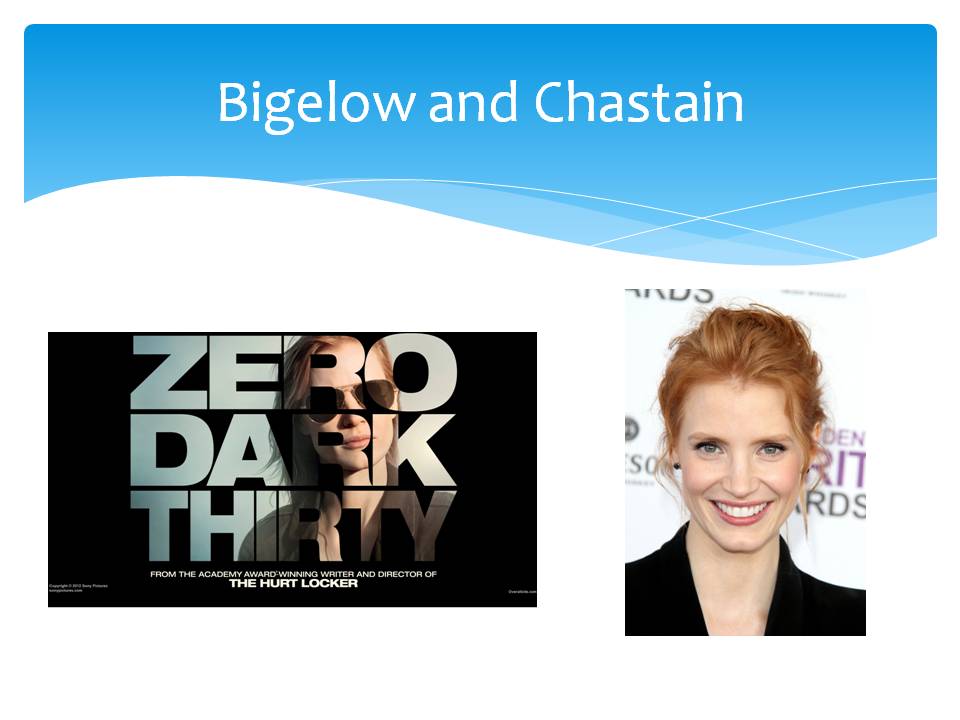
When Zero Dark Thirty (Kathryn Bigelow, USA, 2012) was released in 2012, the film was the subject of criticism as a result of its seeming pro-torture stance. To take two examples, both from The Guardian, Glenn Greenwald (2013) called the film ‘pernicious propaganda’, while Marxist philosopher Slavoj Žižek (2013) argued that the film ‘normalises torture’, suggesting that if another film tried to normalise rape in a concentration camp during the Holocaust, then it would be accused of moral indecency.

My task today is not expressly to agree or to disagree with these criticisms (though, should anyone care to know, I tend to agree with them – and will return to the issue of the ‘normalisation’ of on-screen torture and violence during this talk). Rather, what I would like to discuss today is how Zero Dark Thirty, as much as it is a ‘procedural’ looking into the way in which Osama bin Laden was hunted down and killed by the CIA and the US military, is also a study in, precisely, the dehumanization of one’s enemy, a kind of willed lack of empathy for other human beings, or what I shall provocatively term ‘war autism.’

This is achieved primarily through Jessica Chastain’s remarkable performance as Maya, the CIA agent who single-mindedly hunts down bin Laden in the film through her pursuit of Abu Ahmed, or Ibrahim Sayeed (played by Tushaar Mehra), who is believed to be the only connection between bin Laden and the outside world. But it is also achieved through director Kathryn Bigelow’s stylistic choices, in particular her use of editing and framing, as we shall see. Having analysed how Chastain’s performance in conjunction with Bigelow’s direction conveys a willed lack of empathy, or ‘war autism’, I shall briefly suggest that Bigelow’s film may indeed normalize torture, as well as the mental conditions that allow it (i.e. a lack of empathy), and that this in turn may well influence audiences and their attitudes towards violence.

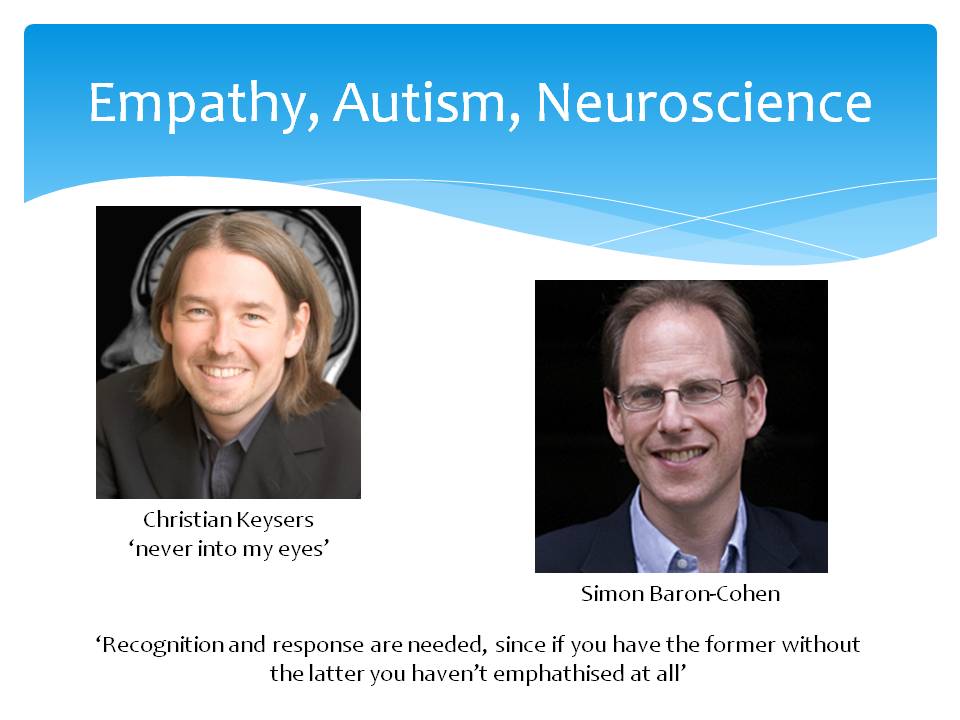
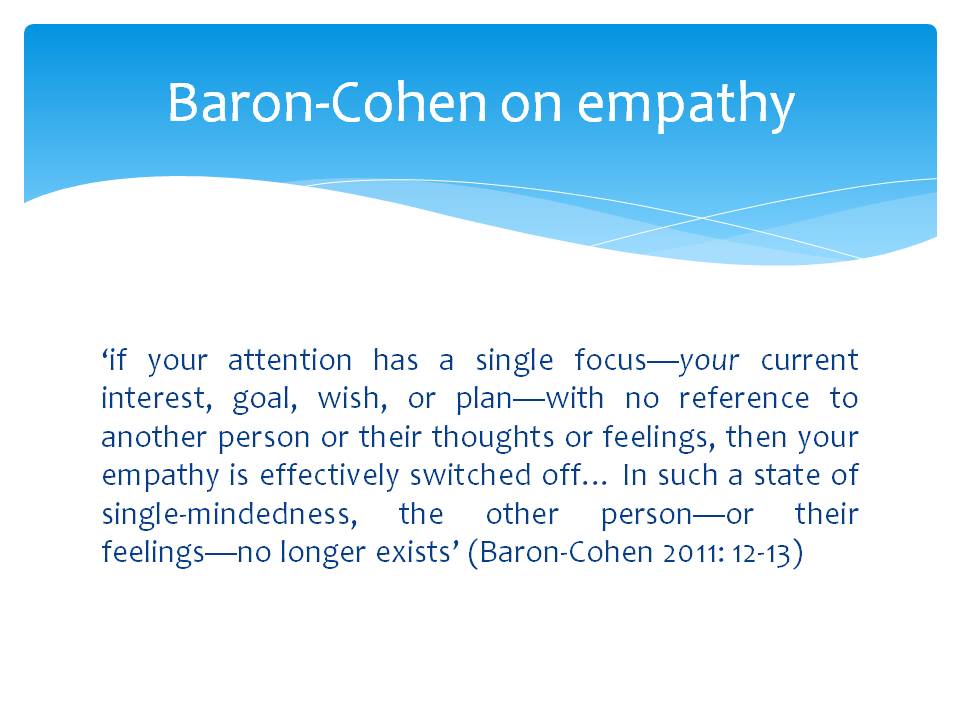
Dutch neuroscientist Christian Keysers, who was one of the key figures in the discovery of mirror neurons, describes his experience with an autistic gentleman, Jerome, as involving Jerome always looking around the room but—significantly—‘never into my eyes’ (Keysers 2011: 18). Meanwhile, Simon Baron-Cohen, Britain’s leading expert on autism, suggests that there are two stages to empathy: recognition and response. As Baron-Cohen says, ‘[b]oth are needed, since if you have the former without the latter you haven’t emphathised at all’ (Baron-Cohen 2011: 12). Recognition involves both identifying and responding to another person’s emotions, and Baron-Cohen suggests that one can recognize emotions by reading faces. However, he does suggest that ‘if your attention has a single focus—your current interest, goal, wish, or plan—with no reference to another person or their thoughts or feelings, then your empathy is effectively switched off… In such a state of single-mindedness, the other person—or their feelings—no longer exists’ (Baron-Cohen 2011: 12-13). Baron-Cohen then suggests that there are seven levels of empathy, from zero to six, with zero empathy being the lowest. People with zero empathy can be zero-negative, which involves borderline personality disorder, psychopathy and narcissism, while people with zero empathy can also be zero-positive, which Baron-Cohen associated with various forms of autism (especially Asperger’s syndrome; see Baron-Cohen 2011: 30-87).

On a similar note, film scholar Tarja Laine (2007) has studied the emotion of shame in relation to cinema, drawing upon Jean-Paul Sartre’s understanding of the emotion to suggest that shame is an excellent means of regulating human behavior, because it is a public, or intersubjective, emotion. That is, it is when one’s acts are recognized as being seen that one modifies one’s behavior, or acts in a more social/sociable fashion. Although relatively unexplored, it nonetheless seems intuitively logical to suggest that empathy is to a large extent intersubjective, or a two-way process, akin to shame: one does not just see in order to recognize an emotion, but one is also seen.

In other words, there seem to be several traits that are linked to a lack of empathy, which in turn is linked to various psychological disorders, including autism. These are an inability to look people in the eye—as well, notably, as being single-minded of purpose. Not looking someone in the eye logically would lead to an inability to recognize the emotional condition of others (because one does not look at them to recognize that emotional condition), which would also mean that one could not respond to those others and their emotional condition, which thus results in a lack of empathy, and therefore in a condition like autism.

Now, with regard to Zero Dark Thirty, it is not that Maya is an autistic character, or a character with a psychological disorder—although such characters do exist in films and television shows about the CIA, with Carrie Mathison (Claire Danes) in Showtime’s Homeland (Howard Gordon and Alex Gansa, USA, 2011-) being an interesting case in point (and one to which I shall return). However, I would suggest that Maya wills herself into a sort of temporarily autistic condition, which I shall term ‘war autism’, over the course of the film.

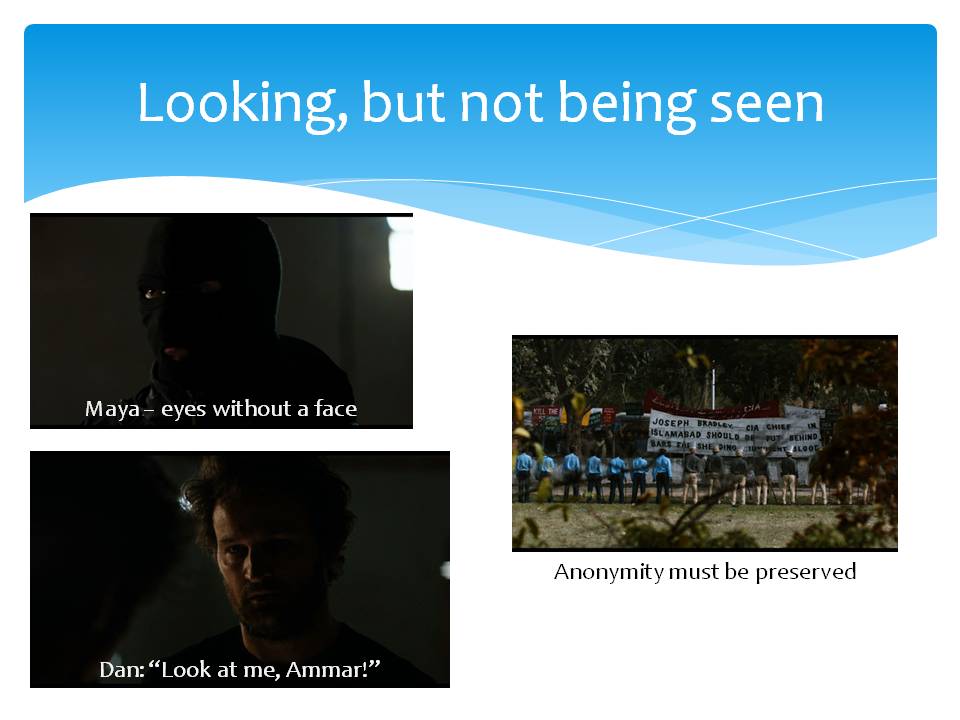
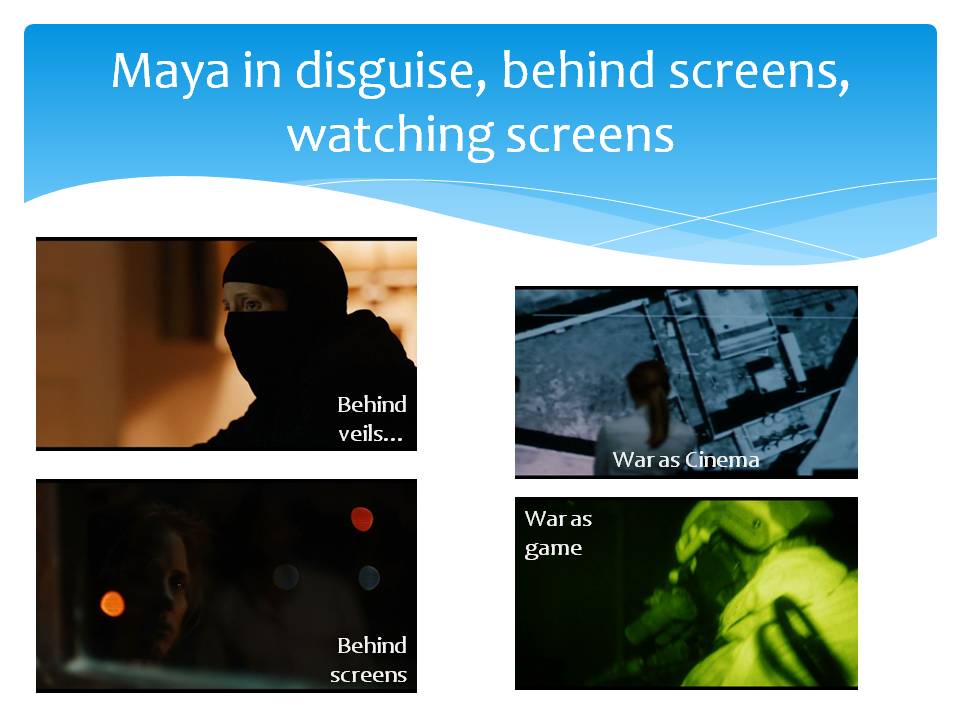
Zero Dark Thirty opens with a black screen and sounds from the attacks on the World Trade Centre and the Pentagon that took place on 11 September 2001. We then jump forward to two years later, at a ‘black site’, the whereabouts of which are unknown, or undisclosed. Dan (Jason Clarke) is interrogating Ammar (Reda Kateb), a Saudi connected to the World Trade Centre attacks, and also torturing him via the use of the infamous waterboarding technique, humiliating him by stripping him, enclosing him in a box, keeping him in soiled clothing, keeping him upright and his arms suspended for protracted periods of time and so on. Maya is initially observing Dan’s work wearing a balaclava. Dan says to Ammar early on in this sequence: “Look at me. If you don’t look at me, I hurt you.” In other words, the issue of looking and eye contact are quickly introduced into the film, but importantly the first we see of Maya is when she is, so to speak, eyes without a face.

That is, Maya observes, but she cannot be seen. And what is literally true of Maya is also figuratively true of Dan: Dan repeatedly tells Ammar that he ‘knows’ him—and reels off facts about Ammar’s life to prove it. Meanwhile the American agents function in anonymity; indeed, their anonymity is to be preserved at all times—and we see one agent, Joseph Bradley (Kyle Chandler), dismissed from his post as the CIA’s Chief of Staff at the American Embassy in Islamabad when his identity is uncovered.

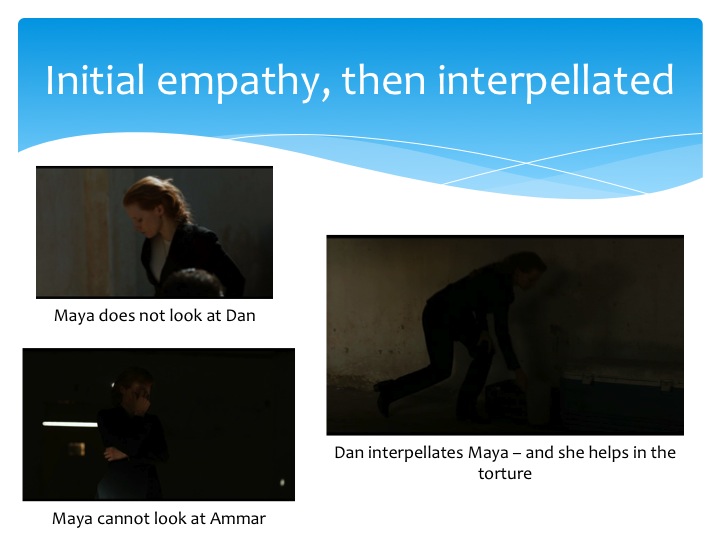
The anonymity of Maya and the other agents is important, because while they can demand that Ammar looks them in the eye (otherwise they will hurt him), he cannot really see their faces. We have here a sense of how intersubjectivity is a key component to empathy. That is, even though Ammar must look Dan and Maya in the eye (and thus feel ashamed that he has soiled his own clothes or is naked, because he knows that he is being seen), Dan and Maya can look at Ammar and know that they are not being seen—literally when wearing a balaclava, and figuratively when shrouded in anonymity. Nonetheless, Maya at first seems upset by Dan’s interrogation techniques, nervously observing from a distance. However, it is she who insists upon returning to Ammar and continuing the investigation, suggesting her first steps along the road to willfully refusing to empathise with those she is interrogating.

Her transition seems fast and is signaled by the moment Dan asks her to put some water in a jug so that the waterboarding of Ammar can continue; interpellated—that is, called into action—Maya becomes not just complicit by observation, but complicit by deed, in the torture of Ammar, and from this point on Maya’s descent into war autism is rapid.

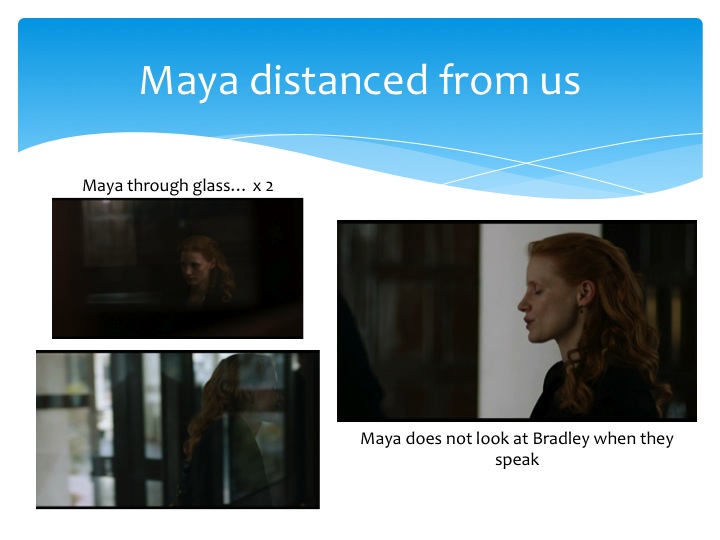
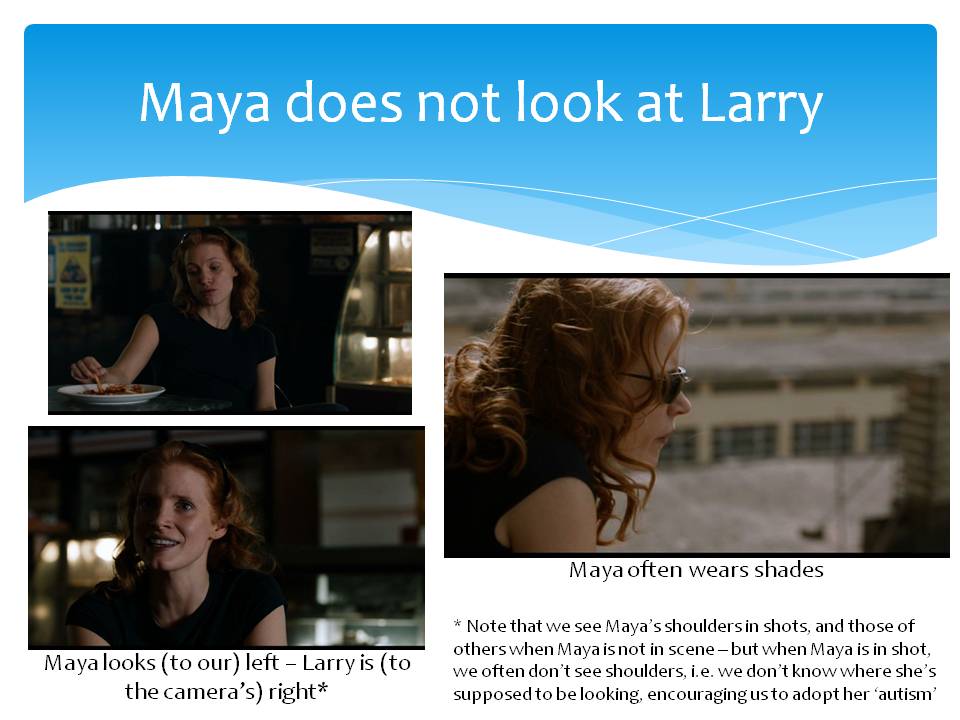
We then see Maya several times through screens—her face obscured in a window, through a glass at the American Embassy in Islamabad. When Maya first meets Joseph Bradley, she makes eye contact, half-smiles, and then her eyes dip down—a refusal of eye contact that will become a signature of Chastain’s performance (and which Bigelow will repeatedly insist, via her editing, on showing, typically in relative close up).

Maya gets to work in Islamabad, the film conveying to us that she watches numerous DVDs showing footage of interrogations and torture sequences. At the end of this sequence, Maya has noticed that many interrogatees mention a certain Abu Ahmed—and so she approaches Dan to ask to investigate this lead. Notably, Maya does not look at Dan until he has left the room during the scene of her request. Thereafter we see Maya in a wig talking to Abu Faraj (Yoav Levi), asking about Abu Ahmed.

Not only does the wig signal a procedural reality of CIA operatives, but it also suggests Maya’s transformation from potentially empathic human being to a willed sufferer of ‘war autism’.

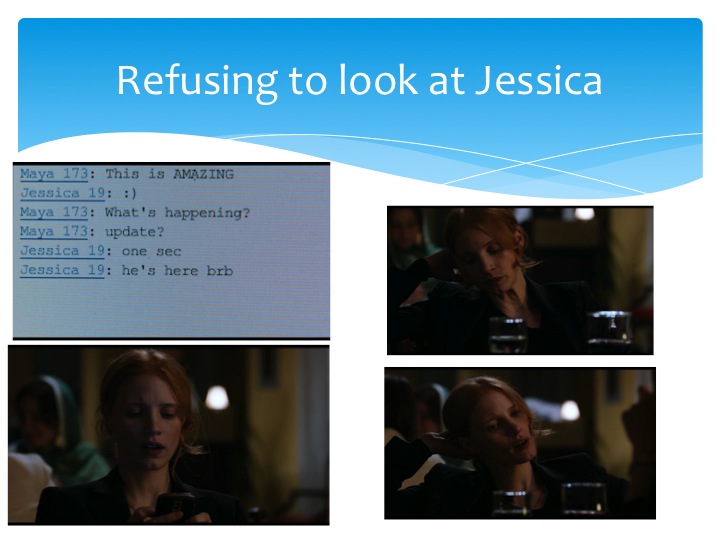
Significantly we only discover Dan’s name after 44 minutes of the film’s running time. Similarly, we only discover that Maya’s main female colleague in Islamabad is called Jessica 56 minutes into the film—just before she is killed by a bomb at Camp Chapman in Khost, Afghanistan. Furthermore, we only discover that Jessica is called Jessica because her name appears in type on a computer screen as she instant messages with Maya as she is about to interrogate a key lead; it is not because we hear her name spoken. In other words, Maya’s lack of empathy with the likes of Ammar is matched by the film’s decision to make her co-workers seem anonymous; it suggests a lack of empathy with/for even her own colleagues.

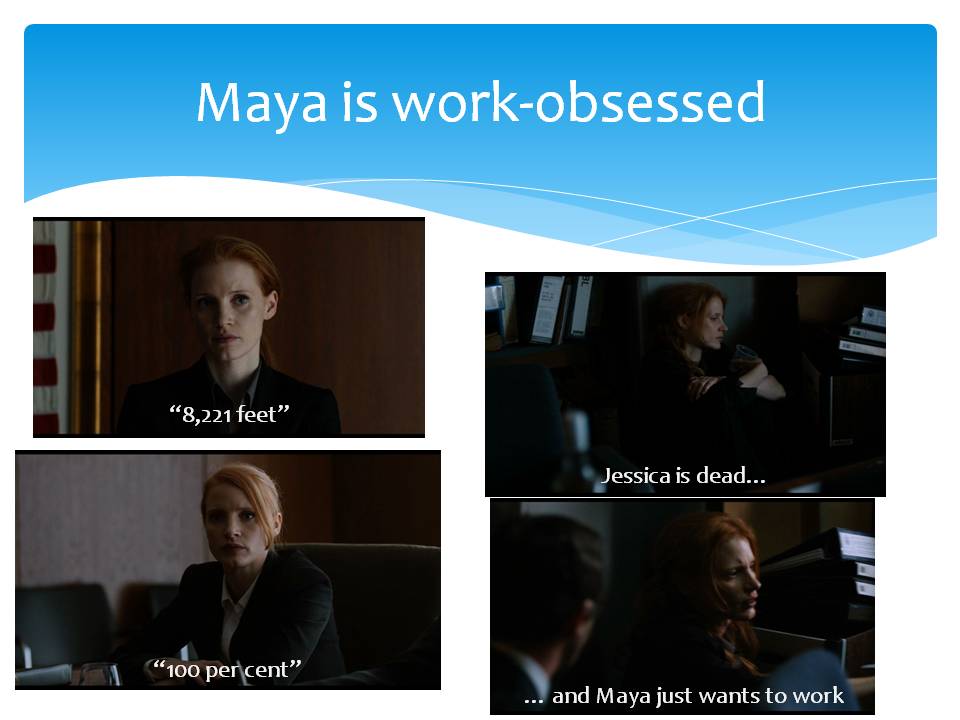
Maya works with a single-mindedness of purpose that we might well associate with a lack of empathy, as suggested by Baron-Cohen, such that even her colleagues have no names. Meanwhile, her refusal to look others in the eye—which Keysers sees as a sign of autism—becomes clear when Maya has dinner with Jessica in Islamabad, just prior to when we discover her name, and just before a bomb explodes at the city’s Marriott hotel where they are eating. As Jessica (Jennifer Ehle) is explaining to Maya that she must relax a bit more, Maya refuses to look at Jessica, suggesting that she can only think of work, and this comes at the expense of any human relations. Notably, the film is structured here in such a way that just as Maya might be thinking of relaxing and (re-?)becoming a bit more human, a bomb explodes to remind her that her task—God given in her eyes (“I believe I was spared so that I can finish the job”)—is all-consuming. In this way, Zero Dark Thirty is a study of how Maya wills herself into a kind of ‘war autism’.

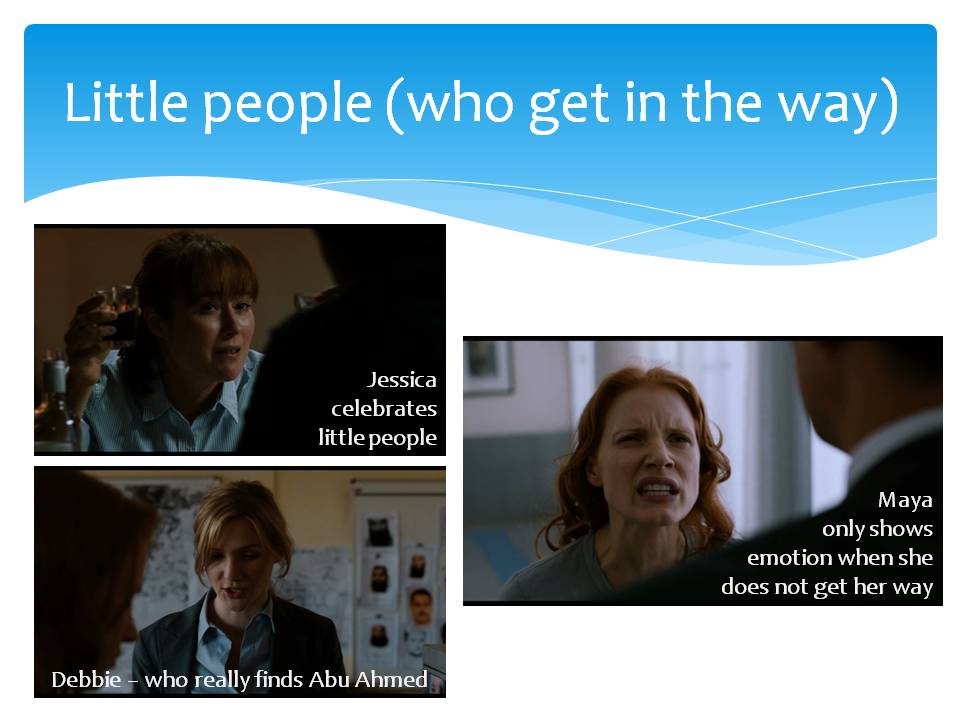
Just before she dies, Jessica says to a colleague “here’s to big breaks and the little people that make them happen.” After Jessica’s death, Maya is also told that her key lead, Abu Ahmed, is similarly dead (she does not look at the colleague who tells her this). Maya’s senior colleague, George (Mark Strong) berates his team for their lack of progress (Maya averts her eyes when he enters the room). And then Maya is handed a lead suggesting that Abu Ahmed is in fact alive—by her colleague Debbie (Jessica Collins). In effect, Debbie is the ‘little person’ who makes the whole bin Laden manhunt happen, but it is Maya who egotistically gets the credit. The only demonstrations of emotion that we see from her are when she shouts at Dan, and then George, in order to get her way.

We see her permanently at work, distancing herself from colleagues by wearing shades, and refusing to look at other members of staff, including Larry (Édgar Ramírez), with whom she works closely in Rawalpindi. When Maya gets a meeting with various CIA and National Security honchos, she blurts out in a somewhat autistic manner that the compound in which bin Laden is supposedly hiding is close to eight tenths of a mile (4,221 feet, to be exact) from Pakistan’s Military Academy in Abbottabad. She egotistically says that it is ‘for me’ that the United States Naval Special Warfare Development Group (or DEVGRU) soldiers will kill bin Laden. “It’s her against the world,” remarks George. In other words, Maya seems willfully to isolate herself from others, beginning to lack empathy for colleagues (to Larry: “I don’t care if your guys get any sleep or not”), and in particular to lack empathy for her enemies, as suggested by her complicity in torture.

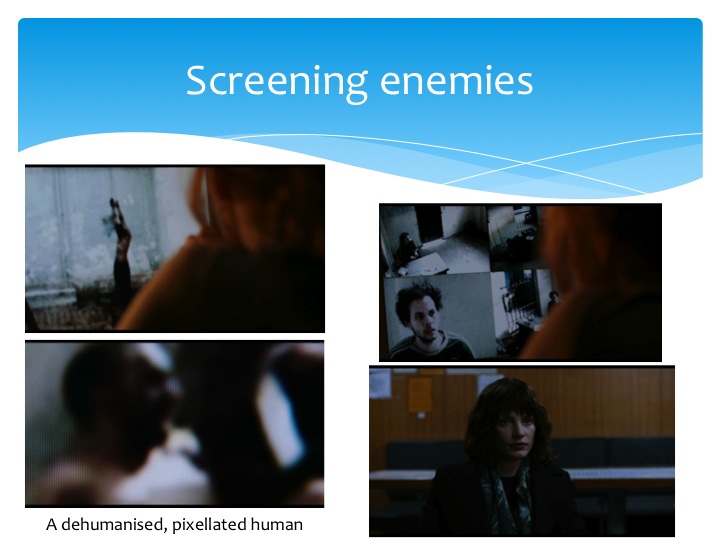
Disguises—in the form of wigs, veils, dark glasses, and even a full burqa in Islamabad—help Maya to perform this ‘autism’, which is reflected in the night vision goggles and uniforms that the DEVGRU troops wear during the film’s final operation. Seeing the world through a screen helps to distance them from the human aspect of war, mediation in Bigelow’s film consistently separating soldiers, including torturers, from their victims, be they innocent or otherwise. Maya stays on in her job for 12 years—much longer than Dan, who has to leave and pursue a desk job in Washington DC.

The persistent presence of the media no doubt has a role to play in Maya’s ‘war autism’; Christian Keysers argues that ‘each hour spent in front of the television is an hour less in front of a reacting human being’ (Keysers 2011: 173), the argument being that it is human interaction that helps prevent autism, rather than simple observation. A set of eyes without a face, then, Maya observes without empathy, often via screens, such that she is without empathy. Her only emotional display—apart from anger at her colleagues—comes at the film’s climax when a tear runs down her cheek as she flies home, to an unknown destination.

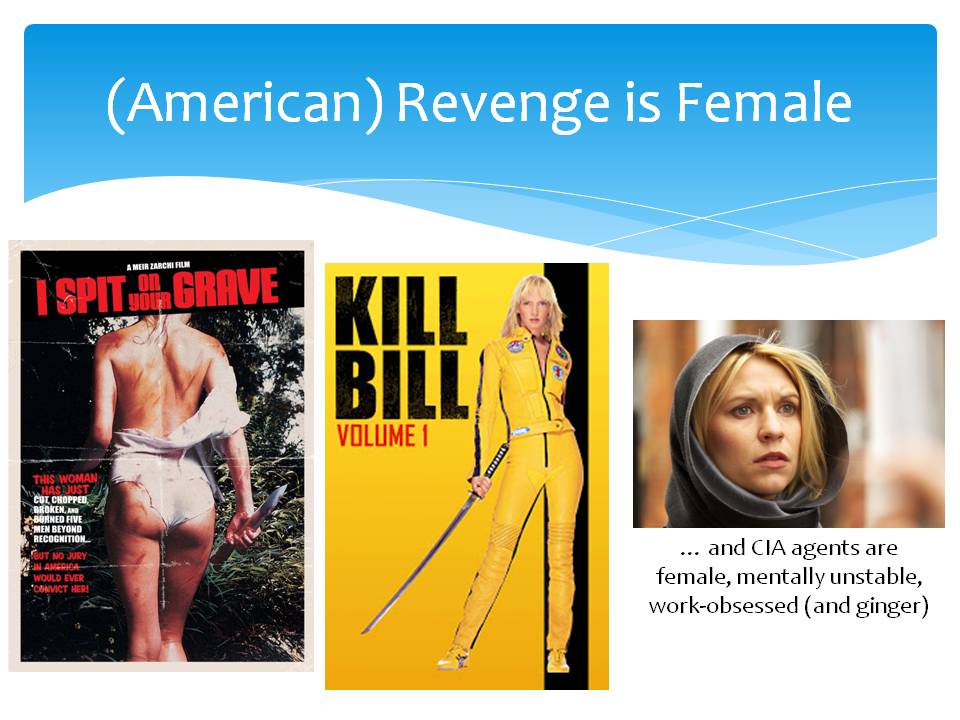
However, the question becomes: what effects might Zero Dark Thirty itself have a role to play in helping to develop empathy, given that it is a film that we watch via the medium of cinema, DVD, television, the computer screen or the internet? Maya says that she is 100 per cent certain that bin Laden is in the compound that she has found, before saying she is only 95 per cent certain, because total certainty “freaks you guys out.” In other words, we have here a gendered ‘craziness’. As Shohini Chaudhuri (2013) has pointed out, Hollywood has a propensity for making films in which revenge is exacted and enacted by a woman, from I Spit on Your Grave (a.k.a. Day of the Woman, Meir Zarchi, USA, 1978) to Kill Bill (Quentin Tarantino, USA, 2003-2004). As mentioned, it also has a propensity, as in shows like Homeland, to show dedicated American agents to be female, unstable (and, in the case of both Maya and Carrie from that show, ginger).

In other words, the film seems to want to naturalise the idea that revenge is a feminine trait, that the USA is a feminine body that has been attacked and metaphorically raped during the 11 September 2001 attacks, and that it is righteous in its pursuit of revenge. Maya’s single-mindedness also naturalizes the hard work ethos behind contemporary capitalism—suggesting that one will get nowhere without being as egotistical and as dedicated as Maya. Although Baron-Cohen suggests that women have more empathy than men (Baron-Cohen 2011: 19), here we see Maya willfully shed herself of empathy in order to achieve the ‘higher goal’ (seemingly God-given) of defeating bin Laden.

Whether Bigelow’s film simply observes or whether it actually endorses such ideas is open to debate. I could, for example, imagine a ‘haptic’ critique of the film, suggesting that it allows us to ‘feel’ more than it allows us simply to observe Maya’s ‘war autism’, such that, paradoxically, we have empathy with someone who denies themselves an empathic response to those around her. Nonetheless, the film does seem to naturalise ‘war autism’, as well as torture, not least because what we see is mediated—we are watching a film.

Kathryn Bigelow’s relatively fast cutting rate (the film has an average shot length of 3.4 seconds, according to the Cinemetrics website) places it firmly in the category of ‘intensified continuity’ that David Bordwell (2006) sees as characteristic of contemporary cinema: faster cutting, an always moving camera, more significant changes of focal length between shots, and so on.

I have argued elsewhere (Brown 2011) that such demands on our attention via fast cutting rates might distract us from closer analysis of the film; by making the film exciting via rapid cutting, even if it depicts deeds that we are not particularly happy to watch, such as torture, what is on screen is thus glamourized. And if what is glamourized is torture, then Slavoj Žižek’s dislike of the film is arguably justified. Nonetheless, Zero Dark Thirty is a fascinating study of what I am terming ‘war autism’. And it may serve as a piece of propaganda designed to endorse such a feminized, victim-like and single-minded approach to revenge. More worryingly, it seems to endorse torture (contrary to many statistics suggesting that torture is not a particularly useful method of extracting information; see Chaudhuri 2013 for a discussion thereof).

Perhaps the normalization of torture via films like Zero Dark Thirty as fast-paced entertainment needs to be countered by slower films that show the effects, both short-term and long-term, of torture not on the perpetrators, who themselves view torture via screens in a bid to become less empathic with those they are torturing, but on the victims.


On the eve of the London Film Festival 2013

Blogpost, Film education, Uncategorized

In many respects, I am certain that what I am about to write will be proven wrong over the next couple of weeks. The London Film Festival (LFF) is about to start, and I am going to write below that cinema is not just dead, but has been for a long time – from a certain point of view, at least. I hope that I shall at the LFF see at least a few films (I cannot afford to go to many) that are formally and thematically interesting. Indeed, on a certain level I have no reason to believe that human genius has come to a close and that humans do not continue to be innovative and ingenious in all fields of endeavour, including filmmaking. But I’d like to outline some concerns nonetheless.

I have a voice that does not carry very well. It is a common experience in restaurants, at shop and kiosk counters, and on the telephone for my interlocutor to say to me something along the lines of ‘I can’t hear you’ – typically in an irritated tone that immediately riles me and which often will lead to me saying something along the lines of ‘well don’t you think you should listen more carefully, then?’ I then often will raise my voice in an exaggerated fashion so that they definitely can hear me – i.e. I basically start shouting at them (or I start doing my version of shouting, which is probably just about audible for them).

Why this anecdote? Well, I am using it as a symptom of something else: namely the fact that the world is not so interested in the low voice, the whisper and the murmur – but really only in the shout, the bang, the loud noise. And having naturally a quiet voice, I find it saddening and infuriating that no one will listen.

Don’t get me wrong; I can perform ‘loud’ both professionally – I am a teacher/lecturer and it is necessary on a certain level to perform ‘loud’ – and socially – I can demand attention as others do, and likely in an equally annoying fashion, especially when inebriated. But forasmuch as I do desire and demand attention, especially when inebriated, I, like many others, also try not unnecessarily to be loud – except when circumstances suit or require it (e.g. during group inebriation).

(This blog is a performance of quiet, too, of course – so bear in mind the fractal of infinite regress that potentially we are entering: is this a ‘loud’ quiet or a ‘quiet’ loud?)

What is true of my personal experience – not only do people not listen to quiet voices, but in fact they find them annoying and are impatient with them (my interlocutors in various places in my daily life) – is perhaps also true of movies.

That is, people have little patience, it seems, with ‘quiet’ movies. With slow movies. With movies that are not immediately recognisable.

What does this have to do with the LFF?

Well, it is not uniquely to do with the way in which the LFF has a large number of gala events revolving around blockbusters (by which I mean large-scale productions, typically featuring well known stars). This is increasingly commonplace at film festivals and it does suggest the encroachment into art house territory of mainstream cinema. Festivals need to hold such events because they attract attention, which in turn attracts audiences, sponsors, and the interest of the media. Nonetheless, that festivals need to do this at all suggests the prevalence of ‘loud’ as the defining ethos of the LFF and other festivals, and ‘loud’ as the defining feature of contemporary society, driven as it is by the storm of hysteria propagated by the media.

Don’t get me wrong; the LFF will also feature many ‘quiet’ films – typically films about poor people from other places on the planet. But there is a sense in which the ‘quiet’ films that one sees are of a kind that has been sanctioned and/or ring-fenced in advance. That is, they are a ‘controlled quiet’ that, by virtue of being controlled, are not necessarily ‘quiet’ at all, since they are ‘quiet’ in the pay of ‘loud’ – or what we might in short term festival films. We might refine our dichotomous quiet/loud analogy here and say that these films belong to one of a small number of vocal pitches or tones that are deemed acceptable; there is not much scope, however, for differences. And while the term festival evokes loudness as probably a defining feature, nonetheless a festival should also be a celebration of difference. Sanctioned/ring-fenced difference is not really difference at all.

Talking with filmmaker colleagues of mine, a common rant against film festivals is the submission process. This is not simply an excuse for me to rant (again) about Withoutabox, the online film festival submission system owned by Amazon, and which sees hundreds of hopeful filmmakers sink large amounts of money into film festival submissions without telling them the honest truth: that maybe one or two per cent of films submitted via this system will make it into the festival in question; that the interns that watch the films submitted may watch two to three minutes of each film submitted, but by no means the whole; that the interns that watch the films may not watch their film at all, the festival instead taking the (substantial sum of) money paid for the submission and – so to speak – ‘running’.

Indeed, the rant against Withoutabox cannot on some levels apply to the LFF at all; they are one of few festivals that does not use Withoutabox (as far as I am aware), and if you are a British filmmaker, it is in fact free to submit your film for consideration. I have no idea who watches films submitted or for how long, but I take it on faith that everything is fair and equal. Although, oddly enough, it remains strange how pretty much all films at the festival have a clear ‘pre-sold’ element to them. That is, the festival is not just thinking about whether a film is good or bad, they’re thinking about how much of a ready-made audience that film already has, about how easy or hard it will be ‘sell’ that film to the general public.

I am going to return to the general public, since they/we are an important aspect in my hopelessness, my sense that cinema has long since been dead. But I would like right now to stick to an issue just raised in connection to Withoutabox. For, filmmakers know these days that they might have two or three minutes in which to convince a festival intern (or a festival director; I am happy to accept that some festival organisers watch every film submitted to them) to accept their movie, and so they commonly ‘frontload’ their film, in effect making it ‘loud’ so that the viewer will continue watching.

But surely wanting to continue watching is the definition of a good film, and why would one accept a film if one did *not* want to continue watching it?

This is on many levels a likely and a useful objection. It helps to raise a couple of points. Firstly, if indeed it is often (likely unpaid) interns who sort through the first rung of film submissions to a festival (and this would include the LFF, regardless of whether one pays to submit a film or not), then – no disrespect to those interns – their tastes most likely reflect their (probably young) age more than they represent the whole filmgoing community. Secondly, and in a related fashion, this means that only certain types of film will be accepted, namely ‘loud’ ones – with ‘loud’ here not being defined by explosions, but by familiar faces (stars), familiar scenarios, familiar locations and/or, in the case of ‘unfamiliar’ faces, scenarios and locations, ones that are ‘familiarly’ unfamiliar, by which I mean to say ‘recognisably exotic’. What is left out, then, are films that are truly different, ones that are, metaphorically speaking, too quiet to be heard. Ones that may be very quiet to begin with – films that are not ‘frontloaded’ – but which potentially could redound in the imagination for years to come, were they given the chance.

But they are not given the chance. Even though they are, like me at the kiosk/on the phone, the client (who we should know nowadays is always wrong, and if he should raise his voice when complaining, then he is obviously being abusive to the poor and not responsible staff member and could face a fine and/or imprisonment, even though bus drivers, to take one example familiar to me, are regularly abusive to their clients, as if now the service provider were the only person who was right), they are chastised for speaking too quietly, as if they were wasting the service provider’s time. And that is all that festivals are – service providers. And makers of different films, like me at the kiosk, are made to feel inferior, incapable, unacceptable as a result of the way in which the service provider/festival is unresponsive to them and/or the way in which the service provider will take their money, but will also make clear that they are really/somehow wasting that service provider’s time.

I sometimes wonder that filmmakers wasting their money on festival submissions would be better advised taking their £50ish submission fee and contacting a school or university that is somewhere within their reach, and using that money to travel to that school or university to present their work to that school or university’s film society (or a film club out in the country, in a small town, in a suburb, in an area of a large city – wherever). This way they might play their film to 10, 20, 30 or 40 people at a time, rather than to a lone festival intern who won’t watch the whole thing.

But this then needs to address the fact that many university film societies themselves just play mainstream fodder in order to attract viewers/people. That is, if I am Jane Filmmaker and I contact a university to show my film, they likely will just ignore me as the festivals do.

To restore some structure to what otherwise might seem to be becoming a rant: the frontloading filmmaker, the festival filmmaker, the mainstream filmmaker, the film festival organiser, the film society organiser, the film festival goer who is not dissatisfied with the service provider – all are guilty of the same logic. And that logic is the cult of the silver screen. It is the belief that you are nobody unless you are cinematic. And this is where the general public must be brought into this blog.

For, so in the grip of cinema are we as a (global) society that many, many (most? all?) people are prepared to go to enormous lengths, perhaps to any lengths, in order to ‘make it’, in order to ‘get into the industry’, in order to become ‘somebody’ by being on or by being connected to the silver screen. This is the cult of celebrity – and it extends beyond cinema itself, though I use cinema as a keyword because cinema is still largely considered the ‘top of the pile’ – even though television and internet celebrity might involve a significantly greater number of viewers.

Everyone is complicit in this system of cinematic logic such that those who are making films to say something unique and different rather than in the interests of pleasing others, those who are making ‘quiet’ films, are inaudible to others. Not only are they inaudible, but people do not want to hear them – not even a student film society that is ludicrously worried that both that no one will turn up to their *free* event, but also that if the audience does not *like* what they show at that free event that somehow this will reflect poorly on them; likewise film festival organisers both put themselves forward as arbiters of taste while also running scared that people won’t like their tastes – as if disappointment were not the most common reaction to most mainstream films, as if people were not actually happy enough with disappointment that the experimental reaching out for new thought that is filmgoing could not sustain greater levels of experimentation with regard to making and programming. And yet, given that films are made by people, not to value original, different, ‘quiet’ films is akin to saying that they do not value the people making those films. Potentially it is against the concept of value that we should take issue; nonetheless, even within a system of value, it is problematic to deem some humans as without value, while others have value because they are ‘loud’ (that is, because they not only conform to, but also set the terms concerning what constitutes value – i.e. they validate themselves and others are complicit in going along with them, in believing their self-validation to be ‘true’ or ‘real’).

But just because people believe the loudest to be the best and thus the quietist the worst, this does not mean that it is so. Everyone has had experiences in which they have a quiet moment to think for themselves. These are not solipsistic moments; most often what happens during these quiet moments is the person thinking or reflecting eventually lets the world consciously into their experience and they get to think about how amazing is a tree, a car, air, the sky, the universe and existence more generally. As humans, we value these moments.

Nonetheless, as humans we are seemingly also bent on destroying these moments and on destroying the possibility for these moments. For, the sheer loudness of the world makes it impossible for us to think. We are bombarded by loud sights and sounds day in day out, and if they do not come from our surroundings (i.e. if we live in the remote countryside), these sights and sounds will nonetheless come crashing into our world via our media (a generation of people who grew up in the countryside and who cannot stand the thought of going back there). In effect, we are killing our capacity to think; we are rewiring our brains such that we would rather put on our iPod headphones and blast musical shit into our brains than listen to what is actually going on around us. Quiet moments of reflection are not solipsistic; the acceptance of a loud world and the putting up around us of a loud wall such that quiet has no place – that is the road to solipsism, and it is the road that humans walk down in growing numbers, traipsing stupidly after the belief that they will become cinematic, that they will ‘make it’, that they will ‘get in’ – with no concern for what is actually around them, for the life that they are leading now.

I like and watch a lot of mainstream films. They are not uniquely bad for you. But they cannot be the only thing. On the eve of the London Film Festival, I take time to reflect on this and related matters – and while I hope to proven wrong, I am concerned that the LFF is more complicit in the culture of loud, in the cult of cinema and of celebrity, than it is in the world of quiet, the world of difference.

If the media, with cinema as their figurehead, are responsible literally for rewiring our brains – for brainwashing us – then this is something that we should take very seriously, indeed. But the battle is not one that can take place outside of cinema – encouraging people simply not to watch films. It is one that is taking place in and on cinema screens. Note how a large number of recent blockbuster movies have involved the use of ‘arty’ directors – from Tim Burton to Sam Raimi, from Ang Lee to Kenneth Branagh. Why the rise of the ‘blockbuster auteur‘? It is because the art house poses a threat to the mainstream; too much quiet, too much quiet time, too much thinking for and – Heaven forbid – expressing of oneself is too much of a threat to a system that requires people to accept their fate by stupidly chasing the carrot on the stick that is cinematic and celebrity culture. And so the way to negate that threat is to get art house directors to become complicit with the mainstream, by making mainstream films.

The rise of the ‘blockbuster auteur‘, then, is an aggressive, combative manoeuvre to negate the art house. To drive the quiet films from art house cinemas and into the fewer screenings that are film festival screenings. And then to drive them from film festival screenings and on to television. And then to drive them from television and on to the internet. And then to drive them from the internet and into oblivion.

This is a war that is raging – the war for our hearts and minds, the war to have a heart and a mind of your own, or to have a heart whose desires and a mind whose thoughts are dictated by the commercial imperatives of cinema and its fellow media. The London Film Festival is a minor battleground in that war, which is ubiquitous and ongoing. Like all wars, what is happening is confusing and confused; people think they are fighting on one side, but in fact are unleashing friendly fire on their fellows. The ideal would be to put down the weapons entirely. But as long as this does not happen, we can only participate in how things unfold. I hope that I am about to see some quiet and different films that help me to think; I am worried that the ones that I see will simply be POWs paraded by a festival that really is wearing the uniform of the loud. Perhaps cinema – a cinema of difference – has long since been dead; it went with a whimper, but no one heard it because they were distracted by the ongoing series of loud bangs.

The Life of an Academic Essay

Blogpost, Film education, Uncategorized

I am delighted to announce that Projections: The Journal for Movies and Mind has just published my essay, ‘Violence in Extreme Cinema and the Ethics of Spectatorship‘.

This blog will reproduce the first version of that essay, which I wrote originally in 2006, although I have on my computer only a version saved on New Year’s Eve 2007. That is, it has taken roughly six years for the essay to be published.

My point is not to demonstrate how ‘slow’ academic publishing can be. Nor is it quite to say that this version is better than the published version. Much has changed in the interim – and the published version demonstrates more scholarship, a greater amount of thought, and probably a greater maturity in thought – such that, even if I had to excise from it various ideas that might have deepened the take on the ethics of spectatorship that the finally published essay presents, it is still nonetheless the best version of the essay available.

What I want to highlight, though, is how academic publishing can often involve the removal of various ideas because they are a bit more speculative or, specifically, because they involve word play and punning.

There are two ideas from the original essay that are not in the final essay, but both of which I like and so in order to get them across, I reproduce that original essay in full (complete with rows of ‘xxxx’ to indicate where I had forgotten something from the film and wanted to check it – I have not updated this error here).

Here it is:

Monsters Incorporated

In an essay on Dusan Makavejev and Ingmar Bergman, the philosopher Stanley Cavell evokes the notion of revulsion in connection to the cinema. Certain images, Cavell says, are revolting, but the revolting, the disgusting and revoltedness are linked to innocence, for (provided I have not misunderstood him) the fact that we feel revulsion proves that we are free of the poison that the non-innocent can stomach without gagging.

I thought about moments in films that I have found disgusting. Divine eating dogshit at the end of John Waters’ Pink Flamingos came to mind; the initial rape scene in Baise-Moi; the death by fire extinguisher in Irréversible; and, most recently, the sexual violence at the end of Thomas Clay’s The Great Ecstasy of Robert Carmichael. There is an array of reasons for finding these scenes disturbing, although foremost among them is my shock at the actors’ bravery and ability to perform these tasks. Divine actually ate the dogshit. The rapists in Baise-Moi actually were aroused and penetrated the actresses before them. But, I asked myself, did I feel revulsion when witnessing these moments? If, truly, I felt revulsion, then I would, as the word implies, have turned away. But I did not.

Is it the case, therefore, that I am not innocent, for I can stomach what these films show me? Not only can I stomach it, but I go looking for it. I have no fear of ‘extreme’ films (although I am not in a hurry to see any of the above films again); I am curious to watch all manner of the Mondo films that exist, the disturbing contents of which are not staged but real and accidentally or deliberately caught on film. I don’t always like what I see, but I do not flinch. I am not revolted. I am glued to the screen. If I am appalled by anything, it is by my very lack of appal at the images I see.

There is an important distinction to make here. Morally, I may find these images repugnant. I was, for example, greatly chastened by Robert Carmichael, and I am perturbed to think that some people watch Baise-Moi as porn. But regardless of what my conscious mind thinks, my body gazes on, my eyes exercising supreme authority over my brain, whose lack of power is perhaps what scares me most. My eyes may have seen many grim things, but the fact of their looking, ‘despite’ ‘myself’, has also shown me other truths that make me believe myself a bit cleverer.

Cavell says that the performance of ugly and indecent acts is in part a rejection of a disgusting world and, again, if I understand him correctly, that to accept the world in all of its hideousness is a sign of adulthood, of the end of innocence. By accepting these films in their entirety (rather than only partially watching them by turning away during the grim parts), I give consent to them to exist as they are. I am in this sense an ‘adult’ spectator who accepts these films ‘as they are’, even if they are not strictly to my taste. We do, however, but true to form, reach a paradox: if, say, Robert Carmichael is a rejection of the world as it is (and this would seem to suit the continual references to contemporary geopolitics in the film), then it is young and innocent, but it is a young and innocent film that will only be viewed and accepted by those that it is seeking to reject – namely, adults who accept this real world. Those who leave the cinema when watching Robert Carmichael are the film’s fellow innocents who, through their revulsion, reveal themselves as kindred spirits, albeit ones who express this fellowship by putting distance between themselves and the screen, young Adams who turn away from the forbidden fruit whilst we Eves gobble it right down.

By eating this fruit, we attain Enlightenment (with all of its Luciferean undertones), and with wisdom comes independence. The troubling ultra-violence of art porn might well be nourishing for us, even if it also involves the sad understanding that, whether God exists or not, we do not need Him (and He does not want us). (By accepting the world, or Gaia?, we reject God. We become Eves, we get Even, we exit the order of men.)

But if becoming a woman (thank you, Gilles and Félix) is to embrace nature in all of its ugliness, then there might be a further worry, and one that Cavell, in his seemingly boundless wisdom, also identifies: if we are not men, are we still humans? Or are we monsters? Are we acting according to our nature, according to Nature, or have we mutated into something we cannot recognise? Quoting Thoreau, Cavell implies somehow that the monstrous, in particular death, is proof of a surabundance of life, before Stanley caveats that if the monstrous be natural, nature has still spawned some unpretty horrible monsters, like the Marquis de Sade… I suppose the clincher is this: is it pre-human to be an innocent child, or is it post-human to accept reality in an adult fashion, that is to say, unadulterated?

I don’t know the answer to this question, and I’m not sure that anyone can know it, except perhaps by widening our definition of humanity and saying that both are, impossibly, human. That humanity is defined by the non-humanity (and inhumanity) not only without, but also within (inhumanity is in humanity, except normally we like to put a space between it and us). Regardless of these thoughts, however, the idea that we could be monsters is interesting, in particular on account of the performative etymology of monstrosity. To be a monster is, naturally, to put on a show (to de-monstr-ate, to enact a demonstration not against the world but as part of it).

In the enhancedly explicit sex and violence of the art porn film that the above examples, and many others, typify, we see the emergence (at a time of emergency, no doubt) of a monstrous cinema that is hell bent on showing to us everything that there is to be seen, no matter how monstrous it is. Being a monstrous cinema, it is seemingly an inhuman and inhumane cinema, a worldly, mundane cinema that demeans the mental (‘rational’) endeavours of humans, instead foregrounding us as bodies, as mere meat (as Vivian Sobchack might put it), as flesh to be eaten by an anthropophagous camera, and, significantly more significantly, by insatiably hungry cinemagoers.

Perhaps it is no coincidence that obesity rates and the consumption of audiovisual media have risen side by side over the past century. No wonder, too, that the disappearance of the kindness that we thought was inherent in humankind can be found distastefully demonstrated in a film that combines the natural monster of the Marquis de Sade and our willingness, literally, to consume shit. I am, of course, referring to Pasolini’s Salò, which qualifies itself as an innocent art porn film that rejects a fucked up world and which seeks not to be consumed. That I managed to mangiare Salò perhaps means that the film fails in its honourable quest to question the terrible nature of the world (terrifically, the French know that the earth [la terre] is inherently terrible): I ate and digested Salò, when it was asking for its viewers to gag and rush from the auditorium, hand over mouth in search of the Royal Doulton. But if I were to allow vanity to speak (i.e. if I were to be honest), I’d say that I ‘got’ Salò and therefore could eat it, whilst those who have left the cinema instead of watching it are the naïfs that could do with getting down and dirty and seeing how the real world works.

I also dare to say that it is no coincidence that the title character wanks whilst reading a dog-eared copy of de Sade’s book some halfway through The Great Ecstasy of Robert Carmichael, a film ‘meal’ that I found very difficult to digest, but the benefits of which I am beginning to understand, and which entitle it, in my mind, to the status of ‘an important film’. For whilst the film is indeed a savage attack on the alienating nature of human society (whereas the moments of peace in the film come when the characters are not in human-constructed matrices but in Nature herself), it is, I think, an important attack on the masculine nature of that society.

This attack goes something like this: man thinks that woman is an unfathomable monster who fuels and is the object of his violent tendencies, whilst the truth is that man is himself the monster and not because of women elsewhere, but because the monster is in the (in)(hu)man already. The film’s puckeringly bitter final quotation from XXXX (“xxxx”) might seem to endeavour to render the movie a profound statement. But it is the quotation’s banality that is most revealing: for all of mancruel’s desire for profundity, it is on the surface that all truth is written. The truth is, tautologically, that there is no truth. Humans want for there to be some meaning to humanity; we construct entire societies and systems of politics in order to create this meaning. And with these noble endeavours there can and must always be a concomitant inhumanity. It is not that the creation of meaning is pointless or not worthwhile; simply that the making of meaning is also its unmaking; every birth necessitates a death.

Robert Carmichael, for me, critiques the shortsightedness of those who project blame on to women, when the log is in our own eyes. We might feel tempted to bite on the line that suggests that society creates Robert Carmichaels, and, as observations go, there is some truth in this. As Robert and his psycho (sicko?) pals walk through the Garden of England in the film’s final shot, however, we see that Robert is part of nature. Robert simply exists.

Interestingly, in the film’s final shot, Robert Carmichael is walking away, his back to us, enacting precisely the motion that we should have done were we truly revolted by this would-be revolutionary. But instead, we are still in our seats watching, and this alone reveals the lie, through the wonderful paradox of an externally projected film, that Robert Carmichael is not a monster out there, in a disgusting world that we do not want to accept, but that Robert is already in here, in us. Our eyes may see what Robert does – and they may be appalled by it; but also, monstrously, our eyes show through the very act of looking that the monster is within, that we are both male and female at the same time, and that adulthood consists of accepting this wholeheartedly.

Ends

Now, in many respects the 2013 essay represents many of the same ideas as the 2006/2007 essay – but in different form, and certainly with more refinement. In particular, I have since crystalised more clearly (mainly as a result of shortcoming I found in a paper by Noël Carroll on how movies teach us morality) the idea that films do not teach us how to act necessarily, but that they show us how we ourselves could be these people that we see, and that as a result of this, we can come to lead not a moral life (following behavioural guidelines by rote), but an ethical life (we decide for ourselves what we do; we take responsibility for our actions, even if where ‘we’ begin and end is not wholly clear-cut).

But, as mentioned, two ideas disappear from the published essay that are in the primitive version of the essay. These are: the notion that that which is ‘inhuman’ is always already in humans (the space that separates the words ‘in humans’ signifies how we deny the fact that inhumanity is in[ ]humanity); and the idea of getting Even, a kind of female revenge that involves becoming woman, becoming Eves rather than Adams.

Both are puns – and as such there is little room for them in academic essays. They might offer up a thought, but they present nothing conclusive. So I understand why the editors asked me get rid of them, and I comply – so I see that the essay is probably improved as a result.

But this does signal a wider issue, which is that academic essays tend increasingly less to feature what I might call creative or experimental aspects – with puns here being creative and experimental, in that they take pre-existing words and concepts (inhumanity; Even) and tease out of them new meanings (regarding the space that separates in from humanity when inhumanity is written as in humanity; regarding how getting Even might be related to Eve).

I had an email exchange with the editor of this issue of Projections, saying that I was aspiring to write in something like a Cavellian style when I first wrote the essay. They said they don’t much care for Cavell, and could I adopt a drier tone. Fair enough – that’s in some respects fine by me. But it also defeats in small part what I would like for an essay to be: that is, something that precisely asks us to re-think words and meanings, to take us in the direction of new thoughts.

Now, don’t get me wrong: most, many, some essays do contain the seeds of new thoughts. But not often in the experimental style that I was trying to use in that first/second draft from 2006/2007. And for me something really is lost.

I have been asked numerous times in my (brief) experience in academic writing to remove puns and what I consider to be mind-stretching ideas (puns as mind-stretching, the measure being my own mind that is stretched). I can loosely understand why: most readers are not reading for puns and might be irritated by the primitive nature of my thoughts. More often, the feedback simply says that the reader does not follow what I am saying/doing.

I cannot claim to be a great wordsmith, but I have my heroes and I aspire to their methods. And so it is always sad when little ideas like this have to go.

In short, I wonder that there might be more experimental writing – but academic publishing is not the place for it. Like I say, I can understand this. But it is always with sadness that a little idea must fall by the wayside.

So in the six years that it can take for an essay to go from germ to publication, it may well grow up and become something more rounded. But it also loses something a bit more fun in the process. I always find this a bit sad – where can these ideas find a home?

Why, in the blogosphere, of course!

A Festival of Guerrilla Filmmaking

Blogpost, Film education

I run a module at my university called Guerrilla Filmmaking. It is a final year module, in which students are asked to make a series of films (a minimum of three, a maximum of five – they submit a portfolio of three at the end).

The rationale behind the module is to encourage students to make films at short notice – to prepare them for the short deadlines that they might face in later life, and to get them to think creatively about how to get around obstacles in their path.

Furthermore, the module is designed to get them to think about how to make films in spite of logistical and technical constraints.

Indeed, the module actively engages with technical constraints. Taking as our starting point Jørgen Leth and Lars von Trier’s Five Obstructions (Denmark/Switzerland/Belgium/France, 2003), and being inspired by Fernando Birri’s assignment to film students in Argentina to make a film without a film camera, the students have to make films that respond to the following challenges:

1.     Make a film that does not feature moving images and which responds to the question: what is the meaning of Europe?

2.     Make a film that does not feature any synchronisation between image and sound, which does not feature any music, and which documents an issue of concern local to you.

3.     Make an experimental, animated or found footage film that deals with recent political events, be those global or local.

4.     Make a film about a human rights issue using only a mobile phone and/or other telecommunications technology (i.e. do not use a dedicated camera).

5.     Make a silent film that consists only of one take, and which is about multiculturalism.

The fourth is intended to coincide with the Roehampton Human Rights Film Festival, to which students are encouraged to submit a film (and at which Guerrilla Filmmakers won all of the prizes this year – as they did last year, too).

Students can play a bit fast and loose with these challenges – and they do, as will be seen below.

Beyond The Five Obstructions, the module also involves watching a series of films that correspond in different ways to what guerrilla filmmaking is or might be.

The ‘guerrilla’ aspects of the films that we watch can be thematic or technical. In short, the films we watch and the texts that we read correspond to what we might term ‘minor’ cinema in various different ways. And they hopefully challenge any traditional hierarchy (particularly technical/technological hierarchies) concerning what constitutes a good or bad film. And of course to watch films from all over the globe.

Here is a list of the films we watch and the key readings that I ask students to look at (although I am not sure that many of the students do the reading):

Week 1 “Thou shalt be ready to do this module”

Screening: The Five Obstructions (Jørgen Leth/Lars von Trier, Denmark et al, 2003)

Key Reading: Mette Hjort, ‘Dogme 95: The Globalization of Denmark’s Response to Hollywood,’ Small Nation, Global Cinema: The New Danish Cinema, Minneapolis: University of Minnesota Press, 2005, pp. 34-65. 

Week 2 “Thou shalt embrace thy limitations”

Screening: Año Uña/Year of the Nail (Jonás Cuarón, Mexico, 2007)

Key Reading: Fernando Birri, ‘Cinema and Underdevelopment,’ in Michael Martin (ed.), New Latin American Cinema, Detroit: Wayne State University Press, 1997, pp. 86-94.

Julio García Espinosa, ‘Toward an Imperfect Cinema,’ Jump Cut, 20 (1979), pp. 24-26. http://www.ejumpcut.org/archive/onlinessays/JC20folder/ImperfectCinema.html.

Glauber Rocha, ‘An Esthetic of Hunger’ (trans. Randal Johnson and Burnes Hollyman), in Michael Martin (ed.), New Latin American Cinema, Detroit: Wayne State University Press, 1997, pp. 59-61.

Week 3 “Thou shalt make a virtue of poverty”

Screening: En Attendant Godard (William Brown, UK, 2009)

Key Reading: Mike Figgis, ‘Choosing Your Weapon, Learning to Love It,’ Digital Filmmaking, London: faber and faber, 2007, pp. 5-14.

Week 4 “Thou shalt keep it simple”

Screening: Lao ma ti hua/Disturbing the Peace (Ai Weiwei, China, 2009) [You can watch the whole film here.]

Key Reading: Valerie Jaffee, ‘Bringing the World to the Nation: Jia Zhangke and the Legitimation of Chinese Underground Film,’ Senses of Cinema, 32. http://www.sensesofcinema.com/2004/feature-articles/chinese_underground_film/.

Jia Zhangke, ‘The Age of Amateur Cinema Will Return’ (trans. Yuqian Yan), http://dgeneratefilms.com/academia/jia-zhangke-the-age-of-amateur-cinema-will-return/.

Wu Wenguang, ‘DV: Individual Filmmaking,’ Cinema Journal, 46:1 (2006), pp. 136-140.

Week 5“Thou shalt not flee but walk towards reality”

Screening: Kid Icarus (Carl Bird McLaughlin and Mike Ott, USA, 2008) [You can watch the whole film here.]

Key Reading: Ana Kronschnabl, ‘Plugin Manifesto,’ 2004. Available online at: http://manifestoindex.blogspot.com/2011/04/plugin-manifesto-by-ana-kronschnabl-web.html.

Rosa Menkman, ‘Glitch Studies Manifesto,’ 2010. http://rosa-menkman.blogspot.com/2010/02/glitch-studies-manifesto.html.

Neocinema, ‘Dogma 2001: New Rules for Internet Cinema,’ 2001. http://www.neocinema.com/.

Week 6 “Thou shalt find ingenious methods of production”

Screenings: Decasia (Bill Morrison, USA, 2002) and Superstar: The Karen Carpenter Story (Todd Haynes, USA, 1988)

Key Reading: Henry Jenkins, ‘Quentin Tarantino’s Star Wars? Grassroots Creativity Meets the Media Industry,’ Convergence Culture: Where Old and New Media Collide, New York: New York University Press, 2006, pp. 131-168.

Week 7 “Thou shalt have a week off” 

Week 8 “Thou shalt embrace that which is considered minor”

Screening:Go Fish (Rose Troche, USA, 1994)

Key Reading: Gilles Deleuze, Cinema 2: The Time-Image (trans. Hugh Tomlinson and Robert Galeta), London: Continuum 2005, pp. 207-215.

Patricia White, ‘Lesbian minor cinema,’ Screen, 49:4 (2008), pp. 410-425.

Week 9“Thou shalt dare to make unconventional films”

Screening: Afterimages (William Brown, UK, 2010)

Key Reading: Jacques Rancière, The Politics of Aesthetics: The Distribution of the Sensible (trans. Gabriel Rockhill), London: Continuum.

Week 10“Thou shalt learn to develop and work in a team”

Screening: Ang pagdadalaga ni Maximo Oliveros/The Blossoming of Maximo Oliveros (Auraeus Solito, Philippines, 2005)

Key Reading: Khoo Gaik Cheng, ‘Just-Do-It-(Yourself): independent filmmaking in Malaysia,’ Inter-Asia Cultural Studies, 8:2 (June 2007), pp. 227-247.

Alexis Tioseco, ‘Shifting Agendas: the Decay of the Mainstream and the Rise of the Independents in the Context of Philippine Cinema,’ Inter-Asia Cultural Studies, 8:2 (June 2007), pp. 298-303.

Week 11“Thou shalt meet the deadline”

Screenings: SMS Sugarman (Aryan Kaganof, South Africa, 2008) [you can watch the film here] and Trash Humpers (Harmony Korine, USA/UK/France, 2009)

Key Reading: Ryan Shand, ‘Theorizing Amateur Cinema: Limitatons and Possibilities,’ The Moving Image, 8:2 (Fall 2008), pp. 37-60.

Week 12 “Thou shalt think about and reflect upon thy work”

Screening: In film nist/This is Not a Film (Jafar Panahi and Mojatba Mirtahmasb, Iran, 2011)

Key Reading: Godfrey Cheshire, ‘Iran’s Cinematic Spring,’ Dissent, 59:2 (2012), pp. 76-80.

Shiva Rahbaran, ‘An Interview with Jafar Panahi,’ Wasafiri, 27:3 (2012), pp. 5-11.

So, overall, the rationale is also to get my students to un-learn what they believe ‘good’ filmmaking to be, and to realise that most constraints can also be considered opportunities for creative expression. It is also to get them to engage with the politics of filmmaking – and to try to understand how the methods used to make a film inform what the film can say and how it says it.

Some 60 or so short films were made this term by 18 students – most done single-handedly, but with some collaborations along the way (if students join up as a team – I only saw pairs this term – then they can only make one film with the same team).

So, with the above in mind, I’d like to use this blog as a means to ‘curate’ a mini, online festival of the most distinctive films that were made this term – with apologies and all due respect to those students who participated but who do not have more than one film in this festival (though at least one film by each student is present).

I shall embed the films from YouTube (you can watch all of the films on the Guerrilla Filmmaking channel). And I shall divide them up according to the five different challenges to which they respond.

1.     Make a film that does not feature moving images and which responds to the question: what is the meaning of Europe?

What is the Meaning of Europe? by Charli Adamson and Alex Crowe

What is the Meaning of Europe? by Metin Bülent and Daniel Pakbonyan

My Europe by James Holliday

Europa by Alex Taylor

2.     Make a film that does not feature any synchronisation between image and sound, which does not feature any music, and which documents an issue of concern local to you.

Local Concern by Jordan Steel

Sound Sync/Local Concern by Charli Adamson

Local Concern by Sam Taylor

– 30 + 30 = 0 by Oz Courtney

Silence of Night by Paulo Fernando de Sá Vieira

Alzheimer’s by Katie Willis

Oyster Users by Alex Crowe

Better than Sex by Danny Riches

3.     Make an experimental, animated or found footage film that deals with recent political events, be those global or local.

Vote Romney by Millad Khonsorkh

Found Footage Film by Kine Tvedt

Pinheirinho by Paulo Fernando de Sá Vieira (Second Place, Roehampton Human Rights Film Festival)

ALL HAIL THE KING OF THE WEST! by Danny Riches

War on Women by Katie Willis

From An Outsider by Oz Courtney

4.     Make a film about a human rights issue using only a mobile phone and/or other telecommunications technology (i.e. do not use a dedicated camera).

What are my Human Rights? by Eman Seidi

Bless Dale Cooper (Free Tibet) by Millad Khonsorkh

The Perfect Human’s Rights by Louise Dias di Benedetto and Sam Taylor (Winner, Roehampton Human Rights Film Festival)

Poverty at Your Doorstep by Cristiana Turcu (Third Place, Roehampton Human Rights Film Festival)

The Death Penalty by Charli Adamson (Third Place, Roehampton Human Rights Film Festival)

Arms Sales and Human Rights Don’t Mix by Dan T. Ngoy

5.     Make a silent film that consists only of one take, and which is about multiculturalism.

Underground by Sam Taylor

Multiculturalism by Daniel Pakbonyan

Multiculturalism by Charli Adamson

Multiculturalism by Kine Tvedt

I hope you enjoy them. Most show wit, some are easier to watch than others, but all show ingenuity in getting around the challenges set…