Palo Alto (Gia Coppola, USA, 2013)

American cinema, Blogpost, Film reviews

I had been hoping to blog about a number of films – but the basic 24:7 drag that is term time means that I basically have space for nothing other than the nose to the grindstone. Imagine that – last year I managed to blog about a number of films at the London Film Festival – and this year I barely saw as many, let alone had a chance to write about them.

Either way, this is a brief blog that summarises things that I shall say this evening at a Discover Tuesday screening of Palo Alto at the Ritzy Picturehouse in Brixton this evening (Tuesday 18 November 2014).

The film is an adaptation of various of James Franco’s collection of short stories, Palo Alto: Stories (2010). It tells the story of a young virgin, April (Emma Roberts), who begins to have an affair with her football coach, Mr B (James Franco). April has a crush on Teddy (Jack Kilmer), who has to do community service after crashing a car while drunk – and mainly as a result of the bad influence of his friend, Fred (Nat Wolff). Meanwhile, Fred has a relatively disastrous relationship with Emily (Zoe Levin), the class slut whom he repeatedly treats poorly.

Perhaps predictably, the film is set in Palo Alto, a town of about 65,000 people in mid- to northern California. If the town has landmarks, they are hidden from view as the action of the film plays out in school classrooms, playing fields, in picket fence-style houses and in skater parks, the likes of which we have seen in countless explorations of small town Americana.

Indeed, although director Coppola hails – as her name suggests – from a family of prestigious filmmakers, this film feels less like her grandfather’s explorations of teen life, as per Rumble Fish (USA, 1983) and The Outsiders (USA, 1983), and more like something that we might expect from Richard Linklater or perhaps a slightly less experimental Gus van Sant. Oh, okay, we can also see shades of Gia’s aunt, Sofia Coppola in this movie – a kind of anti-Bling Ring (USA/UK/France/Germany/Japan, 2013).

For, if in The Bling Ring we see the way in which poor little rich kids avoid boredom by breaking into the houses and disrupting the lives of celebrities in the big city, Los Angeles, here we see how poor, more middle class kids avoid boredom by doing whatever they can in the small town: crashing a car on purpose, getting trashed at a house party, drink driving, taking drugs, having affairs, and so on.

Perhaps in this way the casting of numerous children of well known actors makes some sense beyond seeming like plain old nepotism. Gia Coppola is, as mentioned, the granddaughter of Francis Ford Coppola, but she is joined by Emma Roberts, the daughter of Eric and the niece of Julia, and Jack Kilmer, the son of Val (who also features briefly in the film as a stoner writer). Coppola’s mother also has a role, with, as mentioned Franco turning up to act in his own adaptation – with Atlanta Decadenet-Taylor, the daughter of former actress Amanda De Cadenet and Duran Duran bassist John Taylor, appearing in a party sequence for good measure. Oh, and the music is by Robert Schwartzman, daughter of Talia Shire, brother of Jason Schwartzman, and nephew of Francis Ford Coppola.

The nearly-properly-famous status of all of the kids – and even the adults – suggests a sense of their waiting for life to begin. It is as if their personal connections give a sense of how each of the characters is close to the action – Palo Alto is not that far from Los Angeles – but somehow they are also so far from it. Hence the self-destructive behaviour. Where Sofia Coppola might offer us a scathing critique of self-entitlement – we find it hard to like these people because of their belief that they must be indulged and/or entertained at all times – niece Gia nonetheless goes in a different and interesting direction.

Perhaps one way to convey what is stylistically interesting about this film is the weather, and thus of the film’s lighting scheme and colour palette. Rain never seems far away in the film; moisture seems to hang in the air; and the sky is not a luminous blue, but more often a slightly dull, mist-filled grey. As a result of these weather conditions, one is often in a sense – somewhere deep down – of uncertainty. Will it rain, won’t it rain? Will the weather actually decide what to do? And this uncertainty, suggested in the weather, transfers on to the characters themselves. And it is in the characterisation that the film shows its greatest strength.

James Franco is having a Marmite kind of moment. Some people love him, I guess, while many online commentators deride him for being pretentious, as one minute he writes a novel, the next he directs a film, and then he acts, writes poems, posts selfies on Twitter and so on. Nonetheless, between him and Coppola, there is a real sense here of uncertainty in the characters, as there is in the weather – and this is the film’s real charm. It is the uncertainty in April as she begins to have an affair but is not sure how to do it. She is kind of adult – able to see through lies, dealing with seemingly disinterested parents – but she also has no experience. She sits in a locker: a kind of quirky individualism, but also a desire for protection from the world.

It is the uncertainty in Teddy, who can come out of his shell when helping and drawing old people in a home or working in a library with kids, but who also knows that he has a wild side and who thus succumbs to the outrageous libidinous adventurism of Fred.

It is the uncertainty in Fred, perhaps, who makes out that he knows what he is doing, but who really is just driving the wrong way down a one way street.

It is the uncertainty in Emily, who is looking to be loved, who is happy to make out with guys and who does not understand the judgement that is imposed upon her. Even Mr B does not really know what he is doing, as seen in his dithering confusion about whom he wants to be with, where he is in his life and, indeed, his retreat into paternalistic clichés when his uncertainty is exposed.

In other words, what Coppola and Franco grasp well is a human sense of not knowing the future, not knowing what will happen in life, and capturing how that anxiety works itself out in a variety of touching, if sometimes self-destructive ways that therefore are agonising for the viewer.

Here perhaps the characters of Fred and Emily come into their own. Played respectively by Nat Wolff, who has relatively famous parents (but not in the league of the others mentioned) and by Zoe Levin (who does not, as far as I am aware, have any famous relatives), these two characters also seem most fragile – hence their being perhaps the most unpredictable behaviour.

Fred in particular seems to launch a one-person assault on a world that does seem so assured in its future, such that he perhaps commits the most (self-)destructive acts of the film.

Emily, too, though, seems deep down most afraid. No one knows what the future holds.

It is paradoxical, then, that the future is relatively clearly written for many of these actors, for the director and perhaps for other personnel involved in the film: their success is imminent.

Nonetheless, with this her first film, Gia Coppola (with input from Franco) has captured a moment of uncertainty, a kind of cinematic celebration of drizzle, which as a result is in its own way a fascinating piece of work. A film in a minor key, no doubt, but that is fleetingly beautiful nonetheless.

Grand Central (Rebecca Zlotowski, Austria/France, 2013)

Blogpost, Film reviews, French Cinema

This blog posting serves as a written form for what I shall say by way of an introduction to Grand Central at Brixton’s Ritzy Picture house on Tuesday 16 September 2014 at 6.30pm.

The film tells the story of Gary (Tahar Rahim), a young man who has dropped out of formal education and who takes on a job with two friends, Tcherno (Johan Libéreau) and Isaac (Nahuel Pérez Biscayart), at a nuclear power plant in the Rhône-Alpes region of France.

In part the movie is a work of social realism, as is arguably made clear by the choice of Olivier Gourmet to play Gilles, the man who takes Gary and friends under his wing and who trains them in the job at hand: the maintenance of the plant and the disposal of radioactive waste. For, Gourmet is a stalwart of films by the Dardenne brothers; indeed, an eagle eye might have spotted him in the similar (if less pleasant) foreman role in their latest film, Deux jours, une nuit/Two Days, One Night (Belgium/France/Italy, 2014).

The social realism is also in evidence via the use of locations, the mumbling acting styles, and the film’s concern with outlining the dangers of working in a nuclear power plant. Getting the so-called radioactive ‘dose’ is not simply something that could happen as part of this job; it is something that inevitably will happen at some point. Furthermore, Zlotowski takes care to detail the petty corruptions that take place almost daily: cheating one’s radiation exposure measurements, stealing equipment from the plant, turning a blind eye to ‘malpractice.’

However, while it is a fascinating insight into the life inside a nuclear power plant (Homer Simpson this is not), the film also takes on a poetic, as opposed to social realist, dimension, both through its love story and, as I shall discuss below, through its imagery.

Gary falls for Karole (Léa Seydoux), who is engaged to be married to Gilles’ friend, colleague and neighbour, Toni (Denis Ménochet). However, while Karole and Toni’s relationship has little wrong with it, she cannot but be attracted – somewhat animalistically – to Gary. An affair begins and, avoiding spoilers, they are on a timeline towards disaster – even if the Karole/Toni relationship is signalled as ‘unnatural’ in some respects both by Toni’s inability to have children – an inability brought on by his job at the nuclear plant – and, in a more meta-cinematic fashion, by the casting of Ménochet as Toni. For Ménochet played Seydoux’s father in Inglourious Basterds (Quentin Tarantino, USA/Germany, 2009). To play now her fiancé seems a step towards the unnatural.

As an itinerant worker, Gary seems to be updated version of a different Toni – the one played by Charles Blavette in Jean Renoir’s early social realist classic, Toni (France, 1935). Indeed, where Renoir is concerned not just with realism but also with poetry via symbolism, so, too, is director Zlotowski in this her second feature film. Perhaps this is also implied by the fact that Zlotowski’s film ends with a shot of Toni (and not of Gary or Karole), a shot that I shall discuss below.

At present, however, let me explain what I mean by the film’s symbolism via what seems to be another – at least implicit – reference point to Zlotowski, namely the work of nineteenth century French naturalist novelist, Émile Zola. In a letter to fellow writer Henri Céard, Zola writes:

Nous mentons tous plus ou moins, mais quelle est la mécanique et la mentalité de notre mensonge ? Or – c’est ici que je m’abuse peut-être – je crois encore que je mens pour mon compte dans le sens de la vérité. J’ai l’hypertrophie du détail vrai, le saut dans les étoiles sur le tremplin de l’observation exacte. La vérité monte d’un coup d’aile jusqu’au symbole.

A (relatively loose) translation of this might read as follows:

Basically, we [writers] all lie at some point, but what are the mechanisms and the mentality behind this lying? Now, perhaps I am exaggerating here, but I still think that I personally lie in order to achieve a sense of truth. I gorge on true detail, and I leap to the stars on the trampoline that is exact observation. The truth suddenly takes wing and flies up into the realm of the symbol.

What more evidence need we have of Zola’s use of symbolism than the ending of his great novel, Germinal (1885)? This book, which details at length the lives of French miners, ends with the image of grass growing, pushing up from underground – a symbolic insistence, then, that the miners will themselves emerge from the ground and become once again a part of nature.

And it is in particular in her juxtaposition of nature and the man-made that Zlotowski’s film, like Zola’s novel, becomes most poetic, most symbolic, in spite of its otherwise naturalistic/social realist approach. This is of course signalled in that most Zola-esque of fashions, in the afore-mentioned animal attraction that takes place between Karole and Gary. However, it is also there in the imagery that we see.

Water, for example, plays a key role in the film. Gary demonstrates great thirst early on when he drinks all of Gilles’ water (this is a man who is ‘thirsty’ for success, who has large appetites and so on), while Gary is also associated with the lake next to which the characters live in their trailers. Water is what is used to hose down the characters when they have been exposed too much to radiation; here we see it explicitly take on a ‘cleansing’ role in opposition to the unnatural life in the nuclear power plant. Finally, torrential rain will of course also play a key role in conveying to us the ‘natural’ attraction that exists between Karole and Gary.

At one point early on, Karole compares the sudden loss of vision and the sense of confusion that is raw desire to the exposure to radiation that is what the characters call a ‘dose.’ Desire, it seems, is similar to radiation – but one is healthy and (re)productive, while the other is noxious and damaging.

The greenery of the countryside – the fields where Karole and Gary repeatedly walk and make love – is also juxtaposed with the grey of the cooling towers that we see looming almost consistently in the background. In the framing and the colour scheme, then, we have a clear comparison between nature and modernity – an almost painterly eye that sees (for want of better examples) the rurality of Sir John Everett Millais’ Ophelia (1851-1852) combined with the industrial urban landscape of The Pond (1950) by L.S. Lowry – with the human remaining also a key component to both images, and to Zlotowski’s.

The soundscape also ‘symbolises’ the possibility of the plant’s threatening nature: its ominous siren calls tell us if someone has had an accident in the plant – with the obligatory and ‘unnatural’ loss of hair that this inevitably entails. What is more, the haunting score by Rob (Robin Coudert) also plays an important part in the film, itself signalling a leap into the heavens as it creates a sense of foreboding throughout.

Finally, there is also a strong emphasis on shoes in the film: Gary carries his shoes around early on in a bar scene, while changing shoes takes place every day at work as the crew steps into the zone where they must wear their protective uniforms.

I am not certain of the ‘meaning’ of this – but it perhaps signals the constraint of the human in clothing. This may seem a bit far-fetched, but the French for shoe is chaussure, which comes from the Latin calx (foot) and calcāre (to tread, but also to crush). Not only does the shoe itself tread and crush, but the shoe might also do this to the foot. The word inculcate, meaning to tread down/stamp in/force upon, comes from the same root: Gary will not be downtrodden.

I have only offered a brief sketch here of Zlotowski’s film, but it is a rich and engaging film, featuring performances from a handful of French cinema’s finest talents, telling a fascinating story not just about the perils of nuclear power, but also about the impossibility for human nature to be extinguished. Nonsensical desire will always dictate our lives more than empirical science can possibly hope to achieve.

As mentioned, the film ends with a fascinating double exposure of Toni, of all characters, on an electronic rodeo bull – the same bull that we have seen Gary ride and defeat near the start of the film. Mysterious and beautiful, it suggests that perhaps even impotent Toni will not be vanquished. It is not that he conquers desire – in the form of a bull; it is that he conquers the mechanisation of desire – in the form of a mechanical bull. The doubling of his image through the double exposure/superimposition suggests multiplication, too, as he is set out twice against a black background: not only will Toni not go away, but there will be of him, more people like him.

Like a ray of light in the darkness, Toni has become the star in the heavens – into which the film has leapt via precise observation. Perhaps if Zola were alive to make films today, this would be the sort of movie that he’d produce.

Alceste à Bicyclette/Cycling with Molière (Philippe Le Guay, France, 2013)

Blogpost, Film education, French Cinema, Ritzy introductions

This blog post is basically a summary, or even a detailed version, of my introduction of Cycling with Molière at the Ritzy Picturehouse in Brixton, London, this evening (9 September 2014).

Cycling with Molière tells the story of an actor, Serge Tanneur (Fabrice Luchini), who has gone into self-imposed exile on the Île de Ré, near La Rochelle in France. A former colleague and successful television star, Gauthier Valence (Lambert Wilson), tracks him down in order to persuade him to take part in a new stage production of Molière’s Le Misanthrope – a play about a man, Alceste, who becomes disillusioned with the hypocrisy of French society and who decides to be entirely candid with everyone with whom he interacts. Naturally, Alceste’s ‘honesty’ leads him to become ever more alienated by society, a kind of alienation that Alceste perhaps even craves, as he tells people precisely what he thinks of them.

Le Guay’s film takes place over more or less a week, during which time the two leads rehearse and/or spar, swapping the roles of Alceste and his best friend, Philinte, who in Molière’s play is the raisonneur character, or voice of reason, who tries to convince Alceste that being more economical with ‘the truth’ can in fact lead to finding a comfortable place in the world and, perhaps, some sort of happiness.

During this period they also meet an Italian divorcee, Francesca (Maya Sansa), who is planning on leaving France; a young porn actress Zoé (Laurie Bourdesoules), who potentially aspires to become a stage actress; and a taxi driver (Stéphan Wojtowicz), whose mother has broken her femur and for whom Gauthier promises to find a doctor.

Broadly speaking, the film sees Serge as Alceste, the man who refuses to be a part of society, and Gauthier as Philinte – and it is these roles that the two for the most part adopt in their rehearsals of Le Misanthrope. However, the film explores how Serge equally has elements of Philinte about him, as Gauthier does Alceste, too. Serge, for example, can be entirely dishonest at times, as seen in some of the tricks that he plays on Gauthier (taking a phone call and loudly saying that he is not doing anything as he watches an episode of Gauthier’s House-style medical drama, Le docteur Morange, with Gauthier and Francesca). Meanwhile, it is Gauthier who at times expresses disappointment at the world of today – for example, gawping at house prices on the Île de Ré.

In other words, both characters have elements of both Philinte and Alceste about them. This is not to say that Molière’s characters are one-sided (and it is certainly not to say that the film is superior to Molière’s play), but it is to say that the film tries to bring Molière’s characters a new context – namely contemporary France.

Indeed, in addition to the character study that the film predominantly is, with two fantastic performances from two of France’s strongest actors, it is the asides on contemporary France that are perhaps a prime focus of the film.

As mentioned, property prices – together with discussions of money in general – loom large in the film, as does a disappointment with the ubiquitous nature of the mobile phone: Serge and Gauthier argue about the latter’s addiction to his phone, while Zoé seems more concerned with her phone than with watching Serge and Gauthier perform Molière’s play.

‘We live in an extraordinary age,’ says Serge at one point. And it seems as though this is a world in which good old-fashioned values have been lost. This becomes clear during a discussion of Molière himself: Gauthier wants to do a more up-to-date version of the text, while Serge insists that one must respect the original text, particularly its Alexandrine poetry (each line is composed of 12 syllables).

Serge wants to preserve the past, in effect, while Gauthier wants to move with the times (and arguably he is of the times as his prime motivation seems to be to make money – hence his work as Dr Morange – for €200,000 per episode). This is also signalled by the way in which Serge wants to ride a bicycle everywhere on the Île de Ré – the construction of a bridge to which Serge also laments.

Gauthier initially rides a bike and falls off. However, he soon is taken in by the charms of the bike, and by the end of the film, it is Serge who falls off his bike and into a canal. Tables turn in the film, such that by the end we somehow want both to resolve their seemingly irreconcilable differences, but are worried that somehow they won’t.

What we do have, though, is both characters kind of stuck in their ways – which is indeed a very Molière-like trope. In play after play, Molière presents to us a monomaniac: Alceste who believes he must always speak the truth, Dom Juan who must chase after women, Orgon in Le Tartuffe who insists that his family must obey him. And in play after play, the monomaniac is not quite cured by the end, but still somehow in search of what they want to find – Alceste goes off into the wilderness; Dom Juan refuses to repent; Orgon seems to suggest that while Tartuffe may have been outed, he still wants total control over his family.

And so it is in Alceste à bicyclette that we have neither Serge nor Gauthier as necessarily having learnt anything. Serge is on the Île de Ré as Gauthier realises that he still cannot get right a line from the first act of Le Misanthrope. ‘You wish an evil to befall humanity,’ says Philinte, to which Alceste normally replies: ‘Yes, I have conceived horrifying hatred for humanity.’ Except that Gauthier repeatedly says ‘Yes, I have conceived an unspeakable hatred for humanity.’

The difference between horrifying and unspeakable, effroyable and indicible, are important, says Serge. And it perhaps points to the way in which it is Philinte who is the real pessimist – believing that since humans cannot and will not change, then it is just worth playing along with the mores of a society in order to succeed. This means being insincere, as we see in Gauthier’s faux concern for the taxi driver’s mother, a concern that leads Gauthier to be in a fight at one point in the film.

It is Alceste, then, who is the optimist of the pair, because it is he who believes that humans can do better and who refuses to compromise in his bid for humans to be better, less conniving and more honest. Wayward as this quest may be (because it perhaps overlooks some of the benefits of dishonesty – a dishonesty that both Alceste and Serge at times share), it is in some ways admirable.

And in saying that his hatred for humanity is unspeakable, Gauthier in fact speaks precisely of his hatred for and cynicism concerning humanity – a fact also revealed subtly by his womanising, while Serge dreams of/idealises a more pure and innocent love, one that ultimately is not forthcoming (though we do not have Serge decry Francesca or the other female characters as Alceste decries Célimène in Molière’s play).

Serge plays at the idealist – but like the pipes in his garden, they cannot but burst at some point. While Gauthier plays at the realist, but whose underlying idealism is undermined when he comes into contact with reality – a jacuzzi that does not work, a fight with a cab driver. As such, Le Guay offers us a complex and thoughtful study of two characters, inspired by one of the great works of French and world literature.

‘On rît dans l’âme,’ said Molière of Le Misanthrope, though the phrase might apply to his plays more generally, since they are often described as comedies, but in the telling of which tragedy is never very far at all (indeed, when there is a comic/happy ending, as in Le Tartuffe, it normally happens via an unlikely deus ex machina device). We laugh in our souls, but not out loud. Alceste à bicyclette is a comedy, but not one full of belly laughs (though there are a couple of those). It is a comedy to provoke thought, some sort of nourishment for the soul, and for the mind. I hope that you enjoy it and get as much food for thought as I did.

Obvious Child (Gillian Robespierre, USA, 2014)

American cinema, Blogpost, Film reviews

It’s perhaps the effect of the ‘new sincerity’ – its evident conclusion. And that is to be up front about the life selfish – and to feel okay about it.

Don’t get me wrong. I am not a Bible bashing anti-abortionist, though I have my reservations about abortion in that I do not believe it should be entered into lightly – and (full disclosure) kind of do consider it to be a form of life ending (because, quite simply, it is). That said, and the disclosure remains full, I reserve this view to myself and cannot and will not impose it upon anyone who chooses otherwise (and it is quite possible that I have no children at this point in my life precisely because of abortions – though if this is the case, I am not aware of it and would be somewhat surprised were it so).

Bringing you up to speed: Obvious Child is about a young woman, Donna, played superbly by Jenny Slate, who, among other things, becomes pregnant after a seeming one-night stand with Max, played equally well by Jake Lacy, and who decides to have an abortion.

Back to the chase: I have seen the photos of aborted fœtuses. They touch me deeply. But if a human is not ready to have a child, then a human is not ready to have a child. Maybe they should ‘become ready’ and simply commit to what they’re doing/what has happened to them. Quite possibly. But I think that Obvious Child works well in bringing us to the point of not judging Donna for her decisions. Instead we have a lot of empathy with her, and like her – not because of her decision, but ‘in spite of’ her decision (it is hard to condemn her, even if we disapprove of her actions). Narrative cinema is perhaps best at this: allowing us to understand other people.

I have 24 minutes to finish writing this blog, since I have to get up very soon to go and shoot my new film, The New Hope, a zero-budget adaptation of Miguel de Cervantes’s Don Quixote. But I have been thinking a lot about Obvious Child since I saw it at the BFI on Thursday 21 August 2014, and feel compelled to write this. I won’t do justice to my thoughts in 24 minutes.

What do I mean by invoking above something called ‘the life selfish’? Hold this thought.

In an interview, director Gillian (pronounced with a hard g, apparently) Robespierre says about the Paul Simon song from which the film takes its name and which features in the film:

It felt perfect, because it had a sort of ambiguity to how people were going to see that title. Is Donna an obvious child? Is it just the song in the movie? It’s one of those things where I hate to overanalyze it, but people seem to love to overanalyze it, and I really like that.

And so here’s my over-analysis. Aside from being a wonderful song that, in moving through three (arguably four) different phases takes on a kind of ‘the continuity of life’ quality, ‘The Obvious Child’ also brings to mind two things. Firstly, in its lyrics regarding how the narrator in the song is ‘accustomed to a smooth ride’ and who then has Sonny, who in turn grows up, the film speaks of class – those who, although not necessarily where they want to be in life, benefit from choice. That is, choice – including choice surrounding abortion – is arguably one that is accorded only to a privileged few (and although in Robespierre’s film there is a financial dimension to the abortion in that it costs US$500, and Donna is not sure where to get that money from, we infer from her parents and friends that this sort of money is not going to be hard for her to find).

[The film sits well with Joe Swanberg’s Marriage Material (USA, 2012), which features a conversation about how having children in fact costs nothing in the USA. And yet a couple decides, without an abortion, that they don’t really want a child. The films make interesting bedfellows.]

The class thing we’ll come back to – because it connects to ‘sincerity’ (and its apparent novelty, such that sincerity is allegedly ‘new’ these days). The second thing that the title ‘obvious child’ brings to mind is its etymology.

Obvious is derived from the Latin preposition ob-, meaning various things, but it is to do with impeding movement and direction (a sense of ‘againstness’ – as in obstruction and obstacle), and from viam, meaning ‘way’ – such that ‘obvious’ means ‘in the way’. In some senses, this ob-servation is in itself ‘obvious’ – but the ‘obvious’, that which is right before our eyes, is also tied to a sense of being in the way. But in the way of what? What does it block us from? Well, it blocks us from the future. But what future is that?

This is going to be precisely my central question. But we still have a word to look at: ‘child’.

Here’s what the Online Etymology Dictionary says about the origins of the term ‘child’ (forgive me if it is inaccurate):

Old English cild “fetus, infant, unborn or newly born person,” from Proto-Germanic *kiltham (cognates: Gothic kilþei “womb,” inkilþo “pregnant;” Danishkuld “children of the same marriage;” Old Swedish kulder “litter;” Old English cildhama “womb,” lit. “child-home”); no certain cognates outside Germanic. “App[arently] originally always used in relation to the mother as the ‘fruit of the womb'” [Buck]. Also in late Old English, “a youth of gentle birth” (archaic, usually written childe). In 16c.-17c. especially “girl child.”

So in effect, we have, as Robespierre herself ob-serves, both a sense in which the fœtus is ‘in the way’ (‘child’ as ‘pregnant woman’). But maybe Donna is also ‘in the way’, being a ‘girl child’ rather than perhaps a ‘woman’.

This is not a criticism of Donna along the lines of ‘ooh, she should grow up and stop being a child and become a woman.’ But it is about the territory that the film explores.

I’ve got about three minutes left, so now having done my set-up, I type for my life.

How can a child be ‘in the way’? Well, literally, when a woman is pregnant a child emerges on the road/way of life. But we think about things being ‘in the way’ as an ob-stacle a lot of the time, and it’s that sense of the term that I want to run with. What world is this where a child is ‘in the way’? A strange one, but it is one about futures.

We look at our lives and we all (perhaps as a result of the media – but that is not the topic today) project forwards to a hypothetical life that we wish to lead. We live so much of our lives now in the future: where we want to go. As a result, we do not particularly live in the present. Paradoxically, by trying to write in advance our futures, we also (try to) deny the futurity of the future: our lives are not uncertain (the future has ‘futurity’ because it is ‘open’, or unknown), but instead our lives are already written (we know what will happen if those ambitions are realised).

(Maybe a potential child feels to many people as precisely a ‘writing’ of the future, such that we would be chained to parenthood and not able to pursue anymore our ambitions, but I query this. Kids or not, you can still lead your own life – but maybe this is a man talking, because motherhood arguably is completely different from fatherhood and does entail more of a sacrifice of one’s open future. In this sense, maybe Donna is completely justified in the abortion since she has ambitions to pursue.)

But I think that this is the strange sensation that the film captures so well: that we are all unsure about the life that we are leading. Are we in the right place? Are we with the right person? And we do not decide a lot of the time (‘we’ being, here, a middle class human likely from the ‘global north’), because we dither over what it is that we are supposed to do; what is ‘best’ for us, drowning in our ignorance because how (the fuck) can anyone know what is their future? But we struggle with the present, because we are worried that what is ‘in our way’ is going to stop us from realising future ambitions (in Donna’s case, being a successful comedian, hopefully at some point – it would seem – on the television and/or in the movies).

This is a terrible anxiety – because we do not know if our futures are going to be the ones ‘we wanted’. In short, choice is a privilege, but it is also an unbearably light (light in the sense of being something only certain people can afford) privilege, almost intolerable. And while Donna makes a decision, and while we admire for her decision, that sense of ‘am I making the right decision?’ pervades the film in an unspoken fashion.

This is the life selfish: deciding what is ‘right’ for oneself. Robespierre makes a film that, while funny, arresting and charming (and the comedy of the film, the fact that the film is a comedy, merits some analysis, too, in that comedy is a com-munal experience that allows us to be ‘beside ourselves’ with laughter – i.e. looking at ourselves as if from the outside), explores this in the most serious terms possible – by making this about the life of an obvious child.

Is one right to think for oneself? We can never know, we just have to decide. And while choice is surely a privilege for those who have a ‘smooth ride’ – those who have choice still must choose. Having chosen, we can always stand by people’s choices. But the film captures that moment when one is stuck, struggling, tormented: projecting into the future, such that what is glaringly before us (a child!) seems ‘in the way’.

I’m still thinking about this film – but wanted to get this down. I am permanently worried that I make the wrong choices, that I just ‘drift’ and if only I’d done x or y then maybe I’d be closer to ‘where I want to be’ (because somehow the life I have is always not quite the one I want, it is ‘obvious’ – right before me, but also somehow in the way, blocking me from the life I feel that I somehow want, perhaps even ought, to be leading).

Maybe others have similar feelings – that is why I’ve tried to write this down (hastily, for which apologies). If no one else does have such feelings, then at least this posting can function as something like therapy for myself.

Now – The New Hope awaits…


Prosthetic Costumes in Film

Blogpost, Uncategorized

I delivered this paper at the University of St Andrews in 2009. It’s about ‘prosthetic costumes’ – i.e. motion capture and the way that actors ‘wear’ digital imagery. Since I am not going to publish it (and have never pursued publishing it), I’ll put it online here as a blog…

Here we go…

Recently researching an article on Motion Capture as used in Robert Zemeckis’ 2007 adaptation of Beowulf, I was struck by a comment made by actor Bill Nighy with regard to his experience of motion capture not in relation to Zemeckis’ film, but with regard to Gore Verbinski’s Pirates of the Caribbean: At World’s End (2007), in which Nighy plays a rather monstrous version of Davy Jones.

Interviewed about the motion capture technology used to construct his performance, Nighy commented that he considered the motion capture suit he wore to be his “digital pyjamas” (Marshall, 2007: 3). This prompted me to think about the possibility of such a thing as ‘digital costume’—and what precisely this might be or how we might theorise it.

Several ideas, as well as several problems, immediately spring to mind. First the problems: we can understand that digital technology may add or remove details from an image, for example removing or adding tattoos, body piercings, or simply making a character look older than the actor playing him (I am thinking of Brad Pitt in David Fincher’s The Curious Case of Benjamin Button, 2008). In this sense, digital technology is used in the services of, and in many respects is not much different from, traditional make-up. When it is not so much make-up but costume that the digital technology modifies, or rather if, as in the case of Nighy’s Davy Jones, it is both make-up and costume that is modified in order to create a coherent (if somewhat unpleasant) appearance, then the dividing line between make-up and costume is blurred: where does make-up end and costume begin if both are equally immaterial, in that both are the creation of a or a team of computer animators?

The idea of the immaterial nature of a digital costume leads to a second problem: given that the costume is added in post-production, and given that the costume never existed (even if it seeks to replicate the look and feel of conventional textures and fabrics), are we simply talking about a literalisation of the Emperor’s New Clothes scenario? That is, what can we say about a costume that is in fact non-existent, and underneath which somewhere—but where exactly?—is the naked actor, who wears a numerical (i.e. digital) costume that erases or at the very least covers over that nudity?

We can of course argue that all costume functions in the same way: any costume covers up as much as it reveals the human body from which it hangs. However, given the indexical relationship between a photographic image and the material costume that it depicts, a costume that has genuine fabric and texture, we do not so much feel that the Emperor, or in this case Davy Jones, is naked underneath the costume, as that the costume is real, that it did exist in front of the camera/in a pro-filmic manner at the time of shooting. Since we can have no such faith in the reality of a digital costume, since it is made not from fabric but from numbers, perhaps there is something different going on here. 

Realism is seemingly the goal of digital animators (certainly this is the case in a blockbuster of At World’s End’s ilk), and a majority of audiences may therefore not notice the entirely false nature of a digital costume. Indeed, the ‘costume’ that Davy Jones wears seems convincingly to mimic historical trends and uniforms (he wears a sea captain’s uniform, worn at the edges and covered in cockles after years of submarine existence). In this sense, it is still a costume that signals to us information about his character in a way that traditional or analogue costume does: corrupted power, masculinity, and a red-grey tint that suggests the threatening colour of crabs or the squid that Davy’s visage is made to represent. However, I would still contend that there is room for theorising the digital costume, or what I term here the prosthetic costume (by way of signalling the above blur between make-up and prosthetics and costume).

And so having addressed some of the problems involved in thinking about digital costume, let us move on to the ideas that come to mind. Firstly, digital technology offers to filmmakers an unparalleled level of control over the image. This means that if a filmmaker is dissatisfied with the way in which a real costume moves or its colour, he can change this detail, or re-clothe his actors in a completely different style. Not only might this happen in such a way that an actor’s clothing and appearance are consistently modified throughout a scene or a film, but this may happen within a scene or even within a single shot. I have not knowingly seen this happen yet in cinema, but there are hints as to how this might work: if in Peter Greenaway’s The Cook, The Thief, His Wife and Her Lover (1989), it is through cutting that Helen Mirren’s Georgina can change dresses from white to red as she moves from one location (restaurant interior) to the next (lavatory) without any apparent lapse of time, this is not the case with the character of Rorschach in the recent film, The Watchmen (Zack Snyder, 2008), whose face mask is constantly morphing within frame and without the need for cuts. Of course, the relationship between Georgina’s location and her costume plays an important part in Greenaway’s film, and the point here is not to suggest any deficiency in Greenaway’s work. However, the shifting costume that Snyder presents to us suggests the possibilities for morphing costumes that may serve a similar function to the morphing appearances that Vivian Sobchack and others have so thoroughly theorised (Sobchack, 2000), and which have perhaps found their real-life counterpart in Generra’s Global Hypercolour line, a series of garments, predominantly t-shirts, that changed colour at different temperatures, and which were popular in the late 1980s and early 1990s. That is, rather than costume becoming a means of expressing an identity that is at any moment in time fixed according to class or gender, the morphing costume has the potential to suggest instability regarding such matters, a certain freedom from the constraints of costume, even if most filmmakers choose not to use digital technology to this end (and even if Rorschach is definitely gendered as male within The Watchmen’s male-dominated narrative).

Stella Bruzzi (1997: 9-10) has correctly argued that the Gaultier-designed costumes worn by Mirren in The Cook, The Thief, His Wife and Her Lover are spectacular, and there is a sense that spectacle plays a key role in understanding the morphing clothes of Rorschach in The Watchmen, as well as of the morph more generally. Furthermore, Sarah Street (2001) has identified how costume can often play a spectacular role in the kind of science fiction or fantasy cinema with which digital technology, in the form of special effects, is generally associated. However, while there is definitely potential for the digital or prosthetic costume to be spectacular (over and above the role of ‘real’ and spectacular costumes in The Matrix (1999) and other films analysed by Street), I would argue that this is not always the case. The practice of changing details of clothing because they distract us from the narrative, i.e. because they are too spectacular, also suggests that the digitisation of costumes can be carried out in the services of narrative, which potentially means that a filmmaker can undermine the work of her or his costume designer if they feel that they are unhappy with it, or that it somehow takes precedence over the story being told. In other words, like traditional costume, digital costume can be, as Jane Gaines and Charlotte Herzog put it, either subservient or spectacular (Gaines & Herzog, 1990).

In his PhD thesis, Richard Dyer explained the relationship between haute couture, luxury, wealth, refinement and power (quoted in Studlar, 2000: 165). While digital costumes do not at present mimic haute couture (and nor, necessarily, does haute couture mimic digital costume), the element of control that digital technology avails to the filmmaker over his actors’ appearance and costume does indirectly reflect a similar relationship between luxury, wealth and power. It is not necessarily that the digital costume itself suggests wealth, refinement or power, although any digital costume that evokes, say, Givenchy’s dresses will bring with it the same connotations of class that Givenchy’s real dresses do, even if the immaterial/digital nature of the ‘fake’/digital ‘Givenchy’ hollows out these associations if we are sharp-eyed enough to see the fakery and/or even bother to stop to think about such matters. However, it is not the costume itself so much as the element of control that the filmmaker has over digital costumes that suggests in a different sense both luxury and wealth (the ability to use such technologies while constructing a film), as well as power: the filmmaker has direct authority over all aspects of the film’s design. Power shifts from the couturier to the filmmaker, from the actor that inhabits the costume to the filmmaker who covers the performance with a numerical skin—and digital effects, including digital costumes, reflect this power, in much the same way that Bill Nighy becomes unrecognisable in At World’s End.

In spite of the above argument, it might be worth noting that to spot a fake Givenchy, be it digital or fabric, is to reveal oneself, i.e. the wearer of the fake costume, as belonging to a certain class: someone who cannot afford the real Givenchy! While Rachel Moseley (2002) has suggested the sense of empowerment that dressing up like a film star can give to filmgoers, I would argue, after Dyer (quoted now in Herzog, 1990: 155), that in some respects there is no substitute for the real thing. While it has been widely recognised that computers have improved the lot of architects, in that now they can more thoroughly model their designs, this is not the case with the fashion industry. Annie Phizacklea (1990: 53-71) has explained that computer-aided design robs the UK fashion industry’s labour force of its skills, and that it is best suited to companies specialising in a large number of short runs. That is, computers are deemed appropriate for clothes designed for mass consumption, but not for haute couture, where there remains an emphasis on manual design and production (without the space to explore here the exploitation of labour forces in the fashion industry as Phizacklea does in her book, Unpacking the Fashion Industry: Gender, Racism and Class in Production). What is true of computers within the fashion industry may remain true of them with regard to cinema and fashion: that is, digital costumes suggest not the elegance and luxury—i.e. the power—of bespoke designs, but, particularly in the case of digital costumes made to mimic pre-existing fashions, an impoverishment of elegance and luxury, a diminished power. In short, knock-off products are considered inferior (by those who can afford the originals?), such that there arises an ambivalence with regard to the digital costume: it suggests wealth (digital effects are expensive), but it also suggests inferiority to the ‘real’ clothes that could be worn. Maybe the Emperor really is naked…

Charles Eckert (1990) has famously established the historical links between the fashion industry and cinema. In the case of digital costumes, the relationship between the two may not be so clear. Without a real-world referent, the digital costume does not serve to sell any real-world clothes, except perhaps party costumes that refer back to the costumes, digital or otherwise, worn by characters in certain films. However, with regard to films like Pirates of the Caribbean, and others such as the Star Wars films (various directors, 1977-2004), we may get a sense of the consumer tie-in through the relationship between cinema and the toy industry. The relationship between cinema and toys remains under-analysed, but if cinematic narratives do play a role in the marketing and sale of toys, perhaps including computer games, then we may be able to identify a sense in which digital costumes, as much as digital special effects in general, are marketed predominantly towards young males, which in turn would suggest that although a morphing costume could in theory undermine fixed notions of gender and class, in that one’s appearance is always shifting, for the main part, e.g. in At World’s End, digital costumes are incorporated into male-dominated narratives in which gender identity is reaffirmed—even if Keira Knightley plays with swords in the films, even if Jack Sparrow (Johnny Depp) is somewhat effeminate in the film, not least through his pronounced use of eyeliner, and even if Will Turner is played by the effeminate Orlando Bloom. In fact, from this perspective, digital costumes as associated with Davy Jones, etc, may come to stand for a threatening masculinity within the film. Meanwhile, the very notion of play that is associated with dressing up, and which has a concomitant potential for reversing or making unclear gendered roles and identities, seems paradoxically to be undermined by the digital costumes within the film: playfulness may be infantile, and digital technology, especially through its use in computer games, may be playful, but the association of the digital with threatening masculinity, and the association of digital costumes with toys targeted at young male viewers, suggests that masculinity underwrites the use of digital technology in cinema, including its application to physical appearance and costume. That the virtual emerges here as being linked to the masculine is perhaps made clear in the virile etymology of virtuality, both coming from vir, the Latin for boy.

Pam Cook (1996: 43) has written that “[c]lothes mark the threshold between the body and the outside world, between the private and the public. They can hide or reveal, but either way they expose our vulnerability.” Digital costumes, particularly when worn in conjunction with digital make-up (the digital prosthesis that is motion capture), blur this distinction: the body disappears under digital pyjamas more fully than it does under real pyjamas, for the very thing that disappears from the digital creature, clothed or otherwise, is precisely its skin, the peau that can be ex-peau-sed in the first place. Real fabrics are removed and instead we have creatures that may well be in the world of the film, but they are neither in nor of the world of the viewer, which is the tantalising role that fashion and costume seems so often to play in analogue cinema: that you could possibly look like that in real life. Anne Jerslev (2006) may have pointed to the possibility for cosmetic make-over in real life through plastic surgery, through the invasion of Trinny and Susannah, through tattoos, piercings, dyes, fashion, make-up, etc. But it remains an elusive and perhaps undesirable goal to look something like Bill Nighy’s Davy Jones, not least because this would involve the removal or effacement of the skin that grounds us in reality. In other words, if Pam Cook (1996) feels that fashion offers us the opportunity to change places out of our everyday roles, digital costumes offer not an escape grounded in the body, but one grounded on virtual air, on nothing.

In a certain sense, the digital costume paradoxically can become even more exclusive than a Givenchy dress: when not imitating existing fashions, or at the very least when allowing characters to wear fashions or uniforms that no longer exist, as per Davy Jones, the digital costume has the potential to suggest an escape that is even more rarefied, perhaps precisely because the digital allows a modification and personalisation of appearance that far exceeds even that of a bespoke dress. No wonder the playful and sometimes disturbing appearances that real life humans give to their digital avatars in virtual environments such as Second Life or World of Warcraft, environments that some users or players feel is the best outlet for their self-expression, in a continuation of the liberating tradition of designing one’s own clothes and/or imitating the fashions of stars that Jackie Stacey (1994) and Rachel Moseley (2002) have identified. If Pam Cook (1996) identifies clothes as a fetish object, then here perhaps the digital costume truly is a fetish: it is a virtual symbol that comes to stand in for the desired appearance that reality cannot offer, the missing appearance that would make us ‘whole’ in real life.

Pam Cook (1996) also explains how nostalgia is a sentiment often associated with costume. And while the freedom enabled by control in the use of digital technology as applied to cinema might indeed allow Davy Jones to wear a sea-drenched costume that is reminiscent of sailors’ uniforms from centuries past, it is interesting to note that this digital costume evokes nostalgia not necessarily for anything real or anything that once we could have known (since no one on Earth was alive to see the real Davy Jones or his locker), but a nostalgia for a past that is non-existent and unknowable or, more precisely, if existent and known, it is only existent in and known through the media. The role of existing costumes no doubt influences the design of virtual clothes or prosthetic costumes in cinema and by users in virtual environments alike, allowing us to indulge our nostalgia for and to fetishise a self that never existed anywhere except in our imagination, a self that typically we characterise as existing in the past (hence, nostalgia), but which may well exist in the future (make-overs giving us real appearances as idiosyncratic and bizarre as those of our Second Life avatars) and even in the present (the virtual present of virtual environments that do now exist alongside the real world in visible and interactive form). No wonder Bill Nighy called them his digital pyjamas: free from the skin, the digital costume does not so much expose/ex-peau-se us, as give us the (at present, but for how long?) illusion of freedom and wholeness of identity that is known only in dreams…

Works cited

Bruzzi, S. (1997) Undressing Cinema: Clothing and Identity in the Movies, London/New York: Routledge.

Cook, P. (1996) Fashioning the Nation: Costume and Identity in British Cinema, London: British Film Institute.

Eckert, C. (1990) ‘The Carole Lombard in Macy’s Window,’ in Fabrications: Costume and the Female Body (eds. Jane Gaines and Charlotte Herzog), New York/London: Routledge, pp. 100-121.

Gaines, J. and Herzog, C. (1990) Fabrications: Costume and the Female Body, New York/London: Routledge.

Herzog, C. (1990) ‘“Powder Puff” Promotion: The Fashion Show-in-the-Film,’ in Fabrications: Costume and the Female Body (eds. Jane Gaines and Charlotte Herzog), New York/London: Routledge, pp. 134-159.

Jerslev, A. (2006) ‘The Mediated Body: Cosmetic Surgery in Television Drama, Reality Television and Fashion Photography,’ Nordicom Review, 27:2, pp. 133-151.

Marshall, L. (2007) ‘Rise of the Machines,’ Screen International, 1606: 3.

Moseley, R. (2002) Growing Up with Audrey Hepburn, Manchester/New York: Manchester University Press.

Phizacklea, A. (1990) Unpacking the Fashion Industry: Gender, Racism and Class in Production, London/New York: Routledge.

Sobchack, V. (ed.) (2000) Meta-Morphing. Visual Transformation and the Culture of Quick-Change. Minneapolis/London: University of Minnesota Press.

Stacey, J. (1994) Star Gazing: Hollywood Cinema and Female Spectatorship, London/New York: Routledge.

Street, S. (2001) Costume and Cinema: Dress Codes in Popular Film, London: Wallflower.

Studlar, G. (2000) ‘“Chi-Chi Cinderella”: Audrey Hepburn as Couture Countermodel,’ in Hollywood Goes Shopping (eds. David Desser and Garth S Jowett), Minneapolis/London: University of Minnesota Press, pp. 159-178.

A Story of Children and Film (Mark Cousins, UK, 2013)

Blogpost, British cinema, Documentary, Film education, Film reviews

This blog post is written ahead of introducing A Story of Children and Film at the Ritzy Picturehouse in Brixton, London, at 6.30pm on Tuesday 27 May 2014.

A Story of Children and Film explores the way in which cinema has dealt with children over the course of its florid history. Mark Cousins, most famously responsible for The Story of Film (UK, 2011), makes a movie that involves clips from some 50 plus movies from all periods of film history and from all over the world.

Analysing clips from films as diverse as E.T.: The Extra-Terrestrial (Steven Spielberg, USA, 1982), Beed-o baad/Willow and Wind (Mohammed-Ali Talebi, Iran/Japan, 2000) and La petite vendeuse de soleil/The Little Girl Who Sold the Sun (Djibril Diop Mambéty, Senegal/France/Switzerland/Germany, 1999), Cousins suggests that children bring to cinema an energy, a vitality and perhaps even an innocence that is not always present in mainstream, adult-centred fictional cinema.

Indeed, remarkably Cousins brings into the film his own niece and nephew, who themselves are by turns timid and performative as he trains his camera on them.

It is an entirely everyday scene, with Cousins and his young wards dressed in pyjamas playing with toys on his living room floor. Nonetheless, there are several things to highlight here.

Firstly, the very everydayness of the situation is important. For, in presenting to us a scene of everyday life, rather than a specific and rehearsed performance of children singing, for example, Cousins brings to his film precisely what he admires in those of other filmmakers, namely life.

This is in part Cousins’ documentary spirit at work, but with the child, it ties in with the sense of energy that children can and do bring to a film, and which Cousins describes in an interview. For, even when acting in a fiction film, there is a sense in which the child is not acting (even if they are acting up), but rather are performing themselves, performing as themselves, and thus revealing to us something more genuine than a studied performance.

In effect, in not being an adult, the child brings to cinema something unadulterated – and this sense of the genuine, of the unadulterated, is perhaps the most exciting thing that cinema can offer – not a projection of our fantasies, but a mirror that shows back to us our world, replete as it is with fantasies of being or becoming cinematic (kids can be and often are, after all, very aware of the camera).

As their moods range from timid to performative, we see in Cousins’ nephew and niece another of cinema’s chief powers, namely its ability to capture change. Cinema is perhaps unique among artforms in this sense, since it alone allows change to be made visible. Where painting and sculpture can show us the static, cinema shows change – and children help to bring both change itself and the possibility for change to the fore, since children are always on the cusp of change, always changing from day to the next, changing from minute to minute. Children are perhaps, then, inherently cinematic – and this is something that Cousins draws out in spades.

The ability for cinema to depict time means that cinema is also not just about depicting things and objects, but the relations between them. What I mean by this is that cinema is not necessarily about one moment and then the next – even if most mainstream films are structured in such a way as to suggest that cinema is precisely this.

Instead, cinema can and often does show us how we get from one minute to the next – the in-between moments that painting perhaps can never depict (although there is a whole history of painters that do try to do this). In showing us how we get from one moment to the next, cinema is interested in the relations between one moment and the next.

This ties in with what I am calling Cousins’ documentary spirit, or instinct: for, as children make clear to us a sense of the unadulterated, a sense of change and a sense therefore of relations, then cinema at its most powerful for Cousins is a cinema that shows a child struggling against elements in transporting a sheet of glass to his school (as happens in Willow and Wind).

That is, even if this is a scripted scene, it is a scene that takes place in the real world, and which takes time – or which is ‘slow’ from the perspective of mainstream cinema – because mainstream cinema often shows to us what needs to be done and then the thing done, with no sense of the work gone into it.

Cinema with more of an eye for documentary, cinema with more of an eye for what cinema, as a time-based medium can do, thus embraces the slow, it embraces work, it embraces effort, it embraces change, it embraces relations and how we fit into the world. Perhaps it is only apt that Cousins (no pun intended) would include his own relations in the film.

And perhaps it is only apt that he, too, should be such a prominent figure in the film – not least as a result of his voiceover – because he is not an abstracted observer of the world, but, too, is participant in, in relation to, the world – just as films exist in relation to us, influencing and changing us as we change in and with the world ourselves.

So cinema is about relations. And the breadth of Cousins’ choices, from America to Senegal to Iran, helps to demonstrate that all films, just like all humans, themselves exist in relation. Thinking of both cinema and the world ecologically, we come to the conclusion that Senegal is as important as America, even if from the commercial and/or economic perspective it is easy to overlook.

In effect, Cousins adopts a child’s perspective on the world – and finds fascination and takes delight in the so-called ‘small’ film as much as in the big-budget expensive film, because he, like a child, has not yet been trained to take notice only of what is big and loud, but he can be fascinated, too, by the small and the quiet.

In effect, Cousins is, like a child, undiscriminating in his tastes; he takes his cinema pure, unadulterated, not filtered for him by the mechanisms that typically make us view only the fast and the furious (which being full of sound and fury surely signifies little to nothing), but open-eyed and whole.

Cousins says in another interview that his films are all about the richness of looking. This is indeed true. His films are not about the solipsistic world in which, as we grow up, we are encouraged only to look out for ourselves, to think only of Number One, but in looking we also realise that we are in relation to other humans.

In private correspondence, Cousins has told me that he works on budgets for his films that are very similar in size to the budgets that I use to work on mine (which puts me to shame given how good his films are).

This, too, is important: he has made a small film here, about small humans. It encourages us not to look over that which is small, and he encourages not to be fooled by surface appearances. Like a child, we can instead look for and find joy in internal richness

We can find joy in the world as cinema presents it to us: perhaps a bit slow, but unadulterated and full of energy and life.

Blue Ruin (Jeremy Saulnier, USA, 2013)

American cinema, Blogpost, Film reviews

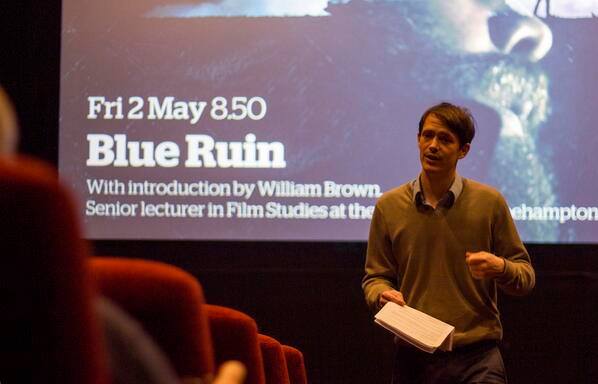
This is a written version of an introduction that I shall be doing this evening for a screening of Blue Ruin at the Ritzy Picturehouse in Brixton, London.

The blog's author introduces Blue Ruin at the Ritzy on 2 May 2014. Photo courtesy of Matt @ The Ritzy!

The blog’s author introduces Blue Ruin at the Ritzy on 2 May 2014. Photo courtesy of Matt @ The Ritzy!

The film tells the story of Dwight (Macon Blair), a seemingly homeless guy living in a car on an anonymous beach somewhere (in Delaware – where else?). A police woman (Sidné Anderson) tells him that a man has been released from prison – and this compels Dwight to drive across the States to his hometown in Virginia to find and kill this man.

This man, Wade Cleland Jr, allegedly killed Dwight’s parents. Dwight therefore murders Wade as an act of revenge, and drives away in the stretched limo that his family has hired for the day to see him out of jail.

However, Dwight soon realises that in the limo with him is William (David W Thompson), Wade’s youngest brother. Dwight lets William go – but only to realise that of course the Clelands now know who killed Wade.

As a result, Dwight reunites with his estranged sister, Sam (Amy Hargreaves), in order to protect her from the Clelands – who of course do come in search of their revenge, too.

And so begins a cycle of revenge that culminates in the film’s final, bloody and brutal showdown at the Cleland household.

Blue Ruin has some strikingly beautiful moments in it – Dwight going through trash cans next to a seaside amusement park and Dwight’s near-dead sedan driving down the mist-filled roads of the USA are two that stick out in particular.

The latter image is in particular haunting – the mist conveying a sense of uncertainty regarding the future, adding to the film’s ominous, suspenseful tone, while also featuring Dwight’s beat up sedan which is of course blue in colour, and thus is perhaps the ‘blue ruin’ that is the film’s title.

In this sense, the film takes on a mythical quality: the once-vibrant dream of the road movie – open space and adventure – is now foggy, the adventure shabby, the future not wide open like the road, but murky and threatening. If the West once found revenge an almost thrilling prospect, it is now tired, haunted, exhausted and dulled. Everything falls into ruin; perhaps Saulnier’s remarkable film is about the fall into ruin of the USA itself.

But what has brought about this ruin? Well, it would seem in part that the desire for revenge, or the violent nature of society, has become so naturalised that even a mild-mannered and middle class man like Dwight will become sucked into it.

And how has revenge and violence become so ingrained in an American society such that it is a/the knee-jerk response to all problems? Well, at least in part through the movies.

Blue Ruin has earned comparisons to the films of the Coen Brothers, and in some senses these are justified, particularly films like Blood Simple (Joel Coen, USA, 1984), Fargo (Joel Coen, USA/UK, 1996) and No Country for Old Men (Joel and Ethan Coen, USA, 2007). With these films Blue Ruin shares a fascination for often quite unexpected violence, delivered in a deadpan, quite detached fashion.

(Note the way that the shots in Blue Ruin just seem a little bit longer than in a conventional Hollywood film, giving a sense of space and how characters are not necessarily agents who conquer space, but who perhaps are smaller than that space, quite small in comparison – something director Saulnier no doubt acquired through his collaborations with Matthew Porterfield, for whom he worked as a cinematographer on several features, including the acclaimed Putty Hill (USA, 2010)).

However, I am going to compare Blue Ruin to another Coens film, their cult classic The Big Lebowski (Joel Coen, USA/UK, 1998). There is a scene in that film in which Jeffrey Lebowski, also known as the Dude (Jeff Bridges) finds himself in the house of pornographer Jacky Treehorn (Ben Gazzara). The Dude sees Treehorn scribbling on a notepad, before Treehorn takes the piece of paper and pockets it. Treehorn then leaves the Dude, who scrambles over to the notepad, takes out a pencil, and starts to shade over the topmost piece of paper – in a bid to trace out what information Treehorn will have left.

What inspires the Dude to do this is of course Alfred Hitchcock’s classic film, North by Northwest (USA, 1959), in which Cary Grant’s Roger Thornhill does exactly the same thing in trying to find the location of Eve Kendall (Eva Marie Saint).

But where Thornhill is successful, the Dude only uncovers a picture of a man with a massive cock drawn by the rather puerile Treehorn.

The reason that I mention this moment is because here we have encapsulated what is perhaps the guiding genius of the Coens: the fact that everyone – at least at times – believes that they are in a movie, and so they adopt behaviour that they have seen at the movies, here the Dude imitating Thornhill, only to find that of course, they are not in the movie that they thought they were – and that reality always has in store for us something different from what we were expecting.

What is true of the Coens is in this respect perhaps also true of Saulnier’s remarkable debut film. Two key examples: when Dwight goes to stab a tyre on the limousine, and when Dwight takes a shot at Wade’s brother Teddy (Kevin Kolack) from all of two yards. Each moment in which Dwight assumes that he can carry out an action seen many times before, but never performed by himself, Dwight comes quickly undone. He has been fooled into thinking cinematically, into thinking, in particular, that actions are easy to carry out and can be done without practise and without work. This is the myth of the movies written large: that we can achieve anything. And it is this myth that Blue Ruin busts, thereby making it an exceptional film.

The body, its imperfections and inadequacies, is what looms large, then. For while violence is so easy and so beautiful in so many mainstream Hollywood movies, such that we aspire to be violent as Dwight pursues revenge here, the body always comes back to remind us that we are inept, malcoordinated and incapable. Rather than being lighter than air – the superhero myth – Dwight is human, all too human – as is signalled by the sheer physical pain he endures through the film, and through all of the fluids that ooze out of his body, which is that of a most unlikely hero.

(Macon Blair’s performance is, by the way, excellent.)

The frailty of the body, then, when compared to its desires (it wants to run, fly, kill; instead it trips, falls and tears open), is the source of the film’s dark, dark humour. And also the source of the film’s suspense: for, will Dwight make it out alive of this world that is far more real and violent than he could have imagined? In this sense, the film’s relative slowness is also its great power: Dwight will have no easy victory, if victory he will have at all. If he is to get out of this alive, it will a long, slow and difficult trudge.

If Blue Ruin is, then, a critique of what I am terming cinematic thinking, the naturalisation of violence and the desire for revenge as a result of the myths peddled by the movies, then it is a film that is, paradoxically, deeply cinematic as a result. Perhaps all art, then, must reflect upon the conditions of its own making in certain respects.

Furthermore, the difficulty and, ultimately, the pointlessness of revenge lends to the film a political edge. For in a world in which we read about the need for payback, and in which violence is indeed a common part of our globalised existence, Blue Ruin suggests that in the real world, revenge is deeply unsatisfying, breeding only more violence that in the end ruins families rather than bringing them together.

Salvo (Fabio Grassadonia and Antonio Piazza, Italy/France, 2013)

Blogpost, European cinema, Film education, Film reviews, Italian Cinema, Transnational Cinema, Uncategorized

The below is a written version of an introduction that I shall make for Salvo at the Ritzy Picturehouse in Brixton this evening (Tuesday 29 April 2014). Come along if you can – though you may also have to suffer me putting in a gratuitous plug for my film, Common Ground (William Brown, UK, 2012), which plays at the American Online Film Awards Spring Showcase from 1 May 2014)!

And so…


Salvo is the debut feature of screenwriters Fabio Grassadonia and Antonio Piazza. It tells the story of a hitman, the titular Salvo (Saleh Bakri), who starts out getting into a gunfight. He chases down his assailants and then goes to the house of Enzo Puleo (Luigi Lo Cascio), the man who organised the hit. There he meets Rita (Sara Serraiocco), a blind woman and Enzo’s sister, who suddenly can see at the moment of her encounter with Salvo.

Subsequent to this encounter, Salvo and Rita go on the run – and must evade the mob, which surely will hunt them down in a quest to find out what has happened to them.

In certain respects, then, the film tells the story of a miracle. But rather than being a miracle couched in a sense of religiosity, we have the miracle functioning in Salvo as something of an allegory.

For, the encounter between Salvo and Rita becomes some sort of primordial event, a transitional moment after which nothing is the same – and this event is based upon the encounter between two people who mutually change.

In short, then, the film is about how love can open our eyes – it can take away our blindness – and it can put us in touch with other people. Indeed, if Jean-Paul Sartre once said that hell is other people, Grassadonia and Piazza might counter this by saying that love, too, is other people, constituted in and by a recognition of other people.

Thus Rita’s literal blindness is accompanied by what the directors call Salvo’s ‘moral blindness’. Indeed, in an interview, Grassadonia explains it thus:

The topic of blindness is important. We come from Sicily, we grew up there, and our experience is that you live surrounded by voluntarily blind people. We told this story, this meeting by two characters affected by two different kinds of blindness: the moral blindness of the mafia killer, who is nothing more than a killing machine at the beginning, and this blind girl, physically blind, but not innocent. She knows exactly her role in that kind of world.

It is in encountering Rita that Salvo can see – and the film works hard stylistically to convey the encounter to us, mainly as a result of its absence of close ups and its absence of faces for the first section of the film, the section that culminates in the miracle.

For, we do not see Salvo’s face until the miracle – if anything we see only disembodied eyes surrounded by darkness. We can surmise two things from this.

Firstly, we can surmise that in a world without faces, people do not exist as humans but as objects that can be killed and discarded without a moral sense of guilt.

Secondly, we can surmise that in having no empathy, it is not that Salvo sees no faces, it is that he himself is also faceless. In encountering Rita, Salvo not only sees her face, but she also sees his, and thus he begins to take on a face.

In other words, identity – Salvo as a recognisable human being – is not something born solipsistically in a body and mind detached from the rest of the world; identity is something that exists only in relation to the world, only with the world. We exist only with other people. Subjectivity is intersubjective.

If the film makes this point, the point does not exist in a bubble. That is, while it it may simply just be that humans can only exist as subjects if there is intersubjectivity, nonetheless the film suggests that we live in a world that lacks recognition of others, a world that lacks empathy, and which is thus a world that encourages what I shall term solipsistic.

So when I say that the point does not exist in a bubble, what I am really asking is: what is this world in which we are encouraged to be solipsistic, blind to each other, rather than with each other?

In interviews, Grassadonia and Piazza talks extensively about how they made the film in their native Sicily, Palermo more specifically. Indeed, in the quotation above, they talk about ‘voluntarily blind people’ there – who in effect turn a blind eye to the mafia, thus accepting its way of life, even if they are not directly involved in it.

In one interview with the ICA, the directors state this clearly:

We are both from Palermo and we naturally chose to set our story in our home town. Palermo is a world where freedom is hazardous. A world that feels the need for a tyrant, an oppressor, is a totally unacceptable state of affairs but somehow understandable. What’s more mysterious is the presence of a silent majority that wishes to be oppressed, that needs to live in a “state of exception”, a state of constant emergency, where violence and oppression are the only laws. A situation where an unencumbered meeting between two human beings is inconceivable.

What is noteworthy here is the use of the term ‘state of exception’ – a concept developed and used at length by Italian philosopher Giorgio Agamben.

For Agamben, the ‘state of exception’ is the generalised totalitarianism of the present age. That is, during exceptional times, a state might give itself increased power in order to keep everyone safe. However, what we increasingly have these days is the way in which all times are presented to us as somehow ‘exceptional’ – and so we live under greater levels of control at all times, under a generalised ‘state of exception’ (a key example for Agamben is the War on Terror in the aftermath of the plane crashes of 11 September 2001).

In suggesting that Salvo reflects upon the ‘state of exception’ that is the mafioso rule of Palermo, Grassadonia and Piazza in fact spread the relevance of their film, such that it might well be speaking not just of Sicily, but perhaps of an Italy that has recently been under the control of a media-magnate. Perhaps even to a world in general, in which political and economic crisis are presented to us as the master narratives that keep us all in our place – and scared in our homes – trusting of no one else, in competition with everyone else.

Not seeing each other as human beings, as subjects, but as threats, opportunities and objects.

This wider relevance of the film is signalled aesthetically, too. It is hard not to read the opening sequences, full of bloodshed, and in which we follow Salvo as he chases down his would-be assassins, as borrowing from computer games, in particular the behind-the-head shot familiar from shooter games (and complete with the odd silences that moving through space can involve in computer games).

In other words, the film suggests via this reference to computer games that its message is relevant to the whole of the contemporary, media-saturated and digital world. That we no longer look at each other – but instead pursue a faceless world characterised by affectless, or unemotional, violence.

Salvo does not just make references to a computer game, however. It also makes reference to other films and/or genres. The filmmakers themselves discuss how their film pays homage to the likes of Taiwanese filmmaker Tsai Ming-liang, and that it also draws inspiration from Jean-Pierre Melville’s classic, Le Samouraï (France/Italy, 1967) – while its use of a miracle, its sparse dialogue and its interest in procedure also seem to recall the cinema of Robert Bresson (for me at least).

In other words, while the film is about how we are with each other in the world, even at a time when we are encouraged to feel that we not together, that to create a bond with another person is ‘inconceivable’, the film itself is also making bonds with other films; films only exist in an inter-cinematic way, too, it would seem.

And yet, for all of Salvo‘s precursors and reference points, the film had a hard time getting made.

After writing the 2004 comedy Ogni volta che ne te vai/Every Time You Go (Davide Cocchi, Italy, 2004) and the TV movie, Gli Occhi dell’amore/The Eyes of Love (Giulio Base, Italy, 2005), the latter of which suggests an ongoing interest in eyes and looking, Grassadonia and Piazza wrote and directed Rita (Italy, 2009), a short film that in some respects is the basis for Salvo (it is about a blind woman).

It then took them four years to get Salvo off the ground, making the film the product of a five-year process. Piazza recounts his experience thus:

Basically if you’re a first time director and you don’t arrive with the conventional comedy made for television, it’s extremely difficult, if not impossible, to finance a film. In our case, the Italian press was talking about the film because of the support of French television but not the support of the Italian television

In other words, the aesthetics of Salvo, a cinephile’s film that is in part about films, reflects the production history of the film, in that a film about two characters who come to understand the existence of themselves through finally seeing others, is a film that was only made because of a transnational coproduction (with the French) – most Italian producers being too risk-averse, too caught up in the solipsism of contemporary capital, to want to tell a story that reaches out in the way that this one does.

The generalised ‘state of exception,’ then, is also present in the risk-averse nature of the film industry – and it is only in collaborating with strangers, perhaps, that films of this kind can get made. Perhaps it was a concession to commercial interests that the film features prominently on its soundtrack the number one Italian chart hit, ‘Arriverà‘, by Modà, featuring Emma Marrone.

Perhaps this even helps to account for the casting of the film. Salvo is played by Palestinian actor Saleh Bakri, the star of Elia Suleiman’s film The Time That Remains (UK/Italy/Belgium/France, 2009), while a couple of well-known actors have cameons, including Luigi Lo Cascio as Rita’s brother, Enzo. Lo Cascio won a Best Actor Donatello (Italian Oscar) in 2001 for I Cento Passi/One Hundred Steps (Marco Tullio Giordana, Italy, 2000), was nominated for the same award two years later for La meglio gioventù/The Best of Youth (Marco Tullio Giordana, Italy, 2003), and was nominated for Best Director in 2013 for La città ideale/The Ideal City (Italy, 2012).

Leading actress Sara Serraiocco, meanwhile, stars in only her first movie. Perhaps this is emblematic of her character, that she is revealed to the world as the world is revealed to her. But then her character is perhaps a bit more canny than this – she is counting mafia money when we first meet her. That is, while Salvo may romanticise her, the film arguably does not, with the ‘miracle’ potentially being in Salvo’s head – it is an allegory, not necessarily a miracle to be believed in a literal sense – with the cheesiness of ‘Arriverà’ as the central musical motif also suggesting as much.

The directors quote great Italian writer Italo Calvino in relation to the film:

In the inferno of the living, where we live every day, that we form by being together, there are two ways to escape suffering it. The first is easy for many: accept the inferno and become such a part of it that you can no longer see it. The second is risky and demands constant vigilance and apprehension: seek and learn to recognize who and what, in the midst of inferno, are not inferno, then make them endure, give them space.

One can argue that the film is not without complications; Salvo and Rita do not necessarily escape the cycle of violence and it is perhaps only by perpetuating it that they stand a chance of surviving. Indeed, as Salvo’s name suggests, not only might he ‘save’ Rita, but he might also be a force for the state of exception, in that ‘salvo’ also means ‘except’ (in the sense of ‘save for’ – as in, ‘I would have been killed, save for a hitman coming to my rescue’).

Nonetheless, as a film Salvo is not inferno – and so we must give it space and thus help it to endure in a world of rapidly recycled and endlessly forgettable films.

Tian zhu ding/A Touch of Sin (Jia Zhangke, China, 2013)

Blogpost, Chinese cinema, Film reviews

It has been a couple of months since I saw A Touch of Sin at a cinema in Paris (La Clef on rue Daubenton), and so my memory of the film is not necessarily fully accurate.

However, I wanted to get down some thoughts on the film ahead of the fantastic-looking Chinese Visual Festival that runs from 8-18 May in London, and which features a visit from director Jia Zhangke to discuss both his early short films and A Touch of Sin.

For, my plan is not to send out spoilers ahead of the film’s screening. Rather, it is to encourage people to attend the screening(s) – since A Touch of Sin is a remarkable film by an important director. And I wish to delineate the film’s importance, as well, perhaps, as its contradictions, in this post.

(I cannot, alas, make the screening – in fact I can only make one film during the whole Festival. Should any readers care to know, I shall be away to give a talk at the Cinemateket in Stockholm, Sweden, for the first part and on holiday/at a wedding in Spain, for the second part of the festival. Even though I have these treats in store, I am still envious of anyone who gets to hear Jia in conversation.)

So…

A Touch of Sin tells four stories, each based on true events, about contemporary China. It opens with a man on a motorbike, Zhousan (Baoqiang Wang), who is held up by a gang of young highwaymen. He kills them with a gun and then rides off – past Dahai (Jiang Wu), who sits astride his own bike next to an overturned tomato truck (it could be red apples).

We then stay with Dahai as he tries to arouse anger in his village against corrupt businessmen, especially an old friend who has become very rich (owning a private jet) while others continue to be poor. So angry does he become that he decides to take getting revenge into his own, soon-to-be-bloody hands…

The film then returns to Zhousan, who has come home for New Year to see his wife and child. He claims to be doing successful work during his migrations, but in fact leads a life of crime (as his early murder of the highwaymen makes clear – more murders follow).

A third section of the film sees a pretty receptionist at a sauna, Xiaoyu (Jia regular Zhao Tao), who is beaten up by the wife and friends of her lover (Jiayi Zhang), before being abused by two rich businessmen (one of whom is also played by Jia regular Hongwei Wang) who mistake her for a prostitute. This insult leads Xiaoyu to exact her revenge on the businessmen.

And, finally, a young factory worker named Xiaohui (Lanshan Luo) quits a job in a clothing factory after an accident sees him needing to pay compensation to one of his co-workers. He joins a friend at a factory in a different town, is found and beaten up by his former colleague who suffered the accident, and commits suicide.

The description of the film at last year’s Cannes Film Festival is as follows: ‘Four people, four different provinces. A reflection on contemporary China: that of an economic giant slowly being eroded by violence.’

While this description is in some senses accurate, I wonder that it is also a bit misleading. It suggests that violence is eroding China as an economic giant, when in fact the film is really about how in becoming an economic giant, China is becoming an increasingly violent place.

And although the violence that we see in this film is both startling and based on a set of true stories, the film also functions at an allegorical level: the major violence perpetrated in this film is by those Chinese citizens who have embraced the get-rich-quick ethos of what we in the West might term neo-liberal capitalism, and who, in adopting this ethos, concomitantly adopt an ethos whereby the rest of the world can go hang. Whereby violence, in the form of exploitation, is enacted on the rest of the world. Humans are deprived of their very humanity and instead are seen as commodities, as economic opportunities, and objects to be disposed of as one sees fit.

A Touch of Sin is vastly more violent than any of Jia’s films to date, even if those other films also chart the disenfranchisement of various members of Chinese society – right from first feature Xiao wu/Pick Pocket (Hong Kong/China, 1997) through to Er shi si cheng ji/24 City (China/Hong Kong/Japan, 2008), Jia’s last fiction feature.

I find this violence interesting for a couple of reasons. Firstly, I have written an essay – to be published in a book provisionally entitled Marxism and Film Activism, edited by Ewa Mazierska and Lars Kristensen – on the films Tropa de Elite/Elite Squad (José Padilha, Brazil, 2007) and Un homme qui crie/A Screaming Man (Mahamet-Saleh Haroun, France/Belgium/Chad, 2010).

In that essay, I argue that we are entering an era of renewed activism, one that in particular features violence as a response to the injustices of the world – and one in which standing by and observing is no longer justified.

For those who care to note the technical aspect of my essay, I make this argument using the language of Gilles Deleuze and his writings on cinema.

Deleuze argued that his concept of ‘time-image’ cinema featured ‘seers’ – characters who can only watch in the face of the world, and who do not decide to be agential heroes that do violence to the world, something we might characterise as the typical mythos of the American western.

I argue that while the ‘time-image’ might have been revolutionary in its time, perhaps a new ‘movement-image’ cinema of action is being adopted now as a means of resistance against the inequities of global, neo-liberal capitalism – as per the (admittedly problematic) violence of Elite Squad, and as per the critique of passivity in A Screaming Man.

I then use Marx to argue that we should not put time-image and movement-image cinema into a hierarchy; the time-image is often interpreted, in the modern context, as superior to the movement-image, which, in broad terms, we can equate as being the superiority – aesthetically if not commercially – of art house cinema to mainstream cinema (cinema that uses the fast-paced aesthetics of what David Bordwell would term ‘intensified continuity editing’).

To return to A Touch of Sin, I see the film’s violence as being Jia’s own expression of how we have perhaps gone through the time of/for passivity as a response to the intensified spread of neo-liberal capital, perhaps especially in mainland China. So maddening is the onslaught that accompanies it that we are looking at what the Invisible Committee would term a Coming Insurrection; an outbreak of violence so severe that it might bring neoliberal capital to its knees.

Perhaps it is worth noting that the move on Jia’s part is premeditated and deliberate. The film’s title is of course a reference to King Hu’s classic martial arts film, A Touch of Zen (Taiwan, 1971), which tells the story of an artist caught up in a struggle against Imperial conspiracy and domination. That film uses martial arts as a means of resistance against hegemony, with the martial being/becoming an art – with art always being a tool for resistance against domination (art is always political, and art for art’s sake is a bourgeois concept intended to nullify the political power of art). Perhaps Jia considers violence in a similar, contemporary fashion here.

But Jia’s film involves not just a reference to King Hu. Among its rich forebears must surely be included not the western, but the spaghetti western, especially the works of Sergio Leone, and/or a film like Django (Sergio Corbucci, Italy/Spain, 1966). As David Martin-Jones has cogently argued, these films also use violence as a means to express the disempowerment of Europe’s impoverished south, and as a means to try to empower themselves, but not by positing a wholly new, artistic cinema (as happened further north in Europe, for example), but by taking the tropes of a very Western genre, the western, and reworking them for their own ends (perhaps we can argue that the giallo does something similar with horror).

In this way, A Touch of Sin also is part of a tradition that takes tropes of the western in order to give expression to dissatisfaction with the ongoing drive towards global capitalist domination, a domination that historically was itself espoused in the Indian-destroying, nature-taming genre of the western itself.

(I argue in this book that Django Unchained (Quentin Tarantino, USA, 2012) might also be trying to do something similar – as might the overwhelming emphasis on revenge in contemporary cinema, with the recent Calvary (John Michael McDonagh, Ireland/UK, 2014), and in some senses, ahem, my own film, Common Ground (William Brown, UK, 2012), being (Christian-influenced?) considerations of how allowing that vengeful violence, of how standing up saying ‘perhaps it is right that you should attack me’ might in turn be a/the bourgeois-but-understanding response.)

The question then becomes, though: does Jia (do all of these films) express a solution to the problem, or only a means of perpetuating it? If (the spectacle of) violence is at the very soul of capitalism, then to give in to violence – even if in ‘only’ a film, albeit one based on a true story – might simply perpetuate the status quo rather than in fact challenging it…

I quote:

as Antonio Negri puts it, “antagonism is the motor of development of the system, the foundation of a continuous resurgence of antagonism each time that the project, the history of capital, progresses,” then perhaps it is only in an inventory of the failed efforts and strategies of human liberation that the forces of oppression can be identified and fought effectively.

This is from Jonathan Beller, quoting, as is clear, Antonio Negri.

Perhaps, then, the antagonism of A Touch of Sin only adds to the progress of capital. Vicious, thought-provoking and heartfelt as A Touch of Sin is, one wonders if Jia has succumbed to a (too-human?) desire for violence in order to endeavour properly to get out of the paradoxes and contradictions of capital – only to fail because antagonism is what capital wants. Indeed, it is not as if the cinema has not commodified violence since soon after its inception – as an early film like The Great Train Robbery (Edwin S. Porter, USA, 1903) makes clear.

The Rocket (Kim Mordaunt, Australia/Thailand/Laos, 2013)

Australian Cinema, Blogpost, Film education, Film reviews, Laotian Cinema, Uncategorized

I recently introduced The Rocket at the Ritzy Picturehouse in Brixton, London. The cinema has asked me to post my comments on the film online. While I was working from notes, and thus cannot reproduce fully what I said, this blog post nonetheless can convey some of my thoughts on the film.

So…

Set in Laos, The Rocket tells the story of Ahlo (Sittiphon Dissamoe), one of a pair of twins, but whose brother dies during childbirth. Ahlo is loved by his mother, Mali (Alice Keohavong), but twins are considered to be omens of bad luck according to local superstition. And since Ahlo’s brother died in childbirth, Ahlo must be a bringer of bad luck – or at least this is what his grandmother, Taitok (Bunsri Yindee), believes.

That Ahlo brings bad luck to the family is affirmed when the family is forced to migrate as a result of a dam being constructed in the region where they live. They are taken to a refugee camp, where their lives are affected by poverty. At the camp, Ahlo befriends fellow outsiders Kia (Loungnam Kaosainam) and her father Purple (Thep Phongam), who is obsessed with James Brown.

The family flees the camp, but endures more loss – affirming Ahlo’s status as the purveyor of bad luck, something that even Ahlo’s father, Toma (Sumrit Warin), begins to believe.

And so, in order to redeem himself, Ahlo decides to enter a rocket competition. This is a festival in which people build their own rockets and then fire them at the sky. Those rockets that fly highest, explode biggest and, if possible, which bring much-needed rain, will win a cash prize.

Ahlo enters, re-bonds with his father, and sets off a rocket that soars high, explodes mightily and forces the heavens to open. After tragedy, then, the film has a happy ending.

The Rocket is directed by Kim Mordaunt, a British-Australian who has lived extensively in Asia, and who has also taught filmmaking there.

Mordaunt has historically plied his trade most prominently as a documentary maker. Indeed, his earlier film, Bomb Harvest (Australia, 2007), has various similarities with The Rocket. Although the central character of that film is an Australian bomb disposal specialist, it nonetheless features Lao children who collect bombs to sell as scrap metal. This film no doubt informed The Rocket, since we also see Lao children playing around and working with unexploded bombs, including Ahlo.

The Rocket is Mordaunt’s first fiction feature, and it has won awards at the Berlin (Crystal Bear, Best First Feature, Amnesty International Film Prize), at the Sydney (Audience Award), and at the Tribeca (Best Film, Best Actor, Audience Award) Film Festivals.

Nonetheless, Mordaunt’s documentary sensibility remains in the film. This is made clear in the use of locations in the film (especially the stunning mountain scenery), but also, particularly, through the final rocket festival that is the film’s culminating point. Here, Mordaunt fuses documentary footage shot from an earlier, real rocket festival with footage shot at a recreation of that festival – and featuring his actors.

Furthermore, The Rocket has something of an ethnographic sensibility, charting rural Laotian life, including superstitions – as embodied in particular in Taitok and her belief that Ahlo is the bearer of bad luck.

Indeed, the clash of tradition with modernity is perhaps one of the key themes of the film, as I shall discuss presently.

According to Mordaunt, Laos is the most bombed nation on the planet, in part as a result of American bombing of the country during the so-called ‘Secret War.’ The ‘Secret War’ is another term for the Laotian Civil War that took place between 1953 and 1975, and which also involved those taking part in the Vietnam War. As a result, American and other forces dropped many bombs in/on Laos during this period.

Indeed, there are haunting scenes in The Rocket featuring unexploded bombs that have become an almost fixed part of the Laotian landscape – even 40 years after the end of the Secret War. The bombs, therefore, come to symbolise in the film both the precarious nature of life for the many people living in the Lao countryside (these devices could explode at any time, and lives can end suddenly, as the film shows us even from the outset with the death of Ahlo’s brother), but also the way in which Laos has perhaps been affected not by internal forces (how ‘civil’ was the Secret War?) but by external forces.

One senses, almost, that rural Laos might well continue to exist in a peaceful and bucolic fashion had it not been bombed into modernity. This forced entry into modernity continues today, but instead of bombs, the film shows to us the forced relocation of many Lao people as a result of dam construction (Mordaunt in interview reminds us that 60 million people have been relocated worldwide for dam construction – more than the entire population of the UK).

And, in an interview with the BFI, Mordaunt talks about how the film wants to reflect on Laos’ relationship with the wider world, suggesting how Australia plays a role in the dam-related relocations and the problem of robber barons (basically, people who bleed a country’s veins dry of its natural resources and get extremely rich in the process).

In Mordaunt’s own words: “There are a lot of cowboys about,” he says. “Our government is always saying we must relate to Asia. But the majority of that relationship is sheer economic opportunism. There are Australians making millions every year out of the place.”

In short, then, we see in The Rocket a Laos being forced into modernity by external factors that are not necessarily much to do with the country itself.

Nonetheless, the film does not simply suggest a romantic return to a pre-modern existence. Taitok’s superstitious belief that Ahlo means bad luck is ultimately proven wrong; Ahlo is not bad luck and, indeed, might be the bearer of good luck as he wins the rocket competition.

Indeed, that Ahlo wins the rocket competition by using materials from the unexploded bombs dropped during the Secret War suggests something quite stubborn, inventive and empowering. As Mordaunt says, the rocket competition allows the Laotians to ‘shoot back at the sky’.

That is, we see Laotians reappropriate the very bombs that brought them into modernity – even if, as Curtis LeMay might have put, the aerial onslaught of the time was also designed to bomb the Laotians back to the Stone Age. And in taking the remnants of foreign presence in Laos, in turning them into their rockets that help to maintain a Laotian tradition (the rocket festival), then we see an affirmative, potentially nationalistic, act of resistance taking place.

Perhaps we can read the character of Purple in this fashion as well. In impersonating James Brown, we see Purple take on an American icon who is associated with sex and libidinal release, suggesting that Laos, too, has desire for change.

However, the film is not without issues – and we can start to sort through those with a further consideration of the character of Purple.

On 5 April 1968, the day after the death of Martin Luther King, James Brown held a concert in Boston (the city where King had been assassinated) that was otherwise due to be cancelled, thus pacifying that city’s black community, which otherwise might have risen up in resistance and outrage in response to the events (as documented in The Night James Brown Saved Boston, David Leaf, USA, 2008).

With King as a noted civil rights activist who was vocal in his opposition to the Vietnam War, Purple would seem to use Brown also a means to speak out against the national trauma that has been the Secret War. Indeed, with Ahlo’s lost brother, with Purple’s alter ego as James Brown, and with the Secret War being the hidden other of the much more widely recognised and covered Vietnam War, The Rocket is in part about doubles – about missing doubles and overlooked histories that really ought to figure much more in our historical consciousness and in our understanding of the world today.

Nonetheless, Brown also caused controversy during the Vietnam War by travelling out to Asia in order to play to American troops. How ‘against’ the war was he such that he could do this? Brown insisted that soldiers are humans, too, but this makes the Purple-Brown analogy muddier and more problematic. And it becomes even more so when a source like this one suggests that Brown only agreed to play the concert if paid US$60,000 (of which he only allegedly received US$10,000). Did Brown take the money because one should not work for the Man for free, as it were? Or in going on stage and in asking Boston’s community not to react violently to the King assassination, did this make of Brown an ‘Uncle Tom’ figure – as various people accused him at the time?

In relation to Purple in The Rocket, that James Brown is such an unclear figure perhaps only reinforces the sense of trauma that Purple, with his military past, must have suffered. Somewhere here we have reworked Purple’s erased, real identity as the double of James Brown, as Ahlo is the double of Laos’ past, trying to work his perceived bad luck into some good luck by taking American bombs and firing them back into the sky.

The explosion might cause some rain to come down – with water being a key symbol of the film. A dam is being built – to use water for power, of course, but in an effort that might also privatise water, this most natural resource. The rural dwellers of the film are in a drought – and all that they have experienced in the past is a rain of bombs. And so they fire back into the sky and a new shower descends; perhaps the past will not so much be washed away, but allowed properly to appear and to be understood.

However, Purple is played by a well known Thai actor, Thep Phongam. In other words, if Purple as a character, and the film perhaps as a whole, are designed to make visible a ‘secret’ past that has for far too long remained invisible, it is ironic that a Thai star in fact only re-occults Laos; not even a Laotian actor can be found to play the part of a traumatised Laotian. That is, Laos continues to be invisible.

Perhaps the same is taking place through the casting of Bunsri Yindi as Taitok, Ahlo’s grandmother. Yindi is also a Thai actress, best known for playing the mother of Ting (Tony Jaa) in Ong-bak (Prachya Pinkaew, Thailand, 2003).

But most pertinent to this erasure-under-the-pretence-of-exposure is Mordaunt as director and the film itself.

 As the film’s website says, ‘The Rocket is one of the first feature films for international release set and shot in the intriguing and little-known country of Laos, rarely seen by the outside world since the end of the Vietnam War.’

(Air America, Roger Spottiswoode, USA, 1993, was set in Laos – but the film was in fact shot in Thailand and the USA. It stars Mel Gibson and Robert Downey Jr as pilots ‘recruited into a covert and corrupt CIA airlift organisation’.)

And yet, the film is made by an Australian-British filmmaker – and not by a Laotian.

In the film’s press kit, Mordaunt proudly declares that after Bomb Harvest, the ‘Lao and international response to the film was that we should make another film with a Lao child as the protagonist. And because Laos didn’t have a funded film industry we should be the team to endeavour to make Laos’ first internationally released feature film.’

It is in some ways fair enough that Mordaunt should make any film he chooses to, not least because, as he makes clear, Laos has no film industry to speak of. But on another level, since it is Mordaunt who is at the centre of the film’s publicity (rather than, say, Ki, the boy who plays Ahlo and whose performance is absolutely remarkable), we see Mordaunt himself becoming a quasi-robber baron of sorts – exploiting Laos and its history in order to make a career for himself.

Similarly, Australia put the film forward as its nomination for the Best Foreign Language Film at the 2014 Academy Awards. Australia, therefore, is happy to reap the benefits of this film in a similar fashion that makes Australian a film that is supposed to be giving to Laos its own cinematic identity. Those amazing landscapes that help to sell the film are not Australian, but Laotian. They should be recognised as such.

In short, then, if the film is supposed to convey how Laos has been forced into modernity by foreign forces (Vietnam, the USA, Australia), then the film and Mordaunt in fact only continue this cycle. Laos itself gets re-buried after having exhumed for the benefit of Western audiences – something made clearer still when we learn that the film was banned in Laos itself (my thanks to Sonia P Barras and to Ben Dunant for bringing this to my attention).

Perhaps this also explains why, even though Mordaunt mentions that the film reflects on how Australia plays a role in shaping contemporary Laos, this is not actually particularly visible (if at all) in the film itself. In other words, while Mordaunt’s words do help to justify his film politically, one wonders that the film itself does not in fact have much political, but rather an economic sensibility.

This is made clear by the film’s final ambition for Ahlo to get rich quick via a rocket competition. As per the equally problematic Slumdog Millionaire (Danny Boyle and Loveleen Tandan, UK, 2008), money – and money gained via luck/a lottery of sorts (it happens to start to rain when Ahlo fires his rocket) – is posited as the answer to all problems. In other words, Laos can only get on board in modernity if it adopts a policy of individual, rather than collective, enrichment via competition.

In short, The Rocket suggests that capitalism is the answer for Laos. No wonder the film got banned in the communist country that is Laos itself…

Slumdog is equally problematic in its British use of India – and in its tale of individual escape by competition-winning. That co-director Loveleen Tandan is barely given any credit for the film – Danny Boyle did not share his directing Oscar with her – demonstrates clearly the true erasure of India that the film in fact gives to us.

Perhaps, then, it is no coincidence that Western reimaginings of places like India and Laos can only be problematic – and perhaps we are in the midst of seeing a new, cinematic imperialism given how prominent it is becoming that Western filmmakers travel to the Third World in order to start their filmmaking careers.

(A short list of films might include Maria Full of Grace (Joshua Marston, Colombia/USA/Educador, 2004), Año bisiesto/Leap Year (Michael Rowe, Mexico, 2010), Soi Cowboy (Thomas Clay, Thailand/UK, 2008), Grand comme le baobab/Tall as the Baobab Tree (Jeremy Teicher, Senegal, 2012), Katalin Varga (Peter Strickland, Romania/UK, 2009) – but there are many, many more.)

Finally, then, cinema is itself a double of reality. As Ahlo hides his dead twin, so perhaps The Rocket hides the real (dead?) Laos that this film proclaims to reveal. The Rocket is a visually stunning and beautifully acted film, demonstrating the precarious nature of life in rural Laos and showing us – at least implicitly – a scarred and traumatic national past in a sensitive and affecting fashion.

The problem remains, however, that while Laotians should perhaps indeed shoot back at the sky, they are not (yet) shooting their own films. The deprivation of water, here understood as the flow of cinematic images, seems instead to continue…