Whiplash (Damien Chazelle, USA, 2014)

American cinema, Blogpost, Film reviews

There is a scene in John Cameron Mitchell’s somewhat overlooked Rabbit Hole (USA, 2010), in which mourning mother Becca (Nicole Kidman) talks with Jason (Miles Teller), the young man – a boy, really – responsible for the loss of Becca’s child.

In one scene, set on a park bench – just like the moment when Mark Ruffalo also did something extraordinary with the equally wonderful Laura Linney (whither Laura Linney, though?) in Kenneth Lonergan’s You Can Count On Me (USA, 2000) – Miles Teller became for me a real talent to watch.

A bunch of teen drinking movies later, and here he is playing Andrew in Whiplash, being given the hardest, probably unethical push by his jazz teacher, Fletcher (excellently played by J.K. Simmons – but the award nominations mean everyone already knows this), and then becoming the man, or realising the potential that he has had all along.

Spoilers: this film is really all about its stupendous, virtuoso climactic scene in which Andrew steps up and takes over from Fletcher in order to begin his own life.

That said, the film is entertaining throughout. Well paced, well acted, with an excellent script involving great put-downs from Fletcher, the film also contains some nicely conveyed moments of arrogance from Andrew (at a family dinner – maybe Thanksgiving), and, in a mildly original way, he does not get the girl because he has acted like a tool towards her earlier on in an equally arrogant way.

I came out of the film thinking that this was the first film among those that I have seen at the cinema in 2015 that I’d want to see again – mainly for that final scene, because I also feel that both Enemy (Denis Villeneuve, Canada/Spain, 2013) and National Gallery (Frederick Wiseman, France/USA/UK, 2014) are excellent (and I hope to blog about them when I get time).

And don’t get me wrong – Teller and Simmons are both fantastic, but that final scene is really about the drumming (apparently Teller himself, with some highly accomplished editing) and, for me, a reaction shot from Andrew’s father, Jim (Paul Reiser), when he sees/hears just how good his son really is.

People have been enthusing about Whiplash for a while, and not for any wrong reason. ‘It’s a music film shot as though it was a thriller,’ is what I remember hearing around the time it played at the London Film Festival (for reasons of ticket pricing and opportunity, I don’t go to see films at the festival that likely will have a major release at a later point in time).

But – here’s where we get to the meat of the blog – I am not particularly convinced about a student-teacher relationship as thriller being so original. I never really got what was that original about Låt den rätte komma in/Let the Right One In (Tomas Alfredson, Sweden, 2008), either. So I could be an ignoramus. But this kind of hybridising of genres is for me inevitable – someone would have done it at some point in time. What it is not is that original – i.e. of a uniqueness that one can never look at anything the same way again.

Let me clarify: Whiplash is excellent, but it is also conventionally shot, cast and played. What is more, about 20 hours after seeing it, other questions and doubts about the film come to mind.

Charlie Parker is referenced a lot in the film, especially the (incorrectly recounted) story about how Jo Jones threw a cymbal at Parker’s head one time, inspiring Parker to go away, practice and to become the legend that is Bird.

Two things: Charlie Parker was black. And Charlie Parker was a jazz musician – a form of music originating in America, and which consists not uniquely of black musicians, but regularly, or most often. Indeed, it is sometimes referred to as a form of black music.

So major critique number one is the fact that a form of music that has race at its core, or in its blood, we might say, becomes here a struggle between two white men. Sure, white musicians play jazz, and it might well be that in the contemporary era white musicians have over-run jazz, thereby making Whiplash something of an insightful film about the state of jazz today. But while we get to see black faces in this film, they are supporting roles – i.e. barely a speaking part – as the story becomes in the end the thesis-antithesis-synthesis of two white dudes.

It makes me think that more people should watch Fruitvale Station (Ryan Coogler, USA, 2013), which is a truly extraordinary film, or, failing that, something like Finding Forrester (Gus Van Sant, USA, 2000).

(In Andrew’s rise to greatness, the film also tells us that women are unnecessary, perhaps even a plain hindrance, for men, but I shall leave that critique for someone else to make. Perhaps it is significant that Nicole, played by Melanie Benoist, works in a cinema, and that Andrew watches movies there with Jim. With a missing mother, he maybe realises that Nicole is a stand-in mother – a cinematic projection – and that he does not need her; men can raise each other, as Jim and now Fletcher have done with Andrew; women are evil wastes of time, anyway, and best seen as objects on a screen and not as autonomous human beings…)

And now beef number two is that this is a film about jazz. And I am just not sure that formally the film reflects its connection to jazz, being structured and paced much more like a mainstream film – even if a thriller while being about music school – rather than the slightly offbeat, somewhat hard to get into, sometimes downright oppositional mode that jazz historically has been.

Here we have again a racial dimension: the form of this film is about as white as we can get. But more than that… For me, given cinematic form, jazz looks something like the movies of John Cassavetes, who dealt directly with jazz in Shadows (USA, 1959), which with the central character of Ben (Ben Carruthers) explores precisely with the issue of race and to which places and rhythms of life the colour of one’s skin gives us access.

I’d also like to refer to other Cassavetes movies like Husbands (USA, 1970) and Gloria (USA, 1980), in which you don’t have any idea where these movies are going to go from one moment to the next. This inability to read these films, their dangerous, improvised quality, in which everything teeters on the brink of disaster and in taking us to the edge makes us find beauty of the most fragile sort, that is what cinematic jazz is and feels like for me.

It is perhaps problematic – for this argument – that Cassavetes himself was white. But one feels like he’s risked everything to make every single one of his films, and that the freedom and fear involved in this produce amazing work. We get a sense of this happening for Andrew in Whiplash, but not necessarily for its director, Damien Chazelle.

‘The road to greatness can take you to the edge,’ pronounces the UK poster for Whiplash. Damien Chazelle’s film demonstrates great talent – but in the spirit of Fletcher, perhaps one ought to say that it is controlled, scripted (even if the film involved ad-libbing) and basically a safe if excellent film. Its ‘safety’ is demonstrated in its whiteness. Maybe Chazelle will next time produce something truly extraordinary; I hope that he does. Maybe he will be able to do so by engaging more closely with gender and colour. Maybe I shan’t go to watch this at the kino again.

Cock Cock Cock Cock Cock (On the Oscar Nominations 2015)

American cinema, Blogpost

This is the unedited version of an article that otherwise appears on The Conversation.

Here goes:-

In order to suck one’s own cock, I guess one needs a cock in the first place. In some senses it is logical, then, that awards ceremonies, along with other systems of self-congratulation, have a touch of the priapic about them.

However, in the spirit of a recent essay on ‘masculinity in crisis‘ over at Souciant, Hollywood this year seems strongly to be about penises. Don’t get me wrong – penises can be beautiful things, even if often also the cause of much embarrassment to their owner (for being too small, for shrivelling up at the wrong moment, for arriving too early at a meeting with a vagina, an anus, a mouth, or whatever other orifice and/or implement it cares to encounter).

A good number of the films nominated at this year’s Academy Awards are pretty good films. Hell, technically, they’re all excellent. That is: yep, they’re penises, and they demonstrate that they work like penises do.

But it all seems like a lot of penis to me. Best Film nominees are about learning how to grow a penis (Boyhood, Whiplash), having a massive penis (American Sniper), trying to retumesce a flaccid penis (Birdman), having a vagina-liking penis that most people think is an anus-liking penis (The Grand Budapest Hotel), having an anus-liking penis that has to hide the fact that it likes anuses (The Imitation Game), having a fully working penis that most people think is a crippled penis (The Theory of Everything), and being a famously cocky civil rights campaigner (Selma).

All the fiction directors – including the ‘foreign’ ones and the ones working in animation – have penises. All the writers – original and adapted – have penises. All the cinematographers have penises. All of the composers have penises. All of the sound editors have penises. Five out of the six nominated editors have penises.

There is one documentary directed by someone with a vagina (CitizenFOUR), but it is about someone with a penis. There is also a documentary about someone with a vagina (Finding Vivian Maier), but it is directed by someone – two people, in fact – with a penis. What is more, this film is really about someone with a vagina who was too afraid to show their work or come out as an artist in their lifetime – perhaps in part because they did not have a penis (and therefore trying to become an artist was a bit fruitless; still, at least a penis is there to rehabilitate her now).

Of course, there are some vaginas nominated in the categories reserved for actors with vaginas. Among the Best Actress nominees, one is a murderous bitch (Rosamund Pike in Gone Girl), one has early onset Alzheimer’s (Julianne Moore in Still Alice), one is an antisocial loner (Reese Wetherspoon in Wild), one a woman who is rejected by most of the men she works with since they’d prefer a bonus to her having a job (Marion Cotillard in Two Days, One Night), and one is the foil to a genius whose own doctorate and motherhood duties play second fiddle to a man who ends up dumping her for a woman who’ll give him a handjob while looking at Penthouse magazine (Felicity Jones in The Theory of Everything).

Compare to the men – and we have a hero (Bradley Cooper in American Sniper), two geniuses*** (Benedict Cumberbatch in The Imitation Game; Eddie Redmayne in The Theory of Everything), a harmless madman who becomes hailed as a genius (Michael Keaton in Birdman, with this being a ‘woah! he’s still got a penis’ nom), and a bonkers rich recluse who eventually kills someone because his mum is a bitch (Steve Carell in Foxcatcher, with the ‘woah, he actually has a penis’ nom).

And the supporting actresses are nominated mainly in roles that are vaginas supporting penises (Keira Knightley in The Imitation Game, Emma Stone in Birdman, Patricia Arquette in Boyhood), with Meryl Streep as a witch (Into the Woods). Maybe only Laura Dern in Wild, playing Reese Witherspoon’s mother, manages to evade being the penis-crutch that most vaginas are expected to be. But, you know, the title alone suggests that independent women are ‘wild’ and dangerous and not to be trusted.

I saw Boyhood and thought that Patricia Arquette was the best thing in it and came out of the film thinking that instead of Boyhood the film should be called Motherhood (or at the very least Texas). But no – it got named after the penis and the vagina is overlooked again.

Even the nomination of Meryl Streep seems more obligatory than worthy – especially when someone like Octavia Spencer made me cry within three minutes of being on screen in the massively overlooked Fruitvale Station (which, admittedly, would not have qualified for these Oscars because it had a – limited – US release date in 2013, even if released in the UK only in June 2014).

But the point remains… The man from Hollywood, he say hail the cock. And fuck the cunt. This is our world.

*** I am intrigued about how these two nominations are about specifically scientific geniuses, and the reverence that scientific geniuses receive, which stands in some contrast to artistic geniuses, perhaps. If the universe is mathematical, then working out formulae that best describe it is inevitable over time – because one must find the formula for A.I. (Turing) and/or the big bang/black holes (Hawking). In other words, if not these men, then someone would have worked out how to do what they did – even if these men were in the ‘right’ place at the ‘right’ time to work it out. Contrast this to a work of art: if Picasso had not lived, his art works would not exist, while someone would have worked out what both Turing and Hawking worked out at some point in time because all they are doing is maths (no disparagement intended). Given the irreplaceable nature of Picasso, but given that logically Turing and Hawking are entirely replaceable, why do we celebrate scientific genius (this year, anyway) more than artistic genius?

Palo Alto (Gia Coppola, USA, 2013)

American cinema, Blogpost, Film reviews

I had been hoping to blog about a number of films – but the basic 24:7 drag that is term time means that I basically have space for nothing other than the nose to the grindstone. Imagine that – last year I managed to blog about a number of films at the London Film Festival – and this year I barely saw as many, let alone had a chance to write about them.

Either way, this is a brief blog that summarises things that I shall say this evening at a Discover Tuesday screening of Palo Alto at the Ritzy Picturehouse in Brixton this evening (Tuesday 18 November 2014).

The film is an adaptation of various of James Franco’s collection of short stories, Palo Alto: Stories (2010). It tells the story of a young virgin, April (Emma Roberts), who begins to have an affair with her football coach, Mr B (James Franco). April has a crush on Teddy (Jack Kilmer), who has to do community service after crashing a car while drunk – and mainly as a result of the bad influence of his friend, Fred (Nat Wolff). Meanwhile, Fred has a relatively disastrous relationship with Emily (Zoe Levin), the class slut whom he repeatedly treats poorly.

Perhaps predictably, the film is set in Palo Alto, a town of about 65,000 people in mid- to northern California. If the town has landmarks, they are hidden from view as the action of the film plays out in school classrooms, playing fields, in picket fence-style houses and in skater parks, the likes of which we have seen in countless explorations of small town Americana.

Indeed, although director Coppola hails – as her name suggests – from a family of prestigious filmmakers, this film feels less like her grandfather’s explorations of teen life, as per Rumble Fish (USA, 1983) and The Outsiders (USA, 1983), and more like something that we might expect from Richard Linklater or perhaps a slightly less experimental Gus van Sant. Oh, okay, we can also see shades of Gia’s aunt, Sofia Coppola in this movie – a kind of anti-Bling Ring (USA/UK/France/Germany/Japan, 2013).

For, if in The Bling Ring we see the way in which poor little rich kids avoid boredom by breaking into the houses and disrupting the lives of celebrities in the big city, Los Angeles, here we see how poor, more middle class kids avoid boredom by doing whatever they can in the small town: crashing a car on purpose, getting trashed at a house party, drink driving, taking drugs, having affairs, and so on.

Perhaps in this way the casting of numerous children of well known actors makes some sense beyond seeming like plain old nepotism. Gia Coppola is, as mentioned, the granddaughter of Francis Ford Coppola, but she is joined by Emma Roberts, the daughter of Eric and the niece of Julia, and Jack Kilmer, the son of Val (who also features briefly in the film as a stoner writer). Coppola’s mother also has a role, with, as mentioned Franco turning up to act in his own adaptation – with Atlanta Decadenet-Taylor, the daughter of former actress Amanda De Cadenet and Duran Duran bassist John Taylor, appearing in a party sequence for good measure. Oh, and the music is by Robert Schwartzman, daughter of Talia Shire, brother of Jason Schwartzman, and nephew of Francis Ford Coppola.

The nearly-properly-famous status of all of the kids – and even the adults – suggests a sense of their waiting for life to begin. It is as if their personal connections give a sense of how each of the characters is close to the action – Palo Alto is not that far from Los Angeles – but somehow they are also so far from it. Hence the self-destructive behaviour. Where Sofia Coppola might offer us a scathing critique of self-entitlement – we find it hard to like these people because of their belief that they must be indulged and/or entertained at all times – niece Gia nonetheless goes in a different and interesting direction.

Perhaps one way to convey what is stylistically interesting about this film is the weather, and thus of the film’s lighting scheme and colour palette. Rain never seems far away in the film; moisture seems to hang in the air; and the sky is not a luminous blue, but more often a slightly dull, mist-filled grey. As a result of these weather conditions, one is often in a sense – somewhere deep down – of uncertainty. Will it rain, won’t it rain? Will the weather actually decide what to do? And this uncertainty, suggested in the weather, transfers on to the characters themselves. And it is in the characterisation that the film shows its greatest strength.

James Franco is having a Marmite kind of moment. Some people love him, I guess, while many online commentators deride him for being pretentious, as one minute he writes a novel, the next he directs a film, and then he acts, writes poems, posts selfies on Twitter and so on. Nonetheless, between him and Coppola, there is a real sense here of uncertainty in the characters, as there is in the weather – and this is the film’s real charm. It is the uncertainty in April as she begins to have an affair but is not sure how to do it. She is kind of adult – able to see through lies, dealing with seemingly disinterested parents – but she also has no experience. She sits in a locker: a kind of quirky individualism, but also a desire for protection from the world.

It is the uncertainty in Teddy, who can come out of his shell when helping and drawing old people in a home or working in a library with kids, but who also knows that he has a wild side and who thus succumbs to the outrageous libidinous adventurism of Fred.

It is the uncertainty in Fred, perhaps, who makes out that he knows what he is doing, but who really is just driving the wrong way down a one way street.

It is the uncertainty in Emily, who is looking to be loved, who is happy to make out with guys and who does not understand the judgement that is imposed upon her. Even Mr B does not really know what he is doing, as seen in his dithering confusion about whom he wants to be with, where he is in his life and, indeed, his retreat into paternalistic clichés when his uncertainty is exposed.

In other words, what Coppola and Franco grasp well is a human sense of not knowing the future, not knowing what will happen in life, and capturing how that anxiety works itself out in a variety of touching, if sometimes self-destructive ways that therefore are agonising for the viewer.

Here perhaps the characters of Fred and Emily come into their own. Played respectively by Nat Wolff, who has relatively famous parents (but not in the league of the others mentioned) and by Zoe Levin (who does not, as far as I am aware, have any famous relatives), these two characters also seem most fragile – hence their being perhaps the most unpredictable behaviour.

Fred in particular seems to launch a one-person assault on a world that does seem so assured in its future, such that he perhaps commits the most (self-)destructive acts of the film.

Emily, too, though, seems deep down most afraid. No one knows what the future holds.

It is paradoxical, then, that the future is relatively clearly written for many of these actors, for the director and perhaps for other personnel involved in the film: their success is imminent.

Nonetheless, with this her first film, Gia Coppola (with input from Franco) has captured a moment of uncertainty, a kind of cinematic celebration of drizzle, which as a result is in its own way a fascinating piece of work. A film in a minor key, no doubt, but that is fleetingly beautiful nonetheless.

Obvious Child (Gillian Robespierre, USA, 2014)

American cinema, Blogpost, Film reviews

It’s perhaps the effect of the ‘new sincerity’ – its evident conclusion. And that is to be up front about the life selfish – and to feel okay about it.

Don’t get me wrong. I am not a Bible bashing anti-abortionist, though I have my reservations about abortion in that I do not believe it should be entered into lightly – and (full disclosure) kind of do consider it to be a form of life ending (because, quite simply, it is). That said, and the disclosure remains full, I reserve this view to myself and cannot and will not impose it upon anyone who chooses otherwise (and it is quite possible that I have no children at this point in my life precisely because of abortions – though if this is the case, I am not aware of it and would be somewhat surprised were it so).

Bringing you up to speed: Obvious Child is about a young woman, Donna, played superbly by Jenny Slate, who, among other things, becomes pregnant after a seeming one-night stand with Max, played equally well by Jake Lacy, and who decides to have an abortion.

Back to the chase: I have seen the photos of aborted fœtuses. They touch me deeply. But if a human is not ready to have a child, then a human is not ready to have a child. Maybe they should ‘become ready’ and simply commit to what they’re doing/what has happened to them. Quite possibly. But I think that Obvious Child works well in bringing us to the point of not judging Donna for her decisions. Instead we have a lot of empathy with her, and like her – not because of her decision, but ‘in spite of’ her decision (it is hard to condemn her, even if we disapprove of her actions). Narrative cinema is perhaps best at this: allowing us to understand other people.

I have 24 minutes to finish writing this blog, since I have to get up very soon to go and shoot my new film, The New Hope, a zero-budget adaptation of Miguel de Cervantes’s Don Quixote. But I have been thinking a lot about Obvious Child since I saw it at the BFI on Thursday 21 August 2014, and feel compelled to write this. I won’t do justice to my thoughts in 24 minutes.

What do I mean by invoking above something called ‘the life selfish’? Hold this thought.

In an interview, director Gillian (pronounced with a hard g, apparently) Robespierre says about the Paul Simon song from which the film takes its name and which features in the film:

It felt perfect, because it had a sort of ambiguity to how people were going to see that title. Is Donna an obvious child? Is it just the song in the movie? It’s one of those things where I hate to overanalyze it, but people seem to love to overanalyze it, and I really like that.

And so here’s my over-analysis. Aside from being a wonderful song that, in moving through three (arguably four) different phases takes on a kind of ‘the continuity of life’ quality, ‘The Obvious Child’ also brings to mind two things. Firstly, in its lyrics regarding how the narrator in the song is ‘accustomed to a smooth ride’ and who then has Sonny, who in turn grows up, the film speaks of class – those who, although not necessarily where they want to be in life, benefit from choice. That is, choice – including choice surrounding abortion – is arguably one that is accorded only to a privileged few (and although in Robespierre’s film there is a financial dimension to the abortion in that it costs US$500, and Donna is not sure where to get that money from, we infer from her parents and friends that this sort of money is not going to be hard for her to find).

[The film sits well with Joe Swanberg’s Marriage Material (USA, 2012), which features a conversation about how having children in fact costs nothing in the USA. And yet a couple decides, without an abortion, that they don’t really want a child. The films make interesting bedfellows.]

The class thing we’ll come back to – because it connects to ‘sincerity’ (and its apparent novelty, such that sincerity is allegedly ‘new’ these days). The second thing that the title ‘obvious child’ brings to mind is its etymology.

Obvious is derived from the Latin preposition ob-, meaning various things, but it is to do with impeding movement and direction (a sense of ‘againstness’ – as in obstruction and obstacle), and from viam, meaning ‘way’ – such that ‘obvious’ means ‘in the way’. In some senses, this ob-servation is in itself ‘obvious’ – but the ‘obvious’, that which is right before our eyes, is also tied to a sense of being in the way. But in the way of what? What does it block us from? Well, it blocks us from the future. But what future is that?

This is going to be precisely my central question. But we still have a word to look at: ‘child’.

Here’s what the Online Etymology Dictionary says about the origins of the term ‘child’ (forgive me if it is inaccurate):

Old English cild “fetus, infant, unborn or newly born person,” from Proto-Germanic *kiltham (cognates: Gothic kilþei “womb,” inkilþo “pregnant;” Danishkuld “children of the same marriage;” Old Swedish kulder “litter;” Old English cildhama “womb,” lit. “child-home”); no certain cognates outside Germanic. “App[arently] originally always used in relation to the mother as the ‘fruit of the womb'” [Buck]. Also in late Old English, “a youth of gentle birth” (archaic, usually written childe). In 16c.-17c. especially “girl child.”

So in effect, we have, as Robespierre herself ob-serves, both a sense in which the fœtus is ‘in the way’ (‘child’ as ‘pregnant woman’). But maybe Donna is also ‘in the way’, being a ‘girl child’ rather than perhaps a ‘woman’.

This is not a criticism of Donna along the lines of ‘ooh, she should grow up and stop being a child and become a woman.’ But it is about the territory that the film explores.

I’ve got about three minutes left, so now having done my set-up, I type for my life.

How can a child be ‘in the way’? Well, literally, when a woman is pregnant a child emerges on the road/way of life. But we think about things being ‘in the way’ as an ob-stacle a lot of the time, and it’s that sense of the term that I want to run with. What world is this where a child is ‘in the way’? A strange one, but it is one about futures.

We look at our lives and we all (perhaps as a result of the media – but that is not the topic today) project forwards to a hypothetical life that we wish to lead. We live so much of our lives now in the future: where we want to go. As a result, we do not particularly live in the present. Paradoxically, by trying to write in advance our futures, we also (try to) deny the futurity of the future: our lives are not uncertain (the future has ‘futurity’ because it is ‘open’, or unknown), but instead our lives are already written (we know what will happen if those ambitions are realised).

(Maybe a potential child feels to many people as precisely a ‘writing’ of the future, such that we would be chained to parenthood and not able to pursue anymore our ambitions, but I query this. Kids or not, you can still lead your own life – but maybe this is a man talking, because motherhood arguably is completely different from fatherhood and does entail more of a sacrifice of one’s open future. In this sense, maybe Donna is completely justified in the abortion since she has ambitions to pursue.)

But I think that this is the strange sensation that the film captures so well: that we are all unsure about the life that we are leading. Are we in the right place? Are we with the right person? And we do not decide a lot of the time (‘we’ being, here, a middle class human likely from the ‘global north’), because we dither over what it is that we are supposed to do; what is ‘best’ for us, drowning in our ignorance because how (the fuck) can anyone know what is their future? But we struggle with the present, because we are worried that what is ‘in our way’ is going to stop us from realising future ambitions (in Donna’s case, being a successful comedian, hopefully at some point – it would seem – on the television and/or in the movies).

This is a terrible anxiety – because we do not know if our futures are going to be the ones ‘we wanted’. In short, choice is a privilege, but it is also an unbearably light (light in the sense of being something only certain people can afford) privilege, almost intolerable. And while Donna makes a decision, and while we admire for her decision, that sense of ‘am I making the right decision?’ pervades the film in an unspoken fashion.

This is the life selfish: deciding what is ‘right’ for oneself. Robespierre makes a film that, while funny, arresting and charming (and the comedy of the film, the fact that the film is a comedy, merits some analysis, too, in that comedy is a com-munal experience that allows us to be ‘beside ourselves’ with laughter – i.e. looking at ourselves as if from the outside), explores this in the most serious terms possible – by making this about the life of an obvious child.

Is one right to think for oneself? We can never know, we just have to decide. And while choice is surely a privilege for those who have a ‘smooth ride’ – those who have choice still must choose. Having chosen, we can always stand by people’s choices. But the film captures that moment when one is stuck, struggling, tormented: projecting into the future, such that what is glaringly before us (a child!) seems ‘in the way’.

I’m still thinking about this film – but wanted to get this down. I am permanently worried that I make the wrong choices, that I just ‘drift’ and if only I’d done x or y then maybe I’d be closer to ‘where I want to be’ (because somehow the life I have is always not quite the one I want, it is ‘obvious’ – right before me, but also somehow in the way, blocking me from the life I feel that I somehow want, perhaps even ought, to be leading).

Maybe others have similar feelings – that is why I’ve tried to write this down (hastily, for which apologies). If no one else does have such feelings, then at least this posting can function as something like therapy for myself.

Now – The New Hope awaits…


Blue Ruin (Jeremy Saulnier, USA, 2013)

American cinema, Blogpost, Film reviews

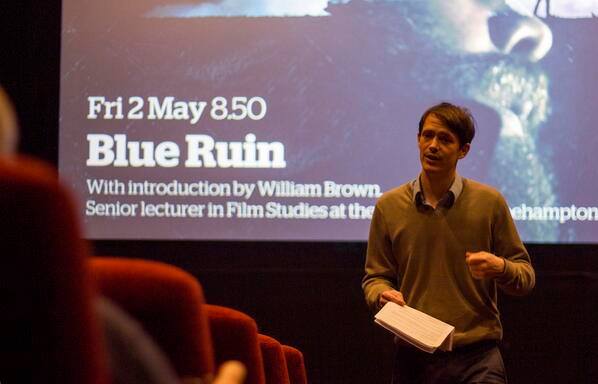
This is a written version of an introduction that I shall be doing this evening for a screening of Blue Ruin at the Ritzy Picturehouse in Brixton, London.

The blog's author introduces Blue Ruin at the Ritzy on 2 May 2014. Photo courtesy of Matt @ The Ritzy!

The blog’s author introduces Blue Ruin at the Ritzy on 2 May 2014. Photo courtesy of Matt @ The Ritzy!

The film tells the story of Dwight (Macon Blair), a seemingly homeless guy living in a car on an anonymous beach somewhere (in Delaware – where else?). A police woman (Sidné Anderson) tells him that a man has been released from prison – and this compels Dwight to drive across the States to his hometown in Virginia to find and kill this man.

This man, Wade Cleland Jr, allegedly killed Dwight’s parents. Dwight therefore murders Wade as an act of revenge, and drives away in the stretched limo that his family has hired for the day to see him out of jail.

However, Dwight soon realises that in the limo with him is William (David W Thompson), Wade’s youngest brother. Dwight lets William go – but only to realise that of course the Clelands now know who killed Wade.

As a result, Dwight reunites with his estranged sister, Sam (Amy Hargreaves), in order to protect her from the Clelands – who of course do come in search of their revenge, too.

And so begins a cycle of revenge that culminates in the film’s final, bloody and brutal showdown at the Cleland household.

Blue Ruin has some strikingly beautiful moments in it – Dwight going through trash cans next to a seaside amusement park and Dwight’s near-dead sedan driving down the mist-filled roads of the USA are two that stick out in particular.

The latter image is in particular haunting – the mist conveying a sense of uncertainty regarding the future, adding to the film’s ominous, suspenseful tone, while also featuring Dwight’s beat up sedan which is of course blue in colour, and thus is perhaps the ‘blue ruin’ that is the film’s title.

In this sense, the film takes on a mythical quality: the once-vibrant dream of the road movie – open space and adventure – is now foggy, the adventure shabby, the future not wide open like the road, but murky and threatening. If the West once found revenge an almost thrilling prospect, it is now tired, haunted, exhausted and dulled. Everything falls into ruin; perhaps Saulnier’s remarkable film is about the fall into ruin of the USA itself.

But what has brought about this ruin? Well, it would seem in part that the desire for revenge, or the violent nature of society, has become so naturalised that even a mild-mannered and middle class man like Dwight will become sucked into it.

And how has revenge and violence become so ingrained in an American society such that it is a/the knee-jerk response to all problems? Well, at least in part through the movies.

Blue Ruin has earned comparisons to the films of the Coen Brothers, and in some senses these are justified, particularly films like Blood Simple (Joel Coen, USA, 1984), Fargo (Joel Coen, USA/UK, 1996) and No Country for Old Men (Joel and Ethan Coen, USA, 2007). With these films Blue Ruin shares a fascination for often quite unexpected violence, delivered in a deadpan, quite detached fashion.

(Note the way that the shots in Blue Ruin just seem a little bit longer than in a conventional Hollywood film, giving a sense of space and how characters are not necessarily agents who conquer space, but who perhaps are smaller than that space, quite small in comparison – something director Saulnier no doubt acquired through his collaborations with Matthew Porterfield, for whom he worked as a cinematographer on several features, including the acclaimed Putty Hill (USA, 2010)).

However, I am going to compare Blue Ruin to another Coens film, their cult classic The Big Lebowski (Joel Coen, USA/UK, 1998). There is a scene in that film in which Jeffrey Lebowski, also known as the Dude (Jeff Bridges) finds himself in the house of pornographer Jacky Treehorn (Ben Gazzara). The Dude sees Treehorn scribbling on a notepad, before Treehorn takes the piece of paper and pockets it. Treehorn then leaves the Dude, who scrambles over to the notepad, takes out a pencil, and starts to shade over the topmost piece of paper – in a bid to trace out what information Treehorn will have left.

What inspires the Dude to do this is of course Alfred Hitchcock’s classic film, North by Northwest (USA, 1959), in which Cary Grant’s Roger Thornhill does exactly the same thing in trying to find the location of Eve Kendall (Eva Marie Saint).

But where Thornhill is successful, the Dude only uncovers a picture of a man with a massive cock drawn by the rather puerile Treehorn.

The reason that I mention this moment is because here we have encapsulated what is perhaps the guiding genius of the Coens: the fact that everyone – at least at times – believes that they are in a movie, and so they adopt behaviour that they have seen at the movies, here the Dude imitating Thornhill, only to find that of course, they are not in the movie that they thought they were – and that reality always has in store for us something different from what we were expecting.

What is true of the Coens is in this respect perhaps also true of Saulnier’s remarkable debut film. Two key examples: when Dwight goes to stab a tyre on the limousine, and when Dwight takes a shot at Wade’s brother Teddy (Kevin Kolack) from all of two yards. Each moment in which Dwight assumes that he can carry out an action seen many times before, but never performed by himself, Dwight comes quickly undone. He has been fooled into thinking cinematically, into thinking, in particular, that actions are easy to carry out and can be done without practise and without work. This is the myth of the movies written large: that we can achieve anything. And it is this myth that Blue Ruin busts, thereby making it an exceptional film.

The body, its imperfections and inadequacies, is what looms large, then. For while violence is so easy and so beautiful in so many mainstream Hollywood movies, such that we aspire to be violent as Dwight pursues revenge here, the body always comes back to remind us that we are inept, malcoordinated and incapable. Rather than being lighter than air – the superhero myth – Dwight is human, all too human – as is signalled by the sheer physical pain he endures through the film, and through all of the fluids that ooze out of his body, which is that of a most unlikely hero.

(Macon Blair’s performance is, by the way, excellent.)

The frailty of the body, then, when compared to its desires (it wants to run, fly, kill; instead it trips, falls and tears open), is the source of the film’s dark, dark humour. And also the source of the film’s suspense: for, will Dwight make it out alive of this world that is far more real and violent than he could have imagined? In this sense, the film’s relative slowness is also its great power: Dwight will have no easy victory, if victory he will have at all. If he is to get out of this alive, it will a long, slow and difficult trudge.

If Blue Ruin is, then, a critique of what I am terming cinematic thinking, the naturalisation of violence and the desire for revenge as a result of the myths peddled by the movies, then it is a film that is, paradoxically, deeply cinematic as a result. Perhaps all art, then, must reflect upon the conditions of its own making in certain respects.

Furthermore, the difficulty and, ultimately, the pointlessness of revenge lends to the film a political edge. For in a world in which we read about the need for payback, and in which violence is indeed a common part of our globalised existence, Blue Ruin suggests that in the real world, revenge is deeply unsatisfying, breeding only more violence that in the end ruins families rather than bringing them together.

Gravity (Alfonso Cuarón, USA, 2013)

American cinema, Blogpost, Film reviews, Uncategorized

I was fortunate enough early this week (18-20 November 2013) to give a few talks in Sweden, at the University of Gothenburg and at the University of Skovde. At both institutions, I spoke about digital cinema, while also delivering a third paper on neuroscience and film at Skovde.

What was in particular of interest, however, was the way in which the trip allowed me to discuss with my esteemed colleague, Lars Kristensen, about his ongoing work on bicycles in cinema. Furthermore, since Skovde, where Lars works, has a strong emphasis on the study of video games, it also allowed us to discuss gaming.

In a relaxed conversation, we ended up hypothesising something along these lines: cinema has a dual tendency – for realism and for fantasy, a dual tendency also at work in video games, but which manifests itself in a different way.

Put succinctly, when cinema deals with bicycles, it often presents to us a strong notion of the physicality – of the embodied nature – of bike riding, and also of what goes into owning and maintaining a bike.

We need look no further than Vittorio de Sica’s classic Ladri di biciclette/Bicycle Thieves (Italy, 1948) to see this realist tendency at work in terms of how the bike is an important component in physical existence: the film tells the story of a man whose very livelihood depends on the bicycle, even if we do not see him ride it very much.

To take a less well known example, we also see in Mohsen Makhmalbaf’s Bibycleran/The Cyclist (Iran, 1987) the way in which the physical act of riding a bike is exhausting – a physical experience that is understood best through one’s body.

This we can compare with a film like E.T.: The Extra Terrestrial (Steven Spielberg, USA, 1982), in which we are given a fantasy version of the biking scenario: Elliott (Henry Thomas) eventually flies on his bike, in effect no longer needing physically to ride the thing, because E.T. just allows him to take off.

This latter example, E.T., is cinema as fantasy: cinema allows us at times to transcend the limits of gravity and to take off.

Now, we tend to think of computer games as not being particularly realistic, and therefore perhaps more fantastic. This is most clear in terms of the relationship of the images that we see in video games to reality: unlike analogue photographs, which have an indexical link to reality owing to the much theorised concept that photographic and cinematographic images bear the direct imprint of the light that was before the camera at the time of the image’s taking, digital images have no such link. And as a result, digital images are freed from the shackles of the real world and can depict fantastic places and deeds that defy the physical limitations of that real world.

The same applies to digital images in cinema as applies to digital images in games: digital cinema – in terms of special effects cinema – sees fantastic figures performing fantastic feats, many of which defy gravity. Flying cameras, flying characters – all unhooked from reality and existing in a fantasy realm.

While cinema commonly offers us myths of flying – of defying gravity – gaming, however, seems paradoxically to be defined precisely by gravity, at least a lot of the time. Sports simulations may involve getting the game’s avatars to perform bitchen and radical moves, including on bikes. But they also involve falling back to Earth. Mario and Sonic can jump great heights, but they always land. Lara Croft sometimes cannot jump high enough. And Tetris is defined almost uniquely by the inevitable weight of gravity – including, as the game progresses, the notion that the objects fall faster and faster the further one gets.

(To go way back through the canon of video games, I always felt horrified when Jet Set Willy would on occasion fall down from one room in his mansion and through into another, where Willy would continue to fall to his death – sometimes seven times in a row (Willy’s number of lives), since Willy would always start a new life in the exact location where he entered the last room before his death. It was agonising to watch Willy fall seven times in a row, even worse when he did this after I’d loaded the cheat version and caused Willy to have innumerable lives – i.e. he would fall and die in a loop forever.)

This discussion provides an excellent context through which to offer up a brief consideration of Alfonso Cuarón’s latest film, Gravity, which I saw this evening (21 November 2013) at the BFI IMAX in London in 3D.

I shan’t do much more than allude to the way in which Gravity has something like a game structure: it is about solving problems in short order, getting from space shuttle to space station, to another space station and then – spoiler (of a sort) – to Earth (though the clue is in the title of the film, so this should not constitute too ‘bad’ a spoiler – ‘worse’ are to follow).

However, being a film that is in enormous part the result of digital animation, Gravity does also play with the dual tensions within cinema – as explained via the bicycle analogy – towards fantasy and towards realism.

For, while digital cinema can show us incredible feats performed by impossible specimens, Gravity seems instead to want to use its digital effects to convey something a lot more ‘realistic’.

This is not simply a case of the perceptually realistic images that we see of Earth and of the Heavens from orbit – excellent though these are, and important though they also are to my argument about the film.

Nor is it that Gravity is without fantasy/fantastic elements, as I shall discuss presently.

But rather, I shall propose that Gravity demonstrates the way in which something so false as a digital image can in fact function towards realistic ends. Or rather, it can function towards helping us to believe in reality.

To paraphrase Gilles Deleuze, the film offers a parable about how the power of the false (the digital image) can reaffirm our belief in the real (the world that we inhabit) – and that, arguably, this is key to the film’s power over audiences (even though some people I know have responded to the film in a way that we might in the vernacular term ‘meh’ – i.e. not particularly impressed).

(I should qualify this by saying – based upon off-blog discussions about the earliest version of this posting, that I am not particularly in love with Gravity if you want my value-judgement of the film. I found the IMAX 3D in particular annoying because parts of the images, typically Sandra Bullock’s face, blur if you do not look at them directly, and Cuarón did not push the deep focus far enough – for me, variable focus and 3D are antithetical, since my eyes want to search the depth of the image, and instead I am confronted with more blur. Beyond which, I am not particularly interested in whether a film is good or bad; these are relative and relatively pointless terms. I am more interested in what a film is trying to do, and I might – as per Gravity – cut the film some slack when it is trying to do something interesting, even if it does not achieve its aims for every audience member – hence the ‘meh’ that many people express at the film.)

Now, Gravity tells the story of how a physicist, Ryan Stone (Sandra Bullock), tries to get back to Earth after her first space flight to work on a telescope goes horribly wrong as a result of a débris shower brought on by destroyed satellites.

She struggles with her colleague Matt Kowalski (George Clooney) to get from her space shuttle to a first and then a second space station, all the while with limited resources – before trying to get back to Earth.

So, here is a key fantasy element: there is in particular a sequence in which Kowalski reappears to Stone late on in the film. She is about to give up on her attempts to re-enter the Earth’s atmosphere, but he enters the Russian pod in which she finds herself and gets her to continue in her endeavours to escape/to survive.

Significantly, the film does not cut as we transition from what appears to be a realistic moment (Stone alone in the pod), into this fantasy apparition from Kowalski, and then back again to her being alone in the pod.

In other words, the fantastic seems to be on a continuum with the real, such that we cannot tell them apart. Indeed, one might infer from this that nothing else that we see is real, but instead all a fantasy – and that Stone is in fact dreaming the whole situation.

This is a plausible take on the film, but one that would only to me signal something that all viewers already know: that the film as a whole is of course a fantasy – this is a fiction film starring well known stars whom we know not to be astronauts in real life – but that this fantasy might nonetheless have an effect in the real world, that this fantasy might allow its viewers to believe (once again?) in the real world.

Perhaps the casting of those self-same stars is important here. We have Clooney, the star of Steven Soderbergh’s slightly maligned but interesting remake of Andrei Tarkovsky’s Solyaris/Solaris (USSR, 1972; USA, 2002). In that film, space is used as a vehicle for fantastic projection: faced with the void of space, the fact that our memories and our fantasies structure and are an inseparable part of our perception of reality becomes most tangible. In effect, we realise that humans are incapable of facing the void, of facing the reality of the enormous scale of the universe, of facing our insignificance and our death, and that we use fantasy (we use the desire to see reality as a film?) to cope with the emptiness that otherwise surrounds and perhaps is us.

Bullock, too, is the veteran of many a ‘fine’ action film – Speed (Jan de Bont, USA, 1994) is the one that most particularly comes to mind – though she also does increasingly a line in credible, realistic portrayals of ‘real’ people, as The Blind Side (John Lee Hancock, USA, 2009) and 28 Days (Betty Thomas, USA, 2000) might suggest. That is, she seems to come with – and to embody – the dual concerns of gravity.

And then, perhaps importantly, we have the voice of Ed Harris as Mission Control – he being associated with ‘real life’ space travel films Apollo 13 (Ron Howard, USA, 1995) and The Right Stuff (Philip Kaufman, USA, 1983). In other words, Harris ‘grounds’ the film in supposedly true/authentic cinematic depictions of space/space travel, thereby reinforcing Gravity‘s credentials as a film that relates to the real world.

I mentioned earlier the shots of Earth and the Heavens from space. These are digital compositions and not ‘real’. However, in particular during the film’s opening 10 minutes, in which we enjoy a single, unbroken shot of space and then of the astronauts as they work on the damaged telescope (and conjoined shuttle), we are – or at least I was – inclined to view these images as awe-inspiring.

Conceivably, images of Earth and of the Heavens have become ubiquitous, such that we look at them without thinking very much when we see them. Nonetheless, we can look at them sometimes and feel that sense of being small, of feeling lucky to breathe, of feeling lucky – mind-bogglingly lucky – to exist at all in a universe that is so dark and cold.

The duration of the shot/take is here important: for no doubt many viewers might regard the Earth and the Heavens in an unthinking fashion, especially were they to pass by rapidly, as can often happen in films set in space. However, because we get so long to contemplate in this opening sequence (as well as at other times), the very duration of these shots helps to maximise the possibility of this sort of response.

If one still feels inclined to say ‘but we know that these are not real images, and therefore I cannot feel about them anything “philosophical” along the lines suggested here’, then perhaps my only attempt to get such a reader to reconsider would be by saying that it is perhaps important that Stone is up in space working on a telescope.

For, telescopes like Hubble in fact have digital cameras. That is, they do not take images of space that have an indexical link to reality – as per analogue photos defined above. Rather, telescopes like Hubble take digital images of space – what we see has no indexical link to what was before the camera at the time of the image’s taking, for what we see is in ‘reality’ only made up of the 1s and 0s that form digital code – and yet these digital images still form the foundation of our best, scientific understanding of the universe.

In other words, it is only in art/cinema that the indexicality issue seems to loom so large; in science, there seems to be no such problem (a likely overstatement, but I hope its spirit is understood).

And when faced with the vastness of the universe, and with our own insignificance and mortality, we are confronted with the void, with death. Perhaps it is for this reason that the film then feels compelled to suture into a disaster movie/game scenario: genre functions as the coping mechanism for us to deal with the fact that ultimately there is nothing but the void, that ultimately digital images are indices, not of the world, but of the void itself.

But cannily, the genre is, as we know, a disaster movie: Stone has to save herself from the perils of space, just as many movie characters before her have saved themselves from sinking ships and alien invasions.

In other words, the film works hard to maintain the notion of a threat of death. And here the ’embodied’ nature of the film becomes important: as many spectators testify, and as the supposedly ‘immersive’ nature of both 3D and large format cinema (IMAX) reinforce (especially when working in conjunction), it becomes as if we are ‘there’ with Stone. That is, we ‘experience’ what Stone experiences, namely a fear of death.

We particularly ‘experience’ this fear through the film’s use of sound, as has been widely noted. We are given to hearing Stone’s breathing – with oxygen forming a central theme of the film, as well as her heartbeat, and I for one as a viewer did often find myself tensing up at crucial moments.

Also key to the film is the notion of touch, and in particular of gripping. The human mirror neuron system functions in such a way that when we see conspecifics (other humans) trying to grip an object, the same neurons fire in our brain as fire in the brain of the person doing the gripping.

Here the film’s editing becomes key. For while the movie is defined by long takes that suggest massive scale – lending to the film a temporal, experiential realism (‘real time’) that sits alongside the film’s perceptual realism, the close ups of hands trying to grasp objects that will save the life of Stone (and Kowalski) give to the film a ‘haptic’ quality, such that we are not just feeling what the characters are feeling, but also feeling for something to hold on to in the same way that they are.

Perhaps it is important that the threat in this film is human caused. Aside from some potential digs at the Russians for launching a missile at one of their own satellites – the initial cause for the débris – it is not necessary for this film to resort to aliens as threat.

By making the threat ‘human’ in origin, Gravity seems to offer no escape from the void, retaining a level of plausibility that in turns helps the film to seem realistic.

As Stone begins to despair, she finds a Chinese radio operator who has a dog that barks and a baby that cries. It is a remarkable moment when Stone barks along with the dog: the barking seems to be the expression of the inner void that the film seems to want to depict.

Perhaps it is no coincidence that Stone has lost a child in her past; that is, she is a woman in despair, overwhelmed by her helplessness before the lack of justice in the universe. For her, work – conceptual space travel – becomes the device that helps her to fill not the void created by the loss of her child, but the fact that the void is all around her anyway. Death is everywhere.

(Perhaps it takes a Mexican director, a compatriot of Octavio Paz, a celebrant of the Day of the Dead, to get a handle on death in this way. Although Danny Boyle’s remarkable Sunshine (UK/USA, 2007) also has a strong understanding of death within the context of a space film.)

I have repeatedly said that Gravity is realistic, and yet the film is also full of symbolic images. Symbolic images potentially challenge the idea of realism, because in real life there arguably are no symbols.

I am thinking in particular of Stone in the foetal position as star-child, or Stone continually being reborn as the film progresses, emerging from womb after womb.

Nonetheless, while symbolic, these moments also visualise something important: namely that, in being continually reborn, we get a sense in which Stone is consistently becoming. That is, she does not settle for who she is and lean back and die, but instead she consistently fights/struggles to overcome her situation.

This may be a (female twist?) on the classical male heroism of normative cinema. But on another level it suggests that Stone learns, that she consistently is taking positive lessons from her interactions with the void/with death, and using these to project herself forwards into life. In other words, even though the film has various symbols of rebirth, Gravity seems to suggest that Stone paradoxically becomes via her interactions with the void, it inspiring in her ever deeper coping strategies that come in the form of her will to survival.

If I have tried to avoid spoilers so far, I am about to offer up a description of the final scene, so you have been warned…

If movies like E.T. present a defiance of gravity – with the defiance of gravity/fantasy being a key aspect of cinema – Cuarón paradoxically (since this is a big budget special effects movie) represents gravity as inevitable. The film must be dragged down to Earth eventually.

And nowhere for me is this more clear than after Stone has landed back on Earth (conveniently in a small lake). Stone (who like all stones must fall) swims to the shore and lies on the beach. We see her grip the sand, then stand up and walk away.

Briefly we get to see during this final sequence one of Stone’s footprints in the sand. The footprint is another index: like light hitting the analogue film stock, so, too, is a footprint a direct imprint of the human standing on that spot at a particular place in time.

In other words, as Stone breathes air and touches the sand, so, too, does she make an impression on it. After much time in space touching objects with gloves (even if keeping a grip is, in every sense perhaps, key to her survival), she is now in touch with reality again.

In other words, having fled into empty space after the loss of her child, she is now able to be in and with the world again. She can believe in the world again. And so maybe the whole film is her fantasy – a fantasy of the void in order to help her escape the void and to believe in the world again.

But we also have here a sense in which the world is our only refuge from the void. Perhaps even our experiential perceptions are attempts for to us impose a pattern on what is otherwise essentially formless, what is otherwise just an empty void, dead.

As such, we cannot ever really see reality/the void, even if we can feel its presence everywhere, just as we feel gravity.

Gravity may be a film that is full of non-indexical, digital images. And yet, if the power of the false that we use/need in order not to be overwhelmed by the void is sufficient to make us believe in the world – as happens for Stone – then perhaps the power of the false that is Gravity can also help us viewers to believe in the world as well.

Digital cinema may be empty like the void; but like the void, what it can do is to spur us to embrace the world and our fragile lives as best we can.
War autism and film style: Zero Dark Thirty

American cinema, Blogpost, Film education

This is the text – with slides – of a talk that I gave yesterday (11 November 2013) at the Rothermere American Institute at the University of Oxford.

I am very grateful to Dr Ben Morgan for the invitation to talk. I hope that the below, when presented, stimulated some interesting discussion/debate.

I have retained my original paragraph spacing – so apologies in advance if some of these are long.

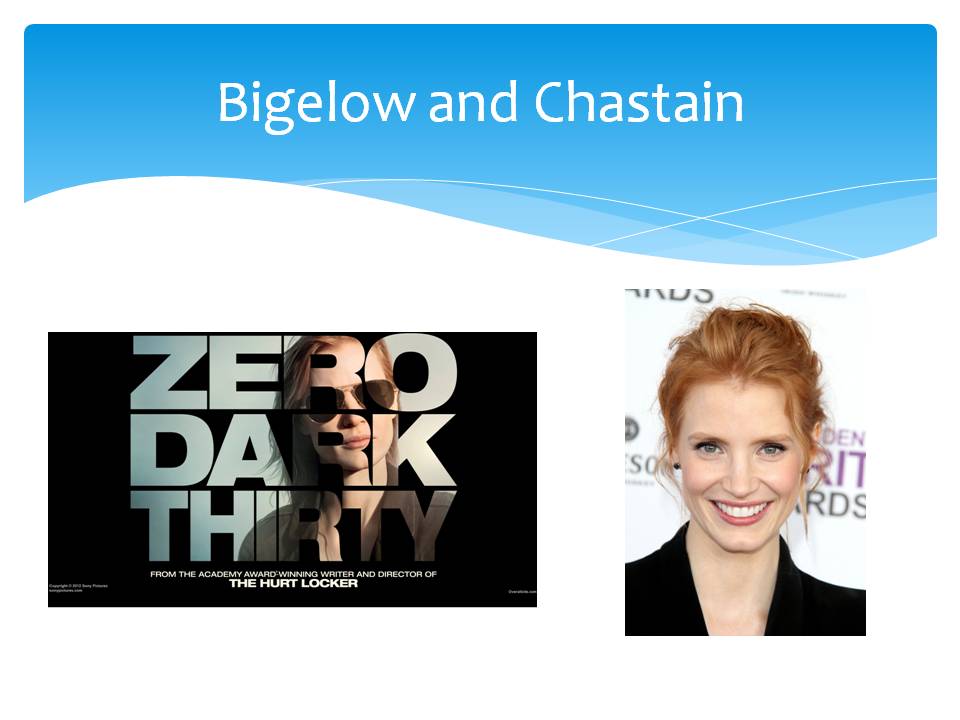
When Zero Dark Thirty (Kathryn Bigelow, USA, 2012) was released in 2012, the film was the subject of criticism as a result of its seeming pro-torture stance. To take two examples, both from The Guardian, Glenn Greenwald (2013) called the film ‘pernicious propaganda’, while Marxist philosopher Slavoj Žižek (2013) argued that the film ‘normalises torture’, suggesting that if another film tried to normalise rape in a concentration camp during the Holocaust, then it would be accused of moral indecency.

My task today is not expressly to agree or to disagree with these criticisms (though, should anyone care to know, I tend to agree with them – and will return to the issue of the ‘normalisation’ of on-screen torture and violence during this talk). Rather, what I would like to discuss today is how Zero Dark Thirty, as much as it is a ‘procedural’ looking into the way in which Osama bin Laden was hunted down and killed by the CIA and the US military, is also a study in, precisely, the dehumanization of one’s enemy, a kind of willed lack of empathy for other human beings, or what I shall provocatively term ‘war autism.’

This is achieved primarily through Jessica Chastain’s remarkable performance as Maya, the CIA agent who single-mindedly hunts down bin Laden in the film through her pursuit of Abu Ahmed, or Ibrahim Sayeed (played by Tushaar Mehra), who is believed to be the only connection between bin Laden and the outside world. But it is also achieved through director Kathryn Bigelow’s stylistic choices, in particular her use of editing and framing, as we shall see. Having analysed how Chastain’s performance in conjunction with Bigelow’s direction conveys a willed lack of empathy, or ‘war autism’, I shall briefly suggest that Bigelow’s film may indeed normalize torture, as well as the mental conditions that allow it (i.e. a lack of empathy), and that this in turn may well influence audiences and their attitudes towards violence.

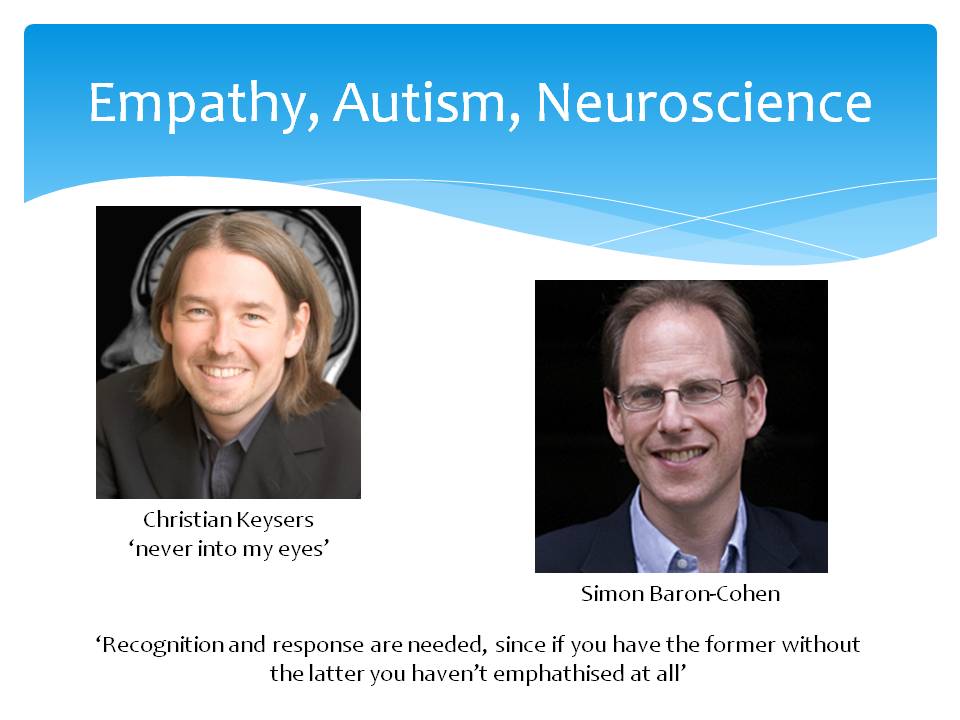
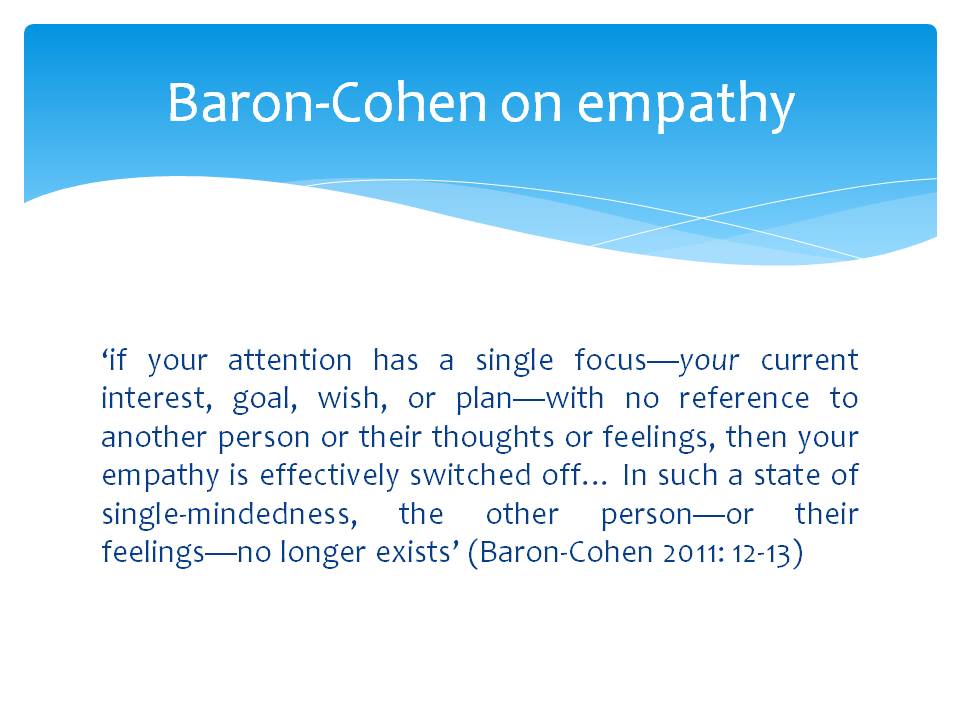
Dutch neuroscientist Christian Keysers, who was one of the key figures in the discovery of mirror neurons, describes his experience with an autistic gentleman, Jerome, as involving Jerome always looking around the room but—significantly—‘never into my eyes’ (Keysers 2011: 18). Meanwhile, Simon Baron-Cohen, Britain’s leading expert on autism, suggests that there are two stages to empathy: recognition and response. As Baron-Cohen says, ‘[b]oth are needed, since if you have the former without the latter you haven’t emphathised at all’ (Baron-Cohen 2011: 12). Recognition involves both identifying and responding to another person’s emotions, and Baron-Cohen suggests that one can recognize emotions by reading faces. However, he does suggest that ‘if your attention has a single focus—your current interest, goal, wish, or plan—with no reference to another person or their thoughts or feelings, then your empathy is effectively switched off… In such a state of single-mindedness, the other person—or their feelings—no longer exists’ (Baron-Cohen 2011: 12-13). Baron-Cohen then suggests that there are seven levels of empathy, from zero to six, with zero empathy being the lowest. People with zero empathy can be zero-negative, which involves borderline personality disorder, psychopathy and narcissism, while people with zero empathy can also be zero-positive, which Baron-Cohen associated with various forms of autism (especially Asperger’s syndrome; see Baron-Cohen 2011: 30-87).

On a similar note, film scholar Tarja Laine (2007) has studied the emotion of shame in relation to cinema, drawing upon Jean-Paul Sartre’s understanding of the emotion to suggest that shame is an excellent means of regulating human behavior, because it is a public, or intersubjective, emotion. That is, it is when one’s acts are recognized as being seen that one modifies one’s behavior, or acts in a more social/sociable fashion. Although relatively unexplored, it nonetheless seems intuitively logical to suggest that empathy is to a large extent intersubjective, or a two-way process, akin to shame: one does not just see in order to recognize an emotion, but one is also seen.

In other words, there seem to be several traits that are linked to a lack of empathy, which in turn is linked to various psychological disorders, including autism. These are an inability to look people in the eye—as well, notably, as being single-minded of purpose. Not looking someone in the eye logically would lead to an inability to recognize the emotional condition of others (because one does not look at them to recognize that emotional condition), which would also mean that one could not respond to those others and their emotional condition, which thus results in a lack of empathy, and therefore in a condition like autism.

Now, with regard to Zero Dark Thirty, it is not that Maya is an autistic character, or a character with a psychological disorder—although such characters do exist in films and television shows about the CIA, with Carrie Mathison (Claire Danes) in Showtime’s Homeland (Howard Gordon and Alex Gansa, USA, 2011-) being an interesting case in point (and one to which I shall return). However, I would suggest that Maya wills herself into a sort of temporarily autistic condition, which I shall term ‘war autism’, over the course of the film.

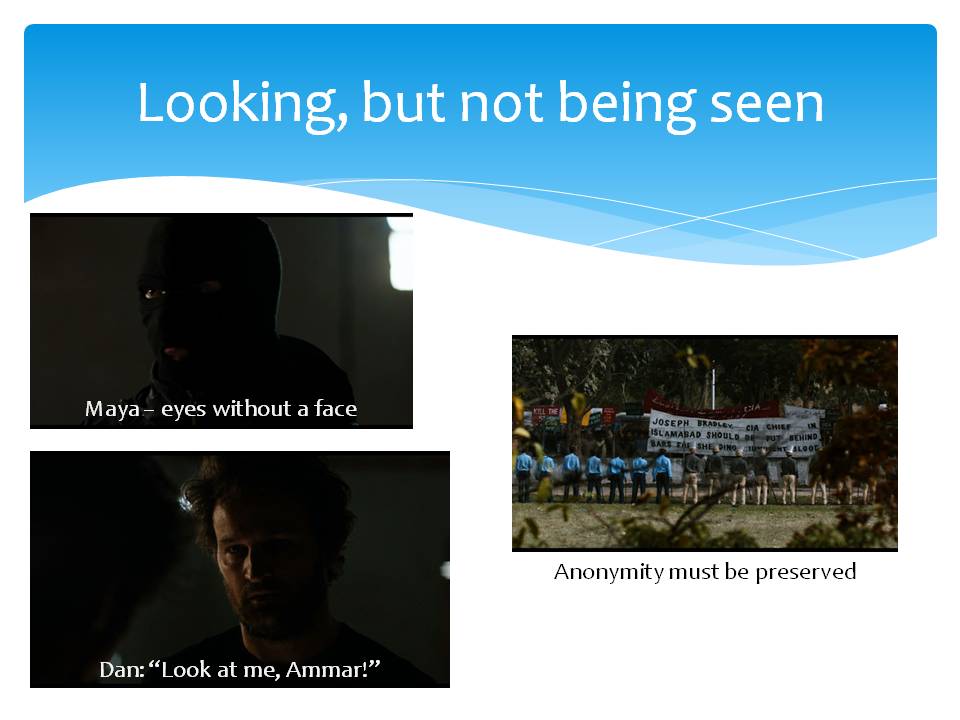
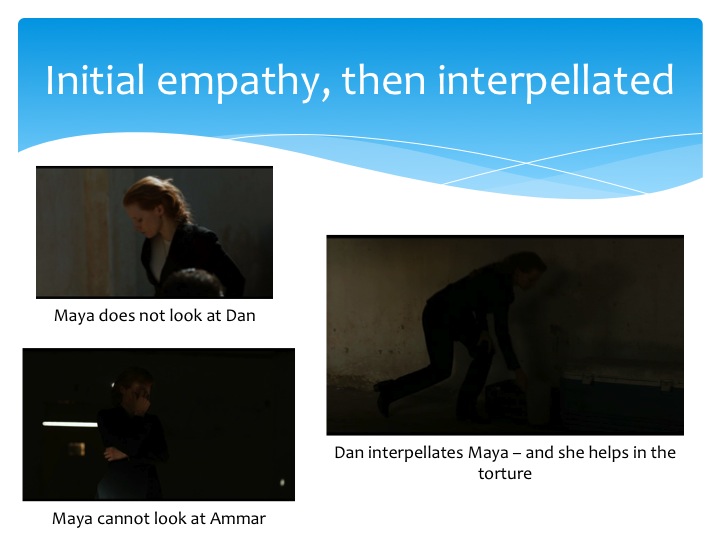
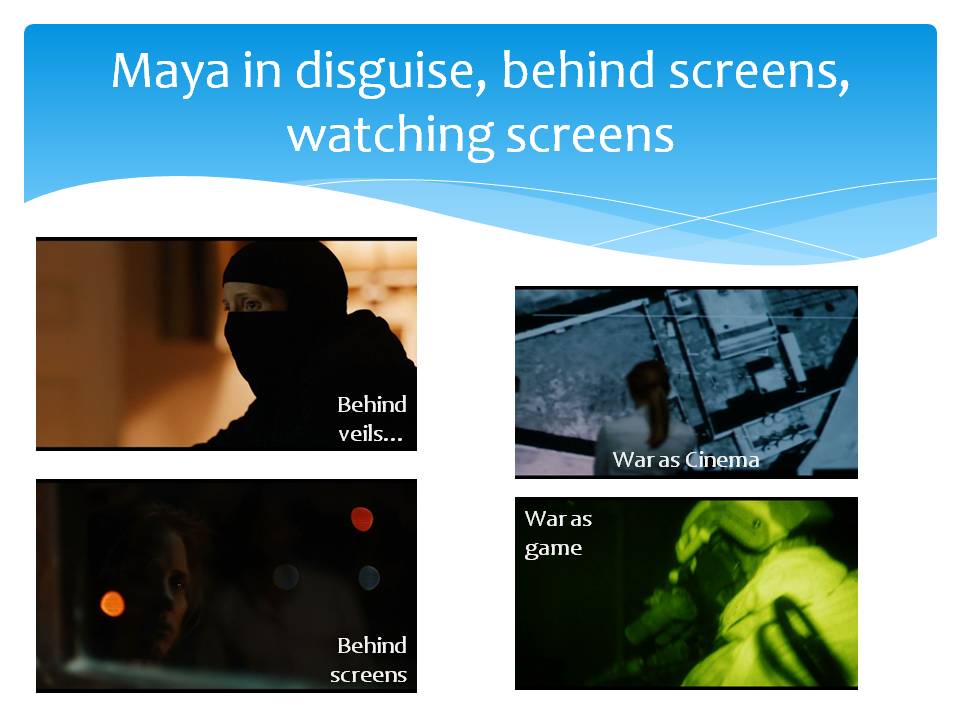
Zero Dark Thirty opens with a black screen and sounds from the attacks on the World Trade Centre and the Pentagon that took place on 11 September 2001. We then jump forward to two years later, at a ‘black site’, the whereabouts of which are unknown, or undisclosed. Dan (Jason Clarke) is interrogating Ammar (Reda Kateb), a Saudi connected to the World Trade Centre attacks, and also torturing him via the use of the infamous waterboarding technique, humiliating him by stripping him, enclosing him in a box, keeping him in soiled clothing, keeping him upright and his arms suspended for protracted periods of time and so on. Maya is initially observing Dan’s work wearing a balaclava. Dan says to Ammar early on in this sequence: “Look at me. If you don’t look at me, I hurt you.” In other words, the issue of looking and eye contact are quickly introduced into the film, but importantly the first we see of Maya is when she is, so to speak, eyes without a face.

That is, Maya observes, but she cannot be seen. And what is literally true of Maya is also figuratively true of Dan: Dan repeatedly tells Ammar that he ‘knows’ him—and reels off facts about Ammar’s life to prove it. Meanwhile the American agents function in anonymity; indeed, their anonymity is to be preserved at all times—and we see one agent, Joseph Bradley (Kyle Chandler), dismissed from his post as the CIA’s Chief of Staff at the American Embassy in Islamabad when his identity is uncovered.

The anonymity of Maya and the other agents is important, because while they can demand that Ammar looks them in the eye (otherwise they will hurt him), he cannot really see their faces. We have here a sense of how intersubjectivity is a key component to empathy. That is, even though Ammar must look Dan and Maya in the eye (and thus feel ashamed that he has soiled his own clothes or is naked, because he knows that he is being seen), Dan and Maya can look at Ammar and know that they are not being seen—literally when wearing a balaclava, and figuratively when shrouded in anonymity. Nonetheless, Maya at first seems upset by Dan’s interrogation techniques, nervously observing from a distance. However, it is she who insists upon returning to Ammar and continuing the investigation, suggesting her first steps along the road to willfully refusing to empathise with those she is interrogating.

Her transition seems fast and is signaled by the moment Dan asks her to put some water in a jug so that the waterboarding of Ammar can continue; interpellated—that is, called into action—Maya becomes not just complicit by observation, but complicit by deed, in the torture of Ammar, and from this point on Maya’s descent into war autism is rapid.

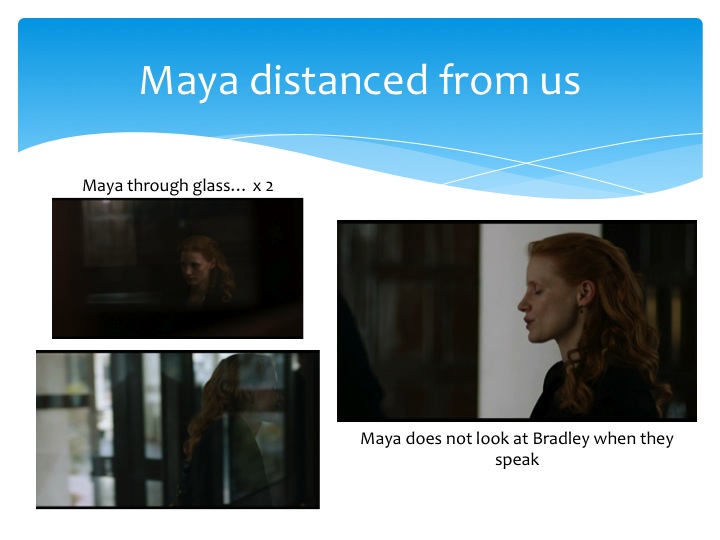
We then see Maya several times through screens—her face obscured in a window, through a glass at the American Embassy in Islamabad. When Maya first meets Joseph Bradley, she makes eye contact, half-smiles, and then her eyes dip down—a refusal of eye contact that will become a signature of Chastain’s performance (and which Bigelow will repeatedly insist, via her editing, on showing, typically in relative close up).

Maya gets to work in Islamabad, the film conveying to us that she watches numerous DVDs showing footage of interrogations and torture sequences. At the end of this sequence, Maya has noticed that many interrogatees mention a certain Abu Ahmed—and so she approaches Dan to ask to investigate this lead. Notably, Maya does not look at Dan until he has left the room during the scene of her request. Thereafter we see Maya in a wig talking to Abu Faraj (Yoav Levi), asking about Abu Ahmed.

Not only does the wig signal a procedural reality of CIA operatives, but it also suggests Maya’s transformation from potentially empathic human being to a willed sufferer of ‘war autism’.

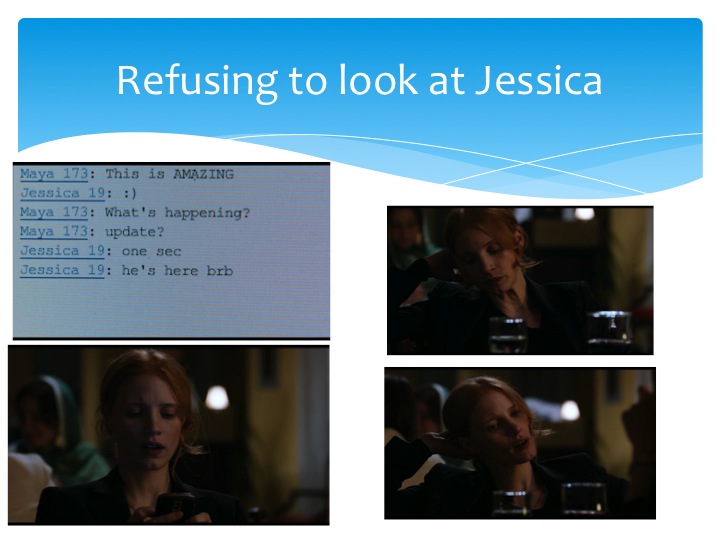
Significantly we only discover Dan’s name after 44 minutes of the film’s running time. Similarly, we only discover that Maya’s main female colleague in Islamabad is called Jessica 56 minutes into the film—just before she is killed by a bomb at Camp Chapman in Khost, Afghanistan. Furthermore, we only discover that Jessica is called Jessica because her name appears in type on a computer screen as she instant messages with Maya as she is about to interrogate a key lead; it is not because we hear her name spoken. In other words, Maya’s lack of empathy with the likes of Ammar is matched by the film’s decision to make her co-workers seem anonymous; it suggests a lack of empathy with/for even her own colleagues.

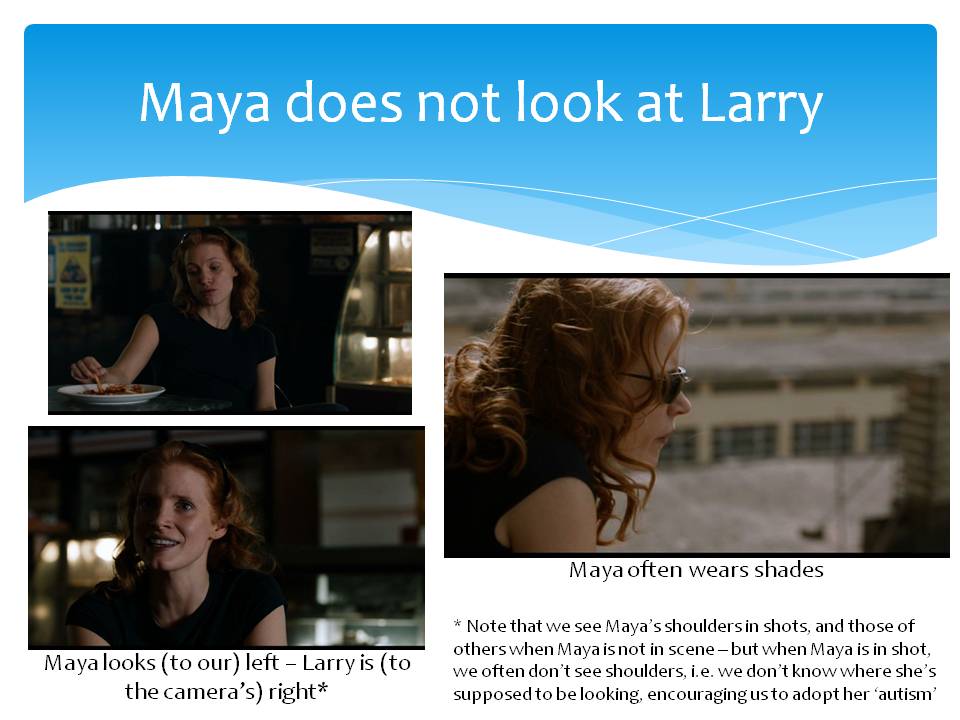
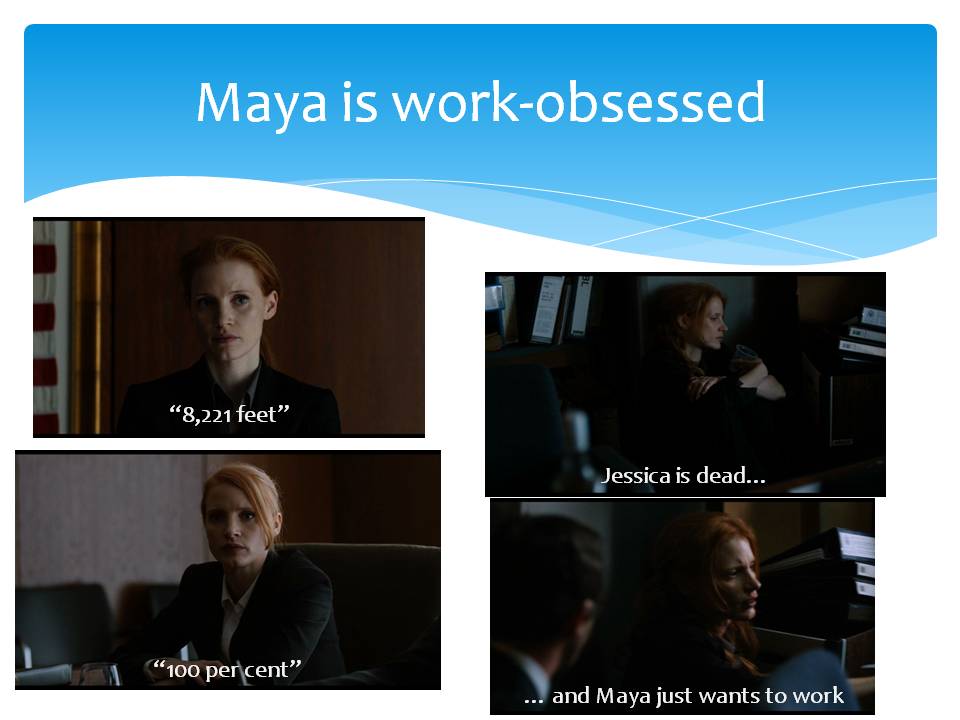
Maya works with a single-mindedness of purpose that we might well associate with a lack of empathy, as suggested by Baron-Cohen, such that even her colleagues have no names. Meanwhile, her refusal to look others in the eye—which Keysers sees as a sign of autism—becomes clear when Maya has dinner with Jessica in Islamabad, just prior to when we discover her name, and just before a bomb explodes at the city’s Marriott hotel where they are eating. As Jessica (Jennifer Ehle) is explaining to Maya that she must relax a bit more, Maya refuses to look at Jessica, suggesting that she can only think of work, and this comes at the expense of any human relations. Notably, the film is structured here in such a way that just as Maya might be thinking of relaxing and (re-?)becoming a bit more human, a bomb explodes to remind her that her task—God given in her eyes (“I believe I was spared so that I can finish the job”)—is all-consuming. In this way, Zero Dark Thirty is a study of how Maya wills herself into a kind of ‘war autism’.

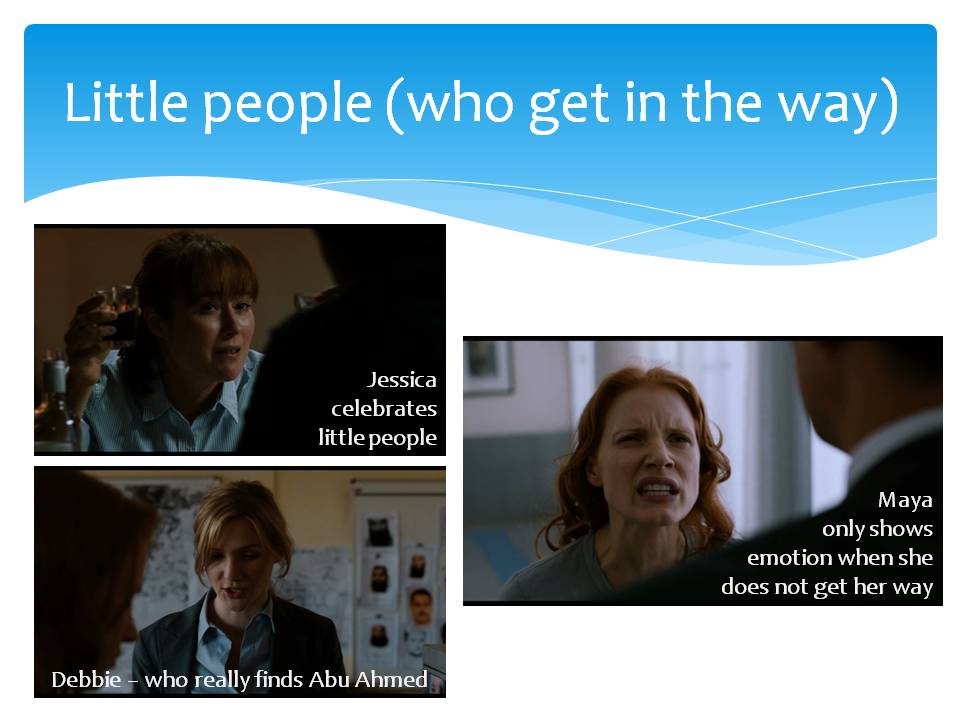
Just before she dies, Jessica says to a colleague “here’s to big breaks and the little people that make them happen.” After Jessica’s death, Maya is also told that her key lead, Abu Ahmed, is similarly dead (she does not look at the colleague who tells her this). Maya’s senior colleague, George (Mark Strong) berates his team for their lack of progress (Maya averts her eyes when he enters the room). And then Maya is handed a lead suggesting that Abu Ahmed is in fact alive—by her colleague Debbie (Jessica Collins). In effect, Debbie is the ‘little person’ who makes the whole bin Laden manhunt happen, but it is Maya who egotistically gets the credit. The only demonstrations of emotion that we see from her are when she shouts at Dan, and then George, in order to get her way.

We see her permanently at work, distancing herself from colleagues by wearing shades, and refusing to look at other members of staff, including Larry (Édgar Ramírez), with whom she works closely in Rawalpindi. When Maya gets a meeting with various CIA and National Security honchos, she blurts out in a somewhat autistic manner that the compound in which bin Laden is supposedly hiding is close to eight tenths of a mile (4,221 feet, to be exact) from Pakistan’s Military Academy in Abbottabad. She egotistically says that it is ‘for me’ that the United States Naval Special Warfare Development Group (or DEVGRU) soldiers will kill bin Laden. “It’s her against the world,” remarks George. In other words, Maya seems willfully to isolate herself from others, beginning to lack empathy for colleagues (to Larry: “I don’t care if your guys get any sleep or not”), and in particular to lack empathy for her enemies, as suggested by her complicity in torture.

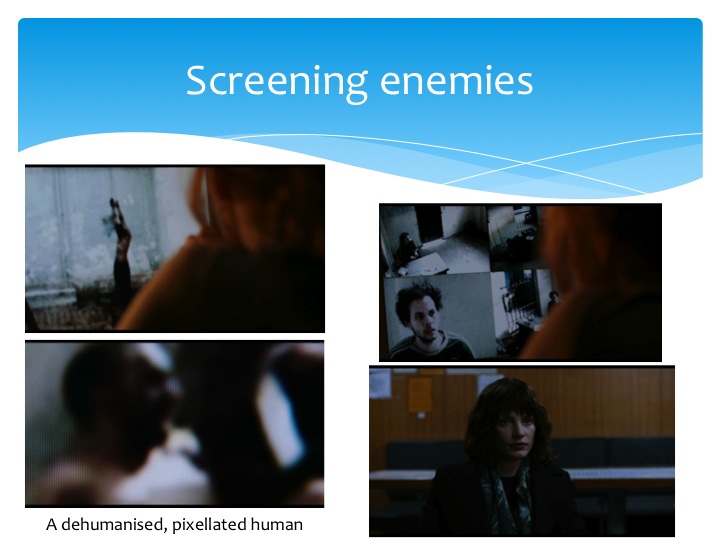
Disguises—in the form of wigs, veils, dark glasses, and even a full burqa in Islamabad—help Maya to perform this ‘autism’, which is reflected in the night vision goggles and uniforms that the DEVGRU troops wear during the film’s final operation. Seeing the world through a screen helps to distance them from the human aspect of war, mediation in Bigelow’s film consistently separating soldiers, including torturers, from their victims, be they innocent or otherwise. Maya stays on in her job for 12 years—much longer than Dan, who has to leave and pursue a desk job in Washington DC.

The persistent presence of the media no doubt has a role to play in Maya’s ‘war autism’; Christian Keysers argues that ‘each hour spent in front of the television is an hour less in front of a reacting human being’ (Keysers 2011: 173), the argument being that it is human interaction that helps prevent autism, rather than simple observation. A set of eyes without a face, then, Maya observes without empathy, often via screens, such that she is without empathy. Her only emotional display—apart from anger at her colleagues—comes at the film’s climax when a tear runs down her cheek as she flies home, to an unknown destination.

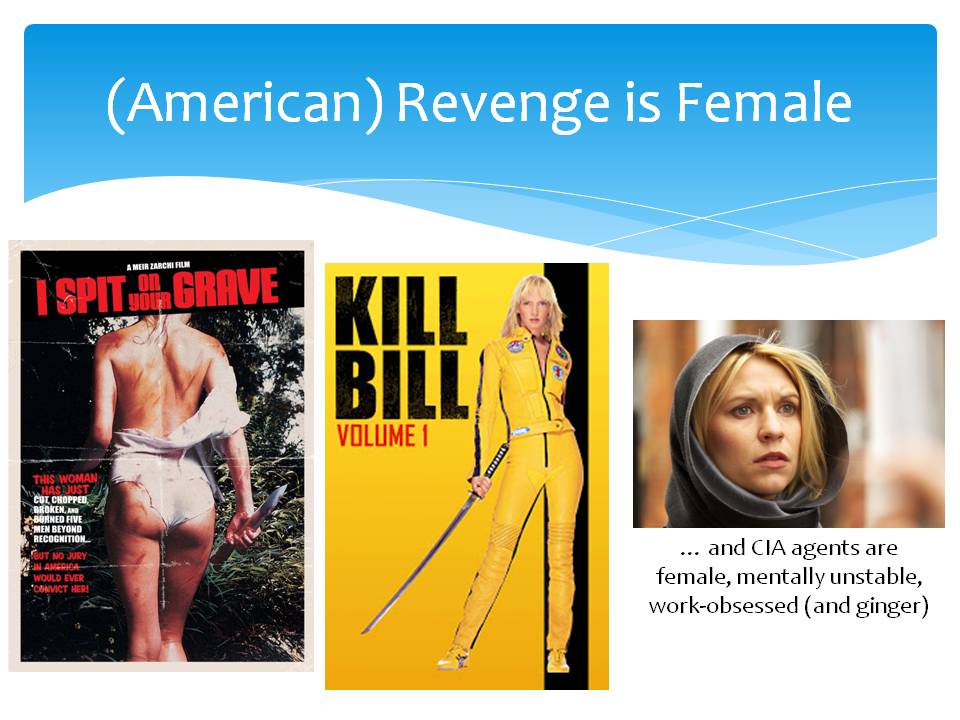
However, the question becomes: what effects might Zero Dark Thirty itself have a role to play in helping to develop empathy, given that it is a film that we watch via the medium of cinema, DVD, television, the computer screen or the internet? Maya says that she is 100 per cent certain that bin Laden is in the compound that she has found, before saying she is only 95 per cent certain, because total certainty “freaks you guys out.” In other words, we have here a gendered ‘craziness’. As Shohini Chaudhuri (2013) has pointed out, Hollywood has a propensity for making films in which revenge is exacted and enacted by a woman, from I Spit on Your Grave (a.k.a. Day of the Woman, Meir Zarchi, USA, 1978) to Kill Bill (Quentin Tarantino, USA, 2003-2004). As mentioned, it also has a propensity, as in shows like Homeland, to show dedicated American agents to be female, unstable (and, in the case of both Maya and Carrie from that show, ginger).

In other words, the film seems to want to naturalise the idea that revenge is a feminine trait, that the USA is a feminine body that has been attacked and metaphorically raped during the 11 September 2001 attacks, and that it is righteous in its pursuit of revenge. Maya’s single-mindedness also naturalizes the hard work ethos behind contemporary capitalism—suggesting that one will get nowhere without being as egotistical and as dedicated as Maya. Although Baron-Cohen suggests that women have more empathy than men (Baron-Cohen 2011: 19), here we see Maya willfully shed herself of empathy in order to achieve the ‘higher goal’ (seemingly God-given) of defeating bin Laden.

Whether Bigelow’s film simply observes or whether it actually endorses such ideas is open to debate. I could, for example, imagine a ‘haptic’ critique of the film, suggesting that it allows us to ‘feel’ more than it allows us simply to observe Maya’s ‘war autism’, such that, paradoxically, we have empathy with someone who denies themselves an empathic response to those around her. Nonetheless, the film does seem to naturalise ‘war autism’, as well as torture, not least because what we see is mediated—we are watching a film.

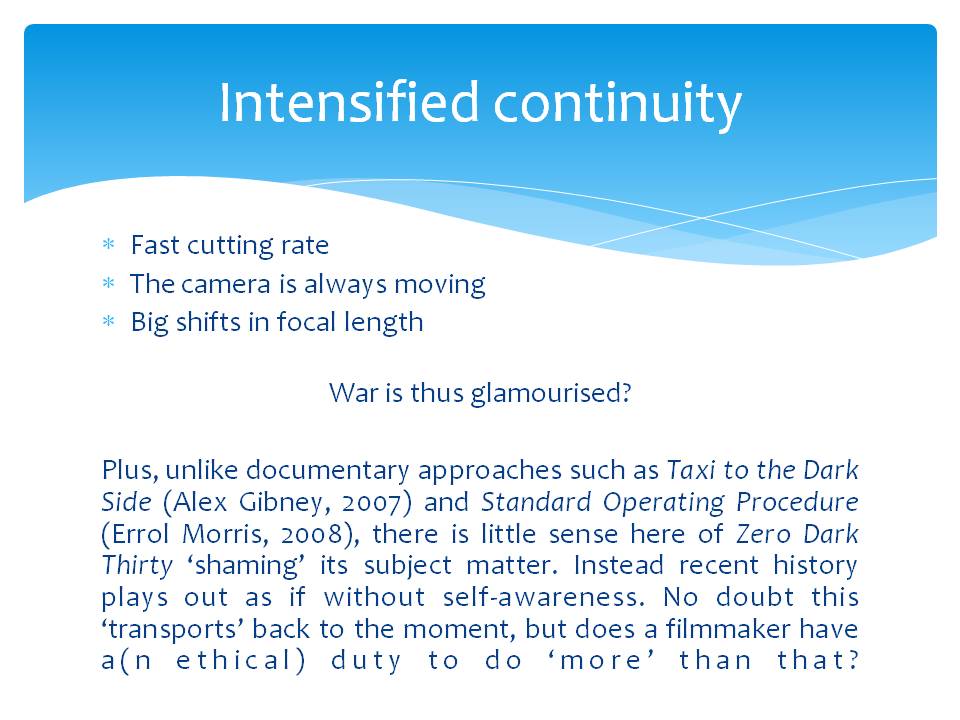
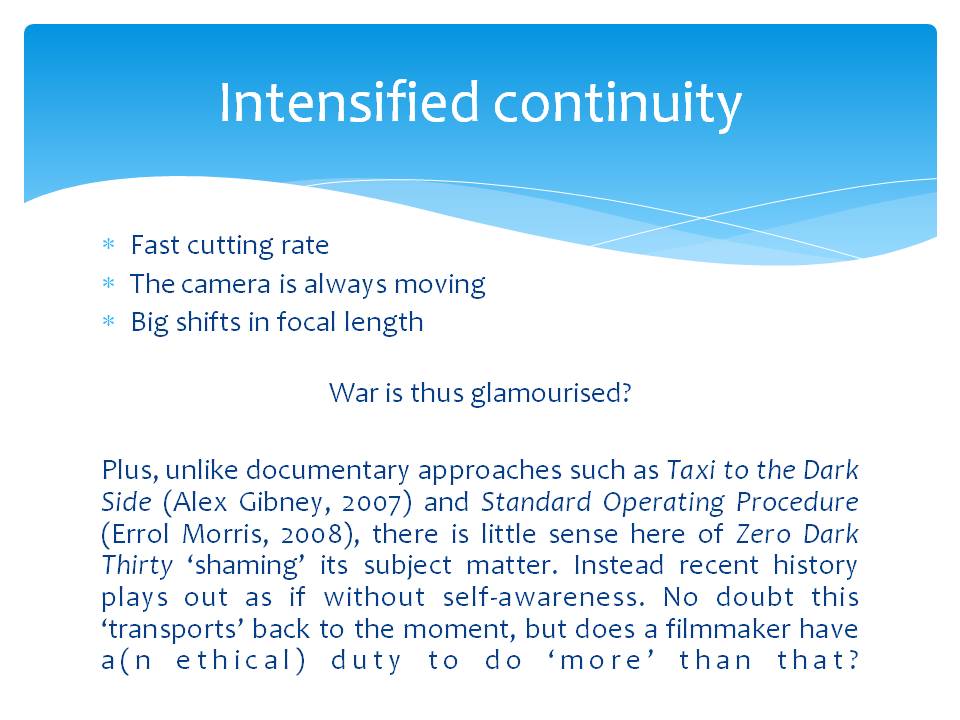
Kathryn Bigelow’s relatively fast cutting rate (the film has an average shot length of 3.4 seconds, according to the Cinemetrics website) places it firmly in the category of ‘intensified continuity’ that David Bordwell (2006) sees as characteristic of contemporary cinema: faster cutting, an always moving camera, more significant changes of focal length between shots, and so on.

I have argued elsewhere (Brown 2011) that such demands on our attention via fast cutting rates might distract us from closer analysis of the film; by making the film exciting via rapid cutting, even if it depicts deeds that we are not particularly happy to watch, such as torture, what is on screen is thus glamourized. And if what is glamourized is torture, then Slavoj Žižek’s dislike of the film is arguably justified. Nonetheless, Zero Dark Thirty is a fascinating study of what I am terming ‘war autism’. And it may serve as a piece of propaganda designed to endorse such a feminized, victim-like and single-minded approach to revenge. More worryingly, it seems to endorse torture (contrary to many statistics suggesting that torture is not a particularly useful method of extracting information; see Chaudhuri 2013 for a discussion thereof).

Perhaps the normalization of torture via films like Zero Dark Thirty as fast-paced entertainment needs to be countered by slower films that show the effects, both short-term and long-term, of torture not on the perpetrators, who themselves view torture via screens in a bid to become less empathic with those they are torturing, but on the victims.


Notes from the LFF: 12 Years a Slave (Steve McQueen, USA/UK, 2013)

American cinema, Blogpost, British cinema, Film reviews, London Film Festival 2013, Transnational Cinema

If I linger on aspects of 12 Years a Slave that I feel do not work, it is because a very moving film might have been – in my humble opinion – an even better film.

I shall take it as read that overall I praise the movie in this blog (because it has things worthy of praise, things that will get mentioned), but the things that grated with this film are three in number: the casting, the use of music and, on a slightly different note, the film’s credits.

With regard to the casting, I can understand that any film can and will use big stars in order to become more commercially appealing. And I can also understand that, when there is a film in production about an historically important topic such as slavery, lots of actors will want to work on that project because it boosts the amount of prestige that they have as actors.

Nonetheless, having avoided reading much about the film before watching it (increasingly my preferred way to see films – as ‘blind’ to pre-hype as possible), to see a procession of fine anglophone acting talent work its way through the film in larger and smaller roles – Scoot McNairy, Paul Giamatti, Benedict Cumberbatch, Paul Dano, Michael Fassbender, Brad Pitt – in fact detracts from the narrative.

For, my experience of the film was along these lines: I am enjoying this film, but now I am faced with Brad Pitt, giving a decent performance as usual (because I think him a good actor), but since he is Brad Pitt (and since his character gets to speechify about the iniquities of slavery) I cannot but think that the he and the film are pushing the ‘worthy’ button a little bit too much.

To be clear: slavery as an historical – and, it cannot be emphasised enough, a contemporary – evil are undoubtedly topics worthy of filmmaking, because filmmaking can and does do all manner of things to raise awareness of slavery, as this film festival in part testifies. As such, the film being ‘worthy’ is not the problem (though a film might want to avoid being too moralising or sentimental in its depiction of slavery – but that is a different issue).

The problem is that one keeps on thinking ‘isn’t Brad Pitt very worthy?’, such that one thinks less about 12 Years a Slave, and more about how morally righteous those people are who made it. Again, this does not make Brad Pitt or anyone a bad person (of course it does not; although the way in which white actors accrue prestige for playing ‘difficult’ and, specifically, racist roles is slightly problematic for me: the white actor’s difficulty in playing a racist potentially occults/keeps out of view both the victims of real slavery and the (again, potential) assumption that black actors playing slaves is somehow ‘easier’).

In conclusion, then, the film can be as worthy as it wants, but the more I am thinking about the making of the film and its actors, the less I am thinking about the film. And slavery should be a topic that is important enough that the film could have no stars in it, and I’d still want to watch it because it should, in effect, speak for itself. The stars stop the film, to my mind, from speaking for itself.

(Furthermore, if the white stars also function to sell the film, then this points to the ongoing issues of race in relation to Hollywood casting. Chiwetel Ejiofor – who gives a fine performance – is relatively famous, but obviously the filmmakers did not want to give this role to Will Smith or various other, more famous black actors because… because he may be too famous for the ‘issue’ of slavery with which the film deals. But it’s fine for Brad Pitt to crop up towards the film’s end, because… I am not sure why (aside from his involvement as a producer in the film). Are these not double standards? And is using white stars to ‘sell’ slavery in cinematic form not also problematic – as if the topic did not speak for itself as important, but instead is only worth thinking long and hard about because a bunch of white actors are involved in the project. In effect, if business comes ahead of morality – stars will bring in the audience, and this is more important than the ‘issue’ that the film portrays – then the film surely is open to criticism.)

My second beef with the film is its use of music. This is not just moments where Hans Zimmer’s score lays down industrial gong sounds to convey the fact that SOMETHING BAD IS HAPPENING. Rather, it is that Hans Zimmer recycles a piece of music in 12 Years a Slave that he used for the magnificent Thin Red Line (Terrence Malick, USA, 1998) fifteen years ago.

Again, this is not necessarily a bad thing, but it does mar the film somewhat. The piece of music the (forgive my lack of knowledge regarding musical terminology) chord progression of which is largely repeated in 12 Years a Slave from The Thin Red Line is called ‘Journey to the Line’ – and it is a beautiful, epic piece of music. However, knowing that McQueen’s film is borrowing from Malick’s film in this way is also slightly jarring.

I could believe that McQueen, being a ‘clever’ artist and all, is pointing to the impossibility to depicting slavery without the use of cliché (with cliché here meaning saying things through terms that other people have used, i.e. repeating someone else’s words or, in this case, music).

Nonetheless, what the Zimmer score does is to give the impression that McQueen aspires to make a Malick film. To do for slavery what Malick does for war in The Thin Red Line, namely to offer a metaphysical treatise on the nature thereof.

But where Malick uses James Jones’ novel to discuss war on a relatively abstract level, McQueen is using a true story potentially to do the same. And true stories do not lend themselves to the abstract in quite the same way: what is slavery? How do some men seemingly desire to be masters and others slaves? (What is this war in the heart of nature? being Malick’s seeming guiding question with The Thin Red Line.) So, again for me, this does not quite work.

Don’t get me wrong; there are moments in 12 Years a Slave when we wonder that Solomon Northup (Ejiofor), a free man cast into slavery by a pair of scheming entertainers, could escape, especially early on when he and the other captives outnumber their captors (although they have all taken a significant beating by this time). And so the film treads that fine line in asking whether men in part desire the conditions that they face, but this is not the same as offering a piece of Malickiana.

The aspirations to Malick perhaps also explain the procession of stars that appear in the film. But, again, one ends up thinking: but Terrence Malick is Terrence Malick and Steve McQueen is Steve McQueen, so why does McQueen piggy-back on Malick? One cannot ‘do’ Terrence Malick (not without comic results). One can only be Terrence Malick. And the Malickiana here – signalled especially through Zimmer’s score – again seem slightly to undermine the film.

Again to be clear: McQueen’s film does have moments that McQueen is famous for, namely scenes that linger and are long in duration, including a powerful moment when Northup is left hanging by the neck from a tree branch, his toes touching the ground and keeping him alive. This protracted sequence – akin in part to the epic confrontation between Bobby Sands (Michael Fassbender) and a Priest (Rory Mullen) in Hunger (UK/Ireland, 2008) – is very powerful, as is a whipping administered on a slave in part by Northup and in part by Epps. But where McQueen and his desire to linger on certain moments is very strong, this strength is hindered at moments when it feels like the director wants to step into someone else’s shoes.

Finally, it is for me a mistake in the final credits of the film to put the name of Lupita Nyong’o a long way down the credit list – and after many of the white stars who have significantly smaller, and certainly less important, roles than she does.

For, Nyong’o plays Patsey, a slave on the estate of Edwin Epps (Fassbender), who is a legendary cotton picker and who also becomes the target of Epps’ amorous advances.

And Patsey is, to my mind, the beating heart of this film. It is she who is whipped by Northup and it is she who, importantly, makes clear that what for Northup is a temporary experience, for others is a lifelong experience.

Don’t get me wrong: 12 years as a slave is a massive amount of time and it is not that anyone should go through a single instant of slavery in their lives. But since we are watching a film called 12 Years a Slave, the clue is in the title that there will be a ‘happy ending’ (forgive the inadequacy of these film terms) for the main protagonist.

And while there is a ‘happy ending’ for American slavery – in that in principle it was abolished in 1865 – this does not make up for c250 years of slavery on what is now known as the North American continent. That is, and no disrespect to Northup, but 12 years pales in comparison to the enormity of North American slavery. And so it is important that the film conveys as best it can how Northup’s experiences are temporary in relation to those of innumerable others.

And this is done through Patsey, in particular the moment when Northup is rescued (*spoiler*?), for she must of course stay behind (the law does not allow her to leave). The moment is deeply moving, and Nyong’o’s performance here, as throughout the film, is remarkable. And so, given the centrality of her part, in that she stands in for that which it is impossible to depict (the size and scale of slavery in the USA in its entirety), it is disappointing that her name disappears at the end until after all of the white stars.

All this in mind, 12 Years a Slave is nonetheless a powerful film, with great performances, as mentioned, from Ejiofor and Nyong’o, and with some excellent McQueenian touches (scenes that linger for longer than most other directors would have them). It is no mean task to try to depict something that is perhaps beyond the bounds of cinema and which can only be suggested rather than shown. On the whole McQueen does an excellent job, but one wonders that a film with fewer stars, less Malickiana, and a desire to recognise upfront the performers involved, might have raised its bar even higher.

Notes from the LFF: Inside Llewyn Davis (Joel and Ethan Coen, USA/France, 2013)

American cinema, Blogpost, Film reviews, London Film Festival 2013

Inside Llewyn Davis feels like a meta-Coens film.

This needs some explaining, since the Coens have always made movies that are in part about movies – making their films a kind of meta-cinema that is about cinema and its influence on society (especially characters who go getting hair-brained scam ideas and who think it’ll work out as per the movies, but for whom things typically go amusingly wrong).

Inside Llewyn Davis, on the other hand, is not just meta-cinematic, but it feels meta-Coen-like. That is, it surveys and reviews Coen films from the past.

Small signs thereof: a cat that we discover latterly is called Ulysses, recalling O Brother, Where Art Thou? (UK/France/USA, 2000), a John Goodman performance that is straight out of The Big Lebowski (USA/UK, 1998), a long, silent car journey as per Fargo (USA/UK, 1996), and the general suffering of a central character that was crystallised by the Coens in their Job film, A Serious Man (USA/UK/France, 2009).

This does not make Inside Llewyn Davis a tired film. On the contrary, it is as ever a pleasant trip into Coenland, as we follow singer Llewyn (Oscar Isaac) from Greenwich Village to Chicago and back again for a week in 1961, surveying the folk music scene of the time (with a hilarious performance from Justin Timberlake as nice guy singer Jim).

Now, the Coens are not exactly without success, having won four Oscars between them, and having been nominated for various more. But Inside Llewyn Davis also seems like something of artistic statement from them.

By which I mean to say, the self-referentiality of the film leads the viewer to suspect that this is quite a personal project for them. Not personal in the sense that it is autobiographical (though I suppose elements of the film could be – not that I am interested/think it important to find out).

Rather, in the sense that the Coens may, like Llewyn, find themselves never quite seeming to make it, unwilling to sell out (except for Intolerable Cruelty, USA, 2003, and The Ladykillers, USA, 2004 – the equivalent of Llewyn’s singing with Jim?), and somewhat on the margins of the film industry in spite of some success (notably, even after the success of No Country for Old Men, USA, 2007, the Coens have had to return abroad – to France and the UK – in order to co-fund their projects).

It is striking that the film is really about Llewyn’s inability to move on from the death of his singing partner, Mike, whom we never see. Llewyn performs repeatedly in the film – and often very well. But his style, while appreciated, is not deemed commercially viable. And, indeed, he is told by those who do not know that Mike is dead that he should find a partner and/or team back up with him.

This is striking, because of course the Coens work as a pair, and yet neither has – and long may it be before such an event comes to pass – has passed away as of yet. And yet there is a sense that while the Coens, like Llewyn, put in some remarkable performances (including winning Oscars), they remain somewhat overlooked – perhaps like Llewyn they feel surrounded by mediocrity, and it is not that they are any better per se, but they are surprised about how everyone settles for mediocrity.

Except that Llewyn ends up playing the same old tracks the whole time – trapped as he is inside himself, as it were. For this reason, the film has a looping structure, which it is not too much of a spoiler to say.

Do the Coens also feel trapped in their own universe? Were it not for the self-referentiality, I would not feel at all inclined to read Inside Llewyn Davis in this way. But it does seem to be working there somewhere under the surface – like Llewyn himself, very honest, but deeply enigmatic for almost precisely the same reason.

It is a joyful journey through Coenland. But Inside Llewyn Davis also seems to be calling out, asking for something more. Maybe the Coens will go really crazy with their next project. Or maybe they are mourning the loss of something dear to them, and which keeps them stuck in Coenland, pleasant though it is to be there with them…

Notes from the LFF: Computer Chess (Andrew Bujalski, USA, 2013)

American cinema, Blogpost, Film reviews, London Film Festival 2013

In a recent essay that chimes with many aspects of my own ongoing research – into DV filmmaking from all over the world – Francesco Casetti and Antonio Somaini argue that low definition filmmaking is cinema’s attempt, after Marshall McLuhan, to ‘cool down’.

That is, cinema has become so fast, so ‘hot’, such an intense stimulation of the senses, that it needs to ‘cool down’ – and to become more low definition in its images. Or rather, films that are made using low definition images seek to cool the medium down, such that a balance is within audiovisual media is restored.

I like this line of argument, but I do not agree with it entirely. For, what Casetti and Somaini’s essay suggests is that low definition films are always already in the service of high definition films – acting as a necessary brake to their relentless drive towards bigger, faster, brighter, louder…

And while I suspect that there is truth in this, I am not sure that filmmakers of deliberately low definition films feel that they are complicit with the high definition films with which they (cannot) compete.

Nonetheless, given that Andrew Bujalski’s Computer Chess is a film shot using video cameras (the Sony AVC-3260) as per those available at the time of the film’s late 1970s/early 1980s setting, this is nonetheless a movie that has resonance with Casetti and Somaini’s thesis.

The film tells the story of various computer programmers who holes up in a hotel conference room for a weekend to take part in a computer versus computer chess tournament, which will culminate in the winner taking on a human chess Grand Master.

Given the ‘tournament’ set-up, the film’s mockumentary approach, and the video aesthetic, Computer Chess feels very much like a mix between Best in Show (Christopher Guest, USA, 2000) and recent return-to-video films Trash Humpers (Harmony Korine, USA, 2009) and No (Pablo Larraín, Chile/USA/France/Mexico, 2012).

But the combination works: here at the beginning of the more intense period of the digital era, we have in fact a nostalgia for buggy, inefficient computers that will never be faster or smarter than a human, delivered with the blocky, blurry images of a video camera that promised never to replace good ol’ analogue filmmaking.

While Bujalski draws some hilarious geek characters, whose commitment to computer chess might make of them something like human automatons, nonetheless Computer Chess itself is a very human film – something made most clear by the increasingly hallucinogenic nature of the film.

That is, cats invade the screen, a computer seems to become sentient, and humans start to act as if computers. Akin in a certain fashion to Ben Wheatley’s wonderful A Field in England (UK, 2013), the trippy nature of Computer Chess suggests the way in which human identity and thought remain elusive in terms of our ability to compute ourselves (indeed, within neuroscience, the argument that the human brain is like a computer has somewhat receded in recent years).

A deliberate assault upon mainstream film aesthetics, Computer Chess does ‘slow down’ mainstream cinema – making of this film an example of the non-cinema that is the beating heart of cinema proper.

In other words, while some so-called ‘mumblecore’ directors seem to be inching – if not sprinting – towards increasingly audience-friendly, cutesy fare (I am thinking of the Duplass brothers and Lynn Shelton, even though I like all as filmmakers), Bujalski seems to be pursuing a braver, more idiosyncratic path (as also is Joe Swanberg, what with his seven-productions-a-year ethos).

Computer Chess won’t please everyone, but is prepared to be its own film, to court disapprobation by telling both a weird story and with a ‘grungy’ aesthetic. Whatever ‘mumblecore’ is or was, if this is it, then it remains relevant and exciting even today.